TRAINING DAY

By Marc S. Sanders

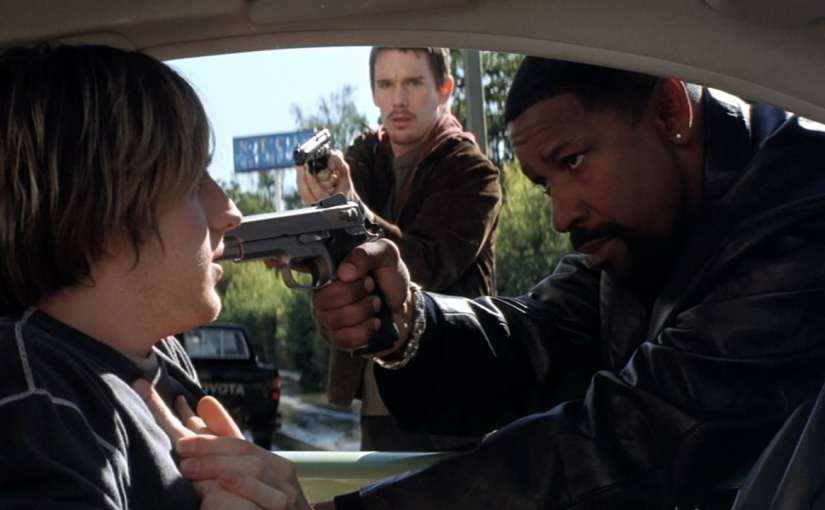
When I first saw Antoine Fuqua’s Training Day in theaters, I found it difficult to watch. The violence or the induced police brutality is very strong. There’s no humor and there’s no thrill. Just an in your face pull over excuse for a cop to exercise his strong arm with his two strapped nickel played Barettas.

Jump to the present and it’s even harder to look at because what the film perpetuates is quite parallel to how many parties view law enforcement and people of color today. Training Day isn’t pretty, nor is it assuring. It’s more or less glamorized evil with a good-looking Denzel Washington driving a gorgeous looking pimped out black Chevy Monte Carlo.

Washington gives an Oscar winning turn (though I’ve seen him in more deserving and nuanced roles; Hello? Malcolm X, anyone?) as narcotics detective Alonzo Harris. He begins his day taking on a new partner named Jake Hoyt (Oscar nominee Ethan Hawke), a boy scout looking cop fresh out of his uniform and into street clothes eager to advance his career and eventually get the kind of big house that other high salary detectives reside in.

Alonzo knows the streets of Los Angeles so well that he can literally stop his car in the middle of an intersection and every other driver will circumvent around him with no protest. Alonzo is here to show Hoyt how to learn the streets for himself and earn the respect of the various gangs and pushers that will lead to the big busts. Only thing is that Alonzo Harris is not a good man. This is a cop who uses his badge as a way of power and intimidation. In this one day, with each passing moment, Hoyt questions his own training and considers if crossing line after line is how you get ahead. Does Alonzo truly know what it means to be a cop making a difference? Does Alonzo care? Does Hoyt care, or does he only concern himself with his career aspirations?

There’s no question that Fuqua’s film is very well made. His dirty, criminally ridden Los Angeles is very convincing and the command that Washington has with his corrupt cop role is all the more intimidating. However, I didn’t feel good with the film after it ended. I didn’t learn anything about race or social classes in America. I didn’t learn that a cop can be a hero. After all, Jake Hoyt doesn’t exactly take the noble approach to surviving his first day in the new job.

There’s a lot of preaching monologues from Alonzo Harris, who is a pretty frightening guy. He’ll his gun at his apprentice’s head, as a means to convince him to smoke some street PCP, because it’s a first step in knowing these streets. Hoyt gives in to the pressure. Still, none of this tells me anything.

Harris goes from one questionable incident to another and Hoyt gives merely dubious expressions but not much else. Eventually, as things boil over between the two men, Hoyt takes the law into his own hands rather than following procedures.

Training Day dictates who is the good guy and who is the bad guy. In the film, however, the good guy more or less becomes the bad guy by the end. That simply didn’t sit right with me. All the necessary ingredients are here for a good cop/bad cop thriller, but I didn’t feel quite good about myself when the film closed out. There really is no one who comes up triumphant. There’s nothing to question about my own view of the world we live in, and there’s too much edge to allow for any kind of suspense. Alonzo Harris is just a bad, bad guy and John Hoyt is never really a good guy. He’s a wimp succumbing to an evil brainwash.

So, then what’s left is to wonder exactly what is there to truly appreciate in Training Day, and the answer is practically nothing except the construction of the film and Washington’s performance. Otherwise, the film is a harsh fiction never concerned with conveying a message within a real problem area of the United States. I would’ve appreciated a response to a harsh reality.

THE RAINMAKER

By Marc S. Sanders

Francis Ford Coppola didn’t just call his film The Rainmaker. He called it John Grisham’s The Rainmaker. I understand the significance as a large portion of the film relies on voiceover narration from its main character, Rudy Baylor (played very well by Matt Damon).

The film focuses on much of the underpinnings of the legal system within the state of Tennessee. Rudy gives insight into his position of ethical practice – he’s fresh out of law school but doesn’t have a license yet – versus the large giant sell out attorneys (a towering, sharp dressed and slick Jon Voight) that represent goliath parties like big time insurance companies. Grisham’s novel, along with Coppola’s screenplay, also leave room in the beginning of the film for the sleaze of the law practice with Rudy’s first employer who goes by the moniker “Bruiser,” played by an oily Mickey Rourke.

Rudy has not even passed the bar exam at the start of the film but he’s already got three cases in progress. He has agreed to completing a will for a kind old lady (Teresa Wright) who is adamant about leaving her estate to a television evangelist. He also volunteers himself to protecting a young woman named Kelly (Claire Danes) from an abusive husband. His biggest case is going after a million dollar insurance company for wrongfully denying a claim filed by one of it’s ill insured. Rudy knows the insured is justified to sue and it could be a huge and necessary windfall for him and his unlicensed, corner cutting partner (Danny DeVito), but it’s only him against a grand army of legal gods lead by the great Leo F. Drummond, Esq. (Voight).

Grisham and Coppola wanted to depict a drive for doing right by the law and the people it’s meant to protect. Damon’s portrayal of Rudy represents that ideal. His father hated lawyers and he grew up in a home life that never responded favorably to the merits of officers of the court. Rudy defies what his father frowned upon. Despite his inexperience in a courtroom and his ability to respond with objections and cited legal rules, he knows he’ll be a good lawyer simply because he can distinguish between right and wrong. He doesn’t need to sink as low as Drummond’s cronies by bugging the opposition’s office. Will Rudy’s righteousness be enough though? He’s so dang honorable in his profession that it might just be the ultimate means of his defeat.

Same can be said for Rudy’s will to protect Kelly, the young, abused wife. Precedents of law keep her husband on the streets no matter how bruised and bloody she gets time and again. This man is a monster, but no higher power is looking upon this victimized wife to legally protect her, and this man will continue to beat her until one day she’s dead. Rudy wears his heart on his sleeve for this woman and again can only serve as an honorable servant of the court. When he steps out of that line a little by risking his life to save this woman, he’s testing his own sworn code that he’s respected while others have dismissed it.

John Grisham’s The Rainmaker is one of those under the radar films not celebrated enough. I recall it being shown in limited theatre capacity, and it hardly did well at the box office, but it’s really a remarkable piece as it shows an unconventional and honorable attorney, reminiscent of Harper Lee’s Atticus Finch but set in modern day. Nearly everyone around Rudy, from his own father, that he describes to the students he attended law school with, to even the even the fool of a judge (Dean Stockwell) who swears him in as well as his own partner (DeVito in a hilarious, quick solving, underhanded role), are beyond any moral compass and yet Damon ensures Rudy Baylor sticks to his convictions.

Coppola’s film is not a legal thriller. It’s an observation of how the established perceive the law and the one fish who treads water above the bottom feeders, allegorically shown in Bruiser’s fish tank, seek out big rewards. For Rudy, the client matters. For everyone else, only the money matters.

MEAN STREETS

By Marc S. Sanders

I must not be that much of an intuitive movie watcher because I can not comprehend what is so fascinating about Martin Scorsese’s Mean Streets.

Robert DeNiro was hardly known at the time but he is certainly a scene stealer here as Johnny Boy. He’s the wild one with no concept of the danger he puts himself and his best friend in. Charlie is the much more respectable and well-dressed hoodlum. Charlie is played by a young strait-laced Harvey Keitel. Keitel & DeNiro are the strengths of the film.

Beyond the headline cast, the structure of Mean Streets is a very loose patchwork of random events that circulate around Little Italy, NYC. The soundtrack comes from side street buglers, transistor radios, and jukeboxes consisting of The Rolling Stones, The Sherrills, The Ronettes, and samplings of Italian opera. It lends to the setting as another character. For a Scorsese film, that’s all part of the plan. The setting talks back to you, or it’ll take your hand and lead you on. Martin Scorsese is a prophet of New York. He uses the grime and steam of the streets to his advantage (even if some of this film was actually shot in Los Angeles).

Still, I just don’t get this picture. It moves slow at times. Random meet ups occur and I found myself asking if we have met this character and that character already.

I give Scorsese credit, in one respect. He testifies that although the film is fiction, it is a direct representation of what he experienced during his own upbringing. I believe all of that. Again though, why couldn’t it all be pieced together a little more tightly? Had it been, I’d probably have taken more of an interest in the setting and the dangerous exploits of Charlie & Johnny Boy.

It’s okay though. I’m glad I watched it, nonetheless. I had seen it many years ago and I was excessively bored then as much as I am right now. Scorsese was destined for better things. MUCH BETTER THINGS.

SILVER LININGS PLAYBOOK

By Marc S. Sanders

Bipolar disorder can be a crippling ailment, not only to the person, but to his/her family as well. That, I imagine are the limits of my knowledge on the subject. David O. Russell’s Silver Linings Playbook will have you believe a way to embrace the disorder is to be involved with people who accept it and love you regardless.

Bradley Cooper is magnificent as Patrick; a hyperactive man suffering from his own demons. He is short tempered, confrontational, and prone to exhausting and uncontrollable outbursts. Because of that, he has lost his wife, his job, his friends and when the film begins, he is being picked up by his mother from an eight month court ordered stay in a mental institution on his way to live with his parents, Dolores and Patrick Sr., played brilliantly by Jacki Weaver and Robert DeNiro. Patrick is determined to rebuild his life. He feels confident that he is now on a positive track of exercise and healthy eating, and he wants to win back his wife. It is not so easy however, when Pat refuses to take his prescribed medication and his own father probably suffers from a similar disorder and he has to share a house with him. This means dealing with Pat Sr’s obsessive compulsiveness over his beloved Philadelphia Eagles, as well as his own short temper and his insistence on using family time with Pat Jr as a means to break the “jeu, jeu” that has cursed the team. Pat Jr. wants to move on with his life and find meaning and peace. His own obsessions with winning back his wife and overcoming witnessing the affair she was having behind his back do not help.

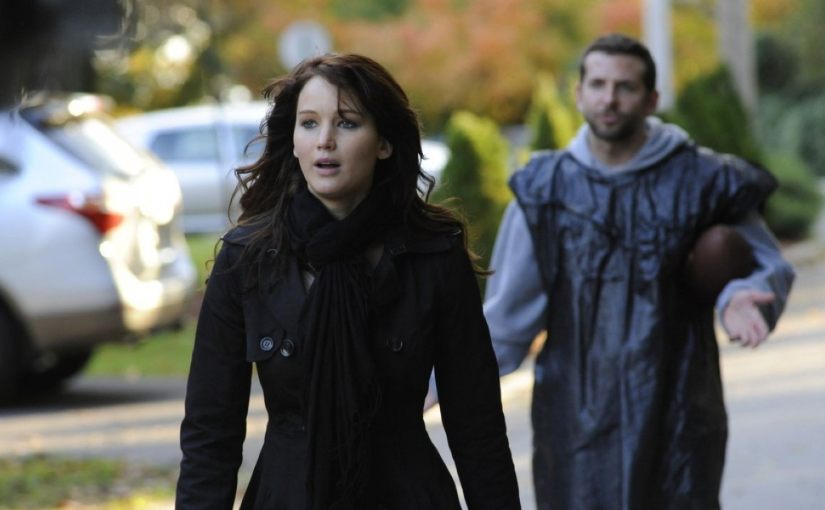
However, then Pat Jr meets Tiffany (Jennifer Lawrence in her Oscar winning role) and her own past is tormenting her, following losing her policeman husband in the line of duty. It’s clear she has not overcome this experience and she has taken up dance, which she is teaching herself in a refurbished garage. Tiffany is not quick to accept Pat Jr, but eventually the moments necessary for any film about relationships line up despite some screaming and shoving.

It sure sounds like I’m describing a heavy, miserable drama, here. Reader, I’m not. David O. Russell offers up moments of comedy without any of his characters really trying. No one is outright normal in this film. They are all burdened with their own idiosyncrasies and diagnoses, even Pat Jr.’s therapist, who we learn is an obsessed, face painted Eagles fan himself. Russell repeatedly uses a steady cam (I believe) to rush right up into the face of his characters, individually, when a moment is overtaking him or her. It’s a way of showing that no one else in the room can see what the sufferer is seeing. Everyone else is bound by their own disorder. Russell uses this device to isolate the character that owns the scene whether it is Delores, who endures the aggravation of her husband and son, Tiffany who can not get over the loss of her husband at a young age, Pat Sr. who must live with his Eagles losing another game, or Pat Jr. who is only trying to adapt to a new way.

There is no calmness in the domesticity of Pat Jr’s life and it only feeds the fire of his bipolar disorder. What he needs is someone who will not shun or ignore the disorder but embrace it and Tiffany is that person. Tiffany is also the person who will beat up on Pat Jr in one scene to bring his self-involved neglect to light. A helpful gesture for Pat Jr, but not a fulfilling action for Tiffany. Then in another scene she will solely come to his defense. The best moment in the film belongs to Jennifer Lawrence as she storms through the door and quickly confronts DeNiro on his own shortcomings, basically disarming him with sports statistics of every Philadelphia team, only to prove that Pat Jr had nothing to do with the outcomes of these games. Lawrence is harboring a machine gun of dialogue and she does not let up. DeNiro, I’m sure, loves to balance scenes like this with talent of this caliber. (I’d imagine he was missing great acting moments like this when he was shooting his Focker movies.) Russell wisely captures most of this scene in one shot. He is well aware of his leading actress’ strengths.

The ending is as quirky and inspired as Little Miss Sunshine, where Pat Jr and Tiffany participate in a dance competition that has everything is on the line, not just for their own sanity, but also for that of Pat Sr and the rest of the family. At the risk of spoiling a piece of the story, I have to recognize the dance sequence in this climax. Russell and his choreographer wisely mix it up with contemporary music that quickly switches over to head banging heavy metal and back to contemporary again. I caught it as an allegory of the mood swings these characters, especially Tiffany and Pat Jr, go through. The dance is messy, unsophisticated, aggressive and most of all it is adorable and lovable all at the same time. Psychologically, there must be something eating at Pat Sr and Pat Jr, and Tiffany and the rest of the cast, but that is, in no way, a reason not to love them.

RAIDERS OF THE LOST ARK

By Marc S. Sanders

Raiders Of The Lost Ark remains as one of the greatest films of all time. There’s nothing not to like about it and the accolades go to Steven Spielberg, George Lucas, Harrison Ford, Lawrence Kasdan and John Williams, along with a sensational cast of still unknown actors that owned their roles with absolute authenticity.

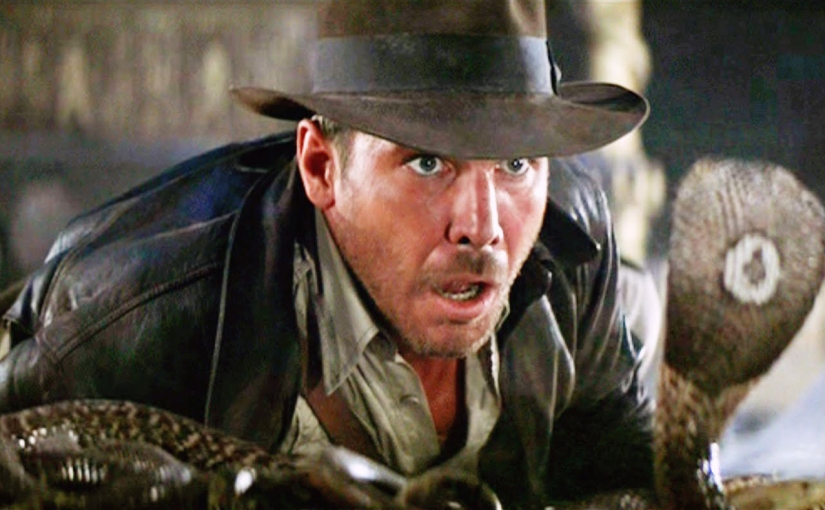
Ford became a great action film star due to Indiana Jones and Han Solo. This film is an example of his best work. He’s the best at facial expression during high action moments. Watch the truck chase during the second half of the film. As he is careening a truck through the sand streets of Cairo, he winces in pain, evokes anger and dons a toothy grin as he shakes Nazis off the vehicle, and throws them through windshields.

He’s got the perfect delivery of lines as he love/hate banters with Karen Allen as tough broad Marion Ravenwood (Jones’ best gal pal of the series). Their chemistry is great because they are two loudmouths who work off insulting and shouting at one another. They are one of my favorite on screen couples; like two Oscar Madisons who belong together.

Recently Ford said no one else can play the role; the role dies with him. He couldn’t be more right. Indiana Jones is not an interchangeable part like James Bond or Batman. Those roles change with the times and technology. Jones remains in history with a trusty whip, a sign of the times fedora hat and a drive to uncover the great unknown. None of these films work unless Harrison Ford is Indiana Jones.

John Williams also needs recognition. Who isn’t familiar with the famous build up horns calling for adventure? His composition just puts a smile on your face. Dialogue isn’t at play much during one of Spielberg’s well orchestrated action scenes. So we rely on the march of Williams’ efforts to relish in the fun of a foot chase through a Cairo marketplace or to thrill at a fast rolling boulder chasing the famed archeologist after he snatches his prized booty.

Spielberg and Lucas always get praise for their brilliant imagination. I venture to guess how many people were aware of the occupation of archeologist before the film’s original release in 1981. Sure, this isn’t what the job realistically entails, but the film opens your mind to what is out there and what we can learn more about from our past.

A great moment in cinematic exposition is when Jones explains the power of the famed biblical Ark of the Covenant. The dialogue works great here, thanks to a winning script from the great Lawrence Kasdan, and it has the audacity to convince an audience that some MaGuffin we read about in Sunday school could actually make Hitler’s Nazi regime invincible. Seriously? What?!?!? When you blend Spielberg and Lucas’ bravado, Williams’ eerily quiet thinking music, and Ford’s professor obsessed role with Kasdan’s efficiency for description all in one scene…yeah…you believe this could be a very, very real threat.

Every scene is different. Snakes, truck chases, spiders, foot chases, bottomless pits, bar shootouts, Nazis, the power of God, and a wide variety of antagonists all used to build the structure of two of the best hours in a film. It’s all brilliantly weaved together with transitioning red lines across a traveling map on screen. This is great editing, people.

Nothing has ever come close to Raiders Of The Lost Ark. Nothing ever will. It is a perfect film.

“Trust me.”

THE INSIDER

By Marc S. Sanders

When I think of Michael Mann’s The Insider from 1999, I cannot get over how deep it is with its storytelling. Inspired by true events and based upon a Vanity Fair article, I consider the adjective “deep” because it’s really a one-story trajectory, but it covers so many different facets; so many different industries and how they operate and sometimes overlap with one another. The tobacco industry, journalism in both television and print, state law and even the deterioration of an American household. Michael Mann shows how one simple action can balloon into something bigger affecting others all at once. You gotta get through one thing before you swim deeper into the bottomless pool of policy, contracts, ethics and threats.

Russell Crowe portrays Jeffrey Wigand, a top leading chemist with the Brown & Williamson Tobacco Company. Upon realizing that he has detrimental information should it go public, the company fires him and compels him to sign a confidentiality agreement not to reveal any of his research or activities while in service to them. That won’t suffice for the incredibly powerful tobacco company though, as Dr. Wigand receives threats that include disturbing emails, possible prowlers and a bullet that mysteriously turns up in his mail box.

Wigand crosses paths with Lowell Bergman (Al Pacino), a producer with 60 Minutes at CBS Television. Bergman works often with famed interviewer Mike Wallace (Christopher Plummer, who should have been nominated, much less won an Oscar). Wigand gets more and more motivated to go on Bergman’s show and tell everything about how the tobacco industry manipulates cigarette manufacturing to make it all the more addicting.

Bergman wants the story but he wants to play it carefully. Toeing the the line of maintaining Wigand’s confidentiality agreement might require a deposition by the scientist in a state courtroom so that his testimony will be public record. In other words, get a state to subpoena him and then the interview can happen because what Wigand says in an interview is already public record.

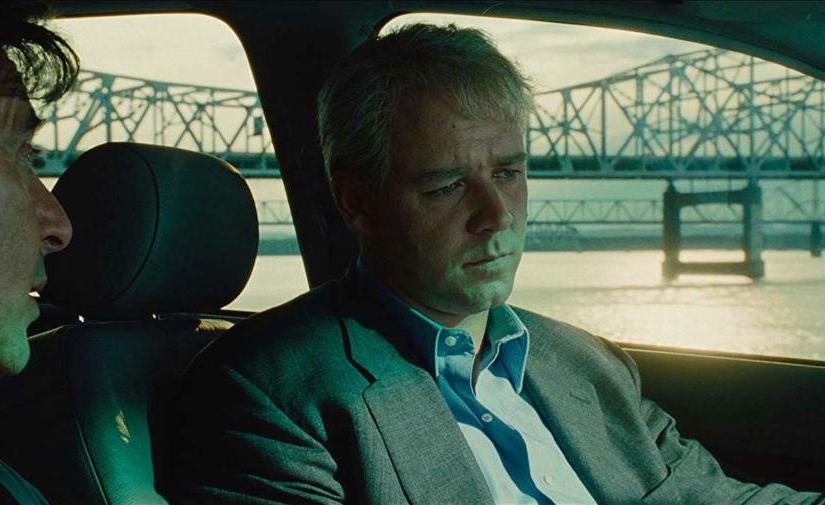
It’s complicated. Not so much for the viewer though. It’s complicated for Jeffrey Wigand. Russell Crowe emotes his rock and hard place situation with terrible anguish and a short temper. Michael Mann gets great closeups that capture the stress like deep wrinkles and dark circles under the eyes along with pale white skin, a big gut, wrinkled dress shirts, and rough shaves. The stress also carries over to his southern gentile wife (Diane Venora in an entirely different role from Mann’s Heat) and his two girls. They are collateral damage here. Wigand could also lose medical coverage on top of his salary and the threats of civil liability. Jeffrey Wigand is an ant under the very large heel of Big Tobacco.

Lowell Bergman also has obstacles from within his own camp. Journalistic integrity is tested with Wigand’s interview. It’d almost be better if Wigand was lying. That way Big Tobacco could not sue CBS for breach of a confidentiality contract. The more truth he tells, the greater the liability. Considering that CBS Corporate is in the middle of a buyout that could be very profitable for a select few, CBS is disregarding Bergman’s reputation for bringing in experts and informants that have made 60 Minutes the most watched news program on television.

These are the dilemmas that comprise Mann’s near three-hour film. What’s as interesting is the in between material. With Mann sometimes shooting with a documentary like approach, we catch glimpses of how a journalist will pass a colleague in a rotating lobby door and they’ll make arrangements to exchange one story in a time slot for another. These are mere seconds, but it paints a colorful setting that the news never sleeps. We see how Big Tobacco (represented by a slimy Michael Gambon) can subtly intimidate one man in a corporate office. We see a trio of lawyers take a phone call from a private jet they are piloting to consider Wigand as a material witness. We see how one of those lawyers (Bruce McGill) will handle an objection during his questioning of a witness (an unforgettable scene). We see how Wigand must adjust with his family to downgrade to a smaller home with old dusty kitchen cabinets and how it all gradually weighs down his marriage. We see how Bergman has to be covert with meeting Wigand in a hotel lobby. We also see how Big Tobacco can issue a smear campaign and how Bergman has to go across the street to a newspaper colleague to first ask for a deadline of print to be pushed back, and later how he grants a story to the paper to reveal shady dealings and how to refute what’s already been falsely claimed. There’s even a deal that indirectly involves the infamous Unabomber. It’s these little details that keep the film’s pulse alive.

Even before all of this begins, Mann demonstrates the lengths Bergman and Wallace will go to for 60 Minutes. They go deep into the Middle East to get an exclusive interview with the Head Sheik for the Hezbollah terrorist group. Christopher Plummer as Mike Wallace is marvelous here as he stands up against an irate bodyguard strapped with a machine gun to argue about how close he will sit next to the Sheik. If you want the story, the true story, you have to be genuine and be fearless with risk.

I can’t say enough good things about The Insider. It’s truly an education to watch the film with blazing cinematography in blues and grey hues from Dante Spinotti. Mann is always known for his coolness with film, dating all the way back to the MTV vibe of Miami Vice to Thief with James Caan, and his LA crime drama Heat. The tradition carries on here.

As well, the dialogue is so crisp from a script by Mann and Eric Roth. Pacino is memorably given an opportunity to sum up the machinations of CBS corporate in the third act of the film. The Mike Wallace character is not written as a television personality with a cue card. He’s got real, good, seasoned intelligence in his words. Plummer just enhances the script.

The Insider ranks at the top of the list of films focused on journalism next to features like Sidney Lumet’s Network, Tom McCarthy’s Spotlight and Alan J Pakula’s All The President’s Men. It explores the danger that can come from truths that need to be told which others never want disclosed. It covers the methods by which parties are recruited to help get the truth and the lengths operatives will go to, to squash a story.

The Insider is a gripping, magnificent film.

HOOP DREAMS

By Marc S. Sanders

Hoop Dreams is not a simple documentary. It spans five years beginning in the late 80s through the early 90s capturing the lives of two young promising basketball prospects looking for a shot at the NBA, a million to one shot.

Arthur Agee and William Gates are two black youths from the ghetto areas of Chicago who are given an opportunity to attend St. Joseph’s High School and to participate on their prestigious basketball squad, the same team where Isaiah Thomas began his trek to the pros. The film, directed by Steve James, continuously shows how far reaching the accomplishments of Thomas really are with moments frequently focusing on the school’s hallway cabinet display dedicated to the legendary former student. Arthur and William are magnificently talented as top coaches and recruiters will attest, but are they that good? Do they have Thomas’ drive and ferociousness on the court. As well, are they capable to maintain their required minimum grades and ACT test scores for college scholarships? Can the boys overcome injury or tuition demands to stay at St Joseph’s?

Hoop Dreams explores these questions in its three-hour running time. Though it’s a documentary, the drama is undeniably intense.

For Arthur, his talents on the court can only go so far. A family life that has highs and lows make it challenging for him during his high school years. His father, Bo, has been in and out of prison and he’s a drug addict. Director Steve James is so attentive and unforgiving with using his camera that he shows fourteen-year-old Arthur playing on the neighborhood court with Bo, who eventually drifts off into the background where we actually see Bo purchasing drugs from a dealer, right in front of his son and right in front of the camera.

Arthur’s NBA dreams also become more fleeting in his sophomore year when his family can not come up with the necessary portion of his tuition to remain at St. Joseph’s. From there, I desperately wondered if he’d ever return to the school.

William’s story begins with much more promise. He’s a magnificent player and comes off very responsible beginning in his freshman year at age 14 while keeping a job, and a respectful and positive attitude with his teachers and peers. His scholarship to remain at St Joseph’s is backed by a top executive for Encyclopedia Britannica. He’s a dynamo on the court and he’s got tremendous support from legendary St Joseph’s Coach Eugene “Ping” Pingatore who started Isaiah Thomas on his road to success. However, a knee injury comes into play. William is given the best treatments available including numerous surgeries to remove cartilage and maintain repairs. The knee never seems to go back to what it once was for William but even worse, according to Ping, the injury is messing with William’s confidence on the court.

This is not only disappointing for William with various setbacks that keep him off the court, but also for his older brother, Curtis, who lost out on his own basketball dreams. Curtis lives through the potential success of William.

The Agee and Gates families have next to no money living in the projects of Chicago. They endure job layoffs, welfare and at times no means to put food on the table or cover the cost of electricity. The need to support families of multiple children while they make every effort to survive the streets laden with drugs and crime beyond these troubles. What they live for is the will of Arthur and William’s potential for athletic greatness. The families are these boys’ greatest cheerleaders.

James’ film puts the golden ticket for these young men front and center at the beginning of the film when Isaiah Thomas speaks at a session for many prospective talents with a shot to attend St. Joseph’s High School. There’s uplifting footage of young Arthur playing with Thomas, and you feel the drive to now follow the boy’s journey to maybe see the professional ball player again but maybe in an arena where Arthur is now wearing a Detroit Pistons uniform as an actual teammate. As a viewer I was truly believing this could work out and by the time I get to the end I’ll finally see that moment captured in real life footage.

Nevertheless, Hoop Dreams shows that exceptional talent is never a promise for a shot in the NBA. Surviving day to day with no money and even a challenge to maintain academics, stay healthy, and avoid drugs and crime are at least just as important factors along that path.

Hoop Dreams is a long film. It needs to be to truly depict the essence of what happens to William and Arthur from year to year in high school. It’s absolutely riveting and emotionally suspenseful. Amazingly enough is that Steve James could never know what would come of Arthur and William when he began covering their stories in freshman year. Unlike other celebrated documentaries, Hoop Dreams is not a recap of a historical moment in time with stock footage that’s been recovered for narrative use. Hoop Dreams is in the moment. It’s a continuous exploration of what direction life will spell out for these boys and their families once high school comes to an end. Steve James was intuitive in following the respective trajectories without really ever being fully aware of the conclusions for these two stories.

Siskel & Ebert declared this film the best picture of 1994, topping films like Pulp Fiction, Forrest Gump, and The Shawshank Redemption. I can’t decide yet if I agree with that ranking, but I will never deny that the film belongs in that company of greatness for sure.

Hoop Dreams is absolutely magnificent, and likely one of the best documentary films I’ll ever see.

HEAT (1995)

By Marc S. Sanders

My all time favorite crime drama, as well another one of my most favorite films, is Michael Mann’s Heat which is widely recognized for the much-anticipated moment where Al Pacino and Robert DeNiro finally share the screen together for the first time. The Godfather Part II never counted as their characters performed in different time periods. Still, Heat has so much more going for it, beyond just its headliners.

Michael Mann wrote the screenplay he directed. It deeply involves both the thief, Neil McCauly (DeNiro), and the homicide detective who pursues him, Vincent Hanna (Pacino), with inspiration from two real life characters. Therefore, this film drives with more authenticity than a standard Lethal Weapon picture. Much more is at stake than a standard kill shot, arrest or the score to take down. The women and children and partners these guys become associated with carry a weight and sense of value. Even the hoods who betray them hold significance. How they matter and are part of the story is just as pertinent.

The story focuses on DeNiro, with Val Kilmer and Tom Sizemore taking down high stakes scores, not petty liquor store hold ups. An early armored truck hold up goes well until a new partner executes the three security guards in broad daylight on the street, at point blank range. Pacino takes the case along with his brilliant squad of detectives that includes great supporting performances from Mykelti Williamson, Ted Levine and Wes Studi. Then it becomes a cat and mouse tale where two equals match one another in wits, skill, and experience. To believe the equal match up though required casting Pacino and DeNiro. The film would not work with any other pair. Through their respective careers, their various performances came off different than one another. Yet, it has been often easy to imagine either one of them playing their classic roles instead. I could envision DeNiro as Michael Corleone or Serpico. I can also envision Pacino as Rupert Pupkin or Travis Bickle. The range of these actors is unlimited.

Diane Venora and Ashley Judd are two actresses not used enough in films. As the wife to Pacino’s round the clock detective, Mann provides time for Venora to show the pain of a woman in love with a man who can hardly ever be home because he’s always on the prowl of DeNiro’s professional thief and his crew. Venora is a likable woman in the role, only the circumstances of her marriage and the difficulties of dealing with a troubled pre teen (a fantastic Natalie Portman who will break your heart with just three scenes) are gradually making her cold. She has a great monologue midway through the film that is terribly dark, as she surmises Pacino’s cunning detective.

Ashley Judd is a different kind of cold as the wife of Val Kilmer’s gambling addicted sharpshooter. She’s a beautiful housewife and mother to a toddler that is trying to maintain a happy home. However, the balance of living with a career criminal is near impossible to maintain.

Michael Mann put so much thought into characters like this. Other directors and writers would keep the story on the streets and in the hideouts and city precincts. Mann goes not just for the low level criminal hoods who provide information in a night club at 2 AM. Mann allows his crime drama to spill over into the home.

He even allows a side story to occur with an ex con (Dennis Haysbert) out on parole trying to get his life back in order. What does this guy with his loving girlfriend have to do with anything else? Eventually, the bridge is connected, and it comes down to an emotional and heartbreaking conclusion.

Heat deliberately takes its time to flesh out a lot of great characters. The large cast are all given moments to stand apart from the rest. It is primarily a quiet, talking picture of careful planning and investigation. However, when the legwork is complete, Mann arrives at two scenes right in the middle of the film. The first is the now famous coffee shop sit down confrontation between Neil and Vincent. Mann did a masterful job of capturing the two actors doing some of their finest work with nothing tangible to aid them; no props or grand music or effects. Just a table in the middle of a crowded coffee shop. The professionals allow their history to show only so much but the cop and thief know this is not going to be easy from here on out. Mann did numerous takes, but with at least two cameras showing at each go round. So, if Pacino is talking, we see DeNiro’s facial reactions and vice versa. Pacino’s take #11 is also DeNiro’s take #11. It is one of the all-time great scenes in film history. Beautifully written. Beautifully constructed. Beautifully performed.

The next centerpiece is the bank robbery that occurs at midday in downtown Los Angeles. Neil and crew are almost scott free when Vincent and squad intercept them in the middle of the street. What sets this massive shootout (based on a real incident) above all others is that I actually get choked up and emotional over the moment. Characters that I have become acquainted with for the last 90 minutes are swept up in huge risks and danger of massive gunfire and ambushes. I even become terrified for the extras that Mann includes in this scene. I’ve watched this scene a hundred times and I can’t help but actually get tearful over it. Mann has the power to make me have an affection for these characters. As well, how will the spouses, who become aware of this matter, be going forward? That accounts for much of the latter half of the film.

Neil holds true to a philosophy he learned while doing time. If you spot the heat around the corner, allow nothing to interfere that you cannot walk away from immediately to avoid getting apprehended. He is put to the test of that motto when he falls in love with an introverted graphic designer played with quiet reserve by Amy Brenneman. This storyline will sum up the ending. Again, Mann shows the characters on the outside of these guys with their guns, working in an underworld environment. How do the risks of these guys play out on others?

Technically, Heat succeeds as well with brilliant blues, blacks and whites in cinematography. Major accolades for Dante Spinotti. Everything from the well-lit coffee shop to Neil’s unfurnished, ocean view apartment and even a blue Camaro that Neil drives away in through an underground tunnel are brilliant. Spinotti paid careful attention to the evolution of the characters. As Neil drives into that tunnel, the car turns white hot. He is on his way to escape with an unsure Brenneman by his side. Often in moments like this, the film tells more than any piece of dialogue could ever sum up.

Heat is a must watch film for genuine portraits of characters few of us will ever cross paths with. We should understand, though, they have more than just a drive to steal or to get an arrest. These guys exist for more than just the score. Few crime dramas ever approach that angle, and that is why Heat is such a special film.

QUANTUM OF SOLACE

By Marc S. Sanders

A writer’s strike never bodes well for a film. So the 22nd installment in the James Bond franchise, Quantum Of Solace, suffered because of it. Daniel Craig returns in his second film as Bond which begins as a direct sequel to my favorite film in the series, Casino Royale. Marc Forster (Finding Neverland) directs, but not very well.

Much of the action scenes are very shaky and choppy. Forster seems to have adopted Paul Greengrass’ technique that works so effectively in the Jason Bourne films and United 93. However, Forster does not make clear what is occurring. You can’t recreate Picasso with crayons.

The opening is a rush job of a car chase as Bond races away from enemies in his Aston Martin. Machine guns and heavy traffic and construction sites make way for his car to gradually fall apart but it’s hard to really see how the car becomes damaged in the first place. Just when exactly did the driver’s side door come off? There’s lots of spinning out of control and dirt flying with bombastic gun fire and engine revving. It’s all sensory overload to hide the preciseness in the high speed chase.

Later, Bond is attempting to rescue the girl Camille (boring name, boring girl) played by Olga Kurylenko when she’s held captive on a boat. He jumps into a motor boat and the chase is on. Bond fends off the bad guy by tossing a rope with a hook on it. Just tossing it up. Suddenly the bad guy’s boat flips over. What exactly happened here? How did the rope take out that boat? I didn’t see the connection. Film is visual. So show me the fundamentals from A to Z, please.

The story involves Dominic Greene (Mathieu Almaric) who appears to be an environmentalist with interest in a pipeline in Bolivia. (Bolivia????) At first Bond is under the impression this pipeline must be for oil. Later, it’s realized that Greene intends to charge the country enormous prices as he takes over the water supply. (Roman Polanski’s Chinatown did this all much, much better.). In exchange, Greene will assist a tyrannical Bolivian General in becoming President. This General raped and murdered Camille’s family. Naturally, she wants revenge. As Bond pursues Greene, he comes to learn that Greene is a member of a secret organization called Quantum. Hence the strange title.

Bond follows through with this assignment while trying to determine why his past love (Vesper Lynd from Casino Royale) was murdered, and after MI6 is infiltrated.

The story is kind of all over the place. It has a lot of interesting threads like Bond’s need for revenge, Camille’s need for revenge and a secret organization that MI6, nor the CIA, were ever aware of. Threads remain hanging as threads though if a writer’s strike interferes.

The story for Quantum Of Solace hardly gets fleshed out. We learn nothing of the organization, Quantum. When Bond finishes his mission with Camille, she just gets out of the car and walks away into the middle of nowhere. Where is she going exactly? The climactic battle takes place in a luxury hotel located in the middle of the desert. Unless this is Las Vegas, who goes to a hotel in the middle of the desert? I mean like ever?????

The film is a tremendous disappointment after the creatively artistic success of Casino Royale. Often sequels do not live up to their predecessors, but Quantum really goes off the rails. This film was a make-up as you go.

Craig is fine in the role of Bond; consistent with his first film. Almaric is okay as the villain, but never given much to do. A second woman comes into play, named Fields played by Gemma Arterton, assigned by M to bring Bond out of service. She seems to have a personality that the Camille character lacks, but she’s hardly given much screen time, save for a nightcap with Bond and later an image that harkens back to Goldfinger.

Jeffrey Wright (a great Felix Leighter, that I have not talked about yet) is belabored to share scenes with an obnoxious CIA partner played David Harbour. These two guys seem to be acting in a different movie.

Marc Forster was given a toolbox but didn’t know which end of the hammer to hold with Quantum Of Solace. There are too many things wrong with this film to justify any merits it may have.

Maybe the most interesting moment happens in the epilogue scene as we learn more about Vesper’s past. The scene has next to no relevance with much of the main story beforehand. Still, why couldn’t this film simply stay on this trajectory from the beginning? This is a thread worth pulling on and then tying off.

In other words, Vesper Lynd is far more interesting than the water supply in…ahem…Bolivia. 

CAPTAIN AMERICA: THE FIRST AVENGER

By Marc S. Sanders

Admittedly, as a kid I read about the star-spangled hero, Captain America, on a frequent basis. In the ‘80s, to me he was nothing special; a guy with a shield, dressed like the flag who was very agile. Not many surprises were left for him to discover on the page. However, in his first MCU installment, Chris Evans, as Steve Rogers the weakling yearning to join the US Army during World War II and kill Nazis, is inspiring.

Director Joe Johnston ably introduces a character before revealing all the goodies. A fantastic special effect of downsizing Evans to a gaunt 95 pounds allows the motivation to become a hero all the more convincing. Following a series of being bullied and being rejected for service, Rogers is given the opportunity to become a lab rat for a “Super Soldier” experiment that will award him with instant fighting skills and strength. Stanley Tucci plays the doctor looking for the right candidate. Why Rogers? Because he sees he has the heart of a man only wishing to do well unto others. The experiment is a success before it becomes sabotaged, but Tommy Lee Jones, representative of the Army, is not entirely convinced. So, Cap only elevates himself to the role of a character logo, forced to sell the idea of buying war bonds across the country and entertaining the troops overseas. A rescue mission finally comes calling, and the boy in blue dons the shield and shows the world who he is and what he stands for.

Chris Evans is great in this part as a guy always on a path of “do good.” Never emoting cockiness, never in service for himself and never one to surrender to illogical and immoral mindsets. This is how Captain America should always be portrayed, a man who stands for the good of country and as the MCU films continue on, the good of the world and, well heck, lets just say the good of the galaxy. With his perfect haircut and clean shaven face, Evans never shies away from that platform.

Tucci is so good in a role that will never define his career. His brief appearance shows no hint of him being in a comic book movie. That’s a huge compliment. He takes the role of a German doctor seriously. He’s the scientist, but the film allows a nice scene for him with Evans showing that he is more so a friend. When his part exits the film, you miss him.

Finally, the MCU gets the female role right following the dismissive nature of characters like Pepper Potts (Iron Man), Betty Ross (The Incredible Hulk) and Jane Foster (Thor). Special Agent Peggy Carter played by the awesome discovery of Hayley Atwell makes the role her own. She plays the part like it is written, never relying on the title character for her cues. Atwell shows determination to stand out as a woman among a sea of men and never regarding herself as any different from those said men. She has some great scenes with Tommy Lee Jones debating the purpose and importance of Rogers. By the end of the film, you are not just paying attention to the fate of Evans’ character, but Atwell’s as well. Peggy Carter is written so well, you could write a TV series about her. Wait….hold on…. anyway I digress. Hayley Atwell remains the best female character of the MCU above those we’ve seen already at this point, as well as ahead of those to come in future installments.

The villain is really just a villain with Hugo Weaving as the Red Skull. The character looks great; looks just like the source material. He’s one bad dude, but not much to him. He stands to be more powerful than Hitler, yada yada yada.

Joe Johnston directs a film with a salute towards director Steven Spielberg. Try to convince me that the opening scene is not reminiscent of the opening to Close Encounters of the Third Kind. Indiana Jones seems to sprinkled about as well. Johnston doesn’t try to get cute with experimental camera shots and blurry CGI action. I think because he follows a paint by numbers approach to this film, it is all the better. He offers lots of good back story to Steve Rogers role, he gives a large cast of characters their own moments to stand out (like Bucky Barnes and the Howling Commandos) and he keeps Captain America likable and a guy to cheer for; a guy to be thankful for.

So, let’s give it up for Captain America!!!!