THREE DAYS OF THE CONDOR

By Marc S. Sanders

Sydney Pollack is such a hero of Hollywood filmmaking. He was a terrific actor and a better director. As Three Days Of The Condor opens I got completely engrossed in its simple, yet frightening set up.

Joseph Turner (Robert Redford) arrives at his office where he works day to day as a “book reader.” He chats a little with his colleagues, jots a few notes down, and steps out the back door to pick up lunch for everyone. When he returns, he finds the entire office staff has been shot to death. This seems like a common day in the life of an Everyman, until it’s not. Alfred Hitchcock capitalized on this motif over and over again.

Turner makes a phone call and is asked for his code name, but before he reveals he’s known as “Condor,” he asks a very good question to the man on the other end of the line. Why is it so important that Turner reveals his code name, but the man he called doesn’t feel the need to share his own?

Having recently watched the film adaptation of The Firm with Tom Cruise, made almost twenty years after this film, I can see that Sydney Pollack knows how to not only build suspense very, very quickly but also how to maintain it too. Still, in both films the complications of the why and how become overbearing. With Three Days Of The Condor, it’s best to just watch the tight editing and well drawn characterizations all the way from Max Von Sydow as a disciplined assassin to John Houseman as the elder authority who relaxes himself with his tweed suit and bow tie behind a large table as the problems unfold. Cliff Robertson is Higgins, the contact for Turner. He’s serviceable in the part.

The entire first hour of the film is perfection; taut and gripping as we uncover what purpose Turner as a book reader serves, and for whom. The second hour found me feeling less engaged, regrettably. To aid himself, Turner kidnaps a woman shopping in a sporting goods store. Faye Dunaway plays Kathy Hale. He forces Kathy to take him back to her apartment where he hides out. Never would it occur to me that these two characters over the course of a day and a half would fall for one another and make passionate love. This is not that kind of movie, and yet there it is. Some producer must have said “Fellas, we’ve got Dunaway and Redford on screen. This is a no brainer.” Faye Dunaway is fine in the part. I bought that out of desperation Redford would hold her at gun point and force her to help. But, c’mon! Really? They gotta bang each other too????

As for the plot behind killing people, the film doesn’t work its way into car and foot chases. It relies on its wording. The problem for me is that Turner works it all out himself. There’s little reference back to earlier moments for an audience to connect the dots along with the hero. So when Turner realizes one of the motivations is in regards to oil trading, I was trying to figure when anyone said anything about oil to begin with. Revelations just seem to be pulled out of a rabbit’s hat at times. They could have said people had to be murdered because the price of milk went up by fifty cents, and that would’ve held about just the same amount of weight as oil. What ABOUT oil????? Nothing ever needed to be so explicitly discussed here.

Part of the fun sometimes in Hitchcock films, for example, is simply seeing the man unexpectedly on the run and then watching how he outwits his adversaries. Harrison Ford does that in The Fugitive. Tom Cruise did it in The Firm. Cary Grant did it plenty of times with Hitchcock. In this film, however, I never felt there was any need to explain. Once it tried to grow a brain, I thought sometimes less is more, because now I’m stuck feeling frustratingly confused amid a lot of convoluted mumbo jumbo, on top of an out of left field, unsubstantiated love sequence.

Three Days Of The Condor was one of the best, edge of your seat suspense stories I’d seen…until it wasn’t.

MEATBALLS

By Marc S. Sanders

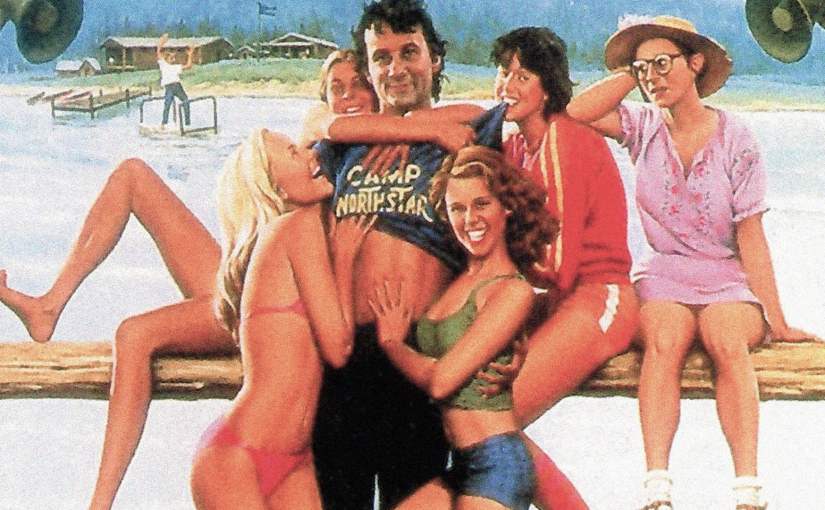
Director Ivan Reitman with Bill Murray and writer Harold Ramis made a fantastic team. Their summer camp comedy, Meatballs, from 1979 is not one of the all-time greats but it’s still a fun romp through the life of young campers peddled off under the supervision of teen counselors for eight weeks.

Meatballs works as an excuse to allow Bill Murray to break free from his SNL restraints and allow his off the cuff humor to improv its way through. As the head counselor named Tripper, Murray gives hilarious loudspeaker announcements about the cafeteria lunch or daily activities. He also uses his CITs, with names like Spaz, Crockett and Fink to carry Morty (“Hi Mickey!”) the camp manager who’s sleeping in his bunk out into the woods, or the lake or high up in a tree for his morning wake up surprise. This is all Animal House lite.

A touching secondary story involves a lonely teen camper named Rudy (Chris Makepeace) to bond with Tripper. Though I enjoyed my summer camp days, I was much like Rudy, not an athlete. I was a fast runner though, and Tripper with the Bill Murray personality builds Rudy’s confidence during the film leading up to the climactic inter camp big race. It’s not necessarily a well-rounded storyline. It tidies itself up pretty neatly by the end, but it’s a break from the material shenanigans, in between. Look, even a film like Meatballs needs some semblance of story somewhere.

The fun comes in brief skits with Meatballs. There’s sing along songs like “Are You Ready For The Summer?” and the campfire favorite “We’re The North Star CITs!” There’s the hot dog eating contest, Spaz’ spoon water relay and the basketball game against the wealthy, neighboring camp who can’t keep their shorts up.

Meatballs is a movie that would be shot with better quality on an iPhone today, but the dated camp days of the late ‘70s remain cherished here, before we became reliant upon technology. It’s a time where we depended on the outdoors, without mom and dad, and getting into harmless trouble while making new friends and discovering our freedom and ourselves.

The original Meatballs still has some material that’s worth a watch, and it still makes me yearn for my cabin bunk days. It’s nice to reminisce and it’s all just fun.

THE BLACK HOLE

By Marc S. Sanders

In 1979, Walt Disney Studios must have felt compelled to respond to the resurgence of science fiction, following 2001: A Space Odyssey, Star Wars, Close Encounters…, and even Moonraker, with The Black Hole. Their contribution to the genre falls flat however with shiny looking, helmeted, stiff robots that hardly use their joints and even more stiff performances from the human cast. If these actors didn’t have dialogue to speak, I would have thought they were dead.

Maximillian Schell is the deranged James Bond villain reject Dr. Reinhart, resigned to helm the mad plot of this film. His long-lost space craft is found at the border of the mysterious black hole. His intent, now that he has converted his entire human crew into mind-controlled humanoids, is to enter the unknown void that’s ahead and discover its secrets.

The small crew of another ship that discovers him consists of Robert Forster, Anthony Perkins, Joseph Bottoms and a poor imitation friendly robot named V.I.NC.E.N.T. who resembles R2D2 in shape and talks in cliche with C3PO’s voice. Their lack of personalities boards the ship simply to listen to Dr. Reinhart’s insane plan to fly into the black hole. Then in the final 30 minutes, the band of heroes run away across the pointlessly long platforms of the lost vessel as it crumbles apart during its slow-very slow-descent into the hole.

This is a film that lives up to its title. There’s no one to really rescue here. No romance or swashbuckling. No one for the villain to threaten. No reason to stop this nut job from committing his own mad suicide; Reinhart could care less if this band is with him or not. Even John Barry’s (“James Bond”) music lacks harmony, as the film contains at most two of his compositions to play over and over again.

When none of the mainstay ingredients for adventure carry any weight, then what’s the point really?

The Black Hole was Disney’s way of pushing action figures with the menacing razor blade bearing red robot Maximillan and the hardly lovable V.I.N.C.E.N.T. I recall when I was a kid the merchandising hardly made a dent in pushing the agenda for this film. A film catered towards kids, but barely entertaining for kids. There’s a lot, a whole lot, of speechifying going on here, mom and dad. What kid would be interested in listening to old farts like Ernest Borgnine or Maximillan Schell just yak away?

The Black Hole is as nothing as its title suggests. A void of a film. A franchise or cultural impact never came to be from this movie, and rightly so.

Though I do recall my mom buying me the pop-up book adaptation of the film. I wonder if that’s a valuable collector’s item these days.

EVERYTHING EVERYWHERE ALL AT ONCE

By Marc S. Sanders

Exploring the science fictional context of parallel universes can turn your thought process into a tailspin.  It can leave you up at night trying to find the center of a never-ending spiral.  Maybe that is why this gradually more common story line is reviving itself in current films like the next Doctor Strange installment from Marvel, or DC’s The Flash with multiple Batmans, and the unexpected surprise of Everything Everywhere All At Once.

My first experience with a multi-verse concept happened one Saturday morning in the early 1980’s.  At age 7 or 8, my favorite cartoon, Hanna Barbara’s Superfriends, explored a Universe of Evil.  Following a volcanic eruption, an evil Superman exchanged places with the noble Superman that we all know.  They each found themselves in opposite universes.  For the good Batman, there was an evil Batman, dressed in pink.  (Pink is evil????)  Evil Robin had a mustache itching to twirl.  Aquaman had an eyepatch.  Later, I hypothesized that this simple plot catered for kids was likely inspired by the famous Star Trek episode Mirror, Mirror.  (Evil Spock donned the evil goatee. Mwah ha ha ha ha!!!!!) These two storylines, which I highly recommend you seek out and watch, were very cut and dry in the concept of multiple universes.  There was a Yin and Yang structure of just black and white.  Everything Everywhere All At Once welcomes diverse complexity in its storytelling.  In this film, nothing is black and white.  Instead, everything consists of infinite shades of grey and gray.

The Wang family are Chinese immigrants buried in demanding and overwhelming tax obligations from the IRS while trying to manage a California laundromat.  Evelyn (Michelle Yeoh) is the matriarch who is married to Waymond (Ke Huy Quan) and they have a daughter Joy (Stephanie Hsu).  Upon visiting the IRS agent assigned to their case, Deidre (Jamie Lee Curtis, who finally found something else to do besides another Halloween retread), odd occurrences take place.  Evelyn is warned by Waymond with suddenly a strange and very different personality to act upon their current situation, like getting off an elevator and turning to the right, not the left.  Just trust me when I say that while you will likely be bewildered for a while as the exposition unravels itself, it will all pay off satisfyingly.  Somehow in another universe that is performing parallel to the one we first see in the film Joy is a villain bent on destroying Evelyn…and that’s not even half of what’s out of place.

I saw this film directed by the “Daniels” (Dan Kwan and Dan Scheinert) with my Cinephile colleagues, Miguel and Thomas.  After it was over, it was no surprise that they knew what I was talking about when I said this film is the reason why good editing is necessary in a film.  Because the Daniels introduce not one or two parallel universes, but SEVERAL, and there is so much happening…well…all at once.  I’d argue most shots in the film last no longer than an average 8-10 seconds because the multiple universe equivalents of Evelyn, Waymond, Joy and Deidre switch on a blink of your eye.  I warn you not to make a quick bathroom exit.  Quick flashes of scenes are relevant towards something else you may see in the next minute or an hour later.

Anyway, I’ll bet you never realized that there is a universe where the people have raw hot dog like fingers.  There’s also a universe where Evelyn is a street sign twirler, and a good thing there is an Evelyn like that to help another Evelyn fend off of a bunch of attackers in a different universe.  There’s also a world where humanity doesn’t exist.  Yet the equivalent of Evelyn and Joy are represented by two rocks.  That’s right.  Rocks with no limbs, no way of speaking vocally.  Yet, the film cleverly has the characters or products of its earth communicate with one another.  There’s even a different variation of the Pixar creation, Ratatouille.  Replace the rat with a racoon and see what transpires.

So, what does this all lead to?  Fortunately, there is a reason for these different worlds to collide and it leads to a valuable lesson in love and understanding within family.  Now that may sound hokey, but the film demonstrates that none of us are the same in what we are affectionate about, or what’s important to us.  How a daughter considers a girlfriend is not going to be easy for a mother to accept as any more than a friend.  The Daniels’ film carries much profoundness among its silliness depicted on the surface.

Having only seen Everything Everywhere All At Once one time so far, I could not help but laugh often and uncontrollably at what I was looking at, and the laughter becomes contagious when watching the film in a crowded theatre.  What made my movie going experience with this film quite fascinating though is that I responded in tune with the rest of the crowd.  Once you get past looking at Michelle Yeoh and Jamie Lee Curtis (two recognizable and accomplished actors) flap their hot dog fingered hands at each other, eventually you recognize the “normalcy” of that particular universe.  You are no longer laughing with them.  Now you are accepting the people and how they function in that specific environment.  Same goes for the rock universe.  The Daniels are brave enough in their direction to just show two inanimate rocks perched on a ledge and communicating with subtitles of very aware and well written dialogue.  It looks completely crazy at first.  Later, you yearn for the impending destiny of those rocks.

Much symbolism is tucked into the Daniels’ script as well.  The most telling is that it focuses on an Asian immigrant family obligated by law to honor American tax codes.  The Deidre character portrayed by Jamie Lee Curtis is not so empathetic to the Wangs’ comprehension of resolving tax violations.  Basically, two different cultures are butting heads with no progress because they have a different viewpoint on how things function.  Wisely, this serves as a springboard to demonstrate how multiple universes will lack perfect chemistry as well when they collide.  None of this is written off as communication barriers.

I imagine on a second viewing, I likely will look at Everything Everywhere All At Once through a different lens.  I won’t laugh as much because I’ve grown acclimated to what were once very odd and strange environments for these characters that dwell within.  Instead, I’ll be even more observant and appreciative of the film as it presents different behaviors and cultures encountering one another.  This is a very good picture that is worth multiple viewings for sure.

In fact, this film is such a pleasant surprise, that I am comfortable suggesting this early on that I will consider it one of the best films of 2022.  If at least Everything Everywhere All At Once does not receive an Oscar nomination for Best Screenplay, then it would be a terrible disappointment.  The imagination of its endless devices is just so inventive.  Heck, I’ll throw my hat out there and strongly suggest nominations for Michelle Yeoh’s performance, along with Best Editing for Paul Rogers (this guy should win the award) and Best Picture of the year.

See Everything Everywhere All At Once in a movie theatre with a crowd and/or a large group of friends.  You may just have a cathartic experience of how human nature responds when getting acclimated to what at first appears to be so foreign.

WEIRD SCIENCE

By Marc S. Sanders

John Hughes, as a writer, stretched his imagination far at times. Really far!!!!! You’d have to, to build up your confidence to make a ridiculous comedy like Weird Science come to life. The movie is blatantly absurd, outrageous, a little crude and outright nonsensical. It’s Frankenstein meets Pretty In Pink. It’s alive!!!!!

Double, maybe quadruple, Uber Nerds Gary and Wyatt (Anthony Michael Hall, Ilan Mitchell-Smith) spend their Friday night in front of the computer to create the hottest woman ever. With the help of a Barbie doll and some Playboy centerfolds, nothing on earth will compare to this creation for the XX chromosome community. They give her a brain as well by scanning in photographs of Albert Einstein, of course. From there, “Lisa” (Kelly LeBrock), with the toned body that SCREAMS SEX, plots out the boys’ weekend at a blues club, then the mall and later a party at Wyatt’s house where the boys’ reputations are enhanced almost as well as Lisa’s chest.

Lisa helps Gary and Wyatt overcome their insecurities with their popular girl crushes and teaches Chet, Wyatt’s idiot green beret brother, to lay off. Chet is played by Bill Paxton. Can you imagine anyone else playing Chet?

There’s a cuteness to Weird Science. However, the slapstick gags are what really wins. Either you like this silliness or you don’t. I get amused watching all the furnishings of Wyatt’s house, including the Baby Grand piano, get sucked out the chimney along with a half-naked girl. I love it when Lisa freezes the blue blood grandparents in the pantry closet or when she erases the memory of Gary’s father. I also like how Chet is reduced to a big blob of literal shit. Then there’s the nuclear missile that rises out of the floor, up through the roof.

Take off your cap of sophisticated maturity, and just appreciate silly, sophomoric comedy for a change. It’s all harmless, anyway. Lisa makes sure everything is back in its place by the end, only now it’s better and funnier than before.

NOTTING HILL

By Marc S. Sanders

Notting Hill written by Richard Curtis (Love, Actually) and directed by Roger Michell is a pleasant surprise of a romantic comedy. It’s not a perfect film but it certainly loves every one of its quirky supporting characters, as well as its two straight romantic leads played by Julia Roberts and Hugh Grant.

Grant plays Will Thacker who lives in the Notting Hill district of London where every proprietor is a charming little shop of some form or other; a quaint street where merchants appear on the sidewalks during the weekends selling their art or homemade jams or coffee products. Will owns a travel book shop located across the street from his flat that is whimsically recognized by its big blue front door. His wife left him for another man and now he’s relegated himself to living with a roommate called Spike (character actor Rhys Ifans doing a British equivalent of Cosmo Kramer, Seinfeld’s neighbor).

One day the superstar celebrity Anna Scott (Roberts) simply strolls into Will’s store. They have a quiet moment and he sells her a travel book about Turkey that he didn’t recommend she purchase. Moments later they run into each other down the street when Will spills orange juice all over Anna. From there, a meet cute relationship begins to unfold. It’s not so simple for the pair though as Anna’s enormous celebrity is hard to negotiate; hard for Anna, not hard for Will.

Anna is at ease when she can have a quiet dinner to celebrate Will’s sister’s birthday with his friends or when she can escape her turbulent life of gossip magazines and paparazzi by taking shelter at Will’s flat, even if grungy looking Spike walks in on her taking a bath.

I like Notting Hill. However, the quiet moments shared between Grant and Roberts sometimes carry on too long. Oh my gosh!!!! Will someone say something already????? Hugh Grant has made characters that trip over their words and stumble with what to say into a master craft. Julia Roberts is one actress that a camera loves especially when she’s distressed. A crying moment in any one of her films will milk the scene for every blush, or glassy eye or tear and whisper she can offer. She’s a terrifically skilled actress in almost any film she does. Eventually, we have to move on from all of this though. My patience for some scenes were just running way too long for me at times. Kiss already!!!! Make love already!!!! Scream at each other already!!!!

Fortunately, there’s much escape to be had with the supporting cast, especially Ifans as Spike who is the most absent minded, lovable, dirty underwear wearing and sloppy prig imaginable. Emma Chambers is just as fetching with her scarlet pigtailed haircut as Will’s sister, Honey. Tim McInnery, Gina McKee, James Dreyfus and Hugh Bonneville round out this madcap collection. The birthday dinner party is a great scene for this ensemble as a comedic but relaxed chemistry blends nicely during a competition to see who is suffering the most to earn the last brownie on the dessert plate. The group is unsure how to include a movie star like Anna in their simplicity but Julia Roberts pulls off a trick that even had me fooled. Simply put, for the whole cast, there’s just that much more life and vibrancy when they are all together and it’s not just relegated to only Roberts and Grant in a scene.

Another special moment occurs later when the couple have split up once again. To depict time fleeting by, Roger Michell offers up a transition of Will wearing one outfit but walking through the hustle and bustle of Notting Hill as the weather and seasons seamlessly change all around him from sunlight to rain to snow and spring sunlight again. You even get a glimpse of Honey starting a flirtatious relationship at the beginning of the sequence and by the time it’s over a minute later Honey is breaking up with the guy. It’s a wonderful moment of wordless narration to show Will’s struggle with moving on as time continues to pass by. More importantly, it allows the titled setting to be a character of its own. This is a great example of showing a lovesick character unable to move on while life has no patience to wait for him to catch up.

I like Hugh Grant and Julia Roberts whether it’s in Notting Hill or one of their many other fine movies. I can’t deny the chemistry they have in this film. It works. I only wanted a little more life to the material that was handed to them. Still, Notting Hill is charming and simply a very sweet romantic comedy.

THE BOOK OF ELI

By Marc S. Sanders

Do you believe in the word of God?

The Book Of Eli directed by The Hughes Brothers will make sure you do.

Faith carries Denzel Washington’s loner character on a journey through a grim, sunburned post apocalyptic wasteland as he protects a rare, sacred text. He has been on a sojourn to reach a final destination out west.

Me, being the religious skeptic these days, might normally find the convenient episodes of survival that Washington encounters as far fetched. However, The Hughes Brothers direct a script penned by Gary Whitta that never mocks the purpose of the film presented. As a viewer it would be rude of me to laugh at how Washington continues to walk when it seems he’s getting shot in the back. I wouldn’t dare misbehave in that manner. Watching The Book Of Eli…well…I feel like I’ve gone to church.

The Loner carries a book he faithfully reads every day as continues his long walk through treacherous, barren and motorcycle pirated lands. If the sun doesn’t blind him and kill him, the various marauders might.

The worst adversary of this bunch is Gary Oldman in yet another treasured villain role. Oldman keeps a tight authority on an “old west” inspired town, commanding from his comfortable leather chair in the upstairs level of the town’s bar (saloon, perhaps?). He’s been tirelessly dispatching men to find a particular book and perhaps it’s the one that The Loner possesses.

Post-apocalyptic wasteland, a book, a Loner, a villain. That’s the structure of this film along with some side characters like an impactful Mila Kunis and Jennifer Beals. Very simple ingredients allow for well edited moments where Washington can display his unexpected fighting techniques with a gun or a shotgun or a forearm length sword. When he exercises these moments the scenes are outstanding. Oldman is the guy who sits back letting his own horde do the dirty work and only acts when he sees that he has an upper hand. He’s oily, scary and in this dense waste of a future he likely dreams of being a prophet or a high powered evangelical might.

I was so pleasantly surprised by this film. Post apocalyptic films wear on me these days. How much is there to show that I haven’t already seen like abandoned cars, skulls, and deserted highways?

This is different however because Whitta’s script offers a reason to live through this hellish void. I had to wait for it but the ending is a very satisfying conclusion. I loved it, actually.

The Book Of Eli is a great film.

INDIANA JONES AND THE TEMPLE OF DOOM

By Marc S. Sanders

Steven Spielberg’s second installment in the Indiana Jones series of films deserves more credit than it has received, nearly forty years later. Spielberg isn’t even fond of his film, and I think he needs to reexamine his own self-criticisms.

By the time he’d make this prequel, he was already a master filmmaker (followed by Close Encounters…, Raiders Of The Lost Ark, and E.T. The Extra-Terrestrial). Temple of Doom almost seemed easy for Spielberg to construct. He just filled in the holes from one scene to the next and he’s so natural in his instincts that the thrill of adventure never wavers, and it always feels new and fresh.

Think about it!!! He accompanies a John Williams led rendition of a Busby Berkeley number while Indy tries to escape from machine gun toting baddies in a Shanghai nightclub (called “Club Obi Wan”; nice wink and nod there).

That’s followed by an unlikely jump out of an airplane with only an inflatable water raft to glide through the heights of the sky. Reader, I bought it, and only because Spielberg shot it. He just knows what looks good on film.

The main crux of the film focuses on rescuing the enslaved captured children of an Indian village from a bloodthirsty cult while also retrieving sacred stones. Over the years as we’ve approached an age of a PC climate, many take issue with racial prejudice overtones. Do Indians eat monkey brains for dessert, and rip beating hearts out of the chests of men? I don’t care, and I don’t associate these horror/comedy moments with people of a certain race. I’m not foolhardy enough to do that.

However, I do correlate this material with what inspired the Indiana Jones character in the first place, and that is the serial cliffhangers of a forgotten age. Ridiculous stunts and outrageous visuals kept the attention of the viewer and that is what Spielberg, along with creative partner George Lucas, accomplishes here.

So you are treated to thousands of icky, crawly bugs, a screeching, off the rails mine car pursuit and a “snake surprise” as a main course dinner entree.

It’s all in good fun and it’s all shown in the campy adventure thematics that Indiana Jones was always recognized for.

Just go get your jolts every time he cracks the whip. That’s all Indiana Jones And The Temple Of Doom was ever meant to be.

E.T. THE EXTRA TERRESTRIAL

By Marc S. Sanders

It’s easy to give credit to a magnificent script by Melissa Mathison when talking about E.T. The Extra Terrestrial.  However, director Steven Spielberg clearly invented tricks of his own off her page.  Thus, E.T. strikes a chord with me on a very personal level. 

While my parents never separated or divorced, in my adolescent years I did not have any kind of relationship with my father.  He left for work at 4:30AM and would not come home until nine at night.  He worked Saturdays as well.  I hardly saw him.  He hardly conversed with me.  One time, later on in life, he explained to me that he just never knew how to connect with a child.  It was only then that I understood why his response of “Oh wow!” amazement seemed so fake when I showed him how the wings pop off of my Star Wars TIE Fighter.

Mom was the constant in my life with regular Saturday trips to Burger King, and the comic book and toy stores, while singing along to Barry Manilow in the car.  The adults I viewed in my childhood were mom and my grandmother, Helen.  So, I understand why Steven Spielberg opts to only include Mary (Dee Wallace), the one adult in full focus through most of his picture.  Mary has recently separated from her husband leaving her to tend to their three children. Gertie (Drew Barrymore) is the youngest. Michael (Robert MacNaughton) is eldest.  Elliot (Henry Thomas) is the middle child and main character of the story.  These kids have no other important influence in their lives except their mom and maybe Michael’s buddies.  Their father is only mentioned to be vacationing in Mexico with his new girlfriend, but never seen.

After an alien ship departs Earth while looking for plant life in a California forest, one of the passengers is sadly left behind.  Through a series of suspenseful moments, Elliot welcomes the stranger from a strange world into the comfort of his room full of toys and games.  A connection is immediately made of trust and friendship, but on a science fiction level, there is also psychic bond.  Somehow, Elliot and E.T. share one another’s thoughts and can feel what the other feels.  In a humorous moment, E.T. gets drunk on beer while being left at home alone.  This leads to disruptions caused by Elliot during a frog dissection scene in science class.  Even deeper though is that E.T.’s biological make up doesn’t appear to be suitable for a long stay on Earth.  As E.T. gets more and more ill, so does Elliot.  It is up to him and his siblings to help their new friend “phone home” so he can be rescued. 

The interference in all of this are the government officials who are surveying the suburban neighborhood for clues on E.T.’s whereabouts.  Wisely, and because Mathison’s story is told primarily through the perspective of children, Spielberg shows these men from the waist down.  After all, if Elliot and the others can’t identify with these adults, why is it necessary to show their faces? (In Jaws, the townsfolk can’t identify with the man-eating instincts of a great white shark.  So, why is it necessary to show the animal?)  One adult in particular is a man who has a keychain clipped to his waist.  The film credits the character simply as “Keys” (Peter Coyote).  Only when the safety of Elliot, E.T. and the family are intruded upon in their home, does Spielberg show the faces of these scientists and G-men.  Still, most of them are displayed with intimidating radiation suits and masks on.  If they absolutely have to be shown, then they are going to look more obscure and threatening then any alien from outer space.

E.T. The Extra Terrestrial will always remain as of one Steven Spielberg’s greatest achievements.  That’s saying quite a lot considering his other films like the Indiana Jones series, Schindler’s List, Jaws and Saving Private Ryan.  What sets this picture apart from those others is the gamut of emotions it sends to the generations of audiences that continue to watch the movie over and over again.  It’s very funny at times.  It’s also very scary, and it can be very sad as well.  At one point, Elliot has to explain why a daring escape for E.T. must occur because “This is reality, Greg!”  Of course it is, no adult would ever believe what they’re involved in.  It takes a child to comprehend this wonderment.  The unknown is frightening as well.  What exactly is leaving footprints behind in the shed?  Is it a goblin?  Also, why are frightening looking figures with helmets and astronaut suits barging out of bright light into every doorway of their home?  As well, how does someone from another place adapt to a foreign environment of stuffed animals, flowers, and what’s on T.V. or in the refrigerator?  In two hours time, Spielberg answers for all of these dynamics. You develop a kinship with not just E.T., the cinematic creation, but also the kids who snap at each other and sometimes affectionately curse and tease one another. 

You also feel the sadness of a mother who is trying her best to uphold a home while hiding a sense of abandonment herself.  E.T. was left behind, but so was Mary.  Dee Wallace provides an exceptionally tear-jerking experience on Halloween night.  The following morning, she is distraught to find a missing Elliot finally return home with a high fever.  I see my mother in that scene each time I watch it.  Now that my mom is gone, it’s even more meaningful.

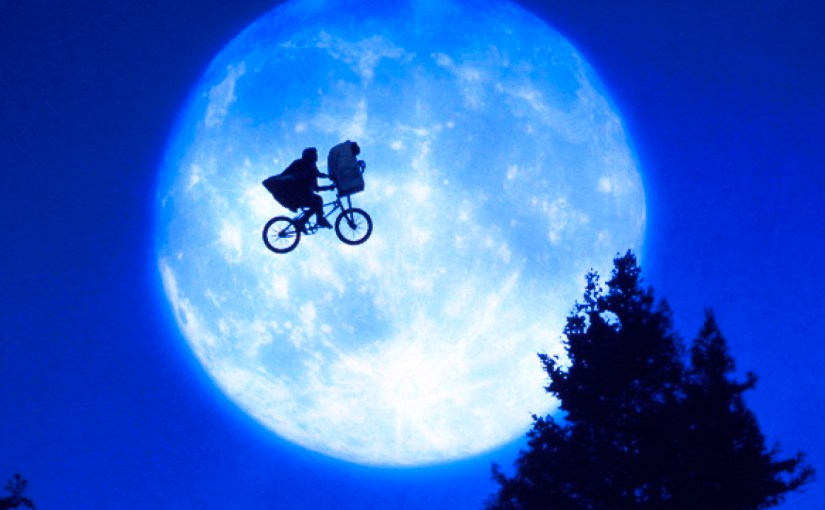
Spielberg’s film also works beautifully with an original score from John Williams.  Williams’ music speaks a language for the characters of the film.  Sometimes, his orchestration is foreboding as someone unseen lurks nearby.  Other times, it soars as the adventure kicks into gear with an outstanding bicycle escape from the government.  Williams also relaxes the pulse of the audience for the tender moments while a friendship of love and support is being built.  Watch how the score enhances the fantasy when E.T.’s fingertip glows and heals a cut on Elliot’s hand.  Williams hits a note that is in sync with Henry Thomas’ amazement.  The best sample of Spielberg’s craft blending well with Williams’ work is when Elliot’s bicycle soars into the sky with E.T. as a passenger.  As they ride across the backdrop of a full moon midnight clear, this movie provides one of the greatest shots in film history.  If there was ever a reason to prove why an original score is so necessary in film, it’s important to use E.T. as an example.

Steven Spielberg was especially sensitive when making E.T. The Extra Terrestrial.  I saw an interview with him where he decided that once E.T. departs the children of the story, the actors themselves would never see him again.  He insisted on that with young Drew Barrymore and Henry Thomas, and he warned them in advance.  Because he was steadfast in that decision, their performances were all the more genuine.  Their tears of love and sadness were kept authentic.   In one documentary, footage following the end of shooting with E.T. shows Barrymore completely distraught in the comfort of Spielberg’s arms.  Spielberg knows that everyone suffers loss.  It’s a rite of passage in life.  My first loss was my grandfather at age 9.  Imagine coming to the understanding for the very first time that someone you’ve grown close to will never be seen ever again. 

That’s the magic that Steven Spielberg possesses.  He can make anything feel real.  His fantasies and frights are true in nature.  Nothing appears ham-handed.  When watching a film from Spielberg, you’re enveloped in its environment.  What’s in front of you is what will terrify you or laugh with you or make you cry.  What you are seeing, and hearing will allow you to reminisce on a time in your life when you were scared or sad or happy or lonely.  Steven Spielberg might have used people from outer space in his films to tell us that we are not alone.  However, we are also not alone in our feelings.  Steven Spielberg reminds us that we all encounter these emotions at point or another and therefore, there’s nothing wrong with responding like any other human being would. 

ANT-MAN

By Marc S. Sanders

Peyton Reed not only capitalizes on Edgar Wright’s interpretation of Marvel’s Ant-Man, but also on the first chapter of the MCU, Iron Man. The similarities in the two films are so familiar that Ant-Man seems a little boring and redundant. You’ll turn to your seat mate midway through and say “We’ve seen this.”

Nevertheless, Reed’s film is saved thanks to a likable Paul Rudd, a welcome Michael Douglas and a scene stealing Michael Pena. Evangeline Lilly is here but she’s as useful as Gwenyth Paltrow has been. Corey Stoll is the bald villain, like Jeff Bridges before him, and well… LOOK!!! You just needed to find someone to be the villain; the guy interested in stealing technology to use for making a lot of money and other nefarious purposes. You’ve seen it all before.

Pena is given the best stuff to do as Reed takes advantage of visually recounting a “telephone game” story of what he and then what she said and then what he said after that. Michael Pena is a really funny guy who deserves more work. He’ll likely get a lead in an ABC family sitcom one day called Pena or Michael!, let’s say.

Rudd has fun with the stupidity of his superhero name and abilities. Let’s face it. Controlling the minds of ants is not as flashy as Batman and his gadgets or Spider-Man web slinging through the city. Rudd smirks through all of it. So, I felt okay to smirk as well.

The film suffers from a lot of exposition and a few too many characters. In a flashback 80s scene, Douglas’ character (the original Ant-Man) breaks some SHIELD agent’s nose. What’s so special or offensive about this guy? I don’t know. Also, Bobby Cannavale is a pain in the ass cop for Rudd to deal with, but more or less you’d have the same film if he was excised from the final cut.

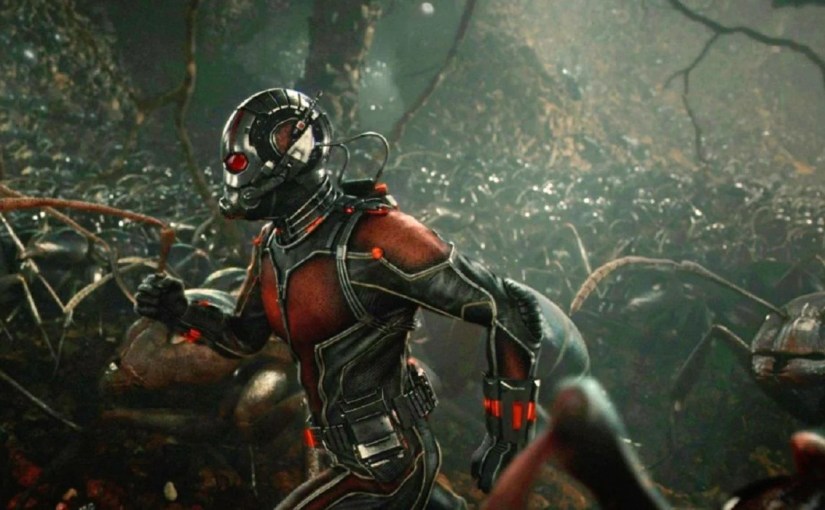
Reed saves his movie with a really fun ending consisting of a battle involving shrinking and enlarging and shrinking again aboard a Thomas The Train Engine toy playset. It’s Rudd as Ant-Man vs Stoll as Yellowjacket (very cool looking and not used enough). As well, you can’t help but smile when you see a fifty foot high toy train crash through a house.

This is a scrappy little film in the Marvel Cinematic Universe and not much seems original, but you got a cast that’s likable and an ending to be entertained by.

Nothing special, but nothing terrible either.