GUARDIANS OF THE GALAXY VOL. 2

By Marc S. Sanders

James Gunn continues his Looney Tunes odyssey helming Guardians Of The Galaxy Vol. 2. The silliness is grander, the story is weirder and the characters are now comfortably fleshed out.

Vol 2 is probably not better than the first installment. However, it is more inventive as Gunn takes his film along the hanging thread left over from before. Peter “Star Lord” Quill (Chris Pratt) meets his father at last in the persona of Kurt Russell who goes by the moniker Ego. This is all enthralling to Quill, though his love interest, Gamora (Zoe Saldana) sees beyond the facade.

Ego has invited them to his planet that he created. It pops with colors, serenity and cheer. This plays for a good story; maybe as a better and more developed Star Trek episode.

What differentiates this film from other Marvel films comes out in the third act. This does not consist of just space battles, laser swords and shootouts. The end is something else, something new, entirely. Thus, you are given the film’s greatest strength. I found it to be very imaginative.

Gunn however falls a little bit into his own trap along the way. There are too many relationships and characters that work as filler for side stories. Gamora vs her bitter sister Nebula. Drax (Dave Bautista) with a new, weird antenna on the head character named Mantis and Rocket Racoon and his big mouth with Yondu (Michael Rooker, in a bigger more significant role this time). Oh yeah! There’s also Yondu vs Sylvester Stallone (huh? why? how?) and Yondu vs his mutinous army, The Ravagers. It’s all a little too much for an already busy looking film.

I found it funny that The Ravagers reminded me of the motorcycle gang, The Black Widows, from Clint Eastwood’s Every Which Way… bare knuckle comedies. Those guys were much funnier than these Ravagers. Gunn overstays their welcome as they randomly cackle and heckle poor Baby Groot, the toddler tree thing. That gets old quickly.

Gunn approaches a special kind of humor here. Repeatedly, because these are outer space characters, it’s apparently funny to lend them explaining the punchline of a gag. So if Drax realizes that Peter has the hots for Gamora, he’ll belly laugh and explain literally how Peter feels and do it bigger and louder. Variations of that gag occur quite often among most of the characters. Sometimes it works. Sometimes it gets old.

GOTG Vol 2 is a fun watch. I don’t foresee this installment carrying the legendary status the first one did or even standing out among the best of the Marvel series, but I will give props to the outcome of what Ego truly is and what his intent depends on. (I won’t spoil that here, of course.)

The cast is great. Saldana is one of the stronger female characters in the MCU. She captures a background to Gamora that is blatantly absent from other Marvel ladies. Bautista has become a great character actor as well. He’s a smart guy with good timing. With his extensive child and adult film resume Kurt Russell is perfectly cast as Pratt’s father. Their personalities lend to some good chemistry.

James Gunn owns the Guardians films. No one else can capture his blend of humor and pop culture salutes. Yet, he overreaches a little trying to incorporate so much story and so many gags into one film. His vision is well defined, though.

Plus, Gunn stages another dance scene for Pratt and Saldana, and it’s great. As I noted in my Vol 1 review, that’s how you get to a viewer’s heart. Everyone loves to dance.

As well, Gunn accompanied his sequences with some tunes both fresh and familiar from Fleetwood Mac, Electric Light Orchestra and George Harrison to name a few.

James Gunn was always going to make sure never to take his films seriously. So, when you see a baby tree groove along while trying to detonate a bomb, I defy you to be so serious as well.

RUNNING ON EMPTY

By Marc S. Sanders

Director Sidney Lumet’s 1988 film, Running On Empty, depicts Judd Hirsch and Christine Lahti as former radicals against the Vietnam War. They have been running from the authorities for 15 years after bombing a Napalm laboratory as part of their cause. They have two sons, one of them played by River Phoenix with a chance to attend Juilliard. His opportunity does not seem likely however as it would mean he could never see his family again, and his family is reluctant to set him free.

In a film about criminals, this is a story lacking in crime or violence. Lumet’s film is a narrative of a family and how they live by constantly changing their identities, backgrounds, and residences. It’s not a life for an innocent child, especially one with a promising future.

Phoenix was nominated for an Oscar for his conflicted role. He’s quiet, but he’s torn and he’s accepting of what fate brings him. Sadly, he prevents himself from making his own destiny. A bright element comes in the form of fellow student Lorna, played beautifully by Martha Plimpton. This is her best role as Phoenix’ girlfriend who falls in love with him and shows him pure happiness. She’s the fulcrum that introduces him to what possibilities are available, but he’ll have to sacrifice his current life for a better one, and his parents will have to accept his decision.

There’s no easy wrap up in screenwriter Naomi Foner’s Oscar nominated script. A painful outcome is inevitable. Yet, that’s what makes this a great drama. The conflict is too great for an easy resolution.

What a terrible shame that 5 years after this film, at age 23, River Phoenix died of a drug overdose. Imagine what he would evolve into as an actor. Here in this role, as well as films like The Mosquito Coast, Stand By Me, and even as a young Indiana Jones, he was more than just a child actor or a teen magazine cover. He performed with a mystery to his characters where he would never reveal every dimension that his parts possessed. In a film like Running On Empty you almost wish his real life fate never came true.

THE SHINING

By Marc S. Sanders

Stanley Kubrick’s The Shining has become a legendary film that set the standard for haunted house films. It’s a spooky story with a musical soundtrack never destined to be played at weddings or bar mitzvahs.

The whole movie is unsettling, beginning with a long winding road drive through the Colorado mountains as the title and credits unconventionally roll up the screen, one at a time. Kubrick was never typical. Here he was frighteningly weird.

The film, based of Stephen King’s bestseller, consists of four characters. Three of them are novelist Jack Torrance (Jack Nicholson), his wife Wendy (Shelley Duvall) and their son Danny. He’s one effed up kid with a mop top haircut. I think I’d be disturbed if I uncovered what Danny grew up to be hereafter.

The fourth character is the main attraction, the isolated Overlook Hotel; left empty during the harsh winter months to take advantage on reviving its morbid history of harsh violence by means of ghosts, bleeding elevators and hacked up innocent looking, pig-tailed, young girls. Don’t ask me to explain the guy with the gold lion mask about to go down on a happy partygoer. No. I also can’t explain what exactly happened in Room 237. Perhaps King’s book covers all of this. Kubrick opts not to and focuses on the naivety of Wendy while Danny and his imaginary friend Tony talk to the consciousness of the hotel only to understand it is gleefully influencing Jack into an obsession of murderous incentive, eventually leading him to charge his ax through some doors.

I once visited the Louvre in Paris. I couldn’t fully enjoy or appreciate it. It was too big and too overwhelming. I didn’t know where to start or where to end. I had a panic attack, but I didn’t know it at the time, and I was eager to leave. Kubrick works on that anxiety during the long exposition of the film. Effectively disturbing tracking shots are provided that shoot deep hallways, vast ballrooms, large furniture pieces, and loud colors of reds, browns, yellows and whites along with emerald, green in the bathroom of room 237. The pastel blues of the young girl’s dresses and pigtail ribbons are also deliberately garish. Colors are normally cheerful for me. Here, they are unwelcome and intrusive and when I say loud, I mean to say the colors scream at you,

You just want to get away with Danny on his Big Wheel that he pedals around the property, softly on the carpet and thunderously loud on the tile and wood.

The character of the setting continues its disturbing details by means of a maze. Kubrick offers a great transition when Wendy and Danny enter the maze while Jack overlooks (pun intended) on a small-scale model. The hotel’s haunts have its prey in sight by means of its possession of Jack. Kubrick clearly shows that with his camera work. There are wide shots both overhead and facing Jack, and narrow, trapped captions of Danny and Wendy lost in the labyrinth.

I won’t say The Shining is a favorite of mine. I think this is only the second time I’ve seen it. I’ll watch horror movies, but they often bother me; leaving me distraught and stressed, unrelaxed. Occasionally, while Kubrick is vague with his imagery, Nicholson is blatantly obvious in his urge to terrify; maybe a little too blatant. He is in direct competition with John Belushi in the facial expression department. He’s disturbing even before the hotel’s influence is available to take hold, and so I didn’t necessarily get a good character arc from him. Same with Duvall or the boy. This family is downright weird all on their own from the moment you meet them until the film’s cold, wintery end arrives. Kubrick gets you curious about what this hotel is capable of. Then he shows you. Then the end literally tires the story out.

The Shining is best when you have an urge for fear and frights. A house of horrors tale where a cat or bird will not suddenly fly into focus for a cheap jump-scare. Rather your vision and hearing will still feel shocked, leaving butterflies in the stomach, and shortness of breath. Repeat viewings will leave you awake at bedtime, and worried and agitated. There’s so much to explore, but do we really want to know what’s in that room, or down that hall or around that corner, or even how that photograph of a July 4 celebration from the 1920s ever came to be?

SUPERMAN: THE MOVIE

By Marc S. Sanders

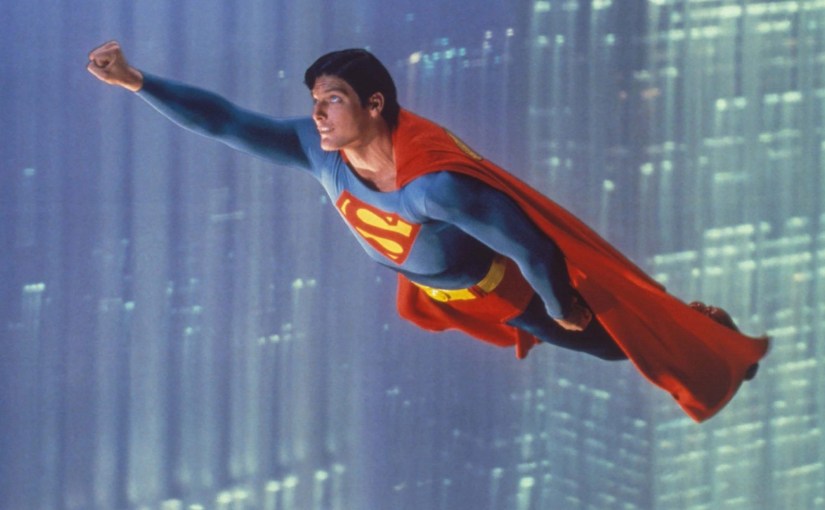
Richard Donner’s Superman: The Movie is one of the best biographical films of a fictional character ever made.  Yes.  It absolutely is a biography.  How can you call it anything but?  The visitor from the planet Krypton is embedded so deeply within the lexicon of worldwide pop culture and historical significance that he rests within all of our subconsciousness.   When we think of ongoing problems in the world from natural disasters to destructive wars or famines and disease, or to even kittens stuck in trees, for a split second we all consider how simple we could go on with our lives if only Superman were here to rescue us. 

By 1978, forty years after Joel Siegel and Joe Shuster created the character, visual effects were at a more than adequate level to convince us that a man could fly. Thus, the man with the red cape was ready to appear on the big screen.  With creative input from writer Mario Puzo, Donner’s film goes through various stages of life from when the extra terrestrial is a new born baby, to a toddler, then a teenager and on to a thirty something adult.  While living on the planet Earth, his powers may make him virtually invincible, but he’s far from godlike.  He cannot prevent the unforgiving nature of death.  He can’t be everywhere all at once.  He can’t even perform on the same level as his colleagues or friends, who are skillfully beneath him.  It would be unfair to have Clark Kent on your football team.

To watch Superman is to see a mini-series over a span of nearly two and a half hours.  We begin on the white crystal planet of Krypton featuring one of the greatest actors of the twentieth century, Marlon Brando, cast as the father of the superhero to be.  Brando is Jor-El.  He serves the planet as a prosecutor and a political leader with an expertise in science.  He’s championed for his knowledge, but he’s also challenged by his peers when he is certain of his planet’s demise. Thus, he must release his newborn son, known as Kal-El, into the far reaches of space to survive.  The script here takes an almost Shakespearian approach in debates of facing inevitability.  Brando’s authoritative screen presence is perfect here. 

Kal-El moves on to Earth, particularly Smallville, Kansas, and the nature of the film changes personality.  1950s Americana becomes our main character’s environment with endless plains of crop fields and farm land as Kal-El becomes identified as Clark Kent, the teenager who develops a crush on the high school cheerleader and gets bullied in the process while he must deliberately withhold all that he’s capable of by influence from his adoptive parents (Glenn Ford and Phyllis Thaxter).  Life for any of us is never complete until we experience the death of a loved one and Donner showcases that here to demonstrate that Kal-El/Clark can not prevent what’s meant to happen when biologically our bodies shut down.  Not even a super man can save us. 

Clark reaches age 18, usually perceived by most as a turning point into adulthood and through a means of Krytonian process he’s educated until his thirtieth birthday upon the rules and boundaries he must function within while on Earth.  He learns of his ancestry and then Donner changes the setting of his film once again into the furthest extreme from quaint Smallville. 

We have transitioned to sprawling Metropolis where Clark works as a mild-mannered reporter at The Daily Planet.  Christopher Reeve plays Clark/Superman and there was no one who could have filled the role better.  Physically, Reeve is the example by which all super human character portrayals still look towards.  Yet, the Julliard trained actor performs the dual personality so well.  When he dons Clark’s glasses you feel as if you are looking at another actor from when he’s dressed in the blue and red costume of Superman.  His posture and voice inflections are so distant from each character he’s playing.  Christopher Reeve was a stellar actor of versatility. 

In Metropolis, we are also introduced to an impure villain, Lex Luthor (Gene Hackman, who never got enough praise for this role) focused on greed and individual power for him to consume at the expense of everyone else on Earth. 

As well, just as life must bring us towards the experience of loss, it also must introduce us to love in the form of Lois Lane. Margot Kidder does a magnificent job of the hustle and bustle career woman with a sense of romance and need for ongoing adventure.  A reporter’s life will only give you that some of the time.  Superman will let you live that every day.  In life, we all start with valuing one person in our lives beyond our immediate family, and Lois serves that purpose to Clark’s perspective. 

Donner takes advantage of comedy and slapstick when Metropolis comes into play.  It’s not as polished as Krypton.  Nor is it as calm and reserved as Smallville.  Again, the personality changes.  Reeve plays Clark as a persona of the inept and gullible newcomer nerd to hide his powerful alter ego.  Hackman’s Lex is accompanied by Ned Beatty as a bumbling sidekick to play off of. (This same actor was a frighteningly powerful and intimidating corporate CEO in Network just a few years prior!) Valerie Perrine holds her own against Hackman as Lex’ alluring dame to have a tete a tete of sarcasm with. Kidder is the leader of Metropolis’ populace always on the go so much that she’s not even aware of her insensitivity to poor Clark.  A great gag is that as a good as a reporter as she is, Lois has terrible skills in spelling.  (There’s only one p in ‘rapist’.)

Maybe you’ve never seen Superman from 1978, or maybe it’s been too long since you last took it in.  It remains a watch that’s worthwhile.  Donner’s film covers so much of this one individual’s life that also includes two separate ancestries.  I get hot and cold on biographical films, sometimes.  It’s a tough scale to measure.  Sometimes filmmakers don’t show you enough.  I thought the film Ray, ended too suddenly on its depiction of Ray Charles.  Sometimes, it’s an overabundance of material.  The Last Emperor and Chariots Of Fire seemed to never end, and became mired in long, drawn-out, sleep-inducing pieces of dialogue.  Superman allows just the right amount of time to live within these different parts of Kal-El/Clark Kent/Superman’s life that you get familiar with who the main character encounters and how he responds to those around him. You also witness how these environments respond back to him.  You get a sense of what he stands for and where he feels insufficient and where feels strong and secure, as well as valued by others. 

It might be crazy to believe, but biographical writers and filmmakers should turn towards Richard Donner’s film for an outline that perfectly establishes every scene and moment that’s cut into its mold.  Superman: The Movie?  When I want to tell the life story of Golda Meir, or Barack Obama or Joseph Stalin or Jesus Christ?  Yes, Superman.  If we are crazy enough to follow the exploits of a man who wears a cape and flies through the sky, then why can’t we believe he can provide the answers to the great mysteries of life better than any of us?

UNLAWFUL ENTRY

By Marc S. Sanders

The boogeyman is dressed as a police officer!

In 1992’s Unlawful Entry, Jonathan Kaplan (The Accused) directs a well-played Ray Liotta as a psychotic cop named Pete Davis who is terrorizing a yuppie couple named Michael & Karen Carr (Kurt Russell, Madeleine Stowe). The Carrs experience a home intruder who puts a knife to Karen’s throat. Officer Davis offers comfort to the pair and happily volunteers the arrangements for a high-tech alarm system. The first mistake that Michael makes is sharing the password with trusty Pete. You’ll expect that to come into play later on. Maybe what inspired the password will work itself into the film as well. Hmmmmmm?????

It’s difficult for Pete to resist the obsession he has for Karen and so he begins a campaign to get Michael out of the way. First, he demonstrates his brutality by offering Michael the opportunity to senselessly beat up the home intruder for no other purpose than personal satisfaction. When Mike refuses, Pete finishes the job. Later, Mike makes efforts to keep Pete out of their lives. It’s hard to do that when a highly decorated cop is involved. Karen, his own loving spouse, won’t even truly believe Mike; neither will the police chief.

As Pete continues with his intentions, Mike’s credit cards are maxed out, he loses a high priced client that Pete has been talking to, parking tickets add up, and so on. Pete also appears at the house at inopportune times like when Karen is taking in a swim or creepily stepping into their bedroom while the married couple is having sex. Eventually, Mike is put out of the way when he’s imprisoned after being framed as a drug dealer. Now Karen is all alone for a terrifying third act that you’ve likely seen hundreds of times before.

Unlawful Entry is engaging while you’re watching, but it does not convey much. The happenings all appear probable if a deranged cop wanted to go through all this trouble. Therefore, Ray Liotta owns the picture. Yet, what did I learn here? Don’t call the police?

For Kurt Russell, this is the first of two “husband is being terrorized” roles for him. Later, Russell would headline the cast of a better film to fall in this genre called Breakdown. Still, I like Russell here. He starts out as a guy who is not capable of fighting for the sake of his wife. He regrettably admits that shame to Pete early on. Pete pounces on that advantage to win Karen. Later, the strength of Mike’s short temper followed by his fear push him to do what he must to protect himself and his wife.

Madeleine Stowe is a good actress. There’s just not much for her to do with this part. She’s the spouse who opts not to believe her husband’s concerns. If she did, there wouldn’t be much of a movie. The third act is all action and blood and falling down the stairs and running back up the stairs. It’s no surprise really. Though it is convenient that Michael is finally able to post bail and get home in time for a final confrontation with Pete.

One thing that kept echoing in my head though was that as good as Ray Liotta is (he’s very, very good actually; very primal and deceiving), he is terrorizing a woman named “Karen.” Every time he says the name Karen, all that comes back to me is the film Goodfellas where he more or less tormented and disrespected Lorraine Bracco known as, you guessed it, Karen. A rule should be put in place, Liotta can no longer be cast with other characters named Karen. His Karen quota is maxed out.

MISSION: IMPOSSIBLE

By Marc S. Sanders

Brian DePalma directed the first installment of Tom Cruise’s film adaptation of the Mission: Impossible series. It’s good, but not necessarily the best of the bunch.

DePalma’s approach with a script by screenwriter Robert Towne (Chinatown) & David Koepp opens with last ditch effort at a Cold War setting. (By 1996, Pierce Brosnan’s James Bond had already abandoned that point in history.)

Cobblestone streets in Prague glisten under wet street lamps as a team of spies, led by Jim Phelps (the “Captain Kirk” of the original series) with Cruise’s Ethan Hunt as point man. They are attempting to prevent a buy/sell exchange of a disc containing identities of undercover agents spread across the globe. There are shadows. People walking covertly and other people watching people through cameras on eyeglasses and computer monitors. Everything is going according to plan, until as we expect, nothing goes according to plan, and Tom Cruise seems to be the only one surprised by it all. Now he’s accused of being a traitor having gotten his whole team murdered and he must go rogue (he does this a few times in the M:I films). DePalma’s opening is straight out of a John LeCarre novel. All good stuff.

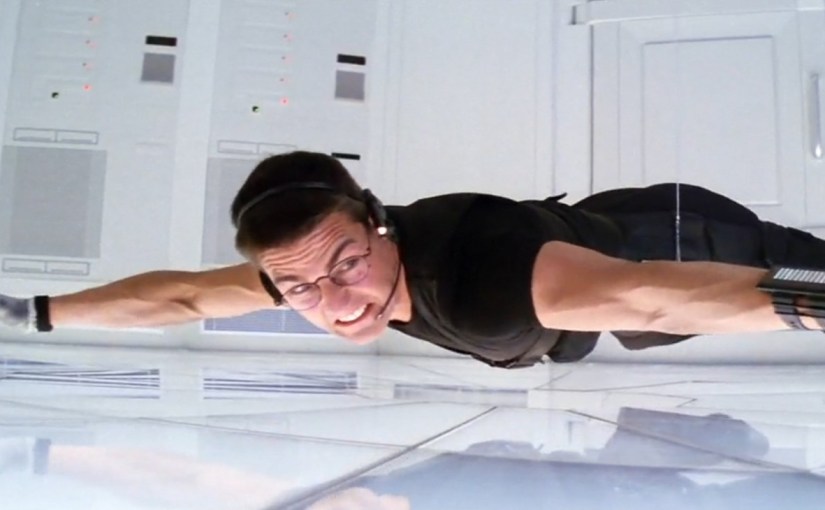
More good stuff appears in act 2 when Ethan Hunt has to infiltrate CIA headquarters to retrieve another disc and allow himself to cable down into the most high tech secure room in the…well lets just say the world, that is conveniently run by the most incompetent dweeb in the…well let’s just say the world…again. The primarily silent sneak is as beautifully choreographed as a Russian ballet. It’s spectacular.

Even more good stuff occurs in act 3 in a high speed super train crossing through the Chunnel in Europe. There’s a helicopter and Tom Cruise on the roof of the train and even some exploding chewing gum. Act 3 is where DePalma, Towne & Koepp opt to leave the Cold War behind because let’s face it, no spy can remain covert when a helicopter gets tethered to a high speed train in a tunnel.

So yeah, there’s lots of goodies in Mission: Impossible, but it falls terribly short because Tom Cruise produced the film with his ego in the way. For example, he sets up a team of four, all with different specialties. They get properly introduced and then they are given not much to do except watch Tom Cruise “Ethan Hunt” his way out of one dangerous situation after another. Ving Rhames seems like an especially interesting character but all he’s reserved to is typing on a keyboard. Vanessa Redgrave puts on a charming mystery about herself for one short scene as an arms dealer only to do nothing else but sit on the train later on.

Lots of talent was assembled for this film including Jon Voight, Emilio Estevez, Jean Reno and Kristen Scott Thomas but they’re only here to be a live studio audience for Cruise’s heroics.

Compare this film to Eddie Murphy’s Beverly Hills Cop. Murphy is no doubt the centerpiece, but he does not own every scene. Big moments come from the supporting cast as well. There’s more variety to that picture, which Murphy produced, than Cruise’s production.

A well utilized cast can be the difference between a good picture and a great picture.

RONIN

By Marc S. Sanders

John Frankenheimer directed the exceptional thriller Ronin, featuring Robert DeNiro and a band of baddies all hired to intercept a mysterious suitcase. The contents are never revealed, and it really doesn’t matter. It’s the pursuit that’s important. Consider this a glossier version of Reservoir Dogs and Pulp Fiction. Not big on exceptional dialogue but huge on top notch car chase action.

Frankenheimer works with a script co-written by J.D. Zeik and David Mamet (using a pseudonym), and all that’s necessary to assemble a gripping two hour story is to have the characters team up, then abandon each other and then double cross each other. How do you identify professionals like these? Well, recruit Michael Lonsdale (former Bond villain from Moonraker) to explain the meaning of the samurai known as Ronin who have become masterless; skilled swordsman with loyalty to no one any longer.

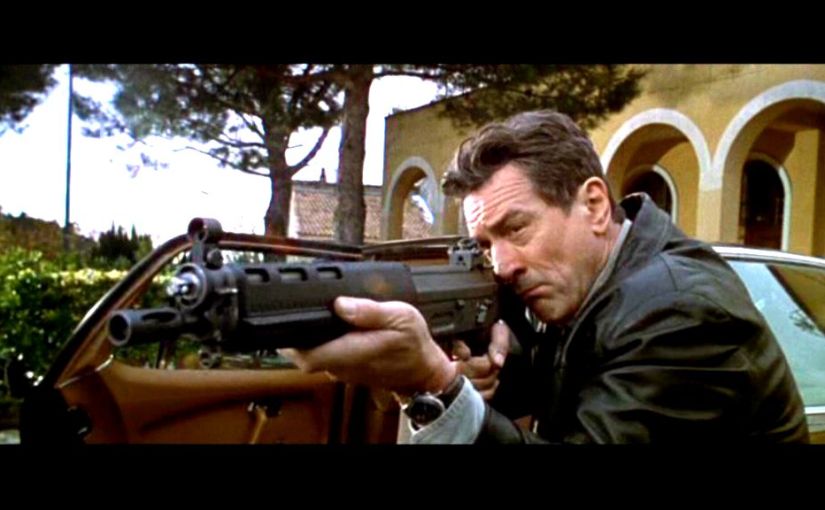
DeNiro plays “Sam” who may be former CIA. He’s one of five men hired by an Irish woman named Deirdre (Natasha McElhone) to retrieve the well-guarded package. This entails intercepting a convoy of cars riding along the French countryside. The fun in the car chase action of all this is that the characters are implied to be at least as ruthless as the subjects they’re stealing from. Therefore, Frankenheimer and his team of 300 (yes, that number is accurate) stunt drivers can offer up reckless collateral damage; cafes are crashed into, buses flip over, and motorcycles skid out of control. It’s Vice City before there was ever a Vice City video game. These guys are not stopping for little old ladies crossing the street.

Jean Reno partners up with DeNiro for a time as a Frenchman and Stellan Skaarsgard plays a German ex-KGB agent. Eventually, Jonathan Pryce comes in to play as well, representing more Irish influence. Sean Bean is here too. (Have you been paying attention? That’s three Bond villains in one movie!!!!) All good casting.

That’s about all there is to say. The plot is deliberately thin with a slight, mediocre twist, and a romance that’s nothing truly interesting.

Still, Ronin is watchable. Frankenheimer and his cinematographer, Robert Fraisse, present awesome locales of a thriving Europe from 1998. Editing is quick and sharp too. Consider Ronin a precursor to Paul Greengass’ Jason Bourne films.

If nothing else, beyond the various car chases and high stakes shootouts, DeNiro had me convinced he was clearly instructing his colleagues on how to remove a bullet from his gut.

Yes. You pretty much see everything.

YOUNG ADULT

By Marc S. Sanders

Charlize Theron is always an actress who impresses me. Ever since I saw her in The Devil’s Advocate, I’ve been taken with her on screen presence. She simply has a natural way of bringing a character to life, and usually it is with unhinged and complicated women who never escape and overthrow what’s tormenting them. Her Academy Award winning turn in Monster as serial killer Aileen Wuornos is a perfect example, and her role in Jason Reitman’s film Young Adult is a close second best.

Young Adult was written by Diablo Cody (Juno, also directed by Reitman) and depicts Theron as Mavis Gary, a once successful author of a series of novels aimed at pre-teen and teenage girls. When she receives an email baby announcement from her former high school boyfriend Buddy Slade, Mavis wearing her sweatpants and worn-out t shirt packs up her puppy dog and leaves her one-night stand in her Minneapolis apartment and heads back to her small Minnesota town. She’s not there to see the newborn bundle, however. Mavis is under the delusion that she can win back Buddy who is now happily married.

This isn’t going to go well for Mavis, especially while she’s drowning in one bottle after another.

Patton Oswalt plays Matt, a former classmate, who comes upon Mavis’ arrival. Matt knows immediately that Mavis doesn’t have it altogether. She has not endured as well as he has following a terribly violent hate crime experience in high school when he was mistakenly taken for being gay. Mavis recalls this moment but with great insensitivity. She laughs as she reflects on the incident. Her take equates to maybe Matt being victim to a wedgie or being trapped in a locker. It was much worse than that. Matt’s legs and genitals were smashed in the beating.

Oswalt is very good in his role. Matt doesn’t need to have any regard for Mavis, the once popular prom princess. However, he can’t help but see her pitifully make a fool of herself as she attempts to intrude upon Buddy’s life.

Buddy appears naive to Mavis’ sloppy advances. Buddy sees the image of a successful author prim and proper. Matt sees the ugliness of Mavis beneath her makeup and dress clothes that never hang well on her intoxicated stature.

Cody’s screenplay takes place over three days. In that time, she allows her main character to come to the realization that she’s not a happy person and most certainly is alcohol dependent. A baby welcoming party makes evident of this conclusion. It is an event that will be remembered but for all the wrong reasons. Theron is astonishing in this scene. Not a likable character and yet so well performed.

Reitman is a good director with simplicity. He is simple at showing what likely eats at the good, published writer Mavis used to be. When Mavis drives back into town, Reitman shows her car pass by franchise businesses like Chili’s or Staples. There’s no imagination in these locales. No history or depth. There’s no stimulation. It’s all corporate. Just my theory, but I’d say that could drive a successfully imaginative writer into a depression. No wonder Mavis left town. Problem is she moved on with no constants in her life. Consider the fact that Mavis doesn’t even share with her parents that she’s come back into town.

Juno is the better film from Reitman and Cody. There was a broader scope of the characters at play, beyond just Juno herself. Theron and Oswalt are the only ones with multi dimensions in Young Adult. It’s a benefit that the film clocks in at only just over 90 minutes. Any longer and I’d have grown tired of this film. I can’t expect Mavis to overcome her demons in this short period of time. So, we are reserved to seeing how she further undoes herself and nearly destroys the family and people (not friends) she once knew. Basically, Young Adult shows a woman arrive at rock bottom. Therefore, I applaud Reitman and Cody for keeping this film condensed. The high school popularity is but a memory. Success is gradually moving away from her. Despair and depression and the illness of addiction is all that is left for her.

FANTASTIC BEASTS: THE SECRETS OF DUMBLEDORE

By Marc S. Sanders

That’s it.  I’ve had it.  Enough already.  After three unnecessarily long movies, if you can’t get it right then what’s the point anymore?

Fantastic Beasts: The Secrets Of Dumbledore, the third film in the Harry Potter prequel series, is an absolute failure beyond any magical or Muggle measure of comprehension. It operates with the same handicaps that crippled the prior installment, The Crimes Of Grindelwald, and maybe picked up an additional dozen or more problems along the way.

I don’t understand it Warner Bros.  Following the abysmal reviews of the prior film and the tepid overall assessment of the first, why, with all the monies at your disposal, would you settle for a boring piece of production work like this, all over again? This new film’s main attraction is simply men in dull grey wool suits and overcoats speaking to one another in quiet English whispers.  Every so often they do something quirky like pull a wand out of their pocket.  Fleetingly, they use them.  How novel. 

It boggles my mind that this world from Rowling’s colorful imagination was at one time intended for pre-teens and young adults.  I’ve seen political debates or Sunday morning commentary programs with more flair.

The fault in these films holds primarily with the creator, J.K. Rowling, and David Yates, the director that’s helmed the last four Potter films and all of the Beasts films up to date.  I’m so exhausted in saying it.  ROWLING NEEDS AN EDITOR!!!!!  There is so much fat on this meat that is impossible to swallow.  Someone needs to speak up and advise her to save this scene and that scene for the DVD extras.  One curse that this film suffers from is the exact same thing that the second film dealt with.  A background story is told, with a majestic fade up and fade down and fade up again flashback.  It takes a good five minutes to tell this tale, and then someone else chimes in and says hold on, that’s not how it happened at all.  Then a new character starts from the beginning and apparently tells us the real story as it truly occurred.  Why in the hell should I trust this new character if you’re now telling me not to believe the lies of the former?  Fodder like this stretches this fantasy towards a distant two- and half-hour mark, though it feels like four.

David Yates has always been a problem.  Look, I know nothing about a camera or the most up to date technology in filmmaking or digital making, but I’ve seen enough special effects laden films in my time.  The prologue to this film commits the same visual atrocity as the prologue to the prior film.  Here, our main hero, Eddie Redmayne’s Newt Scamander – a magic zoologist – is observing a magical deer like creature deliver her offspring.  Suddenly, some other magic figures come upon the sight and attempt to zap the creature and Newt with their wands.  It’s the middle of the night amid a dense forest/jungle of thick plant life and trees.  We see flashes and blurs.  We hear ear piercing sound effect swishes, and the music from James Newton Howard (which is quite good) carries to a high volume.  Just like the last film, though, action scenes like this are murky.  It’s like the lens is covered with the bottom of a soda bottle filled with vinegar.  I can’t tell who is chasing who or who is zapping who, who dies or who lives.  Yates is not doing any favors for what bills itself as fantastical adventure.  When he isn’t shooting action scenes like this, his direction seems to perform on cruise control at a top speed of 15 mph.  There’s little drama or interest in any of the speaking scenes that drag on and on.

The movie’s story picks up with whatever cliffhangers were left from the last time.  It’s really not necessary for me to recap.  They hold little relevance here. 

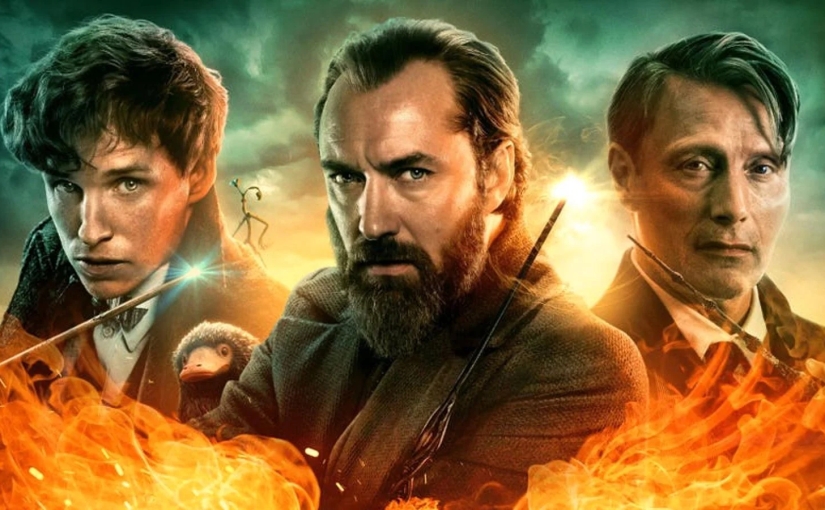
Basically, Grindelwald (Mads Mikkelson, now taking over from a controversial Johnny Depp) is getting his bearings together with the troubled young man Credence (Ezra Miller) who we were told earlier is the brother to the Albus Dumbledore (a well-cast Jude Law).  Once again, Dumbledore recruits his former prized pupil Newt Scamander to locate the criminal Grindelwald and defeat him.  Newt assembles his brother, his assistant (neither of which we hardly get to know; so why should I disclose their names) and his Muggle baker friend Jacob Kowalski (Dan Fogler). Two more new characters round out this fellowship.  However, if you are looking for a real, solid fellowship, go back to those movies where the characters go after a plain gold ring.  That is fantasy at its finest.  This is the back story of a National Geographic issue found in your grandmother’s attic.

A whole lot of nothing happens for long stretches of time.  Grindelwald has managed to get the criminal charges against him dropped, and arranged to become a viable candidate to be elected the head of the magical world.  That spells trouble though, as he believes in complete genocide of the entire Muggle/No Maj population.  Dumbledore, his former lover, stands on the other side of that debate.  What does this have to do a with a magic deer that was delivered many moons ago when this movie started?  Well, you find out……….eventually, but your patience will be shot to hell.

Only one good scene in the film works on a sort of mischievous Spielberg direction (like the Cairo sequence in Raiders) where a “shell game” with various suitcases is passed around through a small village.  This turns up in the third act and finally we see some fun magic arrive.  Wands are lit up that trap one wizard in a transparent brick wall.  Props are turned into glass globes to trip over, and the characters smirk at one another through the hijinks.  This one scene provides some welcome reminiscence of Quidditch and other prop pieces from earlier Potter films. Until this moment, no one is enjoying themselves in this movie.  There’s next to no humor or cuteness from Newt’s assortment of magic wildlife. There’s no discovery from any magic spells.  Dumbledore doesn’t even have any secrets to disclose, save one. 

Yates and company fail as well with the details.  When we get to visit Hogwarts, it’s terribly boring and dull.  There’s no interesting Easter eggs or wonderment to savor.  No new rooms or tunnels to uncover.  No silly spells or magic props or ghosts to engage with. 

A glaring part of this new series is also conspicuously missing.  Tina (Katherine Waterston), puppy love interest of Newt, is hardly seen nor acknowledged.  Her role was a large part of the first film, minimized in the second film and only welcomed this time as a close up with no more than four words of dialogue.  Maybe not even that much.  Why establish this romance angle for the hero, if she’s hardly to be used?

The one error that really stands above all else is Grindelwald played by Mikkelson.  This is such an underrated character actor destined to be in every popular film franchise.  He’s done Marvel, James Bond, Star Wars, now Potter, and he’ll be in the new Indiana Jones film.  I welcome him to have this role in the Beasts series.  Yet, he looks nothing at all like Depp’s appearance.  Mikkelson just wears a grey wool suit and tie with an overcoat.  Depp had bleach blond hair and pale white skin for a foreboding albino characterization.  I’m not suggesting a complete duplication of what was formerly seen, but there’s a huge difference in looks between the two actors who have now occupied this part.  Reader, when there’s an absence of story, mundane dialogue and distorted visuals to settle for in a big budget movie, this is where my mind is going to run off to.  Mikkelson looks like he’s showing up for a read through rehearsal before the full-dress performance.  At the very least, couldn’t you dress the guy in the same unusual silk vests and fabrics that the other guy wore?  Put the different colored lenses in his eyes?  It truly makes me wonder if there was a stipulation in Mikkelson’s contract – he’ll do the role, but he refuses to look like a clown.  You just can’t not see how far apart this is from what’s been traditionally shown already.

Two more films are promised to be released in this prequel series.  Really? Another two more near three hours pieces of tripe?  Well, according to my Potter versed daughter, it has to be that way.  These films take place near the end of the 1920s.  There’s the climactic showdown that must be depicted between Dumbledore and Grindelwald though, and according to Rowling’s timeline, that occurred in the late 1940s. 

So, we got another twenty or so years of this.  Friends, watching these three films, I feel as if I’ve gone about sixty.

WITNESS

By Marc S. Sanders

Recently, I viewed The Last Emperor and one issue I had was that it was challenging to comprehend the in-depth culture of the people it depicted. I really wanted to learn and pass the final exam with flying colors. Sadly, this was an AP class that I just wasn’t qualified for.

Now that I have watched Witness for the first time in many moons, I can honestly say there is an approach where you can get absorbed in a thrilling crime drama while also appreciating the core values of the community the film focuses on, namely the Amish who reside in the state of Pennsylvania. It’s a much easier film to learn from. That’s for sure.

Peter Weir directed Harrison Ford to his only Oscar nomination to date. Ford plays police officer John Book, opposite Kelly McGillis as Rachel Lapp, a widowed Amish mother traveling by train from home to visit family. At a layover stop in Philadelphia, her young son Samuel (Lukas Haas, in one of the best child performances I’ve ever seen, so bright, observant and wide eyed) witnesses a murder committed by a decorated narcotics police officer (Danny Glover). When Book gets wind of who the cop is, all three of their lives are in danger and they are forced to flee and hide back at the Lapps’ home among the Amish community. Book, however, has taken a gun shot wound following an attempt on his life. The Amish see no choice but to heal him, especially at Rachel’s insistence.

Weir, with a marvelous script by Earl & Pamela Wallace and William Kelley, shows the intersection of two extremely different ways of life where an “Englishman’s” belief in aggressive tactics conflicts with the peaceful nature of people looking to never get involved with any other culture. A romance may seem inevitable between the two leads but it’s a difficult one to embrace. It’s truly forbidden, not simply by the elder Amish and their respective code, but both Book and Rachel know it can’t happen either.

Because we are aware of this forbidden romance that seems to break through anyway, there’s a terrific dance scene at night lit only by headlights within the barn. Ford and McGillis really shine through in this scene as it is the first escape from the fear they have for their lives and the code they honor and are reluctant to violate. It’s the best scene in the whole film. It presents possibilities for different people to interact despite the barriers that prevent such feelings and actions. They laugh and swing naturally. It’s a different kind of moment for Harrison Ford, unconventional when compared to a large majority of the action film roles he’s widely recognized for.

With a biting soundtrack of suspense from Maurice Jarre, Peter Weir also focuses on the theme of intrusion. When the climactic and certainly expected shootout sequence on the farm is to begin, it’s frightening and disturbing to actually see men in suits holding shotguns amid an unarmed society. There’s a masterful shot at dawn of the three men marching down the hill quickly approaching the farm. These aren’t cops being covert. These are cops storming a palace of peace and tranquility. It’s hard to watch because of the stain it leaves.

Josef Sommer is the lead dirty cop and he plays a great villain, truly an uncelebrated bad guy character, as the years have gone on. He’s a decorated officer who comes off with an intent that looks like it’s noble, until nobility will no longer work and intimidation has to set in. Weir shoots Sommer at a lower angle to give him an imposing height.

Ford is terrific. You see some of the Han Solo vibe in the character. He’s a tough cop after all, but then he transitions into an awakened man healed by the more primitive methods of the Amish and their drive to simply build and nurture. Another good moment occurs when Book contributes to building a barn with the other men. He shares lemonade with them. Assists with lifting the framework and hammering along. Two communities are no longer clashing. They are now blending.

McGillis is also very good in her role. She is determined to honor her background, but questions if she is capable of sin and defends her position later.

Witness gives an in depth look into the daily life of the Amish, literally how they farm, build and dress. Book wakes up with them before sunrise to milk the cow and he experiences what they endure from pesky tourists looking for photo ops. It makes for some funny moments as well as an opportunity to cheer for the stand he eventually takes.

Another funny moment is when Ford dons the Amish attire for the first time; it doesn’t exactly compliment him well at first. Book’s adaptability to his new community is awkward to grasp.

Witness presents a bird’s eye view into a very private way of living, and I saw a very large picture.

Beyond that, it’s also a crackling, good thriller.