ARLINGTON ROAD

By Marc S. Sanders

Arlington Road is a disturbing and all too real glimpse into how domestic terrorism in the United States operates.  The film from director Mark Pellington becomes more intriguing with repetitive views. Evening news shows and commentators’ programs airing nightly on outlets like FOX, CNN and MSNBC will delve ad nauseam into the hows, whys, and whos of a startling attack upon a populated area within the country.  Theories are pronounced, explored, and fault is found with someone, somewhere.  The protagonist of the film suggests that a name and face must be declared to ensure the country is at peace once again and punishment is rightfully delivered.

What surprises me about Pellington’s film is that it was released in 1999, two years before 9/11.  The worst, modern tragedy at that time was the Oklahoma City bombing.  School shootings were not even as prominent; practically unheard of.  We were only on the brink of Columbine High School’s terrible massacre.  At this precursor moment in time, I have to believe it was especially complex and required meticulous strategizing to bomb a government building.  

When I watched Arlington Road for the first time in theaters, I went with a last resort option for a ritual Sunday movie outing with dad.  We had seen everything else that was playing.  Title is lousy.  (Really lousy – Arlington Road??? That’s the best name they could come up with???) The marquee actors are meh to my twenty-seven-year-old psyche.  (Where’s Harrison Ford or Tom Cruise or Schwarzenegger???). Who’s the director????  Well, for dad and I this film was a huge surprise because of its taut, compelling screenplay and magnificent performances from Jeff Bridges, Tim Robbins and Joan Cusack.  The acting is what stands out the most while you forgive all of the conveniences that intersect to keep the story on its tracks.  

However, when I watch the picture on repeat viewing every couple of years, I realize that other than a random encounter in a parking garage for two characters, everything had been well planned ahead by the villains.  Roger Ebert and even the other unpaid critic, Miguel, took issue with minor happenstances that occur at just the right time.  Well, sorry to disappoint them but Arlington Road has an explanation for nearly every detail that seems contrived when in fact it was all part of a villains’ orchestrated construction.  The bad guys are especially smart in this movie.

Jeff Bridges plays Michael Faraday, a college professor who teaches a history class about domestic terrorism in relation to bombings, shootings, and assassinations.  He lectures his students about the faults and responsibilities of the FBI and other law enforcement departments.  He also provides insight into the people responsible for these heinous acts and often questions if these nefarious figures were lone wolves capable of such madness or were they scapegoats or were there others involved to help carry out these acts.  

Michael is a widower and a father to a ten year old son named Grant (Spencer Treat Clark).  After his FBI wife is killed in the line of duty, Michael has not fully come to grips with the loss.  He is dating Brooke, a former graduate student (Hope Davis), but he is clearly obsessed with what went wrong on that fateful day when his wife perished.

Oliver and Cheryl Lang (Tim Robbins, Joan Cusack) are the happy neighbors who recently moved in across the street.  Michael becomes acquainted with them when he saves their son’s life following a fireworks accident.  The Langs quickly become enmeshed within Michael’s space with child sleepovers, barbecues and evening dinners.  However, the friendlier the Langs seem the more suspicious Michael feels about them.  

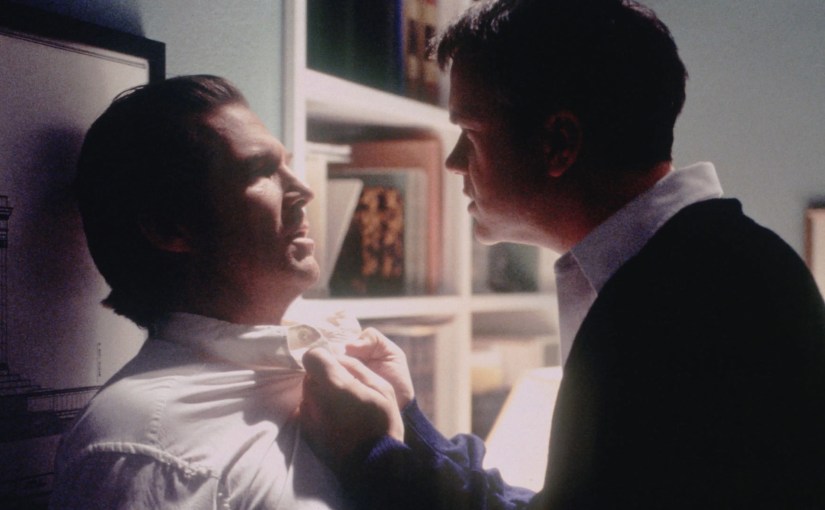
Oliver’s backstory seems inconsistent with what Michael observes.  Soon, the professor’s hysteria becomes increasingly amplified.  As wholesome as Oliver and Cheryl are with big, toothy grins and neighborly charm, could they actually be plotting for an act of violence to occur?  As Michael becomes more skeptical around them, Grant, Brooke, plus his wife’s former FBI partner, seem all the more dismissive.  Whatever Michael is beginning to believe is nowhere near as apparent as his own expressive paranoia with big outbursts and unkempt appearances.  Jeff Bridges delivers a manic performance that leaves you breathless and uncomfortable.  He’s so focused on how unhinged this guy is even when he’s just trying to move on with a new normal as a surviving spouse and parent.

One of the many strengths of Arlington Road is reliant upon its ongoing build.  More is learned with each passing scene.  When you feel like you’ve grasped everything, new material presents itself and the actual truths may be more disturbing than what’s already been revealed.  

Joan Cusack is freaky frightening.  She performs to the camera with wool over the viewers’ eyes and she says so much by doing so little.  Before you die, the last thing you want to see is a Joan Cusack with a crooked, unwelcome grin. I salute the simple costuming of Tim Robbins character.  He dresses like Mr. Rogers with a lanky, thin build covered by earth tone sweaters and khakis.  He’s so plain and corny that its terribly awkward. These friendly neighbors hide in plain sight.  

On a first view, Arlington Road may feel like a paint by numbers formula with a few jump scares as the hero sneaks around for clues along with a high stakes chase through Washington DC.  However, I encourage anyone to watch Mark Pellington’s thriller more than once.  The first time you are focused on Bridges, Robbins and Cusack.  The second time you are likely to find what explains the conveniences of the characters and the story.  Then you realize that Pellington and screenwriter Ehren Krueger have done thorough research into what realistically upholds the actions of these characters and situations.

Arlington Road only suffers from a terrible and misleading title.  It’s simply unattractive.  However, the film is compelling and authentically conceived long before a dark trend of American terrorism and mass violence dominated social media and evening newscasts.  It’s a mixed compliment to suggest that the cast and filmmakers got so much right with a topical story that was not yet so commonplace.  

This is an absolutely engaging thriller that I only wish was more fictional and exaggerated than it actually is.

KLUTE

By Marc S. Sanders

Perhaps Klute, directed by Alan J Pakula, was one of the earliest erotic thrillers to hit the cinema.  In 1971, with Jane Fonda portraying a call girl who briefly goes topless on screen, the daringness of the picture likely garnered a lot of attention.  I bet it was perceived as controversial and elevated the common murder mystery to a grittier more forthright and sleazier height.  Even John Klute, the investigator, played by Donald Sutherland, did not possess the theatrical disposition of a Sam Spade like Bogart or even a Jake Gittes that was just a few years away.  The case at hand in Klute felt real and disturbing.  The actions of the characters were unmentionable and unfathomable.

A highly respected married man named Tom Grunerman turns up missing.  The most unusual clue into his disappearance are letters found in his desk that were written to a New York City prostitute named Bree Daniels (Jane Fonda).  According to his wife and the CEO of his company, the letters seem out of character for a man like Tom.  Six months go by and there is still no sign of the man.  So, John Klute voluntarily goes to New York to investigate for himself while becoming acquainted with Bree.  

Bree is a very high-priced call girl who estimates she does between five hundred and six hundred calls each year.  She’s trying her best to step away from this lifestyle and work as a professional actress and model.  Yet, to uphold her means of living and to make up for the various rejects at auditions, she can’t help but return to what she’s best at.  Occasional visits to a therapist help her justify why she maintains this seedy occupation.  Various recordings of Bree’s observations and conversations with her Johns are about her regard for the profession. She claims that she is capable of catering to any particular vice a man might have. Most impressive is that she does not get turned on by the trysts she shares with these men. She also does not cast much judgment on whatever niche her various clients are into.  She’s positively cold to the demands of her job. Tom does not sound familiar to her, but he might have been the guy who beat her up a year earlier.  

I like the slow burn wait of this story.  A picture like Sea Of Love with Al Pacino works this way.  That’s a better movie though.

Donald Sutherland has significantly less dialogue than Jane Fonda.  He’s got a disturbing expression with large eyes and closed lips, not to mention a tall stature, that allows him to seem alert as an observer and a listener, particularly to Fonda’s character who is protective of herself even if she has much to say.  So, while the two get to know one another with Bree offering some possible leads for Klute to follow, there is an eerie and deliberately meandering pace to the story.  I knew I had to keep up my patience with Klute because an unexpected payoff would eventually arrive.

What bothered me though is that the twist of the mystery is revealed midway through the movie.  You brought me my steak before I had time to finish my salad.  Now, for the rest of the story I’m smarter than the characters and I’m only watching everything unfold. That left me feeling unchallenged through the whole second half of the film. Klute became boring and less inviting.

In 1971, this was a bold kind of picture though, not a common 1990’s erotic thriller like Basic Instinct or Color of Night.  It was seedy, unheard of and therefore fascinating.  At the time, the intrigue for a picture like this must have been off the charts.  Pakula even shows off how novel a tiny tape recorder was in 1971. Imagine what this recorder is capable of!

Had Klute been released today, I’m certain many would take issue with its final edit of story development.  I would also argue that a young Jane Fonda would never be accepted in a role like this.  Frankly, twelve years after this film, Jamie Lee Curtis was more convincing to me as a call girl in Trading Places.  Fonda’s inflection and voice of maturity just did not work for me in this role.  I did not find her alluring in the part, and I think she was too organized and educated to be Bree the call girl.  I was surprised to read afterwards that Jane Fonda won the Oscar for Best Actress for this film because I considered her miscast. Fonda’s voice always sounded overly patronizing to me.  I read later that the actress’s moments with the therapist were primarily improvised by Fonda, shot after the bulk of the picture was completed. Pakula honored her wish to shoot the therapist scenes later because Fonda wanted to have more of a grasp on this call girl character. The therapist scenes definitely look unpolished, particularly for the woman portraying Bree’s counselor. I could detect the improv going on before I knew that it was so. I was watching Jane Fonda, the actress, making a case for the research she collected to prepare for this role.  I wasn’t convinced Jane Fonda was playing the role, though.

The film provides moments where Bree is catering to a couple of clients.  Pakula is honest with his staging.  One client breathes heavily with nervousness about the trouble he’s about to indulge in and then there is the awkward business agreement between Bree and the man followed by the necessary construction of turning the hotel sofa into a bed. It’s weird and unromantic. All this business interrupting this guy’s ultimate fantasy. Very good direction by Alan J Pakula.

Another client hires Bree to pose like a woman from a pre-World War I era where she simply narrates a scenic moment from his past. He does not touch her. He does not undress. This old man from the city’s fabric district simply takes it all in, allowing Bree to do the heavy lifting while he remains stoic in his chair surrounded by the darkness provided by famed cinematographer Gordon Willis (The Godfather).  Still, Fonda seems out of place in these episodes.  Even her fear of a possible killer on her trail left me unsatisfied.  This woman always looks like she has it altogether. She arrives on John Klute’s doorstep in the middle of the night because she’s apparently haunted by what he’s pursuing and also, she’s getting prank calls at odd hours. Nevertheless, I’m still not convinced that Jane Fonda as Bree the call girl is truly shaken by any of this. Jane Fonda is just too put together and hardly evokes any convincing weakness.  

It is ironic the film is named after Sutherland’s character, Klute.  The story begins with his perspective.  I liked his detective.  Almost like the guy could’ve branched off into other stories, like Sherlock Holmes or Sam Spade or Mike Hammer.  The fact that the picture is called Klute leaves me wondering if a series of mysteries would have been paved for this character.  To my knowledge, I do not believe that ever came to be.  I’m sorry the trajectory of the movie veers off into Fonda’s character primarily when she enters the story.  Little is revealed about John Klute.  I only know his experience as a detective is limited, and he’s actually never visited New York City before.  Some interesting challenges for this guy, but none of this hardly becomes obstacles or factors for the rest of the film.  Much is learned about Bree Daniels, but hardly anything is absorbed about the title character, John Klute.

Klute starts off with a lot of promise.  I was excited to tag along with a new kind of brooding investigator who is impervious to influence and looks like he could not get easily overwhelmed. The mystery to uncover why a man went missing but not murdered is very intriguing.  My curiosity was there from the start.  Unfortunately, my interest dwindled as the picture carried on.  Jane Fonda talks a lot with not much to say and when the real culprit is unmasked at the midway point, my attention span is no longer demanded by the film.

Klute was likely a risky, pioneering kind of picture at the time of its release.  A sexy thriller.  Nowadays, it’s like any Saturday night midnight kill thrill of the week where the tempos are foreseen several minutes before they come to life.  Klute just loses its lust–ahem–sorry luster.

NOTORIOUS

By Marc S. Sanders

In 1946, Alicia Huberman (Ingrid Bergman) is numbing the shame of her father being convicted for treason by drinking herself silly at a party she’s hosting.  We see the back of the head of a nameless guest, eventually revealed to be a man named Devlin (Cary Grant).  Once Alicia is sobered up, she awakens to the handsome image of this man entering her room with her point of view turning like a clock in a hundred- and eighty-degree direction.  This mysterious fellow is about to escort her into a dizzying labyrinth that will test the limits of her loyalty to him and the patriotism she has for her country.

Devlin is an American agent who has been assigned to recruit Alicia as an insider to an associate of her father’s.  His name is Alexander Sebastian (Claude Rains) and he’s likely a Nazi stooge with a deadly plot ready to set in motion.  Alicia is tasked with reacquainting herself with Alex and uncovering who he is working with and what they all have in mind.  Devlin will check in with her on occasion.

Complications ensue however because just before Alicia begins her mission in Rio De Janerio, she has fallen in love with Mr. Devlin.  Normally, I would not be able to buy into the quick whirlwind romance of Alicia and Devlin.  I never liked it when Sydney Pollack would wedge a love story into his thrillers (Absence Of Malice, Three Days Of The Condor).  However, this is Ingrid Bergman and Cary Grant we are talking about here, and they are being directed by Alfred Hitchcock in the classic film, Notorious.  The famous three-minute kiss in the picture seals the argument.  

Standard film practice of the time would not permit a kiss lasting longer than three seconds.  The actors though expand on this romantic moment with inserted dialogue, none of which is altogether memorable, and focus on a prepared chicken dinner to have on the balcony overlooking the coastline.  This scene occurs early in the film just after the exposition of Alicia and Devlin’s assignment is established.  I still don’t know either of character very well.  So why do I care about them?  Well, it’s how Hitchcock films the script by Ben Hecht.  There’s disturbing shadows and ominous mystery to the world that Alicia is seduced into entering after her drunken binge has ended.  As well, Devlin is warned that he will have to keep his distance from her so as not to alarm Alex or any of his Nazi associates.  Now, I’m genuinely nervous for Alicia’s safety.

Once Alicia is ingrained in Alex’ world, a new romance arrives, and she willingly marries the German aristocrat to uphold her ruse while making efforts to uncover the Nazis’ plot.  Devlin enters and exits her life to collect whatever information and access Alicia can supply.

As Notorious played out for me, sadly the first thing that came to mind was that Tom Cruise’s second Mission: Impossible film is nearly a scene for scene remake of Hitchcock’s classic, minus the over-the-top stunts and rock climbing.  Yet even before that thought popped into my head, I thought this is a film that could be remade into a wonderful modern update, but only in the hands of select filmmakers like Martin Scorsese or Christopher Nolan.  Keep the guns and blood and car chases out of it though.  Notorious succeeds without a single punch, gunshot, curse word, or ball of fire.  It’s the characters and Hitchcock’s use of brooding light, mood and shadows that maintain the suspense.  Select props and costume wear are scarier than Godzilla or The Birds.

Nearly twenty years before he made Psycho, the director was terrifying audiences with a maternal element already.  Madam Sebastian (Leopoldine Konstantin) is such an intimidating force within the castle like estate she shares with her son Alex, who easily falls in love with the beautiful Alicia.  The Madam is upholds a watchful eye on all activity. Bergman’s fear of this foreboding mother is just one of the dynamics she brings to her portrayal.  

Suspense is what Hitch relies on.  Sometimes I felt like I could not trust Mr. Devlin.  The name Devlin bears a sinister reminder of a beast within its spelling. Cary Grant is at first aloof with how Devlin regards Alicia’s potential for self-harm.  Hitchcock eerily introduces Cary Grant in the picture.  First, by only shooting him behind his head, not revealing his face. A little later, I felt reluctant to trust his upside-down appearance as Alicia awakens from her drunken stupor.  Thereafter, he will take a measured risk with Alicia riding horseback and never attempt to rescue her.  He leaves it to someone else to save her. He’s a tricky sort of fellow.

Conversely, Claude Rains as Alex, the supposed Nazi, is utterly charming and attentive towards Alicia.  Despite what he might be involved with, he’s ready to begin a newly loving and glamorous life with her.  I trust Alex.  He maintains a genuine affection for Alicia and it’s hard to presume he is anything else, especially of the sinister sort.

Ingrid Bergman is captivating as soon as she appears on screen, exiting her father’s courtroom sentence.  In fact, she resembles her most famous portrayal as Elsa from Casablanca that easily can be part of this cinematic universe.  With Claude Rains on screen with her again, could this have been a sequel of sorts?  I have much more experience with Meryl Streep’s career and therefore Bergman gives me a lot to reminisce about Streep both when she’s a strong and confident person or a fearful subject.  Either way, the bravery of the character upholds.

There are eye opening camera tactics of Hitchcock working here.  I’m amazed at a zoom in that lowers its focus from a great height at Alex’ mansion down to the grand foyer below where Alicia stands with a vital prop key hidden in her fist.  Amidst all of the traffic of an evening party, this tiny key is what’s most important.  A teacup is given greater scale to enhance a monstrous threat of what’s inside the drink.  A wine bottle suddenly becomes a mystery.  Some elderly, petite men dressed in perfectly tailored tuxedos spell a likely outcome of doom.  The darkness of rooms shot in black and white feels inescapable.  The absolute final shot of the picture is unforgettable.

For years, the adventurers of North By Northwest with Cary Grant in his beautifully fitted blue suit held the crown as my favorite Alfred Hitchcock picture.  That title has now been surrendered to Notorious.  It is signature Hitchcock with twists in character, reasons for mistrust, a MacGuffin (that item that drives the story, yet bears hardly any importance), motherly instincts of fear, obscure camera angles, shadows and dim light which is particularly chilling when shot in black and white.  All of these elements add up to the director’s expert craft at suspense.  

Notorious is a hundred percent perfect example of why Alfred Hitchcock remains celebrated as one of the best directors to ever film a motion picture.  

NOTE:  I am surprised that neither IMDb trivia, nor Roger Ebert in his Great Movie review, ever acknowledged that the story of Notorious begins on April 20, also known as Adolf Hitler’s birthday. A curious date for a spy thriller centered around Nazi espionage.

NOTE: I want to also draw attention to a move that Cary Grant does in the film.  Following Alicia’s drunken party, several guests are passed out on the sofa.  Devlin finishes a drink and rests the glass on the upper torso of a passed-out woman where it balances perfectly.  We may be going after dangerous Nazis, but Grant and Hitchcock still found opportunities to make audiences smirk at their mischief.

WALL STREET

By Marc S. Sanders

Oliver Stone is a very good director at providing the evidence of cynicism within the worlds he films.  JFK covered a clandestine, conspiring environment oozing out of the columns of government.  Platoon not only depicted the horrors of war, but also the cancer that poisons the mentality of soldiers expected to protect one another.  Wall Street explores the temptations to cheat the stock market for grand prizes in wealth.  Gordon Gekko is the 1980s tycoon who never knows the meaning of enough.

The well-dressed yuppie lizard, Gordon Gekko, is memorably played by Michael Douglas in his only Oscar winning role; regarded as one of the most villainous characters of the last fifty years.  It’s not a modest part, and Douglas’ performance is therefore electrifying.  With slicked back hair, the signature crackle of a voice inherited by his father Kirk, and the newest 80s innovation, a brick size cellular phone, the power to earn money and crush corporate enemies is done with ease.  Gekko relies on obtaining inside information (a federal crime) to find the next chest of treasures.  It might be an illegal practice but the best of the best at making mountains of money do it, and if you keep your process on the down low, nobody will catch wind of what you’re up to.  Gordon Gekko is an absolute genius, and he’s awarded a script of fast talking, slick monologues that justify his sins.

Bud Fox (Charlie Sheen) is the kid on the ground, way below Gordon’s high-rise office, desperately trying to get five minutes with the guy.  A whole day’s wait in the lobby and a birthday gift of Cuban cigars does the trick.  Now the lizard has the fox ensnared in his money-making schemes of deception and pursuits for unlimited greed.

Oliver Stone writes Sheen’s character as virginal when it comes to stock trading.  The kid is dying to get laid with the big boys while getting away from the cold calling hang ups of promising uncertain futures in stocks and bonds.  A subtle and effective angle is to give Bud a mentor.  Hal Holbrook enters the screen from left or right on many occasions to put his hand on Bud’s shoulder and give him his own twist of Confucius philosophy.  Then he exits out of frame towards the opposite direction he enters, leaving Bud to follow the questionable paths that Gordon paves.  Holbrook’s contribution to Wall Street has never been celebrated enough over the years.

Michael Douglas and Charlie Sheen are an outstanding pair of devilish mentorship against innocence lost.  Gekko preaches his passion for wealth on top of more wealth and why nothing should stand in his way, especially the law or the cost of others’ livelihoods.  Bud Fox emulates him as a master of the universe.  Charlie Sheen is great at being the biggest fan in Michael Douglas’ concerts of monologues. Watch how Sheen listens when Douglas has the floor. 

Martin Sheen extends his paternal role to Charlie within Stone’s film.  As Gordon sets designs on taking stock ownership of the small airline company that the father works for, the father/son relationship is tested, and Bud becomes blurred between what is right and wrong.  The Sheens have good debates and heightened dramatic moments.  I wish they were given more to do together though.  Perhaps even showing the wedge of the mother role within this family.

Additionally, Oliver Stone writes dynamics for Bud in a worker relationship with a fellow trader colleague (John C McGinley). There’s a former college pal/now lawyer (James Spader) that Bud tries to squeeze at the behest of Gordon’s demands.  Bud is also covered doing his own tricks of the trade such as dressing as a janitor to dig for what’s forbidden.

Why bring up all of these storylines?  Well, there’s a wealth of great material in Wall Street that’s relevant to the practice of insider trading and corporate overhaul.  Somehow though, Oliver Stone is responsible for writing one of the most unnecessary characters in film history.

Daryl Hannah just had to be cast as the buxom blond love interest for Bud Fox.  She’s never believable as a New York City interior designer and the chemistry between Hannah and Sheen is as thin as water.  Her name is Darien (a 1980s name) and one scene between Michael Douglas and her bustling the streets of Manhattan goes nowhere.  Wall Street is simply not the superb film it could have been because of the amount of time devoted to Daryl Hannah’s character.  Every moment she occupies is cutting room floor material.  When Darien exits the picture she’s never mentioned again.  The history she has with Gordon is never revealed to Bud.  Regrettably, it’s all meaningless.

What’s frustrating with Wall Street is its promise is never fully committed.  The roles awarded to Spader, McGinley, Holbrook and even Saul Rubinek in an early role as Gordon’s nerdy lawyer could have been even more fleshed out in lieu of what is covered with Daryl Hannah’s part.  More moments with Martin and Charlie Sheen would have better served the film.  A competitor tycoon played by Terence Stamp is very interesting and worthy of a larger presence.  Sadly, I imagine a studio producer or even Stone insisted on having a love interest that serves no purpose here except to put a glamorous actress above the title in the credits.  

Nonetheless, Oliver Stone built an authenticity to the hysteria of stock trading and corporate underhandedness.  When he shoots the scenes occupied by Bud and Gordon, he does handheld shaky camera work to emulate that nothing feels sturdy and balanced.  In moments that Bud’s father is at the center, the director shoots with a locked in position, bearing the character’s assured apprehension to trust his son or this prophet of greed.

I especially like the scene where Michael Douglas delivers his famous “Greed…is good!” speech at a shareholders’ annual meeting.  Stone glosses over all the company vice presidents and officers as well as the fat cat suits who carry stakes in the company.  Yet, the filmmaker also takes the time to show that little old lady with the pocketbook who finds her entitled seat to see how the value of her small ownership share is being treated.  Remember, if you own stock like Disney or IBM, you get that invitation in the mail to attend these meetings, and you have just as much a right to attend as all the Gordon Gekkos of the world.

Wall Street serves an important reflection of 1980s capitalism, while taking place in 1985, two years ahead of the infamous market crash of 1987 (the year the film was released).  Guys like Bud Fox had the Charlie Sheen image. Boyish men who got rich quick with little imagination to create and build.  They stood next to tall wealth and learned, but they never gained the knowledge to prepare for quick falls and disheartening sacrifice.  Most importantly, they took their own sense of morale for granted.  These are the best parts of Wall Street.

SUPERMAN (2025)

By Marc S. Sanders

Once again the man in blue, red and yellow has returned to the big screen by means of director James Gunn who is intent on starting a whole new universe of DC comics characters.  The 2025 interpretation of Superman is zippy and fun even if it is a little too shallow of character development and dimension.  That’s regrettably ironic actually.  A man who dons two different personalities, Superman and mild-mannered reporter Clark Kent. Yet, neither has much to say or stand for in this two hour picture.

Gunn’s film is defiant to avoid any heavy exposition as this film begins.  There’s a slim foreword as the picture begins to describe this new universe that contains metahumans who arrived on Earth centuries ago, along with a little bit of Kal-el’s origin that many of us are familiar with.  Then we see the Man Of Steel crater into the Antarctic wounded from battle and aided by his feisty canine friend, Krypto, who drags him to his ice palace, the Fortress of Solitude.

Action commences thereafter back in Metropolis.  Lex Luthor (Nicholas Hoult) is pulling the puppet strings.  Lois Lane (Rachel Brosnahan) and the rest of the Daily Planet staff witness the mayhem over the city.

Then we get a bit of Clark looking a little goofy as he rushes into work, followed by some romantic interlude between Clark and Lois back at her apartment.  The two toe the line of their relationship when finally, the Superman persona allows his girlfriend to test his purpose for serving planet Earth along with his limits of authority and decisive action.  They go back and forth but none of the dialogue lands and the argument has no impact.  A missed opportunity to set up the Lois and Clark relationship.

The rest of the picture focuses on comic book episodes of endangering Superman while other metahumans make appearances – an obnoxious Green Lantern (Nathan Fillion), Hawkgirl, the shape shifting Metamorpho, and the surprisingly entertaining Mr. Terrific (Edi Gathegi) who seems to operate like Mr. Spock from Star Trek.  Of the four, the guy with the dumbest name actually serves the picture the best.

James Gunn’s film takes a huge departure from the recent films of Zach Snyder’s universe.  Nothing is dark and hardly anything is morose.  Some subplots seem to be ripped from the headlines of current events that’ll have you thinking about the Russian-Ukraine war.  None of it is overly heavy though because this picture is designed for families to watch together. 

Superman is pure escape with a red cape.

What I miss though is what both the Snyder and the Christopher Reeve pictures offered.  What does Superman mean to himself and the planet Earth?  The one conversation between Lois and Clark/Superman goes on long and while it feels like there is a purpose in that exchange, I cannot recall one kind of conclusion that stemmed from it.  For the rest of the film, Lois flies a spaceship and helps a weakened Superman find aid. When the two share any more scenes together it is for the action of the piece followed by a kissing scene.  I just didn’t respond to the puppy love or risks of their relationship that other iterations offered.  Their connection is just written a little too thin.  That’s a problem, because the Superman mythos always hinged on their relationship in the face of danger or true love or even journalistic integrity.

Am I being too serious and hardheaded?  Yes.  Nevertheless, even with a comic book/Saturday morning cartoon gloss, I wanted to see more weight to the relationship between the two characters.

The best attraction is Nicholas Hoult as a connivingly evil Lex Luthor.  He’s a raging madman bent on destroying Superman like everyone knows and the actor chews the scenery while primarily hiding in his glass headquartered command center for most of the film.  Anytime the movie diverts to Luthor, the picture just felt more alive.  This is a great Lex Luthor!!!!!!

Like he did with a smart aleck racoon in his other films, James Gunn introduces a toy line merchandise with the flying white terrier dog known as Krypto.  His intent is for audiences to cheer for him like other precocious creatures from past films such as any Disney movie or E.T. or Baby Yoda or Rocket Raccoon.  He’s cute and spirited.  When he’s in danger, the kids will be worried.  When he flies into the center of the screen with a bark or a yelp, everyone will applaud. 

David Corenswet is Superman.  He’s fine.  He definitely looks like the part.  He’s a happy go lucky Kryptonian.  He’ll never be as memorable as Christopher Reeve.  I also have more to appreciate in Henry Cavill’s performance.  I just didn’t see Corenswet do enough with this role.  I’ve yet to really see the dramatic chops he could offer.  Simply lying on the floor of a cell while falling ill to Krytonite is not urgent or frightening enough.  I hardly got to know this guy to care enough if he lives or dies.  I hope he’ll blossom some more within future installments of Gunn’s superhero universe.  That’s up to the writers though.  David Corenswet is pleasingly relaxed in a role that demands almost a hundred years of acceptance for a modern age.  I’m confident he can do it and that Gunn cast the right guy for the part.  While he’s acceptable, both Corenswet and Brosnahan would best be served better material for them to work together. 

As for Rachel Brosnahan, I guess she’s okay.  I don’t see her do much beside fly a spaceship.  Lois Lane is such an immense character of brains and gusto striving to always be the number one reporter.  Her only weakness is her love for Superman.  There’s not much I remember about her from this film.  I did notice that she primarily wears purple like the character did in 1990’s animated series.  Nice salute.  Come on James Gunn.  Rachel Brosnahan is good actress.  Give her something more to do.  Let her act a little.  (Let David Corenswet act a little too.)

It’s wonderful that an optimistic interpretation of Superman has arrived.  We need it.  It’s colorful and fun.  It could be more exciting, though, with higher stakes that just didn’t arrive quite right.  This film is not my ideal picture of the hero, but the universe to come, especially with a quick appearance from another character at the conclusion, offers promise. 

Despite my reservations, the new DC Cinematic Universe seems to be in the right hands once again, and James Gunn’s team will deliver something entertaining for the next few years to come.

JAWS 2

By Marc S. Sanders

The last movie, the masterpiece of masterpieces, told us that a great white shark is rare for the kinds of waters that surround the New England area of Amity Island.  Well, Jaws 2 disproves that fictional theory as Chief Martin Brody (Roy Scheider) ascertains that another man eater has arrived with a large appetite for chomping on swimmers, scuba divers and water skiers.  It’s ridiculous but it’s an entertaining sequel with a supporting cast of young actors ready to effectively tremble and scream while trying to survive the clutches of a hungry great white.  

Things appear tranquil yet prosperous for Amity.  A developer has completed a large Holiday Inn hotel that will magnify tourism profitability.  To Martin’s chagrin, his wife Ellen (Lorraine Gary) works for this guy.  Mayor Vaughn (Murray Hamilton) somehow got reelected following that terrifying Fourth of July weekend from a few years ago.  (Well…his kids were on that beach too.) Chief Brody’s biggest concern though is his oldest son Michael’s penchant to laze around sailing with his friends for the summer when he should be getting a job.  Michael just wants to score with the new girl in town.

All is well until an abandoned boat is discovered off shore with an underwater camera dropped on the ocean floor, near Captain Quint’s shipwrecked Orca.  Thereafter, is an explosive water skiing accident.  The most hideous eyesore must be the beached, partly devoured corpse of a humongous killer whale.  The bite sizes are enormous.  Chief Brody is getting terribly suspicious, but once again his intuition is being disregarded until the truth reveals its blood in the waters. 

Jaws 2 is effective suspense.  The teens are straight out of familiar slasher movies, but this film actually released ahead of Halloween and Friday The 13th fare.  Director Jeannot Szwarc captures good close ups of the whole cast and magnificent pace with a speeding fin that slices through the ocean surface.  These kids are mostly nameless but the director gives them good moments to put their greatest fears on.  When the sailboats capsize and the kids topple into the water, there’s a nervous tension all the way to the end of the picture.

It’s no secret that Scheider hated making this movie.  Universal contractually beheld him to it after he dropped out of Michael Cimino’s The Deer Hunter.  Nonetheless, I like the direction the character takes with returning script writer Carl Gottlieb.  Brody’s job is in jeopardy and maybe his marriage, along with the paternal strife he gets in the way of his eldest boy.  Roy Scheider does fine with the material.  Perhaps his personal frustrations lent to the performance.

What doesn’t work is Bruce II – the shark.  To this day I’m still stricken with fear of the shark from Spielberg’s film, even after we finally get to see it.  It truly is a scary monster.  In Jaws 2 however, the animal looks like something you buy at a beach novelty store for your grandson to play with in a kiddie pool.  The texture of the shark never feels authentic particularly after it survives a fire.  I am not fond of how it swims or raises its head above water.  Even when a helicopter gets in its crosshairs, the shark looks small and literally mechanical, never seeming strong or powerful enough to kill, maim and destroy. The magic trick just appears entirely too transparent.  Fortunately, I bought into how this town’s worst fears eventually come true again.  The perception of Brody and the kids is the mightiest strength of the film.

A brief mention is given to Matt Hooper (famously played by Richard Dreyfus in the first picture).  That always left me curious with why Universal did not pursue a sequel based on his character instead of Brody.  It’s hard to swallow that another monster shark is terrorizing Amity again.  Wouldn’t it have more plausibility for the actual shark specialist to pursue another brutally unforgiving Carcharodon Carcharias elsewhere in the world?  I think a story moving in this direction could have opened a lot fresher possibility.

Regardless, Jaws 2 is a fun summertime escape with one of the most familiar taglines in cinematic history: “Just when thought it was safe to go back in the water.”

Only watch Jaws 3 & The Revenge when you’re ready to get your itch for a Mystery Science Theater 3000 kick to commiserate with some friends on a Saturday night.  Save Jaws 2 for when you want more shark chum after having watched the classic original for the five thousandth time.    

F1

By Marc S. Sanders

Miguel and I are the two unpaid movie critics who find ways to entertain ourselves beyond the IMAX picture on the screen.  By now, I know when Nicole Kidman is arriving and I start her off by saying out loud “We come to this place…”. Mig turns his head down in sarcastic annoyance.  We applaud at the return of Jaws in theaters this August.  There’s a rhythm we chemically thrive on.

Thirty minutes after a series of trailers plus an unwanted Allstate commercial (Thanks a lot AMC), the film begins, and the personal hand gestures begin.  Excuse me a moment.  I must pause for a moment.  (a-hem!) 

GET YOUR MINDS OUT OF THE GUTTERS!!!  

Now, where were we?  

Oh yes…

During the running time of Brad Pitt’s racing movie, F1, there were animated fist pumps (“Yeah!  Alright!!”).  There was rhythmic poking in and out of my right index finger jamming into my left thumb and forefinger (“Brad is about to get it on with Kate, the staple romantic interest, played by Kerrie Condon”).  A palm up facing twirl of the wrist (“Of course.” “Naturally!”). There’s the muted gasp pat on Miguel’s arm (“Is it?” “Could it be?” “Don’t tell me!” “Brad is fully recovered and walking through the steam cloud to pilot his race car?” “Again?”  “For one last time?”).  F1 covers all the expected beats.  

Frankly, I am not aware of too many racing films.  Days Of Thunder with Tom Cruise, of course.  Ron Howard did an engaging piece called Rush.  Ford Vs Ferrari works better as a bio than just a racing movie.  Pixar has its series of cute films. Still, just like the new Jurassic World picture, and I’m sure the latest Superman iteration arriving later this week, F1 is all too familiar like any kind of sports movie or Top Gun on the track Jerry Bruckheimer pic.

Tom Cruise—I mean Brad Pitt—is legendary stock car racer Sonny Hayes, a middle aged, washed up and broke recovering gambler desperately invited by his friend and former teammate Gabriel (Javier Bardem) to rescue his racing team from going belly up and leaving him hundreds of millions of dollars in debt.  Gabriel already has a cocky, promising driver named Joshua enlisted. He is performed very well with a lot of appeal by Damson Idris.  However, the young man does not have focus yet and lives for his social media likes and attention.  It’s up to Sonny to make the Formula One racing squad look like a contender while reigning in Joshua who can’t let go of personal conceit and a jealous animosity.

Kerry Condon is the engineering designer of Sonny and Joshua’s racing vehicles.  With each race, Kate trouble shoots what needs improvement and what can advance the drivers’ rankings.  Too bad she can’t fully invest her expertise as F1 demands she flirts with Sonny.  (Cue my right index finger while Miguel is ready to brush it away.)

The most impressive moments from Joseph Kosinski’s (Top Gun: Maverick) film are the racing scenes.  You are seeing both Pitt and Idris tucked within the snug cockpits of these low to the ground speedster machines.  The editing is superbly matched with the roaring sound and a pulsing soundtrack from another Hans Zimmer masterpiece.  

My one issue is the final cuts of the various races lacked overhead shots.  I would have liked to have seen moments from above where I could follow when the race cars pull in and out of a pit stop for example and stay on pace with unnamed competitors.  Kosinski gives an overabundance of close-up shots of the actors in the cars but not as much outside of the vehicles.  It’s all very exciting though, and when a film opens with revving engines playing in tandem with Led Zeppelin’s Whole Lotta Love, well you have me hooked.

F1 is like another exciting amusement park ride that you’ve experienced a hundred times before.  In between the races, while there are well drawn characters played by good actors, there’s ho hum filling material that keeps this speedy ride going about a half hour to forty-five minutes too long.  The guys have to argue.  They have to lose the race.  They each have to crash their cars.  They have to be tricked into getting along.  There also has to be a traitor among the ranks.  There has to be sequences of music overplaying a series of different races and the voiceover commentators chiming in with standard fare like “…and here comes Sonny Hayes from behind…” As well, Pitt and Condon have to get it on.  She has to tell him she doesn’t get romantically involved with racers before they hump each other’s brains out (Cue the index finger!).  

Sonny also has to be told he’s finished, before emerging from that humid, sunlit steam cloud where Joshua and the pit crew slowly raise their sunglasses and drop their jaws, upon his return. (Cue the muted gasp, followed by my twentieth fist pump.)

Look, F1 is entertaining.  It’s well made.  It’s got great action with impressive direction and an enthusiastic cast.  Still, I’m tired of this more of the same.  I alluded to my same feelings yesterday with Jurassic World: Rebirth.  It’s all the same flavor and these iterations are not daring enough to take big risks or surprises with what they offer.  Consider Avengers: Infinity War and Endgame.  Those films were expected to play by the same beats and yet there were some shocks to come through.  Look at what happened with The Empire Strikes Back.  Anyone see those surprises when first encountered?  The stakes were always surprisingly high, and the heroes were getting personally affected, not just episodically, but permanently.  

Blockbusters need not be so cookie cutter all of the time, but that’s exactly what is happening.  I already know the outcome of the upcoming Fantastic Four movie.  It could not be more apparent and unimaginative.  

I watched Companion which just hit HBO MAX earlier this month and in ninety minutes, that bloody delicious film diverts in so many different directions with a bare minimum setting and a small cast.  It’s as bloody as most thriller movies we’ve seen but an applied script turns on its axis over and over again.

On an IMAX screen, F1 especially delivers. Yet, while I’m absorbing well staged cuts of movie made racing footage, my mind is turning into comatose mush and the only thing that keeps it electrified is to acknowledge the standard beats.  

Declaring “Gentlemen, START YOUR ENGINES!” will not hold my attention for 200 laps.

Do it with me now:

Fist pump!

Finger fuck!

Muted gasp!

The Of Course!

Now you know the drill! Hit the gas!!! Turn up the volume and let Robert Plant remind you that You need coolin’/Baby I’m not foolin’

JURASSIC WORLD: REBIRTH

By Marc S. Sanders

You’ve seen this movie before.  You likely saw it when you saw the trailer.  

The Jurassic films spawned from Michael Crichton’s ingenious best-selling novel, Jurassic Park (my favorite book of all time), stampede on and on, going on thirty-two years now.  Here is the seventh installment.  Once again, reinvigorated with a new cast and a bankable headliner/former Marvel Avenger.  

All year long, just like the last five films, I’m asking myself again why any of these people are going back to these islands.  Well Rebirth lends as good an answer as any.  Somehow the DNA from three different prehistoric mutated mega beasts will lead to a cure for heart disease.

Reader, from the outset I recognized the familiar pattern.  I knew precisely who was going to survive and who was going to perish before the closing credits arrived.  I got a perfect score, by the way.  Likely, you will too and thus the suspense is very watered down in Jurassic World: Rebirth. Seven times on the merry go round, you should know by now which direction this ride is moving.

Nevertheless, I was hoping against hope that the cure for heart disease will make it for the eventual consumption of human civilization.  The vials of Dino-DNA are collected and stored in an airtight briefcase.  So, while the scant cast of people screams, runs, tip-toes, swims, climbs and falls all over this tropical island, located close to the equator, my eyes were fixated on this medical breakthrough.  

Where are your priorities people? On the kid and her toddler dinosaur friend named Delores?  Come on!!!!! There’s much more at stake here than that or Scarlett Johansson and two-time Oscar winner Mahershala Ali. 

Gareth Edwards (Rogue One: A Star Wars Story) is new director in the franchise and I wouldn’t have it any other way.  The visuals of his dinosaur adventure are marvelous if not as impressive as they used to be.  Just like David Koepp’s script shamefully admits, the world no longer cares about dinosaurs as much.  Much of Jurassic World: Rebirth feels like a retread of the same old stuff.  At best, the only inventions left to tackle is to mold new monsters that are of a Frankenstein product.  The animals look fiercer and meaner and toothier and bigger…like way, way bigger.

Edwards and Koepp put the creatures in the ocean and in nestled caverns that have not been depicted as much before.  The sequences are done well but still I felt as if I had seen this movie before.

Not much can be said about Johansson or Ali’s performances.  She’s a high priced, skilled mercenary.  He’s the charter boat captain.  The rest of the cast is just the rest of the cast which includes some ready-to-sacrifice nameless folks gifted with screams to edit within and about five or six lines (one guy is privileged to share his French fluency), a pair of teenagers, an adorable kid and the resident greedy industrialist.  You know who I’m talking about, right?

I’m amused by those who rank the Jurassic movies.  How can you decide what is best or worst anymore?  The blueprints are so identical and the Dino gobbles and Dino chases and Dino roars all blend together for me by now.  If it was a Jeopardy category to identify which movie any scene was from, I’d lose big time and wager little on the Daily Double.

Beyond the first film from Spielberg none of these films are as special to me.  Like Chinese food, I fill up and I go back for more but that’s it.

Still…

Go to the movies.  Keep the cinema alive.  See the new Jurassic World movie and have fun with this new iteration of people going to the restricted island where dinosaurs romp and play.  I enjoyed it even if I never felt overwhelmingly stimulated.  At the very least I enjoyed watching my wife clap when she learned that one character survived.  

Me? 

…and 3…2…1… of course!

SILKWOOD

By Marc S. Sanders

As the 1980s were setting its stride, Silkwood might have been one of the earliest in a line of films to focus on the union worker who fights back at the billion-dollar corporation.  Some might unfairly regard the movie as The China Syndrome, Part II. Other well-known pictures of this mold are even more familiar to me like Michael Mann’s The Insider.  However, director Mike Nichols, working with a first screenwriting effort from Nora Ephron who partnered with Alice Arlen, showcases the aggravation on not just Karen Silkwood, the real life potential whistleblower, but also her friends and co-workers in a one factory town just outside of Oklahoma City.

Karen (Meryl Streep) lives with her boyfriend Drew (Kurt Russell) and her best friend Dolly (Cher) in a run-down house in the middle of nowhere.  They ride to work together at the local plutonium manufacturing plant where they dress in scrubs and gloves. Punch in, punch out kind of days, and often they are expected to work double shifts and weekends.  Karen works an assembly line where she places her hands in rubber gloves and assembles dangerous combinations of chemicals in an enclosed box.  It’s also routine that before you leave your station you wave your hands over a sensor to ensure you have not been exposed to radiation.  There’s even sensors you walk through as you enter and leave the plant.  When those sensors go off, a calm kind of film seemingly turns into a horror movie.  The last thing anyone could ever want is to get “cooked.”

Karen does not live a perfect life.  Her three kids reside with their uncompromising father in Texas.  Money is not ideal.  Dolly is a slob and has also invited her girlfriend to live with them.  Karen can manage with all of this, but when she observes some unconventional activities around the factory she gets up the nerve to head the union for better protection and working conditions.  However, the further she goes looking at files and photos, jotting down notes of what people say and do, plus taking trips to Washington DC, and getting phone calls from attorneys at night, she becomes more and more isolated from Dolly and Drew, along with the rest of her close-knit workers.  Karen is not just risking her job, but everyone else’s jobs and worse her own life.

The attorneys lay it out to the townsfolk and the union of the horrifying statistics that go along with radiation exposure.  The tiniest fraction of a miniscule of exposure to the smallest crumb of chemicals could increase a human’s bearable limit towards radiation and cancer.  The sad irony is that the more that is learned, the more the people of this area smoke and smoke some more.  Granted, this story takes place in the early 1970s, though.    

The company is primarily represented by an intimidating Bruce McGill.  He’s great in everything he does and is worthy of an Oscar nomination somewhere.  M Emmet Walsh has no lines but his presence is enough to shake you; the slimy guy you easily recognize from every other movie you have seen.  While the company’s overbearing intrusion is shown plenty, the script for Silkwood focuses more on how these working people get by.  They are treated unfairly and in dangerous working conditions, but they also know this is the only place that offers steady income in the area.  Without this factory, the whole town would be left in dire straits.  Karen is repeatedly told or implied to leave well enough alone.

Meryl Streep notches another harrowing performance on her resume and bears such a departure from more sophisticated characters found in Sophie’s Choice and Kramer Vs Kramer.  Karen Silkwood is not educated and she bears an unmistakable white trash dialect but she’s also not stupid and the more progress she makes at exposing the plant’s shortcomings the more unfairly she is treated with department transfers and workplace shake ups that she is indirectly blamed for.  Potential threats on her life begin to build, but she only upholds a bravery.  You really observe the strength of Meryl Streep.  She’s at the top of an elite class of actresses at this time that also included Sally Field, Jessica Lange and Glenn Close.

Cher plays Dolly in her first on screen role.  The variety act performer probably subjected herself to a bigger departure than Streep.  She was not a professionally trained actress at the time.  Mike Nichols insisted on no makeup along with her hair unkept and flat, while dressed in green chino pants and baggy sweatshirts.  The new actress carries herself so well without the usual glitz that accompanies her.  Her scenes with Streep are workshops in acting technique. 

Kurt Russell delivers another understated performance.  One of the best actors out there who has never been enough of a critical darling.  Drew is likable and Kurt Russell plays him as a settled in match for Streep’s portrayal of Karen.  Watch how they tangle up in each other’s arms in bed or when he snaps at her as she carries on her crusade while he’d rather things be left alone.  His timing is perfect for the script.

Mike Nichols keeps his film calm, except when the go by the numbers narrative must be disturbed.  A radiation cleanse with high pressure hoses will make you wince.  The factory alarms will terrify you.  Meryl Streep accepts the physical taxations necessary for this setting.  Nichols gets in close with his camera to show how cleansers dressed in scrubs and masks rub Streep down until her skin is a burning red.  I distinctly remember how her right ear appears in this scene, getting flushed by something just short of a fire hose, and the aftermath of her sitting in a chair is so discomforting while a company doctor assures her that there’s not much to worry about as long she brings in her urine samples daily.  In fact, soon all of the employees are tasked with delivering their urine samples.  What kind of place is this?

While Silkwood is based on a true story with a burning question left behind, I do not want to reveal too much.  Many have seen Silkwood since it was released over forty years ago, but as the third act begins, the fallout only becomes more disturbing and Mike Nichols directs a horrifying sequence built primarily on the pealing of old wallpaper.  That’s all I want to suggest. 

Karen Silkwood was a very unlikely crusader.  She probably never envisioned what she would become and what she would fight for.  Yet, she uncovered horrible truths that should not have been occurring under the eye of billion-dollar corporate America.  After watching Silkwood, I can only imagine what else was there to turn over.

NOTE: Another good reason to watch Silkwood is to discover early performances from some amazing character actors who were either just starting their careers or continuing to hide in the crowd. 

Scavenger hunt for Anthony Heald, James Rebhorn, David Strathairn, Ron Silver, Fred Ward, Diana Scarwid, Bill Cobbs, M Emmet Walsh, Craig T Nelson, Tess Harper, Will Patton, Richard Hamilton and Josef Sommer.

NEVER SAY NEVER AGAIN

By Marc S. Sanders

If it walks like James Bond, if it talks like James Bond, it is…STOP RIGHT THERE! 

Sean Connery in Never Say Never Again is not James Bond…at least not the James Bond that I know.

Why was this movie even made?

I know.  You don’t have to tell me. 

For the most part it was a legal blessing for a gentleman named Kevin McClory, a contributing writer to the film Thunderball.  McClory sued the Ian Fleming estate for the rights to such named properties as the villainous “Ernst Stavro Blofeld” and the organization he heralds known as “SPECTRE.”  Eventually, it came to be that none of the films could use these copyrighted terms going forward.  (Hence, why Roger Moore never uttered these names in any of his films.  He just dropped a wheelchair bound bald man down a smokestack.)  Anyway, the courts allowed McClory a second chance at his Thunderball creation by granting him the blessing to remake the film with certain moments and developments that upheld the structure of the story.  So, in 1983 a competing studio to United Artists called Warner Brothers greenlit the release of this new film and banked on Sean Connery’s return to the famed secret agent.

Frankly, the backstory is a much more tantalizing adventure than this misfire.

Never Say Never Again always eluded me.  I never had a desire to see it.  I regarded it like a generic brand.  I turn to the EON productions for my James Bond fix the same way I turn to Heinz ketchup, never, ever Hunts.  What I’d heard of this film and the scant moments I saw of Connery in the picture over the years made me question how necessary this movie ever was.  It’s like that Gus Van Sant shot for shot remake of Psycho.  Why do it?  Because you can?  Is that all you need?

So, Connery opted to return for a large salary and for the only time in history two James Bond films were released in the same year, 1983, when Moore’s Octopussy also made it to the big screen.  Connery’s picture is a direct remake of Thunderball. One of SPECTRE’s top agents Maximillian Largo (Klaus Maria Brandauer) catches possession of two United States nuclear missiles and hides them in the Bahamas.   Bond is older now, reflective of Connery’s age at the time, and practically retired as he loses a bit of his step in a training simulation.  Soon, however, he is on the case and contends with a female henchman by the name of Fatima Blush (Barbara Carrera) while also womanizing Largo’s main squeeze Domino (Kim Basinger, in a very early role).  His primary gadget is an exploding fountain pen.

Other than Carera who was Golden Globe nominated for her role, I can’t say anyone is doing anything terribly wrong here.  It is simply that this reiteration seems altogether flat.  This film is certainly missing the exhilarating pace of director Irvin Kershner’s The Empire Strikes Back.  Here, James Bond the hero just seems to walk and sit and stand in and out of frame.  A lifeless tango occurs midway between Connery and Basinger as an opportunity to share some confidential information.  I don’t care if 007 is adorned in his tuxedo next to a 1980s hair sprayed Kim Basinger, the tango is boring to watch.  It is a dance that goes nowhere or builds to anything. 

Games are updated as well.  We are not in the casino watching baccarat or poker anymore.  James Bond plays video games against Largo and the only threat is a shock on the joystick when a parlay is struck.  I can’t feel the zap that is supposed to happen, and Sean Connery is hardly displaying any anguish as Klaus Maria Brandauer smirks in triumph.  So, where’s the suspense here?  Sound effects from an Atari 2600 while the hero and villain sit at a table with joysticks doesn’t send this scene into astonishment. In 1983, in the movie theatre next door, Roger Moore is undoing a cheating Louis Jordan in backgammon while the muscle headed henchman crushes the dice into dust.  That’s much more frightening. 

A midway motorcycle moment with smoke and missile gadget tricks is fun but still not as escapist as most other Bond pursuits. Maybe it’s because 007 wears a dark helmet and thus hiding his charm.  It’s a lot more fun to see Connery or Moore give a wink and nod as the chase continues.  Here there is no reaction and no response to the environment of the Bahamas.  Couldn’t a banana tree topple over or something?  Maybe some coconuts?  Could a yacht or boat capsize?

I always remember the infamous shark scene in Thunderball as Bond gets trapped in a swimming pool with a couple of great whites.  That scene is now changed to an ocean floor shipwreck setting.  For the most part this works as Bond circumvents through the wreckage trapping one shark after another.  This is one of the film’s few improvements.

The big regret is that Klaus Maria Brandauer as the main villain Largo was not served a better product. He is gleefully good.  He’s at least trying as hard as he can. He has the evil grin and short fused temper, but he’s also sophisticated among his wealth. 

He’s certainly working much harder than Sean Connery who seems to just be going through the motions and hardly exerting himself.  The actor is much too relaxed in his role here.  It looks like he memorizes his few lines minutes before the camera starts shooting.  Then he says what needs to be said.  You can subconsciously visualize Connery walking back to his trailer take after take.  There are some decent one liners, but none of his delivery soars anymore.  I think Connery was out of the role far too long since his last turn in 1971 and he just didn’t pick up where he left off.  He’s never applying himself.  His wardrobe, from the tux to a camouflage uniform, or even his swimsuits do not seem to rest well on him.  The tailoring looks off.  He’s not wearing anything as well as he used to.  Not even his hair piece, which is far too thin and uncooperatively resting on his scalp, sits well.

Kim Basinger is the blond.  Nothing more needs to be said.  Rowan Atkinson debuted on the screen with some silly escapist humor but either he’s not on long enough or he’s there too much.  The part should have just been cut altogether.

You don’t forget Barbara Carrera but that’s not necessarily a compliment.  She’s working like a dastardly cartoon from the Adam West Batman TV show and Connery is hardly responding to her screaming or antics.  Funnily enough, the screenwriter is Lorenzo Semple Jr, writer of the Batman show and Flash Gordon, from 1980.  So, while the tongue is trying to touch the cheek it’s only reaching the roof of the mouth this time.  Carrera is a headache. She acts like a misbehaved child.  Somebody loved her though for that Golden Globe nomination.  How? Why?

Another bit of buyer’s remorse is the casting of Max Von Sydow as Blofeld.  Inspired casting.  Yet, why is he given nothing to do?  This is Max Von Sydow!!!!!  He’s been hired to watch a Sony monitor with his white cat tucked into his lap, but that’s it.  Between Brandauer and Sydow, these are some heavy hitters.  Plus, Connery, and a built-in storyline.  It should have all worked but it doesn’t.

The theme song is a painful earworm.  It is performed by Lani Hall, doing a Holiday Inn barfly lounge act that will never leave your consciousness.  You can practically see that wet, shiny lipstick slobber all over the microphone while she’s wearing a blingy sparkle dress and a red, leafy boa around her neck.

Never Say Never Again is a lifeless, uninteresting, tedious and sleep-inducing picture that no one but a Mr. Kevin McClory wanted. 

Like Jeff Goldblum would say ten years later, just because you could doesn’t mean you should.