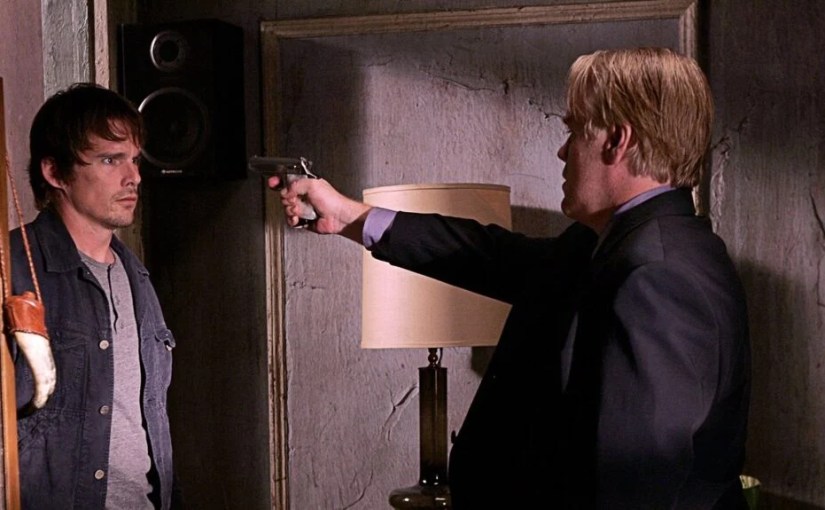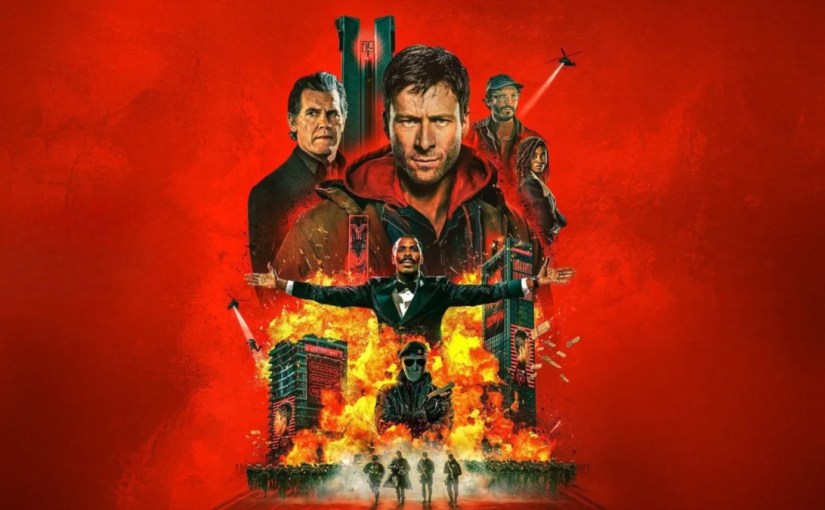
THE RUNNING MAN (2025)

By Marc S. Sanders

Everything you see in the remake of The Running Man belongs.  So why doesn’t any of it work?  I think director Edgar Wright needs to have his feet held to the fire.  He made this movie with his eyes closed and his ears muffed.

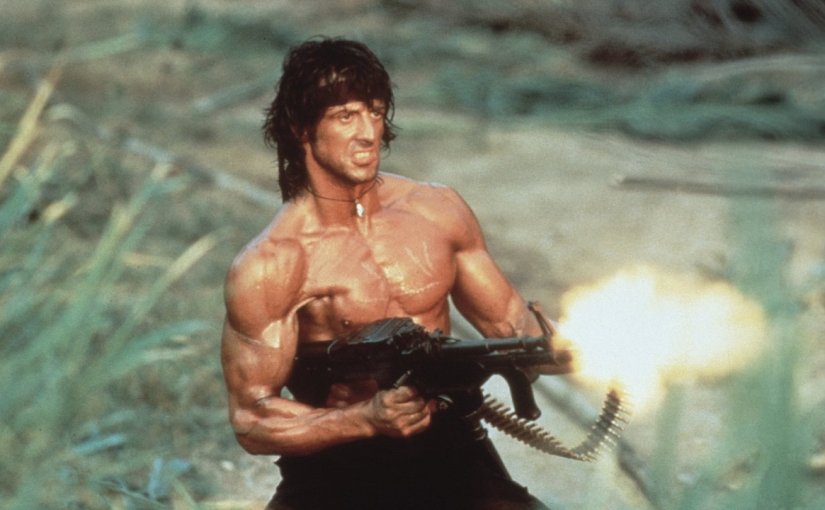
Like the Stephen King (or under his pseudonym, Richard Bachman) story and the original 1987 picture with Arnold Schwarzenegger, a violent game show called “The Running Man” occupies the airwaves in a dystopian future.  Modifications from the first film are done to separate this picture from that one.  In the last film, contestants were violent criminals on the run to win freedom from incarceration.  Here, anybody can try out to win the cash prize of a billion dollars.  I’m not sure which is more faithful to King’s novella.  

Ben Richards (a name which always gets me thinking of The Fantastic Four; Ben Grimm, Reed Richards) is played by Glen Powell with a handsome athletic build but not the muscular physique of Schwarzenegger.  Powell looks more like an Everyman who auditions for one of this future’s various twisted game shows, hoping to win cash prizes that will rescue his wife and sick baby girl from poverty.  He never intended to get thrust into the ultra-violent “Running Man” though.  The object is to outlast and survive for thirty days while sadistic headhunters attempt to find him and deliver a gruesome televised slaughter.  The producer, Dan Killian (Josh Brolin), foresees a ratings bonanza with Richards as his most wanted runner.

Glen Powell needs to enhance his career with his sudden popularity.  Between this film, Twisters and Top Gun: Maverick he is playing pick-up sticks on resurrected franchises, and he ends up being completely unmemorable and uninviting.  Other than a square chin, there’s nothing special about this guy and I never once felt empathy for his role here.  He does not convey fear or anger or humor like a Bruce Willis, a Tom Cruise or even an Arnold Schwarzenegger.  He’s boring.  Edgar Wright’s script with Michael Bacall does not help the actor either as The Running Man is neither quirky or offbeat like a dystopian action picture or a standard Edgar Wright piece (Scott Pilgrim Vs The World) should promise.

The most exciting ingredient is Coleman Domingo, one of my favorite actors working today.  He is so magnetic in anything he does that I can practically guarantee whatever pizzazz he brings as the larger-than-life game show host, Bobby T (Yes!  That’s his name!), carries no impact.  This script gives him nothing to do other than wear a purple sports jacket while belting out “WELCOME TO THE RUNNING MAN!!!”  If he was simply given all of Richard Dawson’s dialogue from the first film, Domingo could have elevated this drippy picture into something engaging and fun.

Lee Pace (The Lord Of The Rings) is fully masked until the third act and has little dialogue as he’s the hero’s main hunter.  Why waste such a charismatic actor?  He’s dressed in black with a black mask.  What’s fun about that? Josh Brolin sits behind a desk as the puppet master producer.  He plays his part like Josh Brolin on a press tour stop on The Today Show.  He’s really not acting at all.

It’s an eye-opening surprise to see Sean Hayes (Will & Grace) make an early appearance as another game show host for a different show.  This should offer magnificent promise.  Brilliant casting for an over-the-top comic performer.  I was waiting for Hayes and Domingo to get into a sparring match of egos for attention in this television world.  You know what happens, though? Sean Hayes is never seen again following his appearance ten minutes after the film begins.  Another overlooked waste of talent.

William H Macy is a good character actor for this kind of film.  Too bad he’s also given little to do other than to tell the hero to go see the guy played by Michael Cera.  Why not cut out the middle man and let Ben Richards just deal with Macy’s character? The Running Man is far from the leaner film it could have been.

Some of the action scenes in this violent tale work, and some don’t.  When Ben Richards catches up with Cera’s character, a run/hide shoot out in a two-story house plays like a video game with bannisters that come apart and rapid machine gun fire.  It’s edited quite well.  Later though, there’s a battle that occurs in the cockpit of a jumbo jet.  Gravity is disabled while gunfire and fisticuffs are at play and everything shakes and bounces so much that it’s hard to tell who gets the gun and who is shooting who.  This looks like the filmmakers were pressed against a deadline and just didn’t clean up or tighten the scene into something coherent.  I just stopped trying to focus on the film and waited for the scene to end with another escape by the dashing Ben Richards.

This screenplay feels like it was made up on the fly.  Glen Campbell is awarded several scenes to speechify melodramatic gargle.  Is there a noble cause that we are to learn about from The Running Man? Just as the third act is about to start, he hitches a ride with a young girl who we have never seen before.  Nor has she been referenced anywhere thus far.  Yet, she’s got something to say with some kind of cause on her mind as well.  This nameless sidekick takes over the movie for the next twenty minutes and then parachutes into open sky never to be seen again.  What was the point of this detour? Moreover, what the hell was she ever talking about?

This Running Man had all the ingredients to work with a stellar collection of fine actors who were up for the task of wit and satire amid ridiculous violence and totalitarianism.  With Edgar Wright at the helm, the new Running Man could have been a harkening back to Paul Verhoven’s ultra-violent tales of gonzo media silliness found in his movies like Robocop, Starship Troopers and Total Recall.

Sadly, Glen Powell is uninteresting, and the more amazing talents of the supporting cast were handed lackluster and witless material.  

The Running Man marches at a speed of sluggishness.  Better to turn off the TV and read Carrie or Misery.

CHRISTY

By Marc S. Sanders

Boxing movies are nothing new.  The best ones depict the fighter surviving personal battles outside of the ring.  That was likely true with the fictional Rocky Balboa.  It might have also been what kept Jake LaMotta alive well beyond his demons.  It’s definitely a fair argument for Christy Martin, the first boxing champion to bring the sport into the mainstream for females.

Her story comes to the big screen with an astonishing Oscar caliber performance from Sydney Sweeney.  I saw Christy a week ago and I cannot stop thinking about it.  The material within this biography from writer/director David Michôd is entirely familiar.  Still, the character of Christy and what she endures is worthy of a movie.

Beginning in 1989, eighteen-year-old Christy Salters haphazardly begins her climb up the ranks with small time underground fights in her Virginia hometown.  She’s not educated and she’s not embarrassed about being in a relationship with her girlfriend.  Her bible loving mother Joyce (Merritt Weaver in an authentic, all too real and villainous role) says otherwise. She’d take her daughter to the local minister to draw the gay out of her if the girl wouldn’t rebel with a temper inflamed by F-bombs.

Christy is summoned for higher stakes fights in Texas.  She wins that one and then is connected with Jim Martin (Ben Foster) who witnesses one hard swing from the girl in a sparring match. He commits his entire life to being her coach.  Ask Jim and he’ll say he made Christy what she becomes, a near undefeated champion adorned in signature pink and on the cover of Sports Illustrated – a first for a female boxer.  The film reminds the audience that Jim’s perspective is hardly true.  This jerk nearly screws up Christy’s chances of getting a lucrative contract with Don King (Chad L Coleman) which included pre-fights ahead of Mike Tyson’s Vegas appearances in the ring.  If only Jim’s laziness and procrastination were his worst qualities, though.

Christy becomes an emotional challenge to watch as it progresses. David Michôd’s film burrows into the dark underbelly of athletic success. Once Jim and Christy are married, a limited lifestyle cages the young phenomenon with the husband/coach’s monstrous tendencies.  The torment that victimizes this woman is beyond compare as she must succumb to demonizing sex slavery for his twisted, intoxicating yearnings, as well as for anyone he collects money from who ready to engage in brawls with her, in dirty hotel rooms.  Working in her corner at the fights, Jim does not protect Christy against opponents that she is clearly no match for.

Christy is physically abused and mentally tortured by Jim, and maybe by other intimidating powers like Don King.  Chad L Coleman delivers a brilliant and familiar persona to King.  The boxer is also financially getting ripped off, despite opening a Florida gym in her name with Jim listed before her on the front door.  

It’s astonishing to see how much peace Christy can find in a boxing ring alone against an opponent.  At home, she can only acquiesce to what’s demanded or forced upon her.  There’s no fight at home.  Only surrender.

I had recently seen Sydney Sweeney host Saturday Night Live.  It was one of many terrible episodes in the show’s history because the writers only catered to Sweeney’s youthful glamour and looks.  There was a skit taking place in a Hooter’s restaurant where her character was collecting the biggest tips based upon how she filled out the signature uniform.  It was lousy, unaware and insensitive writing.  Actors like Anne Hathaway or Natalie Portman were never treated this way on the program. None of the skits gave Sweeney something unique and worthy of what she’s capable of.

In Christy, with a white trash twang, and a puffed up brunette curly hair style (later it becomes blond corn rows), Sydney Sweeney is doing what Meryl Streep would have committed to in a physically taxing role like this.  Sweeney demonstrates a focused young girl going after what she wants even if it means she has to make up for her husband’s shortcomings as a negotiator.  He’ll beat the shit out of her, but Christy Martin matures as Michôd’s film progresses with intense training moments and riveting fight scenes that have Sweeney in action.  

Ben Foster is that committed actor who never looks the same in two different roles.  I didn’t even recognize the former Disney kid until I saw his name in the end credits.  Outdated polyester clothing and track suits from the 1990s do not hide that paunch, ugly belly.  Christy’s winning purses of prize money cannot conceal his bleach blond combover or his trashy southern accent.  Yet, he is nothing but noticeable when he is on screen.  Foster is the worst kind of cad with a terrifying grip on his wife and her career.  A terrible eyesore within the presence of the film.  Jim Martin is none too bright, but he knows how to hold a wrenching grasp and he’s entirely frightening.

Merritt Weaver is the quiet antagonist.  Unlike Foster’s character, the mind games that Joyce plays on her daughter are not so intentional as they are natural.  This mother refuses to see beyond the expected dominance of a man to uphold a catholic home, devoid of sinful lesbian practices.  It’s awful when a mother will side with a daughter’s abusive husband. Weaver’s portrayal of Christy’s bible committed mother demands to be hated.  

Ahead of seeing this film, I knew nothing about Christy Martin.  So, when a shocking moment occurs in the third act, my jaw dropped at the direction of the scene.  An action occurs and Michôd’s camera seems frozen in position as a character paces in and out of the room.  Then the character returns and commits a much uglier act.  Then the back-and-forth pace continues with a harrowing stare down before exiting to take a shower.  I know Christy is just a movie.  Yet, I cannot recall the last time I felt so helpless as a witness to what I was observing. I wanted step into the screen and lend aid. I only hope that when the film comes out in digital format, some insight is provided into how Sydney Sweeney and Ben Foster circumvented around their clashes of characters.  All of it feels too real.

Sydney Sweeney is also convincing as the battering boxer.  Like most films that cover sports, there are typical training and fighting montages here.  Sweeney is not afraid to behave ugly for the showmanship needed to be in an elite ring.  There’s one expression she delivers in a blink/miss wide shot lens after she knocks out an opponent.  It feels so organic as a bloodied Sydney Sweeney outstretched with her gloved fists, prances around the ring, gives a shoulder shrug and sticks her tongue out.  This actress knew exactly how to play this character, soaked in sweat with blood streaking out of her mouth and nose absent of any kind of humility that would show weakness in a champion fighter.

I am afraid though.  Christy is currently not the box office titan it deserves to be and come awards time, I’m certain Sweeney, Foster, Coleman and Weaver will be wrongfully overlooked.  Sydney Sweeney, a producer on the film, was asked what her reaction is to the sluggish financial returns.  Best she could, she replied by saying not all films are made for the money.  Some need to be made for the art.  I’ll go a step further and declare that Christy serves as an advocate for awareness of domestic violence and prevention.  Amazingly though, this film executes astounding triumphs for those underdogs who have next to nothing.

Christy is one of the best films of the year.  

HIGH PLAINS DRIFTER

By Marc S. Sanders

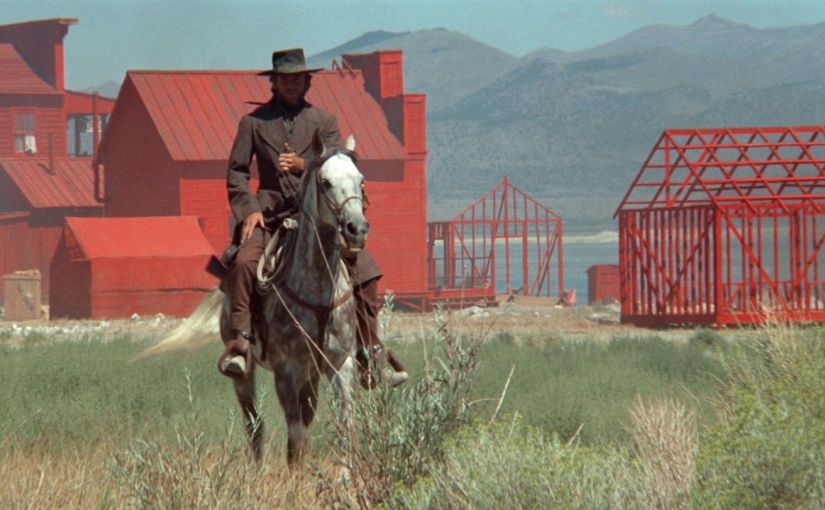
Because Clint Eastwood’s career of acting roles is thematically the strong, silent type, it’s easy to appreciate that in one film he may be The Man With No Name, while in another picture he’s simply The Stranger.  In the second film he directed, High Plains Drifter, he’s an intimidating force riding on horseback into the lakeside town of Lago.  

He may enter the saloon for a beer and a bottle and then cross the street to the barber for a shave and a bath, but you likely do not want to ever involve yourself with him.  He is also horrifically unkind to one of the few women in these parts.  Let’s just say it ain’t no roll in the hay.  This Stranger is a scary dude in a black hat.

The townsmen recognize a convenience in this man’s arrival though.  He’s demonstrated what he is capable of and therefore he appears to be the one qualified to kill three outlaws who were just released from prison with vengeance on their minds as they make a return to Lago.

There’s a hint of supernatural play in High Plains Drifter.  The Stranger recalls a harsh night when the local Marshall had been whipped to death by the townsfolk.  Could the Marshall be the Stranger?  Perhaps.  The victimized Marshall is portrayed by Eastwood’s long time stunt double and occasional director Buddy Van Horn (Pink Cadillac, The Dead Pool).  While that bloody slaughter occurred, the townsfolk simply watched with no offer to help.  For a while, High Plains Drifter was rumored to have been inspired by a real-life rape from the mid-1960s which ultimately led to the need for calling 911 in the event of an emergency.  Art imitates life even in the Old West.

The Stranger agrees to help the town prepare for the outlaws’ violent return, but like a fantasy character he makes special requests of his own including reassigning the sheriff’s badge to the town dwarf, plus taking whatever merchandise he wants from the mercantile and occupying the two best rooms in the hotel.  Also, he gives instructions to load up on a large supply of red paint.  Is the town of Lago getting what they bargained for or are they dwindling into a worse fate? Could be a deal with the devil or as Jewish mysticism might imply, the town of Lago might be inheriting a gollum.

Clint Eastwood salutes his prior directors that prepped him to become an esteemed filmmaker.  Don Siegel’s (Dirty Harry) and Sergio Leone’s (The Dollars spaghetti westerns) names are engraved on tombstones within the nearby cemetery built for the set.  Eastwood adopts some of their famed techniques while not setting himself apart from what those influencers accomplished.  He was still finding his footing behind the camera. High Plains Drifter is just a tale of revenge with recognizable set ups found within typical Hollywood westerns.  

Visually, the film starts out mysteriously with The Stranger’s arrival out of a sun soaked desert boil.  The photography looks deliberately grainy before the modern twenty-first century film restoration appears. Not a word of dialogue is uttered until after the picture has run for over seven minutes.  

Lago becomes a town with a new kind of identity later in the film as mandated by the script.  This is where Eastwood finds opportunity to do things with his western that his earlier pictures had not offered yet.  A bloody, hellish war is expected.

High Plains Drifter traverses in different directions while primarily staying in this one small town and you may wonder what this storyline has to do with that storyline.  Well, the commonality of its various parts is The Stranger’s arrival.  

You’ll may question who this unnamed man truly was by the time film ends.  Maybe it was not a man at all.  There are moments included by Eastwood’s direction to question what precisely occurred.  

Is High Plains Drifter a western or is it a ghost story? Like me, perhaps you’ll uncover moments that support either argument.

THE MUMMY (2017)

By Marc S. Sanders

The Universal logo comes up with that familiar music across the blue globe. Then it goes in reverse and turns black and gold to introduce a new franchise known as the Dark Universe.  This is the first installment.  The problem is of all the famed monsters in the studio’s library, they probably shouldn’t have started with The Mummy.  Brendan Fraser’s attachment to this mythical Egyptian horror is still widely accepted, and Tom Cruise is no Brendan Fraser.

This reinvention begins much like the 1999 film by telling of a Pharoh’s daughter who believed she was the sole heir to the kingdom.  Yet, betrayal happens and the beautiful princess is mummified into eternity, buried deep under the desert and laid with vengeance on her mind.  Elsewhere, another tomb is discovered under the streets of London. Could there be a connection? A dagger with a red stone might have the answers.

Jump to present day and Tom Cruise is back with another character who can run very fast.  He is Nick Morton and with his partner he clumsily runs and jumps over rooftops in the Egyptian desert while closely evading military air strikes from above.  Why the military is dropping bombs is apparently irrelevant.  Tom Cruise just needs something to run away from.

A massive crater opens up and the pair along an expert archeologist named Jenny Halsey (Annabelle Wallis) come upon a tomb.   Nick mistakenly frees the Egyptian princess buried within and they transport her, still contained in her coffin, back to London aboard a cargo plane.  Only now Nick is seeing visions of what once was and becoming familiarized with an ancient language with which he had no prior knowledge.  Nick has been chosen.

When you place Tom Cruise on board a military cargo plane, what do you think happens? It doesn’t have to be called Mission: Impossible to be a seemingly impossible mission. The crashing airplane sequence is impressive, not the best, but I’ve seen this stuff already. I’ve seen this stuff already with Tom Cruise. I do not need to see it again. 

The Mummy cannot decide what it wants to be.  It has some good ideas but just when I think I’m watching another Brendan Fraser swashbuckler with a monster, Tom Cruise must pound it over my head that this is a stunt filled trajectory.  

Russell Crowe is a mysterious character offering voiceover narration during a prologue. He later reveals his identity to Nick.  I will not spoil who he turns out to be.  Let’s just say it is likely you heard of this guy.  It’s hard to believe that Nick has not, and Mr. Cruise does not play dumb very well. This man has an interesting laboratory that contains relics and possessions that belonged to other well-known cinematic monsters.  Frankly, this picture should have exclusively belonged to Crowe’s character who comes off very dynamic and fresh while setting up a whole – forgive the pun – universe for a long line of films to come.  

Alas, Tom Cruise sets the stage.  He’s okay in the role, but between his temptation to be Ethan Hunt while adopting a Robert Downey Jr sarcasm and the imperfect Brendan Fraser/Indiana Jones hero, it all gets muddied. I just didn’t like this guy.  Cruise delivers what each chapter of the script demands of him and none of it is consistent. Near the end of the film during the final battle, Cruise offers up a one liner that comes nowhere near as close to what Downey, Fraser or even Arnold Schwarzenegger could have accomplished.

The only clarity I find in the visual effects is that they look rushed for final print towards a summer blockbuster release.  The Mummy Princess (Sofia Boutella) unleashes her monster minions to pursue Nick and Jenny while they are escaping in a clumsy looking ambulance.  As the creatures attack the top and both sides of the vehicle they are shaken off, thrown into trees, or run over.  They all look like monster vomit accompanied by loud hissing to startle your hearing.  

This iteration of The Mummy is partly assembled by the guys who made the Transformers movies where the robots look like metallic throw up mush.  Guys like Robert Orci and Alexander Kurtzman, the director, are poor artisans at the sci-fi/adventure/horror genre.  They know how to helm movies like this about as well as I do.  I don’t know shit, but I do know the visuals here are pure junk while being an enormous step back from the Fraser films of twenty-five years ago.  

The Mummy ends like the Marvel movies with the hanging threads of what we should expect.  I’m game!  Only, don’t do it like this.  Anything but this, please.  

Sadly, as quick as the Dark Universe got started it all got canceled.  This film was poorly received and did not generate the box office bonanza the studio was counting on.  I recall a fascinating publicity photo that assembled Cruise, Crowe, Boutella, along with Javier Bardem, and Johnny Depp. All were publicized to occupy upcoming installments of this new franchise.  The potential was so strong to see the likes of The Mummy, the Invisible Man, the Bride of Frankenstein, the Creature From The Black Lagoon, The Wolfman, Dracula and Jeckyl/Hyde sharing the screen together.  This could have been the antithesis to The Avengers and Justice League with gags of gore to delight audiences.

I swear when I saw that Dark Universe logo at the beginning, I was ready to love this movie.  I really was.  Unfortunately, The Mummy works hard to be a Tom Cruise actioner with his preserved thirty something looks adhered to an assortment of unfinished and indecipherable special effects.  Its script from David Koepp (Jurassic Park) is exhaustingly incoherent.  

The Mummy was a long-term investment by a million-dollar corporation.  It’s too bad the wealth went into junk bonds though. I urge Universal to try again. There is something to be made here, and it cannot get worse than this.

GET OUT

By Marc S. Sanders

Consider this for a second.  You’re an African American thirty year old who has recently begun a promising relationship with an affectionate, loving Caucasian woman.  As she attempts to ease your apprehension about meeting her parents for the first time she tells you her dad would have voted for Obama if he could have run for a third term.  When you arrive at their upstate home, one of the first things dad tells you is that if he could, he would have voted for Obama for a third time.  Exactly why is that so important to say?  From her?  And later from him?  Why is it necessary for an audience to hear the statement twice within a span of less than fifteen minutes? While it should sound assuring, it feels anything but trusting.  That’s how smart Jordan Peele’s debut horror/thriller is.  He has a way of delivering two different perspectives with one simple statement.

In Get Out, Daniel Kaluuya is Chris.  His girlfriend is Rose played by Allison Williams.  These actors are a perfect pair on screen but that’s about all I want to share with you considering their relationship.  

Chris is meeting Allison’s family at their home for their weekend.  It’s a beautiful, quaint estate off the beaten path from any intrusive neighbors.  Burrowed within the woods, this is a place to escape the stresses of city life.  Just like with any horror film though, the characters do not know they are operating inside a horror film.  The audience always does, and the best filmmakers find those frequent moments to get their viewers to squirm in their seat, tuck their knees under their chin, clench the butt cheeks maybe and say, “Don’t do that!,” “Don’t go in there,!” or maybe they’ll urge you to “GET OUT!!!!”

Nevertheless, the storyteller finds it important to bring up Barack Obama on more than one occasion???? 

Before they even get out of the car, the landscaper, a black gentleman, seems curious to Chris.  Friendly handshakes and welcoming hugs on the porch segue into the furnished home and there’s the maid, a black woman, who is as intriguing as the first black person to be seen.  Wouldn’t you know it but over lunch, you learn that tomorrow there’s the annual party gathering of friends.  Oh my gosh, was that this weekend?  

Jordan Peele doesn’t turn on the creepy music you may expect.  He relies on his visuals and while you are being as observant as Chris, you just might be alarmed and less sensible than he is.  That credit goes to Kaluuya, giving a reserved, contained performance.  This guy does not look like a hero in the least because he has instincts but seems to never look for a fight or a debate or the need to set an example.  An unexpected stop on the drive over demonstrates where Chris stands in a topsy turvy world of political divides in the twenty first century.  He just wants to make life easy.  So, he also will not make waves when that groundskeeper runs directly at him in the middle of the night.  This is just too freaky, but Chris tells us to just get through the weekend.

Rose’s brother seems like a weirdo from a Judd Apatow comedy, but he’s not being a clown.  Dad (Bradley Whitford) is a successful surgeon always ready with a relaxing tone and an open hug.  Mom (Catherine Keener) has done well as a psychiatrist performing hypnosis on her patients.  Yet, a late-night encounter with her leaves Chris feeling uneasy. Visually, it’s disturbing when he reflects on what he thinks he experienced with her.  However, he tries to give the family the benefit of the doubt especially when he shares his concerns with Rose.  Allison Williams is quite good with being convincingly dismissive.  I trust her, and I like her too. 

Then there’s the party the next day.  All the guests, primarily white, arrive exactly at the same time in a convoy of tinted black sedans and SUVs.  Chris doesn’t hide himself despite feeling awkward, and he doesn’t initiate the odd conversations with these middle age WASPs, but he politely keeps engaged with them.  Ironically, the strangest conversation he experiences is when he approaches a fellow black guest who is oddly dressed inconsistently compared to everyone else while his demeanor looks like he’s in a trance.

For comedic effect, Jordan Peele incorporates a best friend for Chris to confide in with opportune cell phone calls.  Lil Rey Howery is Rod and I can say, unequivocally, he is the best endorsement for the TSA. I do not recall seeing Howery in other films of late, but this actor deserves a long career for making a big splash in Peele’s busy picture.  Get Out would never be as inventive if Howery’s role is edited out.  Rod is the only other guy who, from a distance, can tell something is not right, here.

Get Out closes on an airtight ending.  Explanations for everything that is questionable is provided.  Yet, on both occasions that I’ve watched the movie, I think about it long after it’s over.  It takes some of the best elements you might uncover from The Twilight Zone, plus what you might have seen in the original Texas Chainsaw Massacre, and builds new ideas off of those circumstances.  

It is especially fun to read the IMDb trivia about the film to uncover a wealth of appropriate symbolism that does not jump directly at you.   You’ll appreciate how clever Jordan Peele is as a writer.  Froot Loops without milk in a bowl says much about a character.  Another character is engorged with the antler of a taxidermic deer head.  One character scrapes cotton stuffing out of an armchair.  Jordan Peele approaches his scary fiction with an educated eye.  

This movie is inventive.  Its horror does not seem redundant and thankfully the monsters are not vampires and zombies all over again.  There are new tactics at play.  There are fresh approaches to victimize the heroes, and there are creative ways to surprise the audience.  

Get Out is amazing the first time you watch the film.  On a second viewing, Jordan Peele’s story works like a class experiment in social standards while it still has fun by keeping you in triggering suspense.

INTERVIEW WITH THE VAMPIRE: THE VAMPIRE CHRONICLES

By Marc S. Sanders

Fantasy of the supernatural or science fiction work best when the writer can teach the reader or the viewer how its foreign worlds work and how the characters who occupy the environments function and live.  Anne Rice had her own interpretation about how creatures of the afterlife live by night.  Her vampires possessed theatricalities.  Some were charming and sophisticated, and relished how they lived immortally while satisfying a hunger for the blood of living humans.  Some struggled with the discomfort that comes from being a remorseful bloodsucker.  The first of Anne Rice’s series of vampire novels, Interview With The Vampire, runs a very wide gamut of perceptions.  By the end of the film adaptation, directed by Neil Jordan, I’ve earned quite an education.  (Frankly, Rice’s novel was tediously slow moving and bored me to tears.)

In present day San Francisco, a young man (Christian Slater) sets up his tape deck to record a conversation with a soft spoken pale faced man in a dark suit with a neat ponytail in place.  This mysterious person is Louis, played by Brad Pitt.  His story begins two hundred years earlier, in New Orleans, back to the day when he was incepted into an immortal life as a vampire. His agent of delivery is the devil-may- care and mischievous Lestat, one of Tom Cruise’s most surprising and unusual portrayals.  He gives a brilliant performance that’s as far a cry from his lawyer roles or his Maverick and Ethan Hunt heroes as possible.  

Lestat is eager to guide Louis into the benefits of vampire life.  Louis, having already been depressed following the loss of his wife and daughter during childbirth, cannot grow comfortable with Lestat’s insatiable appetite to feast on aristocratic figures or plantation slave servants.  This is not a match made in heaven and their chemistry as a couple is tested. Louis would rather miserably feast on chickens and rats, while Lestat grows frustrated by unsuccessfully swaying his partner to taste the sweet nectar of blood dripping from the wrist of a lovely young lass.  Lestat turns towards a grander extreme to maintain his embrace of the morose Louis.

Through deception, the men welcome an eleven-year-old “daughter” into their underworld.  Her name is Claudia, played Kirsten Dunst in her introductory role.  I still believe this is her best performance, worthy of an Oscar.  The life of a vampire is delightful to the child, the same as Lestat perceives it.  However, as the decades move on, with changes in fashions and industry quickly developing, so does Claudia’s understanding.  Her body never matures, destined to always remain within the shell of a preteen child, and thus she commiserates with Louis.

It appears like I’ve summarized Anne Rice’s entire story, but I have not even come close.  Interview With The Vampire is to gothic horror the same way The Godfather is to mafia gangster life.  Both communities victimize people of an innocent world, but their members are expected to follow codes of decorum and respect.  The conflict lies in living as a bloodsucking vampire or a criminal gangster.  When a peer interferes or does not cooperate, then the individuals of these respected worlds become violent unto each other.    The viewer/reader observe how their patterns of behavior all play out and how one action or policy generates one response after another.  These films are high ranked authorities on their subject matters.

Louis explains to his interviewer how Bram Stoker’s celebration of vampires is dreamed up escapist fiction, though coffins and the avoidance of sunlight are absolute necessities to carry on.  Just like any person, vampires want to live happily, but life gets in the way and that can be frustrating on any number of different levels.  

Neil Jordan’s film is a marvelous exploration into the mindset of being a vampire.  Tom Cruise perfectly exudes Lestat as a vampire ready to joyously live with sin while he savors and lives a life of eroticism and material wealth.  A child like Claudia sees the attraction of being spoiled and spoiling herself, and she cannot get enough consumption of blood. Eventually though, her mentality outgrows what becomes redundantly mundane.  Louis is relatable like many people.  He is unhappy living the life he was born into.  Lestat grows aggravated with his family’s resistance to partake of what he relishes.  There is an extensive range of emotions on display with Interview With A Vampire. To be a vampire can be a privilege or a curse. It all depends on who you interview.

The look of this film is astonishing.  I know it was shot within New Orleans, Paris and San Francisco locations.  However, I can easily recognize some sound stage locales, and I have no complaints.  The art designs from Dante Ferretti are thoughtfully crafted with lantern lit, rain-soaked cobblestone streets of the seventeenth century to mucky, moonlit swamps.  Horse drawn carriages transporting abundances of coffins serve a purpose of humor and narrative as character misdeeds are routinely committed by Louis, Claudia and especially the trickster Lestat.  The furnishings of the aristocracy are embracing too.  It’s a remarkably convincing step back in time.  

The periodic costume wear by Sandy Powell completes the settings with colorful, silk garments, white ruffled shirt sleeves and buckled shoes for both the men and women as well as for Kirsten Dunst and some cherub cheeked children who come into play.  Everything looks so rich. The whole picture feels like stepping into one of those late-night ghost walking tours I’ve taken in small southern towns like Savannah and St Augustine.  Every scene, even when the film jumps to late twentieth century, is immersive.  

Anne Rice’s screenplay adaptation tells so much within two hours.  She allows time for the characters to sail to Europe seeking out others like them.  The second half of the film teaches us more about what it means to uphold oneself as a vampire.  

Neil Jordan sometimes delivers his film like a how-to documentary because you are consistently learning new details, not so much about plot but about a people you are not as familiar with. Often, the film segues into theatrical play as you might expect from Phantom Of The Opera.  It’s no wonder since eventually Anne Rice puts us in touch with the cabal known as Theatres des Vampires. Stephen Rea and Antonio Banderas get to take center stage within a literal theater where the facade of behaving like a vampire can be executed beyond the suspicions of a – ahem- live audience.  

Rice and Jordan get playful while also performing with horrific familiarity.  The bites on the neck are known to many of us for drinking blood.  Did you also realize that a vampire can drink from a crystal wine glass? There’s an elegance to how the actors’ characters consume the blood of humans.  Cruise and Pitt begin by going in for a passionate kiss, either on the neck or the weightless wrist of a victim.  Lestat is more aggressive. Louis caresses his meals on the rare occasion he dines. Claudia gives a puppy love bite. Cruise especially finds new and titillating ways to dine with each new feast.  Both actors are deliciously homoerotic, but on different parental planes with their child. Their love/hate relationship operates like Shakespearean stage work. That’s why I really take to Neil Jordan and Dante Ferretti’s choice of soundstages.  

I’ve become so bored with zombies and vampires.  How many iterations must be churned out of the same kind of monster.  This year’s horror hit, Sinners, was superb until it stopped being eye opening with surprise.  It eventually became the same old thing and offered nothing new to show me in its final blood-shedding act.  

Interview With The Vampire is one of the best vampire films though.  The film never ceases to speak directly to its audience.  The settings describe how life is lived.  The characters grapple with both internal and external struggles.  

It’s one shortcoming is that Anne Rice, Neil Jordan and cast/crew did not follow up with the author’s subsequent tales.  The subtitle, The Vampire Chronicles, seemed to promise an extension of this universe. I know of other Anne Rice film adaptations that chose not to continue on from what was done here, and the execution was terribly poor and disappointing.  There’s a biographical intelligence to Neil Jordan’s film that many films of all genres lack.

Anne Rice’s first film adaptation set the standard on vampire culture, and I have trouble thinking of anything since its release that closely matches it.  

Interview With The Vampire is the only one with a blood curdling bite.

DOCTOR SLEEP

By Marc S. Sanders

I never yearned for a sequel to The Shining.  Yet, color me surprised at how well I took to Mike Flanagan’s adaptation of Stephen King’s return to psychic Danny Torrance and the haunting baggage he carries as a middle-aged adult in Doctor Sleep.  This is a time jump sequel that is nearly forty years in the future.

The film version of this story had a tricky challenge.  King notoriously despised Stanley Kubrick’s horror classic adaptation of The Shining. Several important details were not consistent between his book and the movie.  So, what was Flanagan to do?  Well, he got his blessing from the author to move ahead as a sequel to Kubrick’s interpretation because he also ensured that he would not veer too far away from how the novel was edited.  The director reasoned with King that more people are familiar with Kubrick’s product than what’s in King’s pages. Mike Flanagan found the right balance to please not only Stephen King, but also the respective fans of the novels and Kubrick’s unforgettable film.

Danny is played by Ewan McGregor.  He’s often reflecting on his childhood following his survival from his stay at the haunted Overlook Hotel in the snowy mountains of Colorado, where his delirious and murderous father terrorized him and his mother Wendy with an axe.  Now Danny is making efforts to recover from alcoholism as he takes a job as a hospice orderly in a small New Hampshire town.  It keeps him isolated while the ugly hauntings that he shines on stay contained in his mental lockboxes.  He also uses his gift to allow patients to peacefully carry over to the other side.   Danny becomes known as Doctor Sleep.

Elsewhere in the country there is a traveling cabal of people who devour the energies off of young children with similar shining abilities like Danny.  This small cult is known as The True Knot and their leader is the charming Rosie The Hat (Rebecca Ferguson).  The presence of one very special child is Abra (Kyliegh Curran).  Flanagan gets very creative in showing how Rosie, Abra and Danny locate and communicate with one another from faraway points.  Rosie’s technique is reminiscent of an amusing sequence in The Big Lebowski, though as you might expect the mood is altogether different in Doctor Sleep.  

Doctor Sleep is a longer picture than it needed to be.  The exposition goes on for quite a while where three separate stories are proceeding, and it becomes cumbersome to see how the dots are connected.  Yet, the movie eventually finds its way as things become more simplified.  Flanagan works some action scenes and neat visuals into the picture, but he does not neglect Stephen King’s penchant for nauseating and grotesque horror either.  Normally, I feign at seeing victimized children in deadly peril for the sake of escapist entertainment.  Here, it is repulsive on more than one occasion, but the moments serve the story and enhance the motives of the villains.  

The payoff of the film is the third act where this adaptation relies on much of Kubrick’s treatment of The Shining.  As the book was entirely different with its ending, Flanagan had to take a chance with some creative liberties.  Amazingly, his efforts score very well.  I’m not the biggest fan of Stanley Kubrick’s film (read my review on this site), but I had to cheer as more developments gradually unfolded.  There’s much to explore through the eyes of Ewan McGregor as Danny.

Mike Flanagan’s craftsmanship with a cast of supporting actors, including Henry Thomas (E.T.: The Extra-Terrestrial) assuming Jack Nicholson’s role, are quite uncanny and lend to the argument to not depend on AI or “de-aging” visuals to recapture what once was.  Carl Lumbly effectively takes over for Scatman Caruthers and Alexandra Essoe does a very good pick up from Shelley Duvall’s performance as Wendy – a little flighty, melancholy and zany. The little ticks and inflections in these newly cast actors are mimicked quite well without going over the top.

Set pieces etched into anyone’s subconscious who has seen The Shining are impressively recreated by Flanagan’s team, from stained walls, big curtains and chandeliers to that very familiar orange, brown/black sectional pattern on the carpet of The Overlook.  At one point in film, Danny goes for a job interview and the office he sits in is an exact recreation of when his father Jack met with the managers of the hotel at the beginning of Kubrick’s film.  This kind of attempt at consistency has to be saluted.  It’s really amazing.  Mike Flanagan shows his painstaking efforts at recapturing Kubrick’s designs. I do not look at these efforts by Flanagan as commemorations so much as I see an omnipotence that observes Danny like it did to his father Jack before him. Danny might have survived, but the demons of his past and the sins of his father remain. He can never escape where he came from even if he relocates to New Hampshire, or wherever he goes.

Doctor Sleep offers the disturbing imagery you’d expect from Stephen King.  I’ve never been the author’s biggest fan.  Still, I really appreciate the creativity he lent to his sequel nearly a half century later.  It makes sense to have waited this long for the writer to pick up where he left off with some of his most well-known characters and locations.  

This dark fantasy works for its collection of heroes and their villains.

NOTE: I viewed the Blu Ray Director’s Cut which Miguel informed me is the better way to watch the film. I agree. There are more nods to Stanley Kubrick’s original film, and the outline of the picture performs in chapter sections like you might expect in Stephen King’s novel. Mike Flanagan never lost sight of either storyteller’s accomplishments. Doctor Sleep is an undervalued achievement in film. A very worthy sequel.

A TIME FOR SUNSET

By Marc S. Sanders

Tom Calloway’s A Time For Sunset is a well-crafted film with shadowy, haunting cinematography and some decent edits.  Unfortunately, it travels towards its conclusion on a repetitive Groundhog Day trajectory.  Regrettably, the deliberate slow burn does not work.

A cell phone rings.  It’s answered.  A few lines are exchanged and then there is the hang up.  Five seconds later, the phone rings again and the same routine occurs, between the same two people. This pattern occupies the ninety-minute running time of this film. Sometimes the same questions are asked. The conversations seem similar to what I’ve already encountered, and I asked myself if we’ve covered this already. Out of nowhere someone gets shot right between the eyes, but I am so numb to this lethargic routine that I can’t even become alert to see what could happen next.  After all, the phone is going to ring again for a couple of lines to be said before the next hang up, followed by another call.

Don Worley is John, a seasoned assassin, who checks into a downtown hotel room with a set of golf clubs.  He calls his wife and daughter to say hello while he begins to assemble his sniper rifle.  Just after he disconnects with them, “No Caller ID” (Nicholaus Weindel) rings and John realizes that while he awaits his assigned target to appear on the street below, John has also become a target.  Each time this caller phones, he seems to share more information about John’s current circumstance thereby putting him in danger along with his wife and daughter.  Now it’s one assassin against another, but John is clearly at a disadvantage because he is unable to pinpoint from where this caller is watching him.

With Thomas L Callaway directing, A Time For Sunset monopolizes its camera work on actor Don Worley who is up for the one-man challenge.  Intermittently, other figures on the hotel floor disrupt the phone conversation to lend to John’s contained paranoia such as a bellhop, a couple of rowdy kids, a manager and an angry mother.  One person arrives to up the stakes with a cleverly rigged bomb and my mind immediately went to the third act of Jan DeBont’s Speed.  These all feel like brief episodes though with not enough oomph to break the monotony.

The pace of the film moves very slowly because it focuses too often on a guy talking into his cell phone or the accompanying earpiece. So, the thrill of this thriller is mostly absent.  Don Worley might be portraying this expert assassin with a measure of calm and cool sensibility during a high-pressure circumstance.  However, his tone hardly changes as the stakes are getting higher.  I never saw the desperation unfold, even as the film was wrapping up.  John hardly breaks a sweat.  Joel Schumacher’s Phone Booth was another picture that came to mind.  Colin Farrell’s everyday man seemed to respond to the fear that is sorely lacking in Callaway’s film.

I liked the idea of this bottled up storyline.  It has the potential to be compelling. A lot can be generated when someone must work against an unknown entity within a small setting.  The original Saw, for example.  Yet, even with a ticking time bomb front and center, plus the intrusion of a red pointer beam from a sniper scope, the direction does not build any suspense here. 

Despite what the introductory scene appears to spell out for John’s fate, I really didn’t care what would become of the poor fellow.

THE EXORCIST (1973)

By Marc S. Sanders

Perhaps it is my Jewish upbringing or the fact that I’m not a spiritual person anymore, but what many consider to be the scariest movie of all time really does not alarm me that much.  William Friedkin’s The Exorcist is a superb demonstration in horror though.  Disturbing? Yes.  Unsettling? That’s an understatement.  Scary? A little bit. 

It’s not so much the threat of a random demon or the possibility of Satan on earth that chills me.  It’s this poor, sweet girl who has been unfairly taken advantage of that makes me shudder. 

William Peter Blatty adapted his best-selling novel into his Oscar winning screenplay and it succeeds so well because amidst all of the terror, there’s an education to be had.  Do any of us truly know or have witnessed someone who has been demonically possessed by an entity of pure evil?  I’ll be the first to come clean and say no.  Therefore, I’m intrigued as Friedkin’s film proceeds to observe how the decision to exorcise a demon from the shell of a pre-teen girl arrives.  Nevertheless, to me it is all fantasy.  I might just hold more faith in the Jedi practice of the Force than I do in the ideas of holy water, devilish idols or even what can befall you by flippantly using the name of Christ in vain.

Famous film star Chris MacNeil (Ellen Burstyn) is on location in Georgetown shooting her latest picture.  She resides in a furnished home with her twelve-year-old daughter Regan (Linda Blair), along with an assistant and a butler servant.  Regan is a fun-loving kid and adored by her mom.  Strange behaviors begin happening and all too quickly, the daughter is beyond control with patterns of activity that are anything but recognizable.  I can’t even describe most of the imagery.  I could never do it justice.

Doctors are quick to attribute Regan’s afflictions to a lesion resting on the cerebellum of her brain.  Yet, extreme procedures and x-rays show no medical disruption or disturbances.  I recall Friedkin’s director cut from 2000 inserted the questionable practice of dosing the girl with Prozac.  Before the supernatural is ever considered, the merits of science and medicine must be explored.  

Nevertheless, it is unbelievably bold how this personification puppeteers young Regan with vile actions of vomiting, uttering the ugliest vocabulary and committing terrible bodily harm and atrocities with a crucifix.  Blatty could have drawn the line with the slaps and punches Regan delivers to the doctors and her own mother.  The point would have been clear.  Yet only something that has to be tangibly real with no question of a joke or side humor, has to go this far.  It’s often sickening and demoralizing to the worst degree, but reality never compromises.  The drivers of this fiction wish to move this as far away from what’s not valid. It’s evident how convincing all the footage is within the film.

Following the mysterious death of Chris’ film director, along with an unheard-of recommendation from a physician, the idea of committing an exorcism to release whatever’s possessing the girl is suggested.  The problem is there is no expert on the subject of exorcism.  It seems absurd, and the Catholic Church is never quick to endorse the procession.  

During the first hour of the picture, a second story covers the personal conflict of Father Karras (Jason Miller).  One of his first scenes shows him arriving home to his ailing mother and removing his collar.  It’s a visual sign that the minister is questioning his own faith as he undoes his garb.  Karras may be a priest, but he also specializes in the study of psychology for his parishioners.  As he encounters Regan in her bedroom, he’s gradually assured that he is speaking with the demon who knows too much about himself.

A third story, which actually opens Friedkin’s film, occurs in Iraq where Father Merrin (Max von Sydow) is excavating through an archeological dig.  He doesn’t have much to say but his stoic expression tells us that his discovery of a medallion buried in the rubble, along with particular statue, spell dread.  It’s no accident that Friedkin places this scene often against the backdrop of a sun sparked, blood red sky.  

Eventually, all three stories intersect within the coven of Regan’s upstairs bedroom, where this demon taunts, cackles, teases and defies the power of the Bible and the Catholic faith.  This third act is impossible to take your eyes off.  Every second of imagery builds upon the power of the supernatural from moving furniture that charges forward like monsters on the attack, to ceilings and doors that split open.  The bed rumbles.  Demonic imagery appears out of the cold darkness.  It’s such a well-crafted sequence of events that is completely atmospheric.  

On what I believe is only my second viewing of the film, there are few things I noticed.  Chris is not a religious character.  So, when she evokes frustration, first at her ex-husband over the phone, and then at doctors and priests who lack explanations, she’s apt to shout “For Christ’s sake,” or “Jesus Christ.”  Variations of the word fuck is also adjacent to this dialogue.  Chris’ language could be a close second to the abhorrent verbiage coming from her monstrous daughter.  Blatty and Friedkin seem to imply how the son of God and the potential of Satan are so easily taken for granted.  Chris may be corrupted, but it is the innocent, young Regan who is trifled with.  There is nary a thing more disturbing in film than watching a child in peril.

Friedkin’s direction with Father Karras is consistently interesting as well.  Often, he positions his camera on a ground floor or at least pointed up to a level above to witness Karras’ ascents.  His faith is clearly shaken.  So, all he can do is rise and rise again, closer to a heaven that may still be welcoming.  Karras climbs flights of stairs or walks up sidewalk hills, to approach a vile intruder seeking to disrupt the purity of angelic youth.  

Only after I watched the film did I read that Linda Blair’s unforgettable performance was not the only contributing factor to Regan’s demonic possession.  Oscar winner Mercedes McCambridge who originally was not credited, supplied the scratchy, tormented and taunting voice of the demon.  It’s an unbelievable embodiment of a powerful villain.  Linda Blair was Oscar nominated for this role, but because she did not entirely own the performance, she likely lost to another child actor, Tatum O’Neil (Paper Moon).  The craft of Blair’s makeup all the way to her changes in eyes is a gut punch to the psyche.  Regardless, this is one of the most uncompromising and effective child performances I’ve ever seen in a film.

Max von Sydow donned aging makeup on his youthful forty-four-year-old complexion, and he looks straight out of another famous role from later in his career (Minority Report).  Richard Pryor and Saturday Night Live did a hilarious spoof on The Exorcist and for this nonbeliever I related to Pryor’s antics.  Yet, Max von Sydow takes what could have looked like utter silliness and convinces me that the ritual of exorcism is incredibly trying and exhaustively repetitive accompanied with the robes he dons to the holy scripture he reads from.  Merrin specifically instructs Karras not to directly respond to the demon.  Don’t even talk to it.  Merrin sticks to that practice.  Karras, the younger and less experienced sidekick, is drawn into the monster’s personal jibes.

Despite my position on religion and faith, I do not frown on what others value.  People find solace in their perceptions of God, the biblical stories, and the figures who teach. Religion often bestows a fulfilling life cycle.  Religion offers comforts through pain, loss, love and hope.  That’s okay. Everyone must follow their own path towards salvation. I tend to turn towards my personal psyche which I speak to daily.  

I watched The Exorcist off of a 4K streaming print found on HBO MAX, and the picture is positively striking.  Aside from dated fashions and cars of the early 1970s, the picture looks incredibly modern.  The themes of the film remain strong.  Hardly anything has ever matched the horror of The Exorcist.

I value everything in The Exorcist that Father Karras and Father Merrin heed to.  I believe in this story wholeheartedly.  Friedkin and Blatty, plus the cast enhance the authentication of demonic possession and how it operates.  This work of fiction, which Blatty claims to have been inspired by from an account of possession of a young boy during the 1940s, is a thousand percent genuine.  Within the moment and inside the confines of this picture this demon lives by overtaking young Regan.

How much did I believe it? Before bed last night, I made sure my little night light was on and I never walked into a dark room.   Every single light in the whole house was practically turned on.  

It’s not about the fear of God or the Devil.  It’s the fear I had for young Regan.

THE MIST

By Marc S. Sanders

I’m tough to satisfy when it comes to monster movies.  Too often they all look the same, or they behave with similar instincts and motives.  There’s a new dinosaur movie coming out this year where they apparently stalk a military unit.  So!  I’ve seen seven Jurassic Parks.  About the only monster that still gets under my skin are the acid pumping, knives for teeth xenomorphs of the Alien franchise.  Everything else is been there, done that, and this includes the insect like pests found within the mist of Steven King’s The Mist, directed by Frank Darabont.  Fortunately, there’s a better and much more engaging attraction to this eat ‘em up blood fest.

Within another small fictional town in Stephen King’s version of Maine, a dark and stormy night kills the power within the area.  The next morning large fallen trees appear to have damaged the homes of David Drayton and Brent Norton (Thomas Jane, Andre Braugher).  Phones and power remain out, but a curious cloud of mist grows over the lakeside area.  

The gentlemen decide to go into town for supplies with David’s son Billy (Nathan Gamble) in tow.  The checkout line of the supermarket is crowded with tourists and residents when a similar mist envelopes the building and clouds up the expansive front window of the shop.  An elderly man runs through the parking with a bloody nose and urges the shoppers to lock the doors because there are things within this unwelcome mist that are terrifying and bloodthirsty.  I’ll spoil this for you. The old coot is right.  The creepy crawlies are thirsty for blood and hungry for flesh.

You’ve seen much of what Darabont’s screenplay adapts from King’s novella in similar iterations of horror.  The wheel is not reinvented here and though an explanation of this mist and the organisms it conceals is spelled out, nothing is jaw dropping.  Seems similar to how King’s The Stand opened.  The cast of this B movie is what needs to be talked about.

Sure, there are doubters of things terrorizing the community just before the blood is spilled.  Some characters make hard decisions despite the urging of others not to leave the store.  Yet, when these flesh eaters become evident, then the end of days gospel of Mrs. Carmody (Marcia Gay Harden) permeates through the populace of the supermarket.  That’s when The Mist grows a brain to demonstrate the power of fear, threat, and especially influence.  The disturbing Mrs. Carmody exaggerates the purpose of this phenomenon with select biblical scripture both documented and I believe conjured on the fly by her.  Now I am reminiscing back to tenth grade English when I studied Lord Of The Flies.  A tribe forced to live together will ultimately divide.

Darabont so wisely reads a collection of different walks of life forced to either work together or work against each other, both sides with desperate means to survive.  William Sadler is a dimwit mechanic who goes through three different modes of purpose during the film.  He starts with a tough guy mentality, then on to timid fear and regret, and lastly, he’s reawakened to echo the call of Marcia Gay Harden’s religious zealot.   Truly insightful because I often wonder how any person can so easily succumb to the influential beliefs of someone else.  I mean you would have to be dense to allow that to alter your mindset, right? Well Stephen King and Frank Darabont remind me that there’s more dense people on this planet than wise.  A dread of cabin fever only exacerbates to succumb to what someone will tell you. Therefore, let’s observe how the morons respond to the dominant personality.

The action for the sake of jump scares and expected horror does not disappoint too much.  There’s screaming. There’s lots of blood. There’s lots of running too, and monsters and webs and teeth and claws.  A sneak away trip to the pharmacy next door is neat centerpiece, but you’ve seen stuff like this so many times before. Frances Sternhagen gets the opportunity to use a makeshift, bug zapping, flame thrower that made me laugh and cheer.  

The jump scares are not very effective, though.  One bug thuds against the window pane. Otherwise, there’s monster stuff to absorb like tentacles, claws, teeth and webbing. I don’t go for slasher flicks and endless bloodletting gore like most movie makers of this genre attempt to achieve.  Too much blood is boring and a sign of a lack of story.

I was invested in uncovering why this all started.  I was taken with how a small group of people quickly engages in a mob mentality because their individual desperations refuse to satisfy. What instincts will undo people when hope dwindles and your companions turn on you?  Darabont presents some effective moments for these questions. However, once the exposition was out of the way, I didn’t care who lived or died.  My concern was knowing how whoever survives gets out of this dilemma.

The answers come and there is an unexpected ending tacked on by Darabont that is not recounted in King’s work.  Trust me when I say I’ll never forget the conclusion of The Mist.  Same as I’ll never forget the ending to The Sopranos.  That’s not necessarily a compliment though because I think Frank Darabont was only adding unnecessary insult to injury. He resorts to using a terrible psychological epidemic for one last twist of his gleeful, mischievous knife in my back.  I am not spoiling anything for you dear reader, but James Cameron went this route during a sequence in Aliens and it made much more sense, while offering convincing justification.

While you might like the chills and thrills of The Mist, be warned that it’s the ending that’ll leave you angered for days and nights thereafter. I had a furious urge to throw my popcorn at the screen.  

Popcorn can be found on aisle 5 by the way.  Bug spray on aisle 9.