CRIMSON TIDE

By Marc S. Sanders

A little over a year ago, having just seen Christopher Nolan’s Oppenheimer, I shared with friends how it is sadly surprising that a nuclear weapon has not been launched by a super power country since the bombs were dropped on Hiroshima and Nagasaki.  Those two bombs certainly served their purpose in response to the Pearl Harbor attack of 1941.  I deem it sad that any of us consider this a possibility that can easily be repeated. With all of the threats that continue worldwide with weapons testing, technological advancements and arms trading, it’s frightening to wonder what can ever be expected. Is it easier to execute a command like that again, now that it has been done?  It’s got to be a little surprising that the United States did not respond that way following the 9/11 attacks.  Tony Scott’s Crimson Tide comes close to providing an answer by weighing sound vs unsound reasoning. 

This is not only my favorite of Tony Scott’s films, but the movie also offers maybe my favorite performances from Denzel Washington and Gene Hackman.  The two actors of different generations are equal in measure as they debate what should be done, along with how the submarine they command, the U.S.S Alabama, should respond while in the midst of a revolutionary conflict stemming out of Russia.  

Washington is Commander Hunter, recruited at the last minute to serve as the Executive Officer aboard the Alabama.  Hackman is Captain Ramsey who proudly leads the charge of the sub with an intimidating welcome to Hunter.  Before any kind of real conflict comes their way, Ramsey puts Hunter to the test.  An uncomfortable dinner conversation, wisely written by Robert Towne (Chinatown), has the Captain question Hunter’s stance on using nuclear force to deliver a harsh defeat to the enemy.  Hunter’s position though is the real enemy is war itself.  Ramsey and his commanding staff have no reply to the new member’s observation.

Another moment occurs when Ramsey orders a missile launch drill while Hunter is assisting with containing an on-board fire in the galley.  The Captain has his reasons that Hunter cannot truly debate. Besides, Ramsey precisely tells his XO to “bite (his) fucking tongue,” even if he doesn’t agree with him.

The centerpiece of the officers’ conflict arrives when they receive a fractured message from command.  Ramsey’s instinct is to launch missiles at Russia based on the presumption that the Soviet rebels have overtaken the country’s arms.  Though Hunter cannot deny the concern, he will not agree to a missile launch until they receive the entirety of the broken order.  This occupies the second half of the film, and it becomes a back-and-forth mutiny of power.  The Captain is relieved of command but then retains control and the crew is divided between the leaderships of these two characters.

Having recently seen and reviewed the submarine classic Das Boot, it’s fair to say that film feels much more authentic and maybe it should be much more tense than any other movie of its kind.  Crimson Tide is glossier with outstanding interior cinematography on a studio constructed set designed to tilt like a maritime vessel should.  The dashboards and colored lighting are fancier.  The cast is good looking as Tony Scott obtains close up shots of them beaded in glistening perspiration with no facial hair.  Crimson Tide is definitely a Hollywood picture.  However, the screenplay from Michael Schiffer is razor sharp with not one wasted piece of dialogue.  In addition to Robert Towne’s contribution, Quentin Tarantino also script doctored a portion of the piece as well which includes a well-placed Star Trek allegory. 

There’s a jolt of energy to Crimson Tide that Das Boot has at times, but because of the latter’s three hour plus running time it also slumbers like life should while living on a submarine.  It is the theatrics of Crimson Tide that hold my attention on many repeat viewings.  I’d never want to question a guy like Captain Ramsey, but I’d be grateful that someone like Commander Hunter is around to stand in protest.  

I wish Gene Hackman and Denzel Washington had done another film together.  Their conflicted chemistry is second to none.  You like them both equally in the scenes they share together, or individually.  The timing of their tempos is perfect.  They find just the right moments to be alarming in a quiet way and save other opportunities for shocking outbursts.  The best actors practice their scripts this way and avoid any traps of overdramatizing.

Tony Scott made this film before his penchant for chaotic angles and grainy captions took over much of his other films to come hereafter.  Crimson Tide is cut perfectly from one scene to another with outstanding colors of blue, red and green lights that illuminate the cast while they stand at their posts.  Washington, Hackman as well as a sensational supporting cast (Viggo Mortensen, James Gandolfini, George Dzundza, Steve Zahn, Matt Craven, Lillo Brancato) do fine work and respond beautifully to the director’s camera positions. 

It’s impossible not to feel the tension accompanied with the progression of this film.  It serves as a motivation to wonder if we act on what we know or don’t act on what we don’t know.  As taut and dramatic as Crimson Tide is, you find yourself considering if those with access to the real-life red button consider all that could come of their decisions.  

Crimson Tide may tidy itself up after two hours, but the movie still makes me ponder if this planet’s military forces are thinking each and every day about if we are preventing nuclear war or if we are on the cusp of waging a nuclear holocaust.

This is one of my most favorite films. 

DAS BOOT (GERMANY)

By Marc S. Sanders

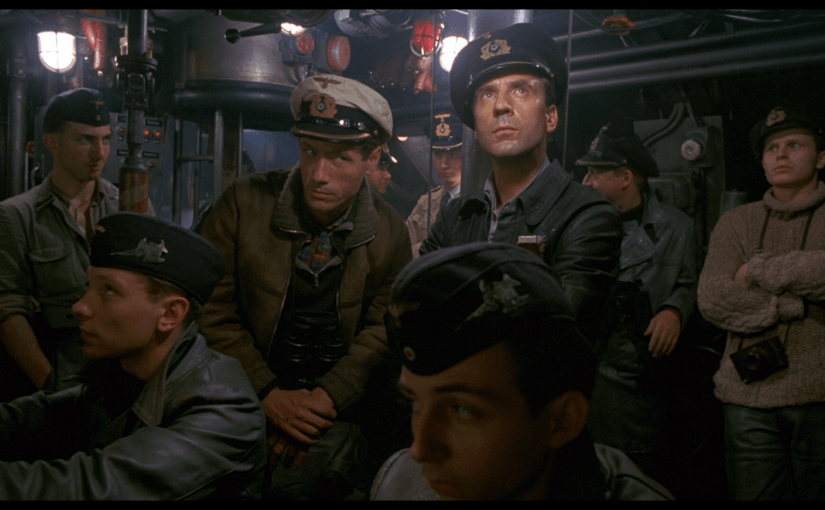
Wolfgang Peterson demonstrated how much suspense he can squeeze out of the tightest of movies when he embarked on filming one of the most realistic and famous submarine movies of all time, Das Boot (translated as The Boat).

During World War II, a German U-Boat is assigned to carry out missions of war within the deep Atlantic.  The purpose is simply for attack and never to question motivations or reasons.  Because these Nazi sailors have no concept of the politics or the totalitarianism behind the Führer, it is not hard to empathize with their plights at sea.  Life on a submarine is no party.

The Captain of the vessel is played by Jürgen Prochnow, the only recognizable actor in the whole cast.  However, all of these men are working just to get by one more day within the very narrow confines of the sub.  In fact, the main character is the submarine.  Rarely has a setting been so evident.  I was told that Peterson used miniature cameras, rare for use in the late 1970s when the film was shot.  He would tightly hold the projector and pursue his cast of shipmates down one galley way after another.  He’d put the camera right up against their face and profiles.  The concentration of these actors to ignore the filming is astounding.  Wolfgang Peterson provides a very clear documentary style to the piece.  Herbert Grönemeyer portrays a war correspondent, easily used within the context of the story to accept Peterson’s approach of simply witnessing the activities and claustrophobia aboard a boat that is primarily under hundreds of feet of ocean water.

To my knowledge, Das Boot is a fictional story loosely based off of accounts from an actual military journalist who was aboard a similar cruiser during the war.  I suppose the film could have been told from an Allies perspective rather than the Axis German superpower.  However, the film works and as a viewer, as you become more engrossed in the picture, you become blinded to the fact that these men served Adolph Hitler.  There’s hardly a swastika in the film.  So, I’m seeing men like any other cadets and officers serving a military branch, working to survive while completing the assignments bestowed upon them.

The torment comes in all forms.  The controls are old and clunky.  It gets very dark at times.  The vessel does not move at a comfortably smooth pace.  They have no choice but to eat rotten food.  It is so bad that the bread turns blue or green.  The men are unbathed and you can practically smell the stench of their body odor and the raw sewage that remains behind.  Sleeping quarters are cramped and are never efficient.

There is such miniscule space available for these people to carry on. The top officers get their exclusive table, but they must get up and move out of the way during dinner, while seamen pass them by on their way to different stations.  Luxury is not afforded for anyone.  The beards of the men become longer.  Wolfgang Peterson shot the film in sequence to accurately show the progression of their beards.  It maintained proper continuity as their sojourn of the boat carried on. 

Most agonizing is when the submarine attacks back at the crew.  A long sequence of suspense occurs following a surprise attack from the air.  The boat has dive into the depths of the ocean, but their controls are malfunctioning and they just continue to sink and sink.  Nuts and bolts pop out of nowhere like ricocheting bullets as the water pressure gets heavier.  My car or my smart phone is more technologically developed and capable than this sub, and I question how this clunker can even withstand the compression.  To maintain balance and direction, the men have to race to the front or back of the ship applying their body weight to work like a scale. 

Imagine the boat coming to a rest on a rocky perch hundreds of feet deep underwater.  There is no propulsion or engine power.  No communications either and the crew has less than a few hours left to survive among the carbon monoxide flooding the ship.  It’s a helpless scenario and at multiple points during the movie, I was convinced this is how it will all end.  Often, I was prepared not to be surprised how this all wrapped up at any given period of time.  Das Boot is a long film. The special edition is over three and a half hours. So, you get a vibe of how stretched out this crew has been away, cramped in these quarters.  Because Peterson stages these challenging scenarios to be extensive, you easily relate to the stress of these men. 

War is hell, even for the Nazis.  The Captain agonizes over a successful attack he’s accomplished when he takes out an American naval destroyer.  He’s done his job well, but he’s angered as he witnesses the aftermath through his binoculars.  Crewmen are set ablaze as they fall off the ship and into water below, and he wonders where the rest of their convoy has gone.  Shouldn’t they be rescuing their men?  This Captain is not a Nazi.  He’s a pawn on a chess board, not assigned to think of the fallen, but rather to do what he is told, absent of questions or emotions.

I do not want to spoil the ending but I cannot recall feeling so much anguish for a collection of Nazi officers before.  Another submarine movie was bold enough to say that the only true enemy in war is war itself and having watched Das Boot, I can clearly see the meaning behind that perspective.  This is not a war picture where one side torments and personally tortures individuals before brutally killing them with gunshots to the head.  In a submarine, the crew is somewhat blind to what they must attack. They are only aware of the environment that troubles them. The men of Das Boot don’t curse the Americans or the British, or the Jews.  They show no prejudice.  That’s not their mentality.

When I see them overcome one daunting challenge after another, I’m relieved for these Germans.  They survived.  They made it. 

However, after watching for over three and a half hours, the final sequence and frame send me a cold, all to real reminder of what occurred during that terrible world war less than eighty years ago and it the film’s ending is the only way this picture could have ended.

Das Boot is a masterpiece of filmmaking.

WINGS

By Marc S. Sanders

The first film to ever win the Oscar for Best Picture actually didn’t win Best Picture.  The category was called Best Production in 1927.  A year later the title was changed.  Wings was the film in question, directed by actual World War I flying ace William A Wellman, only ten years after the worldwide conflict had ended.

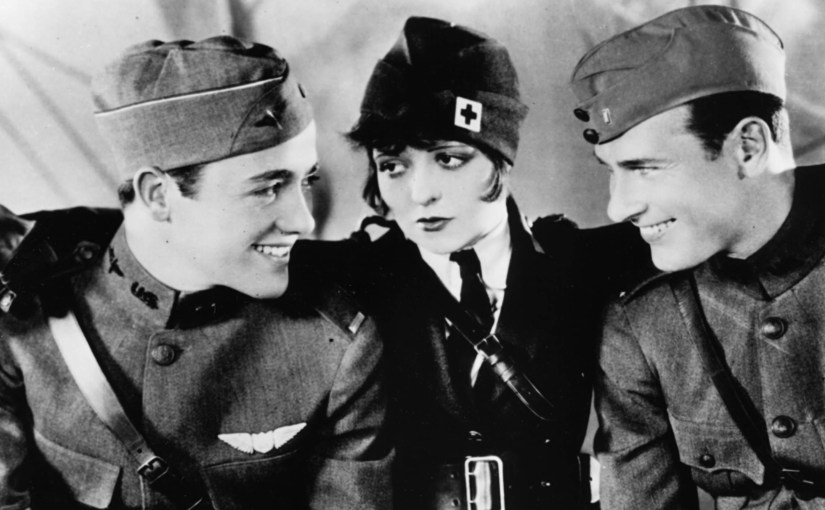
To watch this two-and-a-half-hour silent movie is an exhilarating experience.  The story focuses on two young men, Jack Powell and David Armstrong (Charles “Buddy” Rogers, William Arlen), who both pine for the affections of a local girl named Sylvia (Jobyna Rolston).  Their competition is put on hold as they enlist to train and serve as fighter pilots in biplanes against the German opposition.  A side relationship focuses on Mary (the adoring Clara Bow), and her affections for Jack who has no interest in her. 

Wellman’s film takes you through the regimen of enlistment with the calisthenics the men practice, through mentorship and then on to piloting the planes.  Jack and David set aside their differences to unite against the common enemy where they routinely say just before take-off “All set?” followed by “Okay!”  Reader, in a silent film with only a few frequent dialogue cards, this relationship was as effective as witnessing Maverick & Goose or Han & Luke.  (“I feel the need, the need for speed.” “Okay Chewie, punch it!”)

William Wellman captures outstanding dog fight footage and enormously vast battle scenes that look even more detailed than what I found in the graphically convincing 1917 from just a few years ago.  

Paramount Pictures invested in a 2012 restoration following the discovery of this film in a basement in France. I believe the restoration incorporated orange flames and sparks into the planes that get shot down, as well as from the cannons that fire from the pilots’ cockpits.  Yet, unlike CGI or quick edits, Wellman holds his camera in the skies above, often following the spiral trajectories of the downed planes with numerous ground crashes.  His camera is also teetered on the hull to capture engaging closeups of the pilots who are actually flying in air during the shooting of this picture.

Both Allied and German pilots get shot with blood pouring from wounds.  There are direct head shots as well as to the torso and appendages. Before Hitchcock, chocolate syrup was already being used as an effective substitute. Wings is action packed and one of the best war films I’ve ever seen.  These are not just random fight scenes captured on film.  A story comes from the developing dog fights. Suspense stems from what becomes of David while Jack wonders if his friend is even alive.

Wellmen’s film does not just resort to the battlefield and the skies above.  There’s a personal story going on for Mary, Jack and David.  Mary is enlisted as a traveling nurse for the troops and the director captures emotive moments from the silent film star Clara Bow as her character reunites with an intoxicated Jack on leave in Paris.  For a silent picture that must rely more on visuals, bubbles are incorporated to float away from the beverages as well as out of the actor’s mouths.  It looks silly like what Chaplin or Laurel & Hardy might include.  However, as Mary witnesses a drunken Jack, exhausted from the perils of war, there’s a sadness to seeing her literal despair for the one she loves. She’s even forgiving enough to accept Jack’s desperate need for immediate affections from a swinger girl.

Escapist comedy also comes into play. A character called Herman Schimpf (El Brendle) is the klutz of the regimen. He’s clumsy with the exercises and Brendle’s physical performance lives up to silliness of his character name. The drill sargeant can not even fathom a pilot named Herman Schimpf accomplishing the heroics expected of a world war flying ace. My extensive experience with late twentieth century films lent references to Goldie Hawn, John Candy and Bill Murray in an army lampoon like Private Benjamin or Stripes. Before these guys, there was Herman Schimpf.

I recommend you watch Wings like I did.  As with most silent films, there is a running loop of rag time piano music.  It’s terribly distracting and does not ever appropriately compliment the images on screen.  I turned my sound system off and watched in silence.  Oddly enough, there are so many explosive visuals to this piece with an enormous amount of artillery vehicles, planes and ammunition being fired, that I could subconsciously hear a sound system in my head as the film moved along with massive explosions, horrific crashes, rattling machine gun fire, and the screams of despair from the 5,000 American troops who were loaned by the United States military to complete the construction of the film. The U.S. hoped that Wings would serve as a recruitment piece for new enlistments.

I have no doubt Wings still serves as a seed for the future of filmmaking.  I easily found elements of hit modern films from Top Gun of course, to the romantic angles found in The Dark Knight, It’s A Wonderful Life, Titanic and It Happened One Night, and furthermore on to the regrets of serving in a destructive war as covered in Born On The Fourth Of July and 1917.

Standards in practice were also not enforced at this time. Wellman had the freedom to shoot graphic violence and even nudity that includes nude shots of Clara Bow and enlisted men going through their routine of living on an army base. Wellman had no hesitancy for offering the authentic.

It is a step back in time, when this film was produced just ten years after the first war ended. William Wellman provided convincing direct oversight from his experiences as an actual fighter pilot, practically reenacting what he went through.    He went so far as to relocate where he was shooting the aerial footage because the Texas skies had no clouds to offer clear composition of the acrobatically flying biplanes.  The clear blue skies could not highlight the planes well enough. He believed they looked like blobs on film. So, artistically, the director refused to settle.

Wellman also went so far as the shoot the actors up in the sky, actually flying the planes.  This allowed for a first-rate perspective as the hair blows in the breeze high above.  Forgive me as I do this again but it’s reminiscent of when I saw Christopher Nolan’s Dunkirk. Much of this kind of footage is identically found in Nolan’s film save for the black and white photography and the absence of sound.

I also have to credit Wellman as a pioneering filmmaker with how novel his camera work is during a speakeasy sequence in Paris.  Though it was not a steady cam, a camera is attached below a harness to allow a one-shot zoom over a half dozen bar tables at once with a crowd of extras occupying the spaces.  Before Scorsese, Wellman had already thought of this eye-opening approach. It is a one shot moment that belongs on any highlight reel.

Simply, there is so much to appreciate technically and theatrically in Wings. There’s a lot of groundbreaking material to uncover. The aerial footage is stunning.  This cast is superb.  The writing is compelling.  Wings has to be one of the most pleasantly surprising films I can recall in a very long time.  The feats that were accomplished here are magnificent.  

Wings is easily a must-see film for any film buff, and anyone who loves movies in general.

KELLY’S HEROES

By Marc S. Sanders

There’s gold in them thar Nazi castle.  Hence the plot is set in motion for a World War II romp called Kelly’s Heroes.  It’s easy to get acclimated to the lightheartedness of this comedic war picture from director Brian G Hutton (Where Eagles Dare). 

The movie opens during a dark and rainy evening within a German occupied France. The on-screen credits pop up revealing an all-star cast of tough guy actors who are also quite funny.  Clint Eastwood is the title character who sits behind the wheel of a jeep. When the Nazis take notice, he hits the gas, makes a sharp left through the muddy road, and zooms away while avoiding shell fragments coming down on him. The film’s catchy theme song marches in – “Burning Bridges” performed by the Mike Curb Congregation.  The chorus of singers speak as a soldier who does not even care about authority or the rules of war.  The lyrics are rather simple to understand, and you want to just join in on the revolutionary merriment.  The song enters the film again and again over the next two and a half hours, reminding you to just enjoy the ride against this tragic capsule of time from the first half of twentieth century history.  Hawkeye Pierce couldn’t have said it better.

In his capture, Kelly has brought back a Nazi commandant and when he sees a fourteen-karat gold bar in the German’s possession, it’s easy to surmise that there must be more where this came from.  Turns out there is a stash worth roughly sixteen million dollars crated in a bank vault in the center of a stopover town, located across enemy lines in war torn France.  Kelly and his squad, led by Big Joe (Telly Savalas), are under heavy fire and forced to retreat for safety, but that isn’t going to stop him from making a snatch and grab.

Joe has been given orders to get the unit to safety and allow them a three-day reprieve of R & R.  However, he’s just as enticed as Kelly and gradually a small team of men assemble to pull off the heist.  First, they’ll need tanks to fight off the nearly indestructible Nazi Panzer machines they expect to encounter.  Fortunately, Crapgame (a scene stealing Don Rickles) and Kelly come across the hippie loving Oddball (another scene stealer – Donald Sutherland) who can supply the tanks they need and fend off what stands in the unit’s way.  What’s also important is Oddball find a bridge for the squad to cross before the allies destroy it.  That’s not so easy.  Sutherland is somewhat of a spaz; maybe an ancestor of Cosmo Kramer.

Meanwhile, a blood and guts two-star General Colt (Carroll O’Connor) is screaming for results from his subordinates.  When he intercepts the guys’ communications, he can’t help but be impressed with their progress and strategies of attack.  He’s ready to go into the field with a handful of medals for every American soldier that’s giving a damn. 

The looniness of Kelly’s Heroes is hilarious. Eastwood carries his signature quietness about him.  So, he’s the straight man leaving the loudmouth material for Savalas, Rickles, and a bevy of supporting actors.  Plus, there’s O’Connor in his own side story.  Sutherland is another kind of comedy – the free spirit who appears to have taken one too many shells to the noggin. 

It’s not a slapstick kind of movie.  It operates like the doctors from M*A*S*H.  These draftees have no loyalty to a cause.  They look out for each other.  They know how to survive the battles and they know that some will not make it.  Brian Hutton does not forget the frightening impact of war.  A memorable scene occurs when the unit realizes they are dead center in a mine field, offering up the life and death factor blended in both the comedy and drama that comes with a heroic war picture. 

There are some inconsistencies to Kelly’s Heroes.  Often, it feels like some scenes that would connect certain dots must have been edited out of the final print.  As the men come close to the to the bank where the gold is stashed, two of the soldiers are already in the overlooking bird’s nest tower giving a low down of the area to Kelly and Big Joe.  Yet, how did those guys ever get up there?  It’s not a terrible violation.  There are sequences like this that make the movie feel a little uneven. Clint Eastwood even went on record expressing his disappointment with the film as there were excised moments that drew more out of Rickles and Sutherland’s characters, and a few of the other supporting characters played by Gavin MacLeod (The Love Boat, The Mary Tyler Moore Show), Stuart Margolin (a very underrated character actor who had memorable episodes on the M*A*S*H tv series) and a young Harry Dean Stanton (here credited only as Dean Stanton). 

This film was shot in Yugoslavia simply because the country still had possession of many tanks and vehicles from the story’s time period.  The art design and battlegrounds are very impressive.  Before CGI, Brian G Hutton and his team were reenacting a lot of these loud, bombastic battle scenes complete with big fireballs of explosions along with the aftermath wreckage left behind of rubble and blasted out walls and craters.  Hutton positions his cameras either on top or right behind the cannons and guns mounted on the tanks.  So, you are actually getting a first person view of these massive war machines driving across the plains while shooting off their firepower.  The filmmakers did not hold back on making World War II look authentic in its battle wear.  I’ll be bold enough to say the settings are comparable to what Spielberg accomplished with Saving Private Ryan, and what Eastwood depicted in Letters From Iwo Jima.  The lens is just not as serious as those films.

The cast is a magnificent fraternity of brazenly funny tough guys, in the same vain as The Dirty Dozen, though much more lighthearted.  They’re a motley sort who all stand out among their similar appearances in green army fatigues and netted helmets. 

Kelly’s Heroes is a lighthearted comedic adventure where the heist is what you come to see against a historical backdrop when nothing was ever sensationalized fun.  History offers up a cruel world of pain and suffering, but who says we can’t enjoy ourselves through all the blood, guts and misery as our heroes ride off into a ravishing orange sunset?

Go for the gold and catch up with Kelly’s Heroes.

THE BITTER TEA OF GENERAL YEN (1932)

by Miguel E. Rodriguez

DIRECTOR: Frank Capra
CAST: Barbara Stanwyck, Nils Asther, Toshia Mori, Walter Connolly
MY RATING: 10/10
ROTTEN TOMATOMETER: 86% Certified Fresh

PLOT: During the Chinese Civil War, an American missionary is gradually seduced by a courtly Chinese warlord holding her captive in Shanghai.


When I hear people talking about the “pre-Hays-Code era” of Hollywood, I conjure up seldom-seen images of nearly-nude starlets bathing or swimming or dancing in unison, as filmmakers and studios took advantage of the proven formula: Sex Sells.  But it never really occurred to me that some filmmakers would be able to use that freedom to make films that not only showed a little bit of skin, but also took the time to tell a story that appealed to mature adults in ways that seem fresh and alive nearly a century later.

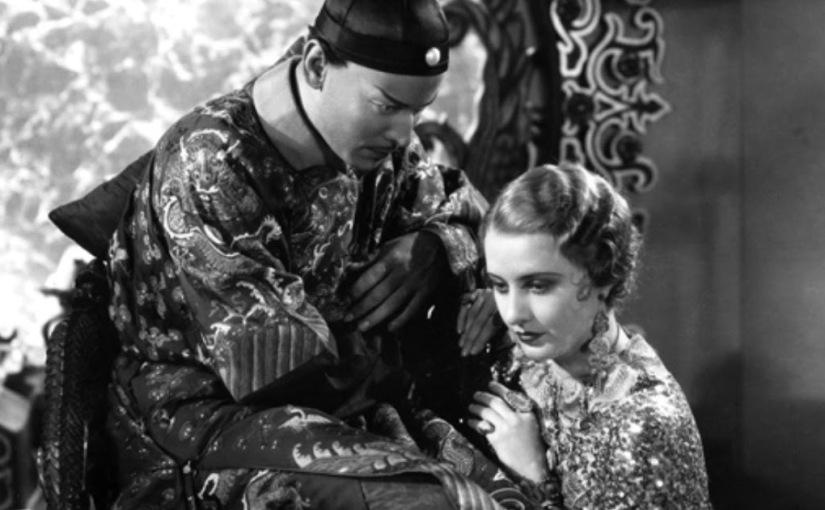
Frank Capra’s The Bitter Tea of General Yen is a contemporary “Beauty-and-the-Beast” tale of an American missionary, Megan (Barbara Stanwyck), who travels halfway around the world to Shanghai to marry her childhood sweetheart, Bob (Gavin Gordon), also a missionary.  It’s set in an unspecified year during the Chinese Civil War [1927-1949] when turmoil rocked the city and hundreds of thousands of refugees filled the streets.  A remarkable opening shot shows hundreds of extras flowing past the camera as Shanghai burns in the background, while a houseful of Americans prepares for Megan’s wedding, untouched and unbothered by the human misery thirty feet from their doorway.  (I was reminded of the idyllic family scenes in Spielberg’s Empire of the Sun where English families held birthday parties oblivious to the impending chaos in Japan leading to World War II.)

Bob insists on postponing his wedding to Megan so he can help rescue some orphans stranded in a burning section of the city.  During the rescue effort, they are separated; in a surprisingly violent scene, Megan is struck on the head by an angry civilian and is knocked unconscious.  She wakes up on a train and finds herself under the care of General Yen (Nils Asther), a famous warlord, reputed to be more bandit than soldier, but who is unfailingly courteous and polite to Megan, even as he informs her that he is unable to return her to Shanghai for security reasons, effectively making her his prisoner.

This scene on the train is a masterpiece of visual storytelling.  Yen sits in a chair and is tended to by Mah-Li (Toshia Mori) who seems to be more than just Yen’s servant.  In an unspoken passage, Mah-Li puts a pillow under Yen’s head, covers his legs with a blanket, and reclines on a chaise.  Megan, with her head bandaged, observes this ritual, then notices Yen staring intently at her.  She becomes acutely aware that she is showing a small patch of bare leg through her covers.  As slowly as possible, she gently pulls the covers up to cover her leg.  Mah-Li observes all of this, Megan watches Mah-Li, and they all go to sleep, each one of them knowing exactly what has been stated without saying a word.  Brilliant.

In a bold move, once Megan is under Yen’s care/protection/whatever, the film never cuts back to her fiancé or to any of the missionaries.  In fact, Yen refers to a Chinese newspaper article which states that Megan is missing and presumed dead.  So that takes care of that.

In another scene of startling violence for its time, Megan wakes up one morning in her private room to the sound of gunfire.  Yen’s soldiers are executing prisoners in a courtyard across the way.  Megan is horrified and complains to General Yen, who promptly orders the soldiers away: “They are taking the rest of them down the road, out of earshot.”  Megan calls him cold-blooded, but he reasonably says he has no rice to feed any prisoners: “…isn’t it better to shoot them quickly than let them starve to death slowly?”

The theme of the film establishes itself in this and other scenes.  Megan, a Christian missionary who believes that people can and must be good for the sake of their souls and their fellow man, finds herself at odds with (and strangely attracted to) a soldier who is brutal by necessity and has no illusions about any innate goodness to be found in any man during a time of war.  There is a powerful scene when she argues with Yen, and in a heated moment utters a racial slur, and as soon as she says it Yen goes silent and squints at her, and she realizes she has crossed a line.

This is not the kind of moral and ethical complexity I expected from a melodrama made only five years after the advent of sound.  I saw the name of Frank Capra and the weirdly evocative title, and I imagined a potboiler with outdated attitudes and cheesy dialogue and racial stereotypes galore.  I could not have been more wrong.  Yes, the title character is played by Nils Asther, a Swedish actor in “yellowface,” but I had to remind myself that, in the time the film was made, this was de rigueur for most films dealing with Asian characters (the highly popular Charlie Chan films starred white actors in the role for years).  I don’t endorse the practice, but it is a fact that must be acknowledged.  And, it must also be said, Nils Asther’s performance as a Chinese man is quite convincing.

The Bitter Tea of General Yen gives us espionage, intrigue, forbidden romance, high melodrama that teeters on the verge of soap opera but never gives in to that temptation (not like Gone with the Wind would do in 1939 with, let’s face it, a rather similar character arc for the two romantic leads).  It’s a film that could be remade today, almost word-for-word, and I have no doubt it would feel right at home with today’s hip audiences.  So many other films of that era feel obviously dated by their dialogue or their performances.  The Bitter Tea of General Yen suffers none of those drawbacks.  It’s a modern classic that just happens to be over 90 years old, that’s all.

[Author’s Note: there is, in fact, one sequence which I’ll call “The Dream Sequence” that feels uncomfortably over-the-top in its depiction of the vilest racial stereotypes associated with Asians.  However, given the context of the scene, who’s having the dream, why they’re having it, and the dream’s resolution, it fits perfectly with the story.  I can’t find it in myself to “cancel” this film based on this sequence.  Just in case anyone was wondering.]

HOTEL TERMINUS: THE LIFE AND TIMES OF KLAUS BARBIE (1988)

by Miguel E. Rodriguez

DIRECTOR: Marcel Ophüls
MY RATING: 9/10
ROTTEN TOMATOMETER: 100% Fresh

PLOT: A documentary about Klaus Barbie, the Gestapo chief in Lyon, France, and his life after the war.


There is so much to unpack in Hotel Terminus, Marcel Ophüls’ epic documentary, that I am hesitant to even try to write about it.  In terms of the craft of filmmaking, there is nothing to critique aside from the skillful editing, which surprisingly makes its 4.5-hour running time fly by.  In terms of content…I mean, where could I even begin?  Here’s a summary I found online: “Marcel Ophüls’ riveting film details the heinous legacy of the Gestapo head dubbed ‘The Butcher of Lyon.’ Responsible for over 4,000 deaths in occupied France during World War II, Barbie would escape – with U.S. help – to South America in 1951, where he lived until a global manhunt led to his 1983 arrest and subsequent trial.”

Wait, what?  The United States intelligence apparatus smuggled a brutal Nazi officer out of Europe?  Six years after the Nuremberg trials?  Yes.  Ophüls interviews various players from US Army Counterintelligence – known as the “CIC” in the 1940s – who state flatly on camera that Barbie had connections and information regarding Russian communists, so it was in America’s best interests to keep Barbie alive and out of prison and get him to South America.

So, at the very least, today I learned something.

This sprawling documentary also features eyewitnesses to Barbie’s atrocities in Lyon, France, where he was stationed.  I don’t want to recite a laundry list of these terrible acts, but the film does key on two specific events during his tenure: the arrest and execution of Jean Moulin, a French Resistance leader, and the deportation to Auschwitz of 44 Jewish children from an orphanage in a town called Izieu.  Ophüls interviews scores of people who were in the room when Barbie arrested Moulin.  Many of them disagree who was to blame – a rat or someone with loose lips – but they all remember who made the arrest.  The stories from witnesses to the deportation of the children are beyond belief.

What is the point of a documentary like this?  Why should it be important for a filmgoer, or just an average Joe, to block out nearly five hours to watch a series of talking heads tell story after shocking story about the inhuman tactics of a monster?  Well, for one thing, that’s not the whole story.  Hotel Terminus actually has an arc, because Barbie was discovered living in Bolivia in 1972.  In 1983, he was extradited to France where he was convicted on numerous crimes against humanity and sentenced to life in prison, where he died in 1991.  The filmmakers didn’t know that in 1988, of course, but it felt good to throw that factoid in there.  Another interesting factoid: America apologized to France in 1983 for helping him escape to Bolivia in the first place.  Better late than never, I guess?

So, it’s good to know while watching that the man in question will eventually get his just desserts.  But there are times when it almost feels like the “A-story” of Barbie’s eventual arrest gets overwhelmed by the “B-story,” which is the paradoxical attitudes of many of the people interviewed.  One man wonders, what’s the point of it all?  Barbie committed his crimes forty years earlier, and France has a statute of limitations of twenty years, so just let the man grow old and die in obscurity.  Another theorizes that stirring up old memories of the war when many would rather move on actually created more civil unrest in France and Germany.  Barbie’s defense attorney at his war crimes trial (a Eurasian Frenchman) wonders why Barbie is being tried for crimes against humanity while France’s own acts of torture and horrific imprisonment during the Battle of Algiers are discreetly ignored.

And always Ophüls has rejoinders for each of these statements with stories of families separated, men and women tortured, family members whisked away and never seen again.  One woman recalls being tortured as a girl by Barbie, while her mother was told, “This is YOUR fault; if you would just talk, we would stop.”  And so on, ad infinitum.  But I am compelled to point out again how compelling this was.  These and so many other stories like them did not depress me or lower my spirits.  Instead, I was riveted.  I can’t explain why.  For myself, I felt like this was something I needed to hear, and other people needed to hear.  Here was a record of something that really happened, to real people in a real place in a time that was not so long ago, in the grand scheme of things.

There was also a section that really made me take notice.  Many, MANY people said on camera that, in his old age, Barbie was “a good man.”  He was friendly to his neighbors – even some Jews! – and a loving father.  His daughter-in-law is interviewed, and she states that he always had a kind word for her and always tried to include her in his family circle, even after her husband (Barbie’s son) died.  It made me think about the driving force behind last year’s brilliant Zone of Interest: the banality of evil.  Perhaps among many others, Barbie was living proof that evil will not always wear a black hat and have glowing red eyes.  Evil is just as capable of engaging you in friendly conversation as the next man.  (I was also reminded of a line from David Fincher’s Se7en: “If we catch John Doe and he turns out to be the devil, I mean if he’s Satan himself, that MIGHT live up to our expectations.  But he’s not the devil.  He’s just a man.”)  Is that one of the lessons of this film?  That evil is not supernatural or some kind of horrific aberration, but just a small person with delusions of grandeur?  Discuss.

There are echoes of Schindler’s List in the details of these stories, but Ophüls notably never uses any archival footage of concentration camps or of the Holocaust itself.  He apparently felt that audiences had, regrettably, become accustomed to the gruesome imagery of those events.  Instead, he relies on the viewer’s imagination to provide all the necessary details.

He also, tellingly, never provides answers to the stickiest questions that surrounded Barbie’s trial, especially the one about France being willing to charge him with crimes against humanity while ignoring their own history in Algeria.  I thought about that one a lot in relation to America.  Our country is great for a whole host of reasons, but it’s not perfect.  We rise up in vocal disapproval when a foreign country commits genocide, or when a country’s citizenry is threatened by totalitarianism…while ignoring (for the most part) the fact that our country exists because of genocidal practices against indigenous Americans.  Am I suggesting that perhaps Ophüls is wrong to focus on Barbie and not France’s history?  Absolutely not.  Barbie was a monster and got what he deserved, belatedly or not.  But I am suggesting that the film raises questions that deserve further discussion.

Ultimately, I’m glad I saw Hotel Terminus, and I would unhesitatingly recommend it to anyone who asks.  The visceral nature of the stories told by some of the subjects is enough to make it compelling, even without the overarching structure of following Barbie to his downfall.  It’s a challenging watch, to be sure, but I promise you’ll never be bored.  Trust me.

BORN ON THE FOURTH OF JULY (1989)

by Miguel E. Rodriguez

DIRECTOR: Oliver Stone
CAST: Tom Cruise, Kyra Sedgwick, Raymond J. Barry, Jerry Levine, Frank Whaley, Caroline Kava, Willem Dafoe
MY RATING: 7/10
ROTTEN TOMATOMETER: 84% Certified Fresh

PLOT: A biography of Ron Kovic, a fiercely patriotic Marine who fights in Vietnam, is paralyzed in battle, and experiences a dramatic turnaround upon his return home.


I can already tell this is going to be a difficult review to write.

There is nothing overtly wrong with Oliver Stone’s Born on the Fourth of July.  It is expertly directed, and the pacing never flags.  Tom Cruise’s Oscar-nominated performance is deservedly legendary; he leaves nothing in the tank, a fierce rebuttal to critics who thought he was nothing but a pretty face.  But even though there is much to admire, when the closing credits rolled, I felt oddly detached.  The movie kept me at arm’s length from really engaging with the lead character.  Or maybe I kept the movie at arm’s length.

Could it be that I simply don’t care for Vietnam films anymore?  Not likely.  One of my absolute favorite films is Michael Cimino’s masterpiece The Deer Hunter.  In fact, the opening scenes of Born on the Fourth of July are reminiscent of that earlier film in that it takes its time establishing the main character, Ron Kovic, as a young man in the early-to-mid 1960s at the dawn of the Vietnam War.  Born and raised in Massapequa, New York, his strict Catholic upbringing and his devotion to high-school wrestling instill a strong sense of right and wrong in the world.  A point is made about how America had never lost a war up to that time.  Kovic’s wrestling coach exhorts him and his teammates as if he were a Marine drill instructor.  “I want you to kill!  You hear me?! …You got to pay the price for victory, and the price is sacrifice!!”  It’s not very subtle, but Stone is making it clear that, in those days leading up to the Vietnam quagmire, the American credo was, “Winning isn’t everything, it’s the ONLY thing.”

Kovic enlists, sees combat, and during two horrific sequences, he experiences: an unintended massacre of Vietnamese civilians, the accidental shooting of a fellow soldier (with Kovic himself behind the trigger), and a fateful gun battle during which a bullet went through his right shoulder, collapsing a lung and severing his spinal cord, paralyzing him from the waist down.  These scenes are appropriately skittish and terrifying, putting us in Kovic’s boots and making us feel the unimaginable stress of fighting a war where half the time you weren’t sure who or what you were shooting at.  Kovic is shipped stateside…and here, as they say, is where his troubles REALLY began.

If the scenes set at the VA Hospital during Ron Kovic’s convalescence weren’t based on his actual experiences, I would denounce them as sensationalistic and manipulative.  Rats roam free among the beds.  (A nurse provides spectacularly unhelpful advice: “You don’t bother them, they ain’t gonna bother you.”)  Orderlies spend their down time getting high on marijuana or worse.  Unchecked catheters get backed up.  When a vital blood pump malfunctions, a doctor has to go to the basement to “rig up a substitute.”  And through it all, Ron Kovic does everything in his power to prove to the (correctly) pessimistic doctors that he will walk again, even re-injuring himself in the process.

(It’s futile, I know, to critique a film for what it’s not instead of what it is, but I can’t help wondering if I might have developed a more emotional reaction or attachment to the film if the entire film had focused on Kovic’s tenure at the VA hospital…although I will admit that would be a thoroughly depressing film.  Also, it might have developed some unintentional similarities to One Flew Over the Cuckoo’s Nest.  Who knows.)

The rest of the film details Kovic’s return home to his family, his emotional swings between the lowest kind of depression (“Who’s going to love me, Dad?  Who’s ever going to love me?”) and angry shouting matches with his parents and occasional bar fights.  Eventually, Kovic has a revelation: he still loves his country, but he can’t stand the government that sent him and his friends halfway around the world for a cause he no longer understands.  After a short hiatus in Mexico (I won’t get into too many details about that plot point because it’s the one section of the film that borders on boring), he returns home and dedicates his life to speaking up for the men and women who returned from Vietnam to a country that, at worst, hated them, and at best, simply didn’t care about them.

Again, the film is a stirring portrait of a man and a life.  However, as much as I want to, I can’t pin down what it is about the movie that failed to reach me at the kind of emotional level that other biographies have done before.  I just recently watched My Left Foot, with Daniel Day-Lewis’s towering performance at its center.  Another film biography, another main character confined to a wheelchair, a character who comes to terms with himself and how the world responds to him and comes up with a way to respond to the world.  But My Left Foot made my heart soar in a way that Born on the Fourth of July never achieved.  I watched the movie intently, focusing on every plot development and every nuance.  But it just didn’t grab me.  I am at a loss to explain why.

Could it be because of the presence of Tom Cruise in the lead role?  He showed these kinds of acting chops again ten years later in Magnolia, giving another Oscar-nominated performance.  In that movie, he completely disappeared into the role, despite having one of the most recognizable faces on the planet.  Perhaps the younger Tom Cruise (only 27 at the time) emits the kind of wattage that overshadows those around him?  So that you’re aware of the face first and the character second?  Maybe.  So why doesn’t the same thing happen in Magnolia or even The Last Samurai?  Perhaps it took him ten years to find a way to modulate or customize his performance so that, when it counts, the character comes first and the Cruise persona second.

I’m speculating.  The bottom line is, Born on the Fourth of July is a worthy addition to the resumes of both Oliver Stone and Tom Cruise.  It knows the story it wants to tell and resolutely sticks with it the whole way.  There are no sidetracks at any time, not even when he becomes an activist.  The focus is always on Ron Kovic, not the cause.  Stone and his screenwriters trusted that the story of Ron Kovic would draw enough attention to the cause on its own.  That approach would work with just about any other film.  This time, it had the effect of diluting the emotional experience while still holding my attention all the way through.  I would still recommend it to anyone who hasn’t seen it, if for nothing else to see Cruise play a role where he gets to sound notes he rarely got to play in his early career.  Would I watch it again?  Maybe.  I think the story is important enough for me to try to see what I might have missed this time around.

CIVIL WAR

By Marc S. Sanders

On the drive home, my wife and I left saying that we could not recall this country existing on a such a divisive plane within our lifetimes as it is currently.  Maybe we were not paying enough attention as we were growing up.  With that in mind however, it’s not unreasonable to see a possible future coming to life from Alex Garland’s Civil War.  What’s clear is the vitriol displayed in Garland’s film is not surprising.

Civil War is an observational piece as it is told through eyes of photojournalists who function with no stake in the conflict.  Lee (Kirsten Dunst) has become a legendary war photographer.  Along with Joel (Wagner Moura), who’s a reporter, they intend to journey through the Northeastern battlegrounds from New York City to Washington D.C.  As they believe, the seceded states of California and Texas are close to overthrowing the government, they are determined to interview and photograph the President (Nick Offerman) before he’s taken prisoner or more likely, assassinated.  An old-time New York Times journalist named Sammy (Stephen McKinley Henderson) and Jessie (Cailee Spaney), a young photographer who idolizes Lee, tag along.  To do this trip is a crazy undertaking, but Lee and Joel know what importance their purpose serves and the fact that they have press passes should uphold their survival amidst violence and chaos. 

My wife asked which side does writer/director Alex Garland lean towards politically and I said I do not know as he’s primarily known for science fiction movies (Ex Machina, Annihilation).  Garland likely wants his political leanings to remain unknown as it upholds what Civil War deliberately steers its focus away from.  We never learn what policies each side of this war stands for or what instigated it.  In fact, it is quite intentional of Garland to make what are arguably the bluest and reddest states in the United States the united seceders who lead one side of this bloody chess board. 

This fictionalized war is well established when the picture opens.  The President attempts to deliver a speech that is clearly uncertain despite the staple resilient vocabulary he includes.  Nevertheless, buildings on fire randomly appear, looters are bloodied pulps who are strung up by random factions, downed helicopters are the carnage occupying a parking lot in front of a JC Penney.  Nothing that anyone says, much less the President of the United States are going to sway this country into a state of comfort.  That time has passed.

The production value of Civil War is astonishing.  Sometimes it looks just like photographic accounts of what we see on the evening news coverage from the Middle East.  Garland also never forgets that his main characters are photographers as he captures in freeze frame people being randomly shot or beaten or simply screaming at one another.  The film abruptly turns off the sound and a black and white photograph interrupts the chaos for you to catch a freeze frame glimpse.  The editing lends to the character designs of the story’s four main players.  I did question, however, why video footage was not also taken beyond just photographs.  Cell phones are not used or mentioned in this picture.  The inconvenience of Wi Fi on a laptop is however. 

The sound design of the film is spectacular and reminiscent of how powerful it served in the Oscar winning film The Zone Of Interest.  As the characters set up camp for the night, rapid pop pop pops are heard in the distance.  On multiple occasions, Garland gets you right in the middle of the various firefights that occur in and around office buildings or what were once shopping districts.  The machine gun fire and rubble blasts are all around you.  The cinematography is also quite eye opening.  I like to think of areas like Virginia and the Carolinas as beautiful American spots during the summertime, and that is when these events unfold. Yet, to see how ugly it is amidst endless debris and bloodshed is an awful, still convincing effect.

My Cinemaniac pal Thomas made a good point about Garland’s approach.  Out of nowhere a needle drop of songs will intrude on the picture and often I found them to be overly distracting and definitely unnecessary.  One such number is a hip hop tune with samples from an 80s tune (I can’t remember which one now) that plays over a gunfire scene.  Regrettably, it takes me a little out of the picture.  Thomas is entirely correct in this area. This technique is not effective as when Oliver Stone or Francis Ford Coppola included The Doors in their set pieces. 

Kirsten Dunst is quite good in her role.  Lee knows where to point her camera, and Dunst lives up to the legendary status that her character is supposed to have.  You can feel the exhaustion that teeters on her mental stability, especially as the story reaches its third act.  Lee has been doing this for far too long and the horrors are a part of her now.  Her trauma can never be erased or covered.  Cailey Spaeny is the standout performer though as Jessie, the young girl who is eager to reach the levels of her idol.  Lee wishes Jessie would just not tag along.  Alex Garland writes good characters, but they are not what stayed with me following the conclusion of the film.  What upholds Civil War is the depiction of this all too convincing reality. 

I write this article the morning after Iran delivered missiles and drones in the direction of Israel and with every article I’ve read, I ask myself again and again what is the purpose.  These efforts are not done for strategic overthrow.  Rather, actions are executed with hate and revenge and the only ones who are paying for it are those that are not arguing; those that are just trying to raise families and live in peace.  Alex Garland might know what finally began his fictionalized American civil war, but none of that matters any longer.  It’s what the pawns do to one another in place to place to place.

The fighters and individuals you meet in his film all move with their own ulterior motive.  A chilling scene includes Jesse Plemons (Dunst’s real-life husband) dressed in camouflage fatigues who does not even have a statement or a cause to deliver.  His minimal dialogue is nowhere near as expressive as the vast graveyard of Americans he’s sprinkling with lye and burying. When the press team comes upon him, nothing they say matters or motivates him to lower his machine gun.

Fighting, fighting, fighting.  That’s all you see in Civil War.  You don’t even know the position that the President holds, or even what his name is.  You never learn what party he represents either.  I salute Alex Garland for not leaning one way or another.  It is the divide that is tearing our country, our world, apart and not what we stand for. 

Sadly, some commentators on social media have already devised in their own minds that Civil War is a “woke film” (whatever the fuck that means) simply because of the pink (HOT PINK!!!!!) sunglasses that Plemons’ sadistic character wears.  Reader do not listen to the voices in your head.  There is no political agenda to this film.  Rather, Civil War shows us what occurs when political agendas have been entirely deafened by gunfire.

LACOMBE, LUCIEN (France, 1974)

by Miguel E. Rodriguez

DIRECTOR: Louis Malle
CAST: Pierre Blaise, Aurore Clément, Holger Löwenadler
MY RATING: 7/10
ROTTEN TOMATOMETER: 100% Fresh

PLOT: In 1944, an 18-year-old boy from a small French village collaborates with the Gestapo and subsequently falls in love with a Jewish girl.


The effectiveness of Louis Malle’s Lacombe, Lucien may depend partially on how much you know about cinema history after World War II.  It’s a historical fact that there were French countrymen who sided with the invading Nazis, going so far as to infiltrate the French Resistance and inform on their neighbors to the Gestapo.  When the war ended, that fact was politely and discreetly avoided in war films for decades.  No one wanted to spoil the notion that the whole of France united with each other to harass the Nazis at every opportunity, and that the Resistance fighters were unambiguously, morally pure.  In France, surviving collaborators went about their business, some more anonymously than others.

In 1974, Lacombe, Lucien became one of the first, if not THE first, French film to not only broach the topic of Nazi collaborators, but also to depict the French Resistance as employing guerilla tactics and carrying out assassinations that were just as morally questionable as any other similar attacks in history.  It was a bold move, to be sure.  Even when you remove that context from the film, when you watch it as a stand-alone piece of cinema, it is still makes for compelling viewing.  However, for my part, the very ending of the movie left me frustrated.  While French audiences may have seen it differently in 1974, I saw it almost as if the filmmakers simply ran out of story and used a title card to tie things up in a bow.  But the journey to get to those final frames is worthwhile, even though the lead character is one of the most loathsome people I’ve ever seen on film.  I would compare him to Amon Goeth from Schindler’s List, not because they are similar characters, but because they elicited the same reaction from me: disgust.  (Or maybe they are similar characters…you tell me.)

The film opens in 1944, just a few weeks after D-Day, in a small town in southwest France.  We first meet young Lucien Lacombe, maybe 17 or 18, mopping a hospital floor, apparently doing a good deed for his community.  Through an open window, he spies a small songbird chirping on a tree branch.  Lucien makes sure no one is watching, pulls a slingshot from his pocket, takes careful aim, and kills the little bird with one shot.  He smirks and goes back to the business of mopping.  We will witness many other instances of Lucien killing other animals.

Indeed, many of these scenes are done for real: the actor playing Lucien clearly kills several rabbits with a shotgun, one with a wooden club.  In another scene, he catches, decapitates, and calmly starts to pluck a chicken for dinner, all in one unbroken take.  Now, this would have been normal behavior for someone living in a farm community in the French countryside, where someone has to prepare tonight’s dinner.  The difference is, Lucien seems to enjoy these tasks a little too much.  Even worse, though, are the times where he is utterly impassive about it, especially with the one rabbit he catches in the snare.  These are hard scenes to watch, but in hindsight, they are vital to unpacking or interpreting Lucien’s actions later in the film.

Through a series of events that reminded me a little bit of Goodfellas (“All my life, I wanted to be a gangster”), Lucien allows himself to be recruited into a cadre of French collaborators whose base of operations is a fancy hotel where their opulent lifestyle is a rebuke to those silly Resistance fighters who must scrape a living from the dirt.  He is more than willing to do what it takes to get a taste of the good life.  He turns in a schoolteacher who is also a Resistance officer; he makes a show of being contrite about it, but he quickly gets over it.

The rest of the movie shows Lucien puffed up with pride in his new social status, bullying anyone and everyone who dares to talk down to him.  There are, to be sure, broader statements being made here about the psyche of anyone who deludes themselves into believing in their inherent superiority over their fellow man just because they’re handed a membership card, regardless of how small-minded or shallow they might be.  However, during the movie, I never thought of those broader implications.  It’s a testament to how well the movie was directed and acted that I was concerned only with how Lucien behaved and acted, and not with whatever director Malle was trying to say from a metaphorical or allegorical standpoint.

To watch Lucien bully people around was sickening and pathetic.  He is introduced to a tailor, Albert Horn, who will make him some new clothes.  Lucien’s friend in the Gestapo casually informs him that Albert is a Jew who is only allowed to live in relative peace because of his skills as a tailor, and because he makes regular payoffs to the Gestapo.  Albert has a 20-something-year-old daughter, improbably named France, with whom Lucien is almost immediately smitten, despite her ethnicity.  He tries to impress France by getting her to the front of a food line, but she demurs.  When people in line complain, he smugly explains he’s with the German police and he can do whatever he wants.  The idea of that kind of power in the hands of someone as despicable as Lucien made me as angry as I can ever recall being while watching a film.

In the background of Lucien’s plotline is the shadowy Resistance itself.  Various members of the French collaborators are being killed here and there, certainly not a bad thing.  But the aftermath of their attacks is no less disquieting than anything perpetrated by the pro-Nazi collaborators, especially after a brazen attack on the fancy hotel headquarters, where the bodies of the collaborators are just as dead as the bodies of the Resistance fighters.  Perhaps the film is making a point that dead is dead, no matter which side you’re on, so you’d better be sure you’re dead for the right reasons because history will remember you one way or the other.

At the center of all this is Lucien’s face with his cold eyes and virtually expressionless mouth.  He doesn’t smile, he smirks.  He threatens Albert and France with exposure and arrest if Albert doesn’t allow Lucien to date, then marry, France.  For her part, France is wise enough to know when to humor Lucien and when to go along with his behavior, for the good of her father.  Lucien, besotted with power, is too clueless to realize how smart she really is.

I have a general guideline that I dislike movies with rotten characters at the center of them.  But I must admit that Lacombe, Lucien sucked me into the story and kept me there, despite how much I disliked Lucien himself.  I guess I wanted to see how much the filmmakers would allow him to get away with before he was swatted down.  Whether he gets swatted down or not is for you to discover, but let it be said that the ending manages to have it both ways, which was challenging for me.  I both did and didn’t get the kind of closure I wanted, which explains my somewhat median rating despite how well-made the film is.

It may be that I’m not old enough, or knowledgeable enough, to really appreciate the impact Lacombe, Lucien had on 1974 audiences.  I can only report how it made me feel right now.  It made me feel anger and indignance towards Lucien throughout the whole movie, even when he makes a crucial decision that seems as if it will redeem his character.  I don’t think it does, because the damage he instigated has been done and cannot be undone by a single act of contrition when it’s far too late to make any difference.  Perhaps that’s not a very Christian idea, but that’s how the movie made me feel, regardless.  Lucien deserves what he gets and more.  Does that apply to the real-life French collaborators, many of whom were still alive when this movie was released?  It’s not for me to pass judgement on those people.  But I can’t deny how the movie itself made me feel towards the people within the world of the film.

THE GUNS OF NAVARONE (United Kingdom, 1961)

by Miguel E. Rodriguez

DIRECTOR: J. Lee Thompson
CAST: Gregory Peck, David Niven, Anthony Quinn, Anthony Quayle, Irene Papas, Richard Harris
MY RATING: 8/10
ROTTEN TOMATOMETER: 92% Fresh

PLOT: A team of Allied saboteurs is assigned an impossible mission: infiltrate an impregnable Nazi-held Greek island and destroy two enormous long-range field guns preventing the rescue of 2,000 trapped British soldiers.


The Guns of Navarone is a “message” picture cleverly disguised as a World War II action-adventure/thriller.  No surprise there since the screenwriter was Carl Foreman, who also co-wrote 1957’s The Bridge on the River Kwai, another stirring wartime adventure with a strong anti-war message buried inside.  I found it interesting that, in the multiple behind-the-scenes documentaries on the Blu-ray, not one of them mentioned the one movie which I feel most resembles The Guns of Navarone: 1967’s The Dirty Dozen.  In both films, teams of men mount insurmountable odds to accomplish an insanely difficult mission, incurring casualties while ultimately succeeding.  In both films, there is a buried, or not-so-buried, subtext about the futility of the mission and/or war in general, while still gluing audiences to their seats.  However, given the timeframe of the release of The Guns of Navarone in the early 1960s, I find it to be the more surprising of the two, despite the foregone conclusion of the movie.

The movie’s narrated prologue tells us everything we need to know.  (Forget for a moment that there is not, and never was, a Greek island called Navarone.)  In 1943, two thousand British soldiers marooned on the island of Kheros must be evacuated before Germany convinces Turkey to join the Axis.  But the only sea lane to Kheros is defended by two massive German guns built into the sheer cliffs of the island of Navarone.  The guns must be knocked out of commission by a team of Allied saboteurs before any rescue attempts can be made.  This team will be led by Captain Mallory (Gregory Peck), Corporal Miller (David Niven), Colonel Stavros (Anthony Quinn), and Major Franklin (Anthony Quayle).  Along with the rest of the team, they must sneak on to Navarone, scale a steep cliff at night, and sneak across the island to the guns, hooking up with Greek resistance fighters along the way.  These details are laid out with admirable brevity, during which we are given just enough information about each of the three primary characters to understand their actions once the mission is underway.

The Guns of Navarone may be constructed almost entirely out of war movie cliches regarding desperate men behind enemy lines on a secret mission, staying undercover, close calls, and unexpected setbacks.  However, I enjoyed how much Navarone sort of “leans into” the material.  It’s almost as if the filmmakers said, “Okay, so this is a cliché, right?  We might as well embrace it and do it up right.”  For example, we find out that one of the squad commanders has a nickname: “Lucky.”  In the history of movies, any character in a war picture named “Lucky” has been anything but.  You know this, I know this.  Even so, as events transpired, I found myself thinking less and less about the most cliched material and just admiring how it was executed.  It’s a tribute to the director, J. Lee Thompson, that he found a way to present everything in such an uncomplicated fashion that its very directness pushes aside our suspension of disbelief.

That’s not to say there aren’t a couple of surprises.  Capt. Mallory devises an ingenious method of dealing with a man so injured he may have to be left behind.  A clandestine trip to a local doctor turns into something quite different, offering Anthony Quinn the opportunity to perform some amazing off-the-cuff histrionics that would make Nicolas Cage envious.  The Greek resistance fighters turn out to be two women who offer much more to the story than mere eye candy or comforting shoulders.  (One of them, played by the great Irene Papas, may even be the strongest member of the squad…discuss.)  David Niven’s character, Corporal Miller, is given two remarkable speeches that would have stopped a lesser film in its tracks, considering their anti-war and possibly even anarchic sentiments, including this exchange:

Mallory: And if Turkey comes into the war on the wrong side?
Miller: So what!  Let the whole bloody world come in and blow itself to pieces.  That’s what it deserves.
Mallory: And what about the 2,000 men on Kheros!
Miller: I don’t know the men on Kheros, but I do know the men on Navarone!

Was that kind of dialogue or sentiment even possible in a war movie made in the ‘50s?  (Aside from The Bridge on the River Kwai, of course.)  A war movie made in 1961, just fifteen years after The Greatest Generation rallied to defeat the worst dictator in history, and one of the main characters seems to be advocating desertion in order to survive the night?  Wow.

In my eagerness to describe how, I guess, subversive The Guns of Navarone is, I have yet to mention the action.  It’s top-notch.  Find it in your heart to forget how some of the effects are clearly matte paintings and models and miniatures and remember that this was top-of-the-line production values in 1961.  In fact, Navarone won the Oscar for Best Visual Effects that year.  There’s an impressive shipwreck sequence, attacks from dive-bombing airplanes, massive formations of tanks and troops (provided by the Greek monarchy), and the titular guns themselves, full-size props that dwarfed the actors and belched real fire when activated.  No expense was spared to provide audiences with true spectacle.

Is The Guns of Navarone perfect?  I mean, I personally could have done without the sequence where one of the soldiers sings along at a local wedding.  The story itself is ageless, but the film doesn’t quite feel timeless, despite its anachronistic tendency towards liberalism in the middle of a war zone.  There are one or two story decisions that I found questionable.  (One character’s death looked as if he was basically committing suicide, and I found no reason for it story-wise.)  But there’s no denying it’s a thumping good yarn.  And come on, who doesn’t enjoy watching Gregory Peck and Anthony Quinn tear up the screen for two-and-a-half hours?