V FOR VENDETTA (2005)

By Miguel E. Rodriguez

Director: James McTeigue
Cast: Natalie Portman, Hugo Weaving, Stephen Rea, John Hurt
My Rating: 7/10
Rotten Tomatometer: 73%

PLOT: In a dystopian future Britain, a shadowy freedom fighter, known only as “V” (Weaving), plots to overthrow the totalitarian government with the help of a young woman (Portman).


V for Vendetta is based on the single greatest graphic novel I’ve ever read, bar none.  It breaks free of the narrow term “comic book” and becomes a leaping, soaring work of fiction that should be on every serious reader’s Must-Read list.  When I heard a movie version was coming, and that it was being produced by the visionary minds behind the Matrix trilogy, reader, I will not lie…I flipped out a little.  At last, the mass market would have a chance to see what I’d been talking about all these years.

To say the movie does not exactly match up to the graphic novel seems a little unfair.  After all, I’m a chief proponent of the notion that movie adaptations of books, TV shows, et. al., deserve the chance to stand apart from their source materials.  On those merits alone, V for Vendetta works, albeit a little unevenly.

Hugo Weaving was a great choice for the title role of a masked revolutionary whose face is never fully seen, whose voice and gestures alone must carry the character for the duration of the film.  At first, one is reminded of Willem Dafoe playing the Green Goblin in the first Sam Raimi Spider-Man film.  It’s unsettling, but it works better here, due to the ambiguous nature of the mask itself, which is the traditional Guy Fawkes mask.  It’s a smiling visage, but the light-hearted nature of the face presented to the public makes it infinitely more creepy and untrustworthy.

The central story of the movie works well enough.  It’s a trope that I, for one, have always thoroughly enjoyed: the story of a man, or of people, rebelling against the dystopian forces governing their lives.  There are echoes of countless other films in this story: Equilibrium, 1984, The Matrix, Gladiator, etcetera.  In fact, although it’s set in Britain, I’d go as far as saying it’s a distinctly American story, given the history of our country’s origins.  It’s always deeply gratifying to see corrupt powers-that-be get their comeuppance by the final reel.

My reservations with the movie lie primarily with certain long stretches of expository dialogue providing vital information, particularly with the chief inspector, Finch (played by Stephen Rea), re-telling a gruesome episode involving the deaths of tens of thousands of children due to disease, and of their government’s possible role in the epidemic.  While the information is needed as backdrop for what comes later, it brings the movie to a screeching halt.  And it happens more than once.  This is the movie’s greatest flaw: the need for tons of information that is more easily conveyed in the written word than it is on film.

However, for the viewer that is not deterred by these long stretches, the movie is immensely satisfying.  It sets up a loathsome Supreme Chancellor (played with spittle-spraying gusto by John Hurt) whose primary message to his cabinet is to instill fear in the people, to “remind them why they NEED US!”  The various action scenes are expertly done, reminding me of the best fight scenes from the Bourne movies, with a little extra flair provided by V’s weapons of choice, lethal throwing knives.  And the finale is suitably spectacular…make sure your volume is turned up to eleven.

The movie contains one speech that is NOT in the graphic novel, and which troubled me greatly the first time I heard it, and is still problematic for me today.  At the opening of the film, “V” has blown up a building in London as a sign of protest, which of course parallels the face of the mask he has chosen.  Evey, a young woman who has come into his care (long story), questions him about his future plans to blow up the Parliament building:

V: “People should not be afraid of their governments.  Governments should be afraid of their people.”
EVEY: “And you’ll make that happen by blowing up a building?”
V: “The building is a symbol, as is the act of destroying it.  Symbols are given power by people.  Alone, a symbol is meaningless, but with enough people…blowing up a building can change the world.”

This was startling to hear four short years after 9/11.  Other movies had already referenced it as a historical event, but this was approaching the act itself in a deeper sense.  Here is the hero of our story talking casually, even heroically, about doing exactly what the terrorists of 9/11 were hoping to do.  In the context of the movie, he makes sense: the totalitarian villains must be sent a message that the people will be sheep no longer.  But…I couldn’t help thinking that this is the philosophy that drove Timothy McVeigh, and the 9/11 perpetrators, and the Weathermen, and Ted Kaczynski, and countless others.  Is it possible to look at this idea of “symbol-killing” in a positive light?  In this day and age, do we even WANT to find a positive spin to the idea of blowing up a building as a symbolic act?

As I said, for me it was problematic, and it cast a faint shadow over everything that came after it.  Yes, “V” is definitely the hero here, but is this line of thinking dangerous?  I dunno.  Perhaps I’m overthinking it, but there you go.
TRANSPORTER 2 (2005)

By Miguel E. Rodriguez

Director: Louis Leterrier
Cast: Jason Statham, Alessandro Gassman, Amber Valletta
My Rating: 6/10
Rotten Tomatometer: 51%

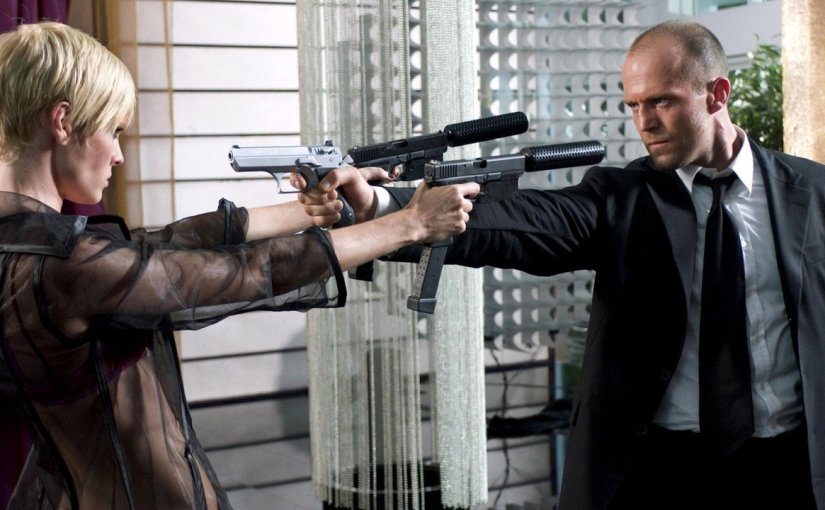
PLOT: An extremely skilled mercenary driver (Statham) is implicated in the kidnapping of the young son of a powerful USA drug official.


When an action film includes a shot of the good guy flipping his car off a ramp so a dangling crane hook can clip off a bomb stuck underneath the car mere SECONDS before it goes off…you either laugh and roll with it or scoff and leave the theater.  I laughed.

Transporter 2 is an example of a movie not really intended for American audiences.  From top to bottom, this is a European action movie, made in the States with the kind of budget unknown in foreign studios.  It was produced by none other than Luc Besson, director of cult classics like Léon: The Professional and The Fifth Element.  Here he farms out directing duties to Louis Leterrier, a genre specialist known for Jet Li’s Unleashed, the original Transporter, and, later on, an honest-to-God entry in the Marvel Cinematic Universe, The Incredible Hulk.

This movie is utter junk food.  It aspires to the kind of delirious cartoonish heights that would later be achieved by Shoot ‘Em Up (2007), but it fails due to too many breaks in the action.  And if you have too many breaks in a movie that’s barely 80 minutes long, something has gone wrong at the screenplay level.  In a movie like this, adding depth of character just gets in the way of the action.

The action itself, while mildly stunning visually, is too sparse.  There’s an extended fight scene in a basement that’s imaginative and well done, making creative use of a fire hose.  There’s a one-sided gun battle in a doctor’s office.  The lone car chase in the film sees the infamous building-to-building car jump from Lethal Weapon 2 and raises it.  And, of course, the bomb-removing flip to a crane.  (I can’t even discuss the finale aboard a plummeting private jet without wincing.)

Other than that, not much here, folks.  For me, this is an all-too-obvious guilty pleasure, something to toss into the player and jack the volume up so the gun battles rattle the walls.  The absurdity of the action allows the movie to flirt with camp classic status, but I usually just fast-forward to the parts where stuff gets blowed up real good.

GLASS

By Marc S. Sanders

M Night Shyamalan’s Glass is mind numbingly stupid and unbearably boring. A slow moving slog of a movie that scrapes the bottom of a barrel of wasted, rejected plot devices.

This is apparently the 3rd in a series of super hero comic book inspired movies from Shyamalan, but it seems to lack the research into the true construction of a standard comic book or graphic novel. If Samuel L Jackson as the title character declares this is an “origin story,” when it’s clearly not, well then Shyamalan expects you to believe that at face value.

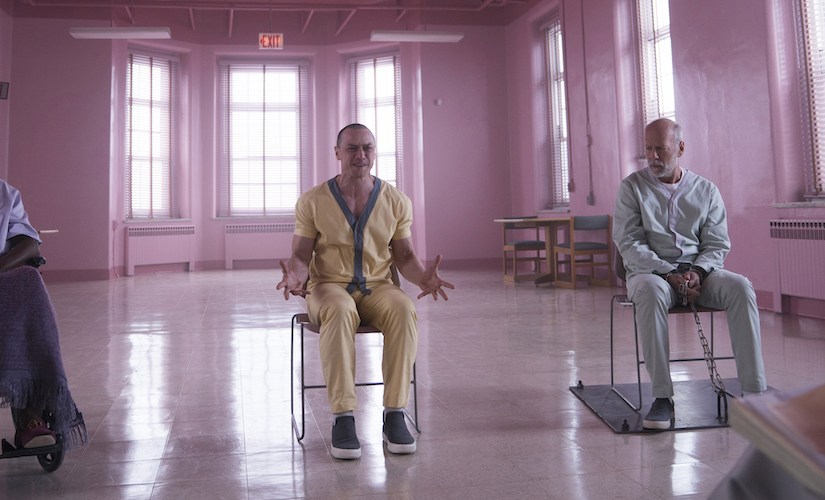
The three central roles played by Jackson, Bruce Willis and James McAvoy are meant to be super human beings. Sure, Willis as the hero David symbolized in green with a poncho has evident powers. Jackson as a villain in purple, however, does not possess any powers. He just masterminds disasters that in other films would be regarded as sabotage and terrorism. Where’s the super power in that? McAvoy as “The Horde” is just mentally ill who hulks out and climbs walls when his beast persona takes over. Yeah, that’s superhuman but for me it’s seems overshadowed by the mental ailments befalling McAvoy’s role as Kevin and 23 other personalities.

Shyamalan is ridiculously overconfident in being a comic book aficionado but has he ever read a comic book? Sorry but I didn’t recognize much in the form of a standard monthly super hero yarn here.

His script has no bite. It has no memorable moments and it has a 2nd act of 4 total that is simply Sarah Paulson sitting in a chair playing a psych doctor offering an explanation for the purpose of the three men. READER, this one has four characters sitting (never standing, never walking, never even turning their heads) in a large room listening to Paulson speak. I’d rather be at an insurance seminar. This scene goes on for a good 20 minutes and I dozed off and on. I literally could not keep my eyes open. Shyamalan typed a long monologue, for Paulson’s character to explain a theory, on a word doc and proudly never edited it.

Revelations are slapped on at the end because god forbid Shyamalan concludes a story without a twist. The ending is as dumb as the film’s 4 note string background which is as dumb as Shyamalan’s script and the film as a whole. It comes from nowhere. It offersno irony and it’s never implied anywhere.

There’s nothing that McAvoy, Willis, Jackson or Paulson should feel proud of here. They stare. They grimace. They make claims on a misguided screenwriter’s behalf that what’s presented is something grander than the absence of storytelling this film suffers from.

Glass is poorly written, poorly edited and poorly directed. It’s a film that’s about as necessary as a sequel to Top Gun.

(Oh shit!!!! Now I’ve done it!!!!)

LEGEND OF THE MUSE

By Marc S. Sanders

In high school my favorite writer/poet of American literature was Edgar Allen Poe. He had the colorful, yet dark, ideas of men who drown their brilliance in their subconscious madness. Having recently been invited to watch a film called Legend Of The Muse, brought back many memories of staying up past my bedtime with a flashlight in hand reading some of Poe’s best short stories while under the covers.

This film focuses on an artistic painter named Adam (Riley Egan) who is a loner relegated to his studio apartment with a messy drop cloth and blank canvases. His pale complexion tells us that his only escape appears to be the dreams or hallucinations he has for the unfortunate demise of two thugs stuck in the woods with a flat tire. These men appear to be terrorized by a strikingly beautiful entity who appears and disappears, only to reappear again for some haunts that startle Adam out of his sleep. Only after awakening, does Adam get the inspiration to paint dark, macabre images of the beautiful, almost naked girl in his dreams.

An intimidating neighbor of Adam’s coerces him to drive him out to a wooded location where a drug delivery has gone wrong. It is there that Adam connects the dots between his dreams and what actually happened to those two men.

The Muse, this beautiful girl that we’ve caught glimpses of, takes up dwelling in Adam’s apartment, and as he becomes more adept and appreciated for his haunting and visual paintings, he becomes drawn to her with passionate, sexual escapades. The problem becomes that now no one can interfere with or threaten Adam or else the Muse will strike. As well, no one can become attached to Adam. Adam belongs only to the Muse.

Now this might sound like a Friday The 13th or Fatal Attraction kind of thriller. However, director and writer John Burr takes a different approach. For one thing, Adam as a protagonist is short on dialogue in the picture. It should be that way, as he’s a lonely and depressed person with no one to talk to or emote with. So Burr resorts to effective close ups of Riley Egan to highlight his isolation and state of mind. There are periods where the most frightening occurrences are Adam with his blank stares and canvases. How can he ever escape this void?  Being a playwright myself, I related to Egan’s performance, faced with debilitating writer’s block at times. The thrills of the picture pay off as Adam grows dependent on the Muse to eliminate his threats and inspire new art. It’s a nice arc for the character.

With even fewer lines (actually none), the Muse is played beautifully with a goose bump measure of fright from actress Elle Evans. There’s a more fanciful name for this possessive Muse known as “Leannan Si.” It’s apparent that John Burr was directing more so with imagery, rather than dialogue. His use of light, blood, paint, nudity and the eyes of Leannan Si stay with you and carry on a running theme throughout the film. His camera really works well with Elle Evans, with cinematography from Damian Horan. If this film would ever lead to a franchise, this could be the role Evans could profit off of for many years to come. It’s a much more sophisticated and artistic interpretation of a Freddy Krueger or Michael Myers like boogeyman. Evans seems to have invented a new kind of scare off of Burr’s screenplay.

I do not know much about how Legend Of The Muse was produced, perhaps on a small budget. Yet John Burr’s crew are resourceful within the limits of their production locations. The weakness of the film may fall within some members of the supporting cast who are given more dialogue than the two leads. Particularly, the various bullies that intimidate Adam may be trying too hard, and that took me away momentarily from the quiet sophistication of the picture. Some of them seemed like the bad guys of the week on an episode of The A Team.

Nonetheless, there are good performances from Jennie Fahn as an art gallery dealer who effectively narrates the purpose of Leannan Si’s relationship with the artist. Much like Poe, she’s poetic and eerie in her exposition. I also like actor Kate Mansi as Maria, the neighbor who takes an interest in Adam. John Burr was wise not to write either character as simple damsels in distress. There’s dimension to these ladies, much like the Muse. They are not just teenage girls running away from a killer. One provides the narrative from her character’s knowledge and experience. The other offers a motivation for Adam to invest in a personal relationship.

Considering the limited options we have amid the current pandemic, Legend Of The Muse is worth a rental to watch at home. If you find an open movie house in your area showing the picture…even better. It’s an atmospheric film with colorful imagination of a new kind of supernatural. John Burr is a visual director who makes good use of camera angles that effectively accompany the bright hues of yellow and white from Damian Horan who also does well with night scenes too. A spooky, synth like feel to the soundtrack from Alexander Rudd works nicely for building some suspense.

I’m aware I’m heavy on the compliments for this picture. Maybe more than other reviews. More importantly, I promise I’m being totally genuine as well. Why? Well, I’d like this film to build momentum and get an audience or a following. I think it deserves it as the hard work shows on the screen. I want this picture to succeed.

As I’ve admitted before, horror is far from my favorite genre. It unsettles me more often than not, and that’s usually not entertaining for me. Yet, Legend Of The Muse is not a bloodbath slasher film, either. The body count rises as the film progresses, sure. Yet, it lends to a developing story. It’s not just there to show me an accomplishment with grotesque makeup and pools of blood. Burr focuses his strengths for storytelling with Hitchcockian devices (particularly from Rear Window) and once again the best works of Edgar Allen Poe.

Legend Of The Muse should be sought out, and you can rent or purchase the film right now on Amazon Prime or Vimeo. It’s a great bedtime story for a rainy Saturday night.

MARATHON MAN

By Marc S. Sanders

John Schlesinger contributed to the long line of political paranoid thrillers that came out in the 1970s with Marathon Man, with a screenplay by William Goldman based upon his own novel.  Most films are not constructed this way any longer.  Here is a picture that, albeit may have large plot holes, leaves you curious as to what it all means while you are watching it for the first time.  Don’t belabor yourself with watching it again as a way to piece it altogether with logic and sense.  You’ll only be keeping yourself up at night.

Marathon Man begins with several different incidents occurring at different parts of globe.  A man is tirelessly running through Central Park.  In Manhattan, two elderly men get into a heated road rage argument that leaves them dead in a massive explosion.  A box of band aids is taken out of a safe deposit box and later smuggled beneath a box of chocolates.  In Paris, an explosion occurs after a sharp dressed man gets into a car.  A little later, that man is violently attacked in his hotel room, leaving a very bloody mess.  A couple is mugged, only the hoodlums are dressed in business suits.  Another man is found with his throat slashed in the balcony of an opera house.  A white haired man hiding out in South America starts to shave his head.  What does it all mean?  How are all of these occurrences connected?

As long as vague moments like these don’t carry on too long, I’m likely to be hooked because I consider myself a curious fellow.  Thankfully, Goldman’s script pieces the characters together with a few hair raising twists that I didn’t see coming.

Without giving too much away, Dustin Hoffman plays a marathon runner/Columbia University history major with a bleak family background.  Beyond his comprehension, he is connected or will find himself connected to each one of these early moments in the film.  Once a person very close to him turns up dead in his apartment, the hysteria sets in.  Hoffman plays this quite well as he is always trying to catch his breath while soaked in sweat and remaining the lightest of sleepers.  Schlesinger creates a terrifying moment with a bathroom door that Hoffman is trying to hide behind.  It reminded me of Kubrick’s use of an axe with a bathroom door that would come out four years after this picture, with The Shining.

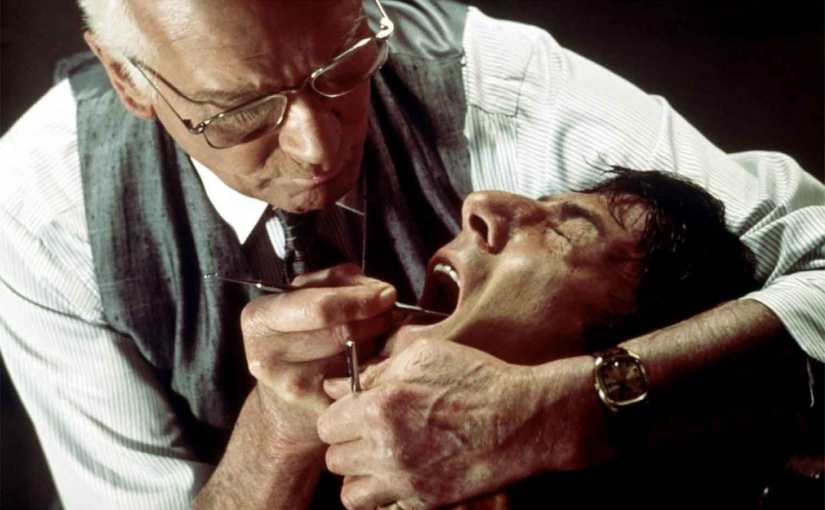
Laurence Olivier is a mysterious elderly man who has arrived in New York, eventually coming face to face with Hoffman. Thus, leading to one of the most uncomfortable torture scenes in film history.  Cancel any upcoming dental appointments that are scheduled soon after watching Marathon Man.  You’ll thank me for it.

The set up and players are eventually explained, albeit at breakneck speed when the tension is very high.  Put it this way. It’s a challenge to sum up exposition when it’s being dictated in a high-speed car chase.  So, on the first viewing, you might miss a few details here and there.  Nevertheless, I knew who the good guys were, I knew who the bad guys were and simply hearing the word “Nazi” in any given line of dialogue is enough for me to know how sinister this all is.

I can’t deny the ending feels a little hokey as it takes place in a Central Park reservoir system with platform stairwells and waterfalls all around.  Yet the tension remains as a young Dustin Hoffman (a hot commodity of 1970s actors) pairs up with the legendary performer, Laurence Olivier.  As I came to understand, Olivier was suffering from a terrible cancer diagnosis while making this picture.  Unbelievably, he never shows his illness, as his performance is electric with a well-deserved Oscar nomination.  Hoffman was striving for method by exhausting himself personally.  I know about the legendary story where Olivier suggested he simply “try acting.”  Hoffman later clarified that conversation and explained it had more to do with a personal divorce he was going through and late night drinking at Studio 54.  Whatever!!!  The ailments these great actors were experiencing at the time lends perfectly to the paranoia. 

I try to avoid movie trailers these days.  They give away much too much.  I had not seen one trailer or commercial for Marathon Man, prior to experiencing it for myself.  All I was aware of was the infamous dental torture scene with the famous line “Is it safe?”  Out of context, I found it to give me goosebumps.  Within the framework of the film, it’s utterly disturbing and it only heightens the suspense that Schlesinger and Goldman were striving for. 

MAD MAX

By Marc S. Sanders

What is the fascination with George Miller’s original 1979 film, Mad Max?  I don’t get it.  I know this film shot in the Australian outback was made a on budget less valuable than even a shoestring.  The fast-paced camera shots of cars careening down long stretches of highway are high octane (pun, most certainly intended) and the crashes are completely in your face.  Yet, I need more than this. 

When the film pauses for albeit very brief moments of storytelling such as a motorcycle gang apparently out for revenge against dystopian future cop Max (Mel Gibson’s breakout role), how is this ever even learned among the characters?  When Max opts to resign from the police force and take his wife and young son on holiday, how does this motorcycle gang led by a savage named The Toecutter (great name) catch up with them, and then after a narrow escape, how do they catch up yet again with one another, while making a sudden appearance on the back of these noisy motorcycles?  Miller’s film never goes from A to B to C.  Rather it goes from W to S to Q and then Z.  It’s a mixed up mess.

I’m all for throwing logic out the window when watching a thrilling action piece…if it’s thrilling.  When it’s not, well then, I’m asking for the logic.  Miller’s film feels like a bunch of want ads cut out of old newspapers, and then scotch taped together into a film reel.  I’d be curious to see an original script.  I can only imagine it being no more than three pages long. 

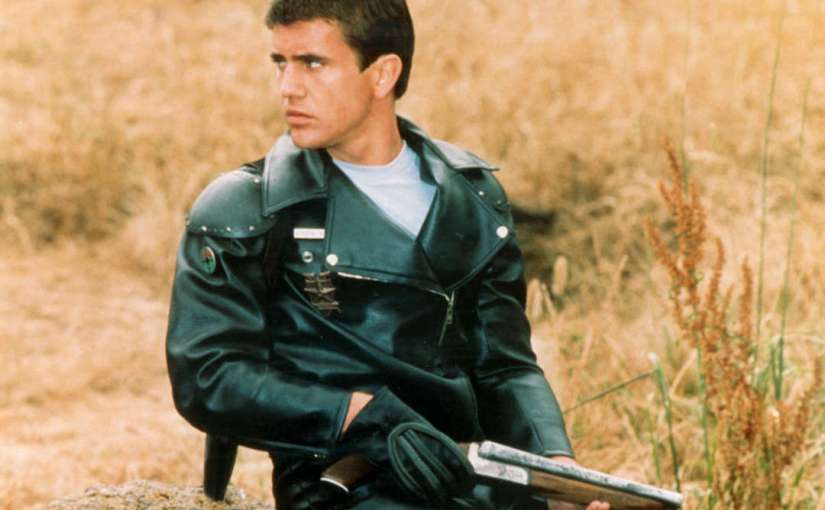
The appeal in 1979 and the years thereafter when the Max character blossomed into a franchise must have come from Gibson on film.  Yes, the stunts in this film with quick edit action pieces are daring.  I still think so forty years later.  This wasn’t CGI after all.  This was all the crunched up metal, rubber tires and flames that Miller could muster.  Still, the one artistic achievement had to be Mel Gibson’s image.  He wears the costume well.  A blue t-shirt enhancing his blue eyes under all black leather with a sawed off shotgun in his right hand while driving a souped up black Pursuit Special automobile with the engine sticking out of the hood.  Just writing that out reminds me of how iconic that image is, and this is before the similar looking Terminator that came along a few years later. Still, that’s where George Miller’s inventiveness stops. 

There is nary a character to consider.  The villains are nothing more than leather clad with bleached hair and dark mascara under the eyes riding Kawasaki bikes.  I know this was made with next to no money.  These guys don’t have to look like Darth Vader, but could they at least offer up something interesting to say?  Max has a couple of partners in the police squad.  They have no camaraderie.  One of them gets burned to a crisp.  Max takes a look at him in the hospital.  Why should I care though?  It’s not like I saw these guys share a Coke together.  Max is married.  They lie side by side each other in bed and their toddler sits on the floor nearby.  So?  Anything else?  Could one of them start a pillow fight or kiss or something, please?  A shoestring budget can still allow relationships to happen.  Miller doesn’t care about that though.  John Woo may show a nonstop bloodbath in any of his films with next to no story.  His films can work however, because he won’t get sidetracked with showing two people in their bedroom doing nothing.  He’ll remain focused on the mayhem.  Miller is not doing that here.  He shows a house with a bedroom.  Yet he doesn’t show the story in that bedroom that’s in that house.  That’s the difference.

I know the subsequent films in the franchise vastly improve upon the original Mad Max.  I’m just amazed they ever saw the light of day.  I’m more amazed that this became one of the most profitable films in worldwide history.  How did 1979’s Mad Max have the legs…no…the wheels…to maintain this ongoing velocity of interest?  What do I know?  I guess I’m a Debbie Downer for wanting people to talk to one another before handcuffing them to a gas guzzling fiery wreckage.  Is it too much to ask for a little sensitivity?