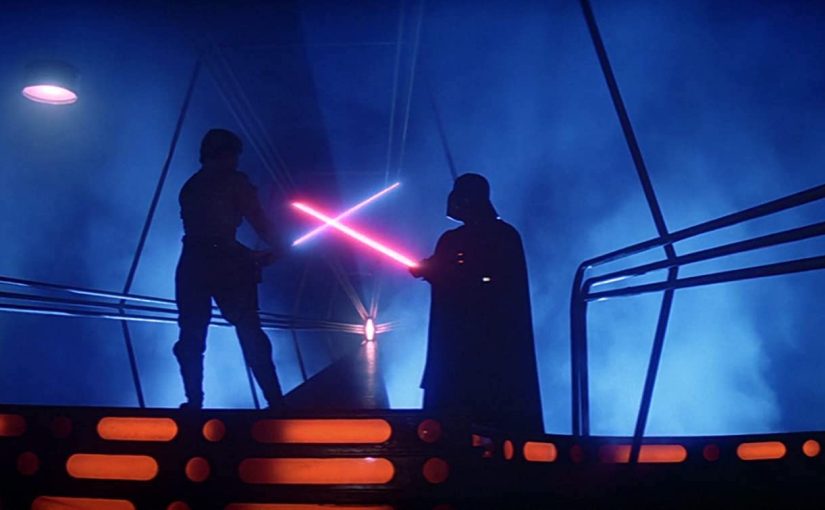
THE EMPIRE STRIKES BACK

By Marc S. Sanders

My absolute favorite film of all time is the Star Wars sequel The Empire Strikes Back.

It is a film that brilliantly reinvents the outstanding product that George Lucas introduced to the world three years prior. The dialogue is sharper for every single character from Han Solo (Harrison Ford giving a breakneck, adventurous performance) to C3PO (Anthony Daniels, masterfully giving the perfect and necessary inflections to a golden droid with a sole expression of worry, but still quite intelligent) to the man in black, Darth Vader (with David Prowse’s hulking physicality playing much more aggressively, and James Earl Jones’ voice giving a more sophisticated nuance to the character’s coldness). Lawrence Kasdan, the screenwriter, uncovered new ways to apply story to these characters above the incredible special effects of miniature models and matte paintings, as well as set design. Just look at the underground tunnels of the Hoth rebel base for convincing set pieces. Director Irvin Kershner knew how to apply the beats. A director and screenwriter make a perfect duet of cinematic filmmaking.

For one thing, settings were unlimited. While the first film showed a great contrast of sandy, sun-drenched desert and lack of development against the industrialized steel of a massive space station, Empire opts to introduce new, previously unseen environments for the characters to play in. A planet made of snow? Yup! There’s that. A planet mired in mud and swamps? Yup there’s that as well. A planet with a city in the clouds? Yup, got that too!

As the film opens, the Rebellion, heroically led by Jedi in Training Luke Skywalker (a terrifically believable Mark Hamill) is in hiding from the evil Empire on the desolate snow planet Hoth (filmed in Norway, accompanied by realistic matte paints in post production). The first battle sequence moves with a kinetic pace as the band of heroes are defeated and forced to retreat when the Empire’s giant four legged walkers (inspired by the monster films of King Kong and Godzilla) locates them.

From there, the film really lives up to its title as the heroes never win the advantage over the domineering bad guys. Han Solo with Chewbacca desperately escorts Princess Leia (a fiercely sarcastic Carrie Fisher to play against Harrison Ford) out of danger, only to find worse encounters to come as Vader remains hot on their trail. There’s a spectacular sequence that includes John Williams beloved score involving the Millennium Falcon in a crowded asteroid field. Meanwhile, at the request of Obi Wan Kenobi (Alec Guinness, in spirit), Luke visits the swampy planet of Dagobah to be trained by a mysterious Jedi Master named Yoda.

Assuming you can avoid focusing on all that you may already know of the film, including events that lead to discoveries in Empire, you have a film that never stops surprising you. Sure, by now we all know who Yoda is and what he looks like. What I remain curious about is Luke’s own image of what Yoda could be before it’s revealed midway through the film. Isn’t it a brilliant surprise and sleight of hand that Lucas, Kasdan and puppet master Jim Henson, with the voice of Frank Oz, to offer up the most unlikely person to be this great warrior or Jedi Master? It’s refreshing and it remains that way to me, no matter how many times I’ve seen the film. No matter how small or odd looking any of us could be in the eyes of someone else, our true strength and wisdom and bravery will show itself in unexpected ways. Yoda must be the most unlikely hero ever to grace a film. It’s smart storytelling when two entire scenes in Luke’s story arc come before the curtain is lifted on who Yoda actually is. Later, we are treated to a demonstration of the small creature’s strength and skills. It’s done beautifully with the absence of a lightsaber or any kind of attention-grabbing fight scene. The moment Yoda lifts Luke’s ship out of a swamp still raises the hair on the back of my neck. This scene shows that the mysterious “force” is more than simply sword fighting. There’s something more intrinsic in the willingness to believe in this element of fantasy. For us, I think it reminds us to believe in unlimited possibilities. I’m comfortable with that philosophy.

Masks are a theme I’ve always embraced in the Star Wars films. It’s not discussed enough actually. It’s ironic to me. Characters like C3PO or Darth Vader or Chewbacca and Boba Fett have these blank facial images to them. However, with the economics of Kasdan’s dialogue they say so much with brief statements of anger, despair (including a howl from Chewbacca) or worry. The expression physically never changes on C3PO’s face and yet I see different moods in the character thanks to the miming techniques of Anthony Daniels, the actor. A nod of the head will say something. With the practically silent Boba Fett agreeing to a contract with Vader, you see how methodical this bounty hunter dressed in dented armor really is. The character hardly gets any action scenes, yet you know how threatening he is. Every dent and scratch of his green armor tells a story. An aggressive walk shows a fear inducing Vader, one who is intolerant of any shortcomings. Sometimes Vader is simply matter of fact. If a minion fails in their assignment, he’ll force choke them and just walk away. As he duels with Luke, he simply puts his saber down when Luke is struggling with a massive wind current. We know that Darth Vader is cunning. So he hardly ever pushes himself further than necessary. We understand all of these characters’ emotions and motivations, and yet they are covered by masks.

The big surprise at the end of the film is the main crux that’s sustained the success of this sequel. It’s an absolute surprise out of nowhere but it seems to belong, as it is consistent with my belief in the mask motif throughout the whole film. There’s a veil draped over many developments of the film.

Allow me to digress. I’ve already discussed Yoda. Also consider other elements of the film though. Han decides to hide his ship from the Empire in the deep cavern of a large asteroid. Later, we learn it’s no cave. We also meet a charming new character named Lando Calrissean (Billy Dee Williams, who’s also great). He might not be what he seems as well. Since the first film came out, we’ve never had a full grasp of what or who Darth Vader is. He murdered Luke’s father and he’s someone or something in black. So, he must be the villain. That’s all we know, however. Yet, we eventually discover there’s something more. Because this is fantasy and science fiction with no roots in Earth based science, Lucas and Kasdan are well aware that they can color outside the lines and make up their own rules to this unfamiliar galaxy we are immersed in. Why not, actually? There are simply no boundaries.

A favorite scene of mine is when the Millennium Falcon makes a daring escape from that cave. It turns out to be the stomach of a giant slug…living in a rock…that floats in space! That’s the beauty of the original trilogy of Star Wars films, nearly anything could be put on the table, and it would be easy to accept and believe. In The Empire Strikes Back, almost every scene is layered and then further layered in imagination. Other storytellers would stop at just making this setting a cave and nothing else. It just might be shocking though. Put it this way, I’ll never forget taking my dad to see the special edition of this film in 1997. When the space slug revealed itself, dad burst out laughing. He didn’t see it coming. Kasdan hooks his audience with the furthest thing from your mind. When we got to the surprise ending, dad turned to me and actually asked me if he heard what he actually heard. When I showed the film to my daughter at age 6, her jaw dropped. How could a being dressed in complete black have any more depth to himself when I can’t even see what he looks like? The storyline of this film in particular is not aimed at any one demographic. Anyone could absorb the merits of surprise stuffed into this piece.

Empire is also admired for its firm stance to wrap up the film with an unhappy ending and cliffhanger. No other film has ever accomplished that so well. Much uncertainty is left to our imaginations. Will a character turn out to be dead? Is Vader’s revelation true, and if so then how does that explain the exposition delivered from Obi Wan? What does this “Jabba The Hutt” I keep hearing about actually look like? Was I looking at Vader’s brain or a human head underneath his helmet? What is Luke’s destiny? He didn’t do so well here. Could that lead to a worse fate? That scene for Luke in the Dagobah cave seemed quite foreboding, after all. Yoda implies “there is another.” Who could he be talking about, and what does that even mean? What about the conflict between the Rebellion and the Empire?

In the year 1980, the internet was not available as a means to spoil certain surprises and dismiss our own theories. We simply had the storytelling to work with. We had to wait three long years, speculating and discussing among our friends and family. It’s what maintained the strength of George Lucas’ space saga. The idea that we could play in the sandbox over a six-year period made these films more than just movies. They were events and they symbolized turning points in our lives. Personally, I discovered the magic of imagination. When I’m the writer the only rules I need to abide by are my own. That is most especially true with The Empire Strikes Back.

STAR WARS

By Marc S. Sanders

Of all the infinite times I have watched Star Wars (now also known as Episode IV: A New Hope), what remains appealing to me is the depth of its outer space setting. It would have to, right? Otherwise, what was the point of making action figures beyond the main characters, Darth Vader & Luke Skywalker? It’s a film where it’s just as important to get to know the extras seen in the film like a “Walrus Man” or a “Hammerhead,” or green skinned “Greedo.” Unquestionably, Star Wars is a film with a very, very rich and very deep setting.

What kept moviegoers coming back to the film time and again in the late ‘70s through the ‘80s and on into the next century, is that there is just so much to get accustomed to. One moment, you are adjusting to a summary scroll that opens the film with John Williams triumphant music, and then you are trying to familiarize yourself with an unusual ship that is being pursued by a much grander one within the depths of space while circumventing an orange planet. Laser shootouts occur with robots caught up in some kind peril, and then we meet a towering figure in black with an asthmatic, incessant breathing mask.

Later, we have to get used to small scavengers, and then scarier scavengers tormenting a boy on the cusp of adulthood who only dreams of adventure. The boy meets a mentor and then we are in a saloon with the oddest collection of patrons we could ever encounter. The film carries forward to daring rescues and escapes and a sword fight that may lack sophisticated choreography, but makes up for it with lightsabers and a surprising death that leaves an air of mystery. Before that’s all over, we still have to become enamored with the daring dog fights within space among battalions of one man piloted space ships.

That’s what has always kept Star Wars alive with much to celebrate. There is always something new and different just minutes away from the current scene you are engaged in. No two characters or bands of people look the same. No two settings look the same either.

Lucas always sought out to build a “used universe.” The ships and settings beyond the villains’ (known as the Empire) powerful Death Star space station were beat up and bruised and rusted and dented. This galaxy is lived in, and mired in a history.

Considering the film released in 1977 is somewhat telling of that decade. Films like The French Connection and Dirty Harry showed the ugliness of their respective cities and citizens with broken down cars and trash in the streets, and hoods with unkempt beards and worn-out clothing. Lucas must have carried these visions over to his PG universe to give viewers the idea that a guy like Greedo is a dangerous bounty hunter unconcerned with drawing his pistol in public, and a gangster like Jabba The Hutt rules a territory with a threatening criminal fist. (Incidentally, I strongly oppose Jabba’s appearance in the reissue of the film; better to imagine how vile this guy is in my own mind when watching the picture for the first time).

Lucas also famously takes inspiration from Akira Kurosawa’s Japanese films (especially The Hidden Fortress) of samurai culture, and blends it perfectly with a sci fi interpretation of the Old West gunslinger as seen in Sergio Leone’s spaghetti westerns.

Star Wars pleases so many different demographics of audiences because it jump starts its multiple stories and settings with what made going to the movies so appealing to begin with. Present within the film are humor, childlike appeal, fantasy, western motifs, suspense and romance.

It’s a visual classic that remains unmatched. At least with the original trilogy, Lucas never allowed any two settings to look alike. With this film in particular, we are treated to the contrast of a desolate desert planet vs the cold industrial operations of a ruling regime proud to carry out their actions with menace and terror. (More pleasing contrasts occur in the next two films.)

Star Wars is well known for the simplicity of its story. It’s main hero, Luke (Mark Hamill), is recognized for his basic innocence simply with his white tunic and mop top head of hair. Same can be said for the damsel in distress, Princess Leia (Carrie Fisher) and the fearful but sweet droids she sets out to embark on a mission. She evokes a royal and dedicated government in her white robe with elegant hairstyle; the droids have an expression of worry for the tall one, and spunky nerve for the shorter fat one, like a Laurel & Hardy pair. Villainy is epitomized with Darth Vader (voiced with commanding authority from James Earl Jones), who dons all black with a terrifying mask/helmet. You don’t know what Darth Vader really is beneath that dark costume. It’s not important for the exposition of this film. All that matters is that Lucas shows you who is good and who is bad. The visual references are enough for the explanations. What we need to know about these characters are summed up with the wise but elderly prophet in quick summation by Ben Kenobi (Alec Guinness, in an Oscar nominated role). Kenobi serves as the historian of this universe.

Over time, even almost immediately upon its release, the commercialization of Star Wars hogged the spotlight of the original product. It’s reflected today based on a measure of expectations both financially and within the fraternity of diehard fandom. Ironically, in 1977 everyone was satisfied with the surprise that George Lucas shared on the big screen. There were no objections to be found. Today, though, it’s become an act of trying to satisfy the masses by what they believe the next developments should be. I’m guilty. I admit to sometimes being an accomplice to that notion. It’s impossible to please everyone. So new film products in the Star Wars franchise will never succeed as well as the original film managed to do.

I don’t let any of that bother me. I remain pleased that I can still feel the sensation of pumping my fist in the air when Luke & Leia swing across the chasm thereby evading Stormtroopers, or getting a thrill when their pirate escort, Han Solo (Harrison Ford), finally lets loose of his quiet, cool demeanor to run down a hallway while trying to take out an army of baddies. I get a lump in my throat when Kenobi gives a slight grin before surrendering to Vader in front of Luke’s eyes.

So much is to be seen in Star Wars, but not all of it is explained. George Lucas completed his film with routes left to wonder and think about; he gave an opportunity to continue our imagination long after we finished watching the film for the first time. On the multiple occasions we watched thereafter, we pondered where we could get a table in the Cantina/saloon, or just how many droids the Jawa scavengers kept in their sand crawler.

As well, what did the blue milky substance taste like. More importantly why exactly did Luke’s uncle give a concerned glance across the dinner table to his aunt during a slight mention of his father?

That’s the magic of Star Wars. Like the land of Oz or Willy Wonka’s chocolate factory, there’s just so much to explore and think about and imagine beyond its surface. Long after we are all gone and our grandchildren’s children are beginning to stimulate their imaginations, they may well turn to the cartoons and other films and toys in the vast galaxy from long ago and far, far away. One thing is certain, though. They should ALWAYS begin with the original Star Wars.

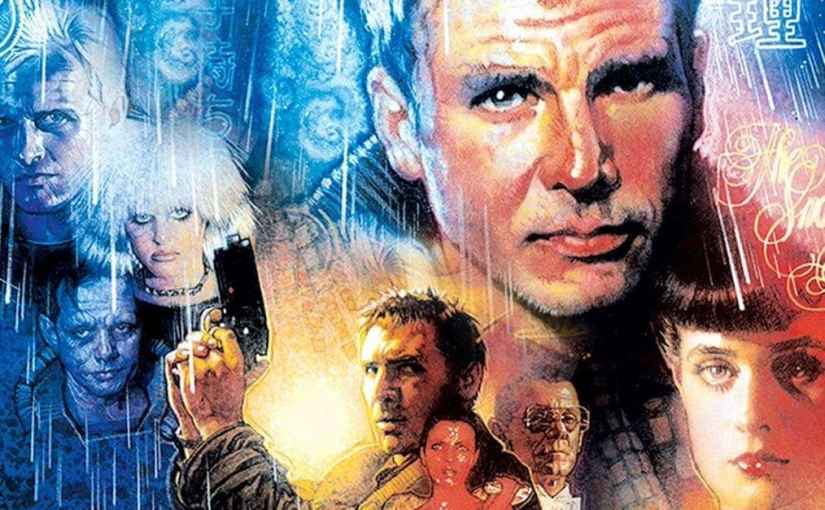
BLADE RUNNER

By Marc S. Sanders

Ridley Scott’s Blade Runner is a technical and special effects masterpiece…however thin-very thin-its story may be. 

When the film was originally released in 1982, its period setting of November 2019 seemed unimaginable.  So, it was easy to accept that the dystopian future first conceived by author Phillip K. Dick (in his book Do Androids Dream Of Electric Sheep?) could actually happen.  With the Vietnam War behind us, and shopping malls becoming the happening place to be in our Members Only jackets and Jordache jeans with Swatch watches, the 1980s seemed like eternal bliss.  Middle class America felt prosperous and free and comfortable with a President on his way to eight years in office.  Bright pastel and neon colors took over.  A hopeless, dreary future was all but fantasy.  Therefore, just like Star Wars, a gritty, urban Los Angeles seemed like another possibility where science fiction had become as trendy as super hero movies are today.  It was cold and rainy and dirty, but we wanted to see that because that was nowhere near what we were living in, much less envisioning. 

Ridley Scott achieved greatness with visuals never thought possible.  George Lucas might have introduced moviegoers to desert and swamp planets and industrialist Death Stars, but Scott delivered an Earth where Coca-Cola, Pan Am, Atari and Cuisinart still existed amid a dark, rainy Chinatown section of Los Angeles with glowing umbrella handles, flying police cars and cabs, hovering electronic billboards, and exhaust flames that spewed out of the rooftops of cylindrical skyscrapers.  Ridley Scott might have supervised this palette of futuristic film-noir, but the real heroes of Blade Runner belong to its Oscar nominees Lawrence G. Paull, David L. Snyder, and Linda DeScenna for set decoration, as well as Douglas Trumbull (already a legend for 2001: A Space Odyssey), Richard Yuricich and David Dryer for visual effects.  All these years later, there’s much to explore within the appearance of Blade Runner, but the storyline still remains shallower than a puddle of water.

I’ve watched Blade Runner a number of times because fellow peers and colleagues carry such admiration for the film.  I cannot deny the first third of the film holds your attention as you acclimate yourself to this enveloping world.  Once your accustomed however, the story is what has to carry you through to the end, and the journey is as slow moving as a rickshaw on one wheel.  Harrison Ford is Rick Deckard, a blade runner and the best one there is.  Upon learning of an escape of four Replicants from an off-world slave site, Deckard is tasked with coming out of retirement to hunt down these Replicants and “retire” them.  Retire is the polite word for kill, exterminate, slaughter or execute.

A replicant is an android that looks completely human, bleeds like a human and talks like a human.  It’s near impossible to tell the difference on sight between a human and a replicant. As well, replicants are manufactured with four-year life spans and are not permitted on Earth.  They are intended for the sole purpose of slavery towards their human creators.  Yet, what makes them so exemplary or offensive?  What trait do they carry that threatens their human counterparts?  Racism often occurs because of fear derived from skin color or appearance.  Antisemitism will have you believe that Jews have horns growing out of their heads under their yarmulkas.  What is so terribly misconstrued or offensive or threatening about Replicants?  The film never makes clear, and that’s frustrating.  What makes a villain a villain?

M Emmet Walsh comes on early enough to tell us through dialogue that he needs the best of the blade runners back and that’s Deckard.  When I’m to understand that I’m watching the absolute best of something, whether it be a cop, lawyer, baker, student, doctor, painter or blade runner, I want to see what exactly makes them the best.  In Top Gun, I saw the aerial maneuvers that potentially justified why Maverick could be the best of the best fighter pilots.  The problem with Blade Runner and the script, written by Hampton Fancher and David Webb Peoples, is that I never see in its two-hour time span when or how Rick Deckard is such an exceptional blade runner.  How is a blade runner different from an ordinary cop or a simple person with a large gun?  No matter which of the various cuts of the film I’m watching, with or without Harrison Ford’s voiceover narration, I fail to see any outstanding fighting skills or clear thought-provoking intuition.  This guy is neither as good as Dirty Harry or Sherlock Holmes or even James Bond.  He’s not even as personable as Sam Spade, the original noir detective.  Rick Deckard just looks like Harrison Ford with a very large hand gun.  Furthermore, where does the term “Blade Runner” derive from?  Is it just there because it sounds cool?  The moniker wasn’t even created by Philip K. Dick.

The film’s eventual sequel, Blade Runner 2049, is a far superior film.  It’s longer, but it’s much more fleshed out in tone and character and understanding of its setting.  The original film stands on the heels of its cult like legendary status.  Some of the best filmmakers today cite Blade Runner as an influence in how they construct their own movies.  I buy that.  The assembly of whatever cut I’m watching is evident of how mind blowing its appearance is.  You can see some of the blue print visuals that carried over in to Christopher Nolan and Denis Villeneuve’s pictures. But I’m past all that.  Now I need to appreciate what it’s all there for, and who is playing in its yard. 

I cannot simply rely on IMDb trivia and endless social media sites that speculate on whether Deckard is a replicant himself, or why he dreams of a unicorn and why Ridley Scott opted not to include said dream in the original cut.  I cannot just tickle my curiosity with the picture’s eerie foreshadowing of the various product placements that suffered real life eventual downfalls after its release.  Beyond the visuals, what am I watching Blade Runner for?  This is not just a riddle in the Sunday paper.

The film boasts an eclectic cast that work well together.  I just wish they were provided with something much more insightful with background and personal experience.  Rutger Hauer became a familiar name following the release of this picture.  When he’s finally given the opportunity within the second hour of the film to come off as hideous and terrifying and strange, it’s worth looking at.  His famous “tears in the rain” closing dialogue is beautifully poetic, as it was personally written by him.  It’s as ambiguous as the film.  Yet, Shakespeare can be vague too.  I might not understand what anyone is talking about, but the performance can keep my attention.  Regrettably, he does not do much else in the film beyond his closing fight scene with Ford.  Ridley Scott insisted on casting Sean Young as Rachel, as her appearance was reminiscent of Vivian Leigh.  She’s intentionally mysterious as a likely replicant and/or niece of the wealthy creator of the replicants, Dr. Tyrell.  It works, but again, if the viewer is going to be questioned on the mystery of this major character early on, then why doesn’t the film follow further into that enigma?  You don’t have to say for sure, but at least give me evidence to argue one way or the other.  The same goes for the speculation on Deckard.  Had it not been for outside references, I’d never question who or what Deckard really is.  Daryl Hannah, Brion James and Joanna Cassidy round out the rest of the cast/replicants within the film.  Edward James Olmos is here too with a curious and odd habit of making origami.  They all have their unique way or look about them.  In science fiction, every character should stand apart.  Yet, again, it’s all about appearance.  What is the motivation here?  What is the motivation to live on earth or off earth?  What is the motivation to kill a human?  What is the motivation to kill a replicant?

I’ve beaten my head enough over this film.  Blade Runner has always been frustrating to me.  Maybe I’m not being fair to myself, as I try to find something else or some underlying layer each time I watch it.  Why do people love this movie so much?  Why does it consistently appear on “greatest of all time” tabulations?  Ultimately, I’ve come to the conclusion that I’m just pounding sand, or maybe as Rutger Hauer’s Roy Batty suggests, I’m impossibly looking for tears in rain.

MOONRAKER

By Marc S. Sanders

Roger Moore’s fourth outing as James Bond was supposed to be For Your Eyes Only. However, producer Albert R. Broccoli made a last minute switch before production was to take place. Two little known films called Star Wars and Close Encounters Of The Third Kind broke box office records and Broccoli went with “Moonraker” to piggy back on the science fiction trend. James Bond needed to launch into outer space. The effort proved profitable even if the story mostly fails.

A Moonraker shuttle is mysteriously hijacked from the Americans. After Bond survives being thrown out of an airplane with no parachute by the hulking assassin Jaws, he is assigned to determine what happened to the ship, and what purpose it is being used for.

Bond travels to California to introduce himself to Hugo Drax (Michael Lonsdale) with his samurai henchman Chang, and to Dr. Holly Goodhead (yes you read that right) played by Lois Chiles.

The issue with Moonraker is it suffers from a number of boring elements including Lonsdale, Chiles and even Jaws is watered down as he falls in love with a nerdy, pigtailed, blonde. Eventually, Jaws becomes a good guy and that’s when your eyes roll. Lonsdale is hardly any fun in his villainy. Chiles is not any more interesting than her character’s last name. Action scenes are bland beyond the airplane drop in the title sequence which has outstanding camerawork accompanied by the staple Bond theme.

Broccoli and returning director Lewis Gilbert (The Spy Who Loved Me) focused more on the science fiction cinematic trend with laser guns and laughable lack of effective zero gravity.

Broccoli became guilty of going with what was trendy with Moore’s 007. Blaxploitation with Live And Let Die, martial arts with The Man With The Golden Gun, Steven Spielberg’s Jaws, in The Spy Who Loved Me, and now science fiction in Moonraker. The sci fi doesn’t work so well for Bond or Drax’ diabolical scheme to destroy all human civilization and begin a new life in space.

Q provides Bond with a cool wrist band that shoots darts. That’s pretty fun.

As well, travel sites still hold up with destinations along the California coast, Italy with a gadget filled gondola and a glass shop fight, and Rio De Janeiro where Bond faces off against Jaws along the tops of two cable cars and engages in a boat chase. Then of course Bond eventually reaches Drax’ satellite base in space. None of it is unwatchable. It’s fun. It’s just not comparatively as exciting as prior Bond adventures before, and still to come.

Moonraker is just a little too weightless.

It should be noted as well that sadly, we also say goodbye to Bernard Lee as M, head of the Double O section for the last eleven films. He’s here to remind 007 that the British government can’t afford any slip ups. The whole series thus far was only better because of Lee to emit humorous aggravation in response to Bond’s relaxed and sarcastic response to the government risks at hand. Bernard Lee deserves recognition.

her

By Marc S. Sanders

Director/Screenwriter Spike Jones is a master at adding multiple dimensions to what we always know exists. It’s been evident in his prior films, Adaptation, Where The Wild Things Are, (which I did not care for personally), and most especially in Being John Malkovich. He plants the seeds of fantasy in what we can normally touch, hear and see. Then his elements of fantasy receive a supportive crutch from what his viewers have always been familiar with.

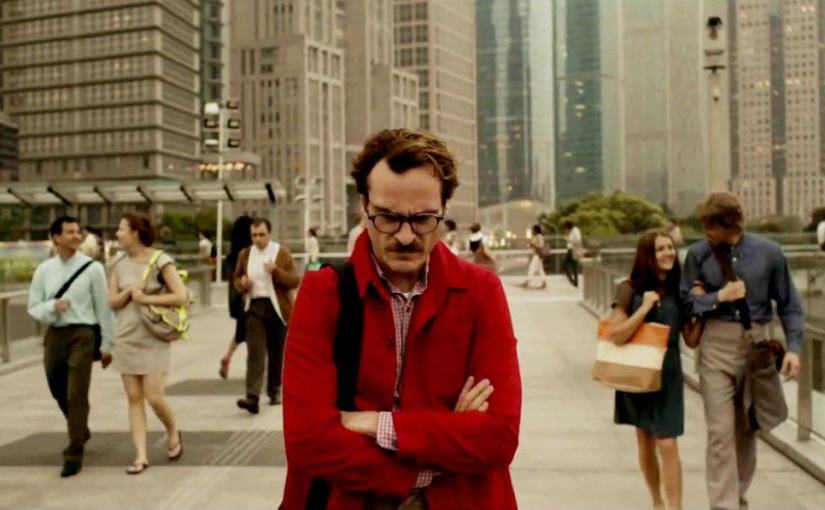
her is another masterwork; a film that takes place in the not too distant future that expounds on our current digital age. If we can already talk to “Siri” or “Alexa” and trick–umm, excuse me, “her” (I mean “Siri”) into making sophomoric dirty jokes, then of course we are bound to approach the stage where we can literally, truly fall in love with her and then she can reciprocate.

With her raspy yet silky vocals, Scarlett Johansson is inspired casting as the voice of “Samantha.” Had she actually had a physical presence in the film I would have totally fallen for her affections. The film hinges on the performance of Joaquin Phoenix as Theodore. If we can’t believe that he loves “Samantha” more than he loves himself (a surefire test of true love as far I’m concerned) then “her” falls apart. Phoenix passes abundantly. He deserved his Oscar nomination.

From the start, you become very accustomed to the banter between Theodore and his electronic device voiced by “Samantha.” Both have personal feelings. Both have personal longings (more especially “Samantha” the computer, of all things!!!).

Spike Jonze explores all the diameters and dimensions of a loving relationship. The ups, downs, and in betweens. What’s different is how all of these layers of a relationship are received in this currently fictional (bound to come true, one day) dynamic of a relationship. Theodore and “Samantha” are affectionate. They argue, they laugh, they even make love. Watch the movie to understand that last point. It happens, and it is perfectly executed with the residual effects of their lovemaking bringing the film into its next act brilliantly.

Jones won the Oscar for original screenplay simply for how innovative this picture is. I’m not sure it’s the most exciting two hours of film, however. Personally, I think other films in this category back in 2013 had sharper and more interesting scripts. her is practically all talk and when it ended, I was ready for it to be over, and it concluded as I expected.

Still, Jones is fortunate that his cast (Johannsson, Phoenix, Amy Adams and Rooney Mara and Chris Pratt) trusts him. If they hadn’t, this movie would have lost its magic by probably how absurd this script must have originally been perceived on paper. Well done work by all involved but credit has to begin with Jones, the screenwriter.

ANNIHILATION

By Marc S. Sanders

Science Fiction/Horror for the thinking viewer is the best way to describe this film.

Director Alex Garland has found a way to make a viewer’s eyes pop, not just with fear but with the unimaginable. This is as good an effort or better than his other well known film, Ex Machina. I foresee it will not be long before Garland is recognized among the ranks of today’s most notable and popular directors like Del Toro and Nolan.

This is not a run of the mill monster movie. This is fictionalized science that seems foreign and strange, yet makes complete sense by the time the credits roll. All questions are thankfully summed up despite a hanging thread or two to relish in deep thought long after the film has ended.

Natalie Portman strongly leads a nearly all female cast to uncover the purpose and functionality of “The Shimmer.” She does so, but at what expense? She’s great and believable in her role with lots of dimension by way of her career as a Johns Hopkins professor/former army infantry soldier and through periodic dreams of sin she feels guilty over.

Jennifer Jason Leigh does her best no nonsense disturbing creep. Gina Rodriguez makes good transitions in levels of sanity.

Like Black Panther, I’d argue this is also a front runner for art direction as an encapsulated swamp is overrun with strange pastel plant life, mixed up animal life and cinematic lens flare. Yes, here the lens flares serve a narrative purpose which is why the cinematography should also be given some recognition.

I’m looking forward to seeing this again to uncover what I missed the first time.

Annihilation turned out to be one of the biggest surprises of 2018.

READY PLAYER ONE

By Marc S. Sanders

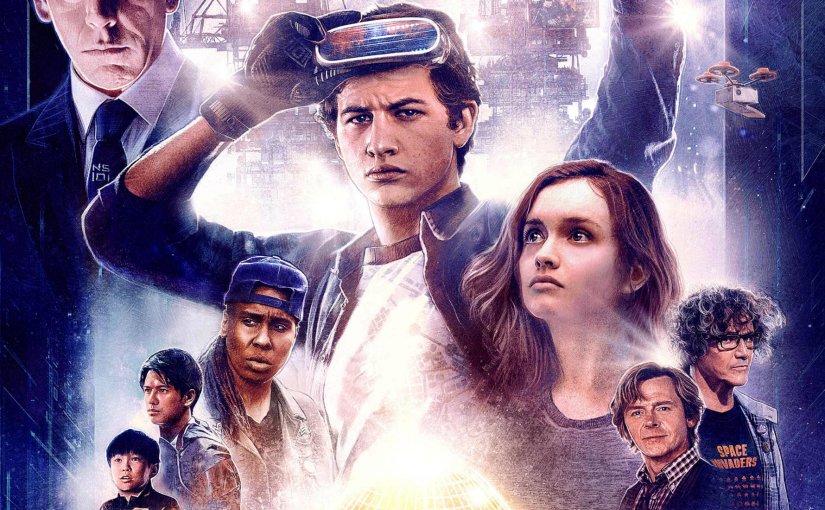
Steven Spielberg’s masterpiece, Ready Player One is the best Easter Egg to search for today.

As a huge fan of Ernest Cline’s novel chock full of pop culture salutes, this latest effort from Steven Spielberg is the film I was looking forward to the most in 2018; more than Solo and definitely more than Avengers: Infinity War.

The film adaptation almost completely succeeds. It is very well cast and the expansive imagination of Spielberg and his crew get everything right. It’s the greatest amusement park for the eyes. When there are not hidden gems to look for, I still found the young cast of characters portrayed by talented unknowns to be engrossing, and more importantly endearing to those cinematic kids of the ‘80s from John Hughes films, as well Spielberg’s other classics.

Authenticity was also truly a priority for Spielberg. I dare not spoil the highlight of the film’s second act but let’s just say the attention to detail was perfection to every minute crammed on the screen. You can’t help but laugh, grin and slap your knee. In fact, you really do it through the whole film practically, but Act 2 really reaches for the skies.

Now the one issue I have. Like Spielberg’s Jurassic Park, the villain was pulled back in their deviousness from the original source material. The danger did not feel threatening enough for me. Here the antagonist is this large conglomerate run by a CEO, and I’m afraid that’s all that Ben Mendelsohn is sadly reduced to. The stakes didn’t seem high enough. Cline’s novel made sure that your life could end as you got closer to solving the puzzles of the “Oasis,” the interactive virtual world that everyone willingly engulfs themselves in. The threat was more convincing in the novel. In the film, I’m afraid it’s a little too watered down.

Still, Ready Player One is incredibly fun with an awesome soundtrack; “Staying Alive” by The Bee Gees will always be the greatest song to bless any film, ever. This film especially supports that argument.

“LET’S SAVE THE OASIS”

THE MATRIX FRANCHISE

By Marc S. Sanders

Miguel and I went to see the The Matrix Resurrections last night and honestly, when I woke up this morning, I had forgotten I’d even seen it.  That’s because, other than the original Matrix film, the subsequent chapters are about as special as cheap food court Chinese food.  When you get home from the mall, you recall what you may have window shopped, but you never reflect on what you had for lunch; well maybe your gut does later on, and that’s certainly not doing you any favors. 

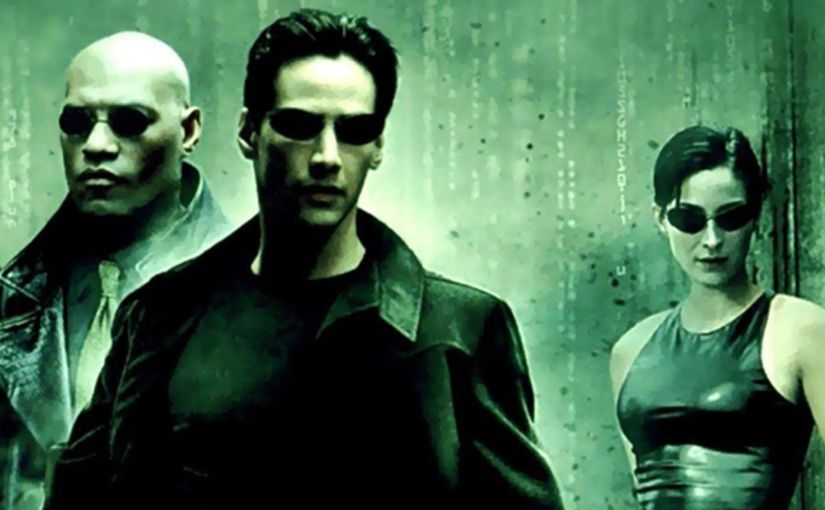
When The Wachowskis introduced the world to The Matrix way back in 1999, it was one of the biggest surprises in films.  No one saw its uniqueness coming.  Everyone was focused on the over hyped resurgence of Star Wars, or a kid who desecrated a pie, or a hand held video film that was seemingly terrorizing audiences.  Yet The Matrix arguably may have had the best longevity that year.  It seemed like a combo sci fi/super hero picture with the players looking ultra-cool in designer sunglasses and leather night club outfits.  Guns and jiu jitsu flew off the screen, but it was done in a new visual kind of way.  Bruce Lee would have likely been a part of this picture had he been alive.  When someone took a kick to the face, it was edited super cool looking sloooooowwww motion.  Bullet time became a thing with projectiles warping through the space between characters and these players, especially Keanu Reeves as the messianic Neo and Carrie Anne Moss as Trinity, would bend and twist and twirl acrobatically (again in slow motion style) to dodge machine gun fire and endless shrapnel.  The look of the film remains absolutely superb.  Nothing (other than maybe the film’s sequels) has duplicated what was accomplished here. 

As well, the original Matrix stands apart from the other three because it actually told a story and developed its protagonist and his mentor (Laurence Fishburne as Morpheus) into fleshed out characters.  It also went so far as to describe what the Matrix is, and what the world outside of that realm represents.  Like all humans, Neo, also known as Thomas Anderson, was actually under the control of a machine-like community designed to sustain a world known as the Matrix, and…well…that’s just bad!  There was solid storytelling here with setting and character development that was later accompanied by well-choregraphed action and pulse pounding club music.  When the film ended, audiences couldn’t wait for more and Warner Bros happily greenlit two more films that were shot back-to-back.  Only the train derailed from there.

Gearing up for the 2021 installment, directed by Lana Wachowski, I watched the first three films again.  Other than the first film, I had forgotten much of what occurred in the 2nd (The Matrix Reloaded) and 3rd (The Matrix Revolutions) pictures.  I realize now that I only forgot what really wasn’t there.  Substance!  Of the two films, Reloaded is likely better, thanks especially to an outstanding highway car chase involving sci fi effects of the characters bouncing off of big rig trucks, motorcycles and car roofs.  A pair of characters dressed in evil white leather with dreadlocks morph in and out of the vehicles and concrete streets as well.  The scene comes late in the film and only wakes you up from the meandering ahead of it.  Truly, it’s hard to comprehend what the hell is being explained in this second film.  The Wachowskis almost would prefer you be impressed with the monosyllabic vocabulary that’s exchanged with each character.  Dialogue doesn’t advance the story any further from where the first film left off.  All that I gathered was our band of rebels who successfully broke free from the slave-controlled Matrix are regrouping at the promised land of Zion, and the machines (squid like metal robots with countless red light bulbs) are advancing for an attack.  Morpheus, Trinity and Neo take it upon themselves to reenter the Matrix (because they look so much cooler there) and do who knows what.  Near the end of the film, Neo walks down a long hallway, opens a number of doorways and encounters the one supposedly responsible for the Matrix, an older gentleman known as The Architect.  This moment was intended to be a highlight of the film and yet it was anything but.  This architect spews out word diarrhea at an alarming rate that only clouds your mind further and further.  The guy has a great radio voice and has an antithetic appearance against the heroic looking Neo, but what in the hell are we supposed to do with any of this?  What’s the point?

On to Revolutions which begins exactly where Reloaded left off.  This is a picture that could have had a running time of thirty minutes at best.  The robots are finally attacking Zion.  One character who seems like he should be important or necessary to the Matrix storyline saddles up in a robot suit equipped with massive machine guns and The Wachowskis make the poor choice of feeding their audience a good seven or eight minutes of this guy spraying endless amounts of bullets in an upwards direction towards the infinite swarm of octopi robotic armies.  His guns never run out of ammo.  He just bellows as he continues to fire.  Where’s the story here?  Where’s the innovation that the first film offered?  Also, what goes up, must come down.  Shouldn’t some of that ammunition have dropped down in a hail storm eventually?  Reader, if I have to ask that last question then you know there’s not much to pay attention to in this film.

The wisest character of the Matrix films, Morpheus, is given very little to say or do in either film.  Fishburne stands in the background and let’s everything happen around him.  He’s not utilized to explain anything like he was in the first picture.  His skill for teaching the audience has been completely diminished.  Whatever he had to offer was exhausted following the first picture.  With Revolutions, especially, the filmmakers rely on B characters that we’ve never really gotten a chance to know or remember or adore like Yoda or Jabba or even Boba Fett in the films that followed the original Star Wars. In fact, Revolutions seems more concerned with its extras than any other film I can recall.  So much so that when a major character from the first film has a death scene, you hardly care for the loss.  There wasn’t much to expound on the character after the original film.  Revolutions only relies on the war nature of the human armies against the monochrome metallic squid race.  Beyond shooting at one another, where’s the conflict?  Ms. Pac Man and Frogger have more depth than any of this.

That’s the problem with these films.  A discovery was made with the 1999 installment and the filmmakers opted to capitalize on the effects and not the challenge of story. 

Furthermore, and this goes back to the original film when I first saw it in theatres, I was always of the mindset that I’d rather live in the Matrix.  After all that Morpheus has revealed to me, the Matrix still seems like the better place to reside.  The real world consists of living on a dirty, dreary ship and eating slop for food while wearing torn sweaters and having electrical plug orifices running down my spine.  Who wants that?  A Judas character from the first film turns on his crew by telling the evil Agent Smith that he will bring them Neo as long as in return he doesn’t know that he’s under the control of the Matrix and he can savor the taste of a juicy steak again.  Now I’m with this guy.  Aren’t The Wachowskis as well, though?  More footage and highlights take place in the computer mainframe of the Matrix than outside of it.  Thereby, more cool looking action sequences can happen and the cast appears more glamourized.  The films want us to fear the horrors of the Matrix on the humans by showing them plugged into wires while drowning in a pod like puddle of KY jelly embryonic ectoplasm.  You know what?  What I don’t know won’t kill me.  So, leave me be.  Perhaps the argument would have been more convincing had the environments been reversed.  Put the rebels as slave dilemma in the real-world areas and the utopian setting within the Matrix.  Then I might buy the problem here.

The newest film, Resurrections, is nothing special and nothing new.  It’s rather boring actually.  Revolutions was boring too.  It only kept me awake because it was two hours of headache inducing noise.  With the new 2021 film, apparently a new Matrix has been developed and thus a new Neo and Trinity have been conceived.  The antagonist is represented by Neil Patrick Harris and that’s about it.  Miguel pondered much, following the picture as to what was going on.  That’s not a good sign for a popcorn action flick, and it’s consistent with what was done with the 2nd and 3rd films.  What the hell is anyone talking about. Once again, dialogue moves to a beat of answering questions with questions. Even the allies speak to one another that way, and if it is not a question, then it is a cliché of some sort.  Don’t these people want to help one another?  If so, then speak to each other like your four years old and get to the point.  The action scenes drone on and on.  A goal of the picture is to keep Neo from finding Trinity because if they do, then the Matrix crashes.  Okay.  That’s simple enough.  Yet (spoiler alert), when they do find each other, somehow this new Matrix continues on.  Huh??????  The movie just betrayed me, and I don’t like that. 

Miguel attempted to conjure up the idea that Lana Wachowski was trying to demonstrate her transition from a man to a woman and this new picture was a representation of that.  Could that be true?  Maybe, but it never occurs to me while I’m watching the picture.  Am I watching The Matrix Resurrections because it’s the newest Wachowski film?  No.  This isn’t a Quentin Tarantino or Christopher Nolan piece.  This is leather and gunfire and sunglasses and noise, all depicted in a green DOS computer hue lens.

The Matrix was always worthy of a sequel; a subsequent follow up that explored imagination and perhaps more background.  What has Neo not yet uncovered.  Yet, the series as a whole continues to deny those opportunities and simply settles for cool looking visuals that get overly exhausted and tired.  No new skills are featured with each passing film.  Over the course of the series, the big bang, so to speak, of the first Matrix never reveals itself.  Instead, we are mind controlled viewers relegated to depend on overlong dialogue with no point and no where left to explore.  We are simply gifted with Neo punching Agent Smith and/or infinite duplicates of Agent Smith with no one getting weakened or wounded or defeated.  Look no further than an early fight scene in Reloaded.  The scene goes on forever.  The editing is amazing.  So is the choreography but after four minutes of this, it’s time to show some progress.  The Wachowskis limit their imagination to just having Neo fly away.  Scenes like this only allow me ample time to exit the theatre for a bathroom break and return having not lost out on any storytelling.  My friends, you can find plenty of bathroom breaks in this series of films.

The Matrix Reloaded, The Matrix Revolutions, and The Matrix Resurrections should never have been made.  Producer Joel Silver and Warner Bros would argue otherwise though.  Their wallets continue to get fatter, but at the cost of controlling moviegoers’ appetite for something more when all they really got was dry rice and overcooked orange chicken from the food court.

MIDNIGHT SPECIAL (2016)

by Miguel E. Rodriguez

Director: Jeff Nichols
Cast: Michael Shannon, Joel Edgerton, Kirsten Dunst, Adam Driver, Sam Shepard
My Rating: 10/10
Rotten Tomatometer: 83% Certified Fresh

PLOT: Two men go on the run with a child in tow, pursued by federal agents and by members of a cult who believe the child has special powers.


The general concept of “mystery” in a film is a subtle art.  Not enough mystery, and people will say they’ve seen it all before.  Too much mystery, and people will wonder why they’ve spent good money to be confused for two hours.

Every now and then, though, a movie comes along that shows everyone else how it’s done.  It manages to plunge the viewer headlong into the story with little to no exposition, provides just enough clues to keep things intriguing without giving the game away, and supplies a climax that is not just satisfying, but revelatory.  Prometheus is one of those movies.  So is Freaks (2018).

And so is Midnight Special, from director and screenwriter Jeff Nichols (Take Shelter, Mud).

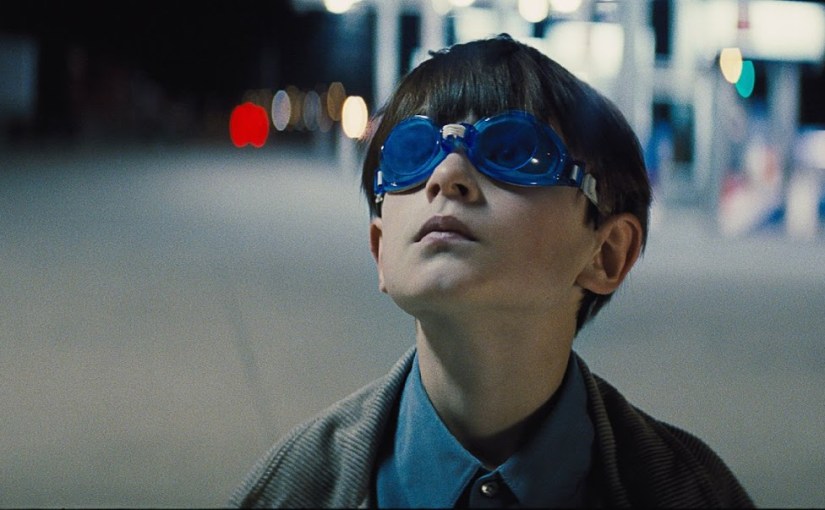
This movie grabs you right from the opening minutes.  Two men appear to be holed up in a hotel room with a young boy wearing blue swim goggles.  Cardboard and duct tape cover the windows.  A news broadcast on the TV reports on the young boy’s kidnapping.  However, he does not appear to be distressed in any way.  One of the men may or may not be his father.  He goes willingly when they vacate the room and hit the road.

In another part of the country, a pastor watches the same newscast with concern.  He later leads a church service, but the scripture reading consists of non-sequiturs and random numbers.  The FBI interrupts the service and hauls each and every church member in for questioning about the missing boy.

What the deuce is going on here?  How is this church connected to the boy?  Where are the two men taking the boy?  What’s with the blue goggles?  What is so important about this boy that the two men with him would be willing to kill for him?

These are all very good questions.  Whenever the movie takes the time to answer one of the questions, two more spring up in its place.  And I may as well tell you now: not every question will get an answer.  But instead of feeling frustrated, I just got more and more involved in the film.  I felt like I was an active participant in figuring out the story, along with the characters.  There’s nothing quite like feeling involved in a movie, rather than simply watching a movie.

When the revelations arrive about where the men are headed with the boy, why they’re headed there, and why the FBI is interested, I’m not gonna lie, I was gobsmacked.  In retrospect, I suppose I should have seen some of the plot points coming a mile away.  But that’s the beauty of the screenplay and the direction.  I wasn’t interested in trying to second guess what surprises were in store.  As a result, when the surprises arrived, I was constantly in a state of jaw-dropping amazement.

I would also like to point out the great restraint used by the filmmakers when it came to the few scenes that required CGI enhancement.  There are a hundred ways these scenes could have gone wrong, resulting in a shot that completely takes you out of the movie.  They avoided all those pitfalls and instead created scenes of startling beauty, even when things seem to be going wrong…or when they at last go right.

This is a movie that deserves to be seen with as clean a slate as possible.  It didn’t exactly make a dent in the pop-culture zeitgeist, so it’s not likely you’ll see any spoilers on the internet without Googling the movie, but why would you want to do that?  Keep an open mind, don’t ask how it ends, and find a way to see this movie.  You won’t be disappointed.

UNDER THE SKIN (2013)

by Miguel E. Rodriguez

Director: Jonathan Glazer
Cast: Scarlett Johansson
My Rating: 9/10
Rotten Tomatometer: 84% Certified Fresh

PLOT: A beautiful, mysterious young woman seduces lonely men in Scotland and takes them to her home, where something very strange indeed happens to them…


Under the Skin captivated me in a way that I did not expect.  It is a sci-fi mystery that stubbornly refuses to supply neat and tidy answers, and yet is spellbinding to watch. How director Jonathan Glazer accomplished this is no less mysterious to me than the origins of the movie’s main character, a solitary young woman played by Scarlett Johansson in a bravura performance that must have required a great deal of courage and trust in her director.

After a cryptic opening sequence involving some trippy visuals accompanied by an eerie musical score, Johansson’s character (listed only as “The Female” in the credits) gets down to business.  With the help of a mute motorcyclist (???), she acquires a van and trolls the streets of Scotland for young men on their own in the city.  She lures them into her van with pleasant conversation and a smile, which is easy enough to do when you look like Scarlett Johansson.  She then takes the men back to a deserted house in the country where I wouldn’t DREAM of revealing what happens.

The appeal of this movie is not the story, although that is obviously a big part of it.  It’s the storytelling.  Director Glazer works from a script that has the bare minimum of dialogue, usually when The Female is convincing men to get in her van.  Everything else depends on visuals.  It’s the kind of movie my friend Marc would enjoy, as it uses the camera to tell the story much more so than the soundtrack.  It shows us images and challenges the viewer to put two and two together to figure out what’s happening.

This visually-heavy strategy is a tightrope walk.  One false step and, instead of a mind-bending masterpiece, you get a head-scratcher that leaves you feeling cheated.  Under the Skin manages it.  There is one specific visual sequence that sealed the deal for me, a scene that provides a more detailed explanation of what happens to the men once they’re inside The Female’s house.  The real genius of the scene is that it provides information without fully answering the questions going through your head.  What is that black liquid?  Are the men hypnotized?  Their behavior would make it seem so.  And exactly how big is that house?

I’m being deliberately obscure because the delight of the film comes from discovering the thread of the story and following it along with The Female.  Her discoveries were just as interesting and scary to me as they were to her, because I felt really in tune with her character while I was watching the movie.  The closest I can get to describing it is…a long, LONG time ago, there was a computer game called Hacker that I got for my Commodore 64.  It came with literally no instructions beyond putting the disk in the drive and loading the game.  Then your screen went blank and it just displayed: “LOGON”.  And that was it.  As the gamer, it was up to you to figure out what to do in order to keep playing.  As you discovered more clues to the object of the game, you became more and more involved.

That’s how I felt watching Under the Skin.  Those opening visuals start you off thinking, “What the f@#k???”  Then the movie progresses, and the wheels start turning, and you realize what’s happening, and what The Female is attempting, and the discoveries she’s making about herself, and before you know it you’re as wrapped up in the story as she is.

I remember there was a lot of talk when this movie came out, but I never really hear anyone discuss it any more, outside of movie-centric blogs and Facebook pages.  If I can convince just one person who hasn’t seen it that this movie is worth their time, I will be happy.  Under the Skin deserves to be seen, discussed, and puzzled over.

P.S.  Under the Skin is, in fact, mildly famous because, yes, Scarlett Johansson gets naked.  But don’t get too excited.  Her nude scenes are utterly drained of any sexuality or eroticism whatsoever, due to their context.  You’ll see what I mean when you watch it.