CLUELESS

By Marc S. Sanders

AS IF!!!!!

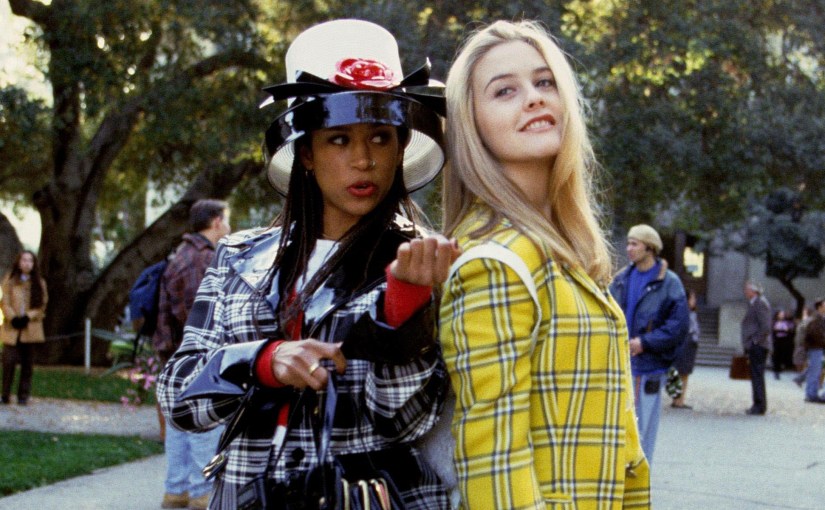
Yeah, Alicia Silverstone’s breakthrough film, Clueless, is shockingly dated, but it is so smartly constructed as it follows Jane Austen’s outline of her classic novel Emma.

You see, here is a movie where the main character goes through a nicely developed character arc. Silverstone’s Cher might be an airhead since her focus is primarily on clothes, the mall, MTV cartoons, and more clothes but as she strategizes to be a matchmaker for fellow students and teachers at her school, she loses sight of her own best interests when it comes to love.

The situations and one liners are priceless in Amy Heckerling’s film. I love how Cher can’t comprehend why her gorgeous crush never hits on her but he loves to shop, dress smart and watch Spartacus.

As director, Heckerling is also attuned enough to deliver gags by means of the extras sprinkled throughout the film. Almost every extra at school has a nose bandage because, you know, this is a Beverly Hills high school where plastic surgery is as common as getting a drivers license. Heckerling might be broadly spoofing the Beverly Hills scene of the ‘90s, but we all know what she’s trying to say with each shot of a high school hallway or classroom.

This film also delivered actor Paul Rudd closer to the main stream. It’s not a glamorous role but he’s cute nonetheless, as Cher’s step brother and maybe love interest???? It’s a long story; watch the movie. He’s the guy with sensibility that Cher doesn’t seem to account for. Rudd’s scenes with Silverstone are marvelous. Typical love/hate material that we’ve seen before, but the characters are so likable it’s hard to resist their charms.

Dan Hedaya (a very underrated actor since Cheers) is really good. He’s such far cry from his on screen daughter as an apparently brutal litigator. Every time he shouts “Cher, get in here!” I laughed.

Again, it’s hard to believe it’s already dated in its wardrobe and slang, but Clueless remains outstandingly funny nonetheless. Bitchin!!!!!!!!

THELMA & LOUISE

By Marc S. Sanders

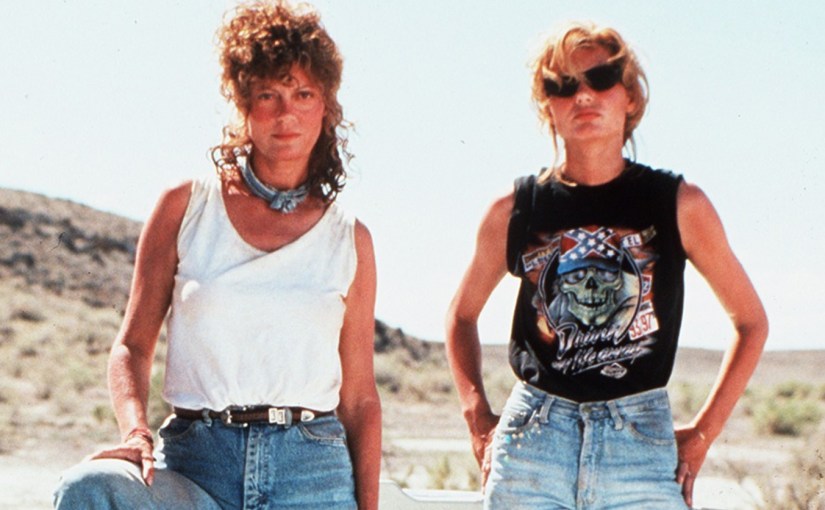
The strength of a good solid picture often depends on a strong cast from the top billing, above the title actors, to the bit supporting players who only have a few minutes of screen time.  Thelma & Louise, directed by Ridley Scott, is that film.  The opening credits of the movie come up in black and white over an out west landscape with an endless dirt road in the center of the screen.  Hans Zimmer’s harmonica and banjo, country sounds build on Scott’s camera work here.  The names of each actor are brought up: Susan Sarandon, Geena Davis, Harvey Keitel, Christopher MacDonald, Michael Madsen, Stephen Tobolowsky, and someone named Brad Pitt. The scene goes to color and then it blacks out and comes up on Louise’s (Sarandon) crowded diner where she waitresses.  Nothing is unfamiliar here.  Yet, it seems a little haunting in a way.  We are about to uncover a history to some common folk who live on the southern bend of America, and we will start in the state of Arkansas.

Louise has made arrangements with her best friend Thelma (Davis) to do a weekend cross country road trip to a cabin in the woods.  This is the southern odd couple.  Louise is always put together, clean and organized.  She’ll check herself in the mirror.  In a crowded ladies room, she’ll check her makeup and tidy her hair while intoxicated patrons are pushing around behind her.  Thelma is scatterbrained.  She’ll bite off a piece of a candy bar, put it back in the freezer and make three more stops back at the freezer for a couple of more bites.  She also will dump a dresser drawer of clothes into a suitcase, taking no time to sort through what she’s packing.

Both women have been treated unfairly by the men in their lives.  Thelma’s husband, Daryl (MacDonald) is a proud white trash carpet sales manager who treats his wife with absolute control, complete disregard and thoughtless disdain.  Louise just can’t even get a hold of her boyfriend Jimmy (Madsen), a musician who can’t commit to anything.  On the first night of their trip, the two ladies hit the road in an iconic 1966 green Ford Thunderbird convertible (one of the greatest, most memorable vehicles in film screen history), they’ll realize there may be worse men than the ones they’ve encountered.  Following an attempted rape, a shooting occurs and the ladies are hitting the road, hoping to make it to Mexico.

Thelma & Louise is at least Ridley Scott’s most sensitive film.  It was not the first or last time he used women as leads in his pictures.  Yet, the film moves symbolically along the stretches of highway and dirt roads as a means to reveal the strength and confidence a woman can have when she escapes the controlling shadow of a man.  At least that’s what I think.  The beginning of Scott’s film, with an Academy Award winning script from Callie Khouri, displays the title characters as weighed down by their past and current lives.  It is only when the two break free (with little options following an unforeseen dilemma) they understand they can be stronger than any man who’s ever dominated them before.  As the road trip moves on, they will encounter more hang ups and they will make mistakes, but by the time the third act comes along Thelma and Louise will sever any restraints that have held them back before.  It is such a gratifying story.

My father encouraged me to go see this movie with him.  It was 1991.  I was graduating high school.  I’d seen trailers for this picture and it was loaded with high energy country music.  I don’t like country music, typically.  In fact, I only can like country music when it is incorporated into a film.  Thelma & Louise is the best example of that feeling.  I hated the title.  Still kind of do.  It doesn’t have the ring of say Starskey & Hutch or Batman & Robin.  However, those are guy pairings.  Thelma & Louise are about two women, and I was never going to forget that.  Once I saw the film, I could not stop thinking about it.  I grew so accustomed to Ridley Scott’s direction and use of cinematography with Adrian Biddle.  The sun on the screen felt hot.  The dirt on the character’s faces and the Thurderbird felt gritty.  The sunburns on Sarandon and Davis felt sore and dry.  The glow of the car’s dashboard light felt bright in my vision. The settings spoke to me.  There’s a great moment where Louise seems to shed her feminine and dainty skin so to speak.  She hands over her jewelry to an old timer sitting on the side of road at an abandoned truck stop.  No words are shared between them.  This guy was born on this spot.  He’s never moved from this spot and Louise will leave her history behind with him.  Later, as the stakes grow, with the FBI and law enforcement closing in on the fugitives, there’s a moment where Thelma tells Louise, that she feels awake; like really awake and alert.  I knew what she was talking about.  I’ve already been on this hike for two hours with these characters, along with the crimes and entanglements they’ve gotten into and the movie has my full attention.  All these years later with repeated viewings, and I still feel that way.  I feel absolutely awake the moment the movie begins.

Khouri supplies her script with a variety of men.  Some are sensitive like the detective played by Keitel who knows that a murder didn’t just happen maliciously.  There’s more to the circumstances at play, and he’s hoping for the best for the ladies.  Some are just procedural like Tobolosky, who doesn’t recognize them as women, only as fugitives. Some are enlightening, yet deceptive like Brad Pitt’s hitch hiking handsome and charming loner that the ladies pick up, and some are simply cruel and vicious, like the rapist or Thelma’s husband, Daryl (MacDonald).  Maybe a trucker along the way is like that as well.  How will Thelma and Louise respond to each of these guys?  As the story contains a gamut of what all these men are, I never regard the picture as a middle finger protest to the male population.  Not at all.  There are men who will give women a chance and will treat them with respect and at least equality, within their surroundings.  Khouri’s script allows time for that.  Sadly though, thirty years later there are still men who will treat women like punching bags with no value and esteem.  It’s wrong.  It’s why the “Me Too” movement had to eventually come into play, long after the release of this picture. 

At the risk of sounding political with potential for debate and preach, watching Thelma & Louise last week, I could not help but think of recent current events that have occurred in mid year 2021.  Bill Cosby was set free from his prison sentence following a technicality that justified his release, but never exonerated him of his crimes of rape.  A former kid actor named Drake Bell was sentenced to three years’ probation for sending sexually explicit materials and texts to an underage girl.  More physical details have been implied on that relationship but Bell was never charged with anything on that topic.  Hence, no jail time.  A Disney channel actor has a warrant out for his arrest following missing a court date with similar charges as Bell.  Following the early rape scene in this film, the attacker is shot and killed in a parking lot.  The ladies consider going to the police and explaining what exactly happened, but they choose to run.  Why?  Because, they know that the police would never believe them.  They were witnessed minutes earlier drinking and partying with this guy in a bar.  Why would anyone believe he would try to rape one of them?  Reader, I know what they mean.  I understand.  Each time I watch the movie, I truly understand.  I know what Thelma and Louise are talking about.  It’s sad.  It’s wrong.  It infuriates me because it’s so unfair.

Callie Khouri and Ridley Scott created an outstanding adventure picture with suspense, and lots of natural humor by means of the outlaw way like Butch Cassidy & The Sundance Kid.  A surprising robbery midway through the picture is hilarious and serves as a legit character change for Thelma.  Davis is great here.  She has scenes of drama and fear throughout the movie, but she also has time for laugh out loud moments.  Alternatively, the Louise character that Sarandon portrays seems to hinge on the dramatic element.  I love a hanging thread that Khouri weaves into the script of an unknown traumatic occurrence that happened in Louise’s past.  I am certain that Sarandon knows what it is even if the audience doesn’t entirely know.  Later in the film, the humor that Louise encounters comes through as Thelma transitions over to a new kind of personality.  These women don’t change individually.  They change together.  It’s a great couple dynamic for sure.

The film is sexy and at times sweet as well.  Yet, it’s also very terrifying, with very real drama.  Thelma & Louise is an important picture to see.  I plan to show it to my teenage daughter when she is a little older.  The rape scene holds me back right now as I find it hard to watch and requires a mature eye.  Nonetheless, I want her to be aware of what is out there.  I want her to know how people, men in particular, respond and treat women.   I want her to be alert and strong when faced with any kind of adversity, deserved or not; justified or not.  I find that some movies offer the best lessons of life about the cruelty and kindness of the world.  Most especially when they are filmed with sensitivity and authenticity, like Schindler’s List or The Shawshank Redemption.  Countless viewings later with thirty years behind it, and I still learn from Thelma & Louise.  It’s another one of my favorite movies.

CHARIOTS OF FIRE

By Marc S. Sanders

The 1981 Academy Award Best Picture winner was Chariots Of Fire directed by Hugh Hudson. However, because of that honor I’m not going to pretend that this was a marvelous film viewing experience. This may be one of a select few movies where the soundtrack is far superior to the film itself. That memorable score that gets your pulse racing belongs to Vangelis, and if the soundtrack to Raiders Of The Lost Ark from John Williams should lose the Oscar, it’s not a surprise if it was to the soundtrack from Chariots Of Fire. For me, the two compared against one another though? Well, we might have an argument there, my dear reader.

The film centers particularly on two outstanding runners, maybe the fastest in the world, who compete in the 1924 Olympics for Great Britain. One runner is Harold Abrahams (Ben Cross), a Jewish Cambridge student who is frowned upon for his religion while he is well aware that his heritage is not valued for anything amongst the Christian Anglo Saxon community. It’s all the more challenging when he agrees to private coaching from Sam Mussabini (Ian Holm in an Oscar nominated performance) of Italian and Arab descent.

The other runner is Eric Liddle (Ian Charleson) who loves the exhilaration of running, though his sister prefers he devote his time to the church. He is devout in his Christian beliefs, nonetheless, and he is tested when he learns that one of his competitions is scheduled on a Sunday, the day he observes Sabbath. Despite the Olympic team’s firm position that he compete, Eric’s stance is not to participate in the race.

I don’t want to say that I was bored with Chariots Of Fire, and yet I was bored. The effort to stay with the picture informs me of the value a film can have with marquee names in its cast. As the screenplay moves from one character’s storyline to the next, it was hard to gather where things had left off. Other runners are covered as well though just not as in depth. Most of this cast, I must admit I’m not so familiar with. Sometimes they all seemed to be cut from similar molds in costume, hair color and the like. With known names in a cast, it’s much more easy to put a face with a name and follow along. Here, it was challenging to stay focused with each character. They didn’t seem distinguishable enough for me.

I know! This is not a fair argument. However, this turned out to be my experience with the film.

The technical production of Chariots Of Fire is outstanding, though. Everything from the cobblestone streets of Cambridge to the Olympic stadium in France and the hilltops of Scotland are spectacular to look at. Absolutely immersive.

I did take issue with the film’s beginning. The first ten minutes opens with Abrahams’ funeral in London, 1978, then jumps to 1924 as a student writes in his journal recalling the team’s experience and so then the narrative moves back to 1919, only to wrap up with the funeral again before the closing credits. Why so much work with these albeit brief time jumps? They carried no impact. Why not simply begin in 1919 and move forward through time?

Chariots Of Fire has always been on my bucket list to catch. It’s a necessary film to see for devoted film buffs due to its accomplishments in technicality and score plus art direction. As well, it is an educational experience in British history, despite the liberties the film takes.

I recommend the picture, but I also forewarn to have patience and strict attention to its narrative. There’s a lot of dialogue and information contained within, Hudson is passionate with slow edits of running scenes and hurdle jumps, for his method of dramatic impact and excitement. All I suggest is to be prepared to sit for what will feel like a good long while. Try to avoid any interruptions (turn your phone off). You’ll need to pay attention where the film carries you from one scene and storyline to the next.

ONE FLEW OVER THE CUCKOO’S NEST

By Marc S. Sanders

After watching One Flew Over The Cuckoo’s Nest for the first time in many years, I recognized a political dual taking place on the battleground of an insane asylum. Director Milos Foreman sets the stage for one patient to win over the community from the Head Nurse in charge.

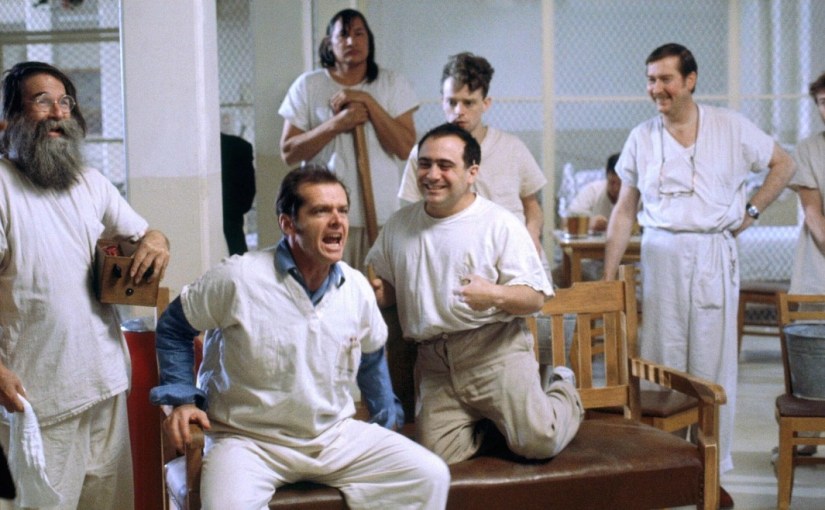
Jack Nicholson is Randall P McMurphy, a criminal who is transferred to the asylum for examination even though there are likely suspicions he’s faking his current condition as a means to escape prison life work detail. Louise Fletcher is his opponent as Nurse Ratched who has maintained an organized control over the floor of 19 men with an assortment of mentally unwell behavior.

McMurphy is a cut up as soon as he joins the gang. At first he appears observant during Ratched’s daily sessions where she asks the men to contribute to the discussion but at the same time she couldn’t be less encouraging. She’s happy to welcome ideas with open arms but don’t disrupt the process. There will also be “Medication Times” and there will be samples of classical and childlike music to subdue the patients as well. McMurphy may request the volume be lowered, but that’s not a simple request that Nurse Ratched will honor.

McMurphy’s experience outside the realm of insanity works as a wake up call for some of the men which consist of introductory performances from great character actors like Christopher Lloyd, Danny DeVito and Vincent Schiavelli. The stand out is Brad Dourif as Billy Bibbit, the stuttering suicidal young man with the baby face who fears his mother’s judgment as Nurse Ratched methodically continues to imply.

McMurphy wins over the crowd eventually. A fascinating scene is when Ratched challenges McMurphy to obtain enough votes among the men in order to watch the World Series. The count of raised hands appears to tie, but then Ratched reminds him that he needs one more vote to win. Before he can get to that point, the session is ended by Ratched. The call for election is lost due to a technicality by the governing control. An election won’t silence the voice of the people as McMurphy quickly encourages the masses to watch a blank television screen imagining his own interpretation of the game. Ratched can only domineer to a certain degree. Here’s the flaw in the Ratched character. At last a breakthrough among these ill men is established as they’ve learned to vote for themselves. They want to watch a baseball game. Ratched won’t stand for progress though.

Questions arise in One Flew Over The Cuckoo’s Nest. Is McMurphy truly faking his mental condition? Is Ratched so drunk on control to disregard doctors’ opinions for his release and keep him institutionalized? If he’s not insane, then why would she want him there? Is it all about Ratched’s obsession with winning?

Ken Kesey wrote the original novel the film is based on. He hated Foreman’s approach particularly with disregarding telling his story from the perspective of the deaf/mute six foot five Native American that McMurphy regards as “Chief” (Will Sampson). Chief seems to be the quiet one who does not take sides until McMurphy demonstrates the ease of obtaining freedom such as when the Chief helps him escape over a barb wire fence and then takes the men on a boating joy ride. I can’t side with Kesey’s insistence that the film be done from the perspective of the silent, yet memorable Chief. Film is a different medium than what’s read on a page. You can’t watch people’s thoughts. What I do find interesting is that Kesey opted for a Native American as McMurphy’s best sidekick. This is a man whose ancestors historically lost their land. McMurphy attempts to rob the rule of the asylum from Nurse Ratched. The political undertones just seem so apparent. The government control, however, is hard pressed to surrender even after McMurphy arranges for his own party of celebration complete with booze and alcohol. Ultimately, and sadly, the fate of McMurphy shows that he eventually becomes a product of his own environment. The Chief however, acknowledges his independence though.

One Flew Over The Cuckoo’s Nest is the second of three films to win the five main Academy Awards (Best Picture, Director, Actor, Actress, and Screenplay). It deserved it, and because of the film’s unsettling and messy nature it’s almost surprising that it was so well received. It’s not a glamorous film. It can show the ugliness of men drowning in their own consciousness.

At the same time, the film shows the subtle yet brutal control of those living fulfilling lives at the expense of the constituents they oversee. Sure, let’s have an open minded community of provoking thoughts, but only if it’s confined to the restrictions that remain in place. Step outside those lines and a more permanent technique will be applied so you adapt to what’s mandated…unless you can bodily lift a concrete water fountain and smash it through a cage bar enclosed window to freedom.

TRUE CRIME

By Marc S. Sanders

Clint Eastwood is having a pretty eventful day in the film True Crime, a picture he produces, directs and stars in. He plays Steve Everett, a womanizing journalist who is assigned at the last minute to interview Frank Beechum (Isaiah Washington) for a human interest story about the man’s last hours before he’s sentenced to death by lethal injection for shooting a young pregnant woman. Everett gets a hunch though that Beechum may be innocent and he’s quickly running out of time to prove his gut feeling. It does not help that his editor (Denis Leary) has discovered that Steve has been sleeping with his wife. It’s also inconvenient that Steve has to honor his promise to take his young daughter to the zoo.

For the simplicity in the storyline of Eastwood’s film, I still found moments that kept me engaged. Washington’s footage which begins at sunrise on his supposed last day at San Quentin penitentiary is very well detailed. I liked how the warden spells out to Beechum what to expect today ranging from requesting his last meal to ensuring direct phone lines to the governor are working properly. I got to witness how all activity of a death row inmate is strictly recorded. I found it interesting how the lethal cocktail is to be administered.

Washington has really good moments with his wife (Lisagay Hamilton) and young daughter wanting to color him one last picture of green pastures. The film doesn’t drown in sappiness or long monologues that you might expect. Like other Eastwood films he looks for the quiet moments in a person’s day; familial, but painful intimate moments of a loving family with all options exhausted.

The other storyline might be debatable for existing. Steve has to contend with his editor’s animosity towards him while also trying to balance what’s left of his family life with his current wife (Diane Venora). Opportunities are given for tough guy comebacks and insults between Eastwood and Leary along with their boss played by James Woods. There’s good timing in these lines but some might question why waste time with this material. I had no objection, however.

These are men who are not putting their lives or instincts on hold to focus just on an inmate sentenced for death. This is just routine work of the day. We don’t stop working just because we find out our spouse is a two timer. We also don’t put our personal interests in hold for a criminal we have regard except to fill a square in the news paper.

Same goes for Steve’s time sparingly spent with his daughter (Francesca Eastwood) at the zoo. Steve turns out not to be an attentive father as he also tries to stay on top of his story on Frank. My cinephile colleagues (including Miguel) took issue with most of the material that the journalist experiences. They thought it was meant for a different film other than the death row storyline. Not I, however. I found it courageous of Eastwood with a script from Larry Gross, Paul Brickman and Stephen Schiff to stay true to this portion of the film. All people have demons they live with and those setbacks don’t grant mercy in even the most desperate of times such as when a possibly innocent man has mere hours left to live. Life is never put on hold even if you’re a lousy father and husband.

True Crime stayed with me up until its last ten minutes. At that point, Eastwood takes the film in a beat the clock car chase direction. This moment is unlike anything else the film presented and I took issue with it here. I wasn’t watching an action picture before any of this. Before the end arrived, I was caught up with the different perspectives of those involved in the process of supposedly humane lethal injection. I saw the prison guards who’d make a joke out of what’s to come. I saw a self involved minister trying to egg on a confession for his own personal salvation, and I saw a warden (Bernard Hill) who actually possessed sensitivity to a prisoner’s fate; that’s something you don’t see too often in film.

Eastwood never allows the audience to empathize with his character’s personal problems. This guy made his own bed. His personal life is not wrapped up in a pretty pink bow by the film’s conclusion. Instead, True Crime told me that beyond a man’s own personal issues is the necessity to help rescue another man who is arguably in a much worse scenario. Dismiss the film’s ending, and you’ll nevertheless appreciate the structure of the rest of the picture.

SPOTLIGHT

By Marc S. Sanders

It’s tough to be a fair journalist when a higher power carries great influence over the what and how of honest reporting. In Tom McCarthy’s Best Picture Oscar winner, Spotlight, it’s not so much the crimes of child molestation by the hands of priests from the Boston Archdiocese that are so important. Rather, it is how the facts are suppressed and the pressure to contain the truth are so apparent. Maybe it finally took the will of a new editor, a Jewish editor from New York, named Marty Baron (Liev Schrieber), at the esteemed Boston Globe newspaper to get the special section crew known as Spotlight to work on how case after case of reported child molestation incidents were allowed to occur for decades under the eye of the highest powers in the church.

First, it’s important to note how easy it is for a priest to seduce a young boy. He welcomes the boy for special duties within the church. Then the priest and child may share a dirty joke together. Just their little secret. After that, touching occurs which leads to unimaginable and irreversible damage. Yet, the grown man once considered that special attention he received as a direct link to God himself. McCarthy deliberately repeats that viewpoint from more than one victim in the film; it was as if God had selected them for special attention and God was especially speaking to them. None of this could be more patterned.

Marty Baron counts on his team to not only collect the mounting number of cases. He tells them to uncover an even worse truth and that is the systemic response the church upheld where when a new case comes to light, a deal is worked with a pawn for an attorney to give settlement hush money while the priest in question will take sick leave or simply be reassigned to another church location free to do God’s will while also committing his own willing nature.

The Spotlight team consists of Mark Ruffalo and Rachel McAdams as well as Michael Keaton. All of their true to life characters were born and raised in Boston. Some under Catholic influence. So the conflict for them to do their jobs ethically and morally is challenging when faced with literally going up against the one institution that seems to own the city of Boston without it showing on paper necessarily. It also means coming to disheartening terms with their own upbringing.

To convincingly depict the grasp the church has on the politicians and newspapers in the area, McCarthy shoots a lot of his talking scenes outdoors on public benches and sidewalks. Therefore, you get an almost claustrophobic shadow of how close the Catholic Church is to the city’s residents. If a scene is at a dinner party or cocktail hour, a man of the cloth is nearby. A sidewalk stroll between a victim and a reporter seems to tread carefully. You never know if that cathedral on the corner is listening. Spotlight is primarily a journalism film of the highest standard. The pursuit for the truth is ripe with the obstacles of slamming doors when trying to get a statement or dealing with the unfair reveal of no records that legally are meant to be public. There’s a race to get the whole truth before a competing media outlet grabs it and misconstrues it. As well, what happens when a bigger story suddenly takes precedence and this story must be put on hold. I mean how do you not drop everything to report on 9/11?

Spotlight is another important film as it does not compromise in its true to life storytelling. It’s unfathomable to believe that men of God could use their positions to take advantage of the innocence of children and then refuse to accept responsibility for it. Even worse is the egregious actions taken to modify the authority of local law enforcement and judicial objectivity that should be there to protect the rights of these victims.

Tom McCarthy’s piece is excellent with a cast in top form. It would have to be as the screenplay is peppered with conversation after conversation. This is a newspaper film. So therefore it’s a talky piece. You get passionate monologues from Ruffalo who does not hold back his anger and disgust at what he uncovers with an acerbic but crusading attorney played beautifully by Stanley Tucci. This attorney has lost every battle he’s had with the church but he does not give up on his client victims either. He’s their only protector in an arena of powerful criminals who hide behind scripture.

You also have a real go-getter reporter in Rachel McAdams. McCarthy repeatedly shoots her from behind walking the streets of Boston with a pad and pen as she meets a victim or simply knocks on neighboring doors for some facts. Her challenge is seeking the truth while her grandmother holds an undying faith in religion of Catholicism by visiting the church at least three times a week. A crushing, albeit brief, scene occurs near the end of the film when the reporter’s grandmother reads her final story in the Spotlight section.

Michael Keaton is the Irish Bostonian rooted in tradition. He knows all the important people in the city. He knows Cardinal Law who runs the church and he holds on to his journalistic code of fact collecting for as long as he can muster.

The truth and web of lies and deceit could never really shock me in Spotlight. I’ve heard it all before. Instead, it’s the knowing acts of concealing horrifying sin. Ironically, those actions are committed by those that listen to the confessions of its sinful disciples. As I’m of an age where I question the validity and need for religion in our upbringing, I can’t help but wonder how these victims would have turned out had religion never became a factor in their lives. These children, now men, went on to commit suicide, become chemical dependent, and occasionally became child molesters themselves. It’s easy to argue that these conditions were never part of their chemical make up. It’s also easy to argue that the Catholic Church carelessly determined the destinies of these men without any regard for being accountable of the damaging results. Spotlight confidentially reaffirms both of these arguments.

TOPSY-TURVY

By Marc S. Sanders

For those that are unaware, I dabble in community theatre. I perform on stage. I direct. I produce. Occasionally, I write plays. So while watching Mike Leigh’s film Topsy-Turvy, I could not help but ask where have I heard some of these conversations before.

As Leigh’s film focuses on the making of the Japanese inspired opera The Mikado from Gilbert & Sullivan, I felt assured that the backstage tendencies of actors, composers, directors and producers has always been the same. They have egos. They are diva like. They are perfectionists, and the best ones of all catagories rehearse over and over and over again until it feels and sounds just right.

Gilbert (Jim Broadbent) is the writer. Sullivan (Allan Corduner) is the composer. Early in the film, Sullivan seeks to break away from the more playful stage escapades of Pirates Of Penzance material. He wants to do more human interest material that don’t just rely on whimsy and “magic potions” or elixirs. Gilbert finds nothing wrong with continuing on the same tract. Audiences seem to respond to it and it comes naturally to him. When the pair are recruited by a producer to write a new production for the Savoy Theatre in London, they find themselves at odds in their artistic goals.

Only after Gilbert attends an expedition featuring Japanese culture does the idea arrive for the opera to be famously known as The Mikado. Sullivan finds himself inspired as well. After all, the English are not so familiar with Japanese lifestyle. Who says films and theatre can’t teach you anything?

From there, Topsy-Turvy presents backstage scenes of rehearsals where there is stop and start readings from the script. Personally, I could not understand why none of the actors wrote their own blocking down, but I digress. The scene with Broadbent as Gilbert directing a portion of his cast by perfecting enunciations and staging is a joy to watch, and a lesson in the efforts to stage a perfect showpiece. It also amuses me how they dress for a backstage rehearsal. The men in their finest day wear suits with top hats. The actress in her well tailored silk gown. Somehow, theatre has diminished itself to my superhero t-shirts and shorts for a seven o’clock call on a Tuesday night.

There are costume fittings. Makeup on the Anglo Saxon performers to make them appear Asian is a constant humorous sidebar.

Dressing room banter is also on display. I love the back and forth ego trips between the lead actor, a fabulously snobbish diva played by Timothy Spall cast as the production’s Mikado, and another cast member played by Vincent Franklin. These actors are not shy about their self regarded importance to Gilbert & Sullivan’s reputable accomplishments. They are even nervy enough to question if the writer/composer still have the knack…but only discuss this backstage when no one is listening. Later, you see how an actor’s insecurity shows when Gilbert considers cutting one of the Mikado’s most popular numbers. Spall’s expressions of hurt say so much.

Another great scene is realizing that another actor questions his costume. Heaven forbid but he cannot perform on stage without an undergarment corset. It’s unheard of.

Mike Leigh’s film was one I was never familiar with. I didn’t know anything about it until Miguel introduced it to me. Technically, it’s spectacular, offering outstanding period set designs and costumes from the the early 1900s before turmoils of war and conflict invaded Europe.

The film runs a little long as it takes just a little bit of effort to get accustomed to period setting and high brow dialogue. On a second viewing I imagine it’ll leave you with a pleasing grin as you’ll feel more in on the jokes and attuned to the nature of operatic theatre. Topsy-Turvy is a well researched and a terrific examination of life in theatre. It explores the disagreements and struggles to stay relevant as a writer, composer or actor. Most importantly, it demonstrates that live theatre is never considered a hit until its one true test; the test of performing in front of a live audience.

THE TAKING OF PELHAM 1 2 3 (2009)

By Marc S. Sanders

While the remake of The Taking Of Pelham 123 is not the best of the Tony Scott directed/Denzel Washington headlining thrillers, it’s still a good time. I’m a sucker actually for most of their films, though as of this writing I’ve yet to see Man On Fire. Washington and Scott made several action pictures together. You depend on Scott to work in all the fast cuts to wake up your pulse and allow Washington to form a variety of characters. Denzel Washington didn’t have to appear like the macho tough guy with the ripped muscles. In Pelham, it could not be more evident.

Washington plays Walter Garber (first name salute to Walter Matthau of the original film), a dispatch operator for the New York City subway line with years of experience in all facets of operation and management. However, he’s been demoted due to an ongoing investigation that he has accepted bribes. Now let me say that I like this angle. He’s not a typical alcoholic or drug addict that we might have seen a Bruce Willis guy do one too many times. This is something different and unexpected. Washington also appears with a pot belly, glasses and no fashion sense. He’s not a decorated war veteran. This is not an action hero. Screenwriter Brian Helgeland got it just right, with this character at least.

John Travolta is your bad guy known as Ryder, and I’m afraid he’s cut from similar cloths of his other career bad guys. He screams in the same way. He has the psycho meltdown attempts at hilarity. So he’s more of the same really.

Ryder and his crew hijack one car off the subway line that comes out of Pelham Bay, NY. Garber answers the call from Ryder with his demands for money within the hour or a hostage will get killed minute by minute after the deadline.

Now Helgeland and Scott are very aware of the absurdity going on here. When the apathetic Mayor (a welcome James Gandolfini) agrees to pay the cash, it has to be transported all the way from the bank reserve in Brooklyn. This requires Scott’s signature moves of racing police cars and bikes through congested New York City to get it to Ryder before the deadline. Only midway through this long sequence which gobbles up tons of the film’s running time, does someone ask why they just didn’t use the helicopter. Cue my colleague Miguel E Rodriguez: “Then there wouldn’t be a movie!!!!”

As much as I like the action shots, because I’m a guilty pleasure sucker for that stuff, I have to insist that there still could’ve been a movie; a better movie. Helgeland’s script wasn’t imaginative enough, or the producers insisted on more car crashes and things blowing up real good. The original with Walter Matthau and Robert Shaw maintained tension for its two hour running time. This remake could have learned a little more from its ancestor. Two great actors are at your disposal, and you might have gotten some good dialogue like that of Clarice & Hannibal, perhaps.

Still, the conversations between Washington and Travolta are serviceable on at least one side with most credit going to Washington. Surprises into the Garber character keep the film interesting. Travolta? Well, I saw this guy in Face/Off and Broken Arrow and Swordfish and on and on.

The Taking Of Pelham 123 always had my attention. Yet, I wish it showed me even more new things than just its unlikely hero. Denzel Washington shouldn’t have to be the only one putting in overtime.

STAR TREK II: THE WRATH OF KHAN

By Marc S. Sanders

I was only a mild fan of the original Star Trek television show. Some storylines were flat and simply a bore. It had some thrilling moments though, including episodes that I’ve watched on repeat. (The Squire Of Gothos was always my favorite.) Unfortunately, the first big budgeted Trek film followed suit of the weaker, less interesting aspects of Gene Roddenberry’s series. Thankfully, Paramount Pictures with producer Harve Bennett had enough faith to try once more and get it right. Star Trek II: The Wrath Of Khan is one of my favorite science fiction films of all time.

Bennett invested time in rewatching the entire series looking for the return of a formidable foe against the crew of the famed Starship Enterprise, and he settled on the power mad muscled genius, Khan (played with gravitas and impressive pecs by Ricardo Montalban) from the series episode Space Seed.

Khan, along with his wife and crew were left marooned by Captain James T Kirk (William Shatner) on a barren planet for their crimes. Fifteen years have passed and Chekhov (Walter Koenig) along with his Captain (Paul Winfield) unexpectedly come upon the villain’s vessel. Now Khan has taken control of their starship with a vow for revenge upon Kirk.

Caught in the middle of this conflict is a new age device called “Genesis” which has the potential to create life from non life. Find a planet devoid of any living organism and allow the device to go to work. In Khan’s hands though, it could serve as a terribly destructive weapon.

Regardless of its ending, The Wrath Of Khan offers the best performance by Willam Shatner with his memorably storied character. There’s more depth than ever in Kirk. He is now ranked as an Admiral who in turn is denied of directly commanding a starship, his greatest career accomplishment. He’s fearful of aging as his birthday approaches. He also meets up with a past flame whom he shares a son with. There’s plenty of dimension devoted to Kirk, and it all works. None of it feels mired down. This is a story devoted primarily to Shatner’s character with the others in tow. He looks so comfortable in the role as he walks the halls of the Enterprise. Because he always looks like he knows where he’s going, so does the audience. He’s very casual in his manner. The setting of the starship has life when Kirk is populated within it.

Furthermore, the friendship he has with Spock (Leonard Nimoy) feels solid. When Spock gifts Kirk an antique copy of Charles Dicken’s A Tale Of Two Cities, you feel cozy in the history of these two people. It’s further noted in Kirk’s relationship with Dr. McCoy (DeForest Kelly). It’s important to realize that this film is only the second film following three seasons of an episodic television show that more or less just showed villains of the week. We never had an opportunity to really get inside Kirk’s head before. So despite the vastness of Star Trek, it’s main players were arguably still quite green.

Director Nicholas Meyer (the best one of all the films), turns two sea captains upon one another amid an ocean of space as they play battleship. You get a strong idea of the tactician that Khan is. Montalban is great as a Captain Ahab seeking to destroy his Moby Dick, suitably relying on quoting Melville’s classic novel. Meyer is so good at drawing from the best of both sides. The adversity between Khan and Kirk works very effectively that you hardly realize that Shatner and Montalban never appear on the same set together. Both primarily work from their Captain’s chairs. The set ups play with much strategy and good back and forth dialogue as they communicate by screen images. Call it their “Zoom Session” if you must. Ultimately, this film demonstrates that how a movie is only as strong as its villain.

The Enterprise setting also looks superb with its elevators, curved and endless hallways, engineering platforms & alcoves and submarine like doors. The command bridge looks realistically functional too. Everything on the Enterprise seems like it has a working purpose. When crew members are running towards something or climbing a ladder, Nicholas Meyer makes it feel like you know where these people are going and what they are trying to do.

Composer James Horner also needs a good amount of credit. At times, his music comes off frightening. As Khan makes various approaches with his ship, Horner has this claw like thunder clap cued in to the danger. His more upbeat tempos feel like proud militaristic marches for the Starfleet characters. You get that feeling especially in the opening credits. During a sequence where the two ships are flying blind through a nebula, the music is eerily string like and quiet. Horner studied this film to get the absolute best notes.

The ending is heartbreaking and suitable to the character arc that Kirk experiences. While it is surprising, it’s also pleasingly foreshadowed, wrapping up the internal dilemma that Kirk grapples with over the course of the film.

I would argue that Star Trek II: The Wrath Of Khan turned out to be the most vitally important chapter in the famous franchise’s history. It succeeded in acting, writing, effects, setting, score and direction. Had this film not generated a response from audiences, I have to wonder if any more of Star Trek would ever have been seen again.

One thing for sure, you don’t have to be a die hard fan to really appreciate a great film like The Wrath Of Khan.

PAYBACK

By Marc S. Sanders

Mel Gibson is Porter. No first name given. He’s just recovered from three bullet holes in the back and all he wants is the $70,000 that he was ripped off after pulling off a heist. Nothing more. Just his seventy grand.

In Brian Helgeland’s film Payback, the idea is to root for the bad guy. Then again in this film, they’re all bad guys. So you are cheering for the best of the best bad guys, I guess. Porter catches up to Val (Gregg Henry), the partner who double crossed him which then leads to Val’s well established crime syndicate that he’s a member of headed by William Devane, James Coburn and Kris Kristofferson. Great surprise character actors for a picture like this. Porter also crosses paths with a professional dominatrix played Lucy Liu (credited here as Lucy Alexis Liu and primed for Quentin Tarantino material). She’s worth every penny you pay for her services.

Helgeland salutes the gritty, urban crime dramas of the seventies featuring the likes of Charles Bronson and Clint Eastwood. The language was more raw during that period. The city was filthy. The violence was even more unforgiving. The film feels quite modern but the cars don’t and the phones are all rotary dials. There’s a washed out grey hue to the cinematography of Payback, and its all very welcome. It’s a well made thriller only deliberately not as glossy.

The run on joke is that Porter is only interested in his seventy thousand dollar stake. The thugs he encounters might insist on not giving him a higher amount but as much as Porter gets tormented, he insists it’s all about just the seventy thousand. So, great responses come from that motif, especially Coburn as the fashionista gangster with the alligator skin luggage.

A film like Payback is simple in its story. The scenes are all about set up. How does Porter evade a drive by shooting? How does Porter handle a couple of dirty cops looking for a piece? How does Porter outwit a bomb in his apartment? The variety of characters that give Porter a rough time each come off like bad guys of the week in a Quinn-Martin television series. It’s just entertaining to watch Gibson as Porter get out of one situation after another.

Payback is a great Charles Bronson film, without Charles Bronson.