ROSETTA (1999, Belgium)

by Miguel E. Rodriguez

Directors: Jean-Pierre Dardenne, Luc Dardenne
Cast: Émilie Dequenne, Fabrizio Rongione, Olivier Gourmet
My Rating: 9/10
Rotten Tomatometer: 90%

PLOT: A poor young woman, teetering on the edge of desperation, struggles to support herself and her alcoholic mother.


The word “neo-realist” is used several times in other reviews or movie blogs where this little Belgian film is discussed. I’m not a film scholar, so I can’t claim to know precisely what that term describes. Without searching for the dictionary definition, I think it refers to a film in which the predominant theme or tone is that of real life, happening to real people. A favorite method of creating this tone is to use non-professional actors in all the key roles, so one never gets a sense of acting from a performance, only reality.

If I got that right, then Rosetta is definitely a neo-realist film, and I typically do not like neo-realist films. I have seen Bicycle Thieves (1948) a couple of times, and while I acknowledge its place in cinema history and its craftsmanship, the appeal of the film (commonly called a masterpiece of Italian neo-realism) eludes me. It’s not my favorite genre and/or time period.

But Rosetta undercut my preconceived notions of the genre and had me riveted from its opening moments to its severely unconventional ending, ninety short minutes later.

The determining factor is the camerawork, at least at first. We immediately follow this young girl, Rosetta (a gutsy, award-winning performance by Émilie Dequenne), maybe 16 or 17 years old, who is walking briskly through a factory floor, though we’re not sure why at first. As she walks, the camera follows her, hand-held, unsteady, very queasy-cam, but it lends a sense of immediacy to the shot. The camera is almost running just to keep up with Rosetta, and I was instantly curious. Where is she going? Why is she walking so fast? Is she about to punch someone out?

But no, she’s about to be fired for being late, and when her boss intercepts her, she refuses to go quietly, to a point where security has to be called and chases her through the entire building. Why so desperate? Aren’t there other jobs to be had for someone her age out there?

Apparently not. This will be a theme throughout the film: her constant hustle to get a paying job. At one point, someone offers to hire her and pay her under the table, but she refuses: “I want a real job.”

Wherever she goes, the handheld camera follows right behind her, like a paparazzo who won’t give up. We only get a handful of long shots, like when she crosses a busy street after getting off a bus. Virtually every other shot is right behind her or right next to her. The effect creates the idea that Rosetta’s life is composed mostly of sleep and hustling to make that next dollar, or franc. In between, she maintains her trailer home with her alcoholic mother, a woman who is so pitifully down the road of addiction that she demeans herself with the landlord of their trailer park to pay for their water, just so she can keep the money to pay for more liquor. Rosetta ruthlessly tries to keep her mother in check, constantly berating her for her behavior, their familial positions clearly reversed.

Rosetta is not a happy film. How can it be? It simply follows this girl’s life from one crisis to another. But I was totally engrossed in a way that reminded me, for some reason, of another movie, Noah Baumbach’s The Squid and the Whale, which was also shot and filmed in such a way that the actors (most of them recognizable and famous) didn’t feel like actors, and as such felt more real than many other films.

So…what is the takeaway from this movie? Is Rosetta a good person? She has noble intentions, I believe, but she is forced to be strong and calculating as a way of keeping her and her mother afloat. At one point, she meets a young man, might even like him, but at one point, on the shore of a small lake, he falls in and appears to be drowning…and Rosetta takes an awfully long time to decide whether to help him or not. After all, if he dies…she might be able to take his place at work.

I just watched a video essay on Netflix about how it’s not always necessary for you to like a character in a movie in order for it to be enjoyable. Overall, I’d agree with that assessment, especially with Rosetta (though What About Bob? is the CLEAR exception). This film was both dazzling and simple, a neat trick, involving a character I didn’t always agree with, but who I believed made the only choices she could make in her situation. I found myself asking what I would do in her place. Left to fend for myself with no steady job and an alcoholic parent, how would I fare in this world? How would you? Rosetta answers that question in a way that makes sense for the lead character. Her answers may differ from yours. Discuss.

FLIGHTPLAN (2005)

by Miguel E. Rodriguez

Director: Robert Schwentke
Cast: Jodie Foster, Peter Sarsgaard, Sean Bean (who, miraculously, does NOT die in this film)
My Rating: 8/10
Rotten Tomatometer: 37%

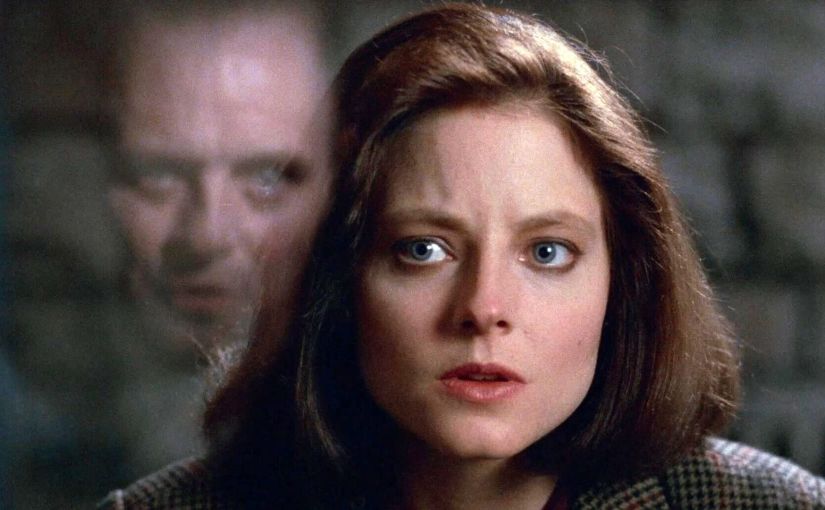
PLOT: A bereaved woman (Foster) and her daughter are flying home from Berlin to America. At 30,000 feet, the child vanishes, and nobody will admit she was ever on the plane.


I get it. Flightplan strains at the leash of credibility. A lot. In order for the plot to work, the audience has to believe that a number of people would have to be involved in a massive conspiracy, a cacophony of coincidences that screams “CONTRIVED” to any sane moviegoer.

But, as ridiculous as it seems, the movie still works incredibly well, even upon repeat viewings. Director Robert Schwentke has not exactly distinguished himself since this film (credits include R.I.P.D., Red, and the last two Divergent movies), but Flightplan displays a surefire command of tone, creating a claustrophobic atmosphere while keeping the camera free to move around the plane along seemingly impossible paths.

This film is a classic example of what Roger Ebert called a “locked room” puzzle. A girl is missing on an airplane – admittedly a very LARGE airplane, but still. There are only so many places she can be. The plane is searched, but she’s nowhere to be found, leaving only two possibilities: she was never there to begin with, or someone’s lying. But who? And why? She thinks she recognizes an Arab passenger on the plane…was he staring in her apartment window the previous night? Is she going crazy, or has there been an actual kidnapping? That’s the central mystery, and it carries the movie for most of its brief running time.

(There’s a neat section where Foster’s character (who, coincidentally, helped design the plane they’re on), monkeys around with the plane’s electronics and gets the oxygen masks to fall, to create a diversion for herself. Tell you what, that would get MY attention.)

The final resolution is…well, let’s say it answers all the questions of what happened without addressing HOW it happened. A lot of folks found that unsatisfactory (thus the 37% on Rotten Tomatoes), but the movie is so well-made and executed that, by the time the credits rolled, I didn’t mind it so much. But, you know…that’s just me.

A CHRISTMAS CAROL (1984)

by Miguel E. Rodriguez

A CHRISTMAS CAROL (12/17/1984)
Director: Clive Donner
Cast: George C. Scott, David Warner, Joanne Whalley, Edward Woodward, Susannah York
My Rating: 10/10

PLOT: In 19th-century London, a bitter old miser who rationalizes his uncaring nature learns real compassion when three spirits visit him on Christmas Eve.

——————————

[SPOILER ALERTS! (For anyone whose souls are so dead they have never seen or read A Christmas Carol before…)]

The TV version of A Christmas Carol that first aired on CBS in 1984, starring the legendary George C. Scott as Ebenezer Scrooge, is the best version of Charles Dickens’ story that I’ve ever seen.

Oh, but let me tell you why.

Without exception, every other version I’ve ever seen, including live theatre versions, have made humor and lightness their prevailing mood. The musical Scrooge (1970) does have its share of dark moments towards the end, but the darkness is derailed by an unnecessary detour into cartoonish humor (while in the depths of Hell, no less). I’m not saying that making the story fun is wrong, necessarily. After all, it’s a Christmas story, with a strong message of redemption, so why shouldn’t it be a joyous experience? Right?

Ah…but this 1984 version takes a novel approach. It realizes what I’ve always known all along: that this is, above all, a ghost story with a Christmas message. And not all ghost stories are merry and bright.

Take the Ghost of Christmas Present, for example. In this version, he’s played by Edward Woodward, with a deep booming voice, an absurdly hairy chest, and hidden stilts making him upwards of 7 feet tall. His eyes twinkle, but something about his grin and hearty laughter gives you the sense of a cat toying with a mouse. There are moments when he berates poor Scrooge for his vices, and his voice becomes intense, and the smile vanishes from your face, and he tells Scrooge that his life may be worth less than MILLIONS of other souls like Tiny Tim, and…it’s quite a moment. It reminds you that this is a morality tale.

Another example, of course, would be the ever-popular Ghost of Christmas Yet to Come. In every other version I’ve seen, this specter doesn’t speak, just points, usually with some kind of musical flourish. This version is no different, except the filmmakers ingeniously use an intensely creepy sound effect whenever this Ghost points or nods. It’s like someone pulling a violin bow across a huge piece of sheet metal. The effect is not comic or melodramatic. It’s deeply unsettling.

Of course, yet another reason to love this version is the towering performance from George C. Scott as the proto-Grinch, a man for whom Christmas is just an “excuse for picking a man’s pocket every twenty-fifth of December.” He injects moments of sly humor if you watch carefully (to the mute Ghost of Christmas Yet to Come, he mutters, “You’re devilishly hard to have a conversation with”), but for the most part he plays the character completely straight with nary a grin to be seen except on the rarest occasions. This is an aspect missing from every other version. The prevailing wisdom seems to be to amplify and overdo the character of Scrooge, so he’s not as unlikable, I guess. Not this time. Scott creates a mean, heartless, ruthless businessman who would as soon bankrupt you as say two words to you. Even Albert Finney’s interpretation in Scrooge, as completely as he disappears into the role, is not as dark and merciless as George C. Scott’s version.

It’s that darkness that appeals to me here. Yes, yes, the ultimate scenes of happiness and redemption are all there – the boy on the street, Scrooge skipping around his room, “giddy as a drunken man”, the massive turkey – but I love this version because it remembers its roots. This is a gothic ghost story, and as far as I’m concerned, any version of A Christmas Carol would do well to remember that.

KLAUS (2019)

by Miguel E. Rodriguez

KLAUS (2019)
Directors: Sergio Pablos, Carlos Martínez López
Cast: Jason Schwartzman, J.K. Simmons, Rashida Jones, Norm MacDonald, Joan Cusack
My Rating: 10/10
Rotten Tomatometer: 94% Certified Fresh

PLOT: The origin story of a certain jolly fellow in a red suit is told with beautifully enhanced hand-drawn animation in a film that deserves to be ranked with the best holiday classics.


I was not prepared for this.

Netflix’s Klaus from 2019 is one of the most beautiful, magical, and relentlessly original holiday films I’ve ever seen.  And heart-rending.  There are emotional beats in Klaus that rival anything in Pixar’s catalog, from the opening sequence of Up to the finale of Inside Out.

Short review: Go. Watch it now. Why are you still reading this?

Long review:

It starts an unspecified number of years ago somewhere in what appears to be Scandinavia, but it could be anywhere.  Or nowhere.  Jesper (Jason Schwartzman) is the ne’er-do-well son of the postmaster general, or something like that.  Determined to make a man out of his son, Jesper’s father assigns him a task: start a post office in a remote northern village on a desolate island and generate 6,000 letters in a one-year period or get cut off from his family’s substantial wealth.

The visuals in this forbidding village could warm the surrealist cockles of Tim Burton’s heart.  Rooftops aren’t so much pointed as sharpened.  Wide-eyed children make snowmen that would give Calvin nightmares.  A generations-long feud between two families on either side of town seems to be their only purpose for staying in town in the first place.

(So far, I’m thinking, okay, kinda weird, not sure where they’re going with this…is this scrawny dude gonna be Santa?)

One thing leads to another and Jesper travels to the other end of the island to visit the isolated house of someone known locally only as the woodsman.  Here he discovers shelves and shelves of handmade toys, gathering dust.  One of these toys finds its way into the hands of a child back in town who wrote a letter asking for a toy…

And here is where the story’s streak of inspired originality really took off.  Virtually every aspect of the legendary Santa Claus is given its own special origin story, from the reindeer to the sleigh to the concept of a Naughty List, right down to getting coal in your stocking instead of a present.

Aha, you say, but this has already been done!  I liked it better when it was called Santa Claus is Comin’ to Town, on TV in 1970, with Fred Astaire, Mickey Rooney, and Keenan Wynn!

True enough.  But Klaus ups the ante by imagining this tale in a way I’ve never seen before.  I’m finding it difficult to express my admiration without giving away key aspects of the film that make it such a delight.  It’s all done so organically, so naturally, that something happens, and you think, “Well, of course they think reindeer can fly, after seeing that!”  I found myself laughing out loud due to the sheer ingenuity on display.

I think it’s a great companion piece to that much-maligned holiday classic, The Polar Express.  Both films approach the Santa legend from different angles, but neither one talks down to its intended audience.  Here is a mystical figure, possessed of magical abilities beyond mortal man.  Both films treat him with the kind of childlike reverence he deserves, and if he’s a little scary sometimes, well…he is always watching…

But none of that would be enough to achieve perfection on its own.  What makes this movie perfect are the heart-rending emotional beats that come as complete shocks to the viewer.  You may notice that I haven’t mentioned Mrs. Klaus, nor is she listed on IMDb.  There’s a very good reason for that, but you won’t get it out of ME.  You may also be asking yourself, well, if this hermit woodsman turns into Santa Claus, what’s the deal with the postman?  Great question!  Watch the movie and find out.

(Pay attention to the wind…that’s all I’ll say.)

These and other surprises pop up here and there, like searching through old clothes and finding folding money in the pockets.  The finale might make you cry like a baby if you’re not careful.  You’ve been warned.

Klaus is buried treasure, lost amid the hubbub of many other films from that year that have been forgotten.  This one does not deserve to be forgotten.  It belongs on any list of classic holiday films, old and new.  If you’ve made it this far in the review, congratulations, thanks for reading, but now it’s time to GO WATCH THIS MOVIE.

Now available on Netflix.

THE STING

By Marc S. Sanders

Find me a better combination of script, cast, direction, score, art direction and costume and I guarantee it’ll take you some time and effort.

The Sting, directed by George Roy Hill and written by David Ward, is the kind of movie where you uncover something new every time you watch it. It’s because the film is all in the minute details to assemble the beginning to the middle to the end. The film is wisely edited in step by step chapters; The Set Up, The Wire, The Shut Out and eventually on to the satisfying The Sting.

The audience is even set up but you’ll have to watch to see how. I dare not spoil it.

Cars, trains, drug stores, diners, a carousel, dames, gangsters, Bunko Cops, Grifters; all are elements needed for the best confidence men superbly played by Robert Redford and Paul Newman, along with a supporting cast like no other, Eileen Brennan, Harold Gould, Charles Durning, Ray Walston, Jack Kehoe and the best villain, or rather “mark,” Robert Shaw.

This is one of my favorite movies. When I first saw it, I was probably age 10 or 12. I understand next to nothing of what was going on. It was the music that drew me in first followed by the sharp suits designed by the legendary Edith Head. The movie’s script is its greatest asset but visually it is just as fun. The 1930s Chicago setting is a character in and of itself. Newman cheats beautifully at poker against a temperamental Shaw, and gets him!!! “You owe me 15 grand pal.” When I first saw it, I didn’t know what he was doing or how he did it. How did he switch hands? I was enamored with the hands that were dealt and the poker chips on the table, but I loved it when the better cheat won out.

The second iteration of the Hill/Newman/Redford trifecta (following “Butch…& Sundance…”) is just plain fun. It was the fun that earned it a Best Picture Oscar.

No other film has come close to duplicating it. Maybe the Clooney/Pitt/Damon version of “Ocean’s 11”? I don’t know. However, if you love that film, you owe it to yourself to watch “The Sting.”

The Sting is…”the quill!”

LIVE AND LET DIE

By Marc S. Sanders

I dunno. For me, the suave sophistication with the tongue in cheek persona of James Bond doesn’t mix well with the ‘70s cinematic themes of Blaxploitation and island voodoo rituals with snake bite human sacrifice. Live And Let Die was never a favorite of mine in the series. Still, it has some merits; even pioneering moments that set the standard for the next 20-25 years of 007. The gadgets are getting cooler (like a handy Rolex watch with a super magnet and buzz saw) and better, more natural looking action.

Harry Saltzman & Albert Broccoli present a film where the action scenes are the most authentic yet. A car chase with a double decker bus doesn’t feature the background film scroll seen in the rear window of an automobile, like prior films.

There’s a particularly long sequence featuring a boat chase through the Louisiana bayou. Great stunts and well edited footage here, although it features one of the most annoying characters in the whole series, redneck Sheriff GW Pepper (Clifton James, who always played the same role like in Superman II and even The A Team). This scene is an absolute blast of fun as Bond commands a speed boat while trying to evade a handful of bad guys in pursuit. Cars are wrecked. Boats are wrecked, and a bride to be wails aloud as her wedding is ruined. It’s just fun.

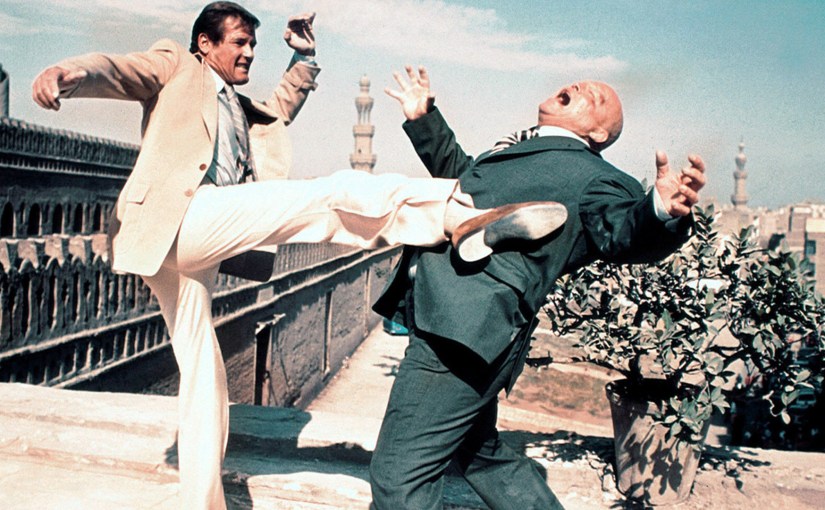
Roger Moore slips comfortably into the role of the Britain’s most celebrated secret agent. He’s handsome, for one thing, and his humor is dry enough that even in the face of death a pun is well delivered.

Yaphet Kotto plays Kananga, a far cry from the Cold War villains of Blofeld and Goldfinger. Turns out this guy just uses a couple of bars as a front for his heroin dealing enterprise while he dons a neighborhood crime boss image of “Mr. Big,” looking more like a villain of Shaft. He’s nevertheless good. Though he starts out the role quite subdued, he gleefully comes alive in the second half of the film when Bond intrudes on his secret lair.

Tom Mankiwietz’ script is lacking though. The pre title sequence gets me curious why three agents are inventively killed, but then the story mires itself in Kananga relying on Tarot card reading from the first virginal Bond girl, the High Priestess known as Solitaire. (Jane Seymour’s first screen role.) This offers no suspense or substance. We wait for cards to literally be turned over. Not exactly nail biting. Seymour is beautiful, but the intelligence and sex appeal of the character is flat.

There are also scarecrows and Caribbean island voodoo that are hardly threatening and belong in a horror film, not a Cold War era Bond adventure.

All of this weird material was twisting the series a little too far off course.

Live And Let Die does add a great henchman to 007’s rogue gallery; that of the imposing Tee Hee with enormous height and his steel lobster claw arm. He’s a fun bad guy that happily deserts Bond in a hungry alligator swamp.

Director Guy Hamilton’s third Bond film is not a total bust. It’s well cast in villains and Roger Moore is a perfect successor. Location shots of New Orleans and Jamaica (subbing for Kananga’s Caribbean island) are cool to see. The Harlem, New York footage really doesn’t belong here, though. It also has one of the best, most often played songs in the whole series, compliments of Paul McCartney & Wings. Again, it suffers however from a short sighted script.

Bond will be better served in missions yet to come.

FRENZY

By Marc S. Sanders

London is being terrorized by the necktie strangler.

In 1972’s Frenzy, Alfred Hitchcock hearkened back to his killer classic themes remembered from Psycho. Only this time he is much more macabre with his material. Frenzy is Hitchcock’s only R rated film and his first movie to show outright nudity. Naturally, it’s all pretty eye opening, and considering that the film’s killer is regarded as a “sex maniac,” necessary as well.

Richard Blaney (John Finch) is not doing so well. He’s broke and he’s just lost his barkeep job. Subsequent from that he turns to his ex wife Brenda (Barbara Leigh-Hunt), a successful marriage and friendship counselor for comfort. It does not help that Brenda’s secretary overhears Richard violently losing his temper. Nor does it do any good when he has an outburst while dining with Brenda in a crowded restaurant. Why, this could only make him look suspicious of a crime, and the infamous, serial necktie strangler has yet to be caught.

When Brenda turns up dead by means of a necktie around her throat, all accounts point to Richard. Once again, Hitchcock’s protagonist is the Everyman caught up in an unwelcome conspiracy.

Frenzy is thankfully like many of Hitchcock’s best films. It gets straight to the point. Just as the film begins, the naked body of a dead girl floats up from The River Thames. Then it follows through with Richard and introduces likely suspects and or villains including Richard’s friend Robert Rusk (Barry Foster) and his bar waitress co-worker Baba Milligan (Anna Massey)

Hitch goes more horrifying than he might have had the liberty to do so a decade prior to this release. The necktie strangler’s rape and murder of the first victim is quite graphic and disturbing. This is a deranged individual and his victim is rendered helpless.

What keeps viewers interested in a good Hitchcock yarn is the suspense he manufactures for the one who is blamed, as well as for the killer. Hitchcock doesn’t dwell on mystery. Rather, he focuses on what his principal characters are going to do next, now that they are swept up in intrigue. The strangler continues his killing spree but overlooks one thing that could implicate him. The man who is blamed seems to get little help from anyone. Richard is in quite a pickle after all. As well, how will these two people encounter one another to wrap up the storyline?

Humor also comes through quite nicely with Chief Inspector Timothy Oxford (Alec McCowen) who is blessed with a loving wife who relishes analyzing the gruesome details of his investigation while preparing dinner time meals that look awfully worse than the corpses the Inspector encounters; quail with raisins for example. To look at her concoctions will certainly make you wince. It’s great side humor for the suspense at play.

A film like Frenzy hardly explores dimension in its characters. Many of Hitchcock’s films never get weighed down with too much material. The stories he directs are lean, only focusing on the central plot at play. The fun is in the disturbing angles he uses like a woman’s outstretched hand or frozen expression after succumbing to strangulation. Overhead shots of a man imprisoned in a small room can also be jarring. He keeps you engaged as tightly as the fingers of a dead body gripping a significant piece of evidence.

Films like Frenzy or Psycho cannot be made today. There are too many advances in technology and science to undo the developments of simple, yet grossly disturbing stories like this. DNA evidence and cell phones would wrap up any of these plot lines in five minutes. It’s fortunate that we can still transport ourselves to the period when these tales of suspense were originally developed. It doesn’t make it easy for the innocent man, the victims or the killer. I wonder how Hitch would approach today’s conveniences of modern science. If anything, he’d likely make his signature cameo on the wallpaper of someone’s iPhone. Nevertheless, I’m sure he’d find a way to continue to build his suspense. He had such an eye for his camera, his captions and his edits.

Frenzy is a demonstration of classic Hitchcockian thrills.

THE CANDIDATE

By Marc S. Sanders

A politician’s career isn’t being elected. A politician’s career is getting elected. Once it is all over, what does the politician do now?

I’m not sure I understand why Jeremy Larner’s script won the Oscar in 1972; only because I didn’t gather much from this Robert Redford star vehicle. What exactly was the point of what I was watching? Redford plays Bill McKay, an idealistic lawyer recruited to run for the California senate on a Democratic ticket.

He’s sure to lose and I guess he’s okay with that because it’s acknowledged that way early on, and yet he just follows through with the campaign. He’s a kid compared to his seasoned Republican incumbent opponent. So he’s got that to deal with, and he’s remorsefully living in the unwanted shadow of his father, a former good ol’ boy governor. He also occasionally brushes past a girl that follows his campaign. Bill is happily married. Sounds like a good set up, right? Maybe it is. Yet I’m not sure any of this is the set up of the film. There is rarely any conversations in The Candidate. Hardly any dramatic pauses occur either. Nary a scene with his wife. The televised debate midway through is generic cliche really. One good moment occurs when the Republican candidate steps on Bill’s toes during a threatening brush fire. Now here’s some conflict. Now we’re cooking. Except…we’re not. The film returns to its established theme from earlier. For some reason in the last half of the film, it throws two or three punchlines at you, and…well, I guess it’s a comedy now.

The Candidate fills a majority of its two hours with McKay doing a lot of handshaking, baby holding, celebrity meets (Hi Natalie Wood!) and autograph signing. When that’s not happening, we are treated to repetitive close ups of members of his campaign and voters. I felt like I should have known these people. Did I fall asleep during their big introduction in the film, or were those scenes deleted from the finished product? Bill doesn’t say much except to make generic statements that no voter would ever disagree with. That’s okay, I guess, yet really it’s just boring. None of this packs any punch.

Larner was a speechwriter for Eugene McCarthy in 1968, and Redford recruited him to write and tailor this script for him to produce and star, in response to his own dismay with the political climate at the time. Maybe The Candidate is supposed to be narrated in a documentarian sense but even if that’s the case, it fell short for me. Scenes here seem about as interesting as someone who unwraps a stick of gum and chews it.

Perhaps the Oscar was merited due to the political climate at the time. Redford’s character told audiences what they wanted to hear and magically Larner’s screenplay is now brilliant. If that’s the case, then I guess The Candidate is now dated. There’s no way this film outshines other political films like Wag The Dog, Primary Colors, Mr. Smith Goes To Washington, or from what I hear Bulworth (never saw it).

The Candidate carries no drama, no comedy, no shock value. I’d say no message either, but the unexpected ending (unexpected only because I didn’t know the end scene was actually the end scene) finally told me something that I laboriously waited a long two hours for. The wait wasn’t worth it.

CABARET

By Marc S. Sanders

Is it possible for a musical to be disturbing? Maybe Bob Fosse’s Cabaret favors that argument.

Liza Minnelli won the Academy Award for Best Actress in 1972 for her portrayal of Sally Bowles, a carefree, happy go lucky performer at the underground Kit Kat Club located in Berlin, 1931. She is the lead attraction among a company of dancers doing a different kind of stage vaudeville with its colorful emcee played amazingly by Joel Grey, also an Oscar winner.

The musical numbers are outlandish with caked on makeup and outfits that could make Victoria’s Secret seem like a children’s shop. I gathered from the film that Fosse, who choreographed the numbers as well, offered up the escape of life first, before showing the harsh reality of Berlin in its historical context.

Sally and the Emcee’s performances are first on hand, depicted as silly and showstopping. Thereafter, Sally encounters an English gentleman named Brian Roberts (Michael York) who is a professor of English study attempting to complete his doctorate. As Sally and Brian become closer as friends first, he must reluctantly admit to Sally that he’s a better bed companion with a man than with a woman. Sally doesn’t understand why he didn’t say that in the first place as she attempts to come on to him.

Herein lies the dilemma many faced as the Nazi party was gaining traction in Germany. How necessary is it to hide your true natures to preserve your life? Sally’s underground lifestyle at the club clouds her vision of what’s gradually happening in the world. Nevertheless, they eventually develop a relationship as Brian appears to be bisexual, more specifically.

A side story concerns Brian & Sally’s relationship with a baron named Maximillan (Helmut Griem), who will wine and dine them at his estate only to later abandon the respective relationships he sets up with them to more or less make them feel as cheap as prostitutes. I wasn’t sure what to gather from this extension, however. The irony is that unbeknownst to Sally and Brian they have both been sleeping with Max. Eventually, Sally reveals she’s pregnant but does not know who the father may be, Brian or Max, and an abortion is considered.

An additional side story concerns a wealthy Jewish German heiress named Natalia who falls in love with a German Jew named Fritz living under the guise of a Protestant.

Cabaret is a loose adaptation of The Berlin Stories by Christopher Isherwood (the Brian character) and his experience with stage performer Jean Ross (the Sally character). Isherwood’s stories gradually formed into different iterations of stage plays and short stories before making it to Broadway and Fosse’s celebrated film.

Though Fosse apparently took some questionable liberties and departures from Isherwood’s writings, I think it depicts the personal struggles of love and self identity while the world around them is quickly changing into a scary reality where your own self identity could get you killed.

Fosse gives terrifying glimpses of how the Nazi party seeps it’s way into a decadent Berlin of underground showmanship. Though apparently Berlin really wasn’t so decadent as the film has you believe. Ross and Isherwood have gone on record describing Berlin was a more destitute and poor environment, actually.

In Fosse’s film, a Nazi youth is seen early on being kicked out of the Kit Kat Club. A few minutes later, the night club manager is being beaten in an alley. Fosse juxtaposes scary moments like this against the silly debauchery depicted on stage. It’s as if the Gypsies, homosexuals and Jews in the area are unaware of the evil practice that is gradually taking over outside.

Soon, Fosse makes the swastika more apparent in the streets with propaganda handouts. Most telling is when a young boy is seen at an outdoor beer garden gathering singing a number selfishly entitled “Tomorrow Belongs to Me.” Fosse is frighteningly effective at showing this boy from the neck up. Eventually, he moves the camera down to reveal the boy’s swastika wrapped around his sleeve. The song which seemed to champion beauty and nature now evolves into a march of grandstanding fascism. It completely shocked me. Just as people like Brian and Fritz are reluctant to reveal their backgrounds, both sexually and religiously, the Nazi party is proud to announce their mindset in a converse manner. By the end of the film, the audience at the Kit Kat Club more predominantly shows Nazis in the audience as opposed to just the one shown in the beginning of the film. Hatred has spread its disease.

While Minnelli shines in her role, her showstopping moment really comes at the end when she dangles her carefree attitude while belting out the title song with “Life Is A Cabaret.” Along with Joel Grey’s Emcee closing out the film with the “Finale,” this musical goes against the grain of most musicals’ cheerful close outs or romantic theatrics. Fosse’s mirror image of the Nazi party taking in Sally and Emcee’s performances are chilling. We sense the characters’ time is at an end and wisely the film runs its closing credits among frightening silence with the cold, blurred images of Nazi soldiers staring right at us.

I had never seen the film of Cabaret until now, but I had attended two different stage productions; neither of which I liked. Bob Fosse’s film seems more clear with its content than I ever got from a stage performance. Perhaps it is because the Oscar winning art direction is more apparent than a stage set. We can see the bustling of Berlin change amid a political climate that at first is not taken so seriously. As hurtful and harrowing the relationships of love between Brian with Sally and then with Max, as well as Fritz and Natasha are, none of this will eventually compare to the upcoming demise for Berlin.

As Miguel noted in our recent podcast that focused on musicals, Cabaret won the most Oscars without winning Best Picture (losing to The Godfather). It’s clear how deserving it was of its accolades. The musical numbers are very engaging but the fear of fascism is well developed too. So there is a roller coaster of emotions to absorb from Fosse’s film. I believe in that podcast I noted that Francis Ford Coppola won Best Director. I now realize I was wrong. It was in fact Bob Fosse who took home that prize, and it’s truly evident how deserving that honor was for him.

Again, while I’ve yet to find a stage production I’ve liked, I was terribly moved by the film. Cabaret, the film from 1972, is a sensational and frightening production.

HOUSE OF GUCCI (2021)

by Miguel E. Rodriguez

Director: Ridley Scott
Cast: Lady Gaga, Adam Driver, Jared Leto, Al Pacino, Jeremy Irons, Salma Hayek
My Rating: 5/10
Rotten Tomatometer: 61%

PLOT: An outsider marries into the Gucci family, and her unbridled ambition triggers a downward spiral of betrayal, revenge, and violence.


Watching Ridley Scott’s House of Gucci was a curious experience.  I could see glimmers of a great entertainment through bars of slow pacing, a meandering story, and unanswered questions.  The performances are top-notch, no question, but they are at the service of a movie that doesn’t seem interested in meeting their level of passion.

Inspired by true events, the movie tells the story of Patrizia Reggiani, a young woman from humble beginnings who meets and eventually marries Maurizio (Adam Driver), one of the heirs to the Gucci fashion empire.  Patrizia is played with fury and fire by Lady Gaga, who seems destined for another Oscar nomination.  Her character is portrayed as a latter-day Lady Macbeth, someone who sees through the deceptions of her new husband’s business associates and manipulates people and events for her family’s benefit.  In true tragic form, her ambitions threaten to derail everything she loves.

Adam Driver plays Maurizio as a rather slow fellow who disinherits himself so he can marry Patrizia but finds a way back into the fold via his uncle, Aldo (Al Pacino), who sees Maurizio as a good substitute for his own disappointing son, Paolo.  Paolo is played by Jared Leto, in another of the film’s performances destined for Oscar recognition.  Buried underneath flawless makeup and a skin cap, Leto portrays Paolo as a self-deluded buffoon whose fashion designs aren’t so much daring as unfortunate.  (Apparently, pastels and brown were never meant to mix…who knew?)

I mention the performances because they are the sole highlights of the film.  For two-and-a-half hours, these performances play against a backdrop of one dreary scene after another. Sure, the performances are fun to watch, but at the end of the day, if they don’t have anything interesting to say, it gets a little boring.  We get behind-the-scenes intrigues and betrayals that seem to owe more than a little to earlier crime epics by Scorsese and Coppola, but there was nothing to get really excited about.  Nothing grabbed me.

Ridley Scott’s films are normally way more imaginative than this.  They look better.  The cinematography is usually more inspired.  I’m not talking about his action or sci-fi epics, either.  I mean his small-scale triumphs like Matchstick Men or Thelma & Louise.  What happened here?  Was he not inspired by the story?  There is great material here, more than enough back-stabbing and lying and cheating to go around.  Yet everything is subdued, and plods, and inspires more yawns than anything else.  I didn’t experience any kind of excitement or passion one way or the other for any of the characters, or for the story.  It just didn’t make me care.

By the time House of Gucci is over, we’ve seen betrayals, marital infidelity, divorce, back-stabbing business deals, sex, and murder.  I have a friend who wrote a stage play that has almost all of those things, and it was WAY more entertaining than this film.