THE LIVING DAYLIGHTS

By Marc S. Sanders

The Living Daylights is one of the best James Bond films. It’s more than just a Bond film with gadgets, and henchmen with unusual scarring or kill techniques. It’s actually a film that plays on the Cold War instead of loosely being inspired by it like say Dr. No or You Only Live Twice.

A Russian agent wants to defect and is eternally grateful for Bond’s assistance. The mission goes as planned but then twists fall into play and maybe there’s more to this Russian agent than was foreseen. Who is his beautiful girlfriend? What does an American arms dealer have to do with all this? How does opium and diamond smuggling become involved? There are travels to Czechoslovakia, Tangiers, beautiful Vienna and ironically Afghanistan. Yes. In 1987, James Bond could rely on Afghan rebels for aid and weaponry. Any chance this film will be remade today?

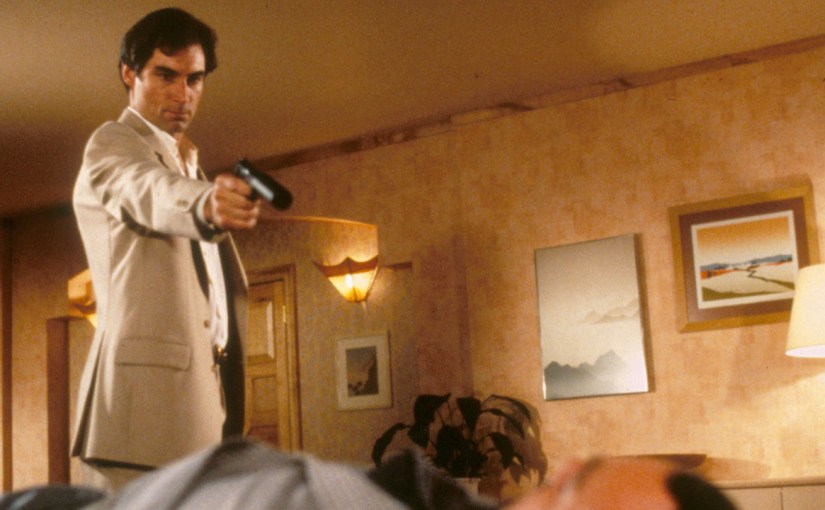
Maryam d’Abo is a beautiful concert cellist and she’s great in the film. Her character is Kara Miloviloy (no innuendo that I could find in that name; this is more spy thriller than sexual schtick). Timothy Dalton makes his first of two appearances as Bond. He’s more serious than audiences were accustomed to, putting his sharp wit and intelligence ahead of his sarcasm like Connery or Moore before him. Dalton and d’Abo have great chemistry together. Jerome Krabbe is the dubious defector playing to whatever side will help him profit, and Joe Don Baker is the redneck arms dealer with an affection for history’s greatest battles only recreating them on his play sets to his own liking.

The film also boasts one of my favorite Bond openings; a runaway Jeep full of explosives careening down the Rock of Gibraltar with 007 hanging on to the roof. It’s a great set piece because it seamlessly looks like stunt work with minimal effects and it lends to the movie’s story.

Another great action moment occurs towards the end with Bond and an intimidating muscle man dangling from the netting of the back of a plane. I’d swear Dalton was doing his own stunts.

Regular Bond director John Glen made a great film of adventure, romance, action and Cold War politics. The Living Daylights is definitely one of my favorites in the Bond series. It’s worth a look, and then another look.

THE GODFATHER PART III

By Marc S. Sanders

Francis Ford Coppola and Mario Puzo finished out their Corleone trilogy in 1990 with The Godfather Part III. Not so much a sequel, this third film feels more like an epilogue jumping towards Michael Corleone’s (Al Pacino) elder years as the Don of the most powerful Mafia family in the late 70s/early 80s.

Michael seems exhausted with his rule as he suffers from diabetes as well as remorse for his past sins; especially feeling the guilt of ordering the execution of his brother Fredo.

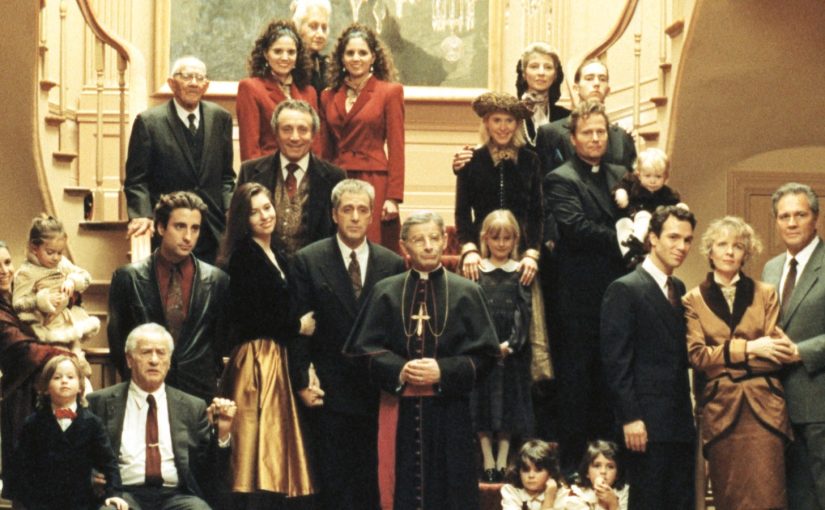
Still, he is drawn to crime, but on a more sophisticated and righteous nature by taking advantage of the Roman Catholic Church. Michael intends to purchase the powerful bank associated with the church but that’ll have to fall in line with the Pontiff’s agreement. It doesn’t help that the Pope is in failing health. The setup of all this lends to another grand opening where Michael earns a prestigious award from the church in the same tradition of an austere celebration of many guests that lend to character set ups for the film. A Godfather movie is not a Godfather movie without a grand reception to open the film.

The most interesting character is Michael’s nephew, Vincent (Andy Garcia), a fierce hot head like his father Sonny. He wants to work for Michael desperately while fending off a street hood boss (Joe Mantegna). An older don also comes into play by the great character actor, Eli Wallach. Diane Keaton as ex-wife Kay is also here but more or less to quietly bicker with Michael. Sister Connie is here, too, with Talia Shire. The Connie character always changes from each movie. Here she’s a deadly black widow. There’s also Michael’s daughter Mary (Sofia Coppola, contrary to popular opinion, I insist she’s very good in the role). Is Mary a legitimate cover for the family as the spokesperson for a fundraising effort? Is the possibility of Vincent and Mary (as cousins) getting intimate a terrible risk?

I like this film and hold it in high regard. Namely because Coppola and Puzo took an approach straight out of the news when there was an embezzlement scheme occurring within the Vatican bank. The problem for many I believe was that the plot of this grand scheme was not flashy or bloody enough, even if a participant is revealed to be hanging from a London bridge with fraudulent receipts falling out of his pockets…which actually happened in real life.

The film allows many opportunities for Michael to allow his anguish in guilt to flow. Fans grew used to a fierce Michael Corleone from the first two films. The elder Michael here would rather not get involved. Hence the introduction of Garcia’s character. He’s very good in the role. Yet there’s not much dimension to Vincent. He’s a scary violent guy, and a contradiction to what Michael seeks. Yet, thats about all there is. I would have wanted more dimension to this role; the guy destined to carry on the reign.

Sofia Coppola is fine in her part and undeserving of the lashing she received upon the film’s release. She’s Michael’s young daughter; a young adult dangerously close to the fray. The one innocent constant within the family. For me, I found a dramatic stake in her character.

The ending is very powerful. Slowly methodical as the family assembles in Sicily to see Michael’s son’s stage opera debut. There are elements that are consistent with the other films’ endings, but this violent conclusion comes with quite a shocking result. I was really moved by it.

Coppola didn’t measure up to the first two films with this effort. I agree with that. Still, The Godfather Part III is worthy of holding its place in the saga. It carries the traditions of the prior films in set up and music and operatic narrative. Be patient with its slow pace because I think the ending will grab you.

THE GODFATHER PART II

By Marc S. Sanders

The first film to use the number 2 (or Roman numeral II, in this case), in its title and the first sequel to win Best Picture is Francis Ford Coppola’s continuous adaptation of Mario Puzo’s Corleone family legacy in The Godfather Part II. It is worthy of all of the accolades it collected as an individual film. Yet, it does not best the first film.

Unlike the 1972 classic, Part II does not provide much character arc for anyone. We’ve already seen Michael (Al Pacino, silently ferocious here) change from good college boy and war hero to the evil puppet master Mafioso he eventually became. This film shows him exercising his threateningly murderous deeds as he works in conjunction with a sly Nevada Senator, a Jewish Miami mob boss (an excellent performance from Lee Strasberg) from the time of his father’s reign, and another mob guy from New York (Michael V Gazzo). We get a whiff of all these guys early on during a commencement celebration for Michael’s son. Coppola keeps this a running theme of grand openings in all three films. It’s a great method of introductions each time.

Following the party, an assassination attempt is brought against Michael. But who did it? Problem is this is where the foundation of the film is not so strong. It’s never really made clear who betrayed Michael. That’s a little bothersome.

Coppola depicts another storyline altogether with the early 20th century origin of Vito Corleone flawlessly played by Robert DeNiro who hardly speaks any English while communicating in a Sicilian variant of Italian. Young Vito immigrates to America following an escape from the Sicilian Don that murdered his family. In New York we witness his rise to power. Famed Cinematographer Gordon Willis washes out these flashback images to enhance a pictorial history accompanied by Angelo P. Graham’s art direction of early brick and mortar architecture and the muddy streets of early Little Italy, New York. It’s a time travel back to a historical age. It’s magnificent.

Back in the 1950s, Puzo and Coppola bring authentic fiction to real life history as Michael considers a go at a business enterprise in Cuba. However, will the rebellion uprising interfere with his plans, and what will it cost him? As well, there’s a great sequence where he has to testify before a congressional hearing in response to suspicion of criminal activities. Coppola used the infamous McCarthy hearing footage as inspiration for this predecessor to what C-Span would eventually look like.

Yet, there’s another story to become involved with as Michael must contend with his dim witted older brother Fredo. John Cazale is superb as the guy who wanted more but was limited by the influence of competing factions and his loyalty to his brother. Pacino and Cazale always had great chemistry together. A great conversation moment occurs in the third act following a terribly surprising twist. One of the best scenes in the film occurs on the porch of the Corleone compound.

More story elements come into play as Michael attempts to balance his married life with Kay (Diane Keaton). She’s pregnant again. Yet, what will that mean for the future of the family?

The sequel to The Godfather assembles another stellar cast. So good, that the film garnered three Oscar nominations in the Supporting Actor category alone (DeNiro, Gazzo, Strasberg) as well as a nomination for Pacino as Best Actor and Talia Shire (Supporting Actress) as Connie, Michael’s sister. That nom left me a little dubious only because there’s not much material for Shire to play with here.

Coppola’s detail is at the top of his game again. The film, like the first, feels like a true life biography.

Puzo offers heartbreaking moments, most especially in the film’s shocking end which leads to a flashback assembly of characters from the first film. That scene alone plays as a great reminder of what Michael once was before becoming the hideous monster that closes the story. Puzo’s whole Godfather franchise hinges on well defined, crushing tragedy.

The Godfather Part II is nothing short of mesmerizing and wholly engaging. You can watch it over and over again. It’s layered in rich storytelling and narratives that provide endless amounts of material for a family meant to be mired in secrets, deliberately hidden in the dimly lit rooms that Willis photographed.

It’s a treat to be the fly on the wall wherever Michael and his family move to next.

THE GODFATHER

By Marc S. Sanders

Probably the greatest character story arc in all of film is of Al Pacino’s portrayal of Michael Corleone in Francis Ford Coppola’s The Godfather based upon Mario Puzo’s best-selling novel. (The film is a thousand times better than the book.)

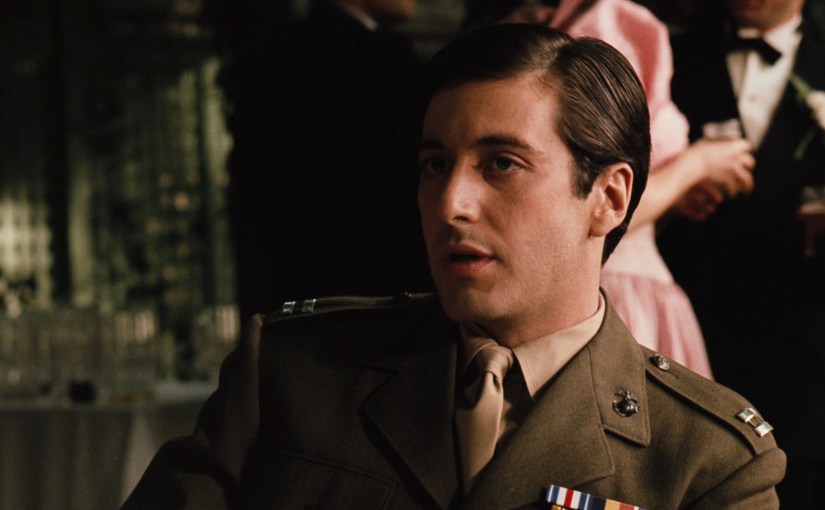
Michael is the youngest of three sons intended for a legitimate life separate from his Mafia family. The masterful opening sequence of his sister’s lavish wedding show him courting his eventual wife, Kay (Diane Keaton), and never feeling proud of the actions of his notorious father, Vito (Marlon Brando), nor his brother Sonny (James Caan) or their consigliere, Tom (Robert Duvall). He’s an innocent war hero in uniform with an open mind of an untarnished future. It is only when bad blood circumstances are tested that he feels forced to strike with the same intent that the Corleone family is infamous for.

Coppola presents quiet, subtle moments of expression in Pacino on camera. You see the change in Michael sneak up on you and you see a character develop into something else entirely. What starts as a false impression to appear as if he’s carrying a gun in his pocket, soon after leads to murder, by means of nothing personal but “strictly business.” From there, he retreats and hides until he is blessed with carrying on an evil legacy.

Yes, the first chapter in the operatic trilogy of crime, is mostly known for a grandstanding performance by Marlon Brando but the story relies on Pacino as Michael. Michael Corleone at least must be one of Al Pacino’s greatest roles. He arguably has one of the most impressive resumes in all of film. Here is where it jump started.

The direction by Coppola is a film student’s required studying. With Puzo’s script, the best idea was to open the film with a wedding. As the film offers so many characters and much back story among all of the guests, the interaction and workings of the family are efficiently condensed into this 25 minute opening sequence. Don Vito meets with people needing favors while outside the home, the crew is dancing, doing their jobs and minding who is watching. By the end of this opening you have a full grasp of the family tree and who works for who and what their characters are like. Sonny is the hot head. Michael is the innocent. Fredo (the middle son played by John Cazale) is not doing much but being a cut up, Momma Corleone is the valued matriarch and Tom is the well managed advisor. You even get a glimpse of some “very scary guys,” some competing hoods, who’s cheating on who, and some people who need help with citizenship and film casting.

Art direction from Alex & Dean Tavoularis is magnificent, depicting a post WWII New York, and a historical Sicily stagnant in open plains, romance and murderous pasts.

The cinematography is better today than it was originally. Gordon Willis returned decades later to (for lack of better word) lighten up the picture. The interiors remain dark in secret and comfort, but the characters are more illuminated. The Blu Ray restoration is a fantastic return to the classic film and its two sequels.

The Godfather is endlessly quotable and never dull no matter how many times you watch it. Puzo’s screenplay plays like the biography of a real person and family, much like his adaptation for the screen of 1978’s Superman: The Movie. It is an American classic rich in a history we believe has been told and carrying on the tradition over the course of a 10-12 year period.

I return to praise Pacino to remind you how his appearance even changes as he gradually builds his strength and accepts his title of Don. I feel like I’m looking at two physically different people from the beginning in his Marine uniform with boyish looks, to his independent walkabout way during his Sicily retreat, to a more broad shouldered, slicked back hair, dark suit tailored appearance during the film’s third act. It’s an uncanny transformation that is built on performance and expert direction and writing from Coppola and Puzo. I still get chills as Michael in his college boy sports jacket volunteers himself to satisfy a family vengeance. Coppola zooms in on him slowly as he sits in a leather arm chair, arms at his side, legs folded. We are seeing a new man in charge for the first time. It’s chilling.

The Godfather is one of the greatest pictures that will ever be made. It’s a perfect chemistry of technical achievement, attentive storytelling and sensitive, yet powerful performances from probably the best cast ever assembled.

I’m amazed that I know of some friends who still have yet to see it.

The Godfather is the film that everyone should see before they die.

A VIEW TO A KILL

By Marc S. Sanders

A View To A Kill marks Roger Moore’s final outing as James Bond 007, and it’s more or less a near complete failure. Quite possibly my least favorite film of the entire series, regardless of an awesome song, compliments of Duran Duran and composer John Barry.

The inspiration for invention is expired in this film. Action set pieces rely on outside elements that do nothing to spice up the scenes. Bond manages to surf away along the snow covered Swiss Alps, in place for Siberia, while evading the Russians. The surfing is one thing, but when accompanied with a lame cover of The Beach Boys’ “California Girls,” you earn every right to roll your eyes and shake your head.

An unnecessary sequence involves Bond dangling from the ladder of a fire truck while the San Francisco police are pursuing him. It’s slapstick, but it’s not funny slapstick. You just wanna yell at the screen “WHAT ARE YOU DOING?????”

A View To A Kill plays like a poor remake of What’s Up Doc? with Barbra Streisand & Ryan O’Neil. Bond eventually partners up with a former “Charlie’s Angel” and hijinx ensue. Tanya Roberts plays the Bond girl this time and her dialogue mainly consists of screaming “James!” as if she is in terrible, helpless fear. She hangs and runs and screams and stands and sits while keeping her flimsy white dress and heels spotless. There’s nothing adoring, funny or attractive about her. She lends nothing to the film but dead weight. A scene involving an elevator fire had me wishing Bond would leave her to perish. The term “dumb blond” must have been coined when Tanya Roberts came on the Hollywood scene. Her character, Stacy Sutton, appears unaware of any of her surroundings and more importantly Roberts, the actress seems to be that way as well.

Roger Moore carries almost no chemistry with any of the fellow actors, certainly not with Roberts, and I think it’s because he gave up trying by the time he got to his seventh Bond film. He moves slow. He looks out of breath as he climbs the stairs of the Eiffel Tower. His delivery carries little wit. He is found hanging from the the Golden Gate Bridge and utters the line “There’s never a cab around when you need one.” Moore seems to show that even he doesn’t think any of this is fun anymore.

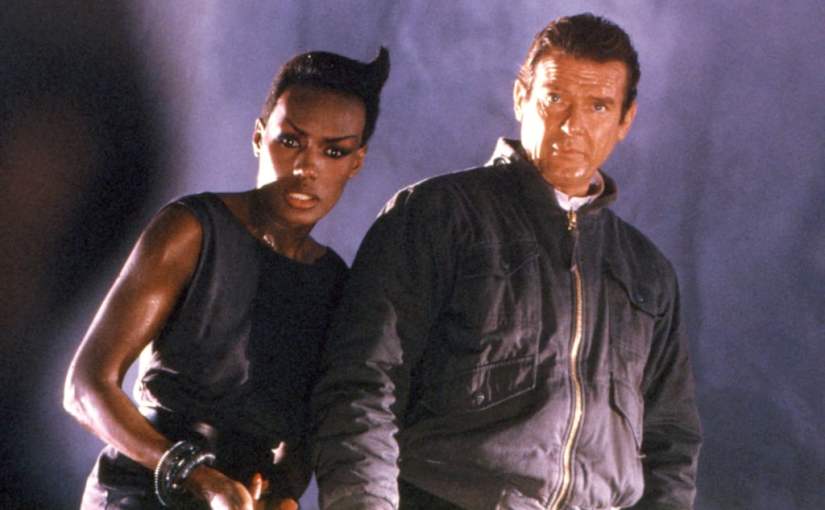
Perhaps the one redeeming quality goes to Christopher Walken as the psychotic Max Zorin. It’s funny to watch Walken play this part all these years later as he shows qualities that movie goers would love in his later films like True Romance, The Rundown, and even Catch Me If You Can. Walken deserved better material than this (especially following his recent Oscar winning status at the time). Instead, he’s given a well-toned Grace Jones as an accomplice who falls nowhere near the ranks of Oddjob or Jaws.

Richard Maibum wrote the unclear script involving Zorin’s desire to wipe out Silicon Valley, and monopolize on the micro chip industry. At least that’s what I think the film was about. The story mires itself in an overlong side story involving drugging race horses snd I could never make the connection. Bond is given the opportunity to photograph various suspects involved with Zorin and then later in quick conversation they’re all explained of their purpose. Yet, I was just more confused and unsure of what was going on and how it’s all bridged together. I don’t think the plot was complex or confusing. Rather, I think the film was cursed with plot holes and little regard for coherence.

Roger Moore notoriously regretted doing this film. He had overstayed his welcome in the franchise by 1986 with A View To A Kill. Albert Broccoli with his new producing partner, Michael G. Wilson (his stepson and a co-writer) were getting stale with the series. At this point the Bond series was no longer relying on crafty, well edited and witty filmmaking.

Moore’s last film was just processed for another buck at the box office with little respect for the franchise.

007 was due for a change.

OCTOPUSSY

By Marc S. Sanders

By the time Octopussy was released in 1983, I think part of the joke was that Roger Moore, on the latter half of middle age, can survive and triumph over insurmountable odds. The crow’s feet show around the eyes. The hair color looks faded. He doesn’t necessarily look physically fit anymore. Yet, 007 can still outrun a pack of hunters riding elephants and shooting at him with sniper rifles. If you just accept this standard and laugh at the absurdity, you’ll likely have enjoyed Octopussy.

Director John Glen’s movie is a mixed bag of really good action material and a regrettably choppy storyline involving jewel thievery and a Russian nuclear bomb. Only it’s not made clear how these two connect until very late in the picture. By that point I didn’t care much.

There’s some amazing footage in Octopussy. Particularly, a spectacular scene where Bond manages to get on top of an airplane and stay there. With the exception of close ups for Roger Moore, this is all stunt work and my jaw drops no matter how many times I see it. Bond is trying to prevent villain Kamal Khan (Louis Jordan) from escaping with his henchman. Khan tries to shake Bond off the plane by doing aerial maneuvers including flying upside down. Glen’s camera captures his stuntman doing it all at 30,000 feet. Then the henchman goes outside of the plane! It’s a sequence that must be seen. Another all time great stunt in the series.

Oh yeah, the story! Bond travels to New Delhi, India to uncover why Khan has spent an enormous fortune on a Russian Faberge Egg at a Sotheby’s auction. Following a backgammon match where 007 outwits his opponent’s cheating with loaded dice, Bond finds himself outrunning bad guys in a street market complete with sword swallowing, a bed of nails and running on hot coals. I was waiting for him to break into song like Disney’s Aladdin. (Ironically, Tim Rice wrote the lyrics to the film’s song “All Time High,” performed by Rita Coolidge.)

Eventually, he catches up with Maud Adams, making her second appearance in the series; this time as the title character. She’s a jewel smuggler working with Khan, only she’s got scruples that Khan does not possess. Consider the fact that once she realizes Khan is working with a renegade Russian general (Stephen Berkoff) to detonate a nuclear bomb during a circus located on an American military base in East Berlin, Octopussy has an epiphany that she has been double crossed. This really does not seem so surprising to anyone except Octopussy.

Bond has to endure a lot in this film. Besides contending with Khan’s turban wearing henchman, he also has to fight against deadly identical twins who are experts at knife throwing. Worse yet is when he has to don a clown outfit complete with rubber nose, floppy shoes and makeup.

The action of Bond making efforts to get to the doomed circus is great as he has to leap on to a train and follow after the locomotive with a Mercedes Benz on railroad tracks. Good automobile stunt work further in this extended scene also works well.

What leaves me feeling ho hum, though, is Octopussy and her lady soldiers in red jumpsuits, all skillful in fighting techniques and weaponry ready to take on Khan’s bandoliers. Looks like an old Batman tv episode really. It’s a little eye rolling to say the least.

Octopussy is watchable but it’s nothing special. This film and Roger Moore’s next and final adventure as 007 are certainly two of the weakest in the series. I must persist though.

FOR YOUR EYES ONLY

By Marc S. Sanders

The 12th James Bond film in the EON Productions series, For Your Eyes Only, opens with 007 visiting the grave of his late wife, Teresa, followed by a priest offering a blessing before the super spy departs in a doomed helicopter hijacked by Blofeld with remote control. The pre credit sequence sends multiple messages. Albert R. Broccoli is ready to get a little more serious (at least with this one film), and say goodbye for good to his franchise’s past adventures. There are other villains besides Blofeld and SPECTRE. In actuality, copyright lawsuits would force this decision. Broccoli, though, happily dropped his bald, cat loving nemesis down a smokestack anyway.

This time Bond is on the trail of recovering Britain’s ATAC system after it sunk with its crew somewhere on the Greek ocean floor. ATAC, in the wrong hands, like the Russians, could order Britain’s submarines to fire upon their own country.

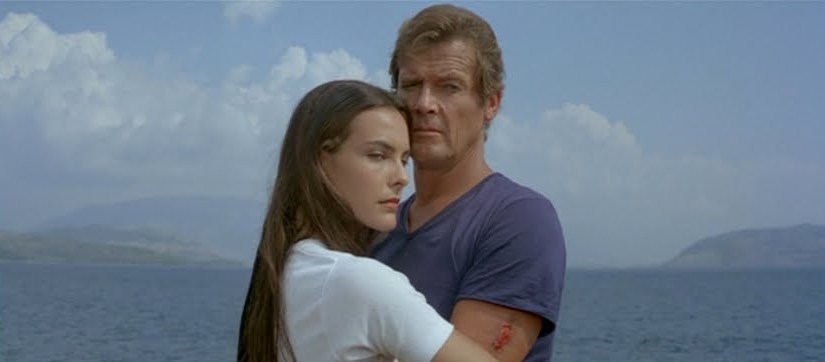
Bond encounters two potential suspects behind the plot, Kristatos (Julian Glover) and Columbo (no…not Peter Falk and his wrinkled trench coat; I’m talking about the one and only Fiddler on the Roof, Topol). The daughter of the designer of the ATAC, Melina Havolock (Carole Bouquet) makes things complicated with her crossbow as she is on a mission of vengeance for the death of her parents.

Lots of action and grounded Cold War politics make this a solid entry in the series. A ski chase in Cortina, Italy is fantastic. Director John Glen (formerly an editor of prior films) manages to maintain realistic speed keeping up with motorcycles in pursuit of Bond. One of my favorite scenes during the Moore era of films.

Greece is beautiful too. Both on land and underwater where some footage occurred, even if some camerawork was manufactured at the legendary Pinewood Studios in London.

It’s funny to watch one recover the identity of a bad guy known as “The Dove” on an “Identigraph” a big, clunky machine in Q’s lab. Today’s Bond would need only use his iPhone or wristwatch.

The once revealed villain is no one exciting or unusual, but Glen in the director’s chair offers up a grittier story apart from the sci fi silliness of Moonraker. The opening scene high above London is really great stuff, along with the already mentioned ski chase, a hockey brawl, a shootout along a Greek sea port and a pretty suspenseful mountain climb for Bond to covertly sneak upon a hidden hideout.

A minor, uninteresting distraction comes from young and immature Lynn Holly Johnson pining for Bond’s affection. She’s as useful as Sheriff JW Pepper from prior films.

Oddly enough, as serious as this one gets at times (Bond tosses a bad a helpless bad guy off a cliff) it closes out by mocking a Margaret Thatcher lookalike mistaking a parrot for 007. I liked it, but rumor had it that Roger Moore hated this bit.

All in all, For Your Eyes Only is Moore’s second best film behind The Spy Who Loved Me.

PHILADELPHIA

By Marc S. Sanders

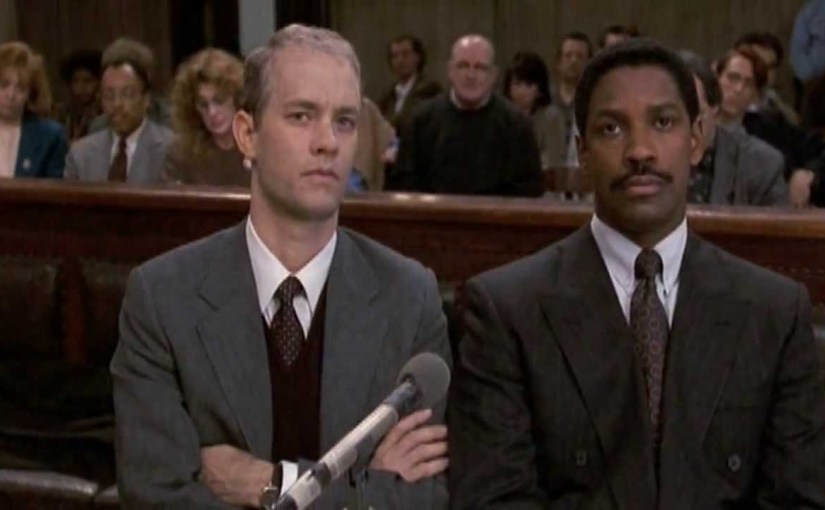
Tom Hanks most certainly deserved the first of his two Oscars for his portrayal of Andrew Beckett, one of the first protagonists to be an AIDS victim on screen in Jonathan Demme’s 1993 film, Philadelphia. Its a good film but not a great film.

I recall seeing Philadelphia when it was originally released. Seeing it today, my opinion hasn’t changed. I don’t believe the film takes enough risks and the script from Ron Nyswaner is too cookie cutter and simple. Beckett hires Joe Miller (Denzel Washington) to represent him when he proceeds to sue the law firm who wrongfully fired him for having AIDS, and most likely being gay as well. The argument hinges on proving that having AIDS is a handicap that never interfered with Andrew’s work performance. Andrew is clearly made out to be the firm’s best of the young attorneys when he’s assigned their biggest client. Nine days later he’s sabotaged, and soon after he’s fired for an attitude problem and carelessness. Eventually, Andrew and Joe assemble, despite Joe’s prejudices against homosexuals.

The trial, Andrew’s struggle of living with AIDS, and Joe’s own inner debate with associating and defending a homosexual, AIDS victim are the three main storylines.

The first storyline is the best. Demme does a masterful job of showing the evolution of the disease. Andrew could be looking at papers on a desk and when he turns his head, a lesion appears on his neck. Makeup artists Carl Fullerton and Alan D’Angerio deservedly were Oscar nominated as Hanks’ appearance seems to change from one scene to another and another. He’s thinner in one moment with very fine ash gray hair. In another scene, he’s got a full head of hair with an energetic way about him. I cried for Andrew’s deterioration. Hanks and Demme carry that aspect very, very well. The actor does great work of changing his voice when he’s fighting a cold with a terrible cough or evoking massive weakness. As the film progresses and Andrew gets sicker, he’s incredibly pale with a droopy eye. The makeup artists tell the story with Hanks’ performance and Demme’s direction.

The 2nd and 3rd storylines don’t offer much of a challenge. The law firm primarily represented by head partner Jason Robards is too easily “evil.” There’s no subtlety here. Robards gets right in the face of the film – “Andrew brought AIDS into our office.” A better script would wait for the bad guys’ momentous third act Freudian Slip. This case was unchallenging really. It was too easy to win. Especially true considering this great and powerful law firm hires Mary Steenburgen as defense counsel. Steenburgen plays her part very mousy and unaggressive though. This case is too lopsided and uneven and I just couldn’t get past that.

Joe’s own reservations are too apparent as well. He’s meant to represent those that simply never understood the mentality of gay love, nor the scientific evidence of the AIDS virus. He rushes to his doctor following an initial meeting with Andrew. Demme does an extreme close up of this doctor to teach the audience the basics of AIDS. This guy is right in your face with his dialogue. I didn’t care for moments like this. Too patronizing.

A side story attempts to show the intimate relationship of Andrew with his boyfriend Miguel (Antonio Banderas). I still feel the same about this part. The script holds back. Hanks and Banderas give each other “bro hugs” and kisses are done on the bottom cheek. Back in’93, filmmakers were not prepared to go all the way with depicting the true nature of homosexuality. I found it insulting. You finally want to make a film that shows AIDS and homosexuals at the forefront but you stop short at the finish line.

Ironically, Joe has a repetitive line “Explain this to me like I’m a 4 year old…” Demme adopts that method throughout the film with major “in your face” close ups to glaringly make the beliefs of what any character values or has to say as obvious as possible. I felt as an audience member that Demme didn’t have to take it this far. I get it. You don’t have to be THAT FORTHRIGHT.

Washington is a great actor as always. He’s likable even if he’s tripped by the fault of misunderstanding. His “TV GUY” ambulance chasing lawyer is comic relief at times within a film of very heavy subject matter.

Demme’s filmmaking does make some wise choices despite some of my issues. The opening credits offers a lot of footage of the city with people carrying on their daily lives while waving to the camera, selling fish at the market, street dancing, etc, all accompanied by Bruce Springsteen’s sweet, yet haunting theme “Streets Of Philadelphia.” I like this opening as it shows what we see on the surface of the people we live with does not necessarily reveal the struggle any one of us might be enduring. This is a moment where the script is not so easy to grasp. There’s a challenge to accepting Demme’s footage blended with Springsteen’s overture.

Jonathan Demme is a good director, who is sadly no longer with us. I appreciate Philadelphia for showing the illness but not much else. It’s a film that should be seen. I’d argue most would embrace more of the movie than I did. I just felt the envelope could have been, actually should’ve been, pushed further. It was too careful with its subject matter.

A great observation though was recognizing the many faces that appear in the film from Demme’s other film, The Silence Of The Lambs. As well as naming Joe’s baby daughter “Clarice.” I also recognized an identical tracking shot that Demme offers. When Joe goes to visit Andrew in the hospital, it is a shot for shot remake of the tracking movement when Clarice goes to visit Jack Crawford in his office, at the beginning of Lambs. This might not be original, but I had fun recognizing it, nonetheless.

FORREST GUMP

By Marc S. Sanders

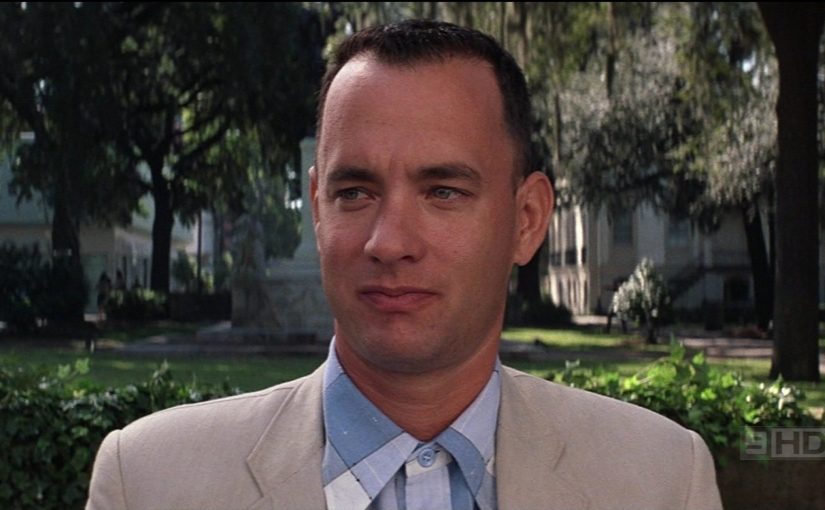
There’s not much that I can say to further praise the merits of Robert Zemekis’ Forrest Gump. It’s a film of legend though it’s a sore spot for die-hard fans of Pulp Fiction, which competed for Best Picture in 1994. Guess which film won. Tom Hanks won the Oscar for the second year in a row, following his outstanding turn in Jonathan Demme’s Philadelphia. Zemekis won Best Director. Eric Roth’s screenplay won as well.

What holds a lasting impression for me about Forrest Gump is the sweeping travel through time of a man with limited intelligence but unlimited willingness to explore and participate, whether it be as a Ping Pong Champion, a Medal of Honor recipient for heroism during the Vietnam War, a millionaire entrepreneur of a shrimping boat business, or a man who just felt like running from one corner to the next of the North American continent. Forrest Gump never knew to compromise a belief he had, probably because he was never aware of the capability to compromise in the first place.

An interesting theme occurs throughout Roth’s screenplay (adapted from the novel by Winston Groom). The people that Forrest encounters are always shouting their ideals and agendas. Yet no one seems to listen. Not just Forrest though. No one at all listens to each other. Lieutenant Dan (Oscar nominee, Gary Sinese) shouts for an immediate evacuation of a hostile territory under attack and no one on the other end of the line, appears to be listening to him. He orders Gump to leave him there, but Forrest does not listen. Forrest only focuses on rescuing his friends, Lt. Dan and Bubba (Mykelti Williamson). What exactly were Americans like the Hippie movements, the War Veterans, the Black Panther party, even the men in the burlesque nightclubs, as well as the various assassinations attempting to accomplish really? Did they accomplish anything? Did any of these parties make an impactful change, or did they just like to hear themselves talk? Did they just want the recognition for only themselves and no one else? When Forrest meets up with his love Jenny (Robin Wright), in a gorgeous caption in front of the Washington Monument (often shown during Oscar film compilations), he has just shared his thoughts over a loudspeaker, unaware that not one of the thousands of war protestors could hear him because the microphone had been unplugged. Later that day, a Black Panther participant only cares to wave his finger and shout his agenda in Forrest’s face. Is Forrest interested? Is he even listening? Is the Jenny, the hippie and her protestor boyfriend listening? Like many Americans, Forrest was only concerned with what was most important to him; Jenny. When Forrest develops a following during his cross country run, everyone is looking for his purpose and his message, and Forrest is unaware that he needed to offer one. Americans are always looking for the next best following. When Forrest passes the Grand Canyon and stops running, the parade of lost souls behind him shouts, “Now what are we supposed to do?” Forrest doesn’t listen. He just walks away and declares he’s tired. America during the mid twentieth century was lost. Forrest was not. Forrest just went in the direction in front of him.

Zemekis pulls an interesting trick of contrasting Forrest against other regulars. The nurse who sits on the bench next to Forrest is more interested in reading a mundane two dimensional issue of “People Magazine.” A man listening to Forrest’s tale of rescue in Vietnam was only concerned with the bullet that struck Forrest in the butt, not the men he saved or the loss of his dear friend Bubba. The old codgers who hang around the local barber shop in Greenbough, Alabama just watch the exploits of Forrest as the years go by. Their hair gets grayer and their skin gets more wrinkled, and life just passes them by while Forrest passes life by. It’s a subtle, yet effective, device that I appreciate on repeat viewings.

Sally Field contributes to the disregard Forrest has for menial issues. If Forrest is going to be denied going to a regular school because his intelligence level falls a few points below average, she will make certain that does not interfere even if it means pleasuring the principal. Mama Gump has the wit and intelligence. Forrest does not. However, their commonality shows in their disregard for what keeps us from living life to the fullest. Without Mama as his influence, Forrest would never have met the President again, and again, and again.

Mama reminds Forrest that “Life is like a box of chocolates…” You know the rest! It doesn’t matter what we get, as long as we get what we pursue.

MOONRAKER

By Marc S. Sanders

Roger Moore’s fourth outing as James Bond was supposed to be For Your Eyes Only. However, producer Albert R. Broccoli made a last minute switch before production was to take place. Two little known films called Star Wars and Close Encounters Of The Third Kind broke box office records and Broccoli went with “Moonraker” to piggy back on the science fiction trend. James Bond needed to launch into outer space. The effort proved profitable even if the story mostly fails.

A Moonraker shuttle is mysteriously hijacked from the Americans. After Bond survives being thrown out of an airplane with no parachute by the hulking assassin Jaws, he is assigned to determine what happened to the ship, and what purpose it is being used for.

Bond travels to California to introduce himself to Hugo Drax (Michael Lonsdale) with his samurai henchman Chang, and to Dr. Holly Goodhead (yes you read that right) played by Lois Chiles.

The issue with Moonraker is it suffers from a number of boring elements including Lonsdale, Chiles and even Jaws is watered down as he falls in love with a nerdy, pigtailed, blonde. Eventually, Jaws becomes a good guy and that’s when your eyes roll. Lonsdale is hardly any fun in his villainy. Chiles is not any more interesting than her character’s last name. Action scenes are bland beyond the airplane drop in the title sequence which has outstanding camerawork accompanied by the staple Bond theme.

Broccoli and returning director Lewis Gilbert (The Spy Who Loved Me) focused more on the science fiction cinematic trend with laser guns and laughable lack of effective zero gravity.

Broccoli became guilty of going with what was trendy with Moore’s 007. Blaxploitation with Live And Let Die, martial arts with The Man With The Golden Gun, Steven Spielberg’s Jaws, in The Spy Who Loved Me, and now science fiction in Moonraker. The sci fi doesn’t work so well for Bond or Drax’ diabolical scheme to destroy all human civilization and begin a new life in space.

Q provides Bond with a cool wrist band that shoots darts. That’s pretty fun.

As well, travel sites still hold up with destinations along the California coast, Italy with a gadget filled gondola and a glass shop fight, and Rio De Janeiro where Bond faces off against Jaws along the tops of two cable cars and engages in a boat chase. Then of course Bond eventually reaches Drax’ satellite base in space. None of it is unwatchable. It’s fun. It’s just not comparatively as exciting as prior Bond adventures before, and still to come.

Moonraker is just a little too weightless.

It should be noted as well that sadly, we also say goodbye to Bernard Lee as M, head of the Double O section for the last eleven films. He’s here to remind 007 that the British government can’t afford any slip ups. The whole series thus far was only better because of Lee to emit humorous aggravation in response to Bond’s relaxed and sarcastic response to the government risks at hand. Bernard Lee deserves recognition.