THE PRINCE OF EGYPT (1998)

by Miguel E. Rodriguez

Directors: Brenda Chapman, Steve Hickner, Simon Wells
Cast: Val Kilmer, Ralph Fiennes, Michelle Pfeiffer, Sandra Bullock, Jeff Goldblum, Danny Glover, Patrick Stewart, Helen Mirren, Steve Martin, Martin Short (whew!)
My Rating: 10/10
Rotten Tomatometer: 80% Certified Fresh

PLOT: Egyptian Prince Moses learns of his identity as a Hebrew and, somewhat reluctantly, realizes his destiny to become the chosen deliverer of his people.


I sat down to watch The Prince of Egypt for the umpteenth time today, ostensibly in honor of Passover, but really it’s just an excuse to watch it again.  In the 24 years since its release, it’s become one of my favorite animated films.  I started out thinking it was a gimmicky cash grab.  Then I realized how majestic the score and songs were (by Hans Zimmer and Stephen Schwartz, respectively).  Then I came to appreciate how effectively it humanizes the Exodus story, so it becomes something more than just an excuse for some crazy visual effects.  Then I looked more closely at those visual effects and realized how magnificent they are, too.

So now it’s a treat when I watch it.  But something rare and unexpected happened to me when I watched it today.  Before I get into that, though, for anyone who may still be unfamiliar with this marvelous film…

Moses (Val Kilmer), a prince of Egypt, younger brother to Rameses (Ralph Fiennes) and son to the great Seti (Patrick Stewart), is comfortable with his place in the world.  One day, he comes across Miriam (Sandra Bullock), a Hebrew slave who boldly informs him he is not Egyptian.  He is, in fact, the son of a Hebrew slave woman who set him adrift on the Nile River to spare him from the bloody purges ordered by Seti, the man he calls father.  Disturbed and conflicted, Moses unthinkingly kills an Egyptian slave driver in a heated moment and leaves behind the only family he’s ever known to face his fate in the desert.

There he meets Tzipporah (Michelle Pfeiffer), a Midianite girl on whom he showed mercy earlier, and her family.  Embracing his new Hebrew identity, he marries Tzipporah and becomes a shepherd.  Time passes.  One day, Moses is searching for a lost sheep when he is confronted with a strange sight: a bush that appears to be, not burning, but covered in cold white flames, nevertheless.  To his shock, a voice speaks from the bush.  It is the God of his ancestors, and He is displeased with how His people are being treated in Egypt.  He commands Moses to go to Egypt and tell the pharaoh to let His people go…

Need I go on?  The staff, the plagues, the blood, the angel of death, the pillar of fire…it’s all presented here in spectacular fashion.

When DreamWorks first announced plans to make what basically amounts to a musical version of The Ten Commandments, I was skeptical to say the least.  I even remember what theatre I saw it in: the Ybor Centro movie theater in 1998.  I sat through the movie, and I allowed my skepticism to color my entire viewing experience, right up until the sensational Red Sea parting, which even now is one of the great animated sequences of all time.  But aside from that, I felt The Prince of Egypt was all flash and no substance, a way for an upstart movie studio to get people into theaters with an overabundance of star power and little else going for it.  But after watching it on home video repeatedly…I mean, REPEATEDLY…I started to analyze it a little more.

The first thing that really renewed my interest and appreciation for the film was the humanization of the main characters, particularly the relationship between Moses and Rameses.  Moses is no movie idol in this film.  He’s just a man.  Kind of a scrawny man, too, not classically handsome like his brother, Rameses.  Where Moses looks a little spindly and frail, Rameses looks like he lifts weights, or whatever folks did back then on “arm day.”  I also like how the movie allows these two men to behave and relate to each other like real brothers might.  They race chariots down city streets, needle each other, call each other names, play pranks on the high priests, the whole nine yards.  It’s a dynamic the two men surely must have shared as brothers growing up, but it never gets addressed in other interpretations of the story.  Because we get to see how much they love each other, the scene where Moses reluctantly turns his back on Rameses carries so much more weight than we might be accustomed to seeing.

This dynamic comes full circle when Moses returns to demand freedom for the Hebrew slaves.  Rameses is now pharaoh, and laughs at Moses’ demands, wondering what his “angle” is.  And then, when the plagues are visited upon Egypt and the city has nearly crumbled, the two men share a scene of astonishing power.  Rameses sees his city in ruins, but ruefully remembers how Moses used to get him out of trouble when they were younger.  It’s a wonderfully human moment.

The second element of the film that sparked my renewed interest was the music.  At the end of the opening number, which is itself emotionally powerful on several levels, a solo female voice sings out, “Deliver us!” right at the end of the song.  I can no longer remember a time when that moment didn’t give me goosebumps.  The score by Hans Zimmer is magnificent.  There is one particular motif of a choir of voices that we hear whenever we are in the presence of something holy or mystical, and even that gives me goosebumps.  Another moment that deservers recognition is during the big number, “When You Believe,” as the Hebrews are flowing out of Egypt.  At one point, the song is replaced by a Hebrew folk song, “Ashira L’Adonai,” sung by a little girl.  Her voice is joined by several others, and then a few more, and then a whole choir, and then the whole orchestra comes in for a reprise of the chorus, and if you don’t get goosebumps at that moment, you need a vacation.

The third element that keeps me coming back to this movie is the visuals.  True, the CGI visuals are relatively primitive compared to what was going on at Pixar around the same time.  The chariot race between Moses and Rameses features CG chariots which you may notice have wheels that don’t always turn while the chariot is moving.  This was an aspect of the film that led to my early dismissal of it.  But then came the Angel of Death scene, with a hole literally torn in the sky and sinister tendrils pouring out of it and into the village streets.  And then came the eye-popping Red Sea sequence.  More so than any other version I’ve seen, The Prince of Egypt made me feel in my bones that, yes, THIS is what it would have looked like if uncountable tons of water were parted down the middle, clearing a path large enough for the entire Hebrew nation to walk across.  (Depending on who you ask, that number could have been up to two million people, so we’re talking about a WIDE path.)  As they walk between the two massive walls of water on either side, lightning flashes illuminate sea life swimming alongside them, including some really large fish.  Now THERE’S something you don’t see every day.

So, yeah, the movie is amazing.  People may quibble about its historical inaccuracy, or the liberties it may take with certain religious beliefs.  But that does not diminish its power in the slightest bit.

Which brings me back to what I mentioned in the opening paragraph:

I sat down to watch the movie today, and for reasons I can’t explain, the opening scenes were bringing a lump to my throat.  That solo female voice singing “Deliver us!” nearly brought a tear to my eye.  And it nearly happened again after a wedding song.  And again, when Moses is leading the Hebrews out of Egypt to the strains of “When You Believe.”  And when Moses slams his staff into the shallow waters on the banks of the Red Sea, and those waters shot up into the air and kept going and going…my God, man, I nearly lost it.  I was one thread of self-control away from going full-on blubber-fest.  I mean, I grabbed my chest like a Victorian lady reading a Jane Austen novel.  In the middle of my emotional experience, I kept asking myself, “What is WRONG with me?!”

The answer is, of course, nothing is wrong with me.  I was just in exactly the right frame of mind to have a borderline religious experience while watching a movie.  It’s the same when I watch the finale of Fantasia 2000, when the sprite erupts from the ground in a gesture of pure joy.  Or when Riley learns the importance of experiencing sadness at the end of Inside Out.  Or any number of other transcendent films that can put me right in the middle of the story emotionally.  The Prince of Egypt does exactly that through a well-managed mixture of story, visuals, and music.  It may not be perfect from a technical standpoint, but it gets me where it counts, and that’s all that matters.

WEST SIDE STORY (2021)

By Marc S. Sanders

Okay!  Let’s get the comparison out of the way first.  Steven Spielberg’s interpretation of West Side Story far exceeds the original 1961 version from Robert Wise and Jerome Robbins that won the Best Picture Academy Award.  I strongly encourage you to see this new film in theatres before it’s gone.  If you miss it, be sure that when you watch it at home, you have the highest upgraded flatscreen with the most enhanced sound system imaginable.  West Side Story of 2021 is a gift of sight and sound.

What Spielberg accomplishes with an updated and outstanding script from Tony Kushner is a more fleshed out, grittier and honest account of territorial entitlement and heated prejudice when the west side of New York City was on the brink of catering to a wealthy white populace and the Puerto Rican community had become established as Americans, even if they were never considered equals.  )The best promise the Puerto Ricans have here for a life is to live as doormen and housekeepers.)  The music and lyrics are more meaningful than ever before.  The characters are given more depth.  The settings become characters themselves.

West Side Story is another example of solid evidence that Steven Spielberg is our greatest modern director.  He not only focuses on the positions his characters hold, allowing them to act with passion and humor and heartache and despair, but he also takes advantage of the props and settings allowed to him beyond limits.  To watch classic numbers come alive not just with the outstanding vocals and dancing, but to see everything in the frame serve a purpose is so gratifying. 

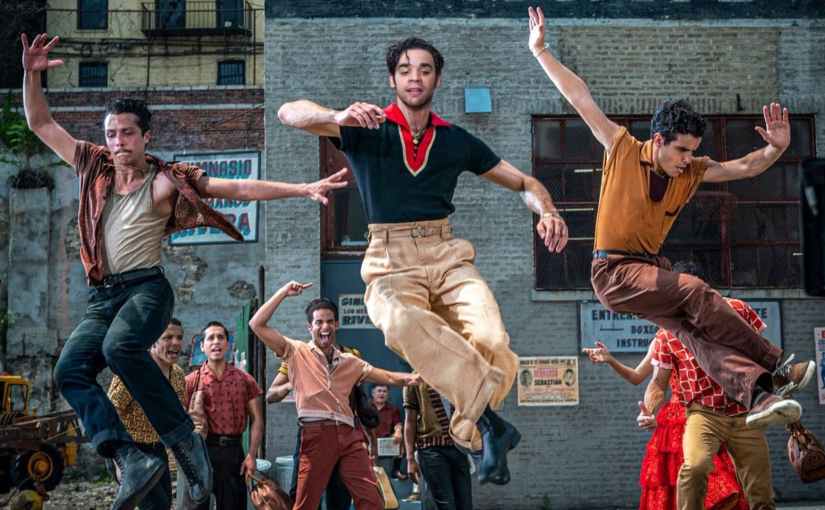
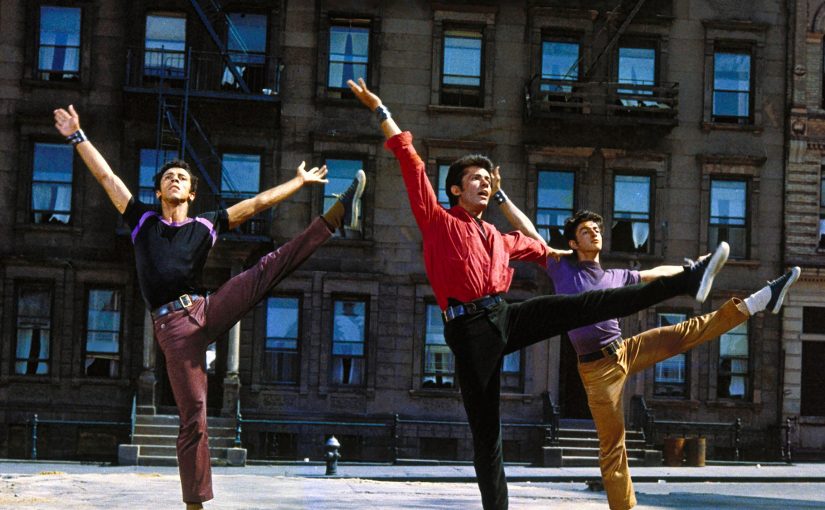
When the Jets strut and ballet down the city streets claiming their elite status in song, Spielberg makes sure these guys literally stop traffic.  Unlike the mundane placement of the winning song “Officer Krupke,” in the original film which only happens on a sidewalk, Spielberg place the boys in the police station where the props of papers and office supplies along with the furniture pieces serve to lampoon the city judge, the cops, the psychiatrists and even themselves.  Maria (20-year-old sensation, Rachel Zegler) owns her rendition of “I Feel Pretty” while the picture enhances the performance with a run through the dress department of Gimbell’s.  Clothes and accessories fly off the racks to send Maria’s enthusiasm of love and happiness into the heavens.  Kushner and Spielberg make a very wise modification to have “Cool” performed by the romantic lead Tony (Ansel Elgort) as a means to calm down his buddy, Riff – leader of the Jets (Mike Faist), before going into a head-to-head rumble with Maria’s brother, Bernardo, leader of the Puerto Rican gang known as the Sharks. Spielberg places these guys on a rickety old dock complete with wide gaps in the floor for the boys to leap over along with smooth planks to slide around on while tossing a gun around like it’s a football.  These characters teetering on manhood beautifully display their recklessness for danger and pride.

Rita Moreno is the significant attraction early on as she fills the Doc mentor role in the local drug store.  Wise & Robbins’ film never made Doc into much of a mentor.  Moreno fills that void.  She portrays a new character named Valentina, the widow of Doc, and the film’s tool of sensibility during these troubled times.  Kushner creates a fleshed-out character who explains that while she married a Gringo, she remains a Puerto Rican and there’s no room for bloodshed.  She has learned to live with others, and now Tony and Bernardo and Riff and the rest need to do so as well.  In another writer’s hands, this might come off preachy.  Not with Kushner’s dialogue though.  The background of Valentina is paved out early on and her elderly physicality can only do so much.  She can’t disarm the toughies, but she won’t stand for their stupidity either.  It’s Moreno’s presence that brings the chaos to a halt even if she knows it’ll never end the senseless war.  She is sure to get an Oscar nomination and like her win as Anita in the original film, she’s likely to win the award here as well.  (The only Hispanic woman to win an Oscar since 1961, and she’s likely to repeat that accomplishment again.)

Another fleshed out character that I really appreciated is that of Chino (Josh Andres Rivera), the nerdy student and best friend to Bernardo.  He’s studying accounting and calculator repair, but Chino wants to join the Sharks and fight for their cause. Bernardo, the tough guy boxer, wants none of that for his friend.  He wants Chino to date Maria.  There’s multi dimension to Chino now that I never saw before, and it is so very necessary.  The character puts a heartbreaking seal on the end of the film or play, whichever you are watching.  With Spielberg’s film, we get more of Chino’s motivation.  We now can understand why it is Chino that really delivers the final punch of the show.

Ariana DeBose plays Anita, Bernardo’s wife, and she’s spectacular as well.  I could watch her lead “America” through the colorful, daylight city streets over and over again.  In her yellow dress, with red lace underneath, and her magnificent energy, she’s a powerhouse of magnetism.  She leads a company of dancers with such a drive.  Again, Spielberg uses the environment of these characters to build them up and Anita dueling with Bernardo during this song in broad daylight (as opposed to just an evening rooftop from the original) is sensational.  Clotheslines and soft fabrics of pink, yellow and blue even sway to the pounding drum of the number from Leonard Bernstein, along with Stephen Sondheim’s original lyrics.

Having seen this film twice, I now recall when I watched it the first time how inappropriate it really was to have Natalie Wood cast as Maria in Robert Wise’s film.  Beyond the fact that she was never an accomplished singer or dancer, she is certainly not the correct ethnicity.  Her skin complexion was actually bronzed for the role and she lip synched her dialogue and singing.  Obviously, she was a marquee name at the time and the bills had to be paid while profits were collected.  Still, what an insult to point of the piece.  West Side Story’s conflicts hinge on racial and ethnic divides.  With Spielberg’s film, he went so far as to not even include subtitles for the Spanish dialogue.  I don’t speak Spanish, and yet while I can not translate, I could understand the emotions and motivations among the Puerto Rican populace.  Why should subtitles be provided?  Why should whites play Hispanics?  It’s a disgrace to consider, especially in a film that relies on ethnic identity.  Often, the Puerto Ricans are reminded by the cops or among themselves to speak in English.  Yet they continue on with the primary language.  Bravo.  Just because the soon to be famed Lincoln Center will be erected on these grounds doesn’t erase a heritage.  You can not whitewash a culture within a melting pot, and you cannot change a mentality that really doesn’t need to be altered.  Puerto Rico is America and Puerto Rico, within the confines of this film’s New York is here to stay.  Spielberg, the Jewish, typically non-musical director, ensures an equal playing field among the divided cast.

The chemistry among the cast has to be celebrated.  The Jets and Sharks work in pitch perfect precision with one another.  You only need to watch the high school dance to recognize that.  Moreover, look at the balletic fight scenes among the Jets in blue and the Sharks in red.  Elgort and the physically much shorter Zegler work beautifully as a couple forbidden to love, much less talk with one another.  Spielberg makes up the odd height differential by placing Tony on a ladder below Maria, who stands assuredly on a balcony or simply by seating Tony while Maria stands, thereby allowing their duets to work nicely in sync as they beautifully gaze upon one another.

2021’s version of West Side Story is an absolute masterpiece.  It is one of Steven Spielberg’s best films.  It’s entertaining, funny, celebratory and authentically heartbreaking. It’s the film I never, ever realized was needed to be conceived again.  West Side Story was the very first stage musical – Broadway musical – I ever saw and it always remained my favorite.  Yet, until I finally saw what Steven Spielberg could do with West Side Story, I actually never realized I hadn’t seen all of West Side Story.

CABARET

By Marc S. Sanders

Is it possible for a musical to be disturbing? Maybe Bob Fosse’s Cabaret favors that argument.

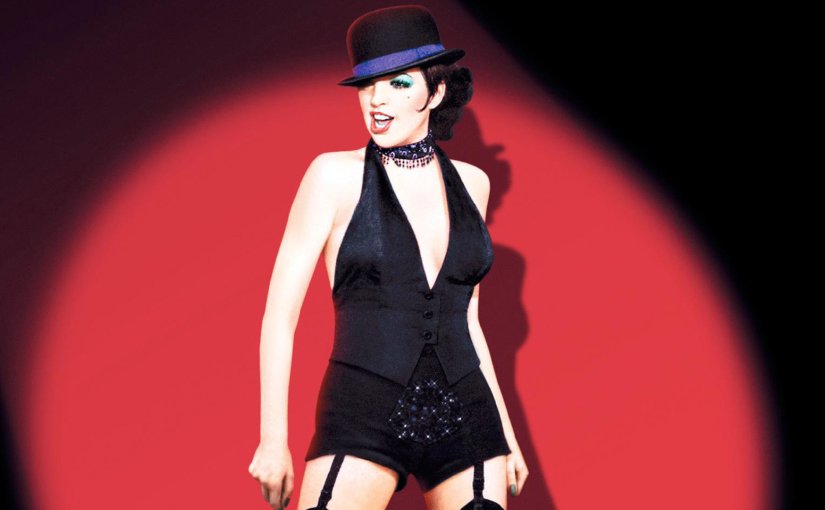
Liza Minnelli won the Academy Award for Best Actress in 1972 for her portrayal of Sally Bowles, a carefree, happy go lucky performer at the underground Kit Kat Club located in Berlin, 1931. She is the lead attraction among a company of dancers doing a different kind of stage vaudeville with its colorful emcee played amazingly by Joel Grey, also an Oscar winner.

The musical numbers are outlandish with caked on makeup and outfits that could make Victoria’s Secret seem like a children’s shop. I gathered from the film that Fosse, who choreographed the numbers as well, offered up the escape of life first, before showing the harsh reality of Berlin in its historical context.

Sally and the Emcee’s performances are first on hand, depicted as silly and showstopping. Thereafter, Sally encounters an English gentleman named Brian Roberts (Michael York) who is a professor of English study attempting to complete his doctorate. As Sally and Brian become closer as friends first, he must reluctantly admit to Sally that he’s a better bed companion with a man than with a woman. Sally doesn’t understand why he didn’t say that in the first place as she attempts to come on to him.

Herein lies the dilemma many faced as the Nazi party was gaining traction in Germany. How necessary is it to hide your true natures to preserve your life? Sally’s underground lifestyle at the club clouds her vision of what’s gradually happening in the world. Nevertheless, they eventually develop a relationship as Brian appears to be bisexual, more specifically.

A side story concerns Brian & Sally’s relationship with a baron named Maximillan (Helmut Griem), who will wine and dine them at his estate only to later abandon the respective relationships he sets up with them to more or less make them feel as cheap as prostitutes. I wasn’t sure what to gather from this extension, however. The irony is that unbeknownst to Sally and Brian they have both been sleeping with Max. Eventually, Sally reveals she’s pregnant but does not know who the father may be, Brian or Max, and an abortion is considered.

An additional side story concerns a wealthy Jewish German heiress named Natalia who falls in love with a German Jew named Fritz living under the guise of a Protestant.

Cabaret is a loose adaptation of The Berlin Stories by Christopher Isherwood (the Brian character) and his experience with stage performer Jean Ross (the Sally character). Isherwood’s stories gradually formed into different iterations of stage plays and short stories before making it to Broadway and Fosse’s celebrated film.

Though Fosse apparently took some questionable liberties and departures from Isherwood’s writings, I think it depicts the personal struggles of love and self identity while the world around them is quickly changing into a scary reality where your own self identity could get you killed.

Fosse gives terrifying glimpses of how the Nazi party seeps it’s way into a decadent Berlin of underground showmanship. Though apparently Berlin really wasn’t so decadent as the film has you believe. Ross and Isherwood have gone on record describing Berlin was a more destitute and poor environment, actually.

In Fosse’s film, a Nazi youth is seen early on being kicked out of the Kit Kat Club. A few minutes later, the night club manager is being beaten in an alley. Fosse juxtaposes scary moments like this against the silly debauchery depicted on stage. It’s as if the Gypsies, homosexuals and Jews in the area are unaware of the evil practice that is gradually taking over outside.

Soon, Fosse makes the swastika more apparent in the streets with propaganda handouts. Most telling is when a young boy is seen at an outdoor beer garden gathering singing a number selfishly entitled “Tomorrow Belongs to Me.” Fosse is frighteningly effective at showing this boy from the neck up. Eventually, he moves the camera down to reveal the boy’s swastika wrapped around his sleeve. The song which seemed to champion beauty and nature now evolves into a march of grandstanding fascism. It completely shocked me. Just as people like Brian and Fritz are reluctant to reveal their backgrounds, both sexually and religiously, the Nazi party is proud to announce their mindset in a converse manner. By the end of the film, the audience at the Kit Kat Club more predominantly shows Nazis in the audience as opposed to just the one shown in the beginning of the film. Hatred has spread its disease.

While Minnelli shines in her role, her showstopping moment really comes at the end when she dangles her carefree attitude while belting out the title song with “Life Is A Cabaret.” Along with Joel Grey’s Emcee closing out the film with the “Finale,” this musical goes against the grain of most musicals’ cheerful close outs or romantic theatrics. Fosse’s mirror image of the Nazi party taking in Sally and Emcee’s performances are chilling. We sense the characters’ time is at an end and wisely the film runs its closing credits among frightening silence with the cold, blurred images of Nazi soldiers staring right at us.

I had never seen the film of Cabaret until now, but I had attended two different stage productions; neither of which I liked. Bob Fosse’s film seems more clear with its content than I ever got from a stage performance. Perhaps it is because the Oscar winning art direction is more apparent than a stage set. We can see the bustling of Berlin change amid a political climate that at first is not taken so seriously. As hurtful and harrowing the relationships of love between Brian with Sally and then with Max, as well as Fritz and Natasha are, none of this will eventually compare to the upcoming demise for Berlin.

As Miguel noted in our recent podcast that focused on musicals, Cabaret won the most Oscars without winning Best Picture (losing to The Godfather). It’s clear how deserving it was of its accolades. The musical numbers are very engaging but the fear of fascism is well developed too. So there is a roller coaster of emotions to absorb from Fosse’s film. I believe in that podcast I noted that Francis Ford Coppola won Best Director. I now realize I was wrong. It was in fact Bob Fosse who took home that prize, and it’s truly evident how deserving that honor was for him.

Again, while I’ve yet to find a stage production I’ve liked, I was terribly moved by the film. Cabaret, the film from 1972, is a sensational and frightening production.

LA LA LAND (2016)

by Miguel E. Rodriguez

Director: Damien Chazelle
Cast: Ryan Gosling, Emma Stone, John Legend
My Rating: 9/10
Rotten Tomatometer: 91% Certified Fresh

PLOT: While navigating their careers in Los Angeles, a jazz pianist (Gosling) and an actress (Stone) fall in love while attempting to reconcile their aspirations for the future.


SPOILER ALERTS! MULTIPLE SPOILER ALERTS!


La La Land was greeted by the American public in one of two ways.  There was no middle of the road.  You either loved it or hated it.

Critics loved it.  It broke records at the Golden Globes that year and was the odds-on favorite to win Best Picture at the Oscars (Moonlight took the prize instead, and deservedly so).

When it came to the viewing public, people were immediately divided into opposing camps, with each trying to convince the other they were wrong.  “It’s homage!” cried one camp.  “It’s derivative and sad!” cried the other.

Me?  I’m part of the “loved-it” camp.  And after re-watching it tonight, for the first time since seeing it in theatres, I have no plans to change my mind.

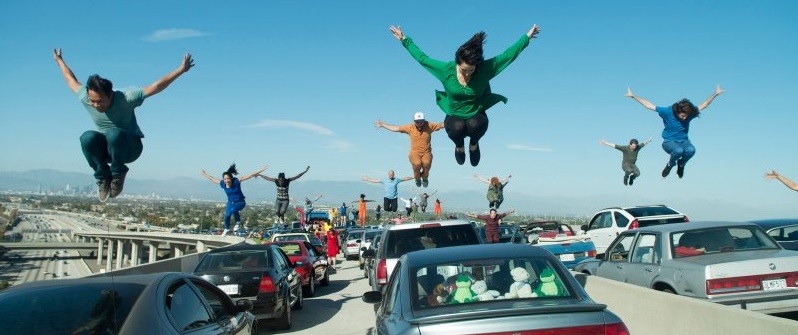
I once wrote that there is no movie more in love with “old Hollywood” than The Artist.  Well, La La Land is more in love with classic movie musicals, specifically, than any other modern movie in recent memory.  It opens with an astonishing musical number, “Another Day of Sun”, set on a Los Angeles overpass.  In a breathtaking feat of choreography and cinematography, scores of dancers perform nifty moves in and around a traffic jam, incorporating a live band inside what looks like a UPS truck, in one single take…or at least what LOOKS like one single take.  Could be some CG in there.  Who cares?  It’s awesome, and it sets the tone right away: this will be like one of those old musicals where people break into song and dance without warning.  You can stay where you are or you can leave now, but this is what’s happening.

After that, we settle in to a tried and true story of boy (Sebastian [Ryan Gosling], a jazz pianist who wants to start his own jazz club) meets girl (Mia [Emma Stone], an aspiring actress looking for a break).  This part of the story was old when Mickey Rooney and Judy Garland did it in countless other films, so yeah, I get it.  I can see why some folks called it derivative.

But that criticism neatly dismisses the underlying subplot about the Old vs. the New.  Sebastian desperately wants to start a jazz club that plays the greats – Monk, Coltrane, Davis – because, as he says in a passionate speech to Mia, jazz is dying.  Nobody wants to hear it anymore.  It’s old.  (He decries a nearby club that combines jazz, samba, and tapas, or some such nonsense.)  “They worship everything and value nothing,” he laments.

But Keith, a fellow musician (played by John Legend) tries to get him to see sense.  (“How are you gonna be a revolutionary if you’re such a traditionalist?”)  History is written by the people who strike out in a new direction.  Sebastian himself uses this philosophy with Mia, who has gotten tired of auditioning for the same teachers and doctors and coroners over and over again.  He tells her to do something different if you’re tired of the same old/same old.  She takes his advice and starts writing a one-woman play about her life.

And here’s where it gets cool.  While the characters in the movie are urging each other to embrace new concepts, La La Land still has one foot firmly in the past, i.e., the grand musical traditions of Gene Kelly and Fred Astaire and Cyd Charisse, etcetera.  Two later numbers stick out in my mind.  One is a twilight duet between Sebastian and Mia, shot on location in the Hollywood Hills when the sky is that perfect shade of somewhere-between-pink-and-purple.  They sing a little and then they do a beautiful dance together, but they’ve just met, so they’re careful to dance ALONE together…watch it and you’ll see what I mean.  Right out of Vincente Minnelli.  (Let’s be clear…Gosling and Stone are not exactly Fred and Ginger, but they do a damn sight better than I could do myself, so I give them props.)

Another number with classic-musical overtones is set during the first giddy months of their relationship.  With little or no singing (can’t remember which), we follow Sebastian and Mia as they tick off Los Angeles landmarks, finishing at the famous Griffith Observatory.  They enter the planetarium, and in a gloriously giddy moment of cinematic fantasy, they rise into the air and dance among the stars and galaxies before falling perfectly into their seats and sharing a kiss.  I no longer remember what I did the first time watching this movie, but this time around, I watched that whole sequence with a goofy grin on my face.  If you can’t enjoy watching people dancing in the stars, well…

At one point, Sebastian tells someone, “You say ‘romantic’ like it’s a dirty word.”  I like that.  This movie is, above all, romantic, in spite of how it ends.  It’s romantic in the sense that it revels in the unreasonable, illogical hope that everything will work out okay in the end.  Sometimes it does, sometimes it doesn’t, but that doesn’t mean you can’t still dream.  (There’s even a song about this exact thing, sung by Emma Stone in a sequence near the end that oozes romance and heartbreak.)

But all of this is nothing…nothing…compared to the emotional roller-coaster of the last thirty minutes of the movie.  It’s here that La La Land gets all serious in the middle of the fluff, because it explores the nature of success and what is necessary to achieve it.  Sebastian is touring with a band that pays well…but it’s not exactly a jazz ensemble.  Mia is just about ready to give up acting…until a casting agent gives her an opportunity to star in a movie shooting in Paris for four months.  These two characters, for whom the audience has been rooting for the previous 90 minutes, are on a downward spiral, and the only way to save their relationship would be for one or the other to completely give up on their dreams.  But neither of them would ask that of the other.  So they go their separate ways.

WHAT?  After all this they don’t wind up together?  Well…what would you have preferred?  An ending that awkwardly keeps them together, with him, say, playing jazz in a French club while she shoots a movie in Paris during the day?  Enjoying success together?  Having kids?  Sure, that kind of ending is POSSIBLE.  (In fact, in one of the many highlights of the movie, you even get a tease of what that might have been like.)  But, hey.  Isn’t that just the traditionalist way of looking at things?  Why not strike out in a different direction?  Do something no one’s doing.  End your movie where each character gets what they’ve always wanted their entire lives…even if that means they don’t get each other.

Boy, that last sentence sounds harsh.  But that’s what this movie’s about, and I think the film’s detractors simply couldn’t get past the grand tradition that demands the two leads wind up together.  They wanted Singin’ in the Rain, and instead they got the musical equivalent of The Remains of the Day.  (Maybe not quite that extreme, but I trust the point is made.)

ANYWAY.  Like I said, I just finished watching this a couple of hours ago, and I am no less convinced of its greatness.  Even though it’s a wrench watching their relationship head towards the rocks, the movie makes up for it at the end with half an hour of glorious, emotional catharsis that left me feeling wrung out, but in a good way.  It’s not quite a tragedy, but not quite a comedy.  Like life itself, it falls somewhere in between.

ROCKETMAN (2019)

by Miguel E. Rodriguez

Director: Dexter Fletcher
Cast: Taron Egerton, Jamie Bell, Richard Madden, Bryce Dallas Howard
My Rating: 8/10
Rotten Tomatometer: 86% Certified Fresh

PLOT: A musical fantasy about Elton John’s (Egerton) breakthrough years in the 1970s.


Much more so than Bohemian Rhapsody, Rocketman feels like a genuine musical.  On top of that, it also provides much more insight into the lead character than Rhapsody did.  I did feel that it was stretching a bit, trying a bit too hard to pluck the old heartstrings towards the end of the film.  But the fact remains that I was more invested in the Elton John character than Freddie Mercury.

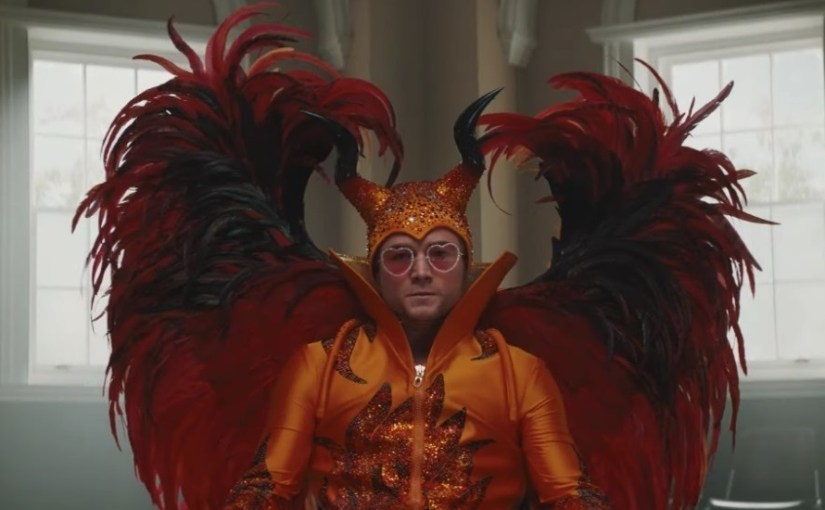
I think a big part of that improvement is due to the way Rocketman is structured.  The entire film is played out in a series of flashbacks, ostensibly during a group therapy session at a rehab clinic.  I say “ostensibly” because, in the opening moments of the film, he apparently walks into the session moments after abandoning his Madison Square Garden concert.  He is in full Elton John regalia: a flaming orange and red outfit complete with spreading wings on his back and devil horns on his head.  Through most of the film (after his meteoric rise to fame), he will do his best to live up to the devilish nature of this costume.

(This structure is not new…see, for example, De-Lovely, in which Cole Porter defends his life to a mysterious figure at the moment of his death.)

I have said over and over again, on Facebook and to my fellow cinephiles, how I cannot handle movies or TV shows with loathsome characters as the leads.  I can never and will never watch the TV show Mad Men.  No power on earth will ever compel me to sit through another screening of What About Bob? If someone had shot Jennifer Lawrence’s character in American Hustle with a shotgun, I would have cheered.

And yet here is Rocketman, featuring a lead character who, in the course of the movie…let me see…gets himself addicted to drugs and alcohol, succeeds in alienating anyone and everyone close to him, attempts suicide, gets the venue city name wrong during a massive concert (that’s a BIG no-no), ditches the people who made him famous in the first place out of misplaced affection for his smarmy manager/lover, and marries a woman (out of nowhere) knowing full well he is gay.

He does all of these things, and yet I was still on his side.  Weird, right?  The last time I felt that kind of empathy for a troubled lead character was in Ray.  (I’m not equating the two films, just remarking on their similarity.)  If I had to draw a line connecting those two films, and why I was able to handle their anti-social tendencies, the first things that come to mind are their music and their backstories.  The music produced by Ray Charles and Elton John (and Elton’s inseparable collaborator, Bernie Taupin) is on such a level that it was intriguing to me to watch their characters evolve, to see where such music comes from, and how much suffering is sometimes (always?) necessary for greatness to be achieved.

Another aspect of Rocketman’s success is the way unique visual tricks were used to convey the extreme emotional impact of certain events in Elton John’s life.  I’m thinking especially of his first concert at the famed Troubador nightclub in Los Angeles.  After a few agonizing seconds of nervous silence, Elton and his band break into “Crocodile Rock”, and when the bouncy chorus begins with its high, ‘50s-esque falsettos, there is a glorious moment when Elton, the band, and the crowd slowly levitate in the air, transported by the music.  I can imagine the real Elton John describing that moment in that specific way.  Or any number of performers describing their one supremely perfect moment in the spotlight, that one fleeting moment in time when it felt like the world revolved around them and their music, or their monologue, or their pas-de-deux.  It’s a magical sequence.

I cannot call Rocketman a perfect biopic.  As I mentioned before, it tries a little too hard at the end.  There is a bit of speechifying that is intended to get a gut-wrenching emotional reaction, but which I felt was a little too much of a muchness.  But it is an improvement on Bohemian Rhapsody.  I got a much fuller picture of Elton John’s life before he became THE Elton John, and as such, I was much more invested in how things turned out.

SCROOGE (1970)

By Miguel E. Rodriguez

Director: Ronald Neame
Cast: Albert Finney, Alec Guinness, Edith Evans
My Rating: 9/10
Rotten Tomatometer: 75%

PLOT: In 19th-century London, a bitter old miser who rationalizes his uncaring nature learns real compassion when three spirits visit him on Christmas Eve (except this one is a musical).

[SPOILER ALERTS! (For anyone whose souls are so dead they have never seen or read A Christmas Carol before…)]


I happened to watch this musical version of A Christmas Carol shortly after watching my absolute FAVORITE version, the CBS TV movie starring George C. Scott as Scrooge.  The two could not be any different, but I can say that, were it not for an absurd cartoonish moment near the finale, this musical would be tied with the TV version as my favorite adaptations.  More on that cartoony moment later.

Albert Finney was only 34 years old when he played the skinflint Scrooge in this 1970 version, and I have to say, the makeup and acting ability on display to turn him into a crusty, hunched-over old man are phenomenal.  There’s a scene where movie magic allows Finney to be onscreen as old Scrooge AND young Scrooge at the same time; as a child, I was convinced they were two different actors.  It’s truly astonishing.

The musical numbers lend a slightly corny air to the storytelling, diminishing the gothic nature of the ghostly visitations.  However, it does make the movie more FUN than other adaptations.  The songs (music and lyrics by Leslie Bricusse of Jekyll and Hyde fame) do capture the spirit of the scenes, in particular “Thank You Very Much” (sung, in a moment of delicious irony, at Scrooge’s death during his visit with the Ghost of Christmas Yet to Come) and my favorite INDIVIDUAL number, the jig danced at Fezziwig’s party: “December the Twenty-Fifth.”  (I would imagine some of these are available on YouTube, for anyone who hasn’t seen the movie and wants a sneak preview before committing to the whole thing.)  The weakest number would have to be the (thankfully) brief song by Jacob Marley, played with vigor by Alec Guinness.  Let us all give thanks Obi-Wan Kenobi was never called on to sing in the cantina on Tattoine.

But the absolute highlight of the movie – really, the BEST reason to watch the film, in my opinion – is the grand finale.  (You’ll have to bear with me, I love this moment, and I want to make sure my description convinces anyone who HASN’T seen the movie to take the plunge.)

It takes place after Scrooge has awakened on Christmas day, a changed man, and has purchased the enormous turkey.  As he skips merrily to Bob Cratchit’s house, with several children in tow, he starts to sing the song originally sung to him by the Ghost of Christmas Present, “I Like Life.”  This kicks off the longest sustained sequence of pure joy in a musical that I can recollect off the top of my head.  Scrooge nearly cleans out a toy store and dons a Father Christmas costume (prompting a delightful reprise of a song called “Father Christmas).  At one point, a troop of bell-ringers perform an elaborate, smile-inducing bit.  As he begins to rip up his debt sheets, “Thank You Very Much” is reprised.  The gathering crowd swells until the narrow streets are jam packed with dancers and singers.  His encounter with Bob Cratchit while decked out as Father Christmas is flat out hilarious.  The finale swells and swells, getting more and more joyous, until it feels like the entire city has turned out to get in on the fun.

Watching that number again today, I found, to my delight, that I was, ah…getting a little verklempt.  Now, don’t get excited, I’m not saying I shed actual tears.  I will say, though, that it wouldn’t have taken much to push me over the edge.  THAT’S why the movie is so good.  It’s very, VERY close to perfect.

And why ISN’T it perfect?  Oh, but let me tell you.

Whenever this movie was shown on television, a curious thing always happened.  In the TV version, the Ghost of Christmas Yet to Come scares Scrooge into falling into his own grave, and he falls and falls…and abruptly, everything goes black, and we see him lying in what appears to be a coffin-shaped hole in the ground.  And then there was a commercial.  And when we get back to the movie, Scrooge is struggling on the floor next to his bed, with his bedsheets wrapped around his head and neck like snakes, and he sounds like he’s choking, and the movie proceeds from there.

Well…what happened?  There’s obviously footage missing, right?  For years and years, I assumed that, whatever was missing from the television airings, it was deemed too terrifying to show on TV.  Maybe he wakes up in Hell, and snakes attack him, which would explain the bedsheets.

Nope.  The DVD version ends the mystery.

In a TERRIBLE move, Jacob Marley shows up again to escort Scrooge to his new quarters in Hell.  This time, Alec Guinness REALLY camps it up, trotting along down the corridors of Perdition as if the ground was too hot to keep his feet down any longer than he has to.  The set design for this version of Hell looks more like a forgotten room in Willy Wonka’s chocolate factory than anything else.  Marley presents Scrooge with the chain he was forging in life (you know the story), and it’s so big, he says, “they had to take on extra devils in the foundry to finish it.”  I mean, really?  They couldn’t have just cut right to him waking up in bed after falling?  They had to add this utterly unnecessary cartoonish button?

It’s this scene that prevents me from marking this movie as a “10.”  Remove that altogether, we’ve got near perfection.  Alas.

But, setting that aside, this is a truly great Christmas film.  It makes the story fun, especially that finale.  If it doesn’t reach the gritty realism of the George C. Scott version, well, we’re kind of talking apples and oranges here.  This is a real treat.

QUICK TAKE: Rent (2005)

By Miguel E. Rodriguez

Director: Chris Columbus
Cast: Anthony Rapp, Adam Pascal, Rosario Dawson, Idina Menzel
My Rating: 8/10
Rotten Tomatometer: 46%

PLOT: The film version of the Pulitzer and Tony Award winning musical about Bohemians in the East Village of New York City struggling with life, love and AIDS, and the impacts they have on America.


If you are not a “Rent-head”, then the long-awaited film version of the late Jonathan Larson’s massive Broadway hit is not likely to convert you.  The musical numbers are competently staged, but without a huge amount of imagination, so you’re basically getting the stage show, on a screen.  (The largest flight of fancy is the “Tango Maureen” number that briefly leaves reality when a character is knocked unconscious.)

I would not describe myself as a “Rent-head”, but I am a big admirer of the live show, so as far as me and my opinion are concerned, this counted as a fun night at the movies.  I like the slightly irregular rhythms of the lyrics, the raw vibe of the music, like Jonathan Larson slapped everything together hoping it would stick, though I’m sure the exact opposite was the case.

The story is melodrama personified.  We’re in the realm of stage musicals, where everything is bigger and brassier than real life, reality turned to eleven.  For those unaware of the plot, it’s loosely based on Puccini’s opera, La Bohème, so don’t expect subtlety or a happy ending.  (Not saying there ISN’T one, just don’t EXPECT it.)

[SIDE NOTE: Watching it again this time around, I couldn’t get away from thinking of the movie Hair, Milos Forman’s cinematic adaptation of that Broadway show.  Rent feels like Hair without the drug-trippy scenes or the hippie music.]

Make no bones about it, this movie was a passion project, from the director on down.  The filmmakers begged the MPAA to downgrade the rating from R to PG-13, to make it more accessible to teenagers.  That passion is evident in every camera swoop and exquisitely lit close-up, but it’s not quite as effective as other move musicals that take bigger strides in the world of make-believe (Moulin Rouge, Across the Universe).

I’m trying to think of a way to wrap up this review, but it’s getting late and I’m getting tired.  As musicals go, it’s no Chicago, but I liked it better than Hairspray.

WEST SIDE STORY (1961)

By Marc S. Sanders

The musical answer to Romeo & Juliet will always remain as one of my favorites.

West Side Story crackles with energy as soon as the 6 minute overture begins and segues into overhead shots of New York City accompanied by its frequent whistle calls. Then it zooms in for something new, fresh, and eye popping; precise choreography from Jerome Robbins to represent street fighting by means of heart racing ballet. You simply can’t take your eyes off the screen.

Young love and pride carry Robbins’ film with partnered direction from Robert Wise. It’s sadly amazing that the prejudices that shape the story are arguably more evident and profound nearly 60 years later. Tony & Maria must never be together. Change the names today, and the logic behind the societal law will often mirror the reasoning found in the film.

Am I focusing too much on that message though? There’s so much to cherish in West Side Story. A film that boasts numbers like “America,” “I Feel Pretty,” “Tonight,” “Stay Cool Boy,” “When You’re A Jet,” “Maria,” and my favorite “Officer Krupke.” It does not get much better than this.

The dancing lunges at the camera. The dialogue may be dated, yeah, but the cast is so genuine to the setting (even if Natalie Wood is lip syncing her songs).

Steven Spielberg has remade the film, to be released in December, 2021. I’ll go see it, sure. Yet I don’t believe it’ll compare to the original 1961 winner for Best Picture as well as the other 9 Oscars it was recognized for.

Go back and catch up with West Side Story. It should be seen by anyone who ever wanted to watch a great film.

MARY POPPINS RETURNS

By Marc S. Sanders

PL Travers’ character Mary Poppins is synonymous with the flavor of Disney. You may visit a Disney Theme Park or Cruise Ship or watch a classic film, and you might think to yourself this sidewalk, this room, this cast member’s uniform appears like something out of Mary Poppins. Walt Disney Studios and all its products would be something entirely different without the exactness of the most popular nanny in film. Ironically, until now, since 1964, has there been only one Mary Poppins film…and, well one PL Travers biography.

Director Rob Marshall (Oscar winning director of Chicago) has been recruited to bring the magical character back complete with her bottomless bag and her umbrella in Mary Poppins Returns. Perfectly cast is Emily Blunt in the role. Because this new installment that jumps to the next generation of Banks children is not a franchise reinvention, Blunt beautifully carries on the rigid mannerisms and casual magic that Julie Andrews effortlessly brought to the part. Blunt is not mimicking Andrews however. I think she takes the purpose of Mary more seriously actually. Andrews would smile at the fantasy. Blunt responds as if animated dog carriage drivers are seemingly normal. I also detected another dimension of maybe sadness or melancholy from Blunt as she observes the anguish of the children’s father Michael (Ben Whishaw, a great performer) now all grown up and reluctant to accept fantasy as a means to save the Banks’ home from foreclosure. When this Mary Poppins has to depart this family at the end, for a moment, I felt like she didn’t want to, like she needed this family as much as they needed her; not something I got from the first installment. Alas, this is 2018 and people are more attuned to the harshness of the world. Maybe Mary Poppins is as well.

Lin-Manuel Miranda adopts a cockney accent and fills the role of Jack, a street lamp vendor, all too familiar with Mary. What Dick Van Dyke brought to the original, as Bert, the chimney sweep, Jack offers to this film. Miranda is great. The best musical performer of the last five years (Hamilton, In The Heights). He opens the film with the whimsical new song “Under The Lovely London Sky” and Marshall and company make sure the audience catches on quick. It’s not “Chim Chim Cheree” but it’s a fun tune that provides a little mystery to the legendary nanny and the goings on at Cherry Tree Lane. Miranda is the only one I can think of to play this role today. Ten or fifteen years ago, it might have been a younger Hugh Jackman.

Cameo appearances abound from Meryl Streep showing another side of her not seen before as a gypsy like cousin of Mary’s, Angela Lansbury, so fortunate she is still performing, and best of all Dick Van Dyke who can still provide a little tap and two step in his spring.

Amidst an entirely new and well versed soundtrack that feels comfortably familiar, the film includes imaginative scenes like diving into an ocean through the bathtub, spinning into the animated (CLASSIC ANIMATION) world of a priceless porcelain bowl and soaring into the sky with a balloon that is just right for you. These are great scenes because they are so silly but Emily Blunt as Mary encourages you to take all this fantasy seriously. “Everything is possible,” she says. “Even the impossible.”

Walt Disney felt that way too. So without Mickey Mouse or Mary Poppins, there really is no institution called Disney. With these brands however, they are all practically perfect in every way.

UNDER THE CHERRY MOON

By Marc S. Sanders

Prince!  The vanity on this guy!!!!!  Watching his second film, Under The Cherry Moon, is to indulge in Prince’s pride, Prince’s ego, Prince’s conceit, Prince’s vanity.  The Purple One, of which I’m an admitted fan of his music, directs his own picture here in beautiful black and white cinematography, compliments of Michael Ballhaus.  That is where the accolades end though.

The film is set along The French Riviera.  Prince never speaks French in the film, nor does anyone else.  So why are we in France again?  He plays a kid named Christopher and along with his best pal, Tricky (musician Jerome Benton) spend their days glorifying Christopher (or Prince as Christopher) and swindling wealthy heiresses as they continue to live a life decadence in outrageous outfits, high heels and a modicum of makeup to especially keep Prince-I’m sorry-Christopher looking gloriously sexy, pretty and handsome.  At night, while putting on music acts in various drinking establishments, they seek out their female prey. 

When Christopher notices Mary (Kristin Scott Thomas, in her feature film debut), he and Tricky go to work.  Somehow Tricky falls instantly in love with Mary.  (I think.  The two hardly have a scene alone together.  Prince monopolizes most of the space.)  Chris plays the “Prince Adonis” with teasing flirtations, ridiculous get ups and so on.  Later, he will fall in love with Mary.  We are supposed to believe Mary falls in love with Chris too.  But let’s come down to reality here, please.  Tricky grows angry and blah blah blah.  You’ve seen this tripe in better fare from the minds of Looney Toons shorts.  A side story character is Mary’s wealthy possessive father, Isaac (Steven Berkoff, playing the same kind of villain he did in Rambo and Beverly Hills Cop).  What do you think he’s here for?  Right!!!!!  He disapproves of Christopher and refuses to let Mary see him.

Beyond the terrible acting of this piece with vomit inducing kissing scenes involving Prince and Thomas, the film is an annoying, pesky love letter from Prince to Prince.  It’d be impossible for me to count how many close ups he does of himself.  Prince is a poet and a brilliant lyricist as well.  However, the script is littered with expressions and slang that feels like they popped into Prince’s head at one time or another.  He must have jotted it down on napkins, and then he passed it all on to the credited screenwriter, Becky Johnston,  instructing her to work this stuff into the dialogue.  Things are uttered out of nowhere, for no reason.  Conversations don’t make sense at times.  Certain words feel like the have a good rhyme.  So, make it work Becky! Mmmkay!

On other occasions, Prince and Kristin Scott Thomas will share scenes together just sitting there with nothing to say, as if it is a director’s (Prince’s) own artistic choice.  Prince is no Terrance Malick.  The gaze and the pose (of Prince!) says it all.  Calvin Klein commercials have more depth.  A phone call scene between the two goes on for a good three minutes.  They never speak into the phone.  They just hold it to their ears.  The edit goes back and forth on them and again…they don’t speak!  Prince makes it exciting by chewing on a cracker.  In another film, this would’ve been cutting room floor material.  You would think this is behind the scenes stuff and the actors were waiting for the sticks to snap and “Action!” to be called out.

Samples of Prince’s music are peppered throughout the movie.  The sounds are good for the most part, but that’s all they are.  Just random sounds.  Most of the music is not complete and seem like samples that were experimented on in a kid’s garage.  The music does not cue up anything.  None of it heightens any developments or drama or comedy.  At times the tunes will obnoxiously interrupt a scene, much like a mariachi band may intrude on an intimate dinner at a quiet restaurant.  Prince loves his music though.  So, he wakes up and tells his film/sound editors to put this and this and this into the film.  Context man.  Context!!!!!!!  What about the context?????

Under The Cherry Moon is an immature film, made by an immature filmmaker with a very mature photographer (Ballhaus).  It’s tripe of the most shamelessly vain kind.  It’s been three days since I saw the picture, and I have yet to think of another film more ridiculously conceited and egotistical.  My Cinephile colleague, Anthony, is a proud Prince fan.  He has a wealth of knowledge on the famed musician.  He’s learned to be forgiving of this film’s shortcomings.  I assured him when we sat down to watch this that I was going in with an open mind, especially when the gorgeous black and white shows up on the screen.  When the movie was over, however, I explained that this might have become something with an admirable B movie cult following, had Prince at least agreed to welcome another director to oversee the picture.  Someone needed to be watching the one in charge and humble the poor guy because if I want to look at various captions of Prince, all I need to do is lay out his album covers on my bed and pick up a Rolling Stone magazine.  I did not have to subject myself to Under The Cherry Moon.