DIRTY HARRY

By Marc S. Sanders

The very first R rated film I ever saw was Dirty Harry. I was probably 7 or 8 when my brother introduced me to it, and it eventually led to my first R rated film to see in the theatres, Sudden Impact, the fourth film in the series.

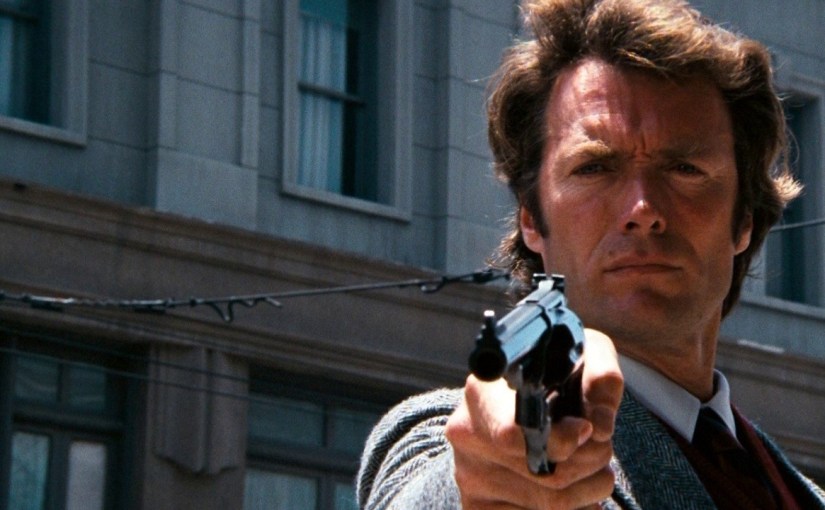
The original installment had such an influence on me, and it remains as one of my favorite films. I did not necessarily understand at the time the complex, albeit simplistic summary, of the law and the barriers Harry Callahan breaks to get the bad guy. I was more impressed with the 44 Magnum he carried and sociopathic behavior of the serial killer, Scorpio.

All these years later, followed by numerous viewings, and I’m just grateful director Don Siegel’s film was actually made. Had it been considered today for a treatment, it would have never come to light. The film is too candid and frank in its liberties of racist undertones and the underworld of a seedy San Francisco during the 1970s. Harry just didn’t care about the sensitivity of any demographic. He also just didn’t care about what was at stake to capture a hardened, dangerous, apathetic killer. Arguably, and only in the fictional world of film, audiences were probably grateful for that. Cut the bullshit. We all know who the guilty party is. Let’s get him off the streets, regardless of what is mandated to avoid any further loss of life. At least through the first 4 of the 5 Dirty Harry films that has been the common theme. (I’m especially fond of Magnum Force for challenging Harry’s own code of law enforcement. There are great debates to think about in that film.)

Dirty Harry is a deliberately ugly film. Siegel shows the worst of people at times, including Harry. Yet, there are sick people on the streets like actor Andy Robinson’s Scorpio killer that treat murder, mayhem and extortion as a twisted game of insane pleasure. Robinson was perfect in this role, a precursor I thought for Heath Ledger’s Joker many years later. Only a guy like Dirty Harry Callahan is right to nab a guy like this.

The film offers great moral questioning on the rights of men whether they are clearly the culprit or not. Miranda and several amendments are appropriately referenced and questioned. Is it ever appropriate to exercise brute force on a suspect? Can a near impossible scenario justify any actions of that measure? “Well then the law’s crazy,” Harry says. Even by today’s standards you can’t help but wonder if Harry is right.

What would be Harry’s opinion of today’s ongoing theme of domestic abuse among NFL athletes? Fair trials, and innocent until proven guilty are necessary but (at least this is how I feel) the circumstances of these stories make it abundantly clear that the guy did it. He beat his girlfriend into oblivion. The evidence is so much easier to uncover these days. It’s easy for me to say this from the comfort of my own home and not on a jury box. What would Harry think? He always knew to see beyond the bullshit. Heck, if I ever got a chance to interview the guy, all he’d probably tell me is get out of here. He’s got work to do. Harry Callahan was never up for sharing anyway.

QUICK TAKE: A History of Violence (2005)

By Miguel E. Rodriguez

Director: David Cronenberg
Cast: Viggo Mortenson, Maria Bello, Ed Harris, William Hurt
My Rating: 9/10
Rotten Tomatometer: 87% Certified Fresh

PLOT: A mild-mannered husband and father (Mortenson) becomes a local hero through an act of violence, which sets off repercussions that will shake his family to its very core.


A History of Violence is an art film disguised as a Hollywood thriller.  It makes some statements about the nature of violence that would be at home in an Ingmar Bergman film, but cloaks them in a conventional plot that, unbelievably, is based on a graphic novel.  (I’ve read that graphic novel, which goes down some gruesome paths not explored by the movie.)

It’s riveting.  As a pure thriller, this movie is gangbusters.  (I thought the ending was a tad abrupt, so I take away a point.)  The central mystery, about an everyman who is mistaken for a ruthless killer, will keep you guessing.  It also has some troubling things to say about violence itself.  Through various events in the film, it’s almost like the moral of the story is the equivalent of Patrick Swayze’s famous line from Roadhouse: “Be nice, until it’s time to NOT be nice.”  Gandhi would not have approved.

I can’t recommend this movie enough.  Find it, watch it, do it.

PULP FICTION

By Marc S. Sanders

No one can deny that Quentin Tarantino’s classic film, 1994’s Pulp Fiction is one of the greatest screen accomplishments of the latter half of the 20th century. It’s strange, lurid, scary, unforgivingly funny and altogether different from practically anything that came before it. How did the Weinstein brothers with Miramax films prophesize the energy it would surge in mainstream audiences?

When I first saw the film I was apprehensively going with two college friends who insisted I see what they experienced from a prior viewing. Suddenly, I realized that alternate surf 70s rock, black suits, and a kinetic visit to the restaurant known as Jack Rabbit Slims could entertain and make me look further than just a facial close up.

Tarantino entertains the lens of his camera by making his audience the camera. A drug dealer scrambles to find a medical book to awaken a boss’ wife who is dying from a potent heroin overdose, and the camera stands in place only frantically swinging left and right. The camera doesn’t move while everyone in the scene remains in a panic, frightened of administering an adrenaline shot. The camera stands still to allow the audience to stand in the room as well. It’s very unusually funny, but unnerving and suddenly we are amid the clutter of crime and drugs frightened of a terrible fate.

Another scene follows two gangsters down the hall as they debate whether a foot massage equates to fellatio on a woman. They look serious as they earlier regretted bringing shotguns to their destination but here they are having a debate likely reserved for men’s locker room talk. Is a foot massage really worthy of dropping a guy out of a four story window into a glass enclosed garden below? I mean, apparently the poor guy developed a speech impediment.

Tarantino used Pulp Fiction as an excuse to show how criminals inadvertently lead their lives to the unexpected, beyond a cliché cop bust. Two guys might be settling a personal vendetta, but somehow get interrupted by a redneck gang rapist and his chained up “gimp.” Two other guys might be trying to deliver a briefcase and yet somebody’s brains splatter all over the inside of a car. Another guy might have left behind a family heirloom gold watch as he and his girlfriend run for their lives, or they might suddenly acknowledge a moment of clarity when death seemingly walks out of a bathroom door.

Some might not agree but I always consider Tarantino’s colorful film characters to be rather two dimensional. What you see is all you see. There are no hints at an underlying motivation or a background to anyone you meet in Pulp Fiction, or any of his other films. Normally, that’s a negative in my book but with Quentin Tarantino it is what’s expected. He’s a masterful script writer of the situation. A well known fan of kung fu and lurid crime movies of the B variety, gangsters like Vincent Vega, Jules Whitfield, Marsellius Wallace, Butch Coolidge and Winston Wolf (even the names are entertaining) get caught up in just a random moment in time. Beyond the incident nothing else matters, and just to make it fun Tarantino uses his favorite editor, Sally Menke, to scramble everything out of order. I like to think the script was assembled this way to demonstrate that what happens in one instance doesn’t reflect what happens in another. Every brief moment is bookended. Again, two dimensional characters who don’t reach an intended karma. It doesn’t matter what’s been done before or what will be done next. It only matters in the moment.

The cast is great. Likely, you know who all the players are by now. The best compliment is that they obviously listened closely to the director’s vision. They spoke his language which had yet to be very mainstream before this film’s release. They are a pioneering cast of great talent and many owe quite a bit to Tarantino for jump starting and reviving their careers.

Pulp Fiction is a rousing expedition in sin and surf music symphony with endless quotable and un-PC dialogue that revolutionized filmmaking and brought about risk taking movie makers. It’s just exciting and fun and wild and it especially became a favorite upon seeing one of my favorite kinds of scenes-a dance sequence. If you incorporate dancing into a non musical film, you’ll likely win me over.

Spoiler alert: Vincent & Mia win the dance contest, and right they should. Chuck Berry’s “You Never Can Tell” became that other popular film song once Pulp Fiction hit the scene.

Thank you Quentin Tarantino.

BEST SELLER

By Marc S. Sanders

It’s kind of sad when two very good actors are provided with really subpar material.  The writing can naturally make the performers look bad.  Two things can happen.  The actors might try too hard or they may not try hard enough.  A perfect example of that is John Flynn’s crime drama Best Seller with James Woods and Brian Dennehy.  Woods tries too hard.  Dennehy isn’t trying at all.

Brian Dennehy is Dennis, a Los Angeles undercover cop.  Following a department robbery in 1972, he writes about the experience and then he is on his way to also being a best-selling crime novelist.  Fifteen years go by.  He’s still working the streets and chasing bad guys while also writing.  Though now he’s got writer’s block. 

James Woods is Cleve, a professional hitman, who enters Dennis’ life and convinces him to write a book about Cleve’s experiences.  Cleve’s motivation for this is to expose a crooked politician that he used to do jobs for and at the same time, the book will become a best-selling true crime novel for Dennis. So, Cleve escorts Dennis around various parts of the country from California to New York then back west to Oregon.  Cleve shows Dennis a bedroom in New York where he successfully executed a man with details about where the victim fell to how he did it, step by step.  There’s not a shred of dialogue or discovery in this scene.  A real estate agent giving a tour of an empty model home is more eye opening.  Cleve also brings Dennis to his parents home for a sleepover where he can gain some background material on Cleve’s upbringing.  Having just seen the ninety minute film, I can not recall one thing that was discussed at the dinner table with mom and dad.  Dennis never looks interested.  Dennis doesn’t even have a tape recorder or a pad to write on.  Dennis isn’t even necessarily convinced that Cleve is the hitman he says he is.  I was convinced, however.  Ten minutes into the film, Cleve saves Dennis’ life by shooting a criminal that was about to kill Dennis and he had pretty good aim with his silencer hand gun.  What more do you need to know?  If Dennis is such a good cop, why can’t he realize what is in front of him?  Was that the dilemma of Best Seller?  To see if Dennis believes Cleve is an expert hitman? 

The story is utterly ridiculous.  It doesn’t help however that James Woods carries himself like a nut job when Flynn directs him in cool postures adorned with stylish Ray Bans and knitted 1980’s suits.  He gets hyper in front of people he’s threatening and prefers unusual sexual positions with women he just met.

Brian Dennehy hardly looks like he’s in character.  His dramatic moments have no impact.  He seems undisturbed by this weird guy he’s travelling the country with.  Wouldn’t a seasoned cop even keep his guard up while with this likely hitman?  Not even a couple of near misses on killing them both seem to faze his Dennis character.  The men make a quick escape from a bomb laced taxi cab and they hardly discuss or consider who is behind the attempt on their lives. 

I’m not sure what was to be accomplished with this film.  It doesn’t explore anything remotely interesting. It’s mostly as boring as Brian Dennehy seems in his role.  Both of these actors have had better material to work with in their careers and they work best as supporting character actors like Woods in Casino and Hercules, or Dennehy in First Blood and Presumed InnocentBest Seller was not a box office hit or even a sleeper hit.  It’s not hard to see why.

WHITE BOY RICK

By Marc S. Sanders

Matthew McConaughey is probably my favorite actor that I somehow always forget about. He always has that god Ol’ boy dialect and yet he hides it so well no matter what role he plays, whether he’s a space traveler in a heavy sci fi drama like Interstellar, an AIDS victim drug dealer in Dallas Buyers Club (his Oscar winning performance), or an over the top unscrupulous stock trader in The Wolf of Wall Street. In White Boy Rick, he’s an unscrupulous black market Detroit gun dealer. Selling out of the trunk of his car, he justifies his trade by telling his son Rick it is a constitutional right to own a gun and sweetening his sales with silencers by metaphorically comparing them to up selling fries to go with a burger. His intensity as this sleazy guy is downright remarkable. A great moment for me was simply a close up of him walking down the hallway of a hospital. This guy knows how to perform in front of a camera. I’ll say it again. His intensity is remarkable. He’s seemingly worthy of an Oscar nomination. Yet, it’s likely come December this film just won’t be remembered.

The title character was first a junior gun runner per the inspiration of his father and was quickly recruited by the FBI to be an inside buyer and seller to the drug houses in the Detroit slums during the mid 80s. In a community of black criminals, with one major player married to the sister of the city’s mayor, Rick earns his moniker of White Boy Rick by speaking the lingo and dressing the part. Thick gold chains with large jeweled crosses are a status symbol. So naturally Rick shows his prominence by donning a Star of David. It makes no difference if he’s unaware of its Jewish symbolism. His bling builds his stature. From FBI insider, Rick gradually moves on towards dealing drugs on his own street smarts and a means to sustain himself along with Dad and his junkie sister as well as his grandparents. He’s a natural.

Newcomer Richie Merritt is very good in the part of Rick and holds his own against McConaughey. His attitude overcomes his father’s experience. He’s smarter than his father actually and he’s a better talker than his father. His one flaw was not realizing his inevitable future.

The director is Yann Demange, a filmmaker I’m not familiar but a skilled guy nonetheless. He captures a dirty snow covered Detroit in 1984-87 very well with dark crack houses, wet streets and a crowded skating arena. These locales are where these guys dwell. The photographery looks worn out and offers that uncozy winter feel. The only glamour of this atmosphere comes mink coats worn by the dealers and their gaudy Run DMC gold chains.

Here’s hoping I’m wrong and this small film gains some more traction and following. It’s a good true story that I never heard of. It’s got a solid cast that easily blends into this dangerous underground, and its performances are worthy of recognition during awards season.

PARASITE

By Marc S. Sanders

I first discovered director Bong Joon-Ho when I watched his futuristic sci fi adventure Snowpiercer. I loved that film despite how absurd the set up was. Absurdity, though, is a credit to his craft. That’s why his latest film Parasite is a hugely successful interpretation of class warfare within South Korea. It might all appear drastically unlikely. Yet, it’s all absolutely possible when you reflect on the film after you’ve seen it.

Parasite begins almost like a farce and ends in deep, realistic horror that you’d never expect, even after you surpass the films midway surprise.

It’s best I leave much of the film’s details out. The less you know the better. I knew nothing at all about the film beyond the numerous accolades it has received. I was better off for it.

Joon-Ho’s film makes its point quickly that there is always someone better off than us and always someone worse off. (This was a theme carried over from Snowpiercer.). A poor family living off scrap money for folding pizza boxes while living in a cramped, bug ridden basement is still better off than the drunk who pisses on the street, outside their window. Just as an upper class family with all the best things in life are better off than them.

It’s only when this poor family find opportunity to dupe their way into this wealthy home through jobs they are hired for that we eventually see how lighthearted material, compliments of Joon-Ho and his writing collaborator, Jin Wan Han, can convincingly escalate into class warfare politics that even their characters ever hardly acknowledge, or are aware of. Is the wealthy matriarch really aware where her family chauffeur stems from or where he lives? The off putting scent of someone’s presence can quickly turn a tide or an impression.

I might sound vague, but I have no choice. It would be a betrayal to the imagination of the best film of 2019 if I spelled the film out for you.

Simply know that I truly appreciate the symbolic research Parasite presents as it makes note of a Korean child’s fascination with Native Americans, and how their plight parallels the story. Even that drunk taking a piss on someone else’s territory. Even the gift of a stone sculpture told me how one can be crushed or weighted down by his own country.

Parasite begins as one movie and ends as maybe five other different movies. It’s a farce. It’s wry and conveniently ironic; maybe silly at one point. It’s suspenseful and surprising. It’s also shockingly horrific.

I recently declared Clint Eastwood’s film Richard Jewell the best film of year. I stand corrected.

Parasite is the best film of the year.

ONCE UPON A TIME IN…HOLLYWOOD

By Marc S. Sanders

There’s no question the most different of Quentin Tarantino’s directorial efforts is his latest film, Once Upon A Time In… Hollywood. Already described as his “love letter to cinema of the late 60s,” his 9th effort also implies the end of the Hippie Era by devoting a portion of time to B movie actress Sharon Tate, infamously murdered by Charles Manson’s followers when she was 8 months pregnant with Roman Polanski’s child.

Margot Robbie plays a near, gorgeous exact replica of Tate. She’s deliberately short on dialogue and I like to believe it’s because Tarantino treasures her as an innocent angel who was loving the atmosphere of Hollywood. She’s preserved of being nothing but likable. She dances with glee in her bedroom in the Hills or in public at the Playboy Mansion. One day she visits the local cinema to see her performance in “The Wrecking Crew” with Dean Martin. Tarantino shoots close ups of Robbie loving her footage as a pratfall klutz while listening to the audience reaction. She’s loving every second of the experience. People love her and she sees the love she has for people. Critics took issue with Robbie’s lack of dialogue. Not me. The performance is all there. Robbie is wonderful to look at with responses of pure happiness and celebration.

The main focus of the film is on Rick Dalton played by Leonardo DiCaprio with a huge range of drama, comedy and well intentioned over acting when Tarantino is wanting to spoof the TV western for fun. We see a collection of Dalton’s work, most especially on the fictional black and white TV western that airs Sundays at 8:30 on NBC (cue Dalton’s cowboy hat close up accompanied with “BONG, BONG, BONG!).

Rick is realizing he’s becoming past his prime. Marty Schwarz, his agent and a producer, played by Al Pacino warns Rick that he’s at a point where he’s only going to be the villain of the week on The Green Hornet and Batman. Rick does not take this well. Using his stunt double pal, Cliff Booth (Brad Pitt) to talk to, Rick is consumed with insecurity and alcoholism.

Tarantino wants to depict an era in Hollywood on its way out. A fictional character like Rick and the well known fate of Sharon Tate symbolize this turning point.

A third example is with Cliff. Rumored to have killed his wife, Cliff has trouble finding stunt work on a set. So he’s happy enough to just drive Rick around in his Cadillac, and fix his antenna. A great moment occurs when Cliff antagonizes a cocksure fist of fury Bruce Lee to a fight. Bruce doesn’t do so well against Cliff. Bruce Lee maybe not be what he once was, or what audiences ever perceived. Times they a changin’.

This is not the aggressive film that Tarantino is mostly known for. It’s primarily calm as we see these characters navigate around Hollywood locals, listening to The Rolling Stones and the Mamas & The Papas, and various product advertisements. Rick and Cliff are suffering a little. Suffering at the loss of what they were and the world they are forced to enter, nor what they are accustomed to. Sharon is ready for what’s next. Yet, will she get the opportunity to carry on?

The ending is bound to leave people divided. It’s different and very, very unexpected. It makes no difference how you feel about it. What matters is if it generates a response, and based on the theatre where I saw the film, yes! Yes, there is a massive response to what occurs.

Tarantino’s Once Upon A Time In… Hollywood is not his best film. There were moments where I thought it was a little slow and the film lacks the dialogue punch that many know Tarantino for. There’s really not one memorable line that stayed with me. I guess that’s what the trade off is when you finally are served multi dimensional characters that Tarantino has hardly offered before.

It’s the best non Tarantino film that Quentin Tarantino has ever directed.

THE GAME

By Marc S. Sanders

David Fincher is a director always focused on playing tricks with the viewer’s mind. His earliest films from Alien 3 (a poor installment in a celebrated franchise) to Se7en (an unrealistic yet frighteningly suspenseful serial killer story) to his third motion picture The Game, a movie that throws you off from the beginning of each scene to the end of each scene are best examples of this technique. It’s a little jarring, and I’m happy to watch it that way.

This film only works if you mask what’s really happening by showing you what’s fake instead. I know I sound vague but those that have seen The Game would probably agree that is the point. It’s based off a screenplay (by John Brancato & Michael Faris) that strategizes itself like a Dungeon Master setting up a Friday night in the basement with some buddies to play some role playing games with a 20 sided die.

Michael Douglas is really the only guy who could play Nicholas Van Orton, a millionaire with everything but really has nothing; no friends, no spouse (any longer), no one to care about. Beyond his fortune, all he has are a weirdly estranged brother, played by Sean Penn, and his attorney only there to ask Nicky “Should I be worried?” The film takes place during Nick’s 48th birthday. Normally, the song would go “Happy Birthday Nicky.” However, for Douglas’ cold protagonist, the lyrics are “Happy Birthday Mr. Van Orton.” A man with everything, who really has nothing.

Penn gives him a card with a number to call. This is his birthday present to Nicky. Then the paranoia presents itself little by little; a wooden clown doll, a tv that talks to Nick, a leaky pen, spilled drinks, and soon Nicky’s life is threatened.

Why are these things happening? What’s with the keys? What’s with the waitress who keeps turning up, played by Debra Kara Unger so effectively that she arguably carries the riddles most convincingly? Unger is brilliant at twisting the story over and over. Another great player is well recognized character actor, the late James Rebhorn (also known from Scent of a Woman) who gets the ball rolling and then wraps up the answers later on.

Fincher plays with the mind quietly but never at a slow pace. There’s a consistent tinkling of piano keys that seem to work as puzzle pieces being matched up. It’s much more disturbing to go this route than with grand horns and bass.

When I saw The Game initially in 1997, I started to piece together how to write multi dimensional characters. There’s a past that gnaws at Nick’s psyche sprinkled with glimpses of his father committing suicide. Fincher offers up a background to Nick by means of grainy home movie footage. It all seems quick and taken for granted but it’s necessary to understand Douglas’ cold demeanor and it circles back beautifully towards the film’s unexpected ending. It works so well as a motivator for Nick that I often circle back to its presentation when I write my own scripts.

There’s a great, short scene that sets up the 3rd act. Probably Michael Douglas’ best scene ever in a film, in my opinion. Nick walks into a diner in a dirty suit with scratches on his face. He asks for everyone’s attention and offers up his last $18 to anyone who can offer him a ride. The character is humbled and changed. An arc is completing itself on the other end. It’s a scene that maybe doesn’t belong here until you realize it does. In another director’s hands, a scene like this would be cut or never shot. Fincher took advantage of Douglas’ technique for substituting intimidating power with humble gratitude to simply be able to just ask for a favor. A new character is born in a most efficient 90 seconds of film. It’s a great moment.

See The Game whether you haven’t seen it yet or to watch it again to remind yourself how all the pieces come together.

You might argue that this can’t be realistic but suspend your disbelief because that is what David Fincher always strives for. You’ll be glad you did. Trust me, or maybe…don’t trust anyone?!?!?!?

TRUE CRIME

By Marc S. Sanders

Clint Eastwood is having a pretty eventful day in the film True Crime, a picture he produces, directs and stars in. He plays Steve Everett, a womanizing journalist who is assigned at the last minute to interview Frank Beechum (Isaiah Washington) for a human interest story about the man’s last hours before he’s sentenced to death by lethal injection for shooting a young pregnant woman. Everett gets a hunch though that Beechum may be innocent and he’s quickly running out of time to prove his gut feeling. It does not help that his editor (Denis Leary) has discovered that Steve has been sleeping with his wife. It’s also inconvenient that Steve has to honor his promise to take his young daughter to the zoo.

For the simplicity in the storyline of Eastwood’s film, I still found moments that kept me engaged. Washington’s footage which begins at sunrise on his supposed last day at San Quentin penitentiary is very well detailed. I liked how the warden spells out to Beechum what to expect today ranging from requesting his last meal to ensuring direct phone lines to the governor are working properly. I got to witness how all activity of a death row inmate is strictly recorded. I found it interesting how the lethal cocktail is to be administered.

Washington has really good moments with his wife (Lisagay Hamilton) and young daughter wanting to color him one last picture of green pastures. The film doesn’t drown in sappiness or long monologues that you might expect. Like other Eastwood films he looks for the quiet moments in a person’s day; familial, but painful intimate moments of a loving family with all options exhausted.

The other storyline might be debatable for existing. Steve has to contend with his editor’s animosity towards him while also trying to balance what’s left of his family life with his current wife (Diane Venora). Opportunities are given for tough guy comebacks and insults between Eastwood and Leary along with their boss played by James Woods. There’s good timing in these lines but some might question why waste time with this material. I had no objection, however.

These are men who are not putting their lives or instincts on hold to focus just on an inmate sentenced for death. This is just routine work of the day. We don’t stop working just because we find out our spouse is a two timer. We also don’t put our personal interests in hold for a criminal we have regard except to fill a square in the news paper.

Same goes for Steve’s time sparingly spent with his daughter (Francesca Eastwood) at the zoo. Steve turns out not to be an attentive father as he also tries to stay on top of his story on Frank. My cinephile colleagues (including Miguel) took issue with most of the material that the journalist experiences. They thought it was meant for a different film other than the death row storyline. Not I, however. I found it courageous of Eastwood with a script from Larry Gross, Paul Brickman and Stephen Schiff to stay true to this portion of the film. All people have demons they live with and those setbacks don’t grant mercy in even the most desperate of times such as when a possibly innocent man has mere hours left to live. Life is never put on hold even if you’re a lousy father and husband.

True Crime stayed with me up until its last ten minutes. At that point, Eastwood takes the film in a beat the clock car chase direction. This moment is unlike anything else the film presented and I took issue with it here. I wasn’t watching an action picture before any of this. Before the end arrived, I was caught up with the different perspectives of those involved in the process of supposedly humane lethal injection. I saw the prison guards who’d make a joke out of what’s to come. I saw a self involved minister trying to egg on a confession for his own personal salvation, and I saw a warden (Bernard Hill) who actually possessed sensitivity to a prisoner’s fate; that’s something you don’t see too often in film.

Eastwood never allows the audience to empathize with his character’s personal problems. This guy made his own bed. His personal life is not wrapped up in a pretty pink bow by the film’s conclusion. Instead, True Crime told me that beyond a man’s own personal issues is the necessity to help rescue another man who is arguably in a much worse scenario. Dismiss the film’s ending, and you’ll nevertheless appreciate the structure of the rest of the picture.

THE TAKING OF PELHAM 1 2 3 (2009)

By Marc S. Sanders

While the remake of The Taking Of Pelham 123 is not the best of the Tony Scott directed/Denzel Washington headlining thrillers, it’s still a good time. I’m a sucker actually for most of their films, though as of this writing I’ve yet to see Man On Fire. Washington and Scott made several action pictures together. You depend on Scott to work in all the fast cuts to wake up your pulse and allow Washington to form a variety of characters. Denzel Washington didn’t have to appear like the macho tough guy with the ripped muscles. In Pelham, it could not be more evident.

Washington plays Walter Garber (first name salute to Walter Matthau of the original film), a dispatch operator for the New York City subway line with years of experience in all facets of operation and management. However, he’s been demoted due to an ongoing investigation that he has accepted bribes. Now let me say that I like this angle. He’s not a typical alcoholic or drug addict that we might have seen a Bruce Willis guy do one too many times. This is something different and unexpected. Washington also appears with a pot belly, glasses and no fashion sense. He’s not a decorated war veteran. This is not an action hero. Screenwriter Brian Helgeland got it just right, with this character at least.

John Travolta is your bad guy known as Ryder, and I’m afraid he’s cut from similar cloths of his other career bad guys. He screams in the same way. He has the psycho meltdown attempts at hilarity. So he’s more of the same really.

Ryder and his crew hijack one car off the subway line that comes out of Pelham Bay, NY. Garber answers the call from Ryder with his demands for money within the hour or a hostage will get killed minute by minute after the deadline.

Now Helgeland and Scott are very aware of the absurdity going on here. When the apathetic Mayor (a welcome James Gandolfini) agrees to pay the cash, it has to be transported all the way from the bank reserve in Brooklyn. This requires Scott’s signature moves of racing police cars and bikes through congested New York City to get it to Ryder before the deadline. Only midway through this long sequence which gobbles up tons of the film’s running time, does someone ask why they just didn’t use the helicopter. Cue my colleague Miguel E Rodriguez: “Then there wouldn’t be a movie!!!!”

As much as I like the action shots, because I’m a guilty pleasure sucker for that stuff, I have to insist that there still could’ve been a movie; a better movie. Helgeland’s script wasn’t imaginative enough, or the producers insisted on more car crashes and things blowing up real good. The original with Walter Matthau and Robert Shaw maintained tension for its two hour running time. This remake could have learned a little more from its ancestor. Two great actors are at your disposal, and you might have gotten some good dialogue like that of Clarice & Hannibal, perhaps.

Still, the conversations between Washington and Travolta are serviceable on at least one side with most credit going to Washington. Surprises into the Garber character keep the film interesting. Travolta? Well, I saw this guy in Face/Off and Broken Arrow and Swordfish and on and on.

The Taking Of Pelham 123 always had my attention. Yet, I wish it showed me even more new things than just its unlikely hero. Denzel Washington shouldn’t have to be the only one putting in overtime.