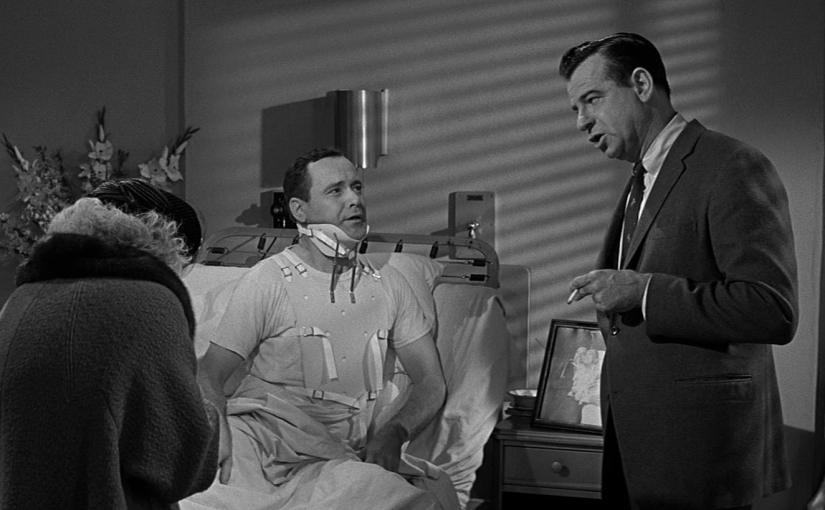
THE FORTUNE COOKIE (1966)

by Miguel E. Rodriguez

Director: Billy Wilder
Cast: Jack Lemmon, Walter Matthau, Ron Rich, Judi West
My Rating: 5/10
Rotten Tomatometer: 96%

PLOT: A crooked lawyer persuades his brother-in-law to feign a serious injury.


Billy Wilder’s The Fortune Cookie reminds me of what it might be like to watch Jerry Lee Lewis play “Chopsticks.”  You sense it’s being done as well as it possibly can be done, but you wonder why it’s being done at all.  C’mon, man, let’s hear “Great Balls of Fire!”

Notable for being the first of twelve films Jack Lemmon and Walter Matthau starred in together, The Fortune Cookie tells the story of a hapless TV cameraman, Harry Hinkle (Lemmon), who is covering a Cleveland Browns football game from the sidelines.  A burly punt returner accidentally runs him over during a play and knocks Harry out cold.  While he recuperates in a hospital bed, his thoroughly unscrupulous brother-in-lawyer, Willie (Matthau), concocts a very modern-sounding plan: Harry will fake serious injuries in the hospital so Willie can work his magic with the insurance company and get a big payout.  Harry demurs at first but is enticed to go along when he finds out his ex-wife, for whom he still carries a torch, is very interested in assisting with his recuperation from his “serious” injuries.

Meanwhile, the poor football player who knocked him down, Luther (Ron Rich), is wracked with guilt over the damage he thinks he’s caused.  He pitches in to buy Harry a motorized wheelchair and offers to assist with his rehab back at home.  This gnaws at Harry’s conscience.  Things don’t get any better when he’s brought a lunch of Chinese food at the hospital, and the fortune inside his fortune cookie bears a grim warning…

There’s nothing wrong with The Fortune Cookie that a rewrite or some editing couldn’t have fixed.  That might be considered sacrilege, considering the script was penned by Wilder himself and his legendary writing partner, I.A.L. Diamond, but in watching the film, I was struck by how many scenes involved a semi-static camera just watching people talk, and talk, and talk.  I don’t mind a lot of dialogue in a scene when the characters have something to say, or when the story is being driven forward.  But here, we usually get a five-minute scene when a two-minute scene could have done the job just fine.

Take one scene in particular that almost had me literally nodding off, when Harry’s ex-wife, Sandy (Judi West), has returned home to help with Harry’s rehab.  Harry is still feeling guilty about the sham he’s perpetrating, but he’s so besotted with Sandy that he’s willing to keep up the pretense just to keep her around.  They catch up a little, blah blah blah, he says he never threw away his ring, blah blah blah, she dumps out her purse looking for her ring, blah blah blah, he puts on a little music, he’s happy, she’s happy, and <snoorrrrrrre.>

I could list any number of films, including some of Wilder’s other films, where other characters talked for even longer than Harry and Sandy, but they were so much more interesting!  What happened here?  What went wrong?  Even in the scenes where Willie, the huckster, is rattling off his grand plans and needling the insurance company attorneys, Matthau just comes off as a two-bit hack that no sane person would pay any attention to.

I’m not saying he must be likable, that dreaded word.  There are movies that are very, very good and that contain nothing BUT unlikable characters. (Anyone wanna watch The Godfather?) But here, something is off with the tone.  When I wasn’t bored, I was inflamed with distaste for what Harry was being forced to do, both by Willie and by his own hormones.

The movie does have one saving grace.  The comeuppance, when it, er, comes up, is brought about with the kind of shock comedy scene that Mel Brooks might have loved.  I don’t want to spoil it, but it features the kind of language that would have been right at home in Blazing Saddles.  When I got over the shock of what I had just heard, I sat back in admiration and smiled, and thought to myself, a little ruefully, “Now what would this movie have been like if it had been this nervy all the way through, instead of just here at the end?”

But The Fortune Cookie even mucks up the ending with an “epilogue” scene that’s so gratuitously manipulative, I wouldn’t be surprised if it had been tacked on by the studio who demanded a happy ending, or at least a happier ending.  If the movie had earned it, I’d have been on board, but everything that came before was so humdrum that it felt super-cheesy.

Billy Wilder’s résumé reads like the Pixar catalog: one hit after the other with only a couple of rare misses.  Double Indemnity.  The Lost Weekend.  Sunset Boulevard.  Ace in the Hole.  Stalag 17.  Sabrina.  Witness for the Prosecution.  Some Like It Hot.  The Apartment.  Even One, Two, Three, which may not exactly be his finest moment, but at least it had James Cagney to liven things up.  I ask again: what happened here?  Where is the dynamite chemistry between Lemmon and Matthau that would become legendary in later films?  Where is the zaniness of Some Like It Hot or the earned pathos of The Apartment or the edginess of Ace in the Hole and Stalag 17?

According to the trivia section on IMDb, the opening football game sequences were filmed during an actual Vikings-Browns football game, which the Browns lost, at home, 27-17.  After watching this movie, I felt like those Cleveland fans must have felt: always glad to see my boys play, but man, it would have been WAY cooler if they had won.


WEIRD SCIENCE

By Marc S. Sanders

John Hughes, as a writer, stretched his imagination far at times. Really far!!!!! You’d have to, to build up your confidence to make a ridiculous comedy like Weird Science come to life. The movie is blatantly absurd, outrageous, a little crude and outright nonsensical. It’s Frankenstein meets Pretty In Pink. It’s alive!!!!!

Double, maybe quadruple, Uber Nerds Gary and Wyatt (Anthony Michael Hall, Ilan Mitchell-Smith) spend their Friday night in front of the computer to create the hottest woman ever. With the help of a Barbie doll and some Playboy centerfolds, nothing on earth will compare to this creation for the XX chromosome community. They give her a brain as well by scanning in photographs of Albert Einstein, of course. From there, “Lisa” (Kelly LeBrock), with the toned body that SCREAMS SEX, plots out the boys’ weekend at a blues club, then the mall and later a party at Wyatt’s house where the boys’ reputations are enhanced almost as well as Lisa’s chest.

Lisa helps Gary and Wyatt overcome their insecurities with their popular girl crushes and teaches Chet, Wyatt’s idiot green beret brother, to lay off. Chet is played by Bill Paxton. Can you imagine anyone else playing Chet?

There’s a cuteness to Weird Science. However, the slapstick gags are what really wins. Either you like this silliness or you don’t. I get amused watching all the furnishings of Wyatt’s house, including the Baby Grand piano, get sucked out the chimney along with a half-naked girl. I love it when Lisa freezes the blue blood grandparents in the pantry closet or when she erases the memory of Gary’s father. I also like how Chet is reduced to a big blob of literal shit. Then there’s the nuclear missile that rises out of the floor, up through the roof.

Take off your cap of sophisticated maturity, and just appreciate silly, sophomoric comedy for a change. It’s all harmless, anyway. Lisa makes sure everything is back in its place by the end, only now it’s better and funnier than before.

NOTTING HILL

By Marc S. Sanders

Notting Hill written by Richard Curtis (Love, Actually) and directed by Roger Michell is a pleasant surprise of a romantic comedy. It’s not a perfect film but it certainly loves every one of its quirky supporting characters, as well as its two straight romantic leads played by Julia Roberts and Hugh Grant.

Grant plays Will Thacker who lives in the Notting Hill district of London where every proprietor is a charming little shop of some form or other; a quaint street where merchants appear on the sidewalks during the weekends selling their art or homemade jams or coffee products. Will owns a travel book shop located across the street from his flat that is whimsically recognized by its big blue front door. His wife left him for another man and now he’s relegated himself to living with a roommate called Spike (character actor Rhys Ifans doing a British equivalent of Cosmo Kramer, Seinfeld’s neighbor).

One day the superstar celebrity Anna Scott (Roberts) simply strolls into Will’s store. They have a quiet moment and he sells her a travel book about Turkey that he didn’t recommend she purchase. Moments later they run into each other down the street when Will spills orange juice all over Anna. From there, a meet cute relationship begins to unfold. It’s not so simple for the pair though as Anna’s enormous celebrity is hard to negotiate; hard for Anna, not hard for Will.

Anna is at ease when she can have a quiet dinner to celebrate Will’s sister’s birthday with his friends or when she can escape her turbulent life of gossip magazines and paparazzi by taking shelter at Will’s flat, even if grungy looking Spike walks in on her taking a bath.

I like Notting Hill. However, the quiet moments shared between Grant and Roberts sometimes carry on too long. Oh my gosh!!!! Will someone say something already????? Hugh Grant has made characters that trip over their words and stumble with what to say into a master craft. Julia Roberts is one actress that a camera loves especially when she’s distressed. A crying moment in any one of her films will milk the scene for every blush, or glassy eye or tear and whisper she can offer. She’s a terrifically skilled actress in almost any film she does. Eventually, we have to move on from all of this though. My patience for some scenes were just running way too long for me at times. Kiss already!!!! Make love already!!!! Scream at each other already!!!!

Fortunately, there’s much escape to be had with the supporting cast, especially Ifans as Spike who is the most absent minded, lovable, dirty underwear wearing and sloppy prig imaginable. Emma Chambers is just as fetching with her scarlet pigtailed haircut as Will’s sister, Honey. Tim McInnery, Gina McKee, James Dreyfus and Hugh Bonneville round out this madcap collection. The birthday dinner party is a great scene for this ensemble as a comedic but relaxed chemistry blends nicely during a competition to see who is suffering the most to earn the last brownie on the dessert plate. The group is unsure how to include a movie star like Anna in their simplicity but Julia Roberts pulls off a trick that even had me fooled. Simply put, for the whole cast, there’s just that much more life and vibrancy when they are all together and it’s not just relegated to only Roberts and Grant in a scene.

Another special moment occurs later when the couple have split up once again. To depict time fleeting by, Roger Michell offers up a transition of Will wearing one outfit but walking through the hustle and bustle of Notting Hill as the weather and seasons seamlessly change all around him from sunlight to rain to snow and spring sunlight again. You even get a glimpse of Honey starting a flirtatious relationship at the beginning of the sequence and by the time it’s over a minute later Honey is breaking up with the guy. It’s a wonderful moment of wordless narration to show Will’s struggle with moving on as time continues to pass by. More importantly, it allows the titled setting to be a character of its own. This is a great example of showing a lovesick character unable to move on while life has no patience to wait for him to catch up.

I like Hugh Grant and Julia Roberts whether it’s in Notting Hill or one of their many other fine movies. I can’t deny the chemistry they have in this film. It works. I only wanted a little more life to the material that was handed to them. Still, Notting Hill is charming and simply a very sweet romantic comedy.

THE LOST CITY

By Marc S. Sanders

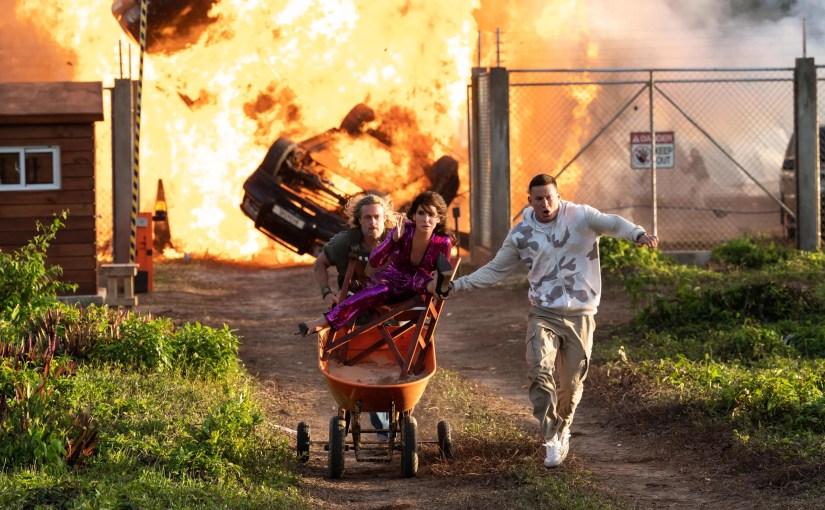
Sandra Bullock’s film The Lost City is nothing more than rollicking fun at the movie theater.  A popcorn movie.  You can simply focus on gorging yourself with endless amounts of popped kernels and large fizzy drinks and you’ll never find yourself lost in a complex plot.  It’s a screwball adventure in the same vein of Romancing The Stone.  What I appreciate is that it is not a duplicate blueprint of Romancing The Stone.  Maybe just the opening scene, but no matter.

Bullock is Loretta, a reclusive romance novelist, who knows that her books are nothing more than cheesy pulp material to the umpteenth degree.  Her agent Beth (Da’Vine Joy Randolph) keeps a positive attitude as she encourages a book tour to promote Loretta’s newest installment in a series that follows the adventures of Loretta’s fictional swashbuckler.  That hero is preserved on the covers of her novels in the image of fashion model, Alan (Channing Tatum) – a Fabio inspiration.  Alan dons the gorgeous blond locks wig with the beefcake chest and the fans seem to go wild for him more than they do for Loretta’s work.  Even the glittery purple jumpsuit with stiletto heels that Loretta dons for an appearance at a book fair doesn’t deter the screaming fans away from Alan’s muscular build and chiseled chin.

When Loretta is captured by a spoiled brat of a villain known as Abigail Fairfax (Daniel Radcliffe), she finds herself having to research the location of a lost city on a remote island rumored to possess treasures beyond anyone’s wildest dreams.  Somehow, within Loretta’s fiction she implied the actual location of this place.  Abigail needs her to delve even further towards the destination.

This all sounds cliché.  It is, actually.  So what!

What saves The Lost City is the screwball comedic approach to the film.  Bullock and Tatum are nearly twenty years apart in age.  Yet, they make a great pair in the same way that Hepburn and Grant did in Bringing Up Baby.  I could care less about the actual lost city and whatever treasure was there.  The symbols etched on an old piece of parchment that Loretta attempts to decipher never mattered to me.  Two days after seeing the movie, I don’t even remember what the lost city revealed when they eventually got there.  I did like the endless pratfalls of Tatum and Bullock, however. 

Channing Tatum looks like the adventurer of a romance novel.  Yet, he’s nothing more than a pretty boy or a “mimbo” as Jerry Seinfeld might describe him.  He’s actually got a crush on Loretta and upon determining that she’s been kidnapped, he recruits the legendary problem solver Jack Trainer (who could only be encapsulated in the form of a gorgeously blond, tan and muscular Brad Pitt) to rescue Loretta.  It’s important to Alan, though, that he gets recognized as the savior.  So, he kind of learns as he goes. 

Adventures in the jungle abound.  There are bad guys on motorcycles.  Guns, of course.  Fires within Alastair’s luxury SUV. Rock climbing.  Rivers with leeches.  Dark caverns and on and on and on.  Yeah.  I’ve seen this all before.  Again, I say so what!  It’s just a fun time at the movies that brought me back to the fast-paced escapades found in the 1980’s films I grew up on.  Yet, it has its own spin thanks to the relationship of Alan and Loretta.

Daniel Radcliffe and his beard are also great characters.  It’s a nice departure from the shoe horned role that’ll never leave him as a certain boy wizard who will not be named here.  He just brings out his fun bratty side.  His beard seems to wink along with him.

A better side story could have come with Da’Vine Joy Randolph though.  As the agent goes from one traveling step to the next as she attempts to find Loretta herself, Randolph just doesn’t look comfortable in the role with her sky-blue pant suit and big breasted physique that is intentionally in your face.  Where’s the slapstick that should be accompanying her?  She’s specifically made up to look like diva luxury and you’re waiting for one disaster after another to befall her. Beyond having to fly on a puddle jumper plane carrying farm animals, she simply survives her trek unscathed.  Either this storyline should have been excised all together, or it should have been rewritten to be just as silly as what Bullock and Tatum are delivering.  A flop in the mud or a slip in the river would have helped this plotline. 

The Lost City is just a cute film for Sandra Bullock and Channing Tatum to look…well…cute together, and in a world where celebrities are slapping each other silly on live television, isn’t this a much better escape on a Saturday afternoon?

BULL DURHAM

By Marc S. Sanders

How Susan Sarandon did not even get nominated for an Oscar for Ron Shelton’s Bull Durham, I’ll never know. Shelton writes the character of the lustrous, Annie Savoy with grace, wisdom and silky sex appeal. It remains one of the best female characters to ever appear on a screen and no one else could have played the part other than Sarandon.

Shelton’s sensational script opens with Annie’s declaration that she believes in the “church of baseball” and from there it waxes poetic on the sport’s religion and traditions as Annie uses her charm to seduce the Durham Bulls’ newest talent, dim witted pitcher Eppy Calvin “Nuke” Laloosh (Tim Robbins) leaving the team’s experienced catcher Crash Davis (Kevin Costner) wanting more. That is until Annie realizes that she’s the one who wants more.

Davis is recruited to groom Nuke for the big leagues. Nuke has got a million dollar fast ball arm but he “…fucks like he pitches. Sort of all over the place.” Crash is the frustrated player with talent but the sun is setting on his opportunity for the big leagues. Dumb Nuke has a future that just doesn’t seem fair to Crash. Annie is no help when she chooses Nuke over Crash to hook up with for the season.

Shelton explores so many dimensions in his script. It does not solely focus on the three primary characters. The screenplay stirs in a mixture of what it’s like to serve on a minor league team with bats and gloves that are cursed, the urge for a rain out game or what present to get Bobby and Millie for their wedding. A call to the mound might settle some of these things.

Shelton directs his script with a very natural approach. Watch Crash and Annie flirt in a batting cage. Costner and Sarandon don’t even flinch as the balls whiz between them. Baseball is a part of these characters. They live and breathe baseball and they relish sex.

Shelton’s last 15 minutes of film offer a celebration of sexual release that appears pleasant, fun and somewhat religious as the chemistry between Costner and Sarandon remains strong. They rattle the whole house it seems and the kitchen will never be the same.

Robbins is great with his idiocy. He wasn’t as well known when this film was released in 1988. His surprise appearance of stupidity is so lovable and welcome. When he tries to think he gets himself in trouble. When he listens to his coaches, Annie and Crash, he excels. The pains he goes through upon their advice is ridiculously hilarious. Don’t forget to breathe through your eyelids, Nuke.

I also gotta recognize Robert Wuhl and Trey Wilson as the managers of the team. They are hilarious but not overt. Wuhl is great as he bellows out encouraging but incomprehensible cheers from the dugout. Wilson looks on with tired facial expressions.

This cast is invested in the cloth of America’s pastime. They know the batting averages. They read the signs. They play for the crowds. It’s as if Shelton moseyed into the town of Durham, North Carolina, put his camera up and watched how another season all played out. His lens could have been working with a documentary mindset.

Bull Durham is one of the best scripts ever written full of brilliant one liners and philosophies that I might not entirely understand what any of it is referencing. Yet when Annie or Crash carry on, I can’t help but suddenly get interested.

Bull Durham is the best baseball film ever made performed by an outstanding cast led by a director with a clear, wide-open vision.

Play ball!!!

MAJOR LEAGUE

By Marc S. Sanders

Never seen it before!!!! Finally at the behest of my colleague Miguel Rodriguez and company I sat down to take in the view.

Tom Berenger was a B leading man of the 1980s. Rugged with shaggy hair and a hoarse voice in films like Platoon, Someone To Watch Over Me and Shoot To Kill (a secret favorite of mine). Here in Major League, he carries on that tradition as an aging ball player with bad knees. He’s not given many of the gags, but he sure is likable. I didn’t need the inevitable romantic subplot with Rene Russo. Nothing great there. When he’s playing the ball player in a catcher’s uniform though, Berenger is at his best.

Wesley Snipes shows the future of his albeit temporary star power. He’s not on the level of Eddie Murphy funny but he made me laugh nonetheless, as the base stealer. His entrance into the film is hilarious. A cross between a Bentley & Volkswagen Beetle perfectly sums up his character. Looks like class when really he’s got none.

Dennis Haysbert is one guy I never knew was featured. Now, this guy can bring the comedy as a Voodoo believer trying to get his idols to help him hit a curve ball pitch. He was my favorite.

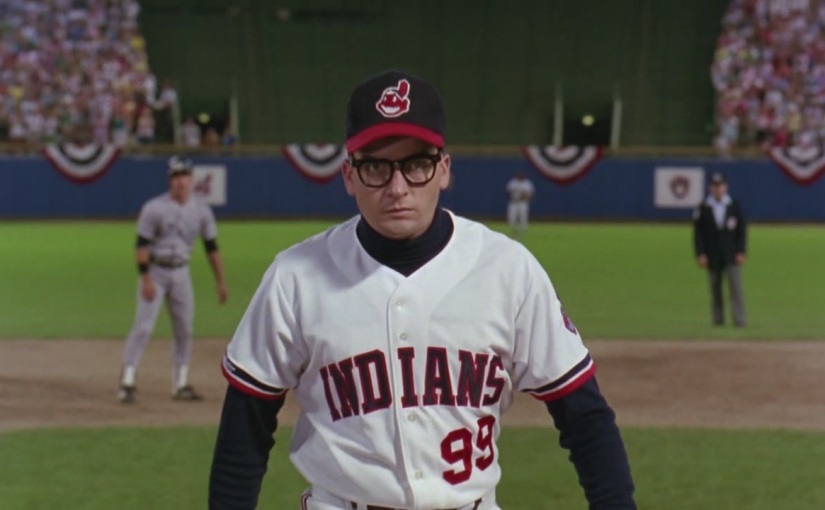
Charlie Sheen is the Wild Thing. It’s not so much Charlie Sheen’s talent. It’s how his character is written that’s hilarious. Writer/Director David Ward (The Sting) doesn’t rely on dialogue for his 2nd billing star. Sheen doesn’t say much actually. Sheen brings the image of a near sighted, out of control, felon with a power arm teetering on 100mph. Throw in some nerd glasses, a punk haircut and an anthem song, and now you’ve got a gag to carry you through a good comedy.

Major League screams of an 80s picture, most especially with the synthesized keyboard soundtrack, Berenger’s Miami Vice sports jacket over a t-shirt, Bob Uecker (great timing as a sports announcer), and 80s mainstay Corbin Bernsen (TVs L.A. Law). Sure, it’s dated but I found the movie to be fun.

Not my favorite baseball film. That belongs to Bull Durham. Still, I’m glad I finally saw Major League.

Oh yeah. As in many sports movies, the team sucks (hey…it’s the Cleveland Indians), the owner wants to stay that way for profit and the team eventually unites themselves to victory.

Exactly!!!! Rene Russo has nothing to do with any of this.

FOUR LIONS (2010, Great Britain)

by Miguel E. Rodriguez

Director: Christopher Morris
Cast: Riz Ahmed, Arsher Ali, Nigel Lindsay, Kayvan Novak, and a very special guest star
My Rating: 9/10
Rotten Tomatometer: 83% Certified Fresh

PLOT: A small group of incompetent British terrorists set out to train for and commit an act of terror.


The world of cinema has a long history of taking subjects traditionally considered taboo and turning them into comedy.  German concentration camps?  Life Is Beautiful mines it for comedy.  P.O.W. camps?  Ever hear of Hogan’s Heroes?  What about Hitler himself?  The Great Dictator and Look Who’s Back lampoon him perfectly.  Race relations?  Look no further than Blazing Saddles.  In recent years, even 9/11 has become a kind of punchline for jokes, with varying degrees of success.  As with all comedy, context is king.

Such is the case with Four Lions, a British film from director Christopher Morris.  In it, the subject and especially the philosophy of suicide bombers are, forgive the pun, exploded with equal doses of logic and ruthless humor.

Omar (Riz Ahmed) is a member of a “cell” of extremists who imagine themselves to be part of a glorious Jihad against Western civilization, but who, as Omar himself puts it, can’t even “stir their tea without smashing a window.”  In the opening scene, Waj (Kayvan Novak) is trying to make one of those videos claiming responsibility for a terrorist act, but the cameraman points out that the gun he’s holding is too small.  It’s actually a replica of an AK-47, but it’s about half scale.  Waj solves the problem by first saying he has big hands, then by simply moving closer to the camera.  Can’t argue with that logic.

Their leader, Barry (Nigel Lindsay), is a Caucasian man who has converted to Islam and become a true believer – “radicalized”, I think is the word.  (Director Christopher Morris says he’s based on a man who was once a member of a far-right, fascist party in the UK; in an attempt to “out-knowledge” the Asian youths he regularly assaulted, this man studied the Qur’an in depth…and as a result “accidentally” converted himself and became a Muslim.  Talk about truth being stranger than fiction.)  Barry is no prize either.  He knows all the proper buzzwords and catchphrases, but he is convinced the best way to defeat government surveillance when walking outside is to constantly shake your head back and forth.  So your face will come out blurry.  Once again, unassailable logic at work.

The fourth member is Faisal (Adeel Akhtar), who buys up large quantities of bleach and liquid peroxide for bomb-making, but to do so he had to make several trips to the same store.  To make sure no one at the shop suspected, he used different voices every trip, including a woman’s voice.  Barry objects: “You’ve got a beard!”  Faisal explains he covered his beard with his hands when he used the woman’s voice.

“So why has she got her hands on her face, Faisal!?”
“…cos she’s got a beard.”

Again…impeccable logic leading to ridiculous actions.  The movie is chock full of these kinds of perfectly logical reasons for doing absurd things.  A movie with only two dimensions would simply use that same lens, point it towards the actions of suicide bombers, and congratulate itself on its cleverness.  But Four Lions, hilarious though it is, goes another level deeper.

Omar has a wife and young son.  They are both totally on board with Omar’s plans for becoming a suicide bomber.  All three are convinced that his act of martyrdom will ensure his place in Paradise where he will eventually be reunited with his family.  When Omar discusses his plans with his wife, Sofia, she is calm, cool, and collected, as if they were discussing when and where to buy their next house.  When Omar tells his son a bedtime story, he makes changes to the story of The Lion King, so it more closely reflects his own beliefs, and the son smiles and eats it up.  Chilling.

But then Omar’s brother, Ahmed, pays a visit.  Ahmed is what I would call an “orthodox” Muslim, wearing the robes and head coverings and the longer beard.  By contrast, Omar is dressed in far more “Western” gear and trainers.  Ahmed has gotten wind of Omar’s plan and wants to try to talk him out of it because the Qur’an teaches non-violence…but his orthodox beliefs also state he can’t be in the same room as Omar’s wife.  Omar makes a point that, according to Ahmed’s beliefs, there are “60,000 opinions saying we can’t fight back!  We must measure our beard with a ruler and lock our wives in a cupboard!”

What you’ve got here is a key lesson in great comedy.  Be funny, but have a point.  What is the point here?  In my opinion, the point of this scene is to single out the vast contradictions possible in any kind of religion where extremists have staked out territory on the fringes.  A man believes in non-violence but can’t be in the same room as a woman.  Another man believes in martyrdom but has water gun fights with his son and wife.  They’re both right and they’re both wrong.  We tend to see one viewpoint as being hand in hand with the other by default, but Four Lions makes the case that great variety is possible.  A man in a robe and a long beard is not automatically a terrorist.  A man with a loving wife and family is not always the “good guy.”  Nothing is black and white.

But I don’t want to make the movie seem like it’s some kind of grand polemic on religious intolerance.  It has its serious moments, yes, but damn, is it funny.  I’m trying hard to think of another movie where a bunch of terrorists wind up running in a fictional “fun-run” marathon dressed as a ninja turtle, a cowboy riding an ostrich, an upside-down clown, and an orange bear.  (Actually, I’m not quite sure that’s a bear…that would be a question for the police.)  Or where one terrorist’s master plan involves strapping a bomb to a crow.  Or where a short discussion is held to determine exactly which parts of a car are Jewish.  As they say in the clickbait ads, the answer to that question may SURPRISE you!

(Also, if you’re a fan of Star Wars, I apologize in advance for any trauma you may experience…you’ll see what I mean.)

Admittedly, the subject matter of this comedy may turn off some viewers.  That is their right.  But if you’re an admirer of sharp-edged comedy that takes no prisoners and follows its own logic to its inexorable conclusions, Four Lions is gold.

THE DARJEELING LIMITED (2007)

by Miguel E. Rodriguez

Director: Wes Anderson
Cast: Owen Wilson, Adrien Brody, Jason Schwartzman, Amara Karan
My Rating: 8/10
Rotten Tomatometer: 69%

PLOT: A year after their father’s funeral, three brothers travel across India by train in an attempt to bond with each other.


In one of the bonus features on the Criterion Blu-ray for Wes Anderson’s charming The Darjeeling Limited, film critic Matt Zoller Seitz compares it to Stanley Kubrick’s 2001: A Space Odyssey because (I’m paraphrasing here) it is the perfect distillation of the director’s method, mood, and style.  I would reserve that distinction for either The Royal Tenenbaums or The Grand Budapest Hotel, myself, but The Darjeeling Limited certainly does capture everything that is typical of a Wes Anderson film: charm, whimsy, troubled souls, a quest of some kind, attention-grabbing camera moves, frequent slo-mo (but not too much), cameos, light and dark material jockeying for position, and a denouement that may signal the end of the film but certainly not the final arc of the main characters.

Meet the Whitman brothers: Francis (Owen Wilson), Peter (Adrien Brody), and Jack (Jason Schwartzman).  A year ago, their father died, and for the first time since that day, they’re about to meet each other and speak to other on board The Darjeeling Limited, a train that will take them across India on a spiritual journey.  Francis, the eldest, is the eager organizer of this little pilgrimage, providing everyone with laminated daily itineraries that are produced by Brendan, his personal assistant who is also travelling in a separate train car.  Francis will spend much of the film wearing bandages on his head and face that make him look as if he lost a fight with a honey badger.  What caused these injuries is not for me to say.

The ostensible reason for this journey is spiritual awakening and reconnecting with each other.  “I want us to become brothers again like we used to be and for us to find ourselves and bond with each other,” says Francis.  Peter and Jack are skeptical and not exactly psyched for this little trip, each for their own reasons.  Peter has a wife back home, 7-and-a-half months pregnant, who has no idea he’s in India.  Jack, a writer, has broken up with his girlfriend, but he obsessively checks her voicemails remotely because he still has the code to her answering machine.  (Hey, this was made in 2007 when you could still do that.)  He has his own return ticket in case he wants to leave the trip early.  Of course, he’ll find that difficult without his passport, which Francis has confiscated.  “For safety,” he argues.  Yeah, right.

There is an ulterior motive for the trip, having to do with who did and didn’t attend their father’s funeral, but ultimately the ins and outs of the characters, while engaging, kind of take a back seat to the trademark Wes Anderson visual style.  This is not a bad thing.  I am not a fan of Anderson’s first film, Bottle Rocket, because I felt it was all posturing with no meat to the story.  However, with each successive film of his, I become more and more endeared and captivated with his trademarks, especially when he uses it to tell stories that I would never have thought would “mesh” with his style.

For example, near the halfway point of the film, an extremely unexpected crisis occurs.  Because the movie has been happy and bouncy and witty up to now, it comes completely out of left field.  But remarkably, in the middle of this action, Anderson’s camera remains as “Anderson-esque” as ever, still performing quick pans and push-ins and keeping me involved in the story.  This crisis might have felt contrived in another film, a plot device to inject some needed drama into the story.  Not here.  Anderson’s storytelling methods made the event feel as random as anything life might throw at us on any given day: the death of a parent, the birth of a child, a snake getting loose in your train compartment, etcetera.

With one or two obvious exceptions (I think), the entire film was shot in India.  The trusty IMDb trivia page informs me the train scenes themselves were filmed inside a moving train travelling from Jodhpur to Jaisalmer.  The beautiful Indian locations are a major feature of the film.  They visit temples, marketplaces, a monastery, and hilltops overlooking vast Indian vistas.

And all the while, Francis, Jack, and Peter struggle to come to grips with their differences and their brotherhood.  “I wonder if the three of us would’ve been friends in real life,” Jack asks at one point.  Great question.  Given what we see in the film, it’s sometimes hard to believe they ever loved each other.  At one point, Francis and Peter get into a wrestling match and Jack has to step in: “I love you, but I’m gonna mace you in the face!”  That’s real love right there.  Right?  I guess…

I’ve heard that if you’re ever not sure what a book or a movie is about, just look at how a character has changed at the end of the story as opposed to what they were like at the beginning.  In The Darjeeling Limited, that’s not so easy to pin down.  I can see that Francis has grown a bit (he eventually relinquishes his brothers’ passports).  But when it comes to Jack and Peter…I’m not sure much has changed with them at all.  Does that make this Francis’s movie through and through?

I’m not sure it matters.  I mean, yes, the story is fun to watch, and I wanted to see where this journey would lead each one of the three brothers.  But for me, the element, or factor, or whatever, that makes The Darjeeling Limited so fun to watch is the directorial style of Wes Anderson.  In this film, as in so many of his films, it’s not about the destination.  It’s about the journey.

[Trivia note: the Criterion Blu-ray also contains a short film called Hotel Chevalier which is intended as a kind of prologue to The Darjeeling Limited.  Don’t make the mistake I did…if you get the Blu-ray, be sure to watch the movie with the prologue.  Don’t wait until after watching the main feature.]

[Super-nerdy trivia note: every musical cue in the film was cribbed from the early films of James Ivory and Satyajit Ray; Wes Anderson wanted to pay tribute to the filmmakers who influenced so much of his style.]

TURNING RED (2022)

by Miguel E. Rodriguez

Director: Domee Shi
Cast: Rosalie Chiang, Sandra Oh, Wai Ching Ho, James Hong
My Rating: 10/10
Rotten Tomatometer: 95% Certified Fresh

PLOT: A 13-year-old girl named Meilin wakes up one morning with the rather inconvenient power to turn into a giant red panda whenever she gets too excited.


Disney/Pixar’s Turning Red is one of the best, funniest animated movies I’ve seen since Inside Out.  Or The Lego Movie.  Take your pick.

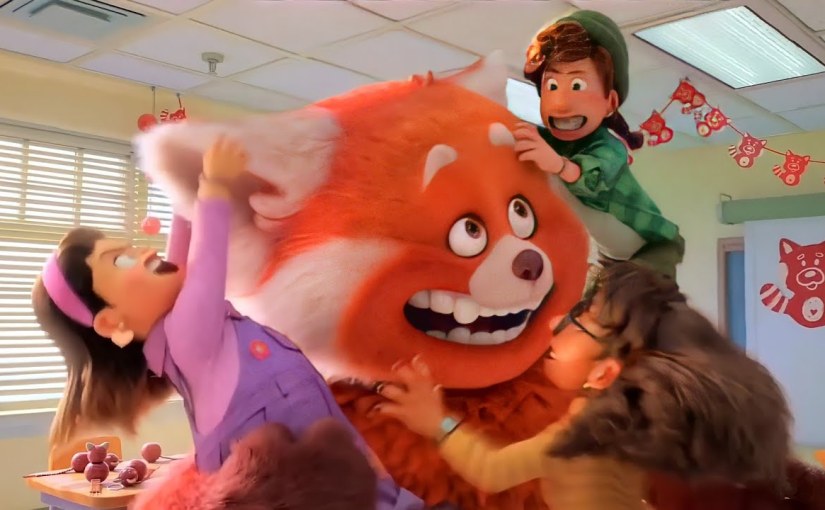
If you’ve seen the trailer, you know the plot.  A 13-year-old Chinese-Canadian girl named Meilin [may-LINN] discovers one day she has the (inconvenient) ability to turn into a giant red panda.

Details: Meilin’s relationship with her mom, Ming (Sandra Oh), is complicated enough without this new tangle.  Ming encourages Meilin to excel at everything and has enlisted her help with running and maintaining a small Chinese temple devoted to an ancient ancestor of theirs who supposedly channeled the power of the red panda to defend her children thousands of years ago.

When Meilin learns to control her newfound power to a certain degree, she decides to use it, not to fight crime, but to earn some money to buy a ticket to see this awesome boy band, called 4Town (even though they have five members), with her three besties.  Like, Oh.  Em.  GEE!

Complications ensue, Meilin tells a crucial, heartbreaking lie at one point, and previously unsuspected powers are unleashed.  That’s all you’re getting out of me, story-wise.

While the story was great, and worthy to stand with Pixar’s finest films, what made Turning Red stand out for me was the humor.  It is just plain laugh-out-loud funny.  I was laughing through almost the entire movie.

Through a completely believable misunderstanding, Meilin’s mom, Ming, thinks she knows what’s behind Meilin’s strange new behavior and asks her, ever so delicately, “Did the scarlet peony bloom?”  There’s a brilliant moment when Ming chases Meilin to school and, in front of an entire classroom, holds up an item she forgot to pack in her bag: a box of pads.  That’s right out of a John Hughes movie, man!  I laughed like a maniac.

Meilin’s three friends are a treat, especially the little spitfire named Abby, whose face seems to be permanently stretched into a fierce scowl.  There’s a moment when she catches one of those red playground balls with her teeth.  Maybe SHE’S the monster.

As with all the best Pixar films, though, the humor, as effective as it is, is just window-dressing for the real thrust of the story.  The exploration of the mother-daughter relationship hasn’t been done this well since Brave.  And I’ve gotta say, it was refreshing to see how real the character of Meilin was.  Because she’s rooted in the real world (of 2002 Toronto), her attitude felt more authentic somehow.  Sure, in Brave, Merida had the same rebelliousness and determination to forge her own path despite an imposing mother figure.  But with Turning Red, everything was more grounded.

There’s a moment when Meilin has turned into a panda and is running down a city street trying to hide.  She passes a convenience store where a cute guy works the counter.  She is desperate to get out of sight…but she stops just long enough to glance through the window at the cute guy, stomp her foot like Thumper, and yell, “Ah-OOO-gah, ah-OOO-gah!”  Another big laugh.  And I thought to myself, “See, that’s normally what you would see GUYS do in a movie.  Who makes a Disney film about a girl obsessed with boys?  What a treat!”  (I know, I know, the early Disney princesses weren’t exactly models of modern feminism, I’m talking about more recent films, stay with me here…)

Naturally, there’s a lot of symbolism with Meilin being thirteen, coming of age, and suddenly going through all sorts of changes.  What’s great about the storytelling is that the symbology is secondary, at least initially.  There’s the usual very well-executed denouement where all the emotional threads come together.  But before we get there, it’s just a story about a young girl with a weird problem.  And I have to say again, it is doggone FUNNY.

I took a glance at the “rotten” reviews at rottentomatoes.com, and I kept seeing one repeated phrase among several of them: the lead character was “irritating.”  I am at a loss to explain this point of view.  Meilin is a 13-year-old girl.  Of COURSE, she’s irritating.  AND obnoxious.  What were you expecting?  Meilin is endearing precisely because she’s portrayed as someone who isn’t perfect, even though she’s trying hard to be.  She lies to her parents.  When she has to think of something to calm herself down, she doesn’t think of her mom…she thinks of her best friends.  She feels bad about it, but what are you gonna do, she’s thirteen.

Further pontificating from me seems pointless.  Take it from a lifelong Pixar fan.  Turning Red is one of their finest moments.  It’ll make you laugh, and if you’re not careful it’ll make you cry.  It might make you remember what it was like to scream like crazy at a rock concert.  It’ll make you remember your first real best friends.  And it’ll make you wonder why more people don’t make movies like this.  Because they should.

KATE & LEOPOLD

By Marc S. Sanders

Fish out of water stories will always be told. Kate & Leopold directed by James Mangold reminded me of the New York City based romantic comedy Big, which was a better variation on that formula.

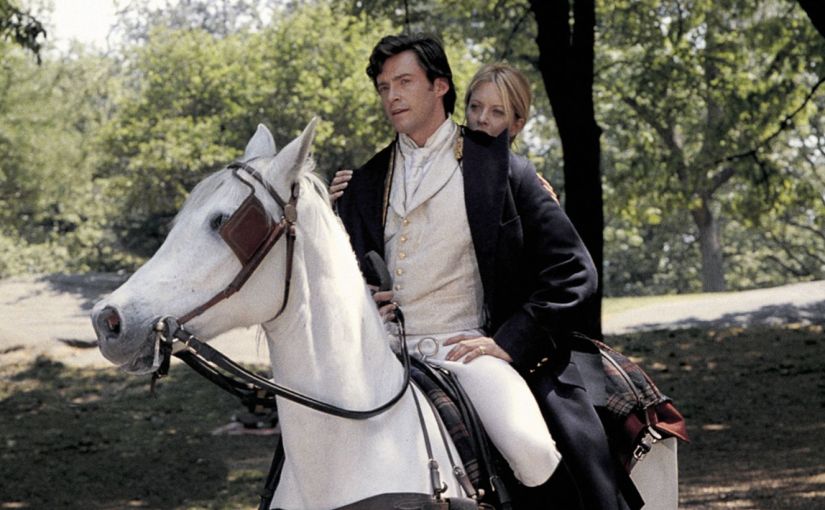
In Kate & Leopold, Hugh Jackman portrays the second title character also known as the Duke of Albany in the year 1876, and apparently the eventual inventor of the elevator. One night, he pursues a curious fellow who is attending an evening ball designed to find a bride for Leopold. The man runs and Leopold gives chase into the rain where they find themselves hanging from scaffolding of what will become the Brooklyn Bridge, designed by-you guessed it-Leopold. The moment of suspense ends with Leopold accompanying the fellow named Stuart (a very miscast Liev Schrieber) into present day New York; a New York unfamiliar to Leopold where manners of grace and elegance have gone out the window and you’re expected to pick up your dog’s poop following a walk.

Let’s get this out of the way, quick. Stuart has uncovered time travel. How does it work? Who cares? Move along.

Stuart’s ex-girlfriend and downstairs neighbor is played by the late 20th century staple resident of the Big Apple movies, Meg Ryan. She’s the Kate of the film’s title. Just like other romantic comedies of this nature, Kate is tense and stressed and trying to land a big account where she’s looking for the right spokesperson for a new butter spread commercial. You think Leopold, in his signature 19th century outfit, may fit the bill? I’m thinking you guessed correctly.

What else do you think happens? Yeah. You’re right. Kate and Leopold start to fall in love.

I grew tired of Kate & Leopold for a few reasons. There’s a side story meant for some slapstick kind of humor where Stuart, who is the “Doc Brown” of this picture, falls down an elevator shaft only to be relegated to a mental ward where he struggles to get in touch with the leads to explain what must be done from here. C’mon!!! A patient in a hospital should be able to make a lousy phone call.

Two, as Leopold romances Kate as well as coaches her brother (Breckin Meyer) in the ways of romance, how does he manage to find the financial resources for a violinist or the decor he uses to uphold his manners of refine? Reader, if I’m occupying myself with these trivial questions, then what do you think might be wrong here?

Chemistry!

Most importantly, the chemistry between Ryan and Jackman seems way off. I didn’t believe for a second these two were falling in love with one another. They speak two different variations of English and while Leopold is a man of great chivalry, I never found a moment in the film where he would be captivated by the modern-day Kate. What did Kate do anywhere in this picture that swept him off his feet? For Kate, when did she fall in love with Leopold? She’s hardly giving him the time of day and he’s really only a convenient opportunity to rescue her big account, but that’s not love for me. That’s not romance. That’s, at best, discovery. Like finding the next big talent or gimmick. If this is what love is, then who fell in love with Mr. Clean and how many years is the Jolly Green Giant married now? Did the Kool-Aid Man find his betrothed when he smashed through her kitchen wall?

In Big, director Penny Marshall found opportunities for the Elizabeth Perkins character to stop and look at the 12-year-old character version of Tom Hanks. Because she stopped and looked, she then still felt comfortable in her own skin. Hanks’ kid like character develops a first crush. A first crush may not be love, but to a 12-year-old, nothing is more confusing or self-occupying.

In Mangold’s film which he co-wrote with Steve Rogers, Leopold admits early on that he’s never been in love. Where’s the weight of his emotions here? I never uncovered those moments between the characters of Kate & Leopold, while a film like Big devoted a wealth of attention to it.

As well, like I said earlier, I could not take my mind off figuring out how Leopold is paying for this elegant rooftop dinner. Where did he get the money, in New York City, to pay for all this?

Know what Tom Hanks did in Big? He got a job!