CLUELESS

By Marc S. Sanders

AS IF!!!!!

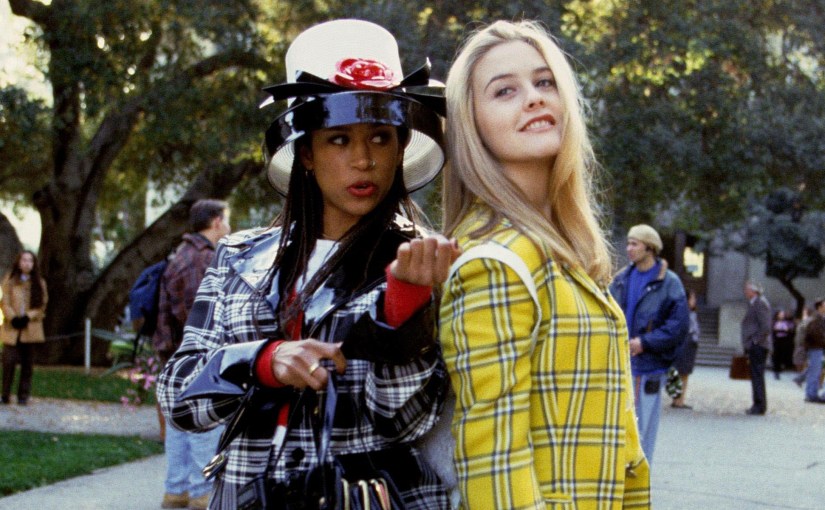
Yeah, Alicia Silverstone’s breakthrough film, Clueless, is shockingly dated, but it is so smartly constructed as it follows Jane Austen’s outline of her classic novel Emma.

You see, here is a movie where the main character goes through a nicely developed character arc. Silverstone’s Cher might be an airhead since her focus is primarily on clothes, the mall, MTV cartoons, and more clothes but as she strategizes to be a matchmaker for fellow students and teachers at her school, she loses sight of her own best interests when it comes to love.

The situations and one liners are priceless in Amy Heckerling’s film. I love how Cher can’t comprehend why her gorgeous crush never hits on her but he loves to shop, dress smart and watch Spartacus.

As director, Heckerling is also attuned enough to deliver gags by means of the extras sprinkled throughout the film. Almost every extra at school has a nose bandage because, you know, this is a Beverly Hills high school where plastic surgery is as common as getting a drivers license. Heckerling might be broadly spoofing the Beverly Hills scene of the ‘90s, but we all know what she’s trying to say with each shot of a high school hallway or classroom.

This film also delivered actor Paul Rudd closer to the main stream. It’s not a glamorous role but he’s cute nonetheless, as Cher’s step brother and maybe love interest???? It’s a long story; watch the movie. He’s the guy with sensibility that Cher doesn’t seem to account for. Rudd’s scenes with Silverstone are marvelous. Typical love/hate material that we’ve seen before, but the characters are so likable it’s hard to resist their charms.

Dan Hedaya (a very underrated actor since Cheers) is really good. He’s such far cry from his on screen daughter as an apparently brutal litigator. Every time he shouts “Cher, get in here!” I laughed.

Again, it’s hard to believe it’s already dated in its wardrobe and slang, but Clueless remains outstandingly funny nonetheless. Bitchin!!!!!!!!

ANNIE HALL

By Marc S. Sanders

Some of the best comedy comes from watching the suffering of others. One of the best examples of this is Woody Allen’s Best Picture winner Annie Hall. Allen directs and stars in the film, and the suffering his character Alvy Singer endures is by his own mindset. Alvy could never be happy unless he is finding another opportunity to be unhappy. At one point he marries a terrific girl played by Carol Kane. Yet that doesn’t work out. As a child, he finds an allegorical reason to live his life as he does by riding the bumper cars where his father works on Coney Island. Alvy just sees life as one crash after another.

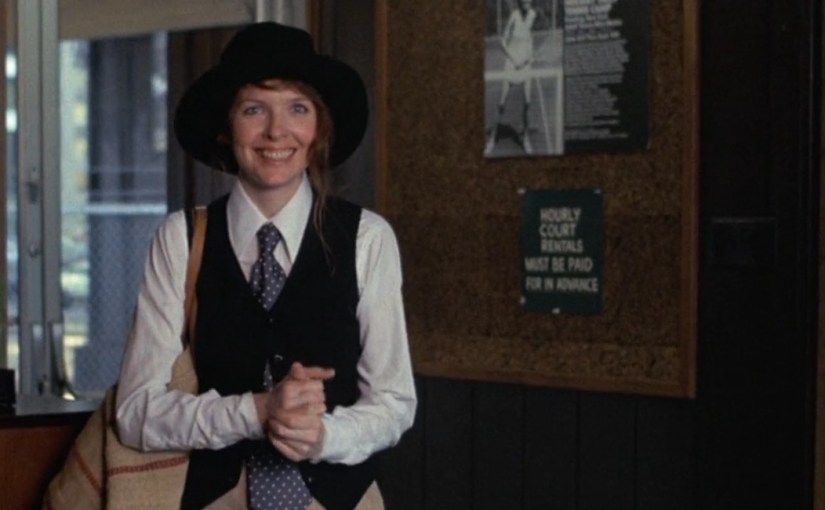
Neurotic doesn’t even begin to describe what Alvy puts himself through. Most especially he becomes insecure with himself as he dates Annie Hall (Diane Keaton, who won her Best Actress Oscar for arguably her best career role). Annie is fun loving and a little flighty. Still, there’s nothing not to love about Annie. She wants to be a singer and Alvy showers her performance with compliments despite a very rough bar crowd. However, when Annie gets reassurance of her talent from others, Alvy is not so encouraging to advance a promising future for Annie.

We see a handful of women that Alvy dates, but most of the ninety minute film focuses on Alvy’s relationship with Annie. Woody Allen penned the script with Marshall Brickman as a loose interpretation of the real life relationship he had with Diane Keaton.

Alvy is a mess. As a child he frustrated his mother with the idea of world ending events yet to come, and thus not much reason to apply himself for a fulfilling life. As an adult, he can’t even wait patiently in a line for a movie because the gentleman standing behind him is aggravatingly wrong on his viewpoint of the films of Marshall McLuhan. The best response to a hilarious scene like this is realized by actually welcoming the real life McLuhan into the frame of the picture to tell off the snobbish jerk standing behind Alvy. I must admit I never heard of Marshall McLuhan myself. Still it’s the idea of running through with a depicted scene like this that’s so dang hilarious. Wouldn’t it be so satisfying to any of us to just have our heroes interrupt a conversation to shamelessly put down our enemies?

That’s what makes Annie Hall a much more special romantic comedy than anything before or thereafter really. Woody Allen breaks the fourth wall at times. He welcomes his adult self into his childhood classroom to debate with his elementary school teachers. Later, he tries to provide a source to his neuroses by bringing both Annie and his best friend Rob (Tony Roberts) into his home to see the relatives Alvy grew up with. These intrusions into scenes of Alvy’s childhood are daringly funny and like nothing I’ve ever seen.

Alvy’s neuroses are so intense that he’ll randomly stop people in the middle of New York to inquire about their sexual experiences. He even unloads his endless dialogue of some of the greatest wit on a horse being ridden by a police officer.

Keaton is perfect for Allen to play against. There’s the hilarious moment of the two of them trying to boil live lobsters. Just between the two of them they are going to be cooking SIX LOBSTERS. Why six? Who cares? The point is to demonstrate a hilariously loving memory at being surrounded by creatures they are both terrified to handle. One lobster even crawls behind the refrigerator and that’s an amusing problem. Annie takes advantage of getting action photos of Alvy with the lobsters. Later in the film, we see that Annie has displayed a collage of this moment on her wall.

Alvy and Annie know they don’t belong together. Yet, it’s hard for them to live without one another too. Annie feels no choice but to call Alvy over at three in the morning to get rid of a spider in her apartment. Alvy obliges without hesitation to leave the bed he’s sharing with his current girlfriend to rush right over to Annie’s aid.

The trying misery they have within themselves is what keeps Annie Hall alive. Interestingly enough is that Allen and Brickman write in a conclusion for the relationship between Alvy and Annie, and show their respective aftermaths. Alvy is a professional stand up comic. Annie dreams of being a singer. What comes of their destinies is refreshing.

I don’t think I could be a close friend to Alvy or Annie. I’d get tired of their ongoing kvetching. That certainly doesn’t mean I don’t like them. I love them actually, and I want them to be happy. Maybe Annie ends up being happy following the events of Annie Hall. For Alvy, I know for sure he’ll be happy so long as he continues to be miserable, and that’s completely fine with me, and I’m certain that’s completely fine with Alvy too.

AFTER HOURS

By Marc S. Sanders

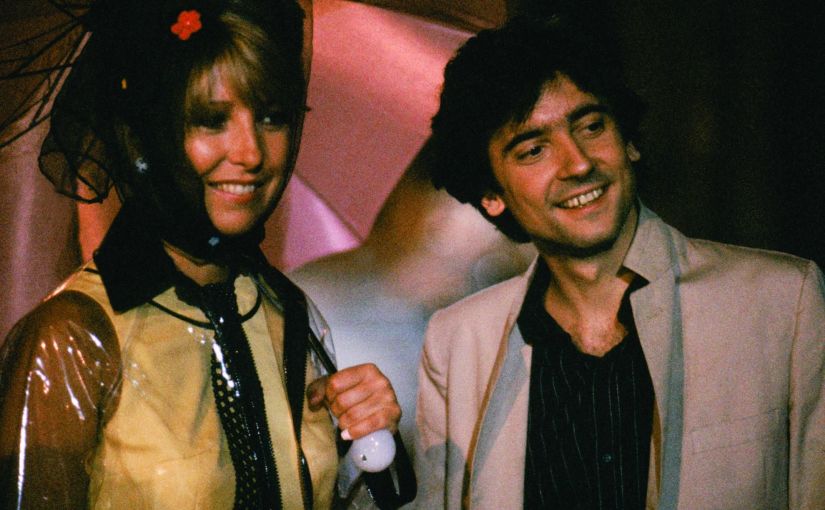
If L. Frank Baum’s classic fantasy The Wizard Of Oz were adapted in a setting of say 1985 New York City in the So Ho section, beginning sometime after 11:30 at night, then it would be a fair argument to change the name of his story to After Hours.  The story would no longer be whimsical. Instead, it would be screwball, with a disturbingly demented narrative from the brilliant but unsettling camera work of Martin Scorsese.  The protagonist would be a lonely yuppie named Paul (Griffin Dunne) who encounters one odd woman after another when all he intended to do was meet up with a kind and attractive young lady named Marcy (Rosanna Arquette) who offered the opportunity of obtaining one of her roommate’s specialty crafts of Parisian bagel & lox paperweights.  (Yes.  You read that description correctly.  Don’t overthink it.)  Unlike Dorothy from Kansas though, the oddballs that Paul meets up with become challenging to him even if they insist on welcoming him into their arms.  These women are not the comfort conveniences of a scarecrow, tin man or lovable lion.

How odd that this film from Scorsese would follow his masterpieces, Raging Bull and Taxi Driver; a major departure from themes of mental disturbance exhibited by characters like Jake LaMotta and Travis Bickle.  Here, the disturbance hinges on paranoia that eventually develops; not seeded in place at the start.  The film relies on absurd situations where Paul inadvertently gets in over his head when all he wants to do is return home and sleep. It quickly dawns upon Paul that it is likely not a good idea to go out after hours when a whole other kind of community is awake, that is uncustomary to his lifestyle.  I was waiting for the film, written by Joseph Minion, to tell me it’s all a dream.  My foolhardy mistake though.  Scorsese would never resort to such a tired, cliché.  If he is going to direct a film of the utmost ridiculous, then he’ll make certain Paul’s unfortunate outcomes are believable…even if they are hard to be believed.

If you’ve seen at least three of Scorsese’s films prior to After Hours, you’ll likely just fall in love with this picture based on his craft with the camera partnered with his always trusty editor, Thelma Schoonmaker.  Cinematographer Michael Ballhaus has his first collaboration here with Scorsese (before Goodfellas and Casino).  Conversations in offices or diners or apartments or bars occur, only they are more exciting than countless other exchanges of dialogue. You will be watching a film that does not sit still and always strives for your attention.  So, while Arquette’s character describes an ex-boyfriend’s obsession with the film adaptation of Oz, your director at play startlingly zooms in on her performance monologue and then circles back to Dunne, her listener on the other side of the table.  No standard quick cuts.  The camera circles and surrounds the players.  A set of keys dropped from a balcony straight down directly towards Dunne’s waiting face below gives an eye opening zoom thanks to Ballhaus’ techniques.

The developments that quickly fall upon Paul are not fair for him.  He loses his only twenty bill that he can rely on, gets caught in torrential downpours of rain, uncovers a suicide, becomes trapped in a punk rock club that wants to give him a tortuous mohawk, and a modern-day pitchfork mob equipped with flashlights and an ice cream truck are hungry for his head because they believe he’s a serial neighborhood burglar.  The poor guy can’t even make a phone call because a ditzy Catherine O’Hara revels in breaking his concentration to remember a phone number.  Teri Garr also appears with a bee hive hairdo as a waitress at an all-night gay diner vying for attention that Paul just can’t afford to give at three o’clock in the morning.  Paul just wants some basic help from anyone who can offer a simple gesture. None of it is that simple however, and the problems build upon one another until they are compounded upon his shoulders so much so that at one point, he literally cannot move out of the physical circumstance he ends up in.  Forgive my vagueness, but I wouldn’t dare spoil what that literally means.  You owe it to yourself to watch the film and find out for yourself.  My first instinct was to go “Come on!!!  Really!!!” Yet, then I remembered this is a film of daring escapes.  Still, Minion’s script and Scorsese’s film turn those breathless escapes into deeper depths of a So Ho hell, as the film proceeds to its inevitable sunrise.

After Hours might have been a subpar John Hughes comedy, only vaguely remembered from the decade of excess, the 1980s.  In Martin Scorsese’s hands though, it’s comedy pathos and yet frightening at times.  Only Scorsese can show us funny, yet bleak.  That’s okay.  It’s different.  I’ve seen the standard slapstick unfortunate circumstances of School Principal Ed Rooney in Ferris Bueller’s Day Off, and countless copycats thereafter.  Scorsese offers up a different, inventive, and very twisted approach for a typical victim of circumstances beyond his control.  

My recommendation for a double feature:  watch Neil Simon’s The Out Of Towners with Jack Lemmon and Sandy Dennis.  Then watch After Hours.  You may begin to understand how New York City can be a vicious and unforgiving beast with enough chutzpah to attack you, even if you never deserved any kind of punishment.  If you’ve ever found yourself in any kind of metropolitan city throughout North America, you’ll likely nod your head at what this poor guy encounters, and you might not feel so singled out.

EDDIE MURPHY’S RAW

By Marc S. Sanders

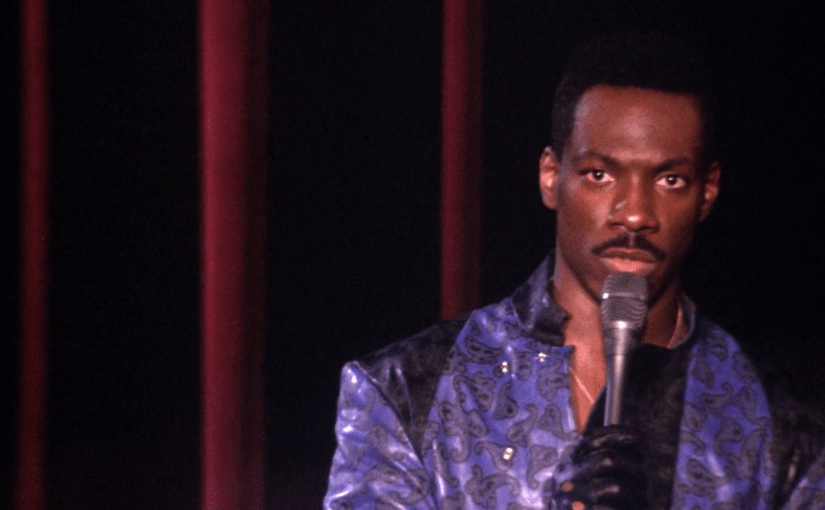
There is no way.  NO WAY that Eddie Murphy’s Raw would ever be produced today.  Nearly every sentence is of the highest caliber offense of any modern day societal belief.  Still, Murphy’s expressions and delivery are lightning in a bottle.  You can’t help but at least grin at his close ups and physicality.

This guy is so incredibly bright that only his comedic stand up monologues could actually feel like you are learning from a college professor who offers up what guys like Bill Cosby, Michael Jackson and Mr. T are really like.  At the same time, he’s somewhat frank with how men and women communicate. It’s comedy.  It’s terribly exaggerated like comedy needs to be, but I can’t deny at least some truth in what Murphy talks about.  If there wasn’t even a fraction of validity in his material, then it would never have been funny, and Eddie Murphy’s career would have ended well before the 1980s came to a close. 

RISKY BUSINESS

By Marc S. Sanders

It’s telling of how happily cash rich people were all to proud to carry themselves in the 1980s Reagan era.  It was not a time to focus on emotions and sensitivity.  War was over.  Shopping malls were all over the place.  Credit cards were easy to get and use.  Forget about what happens later.  Heck even the music was happy and fun with acts from Wham! The Go Go’s and Katrina And The Waves.  Maybe it was not as apparent, compared to today’s “Me Too”/”Black Lives Matter” themes, to focus on the minorities or even basic charity.  Free enterprise was the theme.  Profits and prestige were the goals.  It was even taught to be that way in high school.  Love was not important.  Making money was the all rage.  Making money and spending money-including your savings bonds from grandma and grandpa.  Paul Brickman’s Risky Business was evidence of that mentality.  Long before, it ever became transparent that well to do parents could buy their kid’s Ivy League education for a promising future, just the idea of mounting pressure to get into a school like Princeton University was a terrible ordeal for a 17 year old kid.

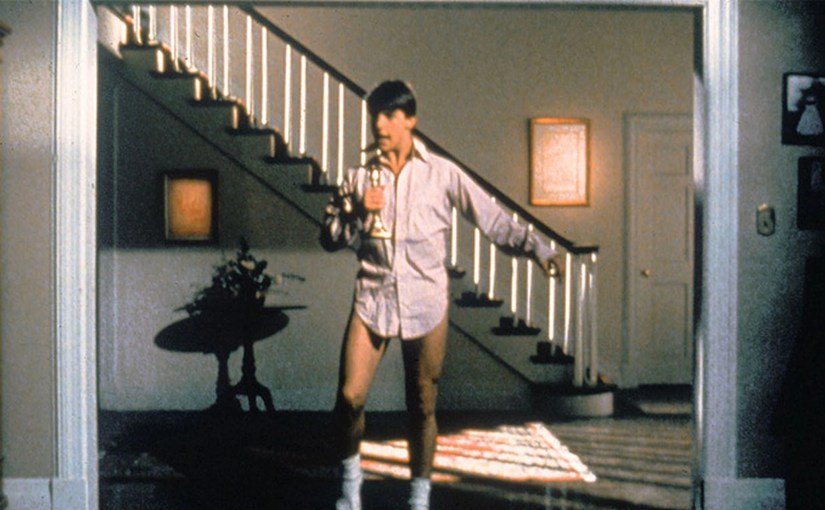
Tom Cruise’s breakout role of Joel Goodson, with his sock covered feet, pink polo shirt and BVD white underpants faced this issue, and yet it was not Joel’s most important problem to contend with.  Risky Business showed us the first couch that Cruise jumped up and down on with help from Bob Seger.  Cruise’s career was never the same ever since this 1983 film.  It only got sexier and better and outrageously more successful following this film.

Brickman’s script which he directed was one of the first commercially successful 80’s teen flicks to adopt the concept of the parents are out of town, so let’s party approach.  Only thing is beyond joyriding in dad’s Porsche, Joel is not as obsessed with popular jock/cheerleader parties, as he is with getting laid. He dreams of gorgeous naked girls in the shower and on his bed, or who is on the other end of the line when he calls an escort personal ad.  Yet, paranoia takes over for Joel.  His WASP parents seemed to have instilled Joel with fear of a S.W.A.T team nightmare if he even dares to make out with a strange and exotic woman in their beautiful suburban home. Through a set of circumstances that disrupts Joel’s comfortable fantasies and strait-laced activities, a high priced and ravishing call girl named Lana (Rebecca DeMornay) enters Joel’s life and his dad’s Porche, and his house and then, doesn’t leave. Joel gets his cherry popped, but things go awry like in most 80s teen comedies.  The Porsche needs to be towed out of Lake Michigan, his mother’s precious crystal egg needs to be recovered from Lana’s pimp (Joe Pantoliano), and Joel has to remember to interview well on Friday night with a Princeton admissions advisor. 

All of this sounds familiar.  These themes have been copied countless times over.  Yet Paul Brickman goes in an extraordinary direction that remains original nearly 40 years later.  His characters of Joel and Lana are smart.  They are portrayed with great instinct by Cruise and DeMornay, who are never playing for laughs and allow the gradual situations of the script to deliver the humor.  Joel is the student.  Lana is the teacher.  By the end, they’ll likely be on an even playing field. 

SPOILER ALERT:  The third act is the true highlight, as the world’s oldest profession becomes a business of free enterprise to make Lana money and rescue Joel from impending doom on a hundred different angles.

As I’ve written before, I love character arcs in all kinds of stories.  Brickman writes Joel as a rigid and by the book kind of kid with his shirt neatly tucked in, a preppy chestnut brown haircut, docksiders and well pressed jeans and khakis.  This kid will not even get a speeding ticket, regardless of the Porsche’s horsepower.  Only after experiencing sex and the possibility of going outside the lines like Lana demonstrates, does Joel realize the value of throwing caution to the wind; more specifically, as the script proudly reminds us “Sometimes you just have to say What The Fuck!”

To sidestep for a moment, when I finally saw James Dean in Rebel Without A Cause, all I walked away with was a very cool looking guy with a red jacket, white t-shirt and blue jeans.  Not much dimension there.  Pretty flat if you ask me.  Then, I’m reminded of Risky Business.  Here is a hallmark film of teen angst.  Joel’s episodes in one week, while mom and dad are away, are not likely to happen in real life.  Yet, Brickman doesn’t aim for farce.  The laughs come in clashing the sons of Chicago white suburbia WASP culture with the nightlife these boys only dream about. 

With Tangerine Dream offering up a cool dreamlike soundtrack, Risky Business is exotic and sexy and dangerous and then it’s funny.  Very, very funny.

BEVERLY HILLS COP II

By Marc S. Sanders

I know. I know. I SHOULDN’T like this movie, but I do.

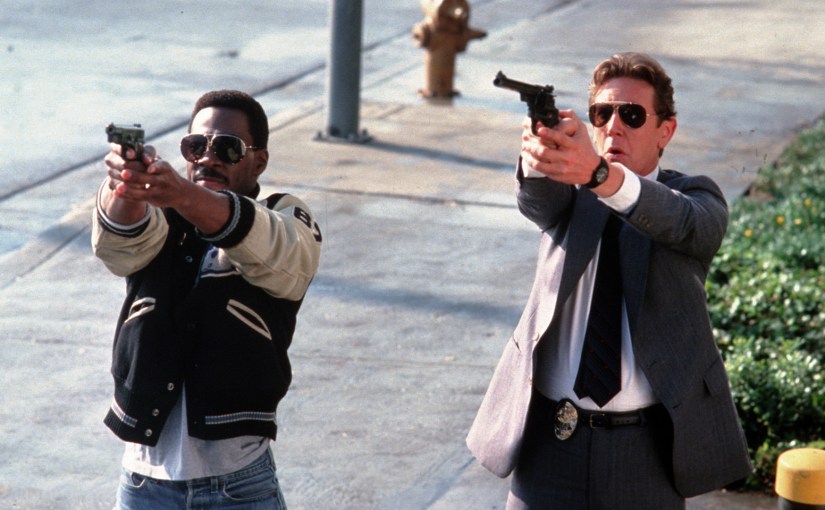
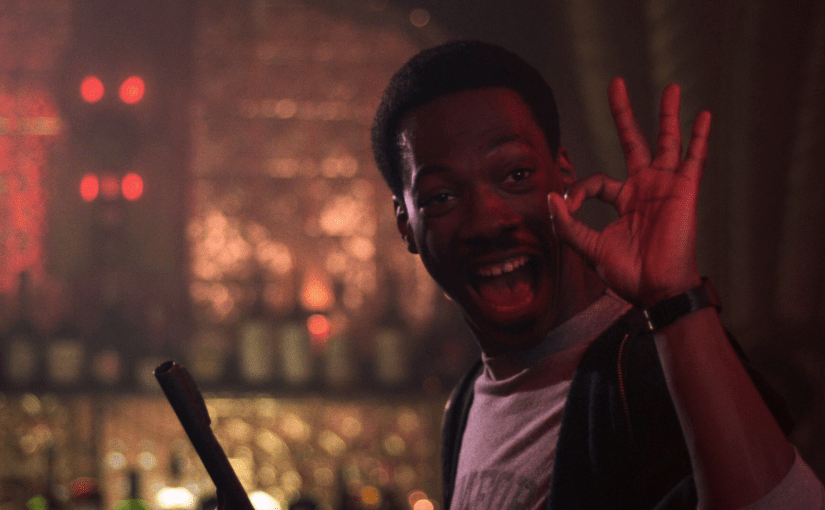
Beverly Hills Cop II is a sequel that is really an opportunity to see a wide variety of close ups of an Eddie Murphy who was well in his ‘80s prime, releasing one #1 movie after another. Here the viewer is treated to Murphy’s Axel Foley blowing a kiss to himself in the mirror, laughing to himself, tucking his crotch in his tailor made suit, flipping sunglasses on and off, driving a Ferrari, and shamelessly plugging the Detroit Lions all while trying to stop an “Alphabet Bandit” criminal in Beverly Hills, CA.

So there’s really not much here when all the vanity is on Murphy. Well, then what’s to like?

Considering I’m a fan of director Tony Scott, who uses great cinematography in all of his films with quick, tension filled editing, it’s hard to resist.  Most especially here Scott’s film is accompanied with an exceedingly cool and dangerous soundtrack from Harold Faltermeyer. Just the opening scene alone (without Murphy in it) belongs in a better movie. A robbery at a City Deposit bank and then later at a horse track are so well edited that you might tuck your knees into your chest and chew on your thumbnail. Great stuff from Tony Scott that would eventually carry over in films like Crimson Tide, Enemy Of The State, and one of my very favorites True Romance.

There are other good moments in Beverly Hills Cop II, especially a great scene with Gilbert Gottfried, and a few with Paul Reiser as well as a smirk inducing scene with Hugh Hefner.

I shouldn’t like this movie but sue me. It’s a guilty pleasure for me. However, watch the far superior first installment over this one any day of the week.

BEVERLY HILLS COP

By Marc S. Sanders

Who actually wrote the Oscar nominated script to Beverly Hills Cop? Daniel Petrie Jr and Danio Bach, or Eddie Murphy?

Murphy’s lines are delivered so fast and so naturally that it seems impossible they could ever rest on a page. Eddie Murphy is an enormous talent of word play and delivery. I miss this Eddie Murphy. I’m reluctant to welcome the Eddie Murphy of PG related fare of recent years. He just doesn’t look comfortable in that garb.

One of the first R rated films I ever saw in theatres (not THE first, as that honor belongs to the Clint Eastwood classic, Sudden Impact) still holds with its hilarity, and the credit does not belong to just Murphy but the whole cast including John Ashton, Judge Reinhold, Ronnie Cox and even early in career appearances from Jonathan Banks, Bronson Pinchot, and Damon Wayans.

I still haven’t forgotten this theatre experience when I joined my older brother, Brian and his friend Nick at the movie theatre in Ridgewood NJ. Never had I heard an entire packed room of people in the dark on a Saturday night laugh so hard together. It’s likely a moment that impressed my love for movies going forward. Movies could bring all sorts of joy and happiness and escape. Beverly Hills Cop was altogether another thing entirely.

Yes!!!! A foul mouthed cop from Detroit who becomes a stranger in a strange land while visiting Beverly Hills to solve his friend’s murder. That’s a film that’s had a great impact on me. As a writer, director Martin Brest’s film (later to do Midnight Run and Scent Of A Woman) offers a very simple blue print to allow Murphy to run wild. It cuts out a lot of complicated red herrings to just stay on a straight resolution. As Murphy’s Detective Axel Foley (great character name) comes across another development, in walks another great set up.

I compare the frame of Beverly Hills Cop and Eddie Murphy to the first Mission: Impossible film with Tom Cruise. The Cruise film makes a huge oversight. Early on it introduces a huge array of characters for an M:I team and then eliminates them all to hardly be used. It was wall to wall Tom Cruise. He was a producer on that film with much creative control and it felt to me as if he insisted on owning every scene, every line, every moment. It turned me off a little.

Murphy on the other hand plays along with his ensemble. Ashton and Reinhold have great moments all to themselves. I still die laughing out loud as Reinhold tries to subdue a situation by ordering an army of machine gun toting bad guys to lay down their weapons only to be silenced with another round of gunfire. The banana in the tailpipe! Ashton working with Murphy to stop a random robbery at strip joint, and then helping to save him later on from arrest. What about Ashton trying to climb a wall during a shootout?

Then there’s Murphy and Pinchot discussing a weird art piece (“Get the fuck outta here!”). Couldn’t you envision Pinchot and Murphy in another film together?  A shame it hasn’t happened.  (No, I won’t count the dreadful reunion in Beverly Hills Cop III.)

Brest provides great showpieces accompanied by one of the best film soundtracks ever. I will never not listen to “Neutron Dance” by the Pointer Sisters on Sirius XM’s 80s on 8 while recalling this film’s opening scene double rig truck chase. Brest directs a symphonic high energy blend of sight and sound. Plays like an awesome music video. Same goes for Glenn Frey’s “The Heat Is On.” If I ever get an opportunity to visit Detroit, that’s what will be playing in my head.

Orchestrator Harold Faltermeyer’s electronic keyboard deserves much credit as well. His covert, sneaky 5 note tune shaped the Axel Foley character. Faltermeyer only made Murphy even cooler during the heyday of “Miami Vice MTV Cops.”

Beverly Hills Cop remains one of the best films with the longest staying power of the 1980s. It’s a comedy. It’s an action picture. It’s music filled fun with great characters. It’ll always be Eddie Murphy’s best film. I can watch it again and again. I’ll never tire of it.