VICE

By Marc S. Sanders

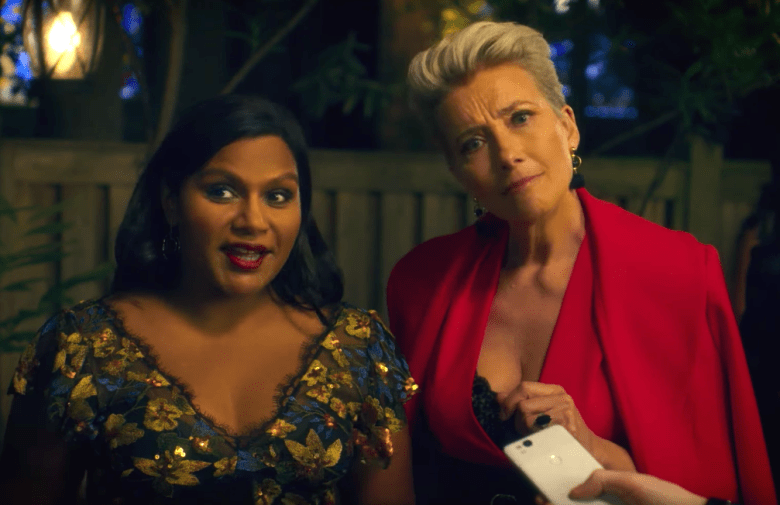
Christian Bale is one of the greatest method actors working today. He’ll put on muscle mass for Batman. He’ll shrink himself down to a skeletal 100 pounds for roles in The Mechanic and his Oscar winning turn in The Fighter. In Adam McKay’s new film, Vice, Bale puts the weight to present an uncanny resemblance to former Vice President Dick Cheney. Without Bale and co-star Amy Adams as wife Lynne Cheney, Vice would not succeed. Both will be nominated for Oscars this year. McKay can expect nominations for himself and Best Picture.

McKay approaches Vice similarly to his winning film The Big Short, where a historical debacle of great proportions is told from a comedic approach. However, the gags of Vice don’t necessarily measure up to the absurdity of the real estate investment collapse of The Big Short. Cheney’s accomplishments were just too sad, too tragic, too shocking to laugh at entirely.

Dick Cheney was a drunk who suffered multiple heart attacks. He got kicked out of Yale University. His daughter, Mary, is gay. His other daughter, Liz, went into politics herself and dismissed her sister’s sexual orientation. Dick has remained married to his very wise and very aggressive wife Lynne who more or less rescued him from a wasted life. Dick Cheney shot his close friend accidentally while hunting, and never apologized for it. He was fortunate to receive a heart transplant that continues to prolong his life, and Dick Cheney became Vice President of the United States for two terms. You don’t have to like the guy but you have to admit he’s got a colorful past.

It’s all in the movie. Immediately, McKay puts in a few words of a byline that this film is based on fact to best of their knowledge but they more or less tried their fucking best.

My impression of what could be considered a very divisive film was actually not divisive to me at all actually. Bale along with McKay’s screenplay show a Dick Cheney who truly sees no other way to carry on a political career than with a silent yet ruthless touch. Later, it required more aggressive tactics not labeled as torture and not appearing beyond his authority even if he is only the Vice President. Bale has the voice down, the walk and as noted before the appearance. This film will likely win Best Makeup.

Having recently seen three potential nominees for Best Actress in The Favorite, I have to say Amy Adams as Lynne Cheney beats them all. This is not an Amy Adams we’ve seen before. Lynne is depicted as smart, aware in a mindset of no nonsense bullshit. She gets the job done, and if she had her way she’d take the job herself but she’s aware of her limits as a woman. Adams easily shows her Lady Macbeth in a scene where daughter Mary reveals herself as gay. Dick promises to love Mary no matter what. Adams as Lynne does not. Adams offers an expression that kills. Right there in this scene is her Oscar moment. This is one of the best performances I’ve seen all year.

Back to Macbeth for a moment, McKay has a great imagination for gags including elevating the fantasy of Dick and Lynne reciting MacBeth to each other in bed while mulling the possibility of becoming George W Bush’s running mate. It’s more than that for Dick. Both know this is absolute power…finally. I’d accept if their decision to run came down to something like this. It takes an ego trip to obtain power after all. If you’ve already been denied power before, the power trip only becomes more powerful on another occasion.

The Shakespeare gag works. Some others fall a little flat. Some really win. Out of the blue, prior to running on Bush’s ticket, McKay wraps up the first portion of Cheney’s life and literally rolls end credits. Then a phone rings and Cheney’s biggest story begins. The end credits moment is a great psyche out.

Vice is not a perfect movie. A huge misfire occurs midway through the end credits that derails McKay’s best effort at a neutral point of view for the Republican. It’s a moment that screams of present day chaos of opinion. McKay said screw it and folded his hand to take advantage of showing how he really feels. Before this scene, McKay and his cast embraced the Cheneys despite their hard to swallow viewpoints and actions. If you are going to make a movie about Dick Cheney or Barack Obama or Mickey Mouse you, as the storyteller, have to develop an appreciation for the centerpiece. If all you are going to do is bash and mudsling, then perhaps you are not qualified to tell the tale. McKay failed at the finish line.

Still, the journey is always interesting. There are things to learn here, things to recollect and things to question how it all came to be a reality.

A good cast is offered including a surprising appearance by Tyler Perry as Colin Powell; make a movie about this guy and get Perry back. Steve Carrell plays a buffoonish Don Rumsfeld. Was Rumsfeld this stupid and this haphazard? I don’t know. McKay uses him to play the fool and the jester. I doubt Rumsfeld has a loyal fan base ready to wave pitch forks. So who cares, really? It’s in the past.

A casting misfire is Sam Rockwell. Moviegoers are too familiar with the real George W. Bush especially in 2018 following the loss of his parents and his deeply appreciated eulogies. Rockwell teeters on 12:45 am Saturday Night Live material, as he chomps down on chicken wings, with a good ol’ boy Texas dialect. I know people want to believe Bush 43 was this stupid. I’m just not ready to accept that. Ironically, a producer on this project is Will Farrell, widely known for his George W Bush on SNL. Farrell would have been a better George here.

Compliments also go to Jesse Plemons as a narrator with an unknown connection to Cheney. Plemons’ delivery plays well on an even keel.

Vice is a complicated film about a hard man to like with little to know redeeming qualities. Adam McKay is cornering the market on films about American absurdities of the past. He’s good at this kind of filmmaking. This isn’t his best film but it still works. Just get ready to leave the theatre as the real end credits roll. Again, it’s a moment that serves the film’s worst flaw as McKay leaves his imagination at the door. Everything before that was right on track. Adam McKay…next time, don’t think too hard.

THE FAVORITE

By Marc S. Sanders

Director Yorgos Lanthimos’ The Favorite. Wow! This is a weird one.

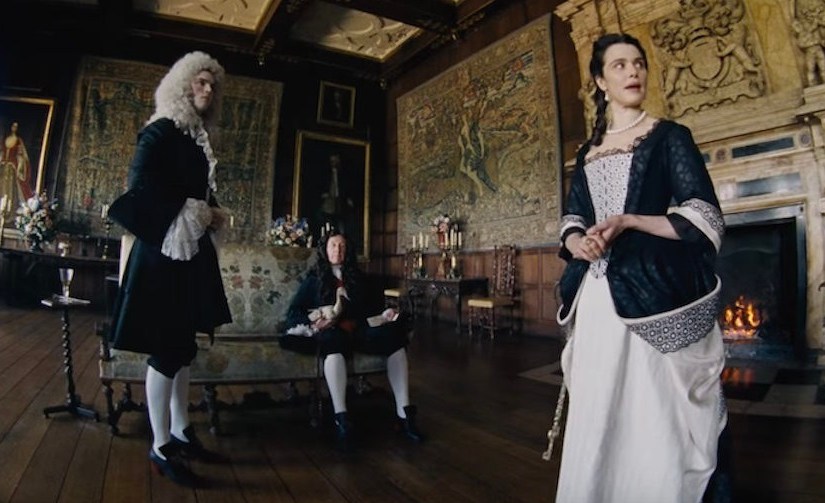
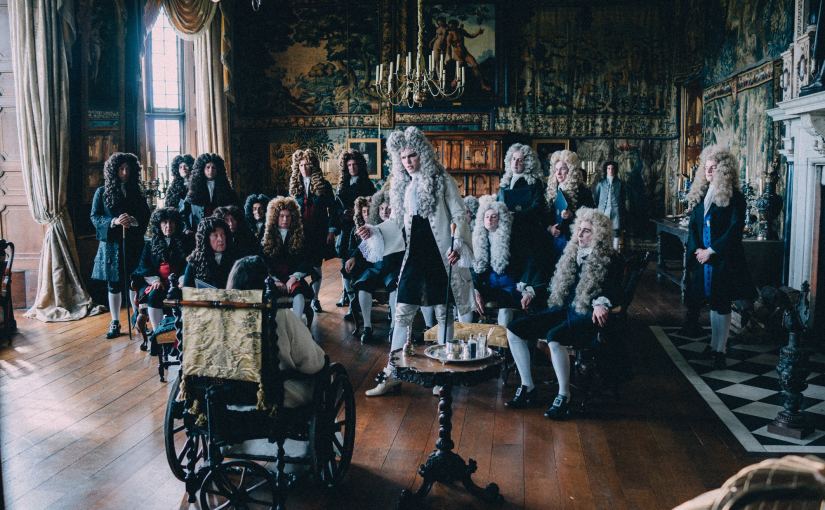
This film focuses on a competition of one-upmanship between two ladies, one a servant named Abigail (Emma Stone); the other a close friend, Lady Sarah (Rachel Weisz) of Queen Anne during 18th Century England. As Queen Anne is frail physically, and often mentally (she insists on keeping 30 rabbits running loose in her bed chamber), Abigail capitalizes on opportunity to win the admiration of the Queen over Lady Sarah, a cruel woman in her own right. The humor is more shocking than overt or witty.

It becomes laughable to witness the shenanigans of the highest of aristocrats from mud baths to duck shooting to naked fruit tossing at one another. Sometimes, you ask why? Then again, it is probably because a lower class, say the majority of the free world, would like to stick it to the upper class and show them as the fools that they are or that we wish them to be. A royal vase is always nearby if a lady feels the need to vomit; not a bucket, a vase.

Olivia Colman is very good as the Queen, seemingly incapable of making decisions and being subtly overruled by the influence that her friend Lady Sarah carries. If the Queen really wants to reduce the taxes imposed to prolong a war with France, Lady Sarah will make certain that just the opposite is done. The Queen will unsurely oblige and back up the message that Sarah makes to the Cabinet. Sarah has no reluctance in abusing and humiliating the servants, the men in the Cabinet or anyone else, including the Queen. She will happily admonish the Queen by criticizing her makeup just as she is to meet with a Russian diplomat, thereby allowing herself to run the meeting while the Queen retreats to her chambers.

Abigail has come from wealth but due to hard times, has become recruited to be a servant destined to take care of menial tasks or be humiliated by being forced to watch an English officer pleasure himself, falling into “mud that stinks,” or taking cruel showers with a rough sponge. An opportunity arises however, when she discovers a natural way to bring relief to the Queen’s frail legs. Soon, Abigail is becoming intimate with the Queen much to the dismay of Sarah and now the cruel games of back and forth begin.

No one is really likable here. It’s a competition in royal politics, and politicians of any nature in any setting are never entirely liked. To hold stature, requires ego. Ego, however, is not a strong enough word for how these three ladies treat each other. The frail Queen is just as guilty. If she feels slighted, she will disregard those that have won her over in prior moments, particularly to her first friend Sarah and later to Abigail. When Sarah goes missing, the Queen declares she better be dead when she eventually begins to worry. If she’s not dead, the Queen will surely slit her throat. Abigail wins the Queen’s affections but will ultimately be used cruelly as well.

Eventually, all of this back and forth has to end of course, and Lanthimos along with screenwriters Deborah Davis and Tony McNamara bring in a sneaky last “stick it to ya” moment.

I’d never seen a film by Yorgos Lanthimos before. I’d heard good things about his other film The Lobster, though. Here, he’s got a camera angle I rarely see in films. There are times when a wide shot of a room, like the Queen’s chambers or outskirts of the palace are shot through the bottom of a glass, where the edges of the caption are curved outward, almost like looking at the film through a view finder or a telescope. Not sure why he opted for this technique. Perhaps it was to up the ante on the strange environment of it all; to offer a discomforting feeling towards watching this community of Establishment behave behind closed doors.

Rachel Weisz and Emma Stone are also very good. A film like this could have played like a bad day time soap opera cat fight. Yet, when you have Academy Award winning actresses like Weisz (The Constant Gardner) and Stone (La La Land), you are watching a period piece that will stand out albeit very strangely.

Yes. Once again, The Favorite is a very strange film. A good film and a weird film that takes some patience and getting used to. Four people walked out of the theatre I was in, but there was still plenty of laughter from the crowd. The best of the year, like most critics claim? Maybe not. Then again, most of the critics’ common choices for best of the year is indicative that 2018 really was not a great year as a whole for movies. I’d argue prior years have offered a better collection of films to treasure, admire, award and salute. In another year, The Favorite would be trumped by many other candidates.

GREEN BOOK

By Marc S. Sanders

The biggest surprise of Green Book is who its director is, the unlikely Peter Farrelly of The Farrelly Brothers, directors of Dumb & Dumber and There’s Something About Mary. Yet, when I reflect on the film it should not be a surprise. The Farrellys are known for raunchy humor, but often it stems from an honest source. When Viggo Mortensen’s character Tony folds an entire pizza pie in half and then scarfs it down whole, that’s a Farrelly touch but likely also what an Italian club bouncer raised in the Bronx would do without any consideration. He’d also win out in hot dog eating contest. Mortensen’s character is a far cry from his Russian Heyman in Eastern Promises or Stryder in The Lord Of the Rings. The pizza and hot dog scenes are great moments in a film weighted down by the Uncle Tom mentality of Deep South USA in 1962. Peter Farrelly needed to direct this film, and it just might be the best picture of the year.

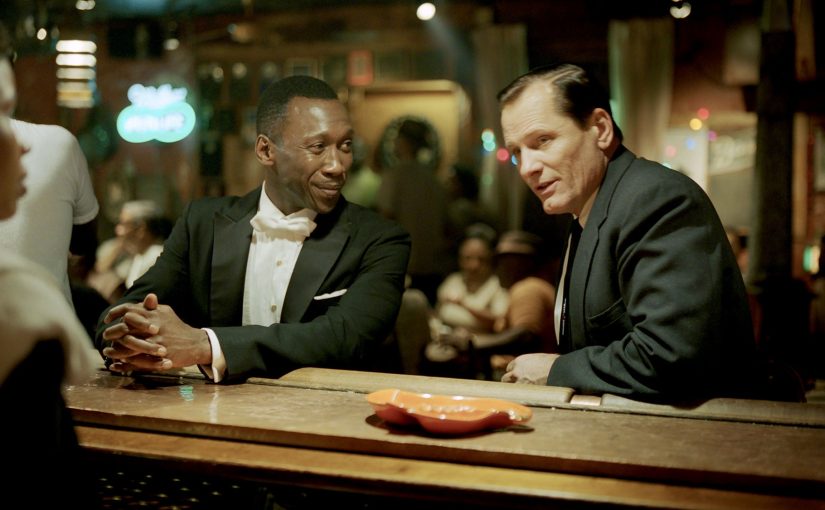
Tony (or “Tony Lip” as he’s known among his peers) is hired by Dr. Don Shirley played with such eloquence by Mahershala Ali. Dr. Shirley is an African American pianist, arguably the best in the world and ready to embark on a tour of the Midwest to Southeast of the country. It’s not that simple however as Dr. Shirley is all too aware of the racial prejudice that will befall him. Tony is hired to be Dr. Shirley’s driver as he has the toughness to look out for Shirley in the event that it is necessary. Sadly, the film shows that Tony is more than necessary.

There’s much comedy here between Ali, playing the well spoken “Felix” role, against Mortensen in the “Oscar” part. Tony and Don are worlds apart having virtually no understanding how the other half lives or what they are forced to compromise with on a daily basis. The hardships that Green Book offers focus more on Dr. Shirley as he is forced into humiliating circumstances where he is offered only an outhouse to use or denial of entry into a dining room. He could be wearing the sharpest of tuxedos, while Tony is a self aware “goombah” slob with no civility and Dr. Shirley remains the one to be overlooked. His value to Deep South America is to play his Steinway piano like meager jester.

There’s much to learn about our country’s mid 20th century history in Green Book. It’s a film I encourage families with pre-teen children to see. Not only will they learn of disillusioned hatred and treatment of black minority, but they will be entertained as well. References to Robert and John Kennedy are presented as well Aretha Franklin, and a Boston Celtics player (Name I cant recall).

The comedy that Farrelly brings keeps the audience engaged. The best dramas possess great comedy like Steel Magnolias, Terms Of Endearment, The Help, and even Kramer vs Kramer. If we can laugh along with our characters, then we will appreciate them that much more when harm and pain strikes. We want to ease their pain and be angry for them when those moments arrive. Their comedy of natural behaviors breeds affection for them. When they are compromised, we cry for them. Farrelly executes this format perfectly.

Mahershala Ali is a stand out here. He is snobbish at times towards the unmannered Tony but he is never deserving of his dismissiveness. He is a victim of the “colored mentality.” If not for the color of his skin, Dr. Shirley would have been regarded by all as a man of integrity; a hero to the American people. Sadly in 1962, many could not see past skin color. Thankfully, a great moment towards the end reminded me that it was in fact many…but not all. Watch the movie, and then tell me if you know what I’m referring to.

Remember, this is probably the best picture of 2018. Bring your children to see Green Book. Keep your children aware.

PARASITE

By Marc S. Sanders

I first discovered director Bong Joon-Ho when I watched his futuristic sci fi adventure Snowpiercer. I loved that film despite how absurd the set up was. Absurdity, though, is a credit to his craft. That’s why his latest film Parasite is a hugely successful interpretation of class warfare within South Korea. It might all appear drastically unlikely. Yet, it’s all absolutely possible when you reflect on the film after you’ve seen it.

Parasite begins almost like a farce and ends in deep, realistic horror that you’d never expect, even after you surpass the films midway surprise.

It’s best I leave much of the film’s details out. The less you know the better. I knew nothing at all about the film beyond the numerous accolades it has received. I was better off for it.

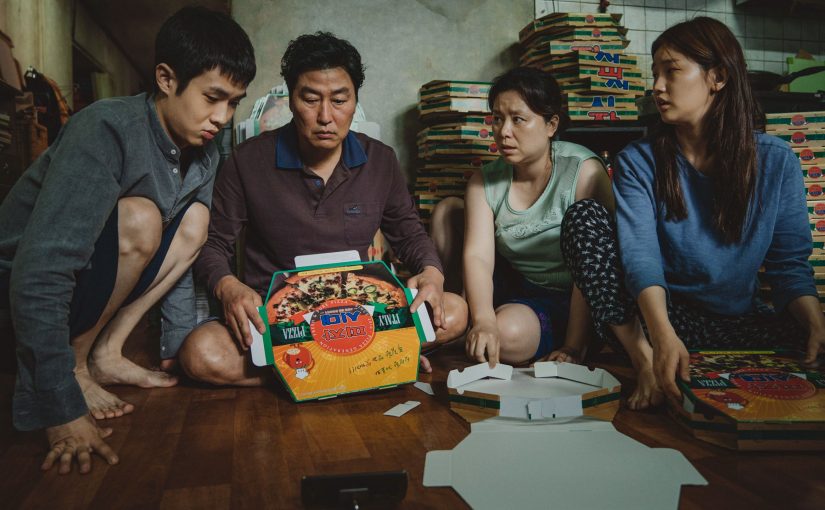
Joon-Ho’s film makes its point quickly that there is always someone better off than us and always someone worse off. (This was a theme carried over from Snowpiercer.). A poor family living off scrap money for folding pizza boxes while living in a cramped, bug ridden basement is still better off than the drunk who pisses on the street, outside their window. Just as an upper class family with all the best things in life are better off than them.

It’s only when this poor family find opportunity to dupe their way into this wealthy home through jobs they are hired for that we eventually see how lighthearted material, compliments of Joon-Ho and his writing collaborator, Jin Wan Han, can convincingly escalate into class warfare politics that even their characters ever hardly acknowledge, or are aware of. Is the wealthy matriarch really aware where her family chauffeur stems from or where he lives? The off putting scent of someone’s presence can quickly turn a tide or an impression.

I might sound vague, but I have no choice. It would be a betrayal to the imagination of the best film of 2019 if I spelled the film out for you.

Simply know that I truly appreciate the symbolic research Parasite presents as it makes note of a Korean child’s fascination with Native Americans, and how their plight parallels the story. Even that drunk taking a piss on someone else’s territory. Even the gift of a stone sculpture told me how one can be crushed or weighted down by his own country.

Parasite begins as one movie and ends as maybe five other different movies. It’s a farce. It’s wry and conveniently ironic; maybe silly at one point. It’s suspenseful and surprising. It’s also shockingly horrific.

I recently declared Clint Eastwood’s film Richard Jewell the best film of year. I stand corrected.

Parasite is the best film of the year.

THELMA & LOUISE

By Marc S. Sanders

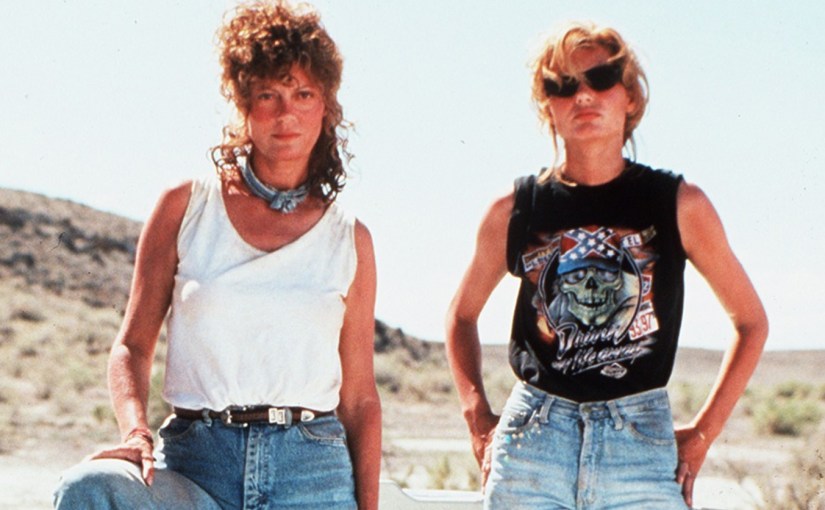
The strength of a good solid picture often depends on a strong cast from the top billing, above the title actors, to the bit supporting players who only have a few minutes of screen time.  Thelma & Louise, directed by Ridley Scott, is that film.  The opening credits of the movie come up in black and white over an out west landscape with an endless dirt road in the center of the screen.  Hans Zimmer’s harmonica and banjo, country sounds build on Scott’s camera work here.  The names of each actor are brought up: Susan Sarandon, Geena Davis, Harvey Keitel, Christopher MacDonald, Michael Madsen, Stephen Tobolowsky, and someone named Brad Pitt. The scene goes to color and then it blacks out and comes up on Louise’s (Sarandon) crowded diner where she waitresses.  Nothing is unfamiliar here.  Yet, it seems a little haunting in a way.  We are about to uncover a history to some common folk who live on the southern bend of America, and we will start in the state of Arkansas.

Louise has made arrangements with her best friend Thelma (Davis) to do a weekend cross country road trip to a cabin in the woods.  This is the southern odd couple.  Louise is always put together, clean and organized.  She’ll check herself in the mirror.  In a crowded ladies room, she’ll check her makeup and tidy her hair while intoxicated patrons are pushing around behind her.  Thelma is scatterbrained.  She’ll bite off a piece of a candy bar, put it back in the freezer and make three more stops back at the freezer for a couple of more bites.  She also will dump a dresser drawer of clothes into a suitcase, taking no time to sort through what she’s packing.

Both women have been treated unfairly by the men in their lives.  Thelma’s husband, Daryl (MacDonald) is a proud white trash carpet sales manager who treats his wife with absolute control, complete disregard and thoughtless disdain.  Louise just can’t even get a hold of her boyfriend Jimmy (Madsen), a musician who can’t commit to anything.  On the first night of their trip, the two ladies hit the road in an iconic 1966 green Ford Thunderbird convertible (one of the greatest, most memorable vehicles in film screen history), they’ll realize there may be worse men than the ones they’ve encountered.  Following an attempted rape, a shooting occurs and the ladies are hitting the road, hoping to make it to Mexico.

Thelma & Louise is at least Ridley Scott’s most sensitive film.  It was not the first or last time he used women as leads in his pictures.  Yet, the film moves symbolically along the stretches of highway and dirt roads as a means to reveal the strength and confidence a woman can have when she escapes the controlling shadow of a man.  At least that’s what I think.  The beginning of Scott’s film, with an Academy Award winning script from Callie Khouri, displays the title characters as weighed down by their past and current lives.  It is only when the two break free (with little options following an unforeseen dilemma) they understand they can be stronger than any man who’s ever dominated them before.  As the road trip moves on, they will encounter more hang ups and they will make mistakes, but by the time the third act comes along Thelma and Louise will sever any restraints that have held them back before.  It is such a gratifying story.

My father encouraged me to go see this movie with him.  It was 1991.  I was graduating high school.  I’d seen trailers for this picture and it was loaded with high energy country music.  I don’t like country music, typically.  In fact, I only can like country music when it is incorporated into a film.  Thelma & Louise is the best example of that feeling.  I hated the title.  Still kind of do.  It doesn’t have the ring of say Starskey & Hutch or Batman & Robin.  However, those are guy pairings.  Thelma & Louise are about two women, and I was never going to forget that.  Once I saw the film, I could not stop thinking about it.  I grew so accustomed to Ridley Scott’s direction and use of cinematography with Adrian Biddle.  The sun on the screen felt hot.  The dirt on the character’s faces and the Thurderbird felt gritty.  The sunburns on Sarandon and Davis felt sore and dry.  The glow of the car’s dashboard light felt bright in my vision. The settings spoke to me.  There’s a great moment where Louise seems to shed her feminine and dainty skin so to speak.  She hands over her jewelry to an old timer sitting on the side of road at an abandoned truck stop.  No words are shared between them.  This guy was born on this spot.  He’s never moved from this spot and Louise will leave her history behind with him.  Later, as the stakes grow, with the FBI and law enforcement closing in on the fugitives, there’s a moment where Thelma tells Louise, that she feels awake; like really awake and alert.  I knew what she was talking about.  I’ve already been on this hike for two hours with these characters, along with the crimes and entanglements they’ve gotten into and the movie has my full attention.  All these years later with repeated viewings, and I still feel that way.  I feel absolutely awake the moment the movie begins.

Khouri supplies her script with a variety of men.  Some are sensitive like the detective played by Keitel who knows that a murder didn’t just happen maliciously.  There’s more to the circumstances at play, and he’s hoping for the best for the ladies.  Some are just procedural like Tobolosky, who doesn’t recognize them as women, only as fugitives. Some are enlightening, yet deceptive like Brad Pitt’s hitch hiking handsome and charming loner that the ladies pick up, and some are simply cruel and vicious, like the rapist or Thelma’s husband, Daryl (MacDonald).  Maybe a trucker along the way is like that as well.  How will Thelma and Louise respond to each of these guys?  As the story contains a gamut of what all these men are, I never regard the picture as a middle finger protest to the male population.  Not at all.  There are men who will give women a chance and will treat them with respect and at least equality, within their surroundings.  Khouri’s script allows time for that.  Sadly though, thirty years later there are still men who will treat women like punching bags with no value and esteem.  It’s wrong.  It’s why the “Me Too” movement had to eventually come into play, long after the release of this picture. 

At the risk of sounding political with potential for debate and preach, watching Thelma & Louise last week, I could not help but think of recent current events that have occurred in mid year 2021.  Bill Cosby was set free from his prison sentence following a technicality that justified his release, but never exonerated him of his crimes of rape.  A former kid actor named Drake Bell was sentenced to three years’ probation for sending sexually explicit materials and texts to an underage girl.  More physical details have been implied on that relationship but Bell was never charged with anything on that topic.  Hence, no jail time.  A Disney channel actor has a warrant out for his arrest following missing a court date with similar charges as Bell.  Following the early rape scene in this film, the attacker is shot and killed in a parking lot.  The ladies consider going to the police and explaining what exactly happened, but they choose to run.  Why?  Because, they know that the police would never believe them.  They were witnessed minutes earlier drinking and partying with this guy in a bar.  Why would anyone believe he would try to rape one of them?  Reader, I know what they mean.  I understand.  Each time I watch the movie, I truly understand.  I know what Thelma and Louise are talking about.  It’s sad.  It’s wrong.  It infuriates me because it’s so unfair.

Callie Khouri and Ridley Scott created an outstanding adventure picture with suspense, and lots of natural humor by means of the outlaw way like Butch Cassidy & The Sundance Kid.  A surprising robbery midway through the picture is hilarious and serves as a legit character change for Thelma.  Davis is great here.  She has scenes of drama and fear throughout the movie, but she also has time for laugh out loud moments.  Alternatively, the Louise character that Sarandon portrays seems to hinge on the dramatic element.  I love a hanging thread that Khouri weaves into the script of an unknown traumatic occurrence that happened in Louise’s past.  I am certain that Sarandon knows what it is even if the audience doesn’t entirely know.  Later in the film, the humor that Louise encounters comes through as Thelma transitions over to a new kind of personality.  These women don’t change individually.  They change together.  It’s a great couple dynamic for sure.

The film is sexy and at times sweet as well.  Yet, it’s also very terrifying, with very real drama.  Thelma & Louise is an important picture to see.  I plan to show it to my teenage daughter when she is a little older.  The rape scene holds me back right now as I find it hard to watch and requires a mature eye.  Nonetheless, I want her to be aware of what is out there.  I want her to know how people, men in particular, respond and treat women.   I want her to be alert and strong when faced with any kind of adversity, deserved or not; justified or not.  I find that some movies offer the best lessons of life about the cruelty and kindness of the world.  Most especially when they are filmed with sensitivity and authenticity, like Schindler’s List or The Shawshank Redemption.  Countless viewings later with thirty years behind it, and I still learn from Thelma & Louise.  It’s another one of my favorite movies.

THE APARTMENT

By Marc S. Sanders

You ever come across a film that begins as sweet screwball, and then segues into serious sensitivity?  If you have, then maybe you have seen Billy Wilder’s classic film The Apartment.  Beyond the film being an Oscar Best Picture winner, Wilder’s film demonstrates that there is a screwball mentality in all of us, but we also know when the party must end.

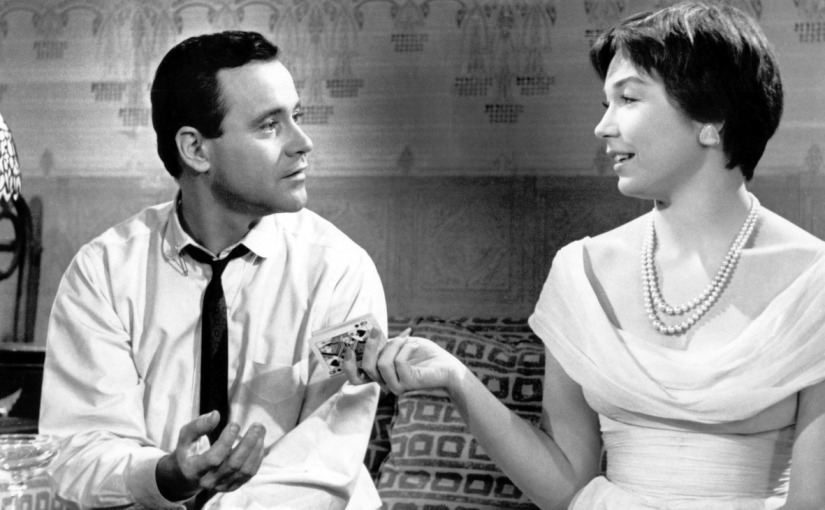
Jack Lemmon plays C.C. Baxter, one of over 31,000 people who works for Consolidated Life in a Manhattan high rise.  He’s a likable fellow who happily does his work with a typewriter amid a sea of other desk jockeys on a floor that seems to expand beyond the architectural limits of the building.  When his eight hour day comes to a close, he’s normally the last one to leave for home because it is likely his apartment located outside of Central Park is occupied with one of the company big wigs that liberally uses his pad to entertain a lady friend beside their respective wives.  Baxter has been relegated to a door mat who holds out hope that any one of these ranking supervisors may one day promote him to an executive position with a private office and a view of the city.  Promise finally opens up when the President of the company, Jeff Sheldrake (Fred MacMurray), summons Baxter to his office to commend him on the positive feedback from the other men in the office and to request some time with the apartment himself.  Sheldrake would like to have some time away from his wife and children to host Fran Kubelik (Shirley MacLaine), the building’s elevator operator.  If Baxter had the availability to his own apartment and a little bit of bravery, he may have asked Fran for an evening out together on another occcasion.

The Apartment begins almost like a farce or sitcom as the revolving door of Baxter’s apartment welcomes one new executive after another.  You may be expecting confusion and misunderstandings that’ll lead to outrageous laughter.  However, poor Baxter is the victim to all of this coming and going by even surrendering his home to Joe Dobisch (Ray Walston) who calls unexpectedly at eleven o’clock at night requesting the place for an hour.  Baxter takes shelter on a park bench in the December cold. The humor of this arrangement is not so funny any longer.  After Sheldrake’s regard for Fran is more apparent, then it’s more clear that these characters are not spawned from the happy home life scenarios of 1950’s television programming.  Sheldrake is only charming to an adorably likable woman like Fran for as long as he cares.  Some might say he’s not terribly cold hearted though.  After all, though he forgets to shop for a Christmas gift for Fran, he offers her a hundred dollar bill from his wallet instead.  Up until this midway point, Shirley Maclaine has been so good at maintaining a cheerful disposition that suddenly her self worth seems a whole lot less than a hundred dollars following Sheldrake’s latest disregard.  Surprisingly, Fran overdoses on a bottle of sleeping pills.  When Baxter discovers her in his bed, he races to revive her with the aid of a doctor neighbor.  Baxter does not give up on helping Sheldrake make this right, while tending to Fran’s recovery on Christmas Eve.  Yet for Sheldrake, this is all an inconvenience and now without even looking for a better way to live, Baxter finds an opportunity to allow his own personal strength to come through against the executives at the office, as well as Mr. Sheldrake, and most importantly with the woman he cares for, Fran.

Jack Lemmon has a energetic method to his performance, as I find he does with most of the roles in his career.  He plays men who never break to sit and breathe.  They are always on the go.  They almost never sleep.  So, his fast paced delivery and flirtation with Shirley MacLaine let Wilder’s film perform at a fast pace.  The range of both Lemmon and MacLaine really work for The Apartment, because they can be naturally funny and intensely serious when the moment calls for it.  Lemmon can sell me as a guy who will use a tennis racket to strain his spaghetti while at the same time standing up for his convictions when life can not allow humor for a moment.  MacLaine can portray a woman with a menial job like an elevator operator and yet still be considered valued and recognized as genuinely hurt when disregarded.  For Fred MacMurray, I think it’s fair to say he actually makes for an effective villain, someone you love to hate, with his portrayal here.  I knew of MacMurray with his television program My Three Sons before I ever saw The Apartment.  What a departure the two roles are.  Here, he is a charming fellow on the outside with a hollow mentality inside.  He’s a man who only cares for his immediate needs.  He can not be inconvenienced with someone else’s feelings whether it is Baxter’s inconvenience or Fran’s despair.  Nothing else matters.  No one else matters.

The film may be called The Apartment, but office politics seems more at play here. Billy Wilder’s film is surprising but it’s honest too.  I doubt many of us would ever surrender our own home night after night to the more powerful and influential.  However, many of us, with a drive to climb a corporate ladder likely have compromised our ideals to get to a higher plateau at one time or another.  Personally, I have to shamefully admit that I have committed such an act.  The Apartment questions when enough is enough.  What’s special about Wilder’s film is that C.C. Baxter must discover if he lives to work or works to live.  

I, TONYA

By Marc S. Sanders

The will to commit wrongdoing must stem from somewhere; an outside influence or perhaps a genetic makeup, or both.  I think I, Tonya suggests it’s central character suffered under the former possibility. Outsiders put former Olympic figure skater Tonya Harding where she is today with a reputation forever scrutinized and forever tarnished.

Margot Robbie was unjustly denied of the 2017 Academy Award that went to a been there, done that Frances McDormand for the horrible Three Billboards Outside Ebbing, Missouri.

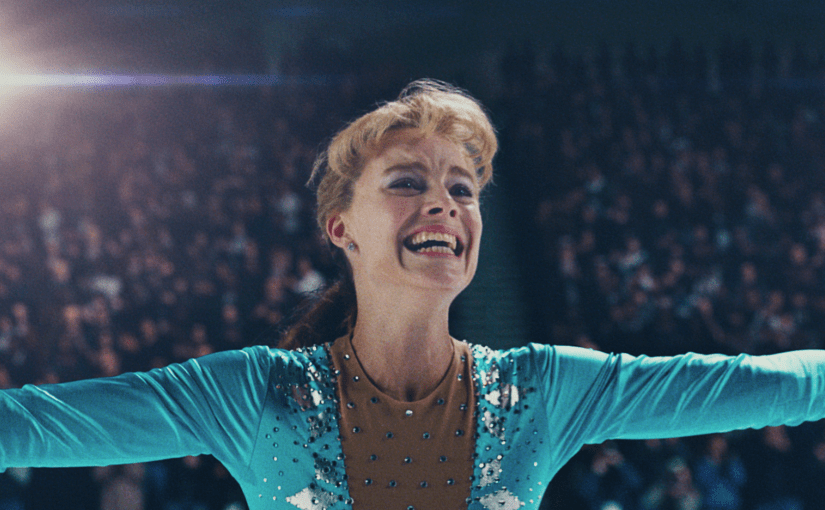
Margot Robbie is one of the most beautiful and talented actresses working today. This film puts her into the stratosphere.  Robbie is unrecognizable beneath the punishing white trash persona of the infamous Tonya Harding.  She is unrecognizable in caked on makeup,  awful periodic perm haircuts, chain smoking, excess drinking and terrible dietary habits that include a shameless plug for Dove chocolate bars.  

Harding is forever notoriously linked to the knee bash heard round the world victimizing her Olympic competition, Nancy Kerrigan.  Margot Robbie does not hold back in displaying Harding’s lack of class and elegance expected in the sport of women’s figure skating.  It’s what Tonya Harding lacks that blocks her from the fame and success expected to come with being a champion athlete. Robbie is fantastic about surrendering her character’s talents for short tempered flare ups, crass behavior and a filthy mouth.  Her facial expressions are shocking.  Stretched fake, Cheshire Cat grins with bulging eyes pull at the pressure Tonya suffered under a hateful mother’s thumb, and an equally abhorrent, stupid husband.  She is forever naïve to how the judges never put her above the competition in points.  I mean this is the only woman to ever successfully accomplish the triple axle!!! 

Equally astonishing is Allison Janey as Tonya’s mother LaVona Harding, an incredibly cruel woman hell bent on making sure Tonya skates for the sole opportunity to endlessly torment her only daughter physically and, even worse, mentally.  Janey joins the exclusive club of cinematic great villains.  This is an unsympathetic woman with no drive to be better at anything except increasing her abuse upon Tonya.  It’s a shocking performance.  Janey appears so comfortable in the cruel insults, offensive language, and non stop smoking all the while her pet parrot sits atop her shoulder.  LaVona is uncompromising in how she punches, throws plates or even tosses a steak knife at her hated daughter.  What a horrible person, and what an amazing performance. You’ll be hard pressed to find a better antagonist in a film these days.

Sebastian Stan chose wisely to accept the role of Jeff Galooley.  It’s a great departure from the Marvel superhero films.  Jeff is a dumb, needy, abusive husband to Tonya; the man who admitted to being the orchestrator of the knee bash (though the movie will tell you it’s not that simply explained).  Stan should have been nominated at least.  It’s not easy to play such a dumb, real life moron, and he excels in the role. What an asshole Jeff Galooley was; what a dumb asshole actually.   He, along with his conspirators, have great chemistry in idiotic planning.  Stan really shows his best moments when he’s being reckless with his rag doll wife, Tonya.   The physical domestic fights are so well edited amid rock ballads from Fleetwood Mac, Laura Brannigan, ZZ Top, and Supertramp. 

Director Craig Gillespie follows the breakneck formula of Martin Scorsese with character interviews, racing steady cams that convinced me that Robbie is as talented a skater herself as Harding was.  She has so many levels of erratic fear, insecurity and tempers.  The method of filmmaking here seems like a slight nod to Raging Bull.  Gillespie takes advantage of all that Robbie brings to the camera.  It’s a perfect marriage of director and actor; as perfect as DeNiro & Scorsese or DiCaprio & Scorsese.  I hope Robbie & Gillespie will be teaming up again soon.

Once again, I have to ask.  How in the hell does that piece of celluloid waste called Three Billboards Outside Ebbing, Missouri get a Best Picture nomination when as far as I’m concerned, I, Tonya clearly stands much higher above it in terms of craft, writing, performance and filmmaking?????  It astounds me.

I, Tonya is without a doubt one of the ten best films of 2017.  I can’t wait to see it again.  It’s unbelievably good.  

Footnote: Do I think any differently or sympathize with Tonya Harding now that I’ve seen this depiction? I don’t think so.  She is clearly a woman who was never given a fair chance at a happy life. She was destructive to herself as much as those that surrounded her.  Yet, she had to also accept responsibility for her actions and behavior.  Any of this could have gone differently.  If only these people were not so stupid or irresponsible.  These people, Tonya Harding included, all had choices to make.  They could have chosen a different option time and again.  Despite some of the positions Craig Gillispie’s film takes, I truly believe Tonya Harding could have opted for a different path while combating her inner and outer demons.  

TERMS OF ENDEARMENT

By Marc S. Sanders

Acclaimed television writer James L Brooks’ first feature film was the 1983 Best Picture Winner Terms of Endearment.  The movie succeeds in more ways than one because of its varied relationships among the characters.  You have Aurora Greenway (Shirley MacLaine) and her daughter Emma Greenway-Horton (Debra Winger).  There’s Emma and her husband Flap Horton (Jeff Daniels).  There’s Aurora and Flap, and then there is Aurora and her neighbor Garrett Breedlove (Jack Nicholson).  Sounds like a lot to take in for a two hour picture, and yet Brooks manages to adapt a script from Larry McMurtry’s novel that smoothly covers realistic depth and dimension among these characters, and how they connect with one another.  Brooks is at least an incredibly efficient writer/director.  Honestly, I’m not complimenting him nearly enough.

Shirley MacLaine provides one of the best female performances to ever grace the silver screen.  She doesn’t have to utter a word of dialogue to say so much about how Aurora feels.  One of her greatest facial expressions is when she is addressed by her grandson as “Grandma!”  This moment is so utterly hilarious that the studio selected it to close out the original theatrical trailer.  If anything is going to get you in the seat at the theatre it’s this moment.  Aurora is a widow who can be difficult to please, judgmental and always conscious of her part in the world-even while she is hosting multiple gentlemen suitors in her Houston, Texas home.  This character is so powerful that it is hard to understand why Hollywood really never followed suit with presenting more films focused on the middle age woman or man.  There are still interesting things to be found in being a widow and dealing with ageism, motherhood and a resurrection of sexuality.  Think about The Golden Girls which dominated television sets on Saturday nights for most of the decade.

Aurora disapproves of Emma marrying Flap.  Flap has no imagination or drive and is as devoid of affection as his name suggests.  Best he can do for Emma and their three children is find whatever college professor job he can muster and uproot his family from one mid-western state to another.  Emma knows of her mother’s disdain for Flap, and can’t disagree with her.  She knows Flap is a loser, but if it means aggravating her mother then it is worth it at least to marry him.  Early in the film it amuses Emma to frustrate her mother a little more and a little more.  Contrary to Aurora’s instincts, Emma is naively unaware that life settles in soon enough and the happy nuptials fade away.

Still, Aurora and Emma have a strong mother/daughter relationship where numerous phone calls each day happen between them.  These conversations consist of Emma reluctantly telling her mother that she may be pregnant, yet again, or that Aurora is proud to let her guard down and approach the boorish, drinking next door neighbor astronaut, Garrett, played with a devil may care seductiveness from Jack Nicholson.  Aurora’s serene peacefulness in her beautiful backyard garden and home is always disrupted by Garrett’s loud bellow before diving into his swimming pool.  Still, she can’t help but be attracted to him while putting on a façade of disapproval in his presence.  The first lunch date that Aurora and Garrett share must be one of the best dates ever depicted on film.  The scene might have been written and staged by Brooks, but it is thankfully hijacked by Nicholson and MacLaine.  One of the funniest moments to ever come out of 1980s cinema for sure.  There’s much reason that MacLaine won Best Actress and Nicholson won Best Supporting Actor.  These actors easily stage a scene of realistic comedic chemistry while later expressing deep rooted drama and affection with one another.  Not easy to do all in one film.

Brooks masterfully writes these characters with such authenticity that you find yourself legitimately laughing at a scene or a piece of dialogue, while the person sitting next to you might embrace the dramatic element of the very same moment.  Both responses to random moments in Terms Of Endearment allow varied reactions like that.  When Emma suspects Flap of committing adultery, pay attention to the dialogue and the performance from Winger and Daniels.  Emma allows Flap to dodge a lie he’s about to tell by warning him that he may have just lost his senses, but if he continues down a wrong path, then he will end up worth less than he already is.  He doesn’t fight her on that observation.  Hard to explain here but listen to the vocabulary Brooks applies to Emma’s dialogue and watch how Winger traps Daniels.  You may nod with a smirk, or you may feel frightened for Emma and her marriage. 

I always say Terms Of Endearment is a comedy first and a drama second.  The film steers towards a frightening fate for the Aurora and Emma.  However, before that third act sequence there is so much to treasure, love and laugh at in the film.  When a cloud of imminent loss feels like it may approach, that is when the dramatic elements step forward.  To truly feel loss, you had to treasure wonderful moments with a loved one or a friend.  You had to value something important in your heart and soul to feel so terribly frightened and mad and hysterical when days might seemingly appear numbered.  James L Brooks and Larry McMurtry remind us of that.  Every person on the planet is destined for this feeling at one point or another.  What happens when the inevitable arrives is what sustains Terms Of Endearment to it’s satisfying end.  A character may appear on a hotel staircase to reconnect with support.  A hug goes a little longer than expected, and for the first time the one who normally lets go first actually tries to keep the moment frozen in time.  A gift from long ago is recovered to touch someone emotionally.  Brooks includes all of these moments in his film and that’s what I embrace most importantly.  Cinematically speaking, these points in the film are heightened by a memorable soundtrack of quirkiness and passage of life from composer Michael Gore.  His music is so effective that it has been used countless times over to enhance trailers for other films marketed at audiences that this picture was catered for.

Yes, after numerous viewings, Terms Of Endearment never fails to me put me in tears.  Like ugly crying!  I prefer to watch it alone actually, because I connect with the characters differently than most people I know, including my wife.  It’s a very personal film for me.  It reminds me of loss that I have felt and experienced.  More importantly though, it reminds me of all I’ve had, and all I continue to hold on to.  Terms Of Endearment is one of my favorite films.