AN EDUCATION (2009, Great Britain)

by Miguel E. Rodriguez

Director: Lone Scherfig
Cast: Peter Sarsgaard, Alfred Molina, Rosamund Pike, Dominic Cooper, Olivia Williams, Emma Thompson, Carey Mulligan
My Rating: 9/10
Rotten Tomatometer: 93% Certified Fresh

PLOT: A coming-of-age story about a teenage girl in 1960s suburban London, and how her life changes with the arrival of a playboy nearly twice her age.


Lone Scherfig’s An Education, written by famed British author/screenwriter Nick Hornby, is yet another example of how my preconceived notions of a film are often very wrong.  Based on the plot description above, I assumed I was in for what I call a “spinach movie”: something that’s good for you, but not a lot of fun to eat.  I thought the film would be dark and deep, delving into unsavory territory involving a predatory older man putting the make on an underage girl.  Lessons would be learned, but it would be an uncomfortable watch.

For about the first half of the film, I felt I was mostly right.  It’s 1962 in England, and Jenny (Carey Mulligan in her first major role) is a sixteen-year-old student who is studying hard to pass her A-levels – I think I got that right – with flying colors, which she hopes will give a favorable impression to the admissions board at Oxford.  Her father (Alfred Molina) supports her plans…or rather, he supports HIS plans for her.  He gives several impassioned speeches about the importance of getting a higher education, making sacrifices, dropping her cello hobby, etcetera, all in the service of getting those Oxford-level grades.

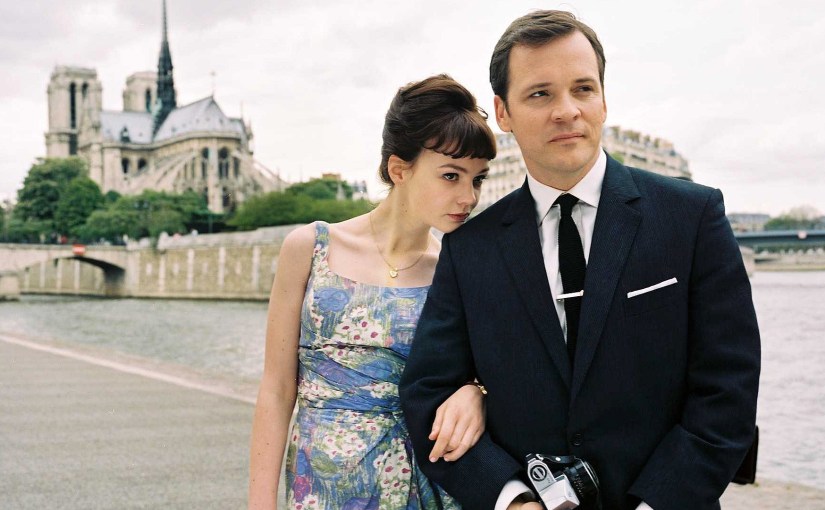
One day, Jenny gets caught in the rain and is rescued by David (Peter Sarsgaard), a charming older man driving an irresistible maroon sportscar.  He isn’t just charming, he’s effortlessly charming, turning the exact right phrases to put Jenny at ease.  The morning after he drives her home, he leaves a bouquet of flowers at her doorstep.  He bumps into her again quite by accident, or “accident”, and asks her on a date for dinner and a concert.  For this, he must convince Jenny’s very suspicious father…which he does with silver-tongued ease.

Jenny is caught up in this whirlwind of attention from a much older man who is clearly well off with sophisticated friends, Danny and Helen (Dominic Cooper and Rosamund Pike).  Jenny’s father, Jack (Alfred Molina), is torn between his protective instincts and the idea that Jenny might have met a man who could make her dreams of Oxford…moot.  Why worry about the expense of university when a rich husband can keep his daughter well cared for?

Despite the father’s (and my own) forebodings, Jenny is genuinely enjoying herself.  She loves music, so David takes her to a concert.  She loves art, so David takes her to an art auction.  She loves learning and speaking French, so David takes her to Paris.  His method of getting Jenny’s father to agree to this overnight trip is simultaneously simple and diabolical.  Jenny is having fun for what seems to be the first time in her life.

She’s having so much fun that, for a while, I wasn’t quite sure what the movie was advocating.  Is it supporting this relationship?  She has a very frank conversation with David regarding her wish to remain a virgin until her seventeenth birthday.  David agrees…then, in one of the ballsiest (and creepiest) moves I’ve ever seen from a guy in a movie, he asks her to give him a “peek.”  What is going on?!?  This guy is clearly a cad.  But he’s so nice to her…and she’s having fun…!

Put it this way: I was prepared to throw something at the television by this point.

Around the midway point, though, the movie finally makes its true purpose known.  It’s not about judging Jenny, which is too easy to do, or even judging David, which is ridiculously easy to do.  The film is based on a memoir by a British journalist named Lynn Barber, which made some of the revelations about David’s past and how he makes a living easier to swallow, knowing that it’s based at least partially on fact.  It also made all the “icky” parts in the first half of the film a little more palatable.  When you realize that someone really went through this, it puts everything in a different light.  I had the same epiphany during Schindler’s List; the concept that this all actually happened brought a deeper level to the viewing experience that I hadn’t expected.  (It’s also what made Fargo so much more entertaining than your average crime film, but that’s another story…)

Anyway, this happens and that happens, and before you know it, Jenny has made the kinds of decisions that would make grown men and women tremble with anxiety. The movie’s title takes on a whole new meaning.  It’s not just about Oxford anymore.  It’s about studying at the University of Life, where the only way to know if you passed your test is if you’re still willing to take the next one, and the next, and the next.  Even David learns a thing or two.  Maybe.  It’s a little inconclusive when it comes to that guy.  What a jackass.

So…is it any good?  Yes, it is.  It’s got brilliant performances working from a Nick Hornby script that switches easily among pathos and embarrassment humor (witness the predicament of Jenny’s other suitor at her 17th birthday party) and even a little suspense.  I tend to think of Hornby as Britain’s answer to Cameron Crowe.  Hornby’s books and screenplays walk that same tightrope time after time (About a Boy, High Fidelity, the original Fever Pitch – soccer, not baseball), just like Crowe’s best work (Jerry Maguire, Say Anything, Almost Famous, which I don’t particularly love, but I do acknowledge its craftsmanship).  By the time I got to the end of An Education, the double- or triple-meaning of the title is fully realized.  Everyone has learned something.  Not all of it has been good.  It doesn’t all tickle.  But, except possibly for David, everyone has taken what they’ve learned, good or bad, and put it to good use.  That’s a satisfying ending.

[Side note: after this movie was over, I found myself thinking of Licorice Pizza and its plot regarding an underage boy and an adult woman. I can imagine my friend and partner-in-crime reading my favorable review above and asking me, “If you like this movie, how can you not like Licorice Pizza?” (He really loved Licorice Pizza.) The difference is that, by the time An Education is over, the characters have EVOLVED. Discuss.]

CODA

By Marc S. Sanders

CODA is a film directed by Sian Heder that focuses on a New England fisherman family known as the Rossis.  There is Frank, the dad, Jacki, the mom, Leo, the son, and then there is Ruby, the daughter.  Frank, Jacki and Leo are deaf. Ruby is not.  Ruby is the family interpreter by default.  She’s content with holding the title, but as she is close to finishing high school, it’s seeming less and less fair.  That’s the conflict at play with CODA.  At times, it’ll make you laugh hysterically and it’ll also make you cry for multiple reasons.  You’ll cry as Ruby breaks free from her reserved lifestyle and shyness, and you’ll also cry because Ruby seems likely to miss out on a lifetime of opportunity with her god given talent of singing.

Ruby is portrayed by Emilia Jones.  Watch out for this actor.  She will be the next big sensation.  It amazes me that she was not nominated for an Academy Award.  Jones operates on so many levels in this film.  She learned fluent sign language for the role, in addition to singing gorgeous harmonies, and operating a fishing boat.  Oh yeah.  She has to act the role too, and Ruby Rossi has got to be one of the best protagonists of the last 10 years in film.  She’s an absolute hero. 

Ruby follows a rigid routine of waking up at 3:00am every day.  She goes out on the boat with Frank and Leo to bring in fish to sell on the dock later in the day.  It’s practically necessary to have her there as the one hearing person out in the open sea.  From there, she races her bike over to school.  She’s only adding to her plate when she opts to join the school choir to be close to a school crush named Miles (Ferdia Walsh-Peelo).  

The problem is that Ruby is incredibly shy.  So, when the music teacher known as Mr. V (a brilliantly energetic Lonnie Farmer) requests she sing solo following a long line up of students ahead of her, she retreats in fear.  Mr. V knows there’s something there though, and he gradually uncovers the singing voice Ruby never realized she had.  Suddenly, he’s proposing the idea of preparing an audition where she could attend the Berklee College of Music.  Ruby is reluctant at first, but Mr. V instills confidence in her talents.  However, he doesn’t stand for her tardiness at private rehearsals either.  He demands she takes this seriously, even if she has to tend to her family.  He’ll also make her tough, not willing to let her surrender to those that tease and bully her at school.  I swear that Lonnie Farmer must be a music teacher on the side. What an inspiring individual he portrays.  He’s hilariously intimidating in his classroom, but loved by his students in this film.  He should have gotten an Oscar nomination as well, and he ranks up there with other celebrated teacher characters in film history.  Completely unforgettable.

The Rossis are in the middle of a crisis.  The dock where they keep their boat and sell their fish supply is charging outrageous fees to all of the fisherman.  What makes it harder for this family though is the communication barriers they encounter.  Frank (Troy Kotsur) relies on Ruby to speak on his behalf, even cursing them out when necessary.  In response to the challenge, Jacki (Marlee Matlin) starts to sell their fish privately to circumvent around the overbearing-imposed taxes.  Yet, she also depends on Ruby to speak on her behalf during a news interview or with customers.  On the other hand, Leo (Daniel Durant) insists that Ruby should follow her own path.  Leo reminds everyone that just because he’s deaf doesn’t mean he’s dumb and he can handle the business.

CODA is a coming-of-age picture.  While the title may stand for “child of deaf adults,” Heder’s film focuses further away from deafness being an obstacle as the film moves along.  It lends more attention to Ruby’s dilemma of not being able to be in three places at once.  She’s only living a different life than that of her family, and that’s a problem I’d argue happens for most of us.  Eventually, we all have to leave our nests   

It becomes problematic when she has to deal with doctor visits on behalf of her parents where she embarrassingly has to explain to them the doctor says not have sex in order to heal their jock itch.  Frank and Jacki have sex in the house, completely unaware of how loud they are while Miles is over to practice singing.  Frank loves to play gangster rap at a high volume to feel the beat of the bass.  Imagine how that looks for Ruby when he’s picking her up at school.  These issues are as inconvenient as any family makes someone feel.  Frank, Jacki, Leo and Ruby enjoy their lives.  It’s just hard at times to enjoy their lives together.  Isn’t that the case for any of us?

CODA is so aware of its subjects on singing, deafness, sign language, family, fishing and first love.  Ruby has a multitude of relationships that are explored.  She has to deal with her affections towards Miles.  She has her mentor, Mr. V, to answer to.  Ruby has to understand that Leo can depend on himself, and she has to balance what is best for her while questioning how much she can give of herself to her mom and dad.  What wonderful storytelling conflicts there are to explore here!  Sian Heder’s Oscar nominated script allows enough time in just under two hours to meet the demands of each angle presented. 

I’m always pointing out how much I love random singing or dancing that appears in non-musical films.  CODA is another perfect example.  Ironically, I just read that the film is actually going to be adapted into a stage musical.  It has to happen.  It’ll break through so many glass ceilings on the limitations people have presumed comes with deafness.  Deafness is never a limitation. In the film, however, each time Ruby sings either solo or as a duet with Miles, your pulse will race.  Emilia Jones has vocals that lift your spirits and make you appreciate the gift of actually being able to listen and hear.  So many of us take that for granted.  Sian Heder’s film will remind you not to.  Just watching Frank place his palms on his daughter’s throat while she sings to him, reminds you that the gift of sound, whether you hear it or not, is a beautiful thing.  Frank doesn’t hear the song.  Rather, he feels the vibration of song.

CODA is one of the best pictures of 2021.  When you watch CODA, it’s simply easy to just embrace CODA.

THE DARJEELING LIMITED (2007)

by Miguel E. Rodriguez

Director: Wes Anderson
Cast: Owen Wilson, Adrien Brody, Jason Schwartzman, Amara Karan
My Rating: 8/10
Rotten Tomatometer: 69%

PLOT: A year after their father’s funeral, three brothers travel across India by train in an attempt to bond with each other.


In one of the bonus features on the Criterion Blu-ray for Wes Anderson’s charming The Darjeeling Limited, film critic Matt Zoller Seitz compares it to Stanley Kubrick’s 2001: A Space Odyssey because (I’m paraphrasing here) it is the perfect distillation of the director’s method, mood, and style.  I would reserve that distinction for either The Royal Tenenbaums or The Grand Budapest Hotel, myself, but The Darjeeling Limited certainly does capture everything that is typical of a Wes Anderson film: charm, whimsy, troubled souls, a quest of some kind, attention-grabbing camera moves, frequent slo-mo (but not too much), cameos, light and dark material jockeying for position, and a denouement that may signal the end of the film but certainly not the final arc of the main characters.

Meet the Whitman brothers: Francis (Owen Wilson), Peter (Adrien Brody), and Jack (Jason Schwartzman).  A year ago, their father died, and for the first time since that day, they’re about to meet each other and speak to other on board The Darjeeling Limited, a train that will take them across India on a spiritual journey.  Francis, the eldest, is the eager organizer of this little pilgrimage, providing everyone with laminated daily itineraries that are produced by Brendan, his personal assistant who is also travelling in a separate train car.  Francis will spend much of the film wearing bandages on his head and face that make him look as if he lost a fight with a honey badger.  What caused these injuries is not for me to say.

The ostensible reason for this journey is spiritual awakening and reconnecting with each other.  “I want us to become brothers again like we used to be and for us to find ourselves and bond with each other,” says Francis.  Peter and Jack are skeptical and not exactly psyched for this little trip, each for their own reasons.  Peter has a wife back home, 7-and-a-half months pregnant, who has no idea he’s in India.  Jack, a writer, has broken up with his girlfriend, but he obsessively checks her voicemails remotely because he still has the code to her answering machine.  (Hey, this was made in 2007 when you could still do that.)  He has his own return ticket in case he wants to leave the trip early.  Of course, he’ll find that difficult without his passport, which Francis has confiscated.  “For safety,” he argues.  Yeah, right.

There is an ulterior motive for the trip, having to do with who did and didn’t attend their father’s funeral, but ultimately the ins and outs of the characters, while engaging, kind of take a back seat to the trademark Wes Anderson visual style.  This is not a bad thing.  I am not a fan of Anderson’s first film, Bottle Rocket, because I felt it was all posturing with no meat to the story.  However, with each successive film of his, I become more and more endeared and captivated with his trademarks, especially when he uses it to tell stories that I would never have thought would “mesh” with his style.

For example, near the halfway point of the film, an extremely unexpected crisis occurs.  Because the movie has been happy and bouncy and witty up to now, it comes completely out of left field.  But remarkably, in the middle of this action, Anderson’s camera remains as “Anderson-esque” as ever, still performing quick pans and push-ins and keeping me involved in the story.  This crisis might have felt contrived in another film, a plot device to inject some needed drama into the story.  Not here.  Anderson’s storytelling methods made the event feel as random as anything life might throw at us on any given day: the death of a parent, the birth of a child, a snake getting loose in your train compartment, etcetera.

With one or two obvious exceptions (I think), the entire film was shot in India.  The trusty IMDb trivia page informs me the train scenes themselves were filmed inside a moving train travelling from Jodhpur to Jaisalmer.  The beautiful Indian locations are a major feature of the film.  They visit temples, marketplaces, a monastery, and hilltops overlooking vast Indian vistas.

And all the while, Francis, Jack, and Peter struggle to come to grips with their differences and their brotherhood.  “I wonder if the three of us would’ve been friends in real life,” Jack asks at one point.  Great question.  Given what we see in the film, it’s sometimes hard to believe they ever loved each other.  At one point, Francis and Peter get into a wrestling match and Jack has to step in: “I love you, but I’m gonna mace you in the face!”  That’s real love right there.  Right?  I guess…

I’ve heard that if you’re ever not sure what a book or a movie is about, just look at how a character has changed at the end of the story as opposed to what they were like at the beginning.  In The Darjeeling Limited, that’s not so easy to pin down.  I can see that Francis has grown a bit (he eventually relinquishes his brothers’ passports).  But when it comes to Jack and Peter…I’m not sure much has changed with them at all.  Does that make this Francis’s movie through and through?

I’m not sure it matters.  I mean, yes, the story is fun to watch, and I wanted to see where this journey would lead each one of the three brothers.  But for me, the element, or factor, or whatever, that makes The Darjeeling Limited so fun to watch is the directorial style of Wes Anderson.  In this film, as in so many of his films, it’s not about the destination.  It’s about the journey.

[Trivia note: the Criterion Blu-ray also contains a short film called Hotel Chevalier which is intended as a kind of prologue to The Darjeeling Limited.  Don’t make the mistake I did…if you get the Blu-ray, be sure to watch the movie with the prologue.  Don’t wait until after watching the main feature.]

[Super-nerdy trivia note: every musical cue in the film was cribbed from the early films of James Ivory and Satyajit Ray; Wes Anderson wanted to pay tribute to the filmmakers who influenced so much of his style.]

BOOGIE NIGHTS

By Marc S. Sanders

Boogie Nights was director Paul Thomas Anderson’s second feature following a very different and very quiet film debut with the gambling addiction piece Hard Eight.

Heck, it’s fair to say all of Paul’s films are very different; here is the seediness of porn while later in his career he will focus on the ruthlessness of a wealthy and angry oil man and then an obsessed dressmaker devoid of care for the models who parade his accomplishments. (See There Will Be Blood and Phantom Thread.). Paul was definitely striving for recognition with his familial depiction of life in the California pornographic film industry.

What I’ve always liked about Boogie Nights was Anderson’s intent to show the naive innocence of this large cast of characters. Filming blatantly oblivious awful porn scenarios can still be regarded as very proud efforts by its talent.

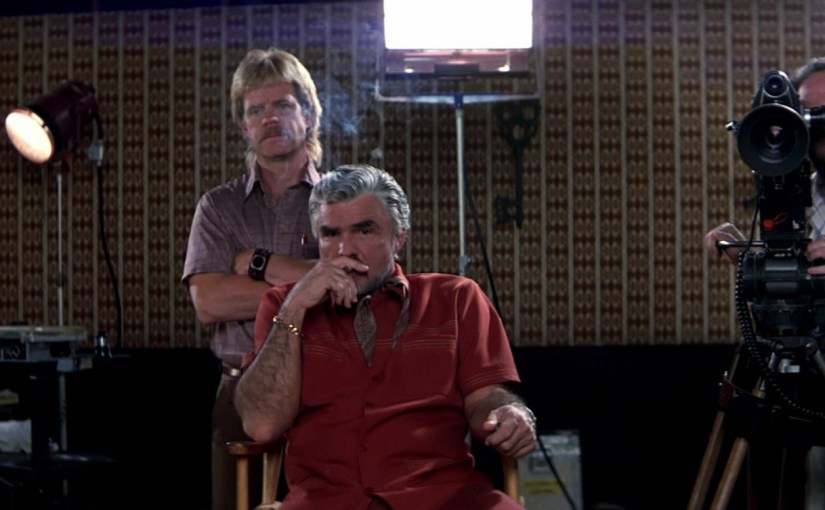
The main character is Eddie Adams (aka the amazing Dirk Diggler) played with macho pathos by Mark Wahlberg. It’ll likely be the best role of Wahlberg’s entire career. Dirk is proud of his natural talent in front of the camera. He’s even more proud of what God has gifted him. Don Cheadle is another porn star named Buck. He’s also proud of his accomplishments and simply a kind fellow looking to make country cowboy a trendy look for a black man while selling the “Hi-est Fidelity” in stereo equipment on the side. Julianne Moore is Amber Waves, the maternal porn mom of the bunch; very affectionate, very comforting and very reassuring when Dirk shoots his first porn scene. The one individual who really holds all of these misfits together is Burt Reynolds as Jack Horner, the porn film director. He’s the paternal one who believes in his artistic merits of shooting porn but with a story, and only with the integrity of film, and never the cheapness of videotape. So, Jack is like any artist who insists on a certain type of canvas. It might be smut, but he has principles, and he has pride.

Anderson is wise in how he divides up the developments. The film begins in the late 1970s during evening night life and decadence and everything seems fine and innocent and right despite the endless debauchery of reckless sex and drug use on a Disco backdrop. Wahlberg’s character is welcomed lovingly into this world, and nothing appears wrong. It all seems to stay that way for Dirk until New Year’s Eve, 1979. The 80s begin with a gunshot and then Anderson’s cast must pay for the revelry of their sins. A great moment presented on this night is where Amber Waves introduces Dirk to cocaine. Dirk has been thriving, making money, developing a following and now it is jeopardized in one moment thanks to his naivety. Julianne Moore is superb in this particular scene against Wahlberg. She’s the mentor with the peer pressure to pass on her high and keep it running.

Drug addiction, violence, sexual abuse and even changes in pop culture lead to hard times for these likable people.

It’s a hard life. It’s a complicated life. Yet it’s not all necessarily illegal. Morally, it might appear wrong, but it’s a life nonetheless.

Anderson was wise to use (at the time, relatively new) filming techniques of Martin Scorsese with rocking period music and fast edits along with savored moments of great steady cam work. One long cut especially works when the film first begins on the streets of Reseda and on into a crowded night club. This industry doesn’t sleep. So, neither will the camera that follows it. The music must also be celebrated. I do not listen to Night Ranger’s Sister Christian without thinking of firecrackers and a dangerously drug addled Alfred Molina playing Russian roulette. Though I know which came first, I also wonder if Three Dog Night’s Momma Told Me Not To Come and Spill The Wine by Eric Burton & War was written to enhance the celebratory introduction for Dirk when he attends his first party at Jack’s house. It’s another great steady cam moment from a driveway, followed by steps in and out of Jack’s house to simply a bikinied girl’s dive in the swimming pool. As a viewer I was absorbed in the California haze. Superior camera work here.

The cast of unknowns at the time were a blessing to this film. Anderson writes each person with care and attention and dimension. They have lives outside of this world like Amber’s child that we never get to meet, thanks in part to her lifestyle. She might be maternal but that doesn’t make her a good mother. Julianne Moore should have won the Oscar she was nominated for. Burt Reynolds’ own legacy seems to carry his role. His distinguished silver hair and well trimmed beard earn him the respect of every cast member and he performs with a quiet grace of knowledge, and insight, even if he will inevitably be wrong with how things turn out. Phillip Seymour Hoffman plays the dumb kid Scotty insecure and unsure of his homosexual attraction to Dirk. It’s not easy to play a dumb character when you are not doing it for laughs. Hoffman makes a huge impact with little dialogue but Anderson is wise enough to capitalize on him.

Boogie Nights offers one of the best cast of characters and assembled talents in any film ever made. An individual movie could be made about each of these people, and it’d be interesting and entertaining.

Try to avoid a blush and mock at the industry depicted because then you’ll see how another walk of life truly lives day to day. It might be porn. It might be smut. Yet, it’s still a thriving industry.

PRETTY IN PINK

By Marc S. Sanders

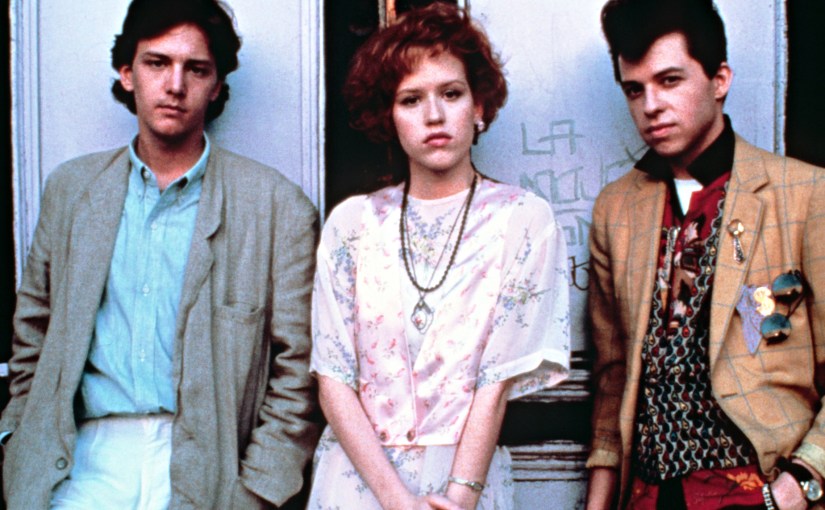
Director Howard Deutch directs John Hughes script, Pretty In Pink, by adhering to the familiar themes quickly recognized as Hughes’ signature touch from prior films. Deutch and Hughes maintain a vibe of alternative rock music amid a Chicago public high school community that could never be possible. Did I have this much independence in high school like Molly Ringwald as Andie, her adoring rich boy crush Blaine (Andrew McCarthy), or weirdly annoying (and lovable at the same time) Duckie played by Jon Cryer? And, oh yeah, a high school senior asshole named Steph played by asshole character perfectionist James Spader with his long cigarettes, Italian suits and barely buttoned shirts would never exist in an institution of education. So, there’s that too.

The kids at this school are divided among two different sides of a track-poor (Andie & Duckie) and rich (Blaine & Steph). Never meant to socialize or get along, the conflict of the film occurs when Andie and Blaine fall for one another.

This is Molly Ringwald’s 3rd Hughes film and looking back maybe it was a mistake for her career as she was outgrowing the roles she was getting pigeonholed for. Still, who else could you envision in the role of the aspiring dress designer who is responsible for her schlub of a father she lives with (Harry Dean Stanton), and friends with a weirdly eccentric, 80s punk/alt dressed co-worker played by Annie Potts?

Hughes’ is quite serious here, though the setup is not acceptably realistic, even back in 1986. These characters are competitive with one another for status in a high school setting. What other environment could the outline for Pretty In Pink take place in, though? Prom is on the minds of these “adults.”

Pretty In Pink was never a perfect movie. It has a perfect soundtrack, and I like the cast a lot as well as Hughes’ characterizations. Its glaring imperfection, however, is that these characters fit like a circle in the square setting of high school. The elements clash big time.

Still, I’ve always had an unusual affection for the film. I guess it is because I look past its inaccuracies and accept a playing field and the positions that Hughes and Deutch defiantly assign to the four characters. How does the intrusion of background and status overcome an affection between two people, and can this ever be happily resolved?

The ending was supposed to be different, very different. Yes. I should agree with the original conclusion because the math of the story adds up to that point. However, Reader…I am as defiant a viewer as Hughes and Deutch were as filmmakers. It’s wrong!!!! Nevertheless, I loved the ending that was eventually tacked on. So don’t judge me.

MURIEL’S WEDDING (1994, Australia)

by Miguel E. Rodriguez

Director: P.J. Hogan
Cast: Toni Collette, Bill Hunter, Rachel Griffiths
My Rating: 9/10
Rotten Tomatometer: 79% Certified Fresh

PLOT: A young social outcast in Australia steals money from her parents to finance a vacation where she hopes to find happiness, and perhaps love.


For years and years, I had always assumed Muriel’s Wedding was your stereotypical romantic comedy.  I mean, come on, it’s got Wedding right there in the title.  The story involves a quirky young woman, obsessed with weddings, who runs away from home to find a new life for herself.  Who knows…maybe she’ll get married herself?

But what am I saying, of COURSE she gets married…once again, it’s in the title.  So, based on that bit of logic, I never made any serious effort to watch this movie.  The rom-com has never been my absolute favorite genre.  For me to enjoy one, it has to really stand out in some way.  Either it must be REALLY different (Stranger Than Fiction), or it must be a shining example of the genre (The Philadelphia Story), or it must be so well written that it sneaks past my defenses (Jersey Girl – I know, I don’t get it either, I just responded to it, leave me alone).  I never imagined Muriel’s Wedding would meet any of those criteria.  On the surface, it didn’t look like much.

Welp…I was wrong.  Be warned because some story spoilers may follow, though I will do my best to be obtuse where necessary.

The plot: Muriel (Toni Collette, in the role that put her on the map) is a painfully awkward, overweight young woman who lives for weddings.  At the opening of the film, she is one of many women fighting for the tossed bouquet at a friend’s wedding, and the look on her face is of pure religious ecstasy.  She wears a hideous leopard print outfit completely out of place with…well, everyone.

Her home life is one of middle-class desperation.  She and her family live in a hopelessly hopeful seaside town called Porpoise Spit.  Her parents are in a loveless marriage, she and her oldest brother are on the dole (that’s “welfare” to us Yanks), and one of her sisters seems capable of greeting her only with the same phrase over and over again: “You’re terrible, Muriel.”  She has “friends”, but when they’re on their way to celebrate their newlywed friend’s discovery that her new husband is already cheating on her (long story), they tell Muriel point blank they don’t want her around anymore because she’s a drag on their image.  Muriel’s reaction to this news is as pitiful and heartbreaking as anything I’ve ever seen on film.

It was around this time that I started to wonder if the word Wedding in the film’s title was some kind of perverse code word for “suicide.”  What’s going on here?  There’s comedy here, but it’s comedy of awkwardness, the kind of comedy that can be painful to watch.

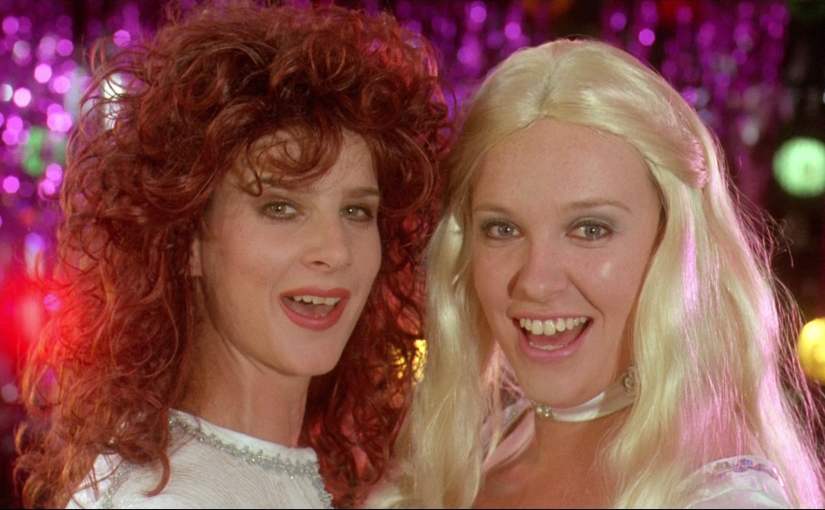
Through an improbable, but satisfying, chain of events, Muriel steals quite a bit of her father’s money, goes on an impromptu vacation, and meets an old schoolmate, Rhonda (Rachel Griffiths, in her film debut), who gets Muriel to open up a little.  For the vacation resort’s talent show, they lip-synch and dance to “Dancing Queen” by Abba in white stretch pants, a scene that must have at least partially inspired the makers of Mamma Mia!  Instead of returning home after her vacation, Muriel moves to Sydney and tries to reinvent herself.  At her low points during this time, she finds herself irresistibly drawn to the wedding gowns on display at the local bridal shops…

The rest I leave for you to discover.  One of the joys of this movie is how one thing leads to another in completely unexpected ways.  This was, without a doubt, one of the most unpredictable films of any kind that I have ever seen.  I can’t tell you how delightful it is whenever I find a movie that avoids cliches and narrative pitfalls and continually surprises me.

For example, there’s a scene involving – how can I say this without giving too much away – two people clumsily making out, a broken window, two naked men, and a malfunctioning beanbag cushion that had me laughing uproariously.  And then, just when I thought the scene was over, a curveball gets thrown that made me gasp audibly, as if I were watching footage of a dog getting run over.

The whole movie is like that.  For an hour and forty minutes, I was completely and utterly in the dark about what might be coming next.  The screenplay is bloody ingenious.  It starts with what looks like a generic rom-com premise, leads you down the garden path, then removes the path, and then removes the garden.  There are genuinely tender moments, and moments of delight (Muriel’s reactions during her first date are sheer perfection), and one or two shocking moments, and, and, and…  You get the idea.

Muriel’s Wedding gets high marks for its honest performances and its unfailing unpredictability.  The posters and especially the trailers paint the film as an “uproariously funny” comedy, and it is…at the funny parts.  There are also loads of dramatic surprises, and tender moments, and utterly unexpected plot twists.  It’s one of the most original movies I’ve ever seen.

SILVER LININGS PLAYBOOK

By Marc S. Sanders

Bipolar disorder can be a crippling ailment, not only to the person, but to his/her family as well. That, I imagine are the limits of my knowledge on the subject. David O. Russell’s Silver Linings Playbook will have you believe a way to embrace the disorder is to be involved with people who accept it and love you regardless.

Bradley Cooper is magnificent as Patrick; a hyperactive man suffering from his own demons. He is short tempered, confrontational, and prone to exhausting and uncontrollable outbursts. Because of that, he has lost his wife, his job, his friends and when the film begins, he is being picked up by his mother from an eight month court ordered stay in a mental institution on his way to live with his parents, Dolores and Patrick Sr., played brilliantly by Jacki Weaver and Robert DeNiro. Patrick is determined to rebuild his life. He feels confident that he is now on a positive track of exercise and healthy eating, and he wants to win back his wife. It is not so easy however, when Pat refuses to take his prescribed medication and his own father probably suffers from a similar disorder and he has to share a house with him. This means dealing with Pat Sr’s obsessive compulsiveness over his beloved Philadelphia Eagles, as well as his own short temper and his insistence on using family time with Pat Jr as a means to break the “jeu, jeu” that has cursed the team. Pat Jr. wants to move on with his life and find meaning and peace. His own obsessions with winning back his wife and overcoming witnessing the affair she was having behind his back do not help.

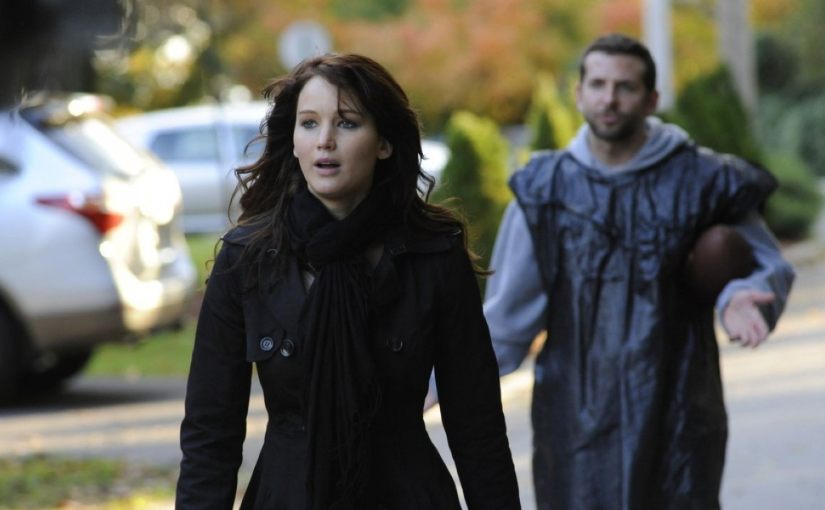
However, then Pat Jr meets Tiffany (Jennifer Lawrence in her Oscar winning role) and her own past is tormenting her, following losing her policeman husband in the line of duty. It’s clear she has not overcome this experience and she has taken up dance, which she is teaching herself in a refurbished garage. Tiffany is not quick to accept Pat Jr, but eventually the moments necessary for any film about relationships line up despite some screaming and shoving.

It sure sounds like I’m describing a heavy, miserable drama, here. Reader, I’m not. David O. Russell offers up moments of comedy without any of his characters really trying. No one is outright normal in this film. They are all burdened with their own idiosyncrasies and diagnoses, even Pat Jr.’s therapist, who we learn is an obsessed, face painted Eagles fan himself. Russell repeatedly uses a steady cam (I believe) to rush right up into the face of his characters, individually, when a moment is overtaking him or her. It’s a way of showing that no one else in the room can see what the sufferer is seeing. Everyone else is bound by their own disorder. Russell uses this device to isolate the character that owns the scene whether it is Delores, who endures the aggravation of her husband and son, Tiffany who can not get over the loss of her husband at a young age, Pat Sr. who must live with his Eagles losing another game, or Pat Jr. who is only trying to adapt to a new way.

There is no calmness in the domesticity of Pat Jr’s life and it only feeds the fire of his bipolar disorder. What he needs is someone who will not shun or ignore the disorder but embrace it and Tiffany is that person. Tiffany is also the person who will beat up on Pat Jr in one scene to bring his self-involved neglect to light. A helpful gesture for Pat Jr, but not a fulfilling action for Tiffany. Then in another scene she will solely come to his defense. The best moment in the film belongs to Jennifer Lawrence as she storms through the door and quickly confronts DeNiro on his own shortcomings, basically disarming him with sports statistics of every Philadelphia team, only to prove that Pat Jr had nothing to do with the outcomes of these games. Lawrence is harboring a machine gun of dialogue and she does not let up. DeNiro, I’m sure, loves to balance scenes like this with talent of this caliber. (I’d imagine he was missing great acting moments like this when he was shooting his Focker movies.) Russell wisely captures most of this scene in one shot. He is well aware of his leading actress’ strengths.

The ending is as quirky and inspired as Little Miss Sunshine, where Pat Jr and Tiffany participate in a dance competition that has everything is on the line, not just for their own sanity, but also for that of Pat Sr and the rest of the family. At the risk of spoiling a piece of the story, I have to recognize the dance sequence in this climax. Russell and his choreographer wisely mix it up with contemporary music that quickly switches over to head banging heavy metal and back to contemporary again. I caught it as an allegory of the mood swings these characters, especially Tiffany and Pat Jr, go through. The dance is messy, unsophisticated, aggressive and most of all it is adorable and lovable all at the same time. Psychologically, there must be something eating at Pat Sr and Pat Jr, and Tiffany and the rest of the cast, but that is, in no way, a reason not to love them.

STAND BY ME

By Marc S. Sanders

I’m not embarrassed to say it.  I’ve experienced a mid-life crisis.  Last night, I watched Rob Reiner’s Stand By Me, and I absolutely broke down in tears when it finished.  As I approach age 50 later this year, the most recent viewing of this film alerted me that my childhood memories are further away than I ever realized before. 

Reiner lifts this coming-of-age story from Stephen King’s novella entitled The Body. Four boys spend the long and hot dog days of summer in Castle Rock, Oregon (it was Maine in King’s story) in their tree house smoking cigarettes and discussing important topics like Annette Funnicello’s breast size on The Mickey Mouse Club and the recent disappearance of a twelve-year-old kid.  Yackety Yak and Lollipop play on their transistor radio in the background.  The wimpiest one of the pack, Vern (Jerry O’Connell), overhears the location of the kid’s body is off the side of the railroad tracks, about twenty miles away.  Teddy (Corey Feldman), along with best friends Chris (River Phoenix) and Gordon (Wil Wheaton) decide to embark on the search for the body and get their picture in the paper, labeled as heroes.  It’ll take them the Labor Day weekend to carry out their quest.

During their long journey across the railroad tracks into the woods, the four boys will discover what concerns them, like figuring out if Goofy is a dog and who could win in a fight; Superman or Mighty Mouse.  As well, they’ll uncover what gives them anxiety ahead of their entry into adulthood.  Gordon lives with being unloved by his parents both before and following the accidental death of his older brother (John Cusack).  Chris lives with being unfairly labeled as a young hoodlum.  Teddy endures the aftermath of an abusive military father currently living in the looney bin.  Vern suffers from a hesitancy to live for adventure and risk due to ongoing fear. These boys had a future that awaited, but for some it seemed like there was no escaping the destiny the locals of their small town had already mapped out for them. 

In the last few years, I reconnected with a childhood friend by means of social media.  Visiting New York City annually over a three-year period, I got to see Scott in person and recollect on our times together.  It had been over thirty years since we had seen or spoken with one another.  We reminisced about tormenting the substitute teachers, and our first crushes.  We reflected on favorite movie scenes that we acted out in between classes.  We are different now, though.  Nowhere near the same as we were at age 12.  We have families and careers and responsibilities.  Yet, our memories of trading comic books, talking dirty, going to movies, and acting out cops and robbers shoot outs in the backyard all remain. 

When Stand By Me opens, a present day adult (Richard Dreyfuss) is shown reflecting in the distance following reading an article about a lawyer who was killed in a restaurant.  This narrator then flashes us back to the year 1959 when this adventure between him and his three friends occurred.  One of those friends was the lawyer who was killed.  A piece of his history has ceased to live and continue on.  That terrifies me personally.  Friends, and family, and people I’ve encountered over my half century will leave my presence, never to be seen or spoken to again.  I’ll never get the opportunity to reflect with them again, much less make new memories.  I’m now living in an age where Facebook comments seem to weekly consist of saying “very sorry for your loss.”  Friends are losing their parents.  Some are passing away themselves.

Stand By Me might not be altogether realistic.  The boys are getting overpowered by a sinister Kiefer Sutherland, who’s not afraid to use a switch blade and cut one of the kids’ throats.  King’s story also feels like an elevated Hardy Boys or Tom Sawyer kind of adventure.  I don’t know of anyone who went looking for a mutilated corpse during my summer days living in Wyckoff, New Jersey.  The adventure conceived by Stephen King serves as a thrill that you imagine as you read it off of the page.  My upbringing consisted of play dates and sleepovers with Scott, Star Wars toys and Saturday morning cartoons.  Yet, the connections that thread the main story together are what’s to treasure in Rob Reiner’s film.  The friends we make in grade school before becoming interested in high school, alcohol, sex, and career planning, are the most important people we know and first encounter in our lifetimes.  It’s impossible to forget them or the impact they had on our lives.  Scott certainly had an impact on my life.  I credit my sense of humor to him, and his carefree attitude to the ugliness of this world.  Sometimes that’s all we have to survive.

King and Reiner use the body that is being sought as a device to drive the characters.  What’s going to bring these boys together with no outside influence?  How can young Gordon deliver his revered sense of imagination as the writer he’s to become?  The best way is to put the boys around a camp fire.  Gordon can then entertain his pals with the story of an incredibly fat kid who got his revenge on the locals during a pie eating contest that results in a massive “Barforama.”  It’s silly and sophomoric and childish fun, but for 12-year-olds, it’s the best thing imaginable.  Teddy dreams of being an army hero storming the beaches of Normandy like his father was rumored to have done.  His sleeping bag is his machine gun mowing down an oncoming train.  Vern’s favorite food?  Watch the movie to find out.  Chris might be regarded as the outlaw, but he’s also the most mature, and perhaps the mentor to Gordon who suffers from the loss of the brother he loved, as much as he suffers from the neglect of his mother and father.  At age 12, in 1959, Chris was all that Gordon had.  I may have had more than Gordon at that age, but whenever I was with Scott, he’s all that I had.

Ultimately, Stand By Me is not an adventure or a silly comedy about boys being boys.  It’s a character study of kids just outside of their formative years.  It’s a film that captures a single moment before friendships inevitably expire.  It’s a reminder to embrace those you’ve treasured over your lifetime, because we cannot be twelve years old forever.

ALICE DOESN’T LIVE HERE ANYMORE

By Marc S. Sanders

Martin Scorsese was destined to be a great director. No doubt about it. Look at 1974’s Alice Doesn’t Live Here Anymore. Not only does it offer an Oscar winning performance from Ellen Burstyn as Alice, but this early career film contains skilled tracking shots.

Scorsese uses his camera like a musical instrument. He times it to move on a certain cue. Near the end when Alice needs to pick up her 12 year old son Tommy (Alfred Lutter, well played here) from a police station, Scorsese is clearly on foot positioned behind the police counter. When the time is right, he walks it behind the cop and extras in a crescent step by step over to behind Alice. We are in the scene. It didn’t take much imagination, but Scorsese is economical for an engaging payoff. The camera continues to follow a young Jodie Foster as Tommy’s rebellious pal, Audrey and then after she’s quickly escorted out by her mother, it peers into the room where Tommy is waiting. It’s an unbroken steady cam moment that predates his classic tracking shot of the Copacabana in Goodfellas, or the bloody overhead outcome from Taxi Driver.

The story is decent, though nothing big. Alice is forced to flee following one set back after another with the men she encounters in her life. First she’s unexpectedly widowed from her unappreciative and cruel husband, next she encounters a charmingly young Harvey Keitel who sheds his first impression quickly. Then she comes across Kris Kristofferson but is he right for her?

The second half of the film inspired the basis for the classic TV show Alice, featuring Linda Lavin and Vic Tayback who plays Mel the cook in the film as well. Scorsese uses the diner sequences for some good laughs of confusion and slapstick with side characters Flo (scene stealer Diane Ladd) and Vera (Valerie Curtain, another scene stealer).

These are good characters here. You want Burstyn’s Alice to be happy and succeed as a mother to Tommy and become the singer she dreams about. She’s adoring. She tries, and she always works hard. Burstyn has some great moments of various range whether she’s feeling like a pestered mom driving the long highways, having anguish and fear with the men who cross her path, or when she’s singing Gershwin’s “I’ve Got A Crush On You” at the piano of a seedy bar. I loved her in the role.

This is not really a special movie. Yet, it’s an important one in cinematic history. See this film to see the master director when he was merely a pupil, exceeding what was likely minimally ever expected of him to accomplish.

Martin Scorsese is just a great director.

FORREST GUMP

By Marc S. Sanders

There’s not much that I can say to further praise the merits of Robert Zemekis’ Forrest Gump. It’s a film of legend though it’s a sore spot for die-hard fans of Pulp Fiction, which competed for Best Picture in 1994. Guess which film won. Tom Hanks won the Oscar for the second year in a row, following his outstanding turn in Jonathan Demme’s Philadelphia. Zemekis won Best Director. Eric Roth’s screenplay won as well.

What holds a lasting impression for me about Forrest Gump is the sweeping travel through time of a man with limited intelligence but unlimited willingness to explore and participate, whether it be as a Ping Pong Champion, a Medal of Honor recipient for heroism during the Vietnam War, a millionaire entrepreneur of a shrimping boat business, or a man who just felt like running from one corner to the next of the North American continent. Forrest Gump never knew to compromise a belief he had, probably because he was never aware of the capability to compromise in the first place.

An interesting theme occurs throughout Roth’s screenplay (adapted from the novel by Winston Groom). The people that Forrest encounters are always shouting their ideals and agendas. Yet no one seems to listen. Not just Forrest though. No one at all listens to each other. Lieutenant Dan (Oscar nominee, Gary Sinese) shouts for an immediate evacuation of a hostile territory under attack and no one on the other end of the line, appears to be listening to him. He orders Gump to leave him there, but Forrest does not listen. Forrest only focuses on rescuing his friends, Lt. Dan and Bubba (Mykelti Williamson). What exactly were Americans like the Hippie movements, the War Veterans, the Black Panther party, even the men in the burlesque nightclubs, as well as the various assassinations attempting to accomplish really? Did they accomplish anything? Did any of these parties make an impactful change, or did they just like to hear themselves talk? Did they just want the recognition for only themselves and no one else? When Forrest meets up with his love Jenny (Robin Wright), in a gorgeous caption in front of the Washington Monument (often shown during Oscar film compilations), he has just shared his thoughts over a loudspeaker, unaware that not one of the thousands of war protestors could hear him because the microphone had been unplugged. Later that day, a Black Panther participant only cares to wave his finger and shout his agenda in Forrest’s face. Is Forrest interested? Is he even listening? Is the Jenny, the hippie and her protestor boyfriend listening? Like many Americans, Forrest was only concerned with what was most important to him; Jenny. When Forrest develops a following during his cross country run, everyone is looking for his purpose and his message, and Forrest is unaware that he needed to offer one. Americans are always looking for the next best following. When Forrest passes the Grand Canyon and stops running, the parade of lost souls behind him shouts, “Now what are we supposed to do?” Forrest doesn’t listen. He just walks away and declares he’s tired. America during the mid twentieth century was lost. Forrest was not. Forrest just went in the direction in front of him.

Zemekis pulls an interesting trick of contrasting Forrest against other regulars. The nurse who sits on the bench next to Forrest is more interested in reading a mundane two dimensional issue of “People Magazine.” A man listening to Forrest’s tale of rescue in Vietnam was only concerned with the bullet that struck Forrest in the butt, not the men he saved or the loss of his dear friend Bubba. The old codgers who hang around the local barber shop in Greenbough, Alabama just watch the exploits of Forrest as the years go by. Their hair gets grayer and their skin gets more wrinkled, and life just passes them by while Forrest passes life by. It’s a subtle, yet effective, device that I appreciate on repeat viewings.

Sally Field contributes to the disregard Forrest has for menial issues. If Forrest is going to be denied going to a regular school because his intelligence level falls a few points below average, she will make certain that does not interfere even if it means pleasuring the principal. Mama Gump has the wit and intelligence. Forrest does not. However, their commonality shows in their disregard for what keeps us from living life to the fullest. Without Mama as his influence, Forrest would never have met the President again, and again, and again.

Mama reminds Forrest that “Life is like a box of chocolates…” You know the rest! It doesn’t matter what we get, as long as we get what we pursue.