ON THE BASIS OF SEX

By Marc S. Sanders

Director Mimi Leder provides a biopic on Supreme Court Justice Ruth Bader Ginsburg in On The Basis Of Sex. The movie is worth a view even if it is nothing very special.

Felicity Jones plays Ginsburg capably, even if her British accent keeps intruding into her performance. If Jones raises her voice in a debate with her daughter, all I’m hearing is Jyn Erso from Star Wars.

Leder’s film opens in 1956 as Ginsburg is depicted dressed in blue as a lone woman walking the campus of Harvard among a sea of male law students dressed in black. I’ve seen symbolism like that before. Nothing inventive here. From there, we learn she is entering the school as of one of nine women in the student body.

Ginsburg is married to fellow law student sophomore, Martin Ginsburg, played by Armie Hammer. I’m convinced if a film takes place at Harvard, Armie Hammer is going to be cast. He’s become a poster boy for the institution. When Martin is diagnosed with testicular cancer, Ruth accepts the challenge of not only attending her classes but Martin’s as well so he does not fall behind. Ruth then requests to finish her law degree at Columbia University to be with her husband. This is her first challenge as she is denied the request and its apparent because she is simply a woman. She perseveres and goes anyway. From there, Leder depicts a setting where even if you are at the top of your class at both Harvard and Columbia, if you are a woman, a mother and Jewish, then there is no job available to you as an attorney. Therefore, Ruth must settle for being a law professor.

The film jumps to 1970. Ruth’s daughter, Jane played by Cailee Spainee is a preteen ably ready to debate with her mother about the merits of Atticus Finch while Ruth continues to fall second to the male population mostly reliant on laws seem directed in preference to men over women. Don’t be too hard on our forefathers. Times have changed! Eventually, Martin introduces a case that would be perfect for Ruth to champion. An unwed man is denied a tax deduction for nursing expenses for his elderly mother. Had he been married or divorced or widowed or even if he’d been a woman, then the deduction would qualify. After all, single adult men should be out hobnobbing and earning a wage, or fighting in a war. So, if we can’t convince our lawmakers that a woman deserves the same equal rights as man, how would it appear if men were not entitled to certain rights equally? The case makes its way to the Supreme Court as Martin and Ruth team up for the cause.

All of this very inspiring and really should be seen by young students to open their minds to what they as people and American citizens are entitled to. However, I worry that if I were to show this film to my daughter, for example, she’d just get bored. Yes. You have to stick to the facts of the story and how it all played but the case that Ruth represents is kind of stale I’m afraid. If I, as a banker by day, find this case uninteresting, what should I expect of other adults and young viewers alike.

As well, Leder and screenwriter, Daniel Stiepleman (Ruth’s real life nephew), portray the opposition as tough minded, stubborn and bullish. Stiepleman might have been pushing this portrayal a little too far though. Were these great minds of debate and justice really this foolhardy and mean, or is this all for cinematic effect?

Ruth Bader Ginsburg is a hero because she’s an agent of change. Many of our current laws and those that continue to be updated must be credited to her efforts. The film primarily focuses on this one case which blazed the trail for her legacy to come. I would have rather have seen the legacy though. I bet that is much more exciting than listening to an exchange of tax law between Martin and Ruth. It just doesn’t make for good movie material and admittedly I got lost in some of the legal jargon speak. What happened exactly?!?! What now!?!?!

Jane and Ruth’s relationship kind of plays like an afterschool special. Jane did follow in her mother’s footsteps but it came off kind of hokey to me how Jane eventually participates in Ruth and Martin’s legal team. Still, this is a device that can attract young students to the material. I just think it’s kind of cheesy. There was better adult/kid chemistry and writing in Iron Man 3, for example.

Kathy Bates and Justin Theroux were kind of distracting to me as individuals who allied with Ruth. They are larger than life in this film and really they shouldn’t be. This film is about Ruth Bader Ginsburg, no one else.

On The Basis Of Sex won’t put you to sleep. I learned about Ginsburg’s beginnings a little bit. So I’m grateful for that, but as far as entertainment and insight, I’d turn to another source. Perhaps, I will seek out the 2018 Oscar nominated documentary RBG that is gaining massive positive response. I expect I’ll take away more from that film than just a dried up tax case that’s detailed over two hours.

GREEN BOOK

By Marc S. Sanders

The biggest surprise of Green Book is who its director is, the unlikely Peter Farrelly of The Farrelly Brothers, directors of Dumb & Dumber and There’s Something About Mary. Yet, when I reflect on the film it should not be a surprise. The Farrellys are known for raunchy humor, but often it stems from an honest source. When Viggo Mortensen’s character Tony folds an entire pizza pie in half and then scarfs it down whole, that’s a Farrelly touch but likely also what an Italian club bouncer raised in the Bronx would do without any consideration. He’d also win out in hot dog eating contest. Mortensen’s character is a far cry from his Russian Heyman in Eastern Promises or Stryder in The Lord Of the Rings. The pizza and hot dog scenes are great moments in a film weighted down by the Uncle Tom mentality of Deep South USA in 1962. Peter Farrelly needed to direct this film, and it just might be the best picture of the year.

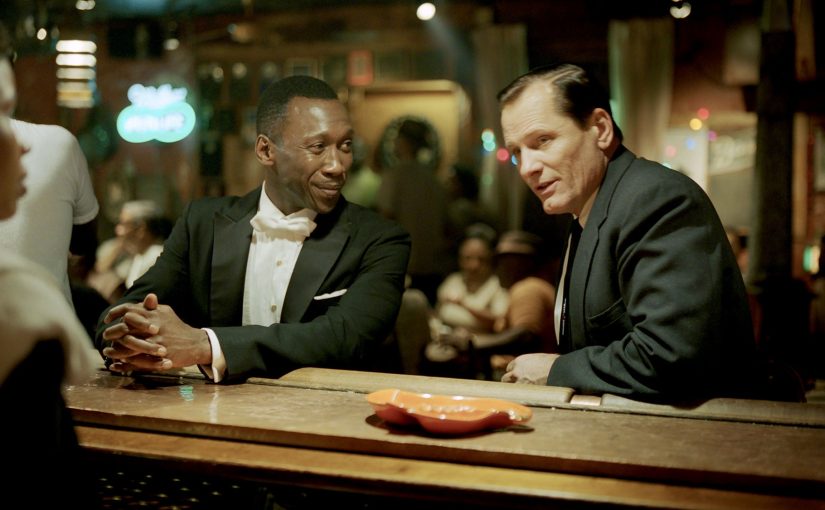
Tony (or “Tony Lip” as he’s known among his peers) is hired by Dr. Don Shirley played with such eloquence by Mahershala Ali. Dr. Shirley is an African American pianist, arguably the best in the world and ready to embark on a tour of the Midwest to Southeast of the country. It’s not that simple however as Dr. Shirley is all too aware of the racial prejudice that will befall him. Tony is hired to be Dr. Shirley’s driver as he has the toughness to look out for Shirley in the event that it is necessary. Sadly, the film shows that Tony is more than necessary.

There’s much comedy here between Ali, playing the well spoken “Felix” role, against Mortensen in the “Oscar” part. Tony and Don are worlds apart having virtually no understanding how the other half lives or what they are forced to compromise with on a daily basis. The hardships that Green Book offers focus more on Dr. Shirley as he is forced into humiliating circumstances where he is offered only an outhouse to use or denial of entry into a dining room. He could be wearing the sharpest of tuxedos, while Tony is a self aware “goombah” slob with no civility and Dr. Shirley remains the one to be overlooked. His value to Deep South America is to play his Steinway piano like meager jester.

There’s much to learn about our country’s mid 20th century history in Green Book. It’s a film I encourage families with pre-teen children to see. Not only will they learn of disillusioned hatred and treatment of black minority, but they will be entertained as well. References to Robert and John Kennedy are presented as well Aretha Franklin, and a Boston Celtics player (Name I cant recall).

The comedy that Farrelly brings keeps the audience engaged. The best dramas possess great comedy like Steel Magnolias, Terms Of Endearment, The Help, and even Kramer vs Kramer. If we can laugh along with our characters, then we will appreciate them that much more when harm and pain strikes. We want to ease their pain and be angry for them when those moments arrive. Their comedy of natural behaviors breeds affection for them. When they are compromised, we cry for them. Farrelly executes this format perfectly.

Mahershala Ali is a stand out here. He is snobbish at times towards the unmannered Tony but he is never deserving of his dismissiveness. He is a victim of the “colored mentality.” If not for the color of his skin, Dr. Shirley would have been regarded by all as a man of integrity; a hero to the American people. Sadly in 1962, many could not see past skin color. Thankfully, a great moment towards the end reminded me that it was in fact many…but not all. Watch the movie, and then tell me if you know what I’m referring to.

Remember, this is probably the best picture of 2018. Bring your children to see Green Book. Keep your children aware.

BOHEMIAN RHAPSODY

By Marc S. Sanders

The aftermath of Rami Malek’s electrifying performance of Freddie Mercury might just follow the same trajectory of Jessie Eisenberg’s portrayal of Mark Zuckerberg. People will never be able to see past the one accomplishment and every role hereafter will be measured against this moment. Bohemian Rhapsody will likely be Malek’s best film of his career.

Bryan Singer, and more importantly an uncredited director replacement, have assembled a by the numbers music biopic complete with defiance against naysayers, sexual discoveries, band discourse, drugs, booze, illness, a wildly eccentric lead and an altogether sensational soundtrack. This isn’t me complaining however. The film might be formulaic but what else should I expect really?

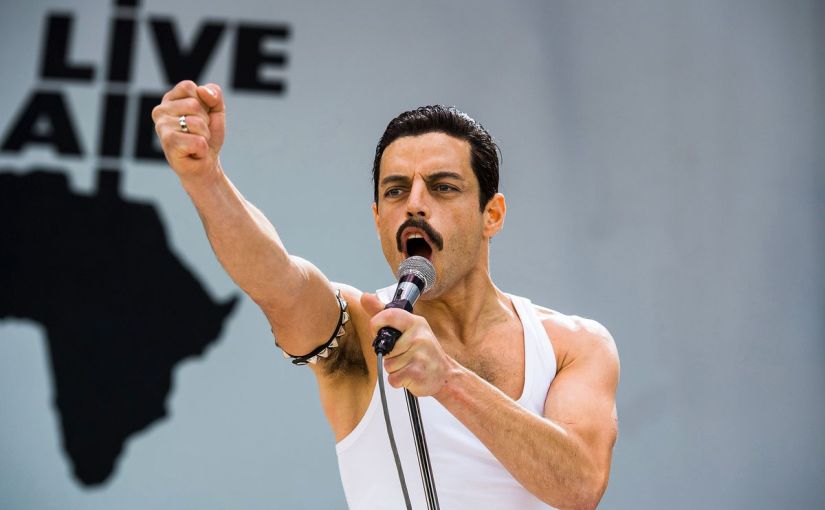
Though I’m dubious if the compositions really were spawned as depicted, I nevertheless loved every second of Bohemian Rhapsody. Yeah, I doubt “Another One Bites The Dust” finally sprung to life during an in studio scuffle but as soon as the bass began to play, I was in the moment. Movies should always touch you naturally. The emotional response should never feel forced. It should be be triggered. The music of Queen has that effect for me. Not every song. Some lyrics are downright silly. Yet if “We Are The Champions” is going to be re-enacted during a Live Aid concert at Wembley Stadium following a series of setbacks for Mercury, you are going to get caught up in the moment.

The song introductions are the highlights of the film. They carry an energy that leads to lip sync and toe tap. However, the movie doesn’t stop there. I appreciated the strife between Freddie and his disapproving father, his affection for his bandmates and the eventual conflict among them, his struggles with loving Mary, his wife, while coming to grips with his bisexuality, his betrayals among those that used him, and finally his AIDS diagnosis. Every aspect is given enough attention. Still , we are treated to a near full shot for shot re-enactment of Live Aid, one of Freddie’s final performances before his eventual surrender to death.

Called me biased. Yet I’m not a die hard Queen fan. I just found the period set up authentic. The music editing to be well orchestrated and the cast to be spot on. A Mike Myers appearance (look for him but you won’t see how apparent he really is) is inspired.

The film ultimately belongs to Malek. Awards season will be generous to him. He’s comfortable and assured in the attire, the skin, the gravitas and even the teeth of Freddie Mercury. This was a film circulating the press for many years. Everyone seemingly wanted a bio pic. Finally, it has arrived and no one else could have played Freddie Mercury so beautifully as Rami Malek. He’s a miracle!

CHAPPAQUIDDICK

By Marc S. Sanders

The morals of Senator Ted Kennedy were tested in July, 1969. While under the influence, he drove his car off a bridge that overturned into a pond. The Senator survived. Over 9 hours later, he reported that a passenger he was with drowned in the accident.

It’s terrible to think about the trust he retained following this incident. He was re-elected to office, and went on to become the 4th longest running Senator in American history. The parents of Mary Jo Kopeckni (Kate Mara) lost a daughter with a promising future.

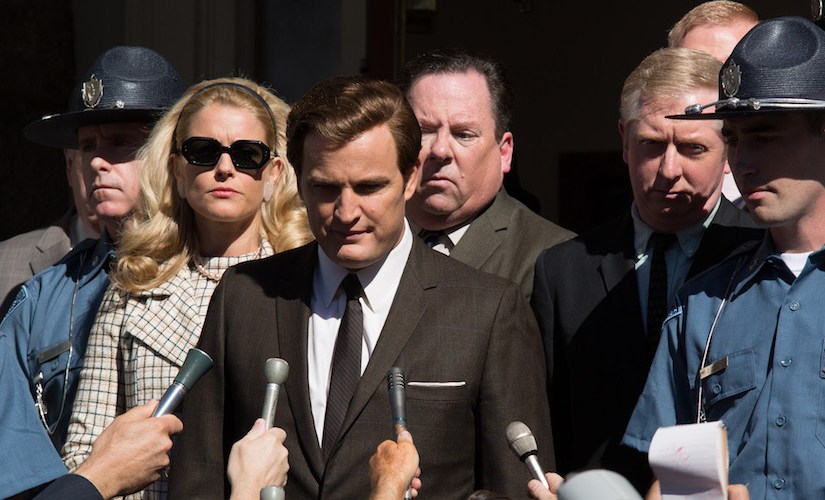
Jason Clarke is excellent as the insecure son of an intimidating stroke stricken Joseph Kennedy Sr (Bruce Dern, effectively overpowering with paralyzed limitation), forced to walk in the shadows of his brothers John and Robert, both assassinated prior to this occurrence. Clarke is great as someone we are to be disapproving of, but for me personally I’m that much more disgusted by the Senator’s response.

Ed Helms is Ted’s cousin Joe who makes all efforts to make this right following the foolhardy actions that occur. Senator Kennedy tries to pride himself as a martyr for the state of Massachusetts, appearing as a victim with a false neck brace, claiming a concussion, hiding left over alcohol and sympathizing with the Kopeckni family. He identifies himself as a “moral compass.” Cousin Joe knows differently as the truly authentic moral character, yet he’s merely disregarded by the army of Kennedy spin doctoring.

Director John Curran will have you believe more of this story and it’s longevity in history did not amount to much considering this all occurred while Neil Armstrong was making his historic walk on the moon, ironically initiated by President John Kennedy. It’s a reason I believe the Senator sustained quite a successful career. Maybe not totally successful. I don’t recall another President Kennedy.

Curran maintains a picturesque image of Martha’s Vineyard and the slow gradual response of all the players, including a police chief who has no scuba gear and must resort to getting down to his skivies to search through the submerged car. The chief is also quite comfortable with accepting an eventual prepared statement followed by a release so the Senator need not concern himself.

None of this was pretty. None of this was Camelot. John Curran’s film reminds you of a young woman helplessly drowning, while the perpetrator did nothing but consider his chances at a Presidency from that point on.

Chappaquiddick is a must see film.

JUST MERCY

By Marc S. Sanders

I’ve learned so much from movies. I really have, and I’m continuing to learn. An important lesson that I absorbed from Destin Daniel Cretton’s film Just Mercy is that we have a long way to go in this country. A racial divide is sadly still in existence. As I watched this film while the nationwide protest response to the killing of George Floyd is still prominent, it’s glaringly obvious that this story, taking place from 1987 to 1993, has likely only made a tiny dent in the reach for equal and fair justice between black and white Americans.

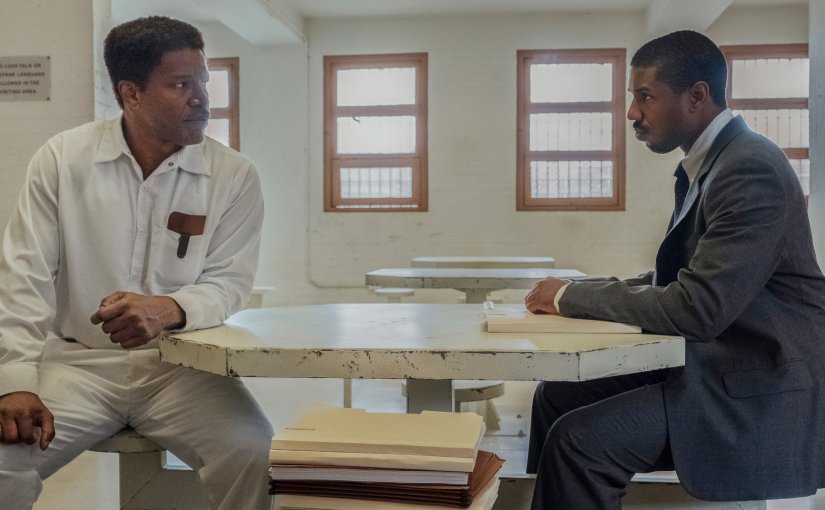
Just Mercy follows newly appointed Alabama civil rights attorney Bryan Stephenson’s (Michael B Jordan, who I still insist will win an Oscar one day) pursuit to overturn a murder conviction for Walter “Johnny D” McMillan (another magnificent performance from Jamie Foxx). Johnny D was easily ruled to have murdered an eighteen year old white woman. The trial hinged on the testimony of another convict (Tim Blake Nelson) pressured into making up an outrageous story that put Johnny D at the scene of a crime he had nothing to do with. All that mattered was that the all white jury believed this ridiculous testimony.

Bryan is newly graduated from Harvard University with nothing but righteousness and the intent of making a difference in this world. Against his family’s urging for fear of his life, he deliberately moves to Alabama with Federal Grant money to start the Equal Justice Initiative (EJI) with Eva Ansley (Brie Larson), a passionate white southern mother who is prepared to face the danger of a prejudiced community that’s hypocritically proud to boast that it is the hometown of writer Harper Lee (To Kill A Mockingbird). Bryan is informed that he can actually visit the Mockingbird museum and see where Atticus Finch actually stood. I question if the majority of Monroe, Alabama have even read Lee’s book.

Bryan’s intent is to research and represent those prisoners that likely never received a fair trial. One man is a Vietnam veteran who did in fact kill a woman with a home made bomb. Sadly though, his PTSD likely motivated this regrettable action. This man is more mentally ill than guilty and his country could care less.

Most of the film’s focus goes to the egregious acts that convicted Johnny D. While it’s plain to see how innocent he is, Bryan is faced with bigoted pushback from the local police force as well as the District Attorney (a very good and effective Rafe Spall). Bryan obtains a material witness but then that is compromised. Now he must rely on if the convict who originally testified against Johnny D will come clean with telling the truth.

There’s a lot you can become more aware of while watching Just Mercy. First, our legal system can be very tainted with extreme prejudice. Second, slavery may have been long abolished by the end of the twentieth century, but it’s racial underpinnings and need to dominate a black community still appears justified in many southern eyes. There’s a sad food chain that exists in the state of Alabama. It therefore becomes an impossible obstacle for Bryan and Johnny D when they take their case to the state Supreme Court. This doesn’t take a law degree to recognize such an apparent wrong. Yet, that means nothing if the judicial system won’t even read a simple and otherwise obvious explanation.

A third aspect that Just Mercy presents is police brutality against black men. It exists. A black man, such as a hard working tree cutter like Johnny D or a Harvard graduate in a suit, can get pulled over. The man can cooperate completely with hands shown and calm politeness when faced with an authority. Yet, with next to no action that black man will suddenly have a gun drawn on him and get slammed against a truck and put in handcuffs.

Moments like this continue to occur simply because of the color of their skin. It matters not where they were going or where they were coming from. If they just look guilty, then they must be guilty.

Just Mercy is a demonstration of a large menu of wrongs being committed against black America. Cretton’s script with Andrew Lanham, is a well edited and focused film that doesn’t drift into any side stories. Bryan Stephenson seemingly takes in a lot of cases all at once but for a two hour and twenty minute film, only so much can be presented.

Yes, Johnny D’s case is most prominent but time is also devoted to what could be his overall fate, a trip to the electric chair. Bryan Stephenson sees this first hand with another case. It is often a wrong and terrible outcome but it at least amplifies his motivation to represent these wrongly convicted men.

Bryan Stephenson is a tremendous hero portrayed by a humble yet passionate performance from Michael B Jordan. How many Harvard graduates would truly take their expensive Ivy League degree and put their lives on the line in an unwelcome community with no pay to save the lives of convicts who no one else has ever regarded?

Most especially during the current climate of our country, Just Mercy is an absolute must see film.

1917

By Marc S. Sanders

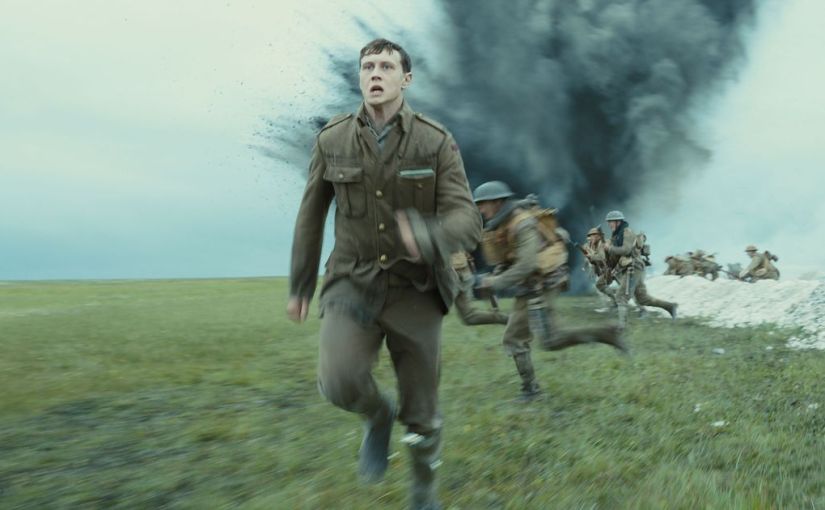
Sam Mendes’ World War I drama 1917 is a cinematic achievement in film artistry. Watching the picture, which I highly recommend in a Dolby theatre, is exhilarating, leaving me to ponder how this type of filmmaking was ever accomplished.

Mendes, along with legendary cinematographer Roger Deakins (Blade Runner) primarily shot the film in one long-real time-take with no breakaway until about two thirds of the film is complete. Then, it resumes into another long take for its final act.

We accompany two British soldiers assigned to trek across the front line into enemy territory and warn a unit of 1600 fellow soldiers that a planned attack has been set up as an ambush against them by the German army.

Mendes is also credited as screenwriter with Krysty Wilson-Cairns and the story and characterizations remain pretty basic. Almost too basic, actually. Because the film is shot in close to real time, 1917 doesn’t allow for much complexity or dimension beyond the now of the mission at hand, and that’s where it suffers slightly. There are moments where we are just walking the countryside and are expected to look at the splendor of war torn Europe. We wind a corner and suddenly we are entering a bunker where a rat hanging from a ceiling enters the frame. We climb a ladder out of a trench, and we immediately come face to face with the aftermath of a violent battle that leaves behind torn up bodies and piles of shell casings.

The achievement with camera work is impossible not to admire and become in awe of it. Eventually, however the novelty wears a little thin. There’s little emotional connection to the two soldiers played by Dean Charles Chapman and George Mackay. Brief appearances by Benedict Cumberbatch, Colin Firth and Mark Strong are fleeting for but a second.

I was highly impressed with 1917, but I was never moved by the film, even when an emotional confrontation comes up near the end. I never got to know these characters beyond the urgent sojourn they take. So much of the conversations didn’t matter much to me.

Again, this is a master class in filmmaking. Mendes will likely win a directing Oscar because I am dumbfounded with his accomplishment. His steady camera could not have been mounted on a ground track against the rough terrain. So how did he do it?

Oscar recognition must also go to Mendes’ team of 6 art directors. The battlefields are strewn about with corpses, barb wire, deep trenches, underground bunkers, dirt, mud, dust, blood, and so on. War is hell is what we’ve all heard. 1917 brings that mantra to life in sickening, shuddering detail.

I recommend the film while it remains in theaters, but I won’t say it is the best picture of the year because for each great feat of technical work, there’s a lack in the emotional punch that other war films have provided.

THE LAUNDROMAT

By Marc S. Sanders

Steven Soderbergh gets a little too inventive in his delivery of revealing “The Panama Papers,” in his new film The Laundromat now showing on Netflix.

His film is too convoluted deliberately to drive home the point of shell company, laundered fraud within the world. As such, it makes it very challenging to comprehend every point crammed into his short 90 minute film.

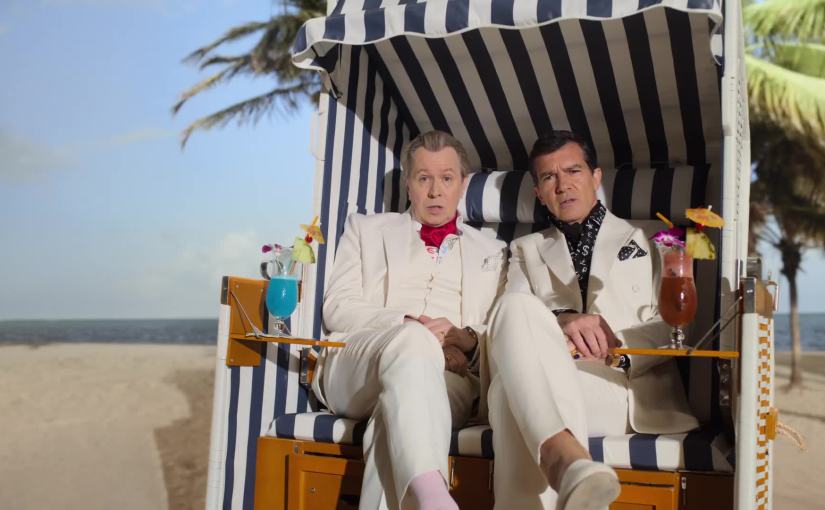
The two Panamanian attorneys behind the scheme, Mossack & Fonseca (played with great duet chemistry from Gary Oldman and Antonio Banderas) narrate the film by introducing different ways in which a shell company valued at everything on paper but tangibly nothing from an actual monetary standpoint.

Primarily, it focuses on Ellen Martin (Meryl Streep) a driven senior citizen who learns the truth of the plot when insurance does not compensate following the tragic accidental drowning of her husband on a boat tour.

Streep is brilliant as always. Such a natural with her monologues and her seemingly useless efforts to gain restitution for her loss.

The whole cast is excellent but the intentional confusion behind the story falls short of satisfying entertainment or enlightenment. I needed some moments where Soderbergh would give it to me straight. A diagram or a graph might have helped.

With The Laundromat Steven Soderbergh fails at becoming the next Jay Roach (The Big Short and Vice). Imagine if Roach actually got his hands on this script. Then there’d be a lot more buzz about this film. Oh well.

BRAVEHEART

By Marc S. Sanders

Mel Gibson’s Braveheart is a barbaric film. It’s barbaric in its nature, its violence and its characters. It’s also a magnificent piece of moviemaking.

It’s incredible how Gibson can depict himself in violent battle sequences swinging his sword and tumbling over enemy extras while directing the film. Braveheart is truly one of the best films to be directed and produced by its lead actor.

In the 13th century, King Edward Longshanks keeps a firm rule of British monarchy over Scotland. He finds the Scottish to be unruly and out of order. Taxes alone will not keep them at bay. So he declares it noble to have any Englishman bed a newly Scottish bride before her husband has the opportunity. Therefore, to avoid this experience, William Wallace (Gibson) marries his true love Murron (Catherine McCormick) in secret from the British Empire.

Following the escape from rape by an English captain, Murron is taken, with her throat slit to draw out Wallace. From that point on, Wallace never puts down his sword as he begins the Scottish uprising for freedom from British rule.

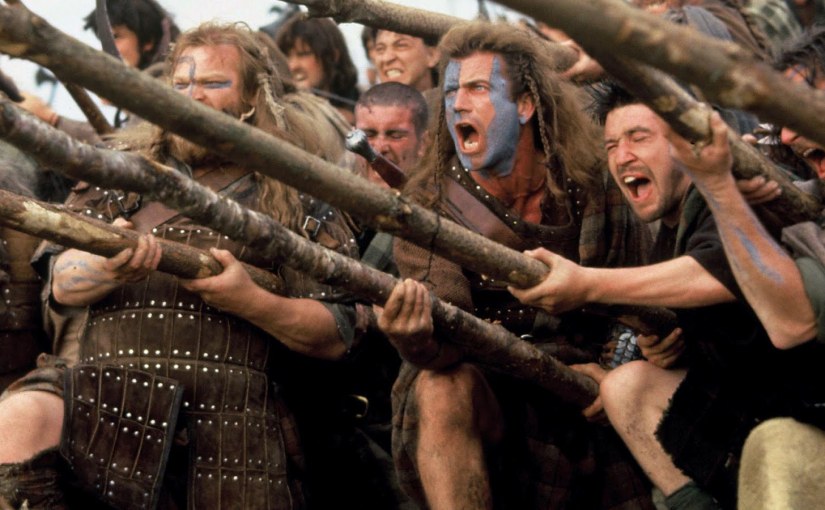
Braveheart is not a complex film and we’ve seen films like this before with swords and shields over wide open battlegrounds. However, the construction of Gibson’s film is outstanding. The extras that make up the British and Scottish armies are dense with breadth. The battle scenes are bloody and fierce with axes, swords, bows & arrows and burning tar.

It’s also a moving piece as Wallace remains steadfast with drive to deliver freedom for his people. It’s not so much a character arc for Wallace. He only changes once Murron is killed from wanting to remain peaceful to war torn and strategic in his attacks.

Instead, a good arc comes from Angus McFayden as Robert The Bruce, a confused Scottish nobleman who allies with William but whose judgement is clouded by his aging father. McFayden gives some brief voiceover narration. His character delivers a few surprises as Wallace continues to do damage to Longshanks’ territorial control.

Patrick McGoohan plays Longshanks and he’s another good villain in a long line of English antagonists. He’s determined to keep his rule and bloodline intact despite his gay, weakling for a son whom he forces into wedlock with the princess of France, Isabella (Sophie Marceau).

There’s a lot of dynamics to Braveheart. Battle scenes of blood and gore with burning flames and garish makeup are the main attraction. However, Gibson’s film offers up conflicts of interest found in Randall Wallace’s script. Romance between William and Marron as well as the rich history that led to Scotland’s independence and the almighty power of England and its conceit that would lead to the country’s defeat against a man’s will to lead his brute army to something greater which they never envisioned.

Braveheart is good entertainment.

SPOTLIGHT

By Marc S. Sanders

It’s tough to be a fair journalist when a higher power carries great influence over the what and how of honest reporting. In Tom McCarthy’s Best Picture Oscar winner, Spotlight, it’s not so much the crimes of child molestation by the hands of priests from the Boston Archdiocese that are so important. Rather, it is how the facts are suppressed and the pressure to contain the truth are so apparent. Maybe it finally took the will of a new editor, a Jewish editor from New York, named Marty Baron (Liev Schrieber), at the esteemed Boston Globe newspaper to get the special section crew known as Spotlight to work on how case after case of reported child molestation incidents were allowed to occur for decades under the eye of the highest powers in the church.

First, it’s important to note how easy it is for a priest to seduce a young boy. He welcomes the boy for special duties within the church. Then the priest and child may share a dirty joke together. Just their little secret. After that, touching occurs which leads to unimaginable and irreversible damage. Yet, the grown man once considered that special attention he received as a direct link to God himself. McCarthy deliberately repeats that viewpoint from more than one victim in the film; it was as if God had selected them for special attention and God was especially speaking to them. None of this could be more patterned.

Marty Baron counts on his team to not only collect the mounting number of cases. He tells them to uncover an even worse truth and that is the systemic response the church upheld where when a new case comes to light, a deal is worked with a pawn for an attorney to give settlement hush money while the priest in question will take sick leave or simply be reassigned to another church location free to do God’s will while also committing his own willing nature.

The Spotlight team consists of Mark Ruffalo and Rachel McAdams as well as Michael Keaton. All of their true to life characters were born and raised in Boston. Some under Catholic influence. So the conflict for them to do their jobs ethically and morally is challenging when faced with literally going up against the one institution that seems to own the city of Boston without it showing on paper necessarily. It also means coming to disheartening terms with their own upbringing.

To convincingly depict the grasp the church has on the politicians and newspapers in the area, McCarthy shoots a lot of his talking scenes outdoors on public benches and sidewalks. Therefore, you get an almost claustrophobic shadow of how close the Catholic Church is to the city’s residents. If a scene is at a dinner party or cocktail hour, a man of the cloth is nearby. A sidewalk stroll between a victim and a reporter seems to tread carefully. You never know if that cathedral on the corner is listening. Spotlight is primarily a journalism film of the highest standard. The pursuit for the truth is ripe with the obstacles of slamming doors when trying to get a statement or dealing with the unfair reveal of no records that legally are meant to be public. There’s a race to get the whole truth before a competing media outlet grabs it and misconstrues it. As well, what happens when a bigger story suddenly takes precedence and this story must be put on hold. I mean how do you not drop everything to report on 9/11?

Spotlight is another important film as it does not compromise in its true to life storytelling. It’s unfathomable to believe that men of God could use their positions to take advantage of the innocence of children and then refuse to accept responsibility for it. Even worse is the egregious actions taken to modify the authority of local law enforcement and judicial objectivity that should be there to protect the rights of these victims.

Tom McCarthy’s piece is excellent with a cast in top form. It would have to be as the screenplay is peppered with conversation after conversation. This is a newspaper film. So therefore it’s a talky piece. You get passionate monologues from Ruffalo who does not hold back his anger and disgust at what he uncovers with an acerbic but crusading attorney played beautifully by Stanley Tucci. This attorney has lost every battle he’s had with the church but he does not give up on his client victims either. He’s their only protector in an arena of powerful criminals who hide behind scripture.

You also have a real go-getter reporter in Rachel McAdams. McCarthy repeatedly shoots her from behind walking the streets of Boston with a pad and pen as she meets a victim or simply knocks on neighboring doors for some facts. Her challenge is seeking the truth while her grandmother holds an undying faith in religion of Catholicism by visiting the church at least three times a week. A crushing, albeit brief, scene occurs near the end of the film when the reporter’s grandmother reads her final story in the Spotlight section.

Michael Keaton is the Irish Bostonian rooted in tradition. He knows all the important people in the city. He knows Cardinal Law who runs the church and he holds on to his journalistic code of fact collecting for as long as he can muster.

The truth and web of lies and deceit could never really shock me in Spotlight. I’ve heard it all before. Instead, it’s the knowing acts of concealing horrifying sin. Ironically, those actions are committed by those that listen to the confessions of its sinful disciples. As I’m of an age where I question the validity and need for religion in our upbringing, I can’t help but wonder how these victims would have turned out had religion never became a factor in their lives. These children, now men, went on to commit suicide, become chemical dependent, and occasionally became child molesters themselves. It’s easy to argue that these conditions were never part of their chemical make up. It’s also easy to argue that the Catholic Church carelessly determined the destinies of these men without any regard for being accountable of the damaging results. Spotlight confidentially reaffirms both of these arguments.

TOPSY-TURVY

By Marc S. Sanders

For those that are unaware, I dabble in community theatre. I perform on stage. I direct. I produce. Occasionally, I write plays. So while watching Mike Leigh’s film Topsy-Turvy, I could not help but ask where have I heard some of these conversations before.

As Leigh’s film focuses on the making of the Japanese inspired opera The Mikado from Gilbert & Sullivan, I felt assured that the backstage tendencies of actors, composers, directors and producers has always been the same. They have egos. They are diva like. They are perfectionists, and the best ones of all catagories rehearse over and over and over again until it feels and sounds just right.

Gilbert (Jim Broadbent) is the writer. Sullivan (Allan Corduner) is the composer. Early in the film, Sullivan seeks to break away from the more playful stage escapades of Pirates Of Penzance material. He wants to do more human interest material that don’t just rely on whimsy and “magic potions” or elixirs. Gilbert finds nothing wrong with continuing on the same tract. Audiences seem to respond to it and it comes naturally to him. When the pair are recruited by a producer to write a new production for the Savoy Theatre in London, they find themselves at odds in their artistic goals.

Only after Gilbert attends an expedition featuring Japanese culture does the idea arrive for the opera to be famously known as The Mikado. Sullivan finds himself inspired as well. After all, the English are not so familiar with Japanese lifestyle. Who says films and theatre can’t teach you anything?

From there, Topsy-Turvy presents backstage scenes of rehearsals where there is stop and start readings from the script. Personally, I could not understand why none of the actors wrote their own blocking down, but I digress. The scene with Broadbent as Gilbert directing a portion of his cast by perfecting enunciations and staging is a joy to watch, and a lesson in the efforts to stage a perfect showpiece. It also amuses me how they dress for a backstage rehearsal. The men in their finest day wear suits with top hats. The actress in her well tailored silk gown. Somehow, theatre has diminished itself to my superhero t-shirts and shorts for a seven o’clock call on a Tuesday night.

There are costume fittings. Makeup on the Anglo Saxon performers to make them appear Asian is a constant humorous sidebar.

Dressing room banter is also on display. I love the back and forth ego trips between the lead actor, a fabulously snobbish diva played by Timothy Spall cast as the production’s Mikado, and another cast member played by Vincent Franklin. These actors are not shy about their self regarded importance to Gilbert & Sullivan’s reputable accomplishments. They are even nervy enough to question if the writer/composer still have the knack…but only discuss this backstage when no one is listening. Later, you see how an actor’s insecurity shows when Gilbert considers cutting one of the Mikado’s most popular numbers. Spall’s expressions of hurt say so much.

Another great scene is realizing that another actor questions his costume. Heaven forbid but he cannot perform on stage without an undergarment corset. It’s unheard of.

Mike Leigh’s film was one I was never familiar with. I didn’t know anything about it until Miguel introduced it to me. Technically, it’s spectacular, offering outstanding period set designs and costumes from the the early 1900s before turmoils of war and conflict invaded Europe.

The film runs a little long as it takes just a little bit of effort to get accustomed to period setting and high brow dialogue. On a second viewing I imagine it’ll leave you with a pleasing grin as you’ll feel more in on the jokes and attuned to the nature of operatic theatre. Topsy-Turvy is a well researched and a terrific examination of life in theatre. It explores the disagreements and struggles to stay relevant as a writer, composer or actor. Most importantly, it demonstrates that live theatre is never considered a hit until its one true test; the test of performing in front of a live audience.