THE WOLF OF WALL STREET

By Marc S. Sanders

When a person carries on with his/her life knowing full well that practically every action is illegal, immoral and harmful, it’s a story that must be told. Jordan Belfort, The Wolf Of Wall Street is such a person.

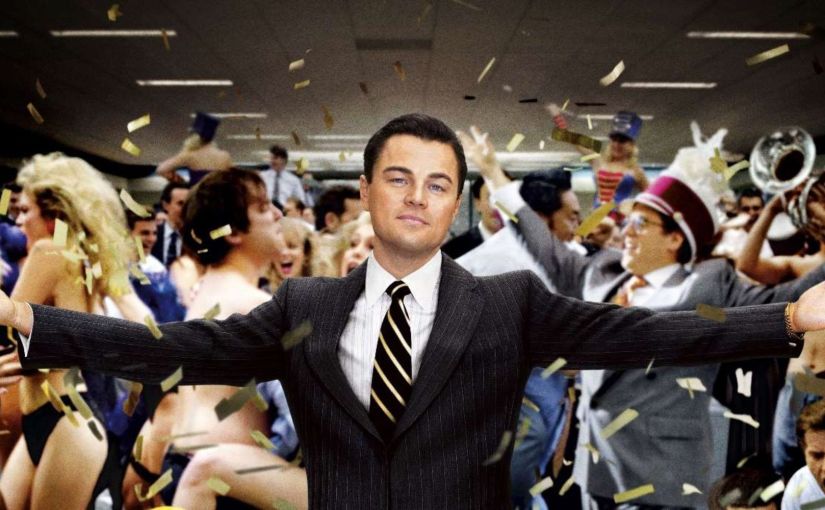
Leonardo DiCaprio explodes with rages of drug use, drinking, more drug use, banging prostitutes, even more drug use and pink slip stock trading along with some drug use. To get this manic, this wild, and this crazy requires a certain kind of energy to perform. The real Jordan Belfort must have had a massive amount of stamina to live this life. After all, he’s still alive today. DiCaprio, portraying the on-screen persona, throws himself into it. There’s no way he got to this pinnacle of hyperactivity on cue, with director Martin Scorsese’s call for action. DiCaprio had to thrust himself into this debauchery. It takes a certain skill to not let up on this. Pay attention to a hilarious scene where his quaaludes have paralyzed him to the point where he can’t even crawl to, much less open the door to his car. It’s a hilarious display of crippling physicality. DiCaprio maxed out on his Belfort portrayal, thereby earning his Oscar nomination. I thought he should have won that year. He lost to his cameo co-star, an excellent Matthew McConaughey for Dallas Buyers Club.

DiCaprio is so good that he yanks the entire cast into comparable craziness as well. Jonah Hill plays Jordan’s sidekick Donny: a buffoon of a guy who’ll whip out his member at inopportune times for attention and display. Hill doesn’t hold back either in his earned second nomination as well.

Scorsese, with a script by Terrance Winter based on Belfort’s book, is not concerned with necessarily showing a story arc where characters question their actions. Instead, he focuses on the hubris of all of this. Crashed helicopters, crashed cars, crashed planes and crashed luxury yachts not to mention endless office orgies, including one in first class on a commercial flight to Switzerland. It’s filmed very well, and while it is one over the top thing after another, it is nonetheless very funny and very entertaining.

The nerve of this guy, right? Yet that’s the thing about The Wolf Of Wall Street. Right from the get-go, Belfort is strongly urged to let up as the FBI easily closes in, and he doesn’t. It’s kinda crazy, really. Belfort put himself in an unwinnable situation and his addiction to money, drugs, ridiculous sex, and the ease by which he does it all calls to him to stay in the game until the lights just turn off.

This film marked the highly visible introduction of Margot Robbie as Jordan’s wife. She’s excellent with a New York accent (Robbie’s Australian) who loves the money and glamour but is not so stupid. Following up with a nominated role in I, Tonya (which she should have won against an aggravating Frances McDormand in Three Billboards…) and offering the best moments of Suicide Squad, it is easy to believe that she could go toe to toe with DiCaprio here. They have great arguments on screen together; funny but true.

Scorsese offers up his signature narrative voiceover from DiCaprio just as he did before in Goodfellas and Casino. His editor Thelma Schoonmaker is great at keeping the energy alive by taking advantage of the legendary director’s quick cuts and great music samplings.

The cast is just right with memorable moments from Jon Bernthal as Jordan’s tough guy friend and errand boy, Brad. (Bernthal is a great character actor all together. Check him out in Baby Driver, too.). Kyle Chandler is the modest element as the FBI agent who brings it all down. He knows he doesn’t have to exert himself too much. Belfort is doing all the work for him. Still, he spells it out harshly and honestly. No bullshit. He just cuts to the chase.

Other great appearances include Rob Reiner, Jon Favreau, Jean Dujardin, Joanna Lumley and I have to recognize Stephanie Kurtzuba. She offers a scene not widely recognized, as a disciple of Belfort’s team who is full of pomp, and confidence that far exceeds any of the guys alongside her. It occurs midway through and it’s an important moment because it really shows the power of influence Belfort had with his stockbrokers. He made them criminal millionaires overnight and to them he’s a Messiah. When Kurtzuba’s moment occurs, she solidifies the power of Belfort’s misdeeds.

It’s very easy to succumb to this lifestyle. Scorsese and Winter show how easily and quickly lots of unclaimed cash can be made at the expense of innocent people. It’s really fascinating. There’s no dimension to Belfort and his cronies of losers who would follow him anywhere despite the cost and the damage. That’s okay for me here. Simply because it fascinates me that he had the chutzpah to continue on with this immoral trajectory.

The Wolf Of Wall Street is a no holds barred, great film.

OUT OF AFRICA

By Marc S. Sanders

Sydney Pollack’s Out Of Africa might seem like a whirlwind romance if you’re only looking at the top billed names of the cast, Robert Redford and Meryl Streep, but it’s much more than that. It’s an education of the African continent beginning in 1913 when World War I was on the brink, and the British monarchy appeared to become territorial of its lands.

Karen Blixen (Streep) is a Danish Baroness who marries a Swedish nobleman, Baron Bror Blixen (Klaus Maria Brandauer) out of simple convenience. She plans to begin a cattle farm outside of Kenya to manage with Bror. To her unfortunate surprise, Bror has invested her monies in harvesting coffee on the land, which is much more difficult to produce at the altitude where they settle. Bror is also not so concerned with growing to love Karen and would much rather hunt on safari and be a womanizer, while welching off of Karen’s enterprise.

Karen grows to love Africa with its wildlife, as well as the local people whom she does not object to them squatting on her property. She provides medical aid and schooling for the children, too.

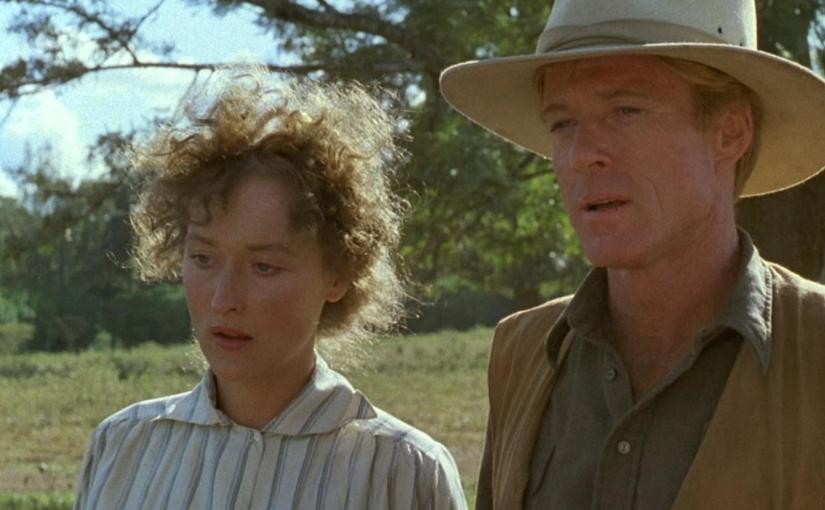
Karen also encounters the dashing adventurer, Denys Finch Hatton (Redford). Denys comes in and out of her life where he welcomes her on expeditions that are up close with lions and rhinos. He also takes her in his biplane to get God’s perspective of the lush scenery, a major centerpiece of the film. Denys, however, is not concerned with offering the full commitment Karen seeks. He’s happy to carry on with his safari treks only to return on occasion.

Clocking in at nearly three hours, Pollack’s film gives plenty of time and footage to absorb gorgeous landscape views of Africa from above and across the plains. The cinematography is on par with some of the best I’ve ever seen in a motion picture, compliments of David Watkin. The colors of sky with green, brown and yellow landscapes are breathtaking. Sunsets are spectacular with Redford’s silhouette in the foreground. Herds of cattle consisting of oxen, gazelles and lion feel so up close and personal. The production design of Karen’s home and coffee farm are also noticeably authentic. The home feels comfortable.

Out Of Africa is based on the stories told from Isek Denisen, Karen’s pseudonym. Like many of these sweeping epics, I find that I need to get accustomed to the nature of the film first. Dialects, when done authentically like Streep always strives for, are challenging for me to understand initially. The African people are hard to understand at times. As well, this is a period picture in a territory that I’m mostly unfamiliar with. So, I find that I have to adjust to the habitat and culture of the characters. Frankly, the first half hour or so was a little tough for me to stay with the picture. Once I got my footing with the film, though, I could not get enough. I felt terrible for Karen when she contracts syphilis. I was truly annoyed with how the Baron treats Karen with such disdain. It’s also heartbreaking when Karen and Denys are in disagreement with one another, simply because I loved the chemistry between Redford and Streep. Later setbacks feel tragic, especially as you feel like you’ve traveled through the progress and impactful differences that Karen affectionately made for Africa and its people.

Out Of Africa is an outstanding piece of filmmaking. It’s another example of a film where the setting is as much a character as the leads who carry the story. Sydney Pollack and his crew, which includes grand horn and string chords from Oscar winning composer John Barry present a captivating story that also feels rich in a documentarian point of view. A restored copy of the film on a large flat screen TV is a must see.

ALL THE PRESIDENT’S MEN

By Marc S. Sanders

People talk too much.

Ten minutes into Alan J Pakula’s film, that’s all I can think about. William Goldman’s dialogue heavy script pounds away at depicting Washington Post reporters Carl Bernstein and Bob Woodward’s uncovering of the Watergate break in, and it shows that simply, people talk too much. So much so that just a stutter or a name in passing conversation will dig the hole deeper and deeper towards self-incrimination, and that of other accomplices. Once a source trips up, then a good reporter can pounce.

Names, dates, slamming doors, rotary phones, typewriters and papers fly fast and furiously during Pakula’s film and that’s what upholds the breakneck pace of the investigative journalism. In a film like this, a crime is depicted and investigated, only the words are the real weapons.

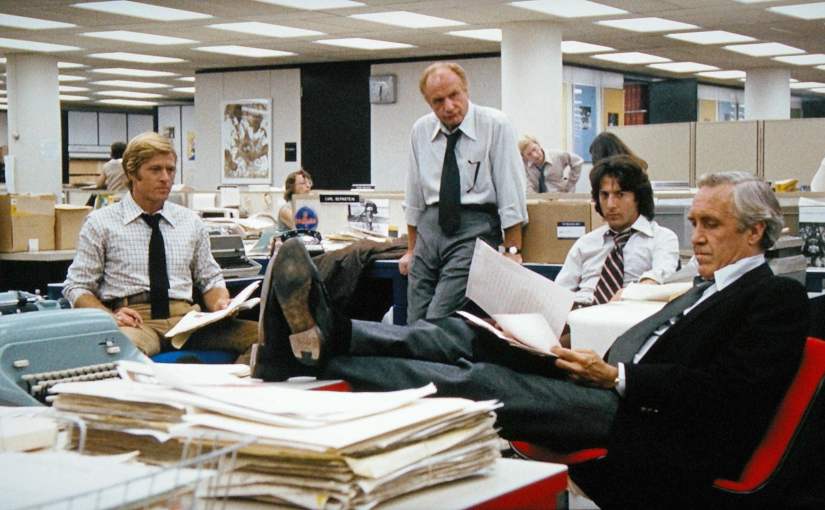
I don’t find All The President’s Men to be a history lesson in the corruption of Nixon’s administration. Rather, I only see what was necessary for Woodward & Bernstein to truthfully prove the corruption took place. The reporters, played by Robert Redford and Dustin Hoffman, seem to run on endless adrenaline of coffee, cigarettes and fast food effectively showing their drive while donning loose ties, wrinkled shirts, and crumpled notepads amid unkept desks and apartments. It’s visually convincing. A story like this doesn’t sleep, nor does it take a vacation. A story like this makes a viewer feel like he/she is still up at 2am, catching a cab to meet a shadowy source in a haunting parking garage; thanks Hal Holbrook for Deep Throat (“Follow the money.”).

Redford has a great scene where Pakula never stops running the camera on close up for over six minutes. All that Redford is doing is dialing, and talking on the phone while maintaining two different conversations. I don’t know if this moment happened in real life but I imagine the best reporters in a pre internet phase had to hold out for opportune times like this to fall into their laps. The cut does not end and Pakula was instinctively wise to do that. The scene itself serves that harrowing pace. Less is more in a moment like this. Props to Redford for maintaining the statuesque momentum.

Equally so, Hoffman has a couple of good moments with Jane Alexander (his eventual costar in Kramer vs Kramer.). She beautifully depicts a victim of intimidating threat, and Hoffman must tread carefully with his questions by strategically letting himself into her home, puffing on a cigarette, sipping cold coffee, speaking softly and eventually getting out his notepad as she gradually breaks down her shell. Alexander doesn’t make it easy and so their scenes work so well in taut suspense of low whispers.

Nixon’s cohorts really are not the antagonists here. In essence, Goldman’s script (based on the reporters’ published book) welcomes the challenge of acquiring factual reporting as the overall conflict. This is best represented by Jason Robards’ portrayal of Post Editor Ben Bradlee. Robards won an Oscar, and he so deserved it. He wouldn’t give “Woodstein” a break until the truth willed itself out by the proper means that are necessary. He’s intimidating in the role but he’s open minded enough to not ignore the young reporters’ instincts. I love watching his scenes; the way he commands an office from a chair with his feet up or fidgets and writes with his red pen. When his boys finally get a solid piece, Bradlee’s character breaks for one moment to knock on a desk and clap his hands as he walks away from his men. They got it. He didn’t relent, and they finally got it. I love that moment. Simply marvelous.

All The President’s Men remains a favorite film of mine. The dialogue moves so fast that after seeing it a number of times I still haven’t connected all the dots, and yet that’s what I appreciate about it. I see something new every time.

THE SUGARLAND EXPRESS

By Marc S. Sanders

Steven Spielberg’s second film, and first full-length theatrical release, is The Sugarland Express.  It’s inspired by real life events that consisted of a convict couple making their way to the Sugarland estate, located in Texas, to reunite with their toddler child living with foster parents.  Goldie Hawn played the mother, Lou Jean, who easily springs her husband, Clovis (William Atherton) from a pre-release penitentiary.  Clovis only had four months to go before a full release.  Once they’re out, they hijack a police car with the deputy driving and make their way across the state for Sugarland.  The rest of the police force, along with out of state authorities, are hot on their tail.  Pitifully speaking though, this becomes a long, drawn-out slow car chase.  It’s a pretty dim-witted story, but because it’s based on fact, well, some thought it’d make for an interesting two hours on film.

Unlike Spielberg’s first film, Duel, I didn’t find much inventiveness with The Sugarland Express.  If anything, it was likely green lit following what the director accomplished so well, at such a low expense, with his first film.  Car crash/car chase movies were also becoming trendy in the early ‘70s with Steve McQueen’s Bullitt becoming such a pioneering film of incredible automobile stunt work.  The French Connection would go on to win Best Picture a few years later with a centerpiece car chase to hang its hat on as well.  The Sugarland Express however is quite silly and very inferior to those pictures, though.

I was impressed with the infinite number of cars at Spielberg’s disposal and many of them get bashed up and crashed up in so many ways.  Yet, I grew tired of the novelty too.  The stakes didn’t seem so high with this film.  It is perhaps a film of its time.  After so many on the run pictures that were made with much better sophistication in the decades that followed, Spielberg’s film often feels unconvincing and unintentionally silly.  A funny moment occurs when Lou Jean needs to finally pee following miles and miles of endless driving.  The outlaws force the police led by Ben Johnson, in a nothing role with a big cowboy hat, to bring in a port o potty in the middle of an open field.  Cop cars are everywhere.  It’s clear as day outside.  Yet no one takes the opportunity for aggressive action.  Lou Jean gets to relieve herself.

As the pursuit carries on, Lou Jean and Clovis become celebrities, and crowds of townsfolk approach the car they occupy to lend them money and good wishes and even a pet pig.  Silly stuff mostly, but just not very amusing to me, and Goldie Hawn, who is normally a natural and adorable comedienne, is not very endearing here.  Lou Jean mostly screams in her redneck dialect and as a former beautician, styles her hair in the back seat applying endless amounts of hair spray to irritate Clovis and the deputy.

I didn’t find much camera work to impress me from Spielberg either.  I appreciated one moment in time however.  As the characters manage to hide out in an RV parking lot overnight, they watch an outdoor screening of a Roadrunner cartoon short out their back window.  Wile E Coyote falls victim to one of the Roadrunner’s tricks, and Spielberg captures a close up of Atherton with a foretelling expression of doom cross over his face.  It’s a nice moment that brought me back into the film, but then the ongoing themes of the film return thereafter.

I don’t care if it’s a true story.  I don’t care how ridiculously absurd it all amounted to.  The Sugarland Express was just noise for me.  Other absurdist stories of the 1970s, approached their subject matter better.  Films like Dog Day Afternoon whereas the ordeal continued to prolong, so did the mental exhaustion and desperation of the characters.  I’m afraid Spielberg just didn’t capture any of that here.

BOUND FOR GLORY

By Marc S. Sanders

David Carradine plays Woody Guthrie in Bound For Glory, directed by Hal Ashby.  It’s a magnificent performance in a well-constructed film especially by the standards available in 1976, and still today in 2022.  Yet, am I capable of showering the film with additional accolades?

My first viewing of the Oscar nominated picture occurred with my Cinephile pals (Thomas Pahl, Anthony Jason and Miguel Rodriguez).  More or less, we all had the same reaction.  The film is as slow moving as much as the slow-moving trek that Guthrie embarks on from his dustbowl home town of Pampa, Texas all the way to California.  Guthrie is a musician, especially when he’s strumming a guitar and he’s altogether attractive to anyone within earshot as he seemingly makes up the lyrics to his Depression-era Americana songs on the fly.  Anyone reading this has certainly heard of “This Land Is Your Land.”

Woody is married to Mary (Melinda Dillon) with two children, and as the film opens in 1936, his hometown is flat broke.  There are no jobs anywhere.  Families are abandoning their homes that they can’t afford to maintain.  Literally, no one has two nickels to rub together.  It also doesn’t help that the town and outlying areas are plagued with monstrous dust storms.  Ashby with legendary cinematographer Haskell Wexler offer up a caption of one such storm towering over the town like a terrible tsunami.  Even on Blu Ray, this is eye opening.  It’s a magnificent visual effect that took me completely by surprise. 

Shortly thereafter, Woody ups and leaves his family with just a note saying he’ll send for them once he settles down in California.  I can only guess he’s looking for a better life, and I can only presume California is the promised land of wealth and well…glory!  I don’t recall a prior conversation that praises the state as the land of milk and honey.

Wexler spoils the viewer with countless moments of scenic design as the film moves on.  We follow Guthrie as he walks the endless roads towards the west with nothing to hold in his hands.  He hops on cars that pass by.  He also hitches rides upon locomotives heading in the western direction.  Ashby reminds us that the sojourn is not easy. Seems like everyone has the same idea in mind as Woody; looking for a better way of life. Fights for sitting space on train cars break out.  Authorities try to shoot stowaways off the trains, and the best place to hide is maybe on the roof of the train, or simply hanging on to a ladder with your elbow painfully folded over, as the train moves on.

Whenever I watch a film, I try to make a habit not to look at the time.  If I do, I feel like I’ve broken the wall of the environment I should be immersed in.  I kept to my rule on this film, but Guthrie’s journey takes so long, that I truly thought once he reached California, that would be the end of the picture.  Not so.  There was at least another hour to go.  Wow, did this thing move at a snail’s pace.  Woody arrives and gets into episodes of infidelity, and more importantly he bonds with another strummer named Ozark Blue (Ronny Cox), who travels the state singing in support of a union for the poor and destitute working odd jobs on farms and railroads earning only pennies by the day.  Woody eagerly takes up the cause even as he is becoming a pop sensation on the radio.  The fight for the rights of the poor becomes so passionate for him that he butts heads with the radio big wigs who insist on knowing what he’s going to sing about on air, to ensure the wealthy sponsors remain happy. 

I read briefly afterwards that much of what is depicted in Bound For Glory is actually not true to Woody Guthrie’s story.  My buddies felt a little betrayed knowing that.  I still don’t know what is and isn’t accurate.  I dismissed all of that, though.  What fascinated me was the technical work of the film.  When David Carradine is leaping on to a moving train or jumping off of it, that’s really him.  We also uncovered that along with Rocky, also released in 1976, Ashby’s picture was one of the first to use a Steadicam and the output is marvelous.  Ashby with Wexell’s lens is unbelievably impressive.  They capture Carradine walk through an ocean of extras while strumming the guitar and singing in the moment; his voice never cracking and all happening in one take.  Carradine is seen standing in between train cars and lying on top of them with the rising or dawning sun in the foreground.  The film delivers a literal moving picture to Woody Guthrie’s most famous song “This Land Is Your Land.”  For a film made in the mid-1970s I certainly believed what was captured was genuine to the mid-1930s. 

Ashby also seemed to be inspired by the The Grapes Of Wrath.  Numerous cars of the time are disproportionally stacked with furniture like dressers, kitchen chairs and tables, along with knapsacks and sleeping bags, while the raggedly clothed children hang out the window or sit on top.  A nipple bottle top is attached to a glass Coke bottle for a baby to drink from.  If you are looking for reference material of what it was like to live in the times of the Depression, look no further than Bound For Glory.

I can’t say I will rush back to watch this film again.  The story never grasped me.  I was waiting for that special turnaround moment to come that would perk up my interest.  It just never arrived.  There’s no question, however, that the merits of the piece stem from the set design and camera work at play.  It is absolutely jaw dropping.  Woody Guthrie’s story, though, not so much.  He had faults. We learn he is not a devoted family man (something we’ve seen many times over in countless stories), and his drive to fight for the rights of the working man doesn’t appear to stretch very far.  After nearly 2 hours and twenty minutes, Guthrie up and decides to resume his countrywide walkabout on trains to sing in devotion for the working class across the country, but beyond a favorite camp fire song, what else did he truly accomplish?  There’s never a time when he sways the authority to see it his way, and there’s never an announcement that a union is established in direct response to Woody’s movement.  At best, we are offered Randy Quaid in a small role as a one of the poor family men who reminds Woody to keep doing what he’s doing.  However, that’s a staple of any biography film really, and in pictures like Malcolm X or The Last Emperor, it seemed that much more effective. 

Maybe there was more to Woody Guthrie.  I just didn’t feel that Bound For Glory illustrated much beyond the song we all know and love.  So, was that enough? 

QUIZ SHOW

By Marc S. Sanders

Robert Redford’s 1994 masterpiece deserves much more recognition than it ever got.

Here, he produced and directed a stellar cast that showed how America was always in it for the competition and for the glory and for the fame and naturally for the money.

Redford opens his film with a car salesman describing the regal elegance and perfection of a 1957 Chrysler convertible. It’s a gorgeous car. Then the potential buyer turns on the radio. The car isn’t so fascinating anymore as a news announcement reveals that Russia beat the United States into space with its launch of Sputnik. All America has now is just a car.

Opening credits roll and the next American sensation is presented, “21,” the most popular show displayed on the greatest invention, a home television set. However, the show is all a lie, and yet by the end it’ll survive along with its network, NBC, and its wealthy sponsors.

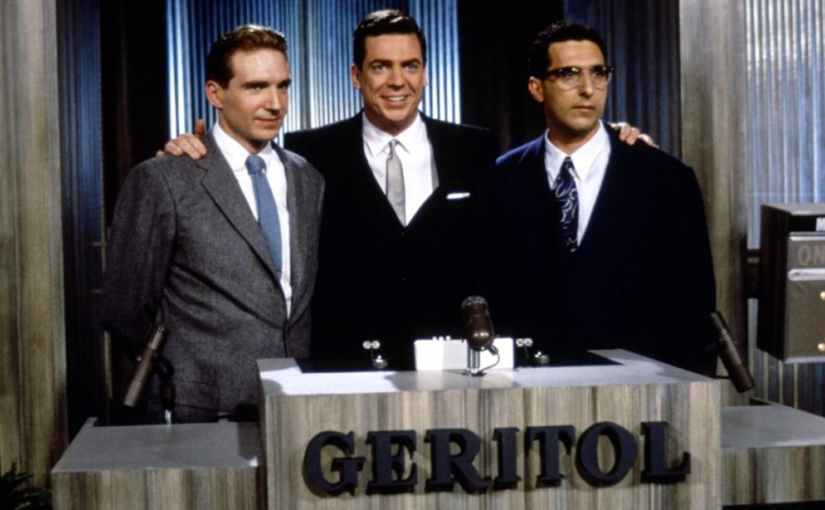
Quiz Show foreshadows the cost of fame and attention. It’s a wonderful sensation until it’s stripped away in personal disgrace. John Turturro (how did he not get an Oscar nomination?) is Herb Stemple, the champion, nerdy schlub who is growing tiresome among producers and audiences. He is forced to take a dive and be replaced by the handsome Charles Van Doren played Ralph Fiennes, a member of one of the country’s most intellectually gifted families. The difference in appearance is obvious. So is the desire for a change in programming. What’s obvious is how the two men are exploited as pawns for gain in corporate America. Cheat, but if you call it television, what harm is there really?

The harm falls in public perception. Disgrace comes to these men, and worse, to their families. It mirrors modern stories like Harvey Weinstein, Joe Paterno, Bill Cosby, Kevin Spacey and Matt Lauer.

It’s a very calm film that debates the ethics of these men and necessities to uncover the truths and reveal the falsehoods.

Redford only gets aggressive in his period settings and I’m thankful for it. Nothing looks out of place, including the large enthusiastic grins of a 1950s American viewing audience dressed elegantly and innocent. Even nuns and pajama clad children are invested in “21.” This clean cut appearance will soon fade , however, after the quiz show scandal dies down.

Ugly lies and denials were committed against Redford’s beautiful backdrops. Therein lies the necessary conflict of another fascinating story.

Was this country ever innocent?

THE BIG SHORT

By Marc S. Sanders

Ever since Adam McKay’s The Big Short was released in 2015, it has remained a favorite film of mine. I watch it at least once every year. McKay’s script with Charles Randolph, adapted from the book by Michael Lewis, is enormously funny but also realistically frightening.

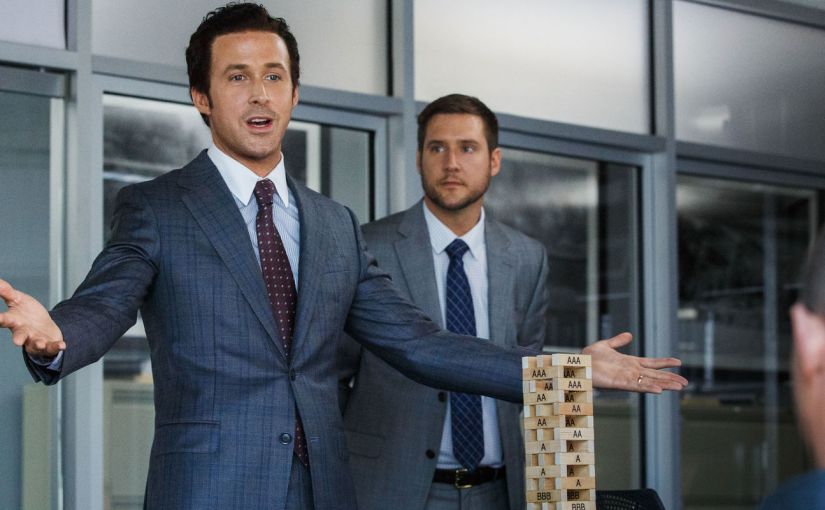
The film shows how America’s housing market crashed in the first decade of the 21st Century. Mortgage backed securities never failed in history until now, and no one anywhere, especially the banks, ever believed a crash would occur, but it did. Only a select few people like Dr. Michael Burry (Christian Bale) and Jared Vennet (Ryan Gosling) foresaw what no one else could imagine, and thus they took advantage of it by making enormous betting transactions against the housing market. To say you need a strong stomach for this kind of investment is a serious understatement.

Burry is the first one to realize that the country as a whole will default on their mortgages once their interest rates go up in 2007. He represents Scion Capital and invests billions of dollars against the mortgage backed investments. Now he watches for the next two years while the capital at Scion declines into negative digits and drowns out the frustration with death metal music. Bale is fascinating as Burry who has a brilliant mind, but he lacks social skills.

Vennet gets wind of Burry’s discovery and sells the idea to Mark Baum (Steve Carell) and his team of representatives. Vennett narrates how it all played out in the market; how ratings agencies gave triple A rankings to bonds made up of worthless backed securities. McKay wisely has Vennett introduce celebrities like Margot Robbie, Anthony Bourdain and Selena Gomez to break down the vast complexities of everything. Robbie in a bathtub. Gomez playing black jack. It’s hilarious and relatable. Gosling is great. A great scene is his selling presentation which includes a metaphoric prop of a Jenga tower. Vennet has no qualms about collecting premiums as the rest of the country is going down. He’s profiting, and why not? Big banks have been doing it for years.

Carell is spectacular as well as Mark Baum. He has a heart, but he’s an angry individual. It sickens him to make money off this short buy, but it’s the responsible action to take for the benefit of his own clients. Mark also suffers from his brother’s suicide. McKay allows just enough time for this to draw out the misery of this character. Carell should have gotten an Oscar nomination at least. Baum is a guy with no filter as he confronts authoritarian parties throughout the film. He’s a hero really, but he’s not a guy I’d ever want to be left in a room with either.

An additional story arc comes from two young guys (Finn Wittrock & John Magaro) who also uncover this opportunity. They enlist Brad Pitt as a recluse who get them into the arena of big traders. These kids who started their investment company in a garage are great as well. Another party who came out of nowhere to uncover what no one else saw.

McKay assembled a magnificent blend of actors for these unusual characters who always hid behind their computer monitors. He directs with a lighthearted approach having his characters breaking the 4th wall at times to explain what all of this means in the simplest terms.

As simple as McKay makes it with his humor, this was a terrible, terrible tragedy putting millions of people out of work and owners losing their homes. Even renters lost their homes. Pay your rent but it means nothing if your landlord isn’t paying his mortgage. McKay tragically shows this outcome.

It’s terrible to imagine, but it’s a major downfall of the American economy. When the country, is doing well, while paying short term low interest rates, no one concerns themselves with what could all go away in an instant. It’s a vicious cycle, and the only funny thing about it all is that the supposedly most brilliant investors will naively allow this to happen over and over again.

The Big Short is one of the best films made in the last 20 years.

BLACKKKLANSMAN

By Marc S. Sanders

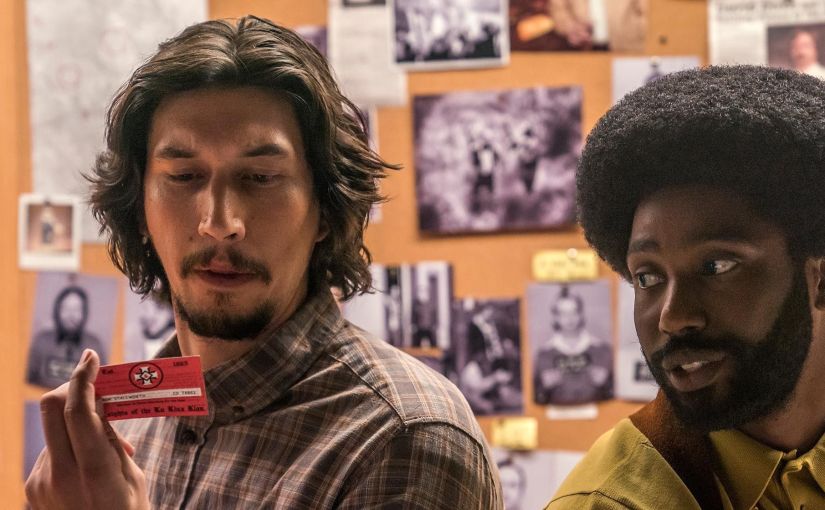
Spike Lee has finally received a Best Director Oscar nomination for his film BlacKkKlansman. It is based on the book by Ron Stallworth. In the 1970s, Stallworth was the only black police officer in the Colorado Springs police department. He was always ready to face the backlash and criticism for his afro and skin color. He also orchestrated an infiltration of the Ku Klux Klan while developing a trust with their Grand Wizard and eventual Presidential candidate David Duke.

John David Washington (son of Denzel) portrays Stallworth with high intelligence, instinct and even tolerance to stay focused on the end goal of incriminating Klan members out to do more than just march. Stallworth partners up with Flipp Zimmerman, a Jewish cop who will make his presence as Stallworth among the ranks of the Klan. Call it a Cyrano set up. Stallworth does the talking over the phone. Flipp stands in their presence.

I’ve usually been hot and cold on Spike Lee. Forgive me but when a “Spike Lee Joint” debuts in theatres, my subconscious immediately expects a very biased and unfair viewpoint of racial tensions in America. I don’t care for Lee’s outspoken statements in the media at times and I shake my head at some of his misguided actions. That’s another conversation that I welcome to have with anyone at another time. However, Lee takes a very aware and balanced approach here. The film opens with Alec Baldwin as an evil messenger of hate attempting to record a sermon for his disciples. Lee films Baldwin very disturbingly among different color hues and jittery close ups and wide angles. It’s nauseating and it should be.

Then Stallworth’s story begins and he is assigned to go undercover at a former Black Panther member’s (played by Corey Hawkins, who I loved in the revival of 24) speaking event on a college campus. The police expect this will be an orchestration of violence among the black community but Stallworth sees it is anything but that. Lee commits a beautiful filmmaking effort as he shows the faces of black people listening to the speech in spotlights as Hawkins continues on. These are college students simply looking for a way to never succumb to anyone who considers them inferior. The speaker does hold the white man accountable, yes, and I don’t care for that as I’m a white man with no instinct of superiority. Therefore, don’t lump me in with a small sect of misguided people, please. Still, the scene is effective and relatable. America has its ugly histories and America is not settling for insensible and uncaring treatment of its people either.

From here, the film takes on a more linear story as Stallworth and Zimmerman build their case.

Lee offers good debates among his cast of characters. Stallworth becomes attracted to an activist named Patrice, played very well by Laura Harrier. Here’s hoping to a long, successful career for her. Patrice believes the police are the enemy and even questions if Stallworth will remain a police officer following this case. Stallworth takes pride in being a cop. Black Life vs Law Enforcement.

Stallworth and Zimmerman bear witness to the mentality of the Klan. Over and over the Klan members suspect Zimmerman of his Judaism. He denies it and goes to great lengths to disprove his heritage and yet the Klan continues to question him, despite some high level members truly believing his guise of white supreme devotion. White Supremicists vs. Judaica & Black Life.

Lee has offered a powerful film that left my wife and I up until two in the morning discussing its dynamics; discussing how many things have changed for the good since the 50s; discussing how many have gotten better, have gotten worse and how some things have sadly resurfaced in recent years.

BlacKkKlansman reminds me that Lee is truly an accomplished filmmaker. Beyond his messages and viewpoints, Lee knows how to edit a scene and offer inventive camera angles and direction. He’s a prize student of film, now a teacher. This latest effort is a reminder of how Lee’s production of Malcolm X in 1991 was robbed of recognition at the Academy Awards, a true injustice.

BlacKkKlansman is Spike Lee’s best film since Malcolm X and one of the best films of 2018.

HOUSE OF GUCCI (2021)

by Miguel E. Rodriguez

Director: Ridley Scott
Cast: Lady Gaga, Adam Driver, Jared Leto, Al Pacino, Jeremy Irons, Salma Hayek
My Rating: 5/10
Rotten Tomatometer: 61%

PLOT: An outsider marries into the Gucci family, and her unbridled ambition triggers a downward spiral of betrayal, revenge, and violence.


Watching Ridley Scott’s House of Gucci was a curious experience.  I could see glimmers of a great entertainment through bars of slow pacing, a meandering story, and unanswered questions.  The performances are top-notch, no question, but they are at the service of a movie that doesn’t seem interested in meeting their level of passion.

Inspired by true events, the movie tells the story of Patrizia Reggiani, a young woman from humble beginnings who meets and eventually marries Maurizio (Adam Driver), one of the heirs to the Gucci fashion empire.  Patrizia is played with fury and fire by Lady Gaga, who seems destined for another Oscar nomination.  Her character is portrayed as a latter-day Lady Macbeth, someone who sees through the deceptions of her new husband’s business associates and manipulates people and events for her family’s benefit.  In true tragic form, her ambitions threaten to derail everything she loves.

Adam Driver plays Maurizio as a rather slow fellow who disinherits himself so he can marry Patrizia but finds a way back into the fold via his uncle, Aldo (Al Pacino), who sees Maurizio as a good substitute for his own disappointing son, Paolo.  Paolo is played by Jared Leto, in another of the film’s performances destined for Oscar recognition.  Buried underneath flawless makeup and a skin cap, Leto portrays Paolo as a self-deluded buffoon whose fashion designs aren’t so much daring as unfortunate.  (Apparently, pastels and brown were never meant to mix…who knew?)

I mention the performances because they are the sole highlights of the film.  For two-and-a-half hours, these performances play against a backdrop of one dreary scene after another. Sure, the performances are fun to watch, but at the end of the day, if they don’t have anything interesting to say, it gets a little boring.  We get behind-the-scenes intrigues and betrayals that seem to owe more than a little to earlier crime epics by Scorsese and Coppola, but there was nothing to get really excited about.  Nothing grabbed me.

Ridley Scott’s films are normally way more imaginative than this.  They look better.  The cinematography is usually more inspired.  I’m not talking about his action or sci-fi epics, either.  I mean his small-scale triumphs like Matchstick Men or Thelma & Louise.  What happened here?  Was he not inspired by the story?  There is great material here, more than enough back-stabbing and lying and cheating to go around.  Yet everything is subdued, and plods, and inspires more yawns than anything else.  I didn’t experience any kind of excitement or passion one way or the other for any of the characters, or for the story.  It just didn’t make me care.

By the time House of Gucci is over, we’ve seen betrayals, marital infidelity, divorce, back-stabbing business deals, sex, and murder.  I have a friend who wrote a stage play that has almost all of those things, and it was WAY more entertaining than this film.

ROCKETMAN (2019)

by Miguel E. Rodriguez

Director: Dexter Fletcher
Cast: Taron Egerton, Jamie Bell, Richard Madden, Bryce Dallas Howard
My Rating: 8/10
Rotten Tomatometer: 86% Certified Fresh

PLOT: A musical fantasy about Elton John’s (Egerton) breakthrough years in the 1970s.


Much more so than Bohemian Rhapsody, Rocketman feels like a genuine musical.  On top of that, it also provides much more insight into the lead character than Rhapsody did.  I did feel that it was stretching a bit, trying a bit too hard to pluck the old heartstrings towards the end of the film.  But the fact remains that I was more invested in the Elton John character than Freddie Mercury.

I think a big part of that improvement is due to the way Rocketman is structured.  The entire film is played out in a series of flashbacks, ostensibly during a group therapy session at a rehab clinic.  I say “ostensibly” because, in the opening moments of the film, he apparently walks into the session moments after abandoning his Madison Square Garden concert.  He is in full Elton John regalia: a flaming orange and red outfit complete with spreading wings on his back and devil horns on his head.  Through most of the film (after his meteoric rise to fame), he will do his best to live up to the devilish nature of this costume.

(This structure is not new…see, for example, De-Lovely, in which Cole Porter defends his life to a mysterious figure at the moment of his death.)

I have said over and over again, on Facebook and to my fellow cinephiles, how I cannot handle movies or TV shows with loathsome characters as the leads.  I can never and will never watch the TV show Mad Men.  No power on earth will ever compel me to sit through another screening of What About Bob? If someone had shot Jennifer Lawrence’s character in American Hustle with a shotgun, I would have cheered.

And yet here is Rocketman, featuring a lead character who, in the course of the movie…let me see…gets himself addicted to drugs and alcohol, succeeds in alienating anyone and everyone close to him, attempts suicide, gets the venue city name wrong during a massive concert (that’s a BIG no-no), ditches the people who made him famous in the first place out of misplaced affection for his smarmy manager/lover, and marries a woman (out of nowhere) knowing full well he is gay.

He does all of these things, and yet I was still on his side.  Weird, right?  The last time I felt that kind of empathy for a troubled lead character was in Ray.  (I’m not equating the two films, just remarking on their similarity.)  If I had to draw a line connecting those two films, and why I was able to handle their anti-social tendencies, the first things that come to mind are their music and their backstories.  The music produced by Ray Charles and Elton John (and Elton’s inseparable collaborator, Bernie Taupin) is on such a level that it was intriguing to me to watch their characters evolve, to see where such music comes from, and how much suffering is sometimes (always?) necessary for greatness to be achieved.

Another aspect of Rocketman’s success is the way unique visual tricks were used to convey the extreme emotional impact of certain events in Elton John’s life.  I’m thinking especially of his first concert at the famed Troubador nightclub in Los Angeles.  After a few agonizing seconds of nervous silence, Elton and his band break into “Crocodile Rock”, and when the bouncy chorus begins with its high, ‘50s-esque falsettos, there is a glorious moment when Elton, the band, and the crowd slowly levitate in the air, transported by the music.  I can imagine the real Elton John describing that moment in that specific way.  Or any number of performers describing their one supremely perfect moment in the spotlight, that one fleeting moment in time when it felt like the world revolved around them and their music, or their monologue, or their pas-de-deux.  It’s a magical sequence.

I cannot call Rocketman a perfect biopic.  As I mentioned before, it tries a little too hard at the end.  There is a bit of speechifying that is intended to get a gut-wrenching emotional reaction, but which I felt was a little too much of a muchness.  But it is an improvement on Bohemian Rhapsody.  I got a much fuller picture of Elton John’s life before he became THE Elton John, and as such, I was much more invested in how things turned out.