RUSTIN

By Marc S. Sanders

I’ve heard of Martin Luther King Jr.  I’ve heard of Rosa Parks.  I’ve heard of Malcom X.  I’ve heard of Medgar Evars. 

I had never heard of Bayard Rustin. 

I guess there’s just a lot of history left out of the books.

Rustin tells the story of Bayard Rustin (2023 Oscar nominee Colman Domingo) who was treated as an outcast by his friend Dr. King and the NAACP when he attempted to think of the grand possibilities of organizing the largest civil march ever to happen.  The secretly homosexual civil rights organizer eventually did see his vision come to light, however, but he had to get started with very little support or resources.  Director George C Wolfe with screenwriters Dustin Lance Black and Julian Breece use this film to depict how it all came together.

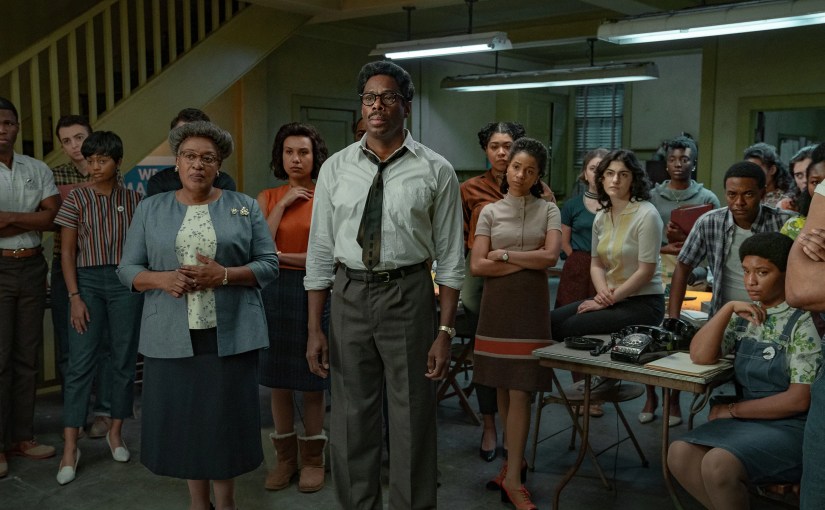
When I saw George C Wolfe’s Ma Rainey’s Black Bottom (with Oscar nominee Chadwick Boseman) my take was that it worked like a stage play on a unit set.  The sensational cast of Rustin perform in the same way, catering to what would be a live audience.  However, the unit set has been expanded to a headquarters office on the second floor, as well as Rustin’s bedroom, and the steps of the Lincoln Memorial and the National Mall in Washington D.C.  While the CGI background of the nation’s capital do not appear seamless against the cast, it is fortunate that very little of it upstages the performances from Domingo, Chris Rock, Glynn Turman, CCH Pounder, and especially Aml Ameen as Martin Luther King Jr.

Colman Domingo portrays this individual with unwavering confidence in his character.  Rustin insists on a non-violent two-day march, despite the local authorities who only grant him one day and limited resources.  One problem is that there are not enough hotels that will accommodate black guests.  Segregation might have ended in 1954, but in 1963, you would believe otherwise.  While debating with the police captain in front of Lincoln Memorial, Rustin is accused of raising his voice and yet he reminds the captain that he’s never changed the volume of his tone.  Rustin vows that this march will exceed 100,000 people from all different states.  He’s also adamant about the police authorities not carrying their service weapons to steer clear of any reason to incite violence. 

A bigger problem is bubbling within his own community of civil rights leaders.  He’s no longer associated with the NAACP which has Roy Wilkins (Chris Rock) leading the charge. Still, he needs their support. Because he does not have the respect, charm and arguably the good looks of Dr. King, Bayard’s passion falls on deaf ears and a lack of motivation from these powerful men of influence.  A large challenge comes from the arrogant Representative Adam Clayton Powell (Jeffrey Wright) who will proudly sit at the other side of the table with his long cigarette, pressed suit and pencil thin salt and pepper mustache.  With a gruff tone in Wright’s voice, this is a marvelous antagonist.

Over the radio airwaves, Senator Strom Thurmond, who was still in office at close to age 100, all the way through 2003, is building a campaign against Bayard Rustin.  Rustin has a past of suspected ties to the Communist Party, and it will also not bode well if his closeted homosexuality is revealed.  On top of that, Mr. Rustin lives with personal problems and imperfections just like anyone else.  He is trying to balance a relationship with Tom (Gus Halper) a young, white gay man and strong supporter of the cause, but Bayard is also involved with a married, closeted man as well.  None of these issues can be afforded to weigh down what Mr. Rustin and his team of youthful, optimistic volunteers are striving for.

Wolfe’s film is less than two hours, though I wish it could have been longer.  It is very engaging and certainly not difficult to follow, especially when text appears on screen to tell us who everyone is from the start.  The movie efficiently incorporates all of these dimensions into isolated episodes for Baynard Rustin to confront.  Primarily, it reflects the debates he has with the civil rights leaders and the naysayers.  There are wonderful moments shared between Colman Domingo and Aml Ameen.  Domingo also has great scenes with Gus Halper who plays Tom as someone uncompromised in the mission even if his lover is unfaithful.  Domingo is the more compelling scene partner with Chris Rock, though, who I have never considered a strong actor. A good effort is made here, but Rock is not altogether convincing as an NAACP leader. 

What I wish for, however, is some more reenacted footage of the actual historic event that famously included Martin Luther King’s “I Have A Dream” speech.  There’s a slight tease of that speech but King was so appealing in that moment that it could never be recreated so well.  It was already perfect.  What I wanted to see was some other happenings going on during this event.  We see buses arrive, chairs getting set up, people gathering, mostly black, but other races as well. What other speeches occurred on that day?  What else was said? 

I recall an episode of The Cosby Show where Theo and Cockroach had to write a school paper about the event and their parents and grandparents talked about how they drove down from New York to D.C. in buses and how hot it was that day. They described people who wore pins that said “Kiss Me I’m Black,” “Kiss Me I’m Jewish,” “Kiss Me I’m Irish,” and so on.  It might have been said to lean into Cosby’s brand of humor, but I also believe it was true.  That episode seemed much more descriptive in about ten minutes of sitcom dialogue than the film Rustin depicted. 

How was the audience on the National Mall responding?  Were people fanning themselves from the heat?  What were they saying to one another?  What songs were they singing?  Wolfe’s film only gives a tiny glimpse of this groundbreaking moment in time when 250,000 people assembled. The picture just doesn’t appear entirely painted.  Perhaps budgetary reasons were the cause of that.

Rustin is a good film and does a fine job of depicting this unsung man’s achievements despite the challenges he always faced with a smile.  Domingo is great at donning the grin with missing teeth and clumsy black framed glasses, and a loose tie with a wrinkled shirt.  He is positively absorbed in this period of time.  Still, it would have been welcome to see more of his end results. 

The picture concludes on a terrific beat before the inevitable footnote text arrives with most film biographies.  I have just observed a man who will not shut up and never tire from pursuing his seemingly impossible dream.  Baynard Rustin was likely considered a pest who would not let up.  Yet, the script closes on the fact that in spite of all I have witnessed, Bayard Rustin was likely the humblest of all of these civil rights servants.

Go learn more about our Civil Rights history and allow yourself to see one of the best performances of the 2023. 

NYAD

By Marc S. Sanders

When some people go through a midlife crisis, they might buy themselves a car, get a new job or opt to not get out of bed for several days.  When Diana Nyad goes through a midlife crisis in her early sixties, she motivates herself to swim 103 miles from Cuba to Florida.  She came up short at age 28, but over thirty years later no one is going to convince her she shouldn’t try again.

Annette Bening portrays the real-life swimmer whose determination will bear the brunt of self-torture to complete arguably the maritime equivalent of climbing Everest.  Jodie Foster is Diana’s best friend and coach, Bonnie Stoll.  As acting partners and the characters they play, the leading ladies make a good pair.  

My first compliment has to go to the makeup department led by Ana María Andrickson.  The actresses received Oscar nominations, but the work done on Bening to play Nyad is astoundingly convincing. Diana makes several attempts to try to complete this challenge that’s never been accomplished before.  With each try, the dried-up complexion, blistering sunburns, chapped lips and bloodied cracks that prominently show on her body are truly painful and awfully uncomfortable to gaze upon.  At times, I was not as focused on the dialogue shared between Foster and Bening as I was on Andrickson’s masterful work.  The makeup alone tells an impactful story. A clear oversight by the Academy.

Annette Bening is particularly good in her role.  At times she’s a terrible annoyance and unlikable.  Yet, a sixty something year old woman who wants to defy all logic and the literal forces of nature will have to be a certain brand of jerk to move forward with her goals. This also comes with the natural degeneration of a body of freckled dry skin, loss of muscle mass and arthritic bones. Bening is far removed from the glamorous roles of an impressively long career past (Bugsy, American Beauty) to get to a persistent, unwavering zenith that the real Diana Nyad had to emote.

Jodie Foster is fine as Nyad’s best friend and former lover now coach.  I’m not sure all the award nominated praise she’s received for this part is merited, but she’s worthy of falling in line with other celebratory coaching mentors like Mickey from the Rocky films and Mr. Miyagi from The Karate Kid.  The film focuses so much on Diana Nyad though that there’s not much depth to Foster’s role.  She does the job, but it did not feel like it demanded much.  Frankly, Viola Davis in Air and Maura Tierny in The Iron Claw left me with more of an impression in an astounding year of great films and performances from 2023.

The unsung cast member who’s getting next to no press recognition is Rhys Ifans as John Bartlett, an oceanographer recruited by Nyad and Stoll to gauge immediate weather patterns and what the currents of the Atlantic are expected to do during the swimmer’s trek.  Ifans is a fantastic supporting character actor who is tasked with finding that suitable small window of time for Diana to start her journey. Within the context of the script, he offers the suspense needed for this sports film.  Can Diana Nyad hold up against the very real and insurmountable warnings that John describes?

Swimming is quite boring to watch.  However, this venture has cause for concerns.  Brutal storms, stinging jellyfish with undetectable approaches, and sharks.  Salt water, weakness and fatigue, the chops of the tide and mental hallucinations are also bears of contention.  A charter boat with Bonnie and John on board with a watchful, supportive crew sail alongside the swimmer, but they can only do so much if she intends to achieve her seemingly impossible goal unassisted.

Elizabeth Chai Vasarhelyi and Jimmy Chin are the directing team for Nyad with a script written by Julia Cox based on Diana Nyad’s novel account.  Most of the film is patterned like many other sports films focusing on an underdog.  I knew nothing about this person or her accomplishments.  Frankly, what I’ve learned is unbelievably impressive beyond what this picture focuses on.  Naturally, you’ll get an idea of how the story is going to conclude.

To enhance the ho hum activity of the swimming scenes, the filmmakers incorporate some of Nyad’s dreamlike delusions to get inside her head.  Falling rainbow stars onto the ocean surface as well as a yellow brick road leading to the Taj Mahal look as fantastical as they should, even if they drift into sidebar distractions.  I appreciated the handful of scenes where Rhys Ifans lays out the desperate concern shared with Jodie Foster about a lack of progress where Diana is wasting strokes against a current as well as his fear of oncoming sharks.  He builds suspense to keep the film focused. It’s pretty cool by the way how the crew responds to the shark issue.  

In addition, as good as Bening and Foster are with enormous careers of outstanding roles, much of their shared dialogue often comes off a little too hokey.  Granted, it’s a standard sports film and it’s more impressive that it’s all true, but Nyad sometimes plays off like a cheesy TV movie lacking that cinematic edge I was looking for.

An unclear element offers glimpses of Diana’s past as a beginner child swimmer who suffered personal trauma. It’s clear what happened to her, but these quick flashbacks are also mixed in with an unclear picture of her parental lineage and other ingredients.  I still don’t know why there were snippets of Diana playing Parcheesi.  Nor do I know who she was playing with to uphold its significance in the final edit of the movie.

Nyad is a biography worth seeing. The endurance the central character sustains to achieve the impossible is tremendously inspiring.  The thought that was running through my mind over the course of the film is that this woman wants to dominate over a powerful Mother Nature.  By the end, you see real life clips of Diana Nyad insisting to audiences that no matter who you are or what age you’re at in life, nothing can defeat what you want to overcome.  As well, whatever you succeed at likely deserves enormous credit for the support team that accompanied you.  Often, I’m a naysayer of Diana’s mantra because I think I’ve chalked up at least five times more failures than successes in my life.  Still, here is the person who eventually proved me wrong.  I should also note that I learn from my failures and remain hopeful that it will lead to success.

I often tell myself never to argue with a woman. Well, at least now I know never to argue with Diana Nyad.  

THE ZONE OF INTEREST

By Marc S. Sanders

Rudolph Höss, and his wife Hedwig, have five children and they seem to live in peace and serenity within a beautiful home that contains plenty of bedroom space, sunlight, a vegetable garden, a pool to splash in and a babbling brook to fish and swim in.  You might say it is The Zone Of Interest that keeps their life so fulfilling.  Yet, beyond their pleasures is the Auschwitz concentration camp conveniently located next door for Rudolph to carry out his responsibilities as a Nazi Commandant. 

Jonathan Glazer writes and directs this quietly effective piece while breathlessly showing a flawed ignorance and apathy for the countless Jewish lives lost during the Holocaust.  The tactics Glazer uses in his film work on your senses first.  Following a long series of production company names that herald from America, England and Poland, the title of the movie appears in big white thin letters against a black screen.  Slowly over a long 3-4 minutes the letters fade as faint music and sound transition.  The music gets softer, as birds chirp and then there are faint gunshots in a distance.  A picture finally appears, and we see the Höss family basking under blue sky and sun while picking flowers alongside the brook.  It’s not even possible to identify the time or setting of this story yet.  Soon after, Rudolph (Christian Friedel) is stepping out of his home in his full-dress Nazi uniform on the morning of his birthday.  Hedwig (Sandra Hüller, Oscar nominated in Anatomy Of A Fall) and the children gift him a beautiful, freshly painted kayak.  Glazer then changes the position of his camera in the opposite direction and the towering wall of the concentration camp is just beyond the pretty stone walkway and front yard that leads out from the family cottage.  Black smoke billows from the smokestacks beyond the wall, and none of this is even remotely disturbing to the family. The pops of gunfire are heard beyond.

The Zone Of Interest does not focus on the suffering of the European Jews during the Holocaust. Jonathan Glazer’s script is wise enough to know his viewers are aware of what occurred even if the mass genocide seemed to have no imaginable end.  He never shows footage of activity inside the camp because this story is told through the eyes of a family who chose not to become aware or alarmed at that massive amount of death and torture that was happening.  The Holocaust was simply a way of life.

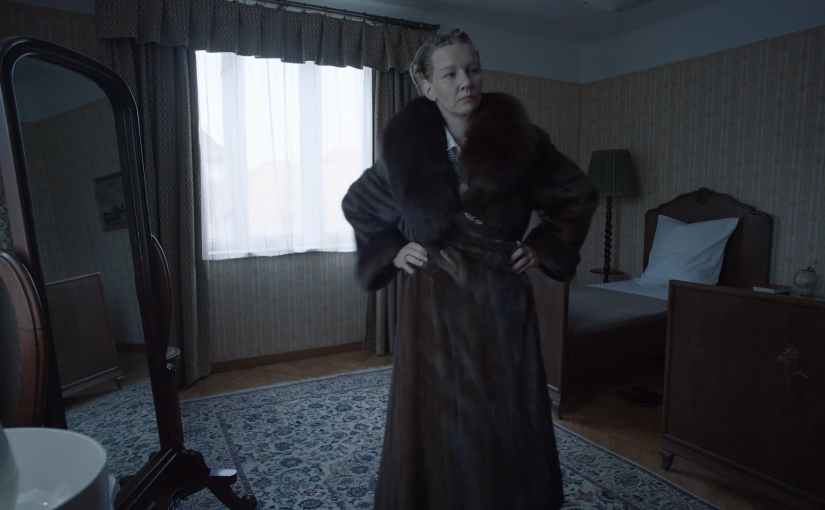
A sack is delivered to the Höss home which contains slips and nighties for Hedwig to rummage through for her use.  More interesting is a beautiful fur coat.  Hedwig tries it on for a personal fitting and looks upon herself in her bedroom mirror.  She finds a lipstick in the pocket.  Does she like the color?  She’ll have to see and draws it across her hand just like my wife and mother would do in a shopping mall.  All the while, the undisturbing (to Hedwig) next-door sounds continue on.

Miguel and I went to see this film together and had an extensive discussion afterwards.  To Miguel’s advantage, he had absolutely no idea what this film was about.  Didn’t know it was another Holocaust picture.  He didn’t know who directed it.  He didn’t know the cast.  I only knew that Jonathan Glazer wrote and directed, though I’m not as familiar with his work as Miguel is, and that it took place during the time of the Holocaust.  To observe my colleague’s surprise early on in the film gave me an interesting experience.  Miguel first witnessed the serenity and peace among the family, and then realized the sinister world that surrounds them and which they choose to be naïve towards.

The Höss family will have you believe they experience the same challenges that any ordinary family encounters.  Beyond what I have described, there are two other scenes that stay with me. 

Rudolph holds a meeting in his home. An architect/scientist is describing the effectiveness of a new model oven that will efficiently slaughter hundreds of Jews per day.  He provides well designed blueprints.  Rudolph asks for a closer estimation.  The architect says it is likely a thousand can be taken care of in one day.  Seems satisfactory.  Take a conversation like this out of the context of the picture and these men could just have easily been talking about an assembly line in a chocolate factory.

Another moment occurs between Rudolph and Hedwig.  The husband explains that because he’s been so good at his job, he’s been promoted to oversee the operations of all the concentration camps and therefore the family will have to relocate.  Hedwig is not happy about this as they have begun their new life here in their beautiful home (located next to Auschwitz).  The wife insists her husband speak to Hitler about this and request he reconsider.  Any of us would know it’s not that simple.  “Oh, excuse me Mr. Hitler…” Uh uh!  Would not work so easily. 

Jonathan Glazer demonstrates how simple dilemmas and pleasures that come with a happy home life can appear common.  Yet, in this case, should it? 

The Zone Of Interest may be a period piece.  Yet, what you witness when you watch this film is all too similar to what often occurs today.  The world has gotten smaller with information coming to us quickly by means of the internet that can update me on Middle Eastern wars or American immigration or the spread of white supremacy as quickly as developments take place.  However, I believe many still remain ignorant, often by choice, of what is presently happening.  Mass suffering and totalitarianism still runs easily and freely, but what remains important to us are the vast luxuries we treat ourselves to while hardly giving a care of what goes on outside our bedroom windows. Our toughest challenges are our inconveniences. 

I’m not chastising anyone, Reader.  We deserve our peace, our solitude, and our happiness.  The Höss family is something else altogether, though.  They live in prosperity right next to the worst way of living imaginable and the patriarch is primarily responsible for that experience.  Yet, as their comfort becomes so commonplace, the naivety only increases.  Their children grow only knowing that a train arrives on a frequent basis, with chimneys exhausting black smoke and there are distant pops on the other side of a brick wall.  It simply goes with splashing around in the garden pool or making mud pies on the edge of the brook.  The title of Glazer’s film serves the perspective of a family who are being raised not to know any better.

Miguel asked me where I would rank the picture.  At the time I gave it a middle grade.  It is a slow-moving piece.   It is not accompanied by a soundtrack of music to easily cue my emotions.  There are no big, momentous monologues.  I found the ending a little ambiguous but perhaps I was not concentrating enough, and Miguel had to explain something to me.  However, two days after watching the piece while also doing some background research on the film, it is worthy of a better grade than I originally gave it credit for while walking out of the theater.

Glazer will set up scenes where nothing happens for the longest time and then an eye opening and very uncommon discovery is made.  A particular moment happens while simply watching Rudolph waist deep in the river while fishing and wearing an SS t-shirt.  Again, out of context, this t-shirt could have been a Tampa Bay Buccaneers shirt.  There’s a disturbing comfort to moments like this before anything is revealed. 

The writer/director positions his camera like a documentarian.  There are no steady cams.  Often shots are from a far end of a hallway or outside a door frame simply to witness the commonplace activities of the family while the horrifying sounds of Auschwitz carry on in the near distance.  Miguel noticed a horizontal technique.  Glazer must have put his camera on a track to follow Hedwig as she walks off her property and marches parallel across the outside wall of the concentration camp.  She is undisturbed by anything happening on the other side of that brick structure laced with barbed wire at the top.

This is a disturbing piece that effectively shows a lack of care for suffering and horrific execution while a family attempts to live their best life and circumvent around common issues like job promotions or gardening or family time or valuing someone else’s belongings to accommodate them.  The Zone Of Interest is a haunting film and Jonathan Glazer has accomplished a tremendous feat, showing comfort just outside of a world of treachery and genocidal productivity.  This is a must watch film.

PS: My recommendation is to watch The Zone Of Interest without taking a break or taking a pause in the picture.  Watch it all the way through, unstopped.  I believe it is necessary to judge the film as a whole rather than in just parts.  As I reflect, it feels like one ongoing hour and forty minute scene.

THE IRON CLAW

By Marc S. Sanders

A compelling sports movie requires that uphill battle that must be overcome.  Rocky achieved that standard.  Raging Bull might not have reached a plateau for its protagonist to defy his faults, but Jake LaMotta’s demons were effectively on display. Reminiscent of that film, is The Iron Claw – the wrestling film that reenacts that supposed cursed theme linked with the famed all star Von Erich family. 

Writer/Director Sean Durkin opens his film with the patriarch of the family, Fritz Von Erich (Holt McCallany), in the ring and putting his signature move, THE IRON CLAW, on an opponent.  The title of the picture occupies the screen in big letters, and we jump to the late 1970s where the four sons of Fritz are having breakfast.  Fritz tells the youngest, Michael (Stanley Simons), that he needs to start working out, building his physique to catch up to his impressively built brothers if he wants to compete like them.  Fritz makes it clear he loves Mike the least but the rankings can change if he works at it.  Durkin’s breakfast scene sets off the pattern of the film where the four boys will have to live under the mantra of their father’s iron claw of unwavering expectations. 

The stand out role belongs to Zac Efron as Kevin Von Erich.  If he does not earn at least an Oscar nomination, then people have not been paying attention.  Kevin is establishing a name for himself in the nearby Texas wrestling federation, and Fritz sees opportunity for him to carry the torch of the family into national and worldwide championships.  What Fritz could not accomplish in his youth, he will ensure his sons complete.  If it is not Kevin, it’ll be one of the other boys.  Kevin is protective of his brothers, as best he can against their father.  The mother, Doris (Maura Tierney, another under the radar performance), makes it her mission to stay out of her husband’s controlling design of mentoring in a household where almighty God will lead the way, and handguns represent the American freedom to bear.

The other brothers consist of Kerry (Jeremy Allen White) and David (Harris Dickinson).  Kerry was on his way to Olympic gold in shot put until the United States opted to withdraw from the games.  Thereafter, Fritz directs his boy’s focus on wrestling as well. Kerry eventually finds himself in the center ring spotlight too. Durkin’s film shapes out each boy’s destiny as cause and effect based on the outcomes of the other boys.

I do not want to share much more.  While I had heard of the Von Erich family, I was not familiar with what they encountered during the boys’ young adult upbringing and within the spotlight.  Sean Durkin writes well drawn characters based on the real-life figures.  Fritz was a villain, a harsh antagonist, who was not so much a father as he was a chess player using his sons as pawns to win and win again.  If a setback occurred, then he turned to another athletic boy in his regiment to step up and fill a void.  If one of the boys were progressing, then he became the father’s primary focus, while another was pushed down a notch.  Holt McCallany is astonishing in this role. Fritz was a coach and hardly a father.  Any scene he occupies defines the obedience his character expects of his family.  Along with many others involved in the film, he is worthy of Oscar recognition as well.

Zac Efron has gone full method with a chiseled body and a mop top haircut that is a full departure from his pretty boy athletic physique.  As Kevin, what he’s done with his body should garner applause, but Efron’s character is tormented with never accomplishing enough, while accepting his father’s oversight when opportunity presents itself with one of his other brothers.  Kevin and his siblings are absolutely forbidden to cry at loss or setback.  This only allows the pain to remain unhidden on Efron’s face.  With no dialogue, the lead actor puts his insecurities and suffering on display whether he’s in the ring, working out or crouched in bed.  This is a stellar performance, in line with Robert DeNiro’s unforgettable portrayal of Jake LaMotta – a tortured, yet talented soul and athletic fighter imprisoned within inescapable circumstances.

Efron has terrific chemistry with Lily James as Pam, Kevin’s wife.  She is an impressive actress worthy of more attention to her career.  Lily James is not the headliner of this picture, but her response to scenes with Efron and a particular one with Maura Tierny make her acting partners all the more effective.

As the mother to these powerful men, Maura Tierny mostly hides in the background.  Should there be a chance she earns an Oscar nomination, the scene where she simply stares despondently at a black dress offers enough evidence.  This one standout moment deserves a lot of attention.

Sean Durkin is worthy of enormous accolades.  He has an ability to depict multiple stories occurring in one caption.  There’s a dizzying moment where Kevin, Kerry and David are working through their own respective progress.  Durkin blends the three athletes together, where you eventually see one hulking, flexing chest.  Above, are the blurred, sweaty faces of the three men meshed together and over one another, while working through their regimental exercises.  Their faces are layered upon each other.  

A later scene will show Kevin and Kerry practicing in an outdoor ring, with Kerry fighting a hard physical challenge.  In the foreground of this nighttime exercise, is a flashlight moving through the fields.  A subsequent moment will explain that significance.  Sean Durkin beautifully balances several biographies within this famed family.  You are viewing multiple stories at once, and nothing is ever distracting. This amounts to outstanding writing and directing that demands multiple layers.  

I became aware later that there is another son who remains unaccounted for in this picture.  Apparently, that story was cut for pacing issues.  I’m not sure I’d say it’s unfair to disregard that person within the confines of this picture.  Most biographical films take certain liberties to assemble an engaging structure, and frankly the destiny of that son is similar to what occurs with others in the movie.  Durkin opted to avoid appearing repetitive in his storytelling.  So, I stand by this decision.  

The Iron Claw is certainly the most surprising film of the year for me.  Based upon what happened within the Von Erich family, it seems so apparent that a movie would eventually be generated.  Yet, falling into melodramatic schmaltz with a drama like this is an easy trap.  Sean Durkin dodged that obstacle with a sensational cast.  There is not one weak performance in this picture.  You could make a separate film out of each perspective offered.  It’s fortunate that Durkin found a way to balance everything beautifully.

The Iron Claw is one of the best pictures of the year.

MAESTRO

By Marc S. Sanders

Bradley Cooper’s second directorial film suffers from the same ailments as his first film.  Like his interpretation of A Star Is Born, Maestro is not as good as the sum of its parts.

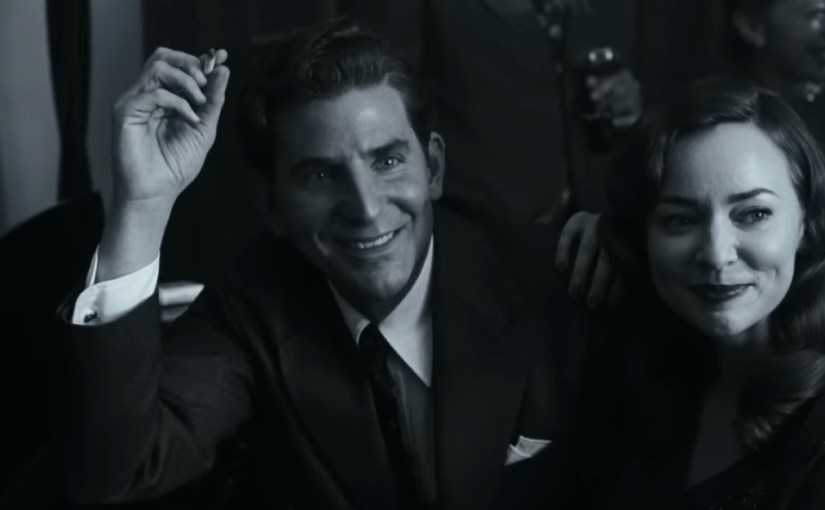
Constructively speaking Maestro is a gorgeous looking picture with a first half in a comfortable, historic black and white followed by its second half in vibrant colors.  The acting from Cooper, as Maestro Leonard Bernstein is well performed.  Carey Mulligan is sensational at no matter what age she is portraying actress Felicia Montealegre, the conductor’s wife.  Within the scenes they share together there is a beautiful rhythmic exchange of dialogue, written by Bradley Cooper and Josh Singer.  Cooper also looks powerful as he reenacts the conductor in front of his choruses and orchestras.  There are also inspiring shots that start out vague and unclear only to come into a full blossom as Cooper’s camera maintains an unbroken focus on an image. 

All that being said, none of it matters because the script from Cooper and Singer is muddied.  While Mulligan and the actor/director are in the midst of marital argument on Thanksgiving day, much is hard to understand as they naturally speak over one another, and what can be made out seems to mean nothing as they fight over people and issues that I do not believe are ever touched upon in the picture.  A scene like this looks like an actor’s dream piece, but it is hollow of substance. 

Like A Star Is Born, there are characters that enter Maestro for long winded scenes and then are never heard from again.  Either Bradley Cooper does not feel the weight of their importance, or he mistakenly presumes the audience will catch on.  An outdoor brunch with Felicia, Leonard, another couple and I believe a mentor or agent of Leonard’s seems well written, but I have no idea who those people are or what kind of influence they carry.  I was hoping to realize later, but those three amount to nothing.  Was the other couple supposed to be Leonard’s parents, and perhaps they were meeting Felicia for the first time?  I’m just not sure.

Bradley Cooper is a master with his camera.  An important moment in Bernstein’s life is when he gets the call to perform at Carnegie Hall when the other conductor calls in sick.  With its black and white imagery, a young and enthusiastic Leonard answers a phone call while a black square, with light from behind, occupies three quarters of the screen.  I was wondering if that was a stage curtain that needs to be lifted.  I was half right.  It’s a window curtain to the apartment Leonard shares with his gay lover.  The film moves into high energy as the would-be composer slaps his lover’s bottom and leaps down the stairs with a quick edit into the theater.  Mike Nichols would be proud. 

Another moment that struck me was Cooper pointing his camera up into the tall reaches of his apartment building staircase.  It’s quite dark.  You may have trouble realizing what you are looking at but then his son drops a paper airplane “good luck” note down to his father on the bottom floor.  These images blossom into something as alive as I would imagine the director/co-writer/actor regards Bernstein.

So, there is much to praise in Maestro.  Unfortunately, the assembly of these shiny, inventive, and magnificent pieces of film do not mesh very well together.  Bernstein led a homosexual lifestyle, even going so far as to welcome a lover into the home he shared with Felicia.  Carey Mulligan is excellent with expressions of resentment towards this other life that her husband follows.  However, the storyline never feels fully fleshed out.  We never get an opportunity to see the value or the menace of the other relationships that Leonard holds on to.  A so-so moment is accompanied by Bernstein’s saxophone opening to West Side Story.  The piece is used as a subtle tool of deceit and ignorant cruelty by Leonard while escorting his apprentice/lover in the home he shares with an angered Felicia in the foreground.  We presume the threat that Felicia likely feels, but it never comes to the surface. 

Bernstein’s career is glossed over as well.  Who pushed him to move on to bigger moments and acquire greater crescendos in his life?  I’d like to think it was Felicia, but I’m not certain.  Felicia has conversations with Leonard’s sister (Sarah Silverman) and other acquaintances, but what is she really alluding to or really talking about?

The most impressive moment in the film is when the Maestro conducts the London Symphony Orchestra at Ely Cathedral.  (I’ll own up and say I looked up what this scene was on IMDb.)  Bradley Cooper does a masterful reenactment of Berstein, dripping in shaggy grey hair sweat, dressed in a three-piece tuxedo with baton in hand.  This is a major multi talent working in films today.  Cooper studied film footage of the scene over a six-year period to get this six-and-a-half-minute unbroken moment caught on film.  It’s positively mesmerizing and I could watch this over and over again.  I’m waiting for the side-by-side comparison to appear on You Tube soon. It is reminiscent of what Rami Malek did as Freddy Mercury at the Live Aid concert at Wembley Stadium in the film Bohemian Rhapsody

Still, this scene much like a lot of the footage in Maestro seems to just be wedged in there.  There’s a balletic flow to some moments in Cooper’s film and then there are times that come out of nowhere and I’m left to wonder how exactly we arrived and what was truly going on in Bernstein’s life when he conducted at this historic moment time.  I’m watching a blazingly fine impersonation of Bradley Cooper doing Leonard Bernstein but I’m lacking the sub conscious dimension a biographical film should have at this point in a historical figure’s life.

Carey Mulligan is laying everything out to portray Felicia and her best moments come in the last third of the picture when the poor woman is struck with breast cancer that has spread to most of her body. We witness how she lives with the illness along with her separated husband by her side.  I’ve seen ill women before in films.  I know I sound crude by saying it’s nothing new.  I’m still allowed to be impressed though.  It’s a huge feat to bring a performance to this kind of level.

The makeup work is marvelous too.  Raw footage of the real Leonard Bernstein is shown before the end credits, and I’m impressed with how much Cooper looks in comparison.  The aging of him and Mulligan over the decades since the late 1930’s all the way through the mid 1980’s is perfectly captured.  At one moment, Carey Mulligan looks just like my mother.  I choked up a little bit when Felicia gazes upon Leonard at the Ely Cathedral.  Same hairstyle.  Same eyes.  Same expression.  Mom would have even worn a soft blue evening gown like that in the mid-1970s.

I wanted to like Maestro more than I did.  I almost feel guilty for not liking it as much.  There is magnificent camera work, sensational acting, wonderous music and perfect impressions on display, but the puzzle just did not have all of its pieces assembled together properly.  Sadly, Maestro lacks the focus it needs, either for the famed conductor’s amazing career or for his relationship with Felicia with his not so concealed homosexual lifestyle on the side.  Bradley Cooper put together a million magnificent moments, but it caused him to overlook the enduring structure of his subject.

MAESTRO (2023)

by Miguel E. Rodriguez

DIRECTOR: Bradley Cooper
CAST: Carey Mulligan, Bradley Cooper, Matt Bomer, Sarah Silverman, Maya Hawke
MY RATING: 8/10
ROTTEN TOMATOMETER: 80% Certified Fresh

PLOT: This love story chronicles the lifelong relationship of conductor-composer Leonard Bernstein and his wife, actress Felicia Montealegre Cohn Bernstein.


Bradley Cooper’s Maestro is a film of scope and depth and tremendous technical artistry, both in front of and behind the camera.  The performances from the two leads contain some of the best acting I’ve ever seen, especially their argument during a Thanksgiving Day parade.  But I cannot deny that, for reasons I’ll try (and probably fail) to explain, I did not feel emotionally invested in the story until the final two or three reels, when something occurs that, if it were fiction, could easily be dismissed as a shameless attempt at Oscar-baiting.  The fact that this really happened lends these final scenes an emotional weight that was missing from everything that came before.

The story is straightforward, but beautifully told, visually.  After a brief prologue, we meet a young Leonard Bernstein (Bradley Cooper), in bed with his male lover (hope that’s not a spoiler), as he gets an early morning phone call that will change his life forever.  This opening scene sets the visual tone for the first half of the film: standard 1:1.33 framing as opposed to widescreen to give it a classic feel, as well as gorgeous black-and-white cinematography.  Indeed, this opening shot alone looks like it could hang in a museum of modern art and not look out of place.

Everything proceeds breathlessly from there, with some conversations held at speeds that would make the Gilmore Girls dizzy.  After a series of early musical triumphs, he meets the woman that will become the polestar of his personal life: actress Felicia Montealegre Cohn (Carey Mulligan, in a performance that will almost certainly win her an Oscar nomination).  After some verbal sparring/flirtation, it becomes clear to them, and to us, that they are meant for each other, despite his later dalliances with male fans and hangers-on.

I especially liked a scene during this early section where Felicia and Lenny – as his friends and family called him – dine with some older friends (or family? I can’t quite remember), and an older gentleman gives him some advice: “They’ll never give Leonard Bernstein an orchestra in America.  But Leonard S. Burns…”  I loved that scene because I loved how Bernstein’s entire career is a rebuke to that well-meant but wrong-minded sentiment.

This gentleman advises Bernstein to give up writing scores for musicals, but Felicia disagrees.  That sets up a wonderful sequence where Felicia and Lenny watch a rehearsal of the stage musical On the Town, with sailors leaping balletically, and then in a fantasy reminiscent of The Red Shoes, Bernstein himself becomes one of the sailors, and the dance becomes a micro-miniature of their relationship and his early successes.  It’s a thrilling little cutaway that had me grinning the whole time.

From there, the movie jumps forward chronologically in leaps and bounds, giving only a cursory glance at the 1960s before settling more or less for the rest of the film in the mid-to-late 1970s, with Bernstein’s face becoming the craggy icon that I personally remember from my own youth, while Felicia Bernstein somehow looks just as beautiful as she did thirty years and four children ago.  I would blame that on movie magic, but I mean, we are talking about Carey Mulligan here, so they get a pass.  And then the last act of the film arrives and we get a glimpse perhaps of why Mulligan receives top billing over the actor-star-director Cooper.  And that’s all I’ll say about that.

As I said, the movie looks amazing.  Obviously the period décor and costuming are all spot on, but the cinematography and direction – what theatre or film studies majors would call mise-en-scène – are just incredible to behold.  Another shot that stands out in my mind is a scene where Bernstein is conducting, and we get an angle where we are looking into the wings, but his undulating shadow looms large, and standing in that shadow, but still illuminated, is Felicia.  Verbal descriptions won’t do them justice, just see for yourself.

But as I mentioned, I just wasn’t invested in the story from an emotional standpoint.  I felt like I was watching an extremely inventive and ingenious exercise in moviemaking.  I suppose I could compare it to the recent sci-fi film The Creator, if that doesn’t get me accused of hyperbole.  Both films show supreme confidence in staging, cinematography, and direction.  But like The Creator, Maestro feels like something is missing where its heart should be for the first 75% of its running time.  Things happen, arguments take place, children are born, Lenny gets a little sloppy with his paramours, but I never felt like any of it really meant anything to me as the viewer.

I tried asking myself, “What statement is the film making?”  And I couldn’t answer that question, aside from fulfilling its purpose in presenting the facts of a story in almost documentary-like fashion.  But the performances and cinematography are so stunning that I must acknowledge that fact with a higher rating than I would normally give a film that doesn’t really grab me emotionally.  (EXCEPT for the last 25%, I mean…I don’t want to give anything away, but the last reels are heart-tugging.)

So, do you want to see this movie?  Well, certainly not if you are an absolute acolyte of Leonard Bernstein.  You’ll see some pretty cool stuff musically, but Maestro does not paint an altogether flattering picture when it comes to his personal life.  But if you want to see one of the best-acted, best-directed, best-LOOKING films of the year…Maestro is your ticket.

NAPOLEON

By Marc S. Sanders

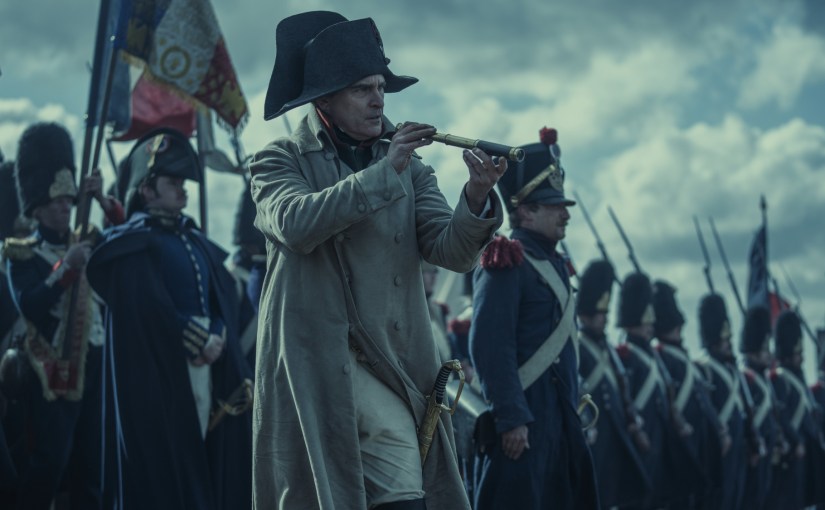
I never knew much about Napoleon Bonapart.  He was short.  He’s French of course. There’s that famous painting with his right hand tucked into his tunic. Or was it his left?  The big hat. I’d heard he was kind of a brat.  Ridley Scott’s latest period piece, Napoleon, confirms most of what I recall.  The painting was nowhere in sight though.

Joaquin Phoenix portrays General Bonapart, and he surely had a great challenge ahead of him. I cannot say that I was bored with any part of the film, but I did find Napoleon to be quite bland during the first act of the film.  Phoenix, doing his best with a script by David Scarpa, seems to be a stand in with nothing of much consequence to say.  It is only when the Captain all but invites a promotion upon himself to the rank of General, following the guillotine beheading of Marie Antoinette, that his arrogance begins to show.  Thereafter, he takes it upon himself to force the hands of the governing council to resign from their positions, a very entertaining sequence for sure.  Then Napoleon sees no other purpose but ongoing conquest. 

With each passing scene in Napoleon, the ego of the title character grows and grows and that is the underlying theme of Scott’s picture.  We journey to the pyramids of Egypt to witness Napoleon lead his armies towards further conquest.  Alternatively, we also trek through the raw winters of Russia and on to a blazing Moscow.  Who set the Russian city alight is a question that history may contradict of the General’s claim.

Napoleon is sure to get a slew of Oscar nominations.  However, it will likely not be in any of the major categories.  The numerous battles are outstanding in whatever setting Ridley Scott offers.  Whether it is in the desert or murky winter grounds, I could not tell if the armies were physical extras or CGI.  It all looked seamless in its construction.  David Lean would be proud.  Sound editing was also perfectly in sync.  The set designs of the many scenes throughout are exemplary from bedrooms to halls and the wallpapers, furnishings and floors and even the outdoor landscaping of the French estates.  Even Napoleon’s tent on one battlefield after another are absorbing.  The costuming always makes a statement.  Every stitch and distressed shade of blues, reds and whites tell a story.  Yes, it’s all very impressive.  However, I did not go to Napoleon to grade a college project assignment in fine arts.  Overall, it has to be the movie itself that grabs me.

Unfortunately, Ridley Scott’s film suffers from shortcomings that cannot be forgiven.  I have to lend credit to my wife who pointed out flaws that did not come to my attention until I heard her input, and thus could not deny.  There are topics brought up in the film that are either not followed through clearly or are left with questions. 

One moment in particular occurs when Napoleon opts to marry the daughter of a leader. Do not ask me to remember which leader. Characters leave the picture just as quickly as they enter.  One daughter is of proper age.  The other daughter we are told is only age fifteen and Napoleon turns down the idea of the latter, but in the scene afterwards it appears that he actually did choose to marry the fifteen-year-old.  The girl certainly looked like a teenager.  So, how did that come to be? 

A storyline I really took an interest in was Napoleon’s marriage to Josephine (Vanessa Kirby).  The widow of a dead soldier, with three children, he marries her for love.  Then he leaves to conquer some more and more around the world.  Yet, the general returns when he realizes she is happily having affairs in his absence.  The bruised egotistic response of Napoleon is very well played out. Joaquin Phoenix has his best moments in the storyline he shares with Vanessa Kirby.  However, while I thought I understood, my wife pointed out that the film does not clearly explain how the relationship continues.  There’s animosity at first but then there is a mutual love between the couple and how exactly did that flourish and change?  When was the mutual affection eventually sparked?  What works best is how the two are unable to bear a child together.  Napoleon is nothing but forceful in his moments of sex with Josephine.  He will damn well force a pregnancy even if it means he has to thrust harder and harder inside of her.  Yet, no results come of his efforts. An heir must carry on the Bonapart legacy.  Since one does not appear, it taxes heavily upon the powerful leader.

Later in the film, following the couple’s dissolution of marriage, a child is born but who exactly carried the offspring?  Details like these seem to be glossed over.

Few directors are as skillful at showing grand scenes of battlegrounds with sharp, clear edits of how the fighting progresses.  Ridley Scott demonstrates that over and over again with one scene after another.  He accomplishes fare like this so well in other films like Gladiator and his interpretation of Robin Hood.  The dark hazy cinematography works beautifully on a big screen.  However, I’m not sure if it will be as effective on a sixty-inch flat screen where there’s a risk of intrusive glares in your living room.  These magnificent scenes need to be watched on a big screen.

Unfortunately, the attention to detail is not lent to the story as effectively. Napoleon’s mark in history did not just happen in a period of a few years.  For a brief window of time, France was a superpower ahead of the likes of Egypt, Britain, Austria, Prussia and even Russia.  Two hours and forty minutes may seem like a long film and yet Napoleon likely needed at least an additional hour to serve a complete historical recount.

If you want to see Napoleon, now is your chance while it plays in theaters.  Again, I do not believe it will have the same effect at home.  Regrettably, the film does not offer enough on the plate.  No one in the cast is doing anything of Oscar caliber accomplishments.  Ridley Scott comes up short of end of the year award considerations for not inviting tighter storytelling, and that also goes for David Scarpa’s script. 

The visual marvels of this period piece are what is to behold.  Watching Napoleon, I certainly felt like I was there amid the glorious costumes, set designs and cinematic photography.  Nevertheless, while I may have been in the room, the hosts of the picture were not sharing their entire conversation with me around the dinner table.  Alas, at times, I was left to stand in the corner, feeling like an unwelcome guest.

GLADIATOR

By Marc S. Sanders

Ridley Scott’s Gladiator is a terrifically sweeping sword and sandal epic adventure.  It contains well drawn characterizations of its heroes and its one tyrannical villain, along with superbly bloody hack n chop violence and action that live up to its title. 

Rome has finally finished its campaign of conquer throughout at least one quarter of the world.  General Maximus (Russell Crowe) is ready to return to his wife and son to live out the rest of his days as a farmer and family man.  However, the dying Emperor Marcus Aurelius (Richard Harris) begs him to take over his position so the Roman Empire may carry forth with prosperity.  If Maximus does not take over, the empire is at risk of being inherited by Marcus’ spoiled son Commodus (Joaquin Phoenix).  While Maximus ponders the request, Marcus dies and Commodus quickly takes over, and orders the immediate deaths of the celebrated General and his family.  Maximus and Commodus will eventually circle back with one another, however.

Gladiator feels like an epic film in the vein of a David Lean picture that would require time and work to follow through its various developments.  Maximus certainly goes through a widespread arc.  One of the advertising bylines described it as the man who was General, who became a slave, who became a gladiator. Russell Crowe is right for this role.  Not only is he lean and built for the part, but he brings a empathetic approach to the character.  Maximus is loyal to his country, but he also carries pain and longing for his family and when he is wronged, Crowe does very well at displaying his character’s plot of  vengeance against Commodus with strategy and skill.

Joaquin Phoenix rightly earned his first Oscar nomination as a wonderful villain.  The screenplay from David Franzoni, John Logan and William Nicholson offer memorable pieces of dialogue for the bratty son.  “I feel vexed. I am very vexed.”  – a line that sounds so minimal and yet when Phoenix delivers it, it’s only more terrifying.  This little monster captured in an adult body can respond to anything that slightly irks him.

The battle between Commodus and Maximus is hardly physical.  Maximus realizes through his companions that a better and wiser form of revenge is to win Rome’s admiration away from its ruler.  Commodus lives off his ego.  So, when Maximus is encouraged by his slave owner to “win the crowd” amid the games performed in the famed coliseum, it not only lends to the gladiator’s ongoing survival, but it tears away at Commodus’ rule.  A great subplot is included focusing on the ruler’s nephew, Lucius (Spencer Treat Clark).  The expression on Joaquin Phoenix’ face when young Lucius role plays as the great Maximus works like a frozen moment in time.  Imagine a famed quarterback’s child cheering for the defensemen who performs an unforgivable sack during the final ten seconds of a game.  It’s terribly bruising.

When Gladiator was first released in theaters, I found the CGI to lack texture and it appeared very dark like a bad 3D film.  It looked too animated.  This most recent viewing was on a restored 4K transfer and the picture quality is astounding.  Every element of the broad landscapes within the battlefields and especially in the gold sheen photography of the coliseum battles blend perfectly.  If you still don’t understand the importance of 4K, turn to this film to uphold the argument. 

Ridley Scott does not waste a shot in this picture.  Reactionary sequences are just as effective as the cuts to the action.  Blades and barbaric weapons shed gorgeous splashes of blood. Every thrust and parry are easy to see. I’ve never forgotten when a chariot rider is cut in half at the torso from an oncoming blade attached to rolling wheel.  The choreography and editing of the battles are thrilling with sound editing that compliments the moments. 

Beyond Russell Crowe and Joaquin Phoenix, the cast is wonderful.  I’ve always admired Richard Harris’ quiet approach in the twilight years of his career.  He never had to do much to offer a presence.  Connie Nielsen portrays Lucilla, Commodus’ sister who he has affections for.  Her subtle resistance allows Joaquin Phoenix more opportunities to feel “vexed.”  Oliver Reed passed away during the making of this film. Fortunately, Ridley Scott and company did not opt to cut out his role as the gladiator/slave trader, Proximo.  He works well as a kind of mentor to Maximus and the band of other warriors, coaching them on how to stay alive and rise above Commodus’ monarchy.  “Win the crowd and you win your freedom.”  Djimon Hounsou is a loyal sidekick to Crowe’s character. Derek Jacobi is once again that guy you have seen before allowing his expert craft in Shakespearean performance to flesh out the political angle of the story among the Senators.  Every actor serves a valuable purpose in the film.  None of these performances feel like walk on roles.  So, the overall casting of the picture must be commended.

Gladiator is a crowd-pleasing film. Though it is based in ancient history, there remains a fantasy element to the movie when you look at grand designs of the settings, costumes, and dialogue.  Storylines of politics and tyranny hold relatable to modern current events.  What can occur when one man takes over everything for his selfish purposes?  Pointless displays of theatrics can occur at the behest of others who were once heroes, instrumental in placing a despot atop a throne.  I presume Ridley Scott’s film is just one more example of the inherent nature found in humans.  Some of us are destined to rule and control.  That alone is cruel and selfish.  It is even worse when this totalitarian mindset is unleased upon those that put these rulers in their place.  History and especially modern times demonstrate that loyalty is only fleeting.  The ability to possess totalitarian control, however, is hopefully even more short-lived.

MISHIMA: A LIFE IN FOUR CHAPTERS (1985)

by Miguel E. Rodriguez

DIRECTOR: Paul Schrader
CAST: Ken Ogata, and a host of Japanese actors unknown to me
MY RATING: 8/10
ROTTEN TOMATOMETER: 79% Fresh

PLOT: Director Paul Schrader and executive producers George Lucas and Francis Ford Coppola present a fictionalized account of the life and shocking death of celebrated Japanese writer Yukio Mishima.


It’s hard for me to know where to start with this review.  I had heard of Mishima: A Life in Four Chapters by reputation for years, mostly because of Roger Ebert’s rave review and also the film’s inclusion in the Criterion Collection AND in the invaluable compendium 1,001 Movies You Must See Before You Die (ed. Steven Jay Schneider).  I finally got a chance to watch Mishima recently, and in my opinion, if it does not quite succeed as Entertainment, I believe it is worthy of consideration as a genuinely artistic achievement.  Mishima is an elegant rebuttal to anyone who doesn’t believe cinema can be Art.

The lives of artists are notoriously difficult to translate to film, especially when it comes to the life of a writer.  Who wants to watch two hours of an author typing, in a fit of inspiration?  Paul Schrader came up with a rather brilliant method of getting over that hurdle by breaking up Mishima’s life story into four distinct acts, with each act featuring three separate storylines that coil around each other: the last day of Mishima’s life, flashbacks to Mishima’s earlier years, and scenes from his semi-autobiographical books that parallel events from those flashbacks.

If that sounds confusing, it’s not.  Each story thread has its own easily distinguishable color scheme.  If it’s black-and-white, it’s a flashback to Mishima’s real life.  If there is muted color and a mostly hand-held camera, we’re watching the events of his last day on earth.  If the colors are brilliant and saturated, we’re watching a scene from one his books.

What sets Mishima apart are those sequences featuring scenes from his books…and right about here is where my powers of description may fail me, but I’ll try anyway.)  It would be easy to just call them dreamlike, but that’s both true and reductive.  To me, they look like a cross-between highly stylized opera and a David Lynch film.  In the first segment, based on Mishima’s Temple of the Golden Pavilion, the set was built with lavish golden walls and accented with green lily pads, while the temple itself is a detailed miniature that at one point splits down the middle.  The second segment, based on Kyoko’s House, is awash in garish pink lights and walls (production designer and Oscar winner Eiko Ishioka describes the scene as being highly informed by American “bad taste”…trust me, she means it in a good way).  The third segment is only slightly more realistic than the first two, with breakaway walls, representational jail cells, and a ritual act that is echoed in Mishima’s real life.

Each segment is not just visually cool to look at; they are also extremely theatrical.  In one scene, we watch a wall get pulled away from a character lying on the ground, and we can clearly see the tracks on which the wall is rolling.  In another scene, a conversation at a roadside noodle stand is staged – literally on a stage – with the restaurant on a turntable turning clockwise, while groups of actors walk in a circle around the restaurant counter-clockwise.  The effect is both simple and convincing, despite its obvious theatricality. (In fact, the visual aspects of the film are solely responsible for taking this movie up from a “7” to an “8.”)

Those scenes by themselves are reason enough for me to recommend the film to viewers.  I am an unabashed fan of superhero films (the GOOD ones), but it seems as if we’re living in an age where, instead of finding different ways to tell the same story (which is bad enough), filmmakers are telling different stories, but doing it all the same way.  For example, I know, intellectually, that Black Widow and Shang-Chi were made by different directors, but is there anything in either movie that bears the imprint of their respective directors?  Nothing springs immediately to mind.  However, here is Mishima, a film that is nearly 40 years old, which may not feature countless CGI battles, but which gave me more visual surprises than any two Iron Man movies combined.  I don’t mean to pick on the MCU (which I do love, full disclosure), but you see what I’m saying.  It’s refreshing to come across a truly original work of art.

The film also asks some serious philosophical questions.  Throughout his life, Mishima believed in and advocated the bushido, which literally translates as “the way of the warrior.”  He was unashamedly right-wing, advocating the restoration of the Japanese Emperor to power, as opposed to Japan’s governmental policies of democracy and globalism.  In the film, he several times mentions “Harmony of Pen and Sword,” a philosophy in which one’s writings are nothing unless they are backed up by action.  Mishima espouses this belief so fiercely that he ruthlessly follows it to its logical conclusion in the closing passages of the film.

What is director Paul Schrader trying to tell us here?  Should we consider Mishima as a hero?  He is certainly one of Japan’s most famous and celebrated writers, but he remains controversial for his right-wing views.  (If you’re wondering how right-wing he was, in 1968 he wrote a play called “My Friend Hitler,” an event omitted from the film.)  Does Schrader consider him heroic for following through on his beliefs, even when it became, shall we say, EXTREMELY inconvenient for him to do so?

That could be one interpretation, but I don’t see it that way.  I came away from Mishima with the knowledge that, once, there lived a man who lived and died by a code.  I did not agree with his beliefs, but they were defiantly his, and no one could take that away from him.  I was reminded of one of my favorite lines from A Man for All Seasons: “But what matters to me is not whether it’s true or not, but that I believe it to be true, or rather not that I believe it, but that I believe it.”

At the end of the day, while I think Mishima’s moral stance was questionable, and while Mishima itself is less entertainment and more museum piece, the experience of watching Mishima was nevertheless time well spent, especially when considering the astonishing visuals.

(Oh, crap, I’ve gotten to the end of the review and just realized I never mentioned the phenomenal score by Philip Glass, parts of which are quoted at the finale of The Truman Show…if you’re a fan of the movie, you’ll know which parts I’m talking about.)

KILLERS OF THE FLOWER MOON

By Marc S. Sanders

Killers Of The Flower Moon reflects on a period in Oklahoma history that I imagine has hardly been told.  In the early 1920s, the Native American residents, consisting of four tribes, came into a blessing of wealth when oil was discovered on the land they occupied in Osage County.  Almost immediately, white folk from all over the country migrated to this area and built up an infrastructure of capitalism that included private practices, pool halls, movie houses, law enforcement, pharmaceuticals, and even cab drivers.  However, they didn’t want to just stop at developing the area.  They wanted to seize it and they proceeded to do so by wiping out the Native American residents.  Family lineages were all but erased as the whites married into the race and gradually found ways to kill and bring about surprising deaths that would ultimately allow them to legally inherit what was rightfully owned by the Indian people.

Director Martin Scorsese has introduced a new kind of historical education with a film that I believe will be my favorite picture of the year.  I was mesmerized by every photographic shot, closeup, edit, and musical accompaniment contained in this movie.  Everything works so well. 

Robert De Niro reunites with the director for the tenth time; an amazing legacy of a partnership spanning fifty years.  He portrays William “King” Hale.  King is a kindly old fellow on the surface, but his intelligence shows as he strategizes how to take over more and more of this area.  He oversees a control of the white gentlemen folk, leading them into quick marriages with the young women of the tribes.  From there, they have children and over time will gradually purify the bloodline.  It’s a ruthless and scheming tactic and it successfully works thanks to how taciturn Mr. Hale is.  De Niro might win his third Oscar for this role.  This character joins that exclusive fraternity of the best villains in cinematic history, ranking up there with The Wicked Witch, Harry Lime, Norman Bates, Darth Vader, Joker, Daniel Plainview and Hannibal Lecter.

Early on in the epic film, The King’s nephew, Ernest Burkart (Leonardo DiCaprio) has returned from the war to work under his uncle.  Ernest starts as a cab driver and meets Molly (Lily Gladstone), the Native American woman he will take as a bride and establish residence together.  DiCaprio does some of his best work following a very boastful career of roles.  He’s also sure to get at least an Oscar nomination.  This is already his sixth film with Scorsese.  Ernest is not very bright, but with The King’s guidance and instruction he’ll also come to own much of this territory.

Mysterious deaths of unexpected natures occur within the tribes of Osage County, particularly in Molly’s family.  Over the course of the film, one relative after another perishes until what’s left of her bloodline is practically only herself.  The children she bears are a mix of Molly and Ernest.  Molly knows something is amiss.  She is starting not to feel well, and her suspicions speak to her.  Others in the community are also suffering peculiar deaths following doctor’s visits or evenings of drunken binging.  An investigation is warranted before it becomes too late.

Lily Gladstone will become a surprise hit at Oscar time as well.  A breakthrough role where her feared silence and bravery matches well against the deceit emanating from the King and even the poorly hidden conniving of her husband Ernest.

Scorsese builds his film with suspense and shock.  A quiet beat of instrumental music haunts certain scenes.  Who will be the next target of the King’s bidding?  The King hides behind his empathy for loss by attending funeral services and allowing the survivors to cry into his shoulder.  On another side, he instructs Ernest to carry out an assignment to some flunky to make a murder appear like a suicide.  A shot in the back of the head will not send a convincing cause and effect though, and the King and Ernest must make up for that. 

The King is everyone’s friend in Osage County, but he’s also a puppet master Grim Reaper.  With the circular rim glasses that DeNiro wears along with his peaceful beige suits, it’s a wonder that this man is an executioner using the hands of others to carry out his bidding.  He dances in the middle of town during festive gatherings.  It even amuses the Sheriff’s office when he voluntarily offers himself up following a warrant for his arrest.  At the risk of getting politically sided, DeNiro was recently interviewed during a press junket for the film.  His animosity towards President Trump is no secret.  I was in the audience at Radio City Music Hall when he led a unified roar of “Fuck Trump” during the Tony Awards.  Still, the skilled actor said he used the enmity he harbors to his advantage for this role.  In the latter half of the film, William “The King” Hale preaches in a similar approach to Trump.  There are figures in our history who just know what buttons to push and absorb massive amounts of influence while earning respect through fear. 

Killers Of The Flower Moon covers a wide berth of its period in history.  Scorsese takes an inspired approach by cutting away on occasion with black and white footage and photographs of the Native Americans coming along with their good fortune and then on to how the white “immigrants” of this area enter this land and assume a daily life within the community, whether they were welcomed or not.  All is depicted from how Osage County quickly changed following the discovery of “black gold,” to how Ernest becomes wise to the advantages of power. 

Leonardo DiCaprio has a great undertaking.  Ernest is not very bright.  He can hardly read.  He’s not subtle with his approach like his uncle.  Yet, the actor maintains an expression of no choice to abide by but what he’s been told is right.  DiCaprio does this incredible expression with long frowned lips and a fat chin that stands out from beneath his nose.  It almost seems like a barrier to finding the humanity he may have once had when he was an infantryman fighting with the allies in Europe.  It is just a haunting performance.

The third act picks up with J Edgar Hoover’s newly established Bureau of Investigation entering the story to investigate the odd happenings in Osage.  Jesse Plemons again plays that guy that you have seen somewhere before.  Often, he occupies similar kinds of roles, and still, I like what he contributes to this picture as Investigator Tom White.  Screenwriter Eric Roth lends the character simple, plainly worded questions for Plemmons to work with and it seems to come off as nothing intimidating.  Rather, the presence of Tom White on Ernest’s doorstep, with Molly mysteriously sick in the bedroom, is enough to rattle Ernest, the King, and the whole county.

It’s no secret that Killers Of The Flower Moon has a long running time at nearly three and a half hours.  However, it is necessary.  This widespread crime is not done in just minutes.  How it is gradually orchestrated needs to be seen, followed by those that uncovered how sinister it became.  Then attention needs to be given to how biased the trials of Ernest and The King had become.  Men who conspired with the King and Ernest serve on the jury.  A lot of unfair wrongs occurred during this time spanning what I believe was at least a decade and a half. 

Roth and Scorsese bring the conclusion of the film with a welcome invention.  In a time where Netflix, Dateline, 20/20 and ABC News thrive off true life crime documentaries that become so addicting, the filmmakers resort to a radio show to sum up what happened to the main players of this devastating episode in twentieth century American history with the director making a cameo to offer his final words for the main victim of the piece, Molly Burkhart.  This bookend to the film has stayed with me since I finished watching the movie, and I applaud Scorsese and Roth for their execution.  Newsmakers of today go for the most sensationalized crimes that have occurred; the ones that leave the most shock and awe and even audaciousness.  What happened in Osage County is unforgivable.  Likely a genocide of bloodlines that were unjustly ceased so that what was rightfully theirs to own could be seized.

Killers Of The Flower Moon is a drama that had to be told because the motivations that led to the series of crimes happens not only to Native Americans, but to practically any other demographic across the globe.  This is a captivating story and one of the best films Martin Scorsese has ever made.

Again, this will likely be my favorite film of the year and Oscars are deserved for DeNiro, DiCaprio, Gladstone, Roth, Scorsese and for Best Picture of the Year. 

NOTE: As I watched this movie, I could not help but think of the film August: Osage County, the motion picture adapted from Tracy Letts’ Pulitzer Prize winning play.  There is one Native American character in the film who is hired to serve the white family living on a wide expanse of land in present day 2013 (2007 for the play).  The first time I watched the movie, I could not recognize the purpose of the character.  On a second viewing, following a conversation among the dysfunctional family of characters about Native Americans, it was much clearer.  Having now watched Scorsese’s film, this picture serves as a great companion piece to watch afterwards.  I’ll be directing a stage production of this soon and much of what I learned from both films will be incorporated into my interpretation.  Even the architectural designs of the homes in both films, interior and exterior, are uniquely similar. 

Look for my review of August: Osage County (featuring Julia Roberts and Meryl Streep) on this site as well.