DAS BOOT (GERMANY)

By Marc S. Sanders

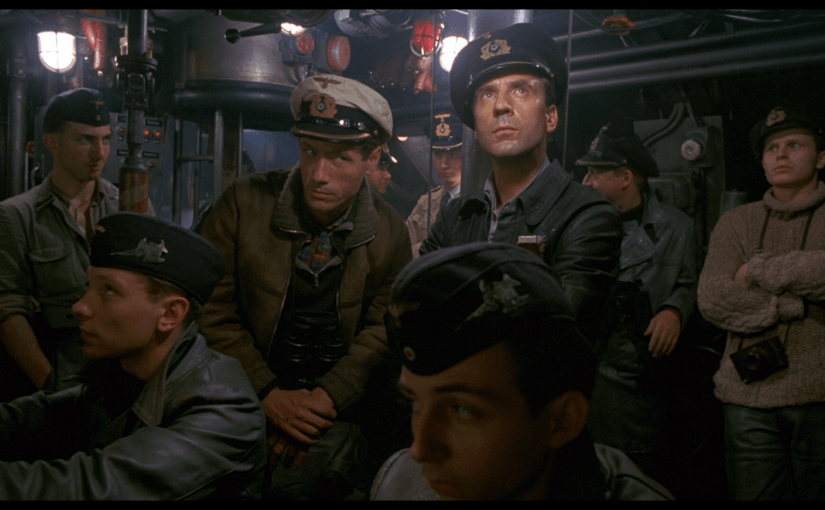
Wolfgang Peterson demonstrated how much suspense he can squeeze out of the tightest of movies when he embarked on filming one of the most realistic and famous submarine movies of all time, Das Boot (translated as The Boat).

During World War II, a German U-Boat is assigned to carry out missions of war within the deep Atlantic.  The purpose is simply for attack and never to question motivations or reasons.  Because these Nazi sailors have no concept of the politics or the totalitarianism behind the Führer, it is not hard to empathize with their plights at sea.  Life on a submarine is no party.

The Captain of the vessel is played by Jürgen Prochnow, the only recognizable actor in the whole cast.  However, all of these men are working just to get by one more day within the very narrow confines of the sub.  In fact, the main character is the submarine.  Rarely has a setting been so evident.  I was told that Peterson used miniature cameras, rare for use in the late 1970s when the film was shot.  He would tightly hold the projector and pursue his cast of shipmates down one galley way after another.  He’d put the camera right up against their face and profiles.  The concentration of these actors to ignore the filming is astounding.  Wolfgang Peterson provides a very clear documentary style to the piece.  Herbert Grönemeyer portrays a war correspondent, easily used within the context of the story to accept Peterson’s approach of simply witnessing the activities and claustrophobia aboard a boat that is primarily under hundreds of feet of ocean water.

To my knowledge, Das Boot is a fictional story loosely based off of accounts from an actual military journalist who was aboard a similar cruiser during the war.  I suppose the film could have been told from an Allies perspective rather than the Axis German superpower.  However, the film works and as a viewer, as you become more engrossed in the picture, you become blinded to the fact that these men served Adolph Hitler.  There’s hardly a swastika in the film.  So, I’m seeing men like any other cadets and officers serving a military branch, working to survive while completing the assignments bestowed upon them.

The torment comes in all forms.  The controls are old and clunky.  It gets very dark at times.  The vessel does not move at a comfortably smooth pace.  They have no choice but to eat rotten food.  It is so bad that the bread turns blue or green.  The men are unbathed and you can practically smell the stench of their body odor and the raw sewage that remains behind.  Sleeping quarters are cramped and are never efficient.

There is such miniscule space available for these people to carry on. The top officers get their exclusive table, but they must get up and move out of the way during dinner, while seamen pass them by on their way to different stations.  Luxury is not afforded for anyone.  The beards of the men become longer.  Wolfgang Peterson shot the film in sequence to accurately show the progression of their beards.  It maintained proper continuity as their sojourn of the boat carried on. 

Most agonizing is when the submarine attacks back at the crew.  A long sequence of suspense occurs following a surprise attack from the air.  The boat has dive into the depths of the ocean, but their controls are malfunctioning and they just continue to sink and sink.  Nuts and bolts pop out of nowhere like ricocheting bullets as the water pressure gets heavier.  My car or my smart phone is more technologically developed and capable than this sub, and I question how this clunker can even withstand the compression.  To maintain balance and direction, the men have to race to the front or back of the ship applying their body weight to work like a scale. 

Imagine the boat coming to a rest on a rocky perch hundreds of feet deep underwater.  There is no propulsion or engine power.  No communications either and the crew has less than a few hours left to survive among the carbon monoxide flooding the ship.  It’s a helpless scenario and at multiple points during the movie, I was convinced this is how it will all end.  Often, I was prepared not to be surprised how this all wrapped up at any given period of time.  Das Boot is a long film. The special edition is over three and a half hours. So, you get a vibe of how stretched out this crew has been away, cramped in these quarters.  Because Peterson stages these challenging scenarios to be extensive, you easily relate to the stress of these men. 

War is hell, even for the Nazis.  The Captain agonizes over a successful attack he’s accomplished when he takes out an American naval destroyer.  He’s done his job well, but he’s angered as he witnesses the aftermath through his binoculars.  Crewmen are set ablaze as they fall off the ship and into water below, and he wonders where the rest of their convoy has gone.  Shouldn’t they be rescuing their men?  This Captain is not a Nazi.  He’s a pawn on a chess board, not assigned to think of the fallen, but rather to do what he is told, absent of questions or emotions.

I do not want to spoil the ending but I cannot recall feeling so much anguish for a collection of Nazi officers before.  Another submarine movie was bold enough to say that the only true enemy in war is war itself and having watched Das Boot, I can clearly see the meaning behind that perspective.  This is not a war picture where one side torments and personally tortures individuals before brutally killing them with gunshots to the head.  In a submarine, the crew is somewhat blind to what they must attack. They are only aware of the environment that troubles them. The men of Das Boot don’t curse the Americans or the British, or the Jews.  They show no prejudice.  That’s not their mentality.

When I see them overcome one daunting challenge after another, I’m relieved for these Germans.  They survived.  They made it. 

However, after watching for over three and a half hours, the final sequence and frame send me a cold, all to real reminder of what occurred during that terrible world war less than eighty years ago and it the film’s ending is the only way this picture could have ended.

Das Boot is a masterpiece of filmmaking.

GLADIATOR II

By Marc S. Sanders

With Gladiator II, you get two of everything.  Two heroes, two emperors, two great white sharks, but only one Denzel Washington which is plenty.

The sequel to Ridley Scott’s Best Picture Oscar winner takes place sixteen years after those events when we had the impression that Rome was left in a state of nobility, devoid of treacherous gladiator games. Not so.  

Two flamboyant young men named Geta and Catacalla have taken joint rule of Rome thanks to their continued worldwide conquering delivered by their General Acacious (Pedro Pascal).  The general fought for Rome, even if he didn’t agree with the rulers’ policies.  Now he wants to rest with his wife Lucilla (Connie Nielsen, one of two returning cast members of the original film).  Though it’s hard for Acacious to remain apathetic even while the two brats demand more widespread conquests.

Elsewhere is Lucius, Lucilla’s son, a child in the first film, now an adult whose African army suffers defeat at the opening of this film.  The opening naval sea raid upon an impenetrable fort is massively impressive with arrows, fireballs, swords, sea water drownings and gory bloodletting.  Lucius is played by Paul Mescal.   

Gladiator II is full of parallel stories.  Still, you can bet these characters’ paths will all intersect in coincidental soap opera fashion during the run time of the film.

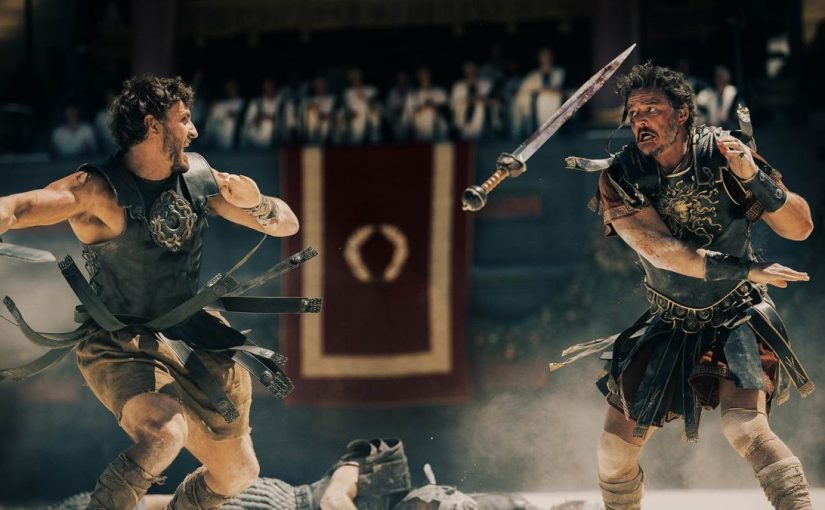
There’s nothing new to this follow up picture that you hadn’t already seen in the original Gladiator.  In fact, the first hour follows a near exact blueprint of its predecessor.  Lucius, a once revered battle commander who lost his wife, is purchased as a slave by Macrinus (Denzel Washington) to fight in gladiator games throughout the Coliseums of Rome.  Because the violence of the sport is so well assembled and enhanced compared to the last movie, it’s easy to get caught up in the fun the film offers.  The action pieces are magnificent.

Though most of the movie is ridiculous.  Historians just close up your encyclopedias.  

Most absurd, yet deliciously fun, is when the emperors arrange for the ring to be filled with salt water and man-eating sharks at the ready as naval battles are reenacted.  Now I’m not sure if this was truly accomplished in Roman times with state-of-the-art plumbing to transport and hold all of this water.  I am also skeptical of bringing bloodthirsty great white sharks straight from the Mediterranean directly into the Coliseum, but I’ll be damned if anyone tells me this centerpiece of bloodshed is not giddy to behold.

Other moments that will have you clapping are match ups between the warriors and big ass mutant, buck toothed (I mean like BUCK TOOTHED) monkeys as well your typical rhino melee.  That latter match had Miguel thinking of Attack Of The Clones.  

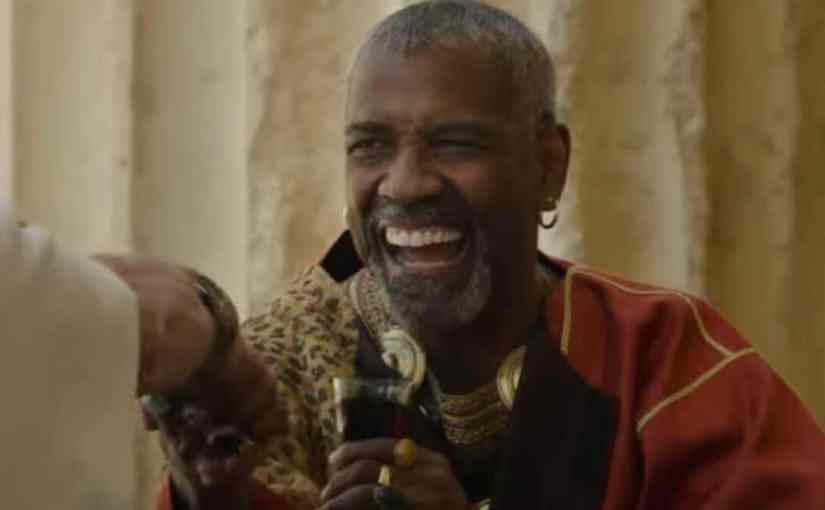
The best of the performances belongs to Washington.  As gleefully over the top (Miguel’s description) as Ridley Scott’s sequel is, Denzel Washington is doing scene stealing work on level with Jack Nicholson and Gene Hackman.  He’s playfully deceitful while appearing proudly respectable with his signature, toothy grin and colorfully eloquent robes that billow with his performance.  The film is not Oscar worthy, but Washington’s performance is because he masterfully works the mind-bending trickery of the character.  Macrinus worms his way through the Senators with conniving wagers placed on Lucius’ undetected fighting talents.  Actor Tim McInnerny is someone I’ve never heard of but as he plays a pitiful, gambling addicted weakling (think of Beaker from The Muppets) against Denzel Washington’s brash and conceited character, you can’t help but take pleasure in how things work out for each of the pair.

Joseph Quinn and Fred Hechinger are the cherub appearing emperors with extroverted cheekbones highlighted in bright rouge.  Combined,  these guys work really well as fill ins for the spoiled brattiness that Joaquin Phoenix left behind in the prior film.  Oh these kiddies are cruel and you just love to hate them.

The two heroes, Paul Mescal and Pedro Pascal, are what is left a little too bland.  They do not match the appeal that Russell Crowe delivered and it’s not simple to care for them or their outcomes.  Lacking any kind of dynamics, they occupy the athletic builds of these guys they’ve been cast to play and that’s where the script limits them.

Thankfully, Gladiator II is very entertaining.  It might not be wholly original when digging up tropes that have been used in many other sword and sandal epics, but Ridley Scott really committed to the carnage and gore we expect.  The director took much pleasure with the outrageous material and the smartest decision was to acquire Denzel Washington.  

Another actor would have slept his way through this role just for a paycheck.  Washington uses the twisted material at his disposal to own the picture all to himself.  I imagine the script documents an unforgettable monologue for his character in front of the weakling Roman senators.  This two time Oscar winning actor must have approached Ridley Scott and said let me try something.  Then the prop department made preparations for a sickeningly, grisly presentation that offers a marvelous image for the Roman Gods to behold, and one that’s hard to forget or not laughingly appreciate.  It may be a stomach-turning scene for some.  On the other hand, I applaud the brashness of the moment.

Our current Congress might be in disarray but with Gladiator II, Denzel Washington and Ridley Scott declare with confidence a resounding “HOLD MY BEER!”

GLADIATOR II (2024)

by Miguel E. Rodriguez

DIRECTOR: Ridley Scott
CAST: Paul Mescal, Denzel Washington, Pedro Pascal, Connie Nielsen
MY RATING: 6/10
ROTTEN TOMATOMETER: 72% Certified Fresh

PLOT: After his home is conquered by the tyrannical emperors who now lead Rome, a rebel soldier becomes a gladiator and must look to his past to find the strength to return the glory of Rome to its people.


[SPOILER ALERT: There is a key plot point that I must divulge in my review, but it is not something I knew before watching the film, despite the fact it was supposedly spoiled in one of the trailers.  You have been warned.]

While I was being underwhelmed by Ridley Scott’s latest film, Gladiator II, I was reminded of his previous lapses in judgement.  Although he is the deservedly acclaimed director of masterpieces like Alien, Black Hawk Down, Kingdom of Heaven, and Thelma & Louise, he also helmed such misfires as 1492: Conquest of Paradise, House of Gucci, and the regrettable Robin Hood [2010].  My point is that Gladiator II is a reminder that Mr. Scott is human like anyone else and occasionally makes mistakes.

I’m not saying that Gladiator II is a terrible film, though.  It is not aggressively bad like some other films I could mention (*cough, The Counselor, cough*).  It has some amazing sights, like the rhino battle in the Colosseum, and it boasts a triumphantly over-the-top performance from Denzel Washington as Macrinus, a flamboyant trainer of gladiators with designs of his own for the city of Rome.  On those merits alone, Gladiator II is maybe worth a watch.

But…but…

While the story is interesting from a standpoint of pure plotting, and while we get the requisite nostalgia bombs of seeing Connie Nielsen back again along with periodic flashbacks to the first Gladiator [2000], I felt curiously distant from the film itself.  I have theories about this phenomenon, but nothing conclusive.

First, the lead actor, Paul Mescal, as [SPOILER ALERT] Lucius.  He looks the part, I grant you that, at least from a physical standpoint.  He’s built, he appears to do most of the physical stunts himself, and he delivers his lines with the appropriate gravitas.  But I never got behind him as the hero of the piece.  Maybe it’s because he’s a complete unknown to me?  Maybe because we barely got to know him before he was suddenly thrust into the main story arc?  (By contrast, in the first Gladiator, we got to know Maximus inside and out before he became a gladiator.)

My sympathies went entirely towards Pedro Pascal as General Acacius, the military mastermind behind Rome’s greatest victories.  He is the new husband of Lucilla (played by the returning Connie Nielsen), whose son, you’ll remember, was last seen following Maximus’s body out of the Colosseum, sixteen years before Gladiator II begins.  Acacius is dutiful almost to a fault, deferring all glory on the battlefield to the empire of Rome, even if it’s currently being run by a couple of brothers (Emperors Geta and Caracalla) who are entitled, bloodthirsty tyrants.  He is weary of the constant bloodshed and wonders if there isn’t a better way to restore Rome to glory.

And Denzel Washington…well, I’ll get to him in a minute.

So, the story, while it must have been compelling on paper, seems to be a healthy echo of the first film.  Another defeated soldier becomes a gladiator.  Another successful Roman general wants to restore Rome.  More spectacular, bloody battles inside and outside the Colosseum.  More political intrigue regarding power-hungry senators and double-dealing merchants.  Forgive me, but I’ve been there, and I’ve done that.  (And adding massive sharks to a Colosseum battle does not intrinsically make it better than anything from the first film.  However, some basic research does show that the Colosseum WAS occasionally flooded with about 5 feet of water to stage mock naval battles…so there you go.)

The undeniable highlights of the film are any scenes involving Denzel Washington.  Not since Training Day has he chewed the scenery with this much gusto (although his recent turn as Macbeth comes pretty close).  I’m guessing he still has traces of Gladiator II set pieces stuck between his teeth.  He can command a scene by his presence alone, but he adds these marvelous gestures of adjusting his robes and tossing in one of his dazzling smiles when you might least expect it.  He makes one of the greatest uses of a dramatic pause that I’ve ever heard.  (“I own…[beat, beat, beat, beat, beat]…your house.”)  In another scene, he uses an exceedingly gory prop as a punctuation mark during a speech; if he gets nominated for an Oscar for this role, that’s the scene they SHOULD use for a clip, but they probably won’t.  Shame.  The whole performance is a classic example of taking a smaller role, owning it, and turning it into a thing of beauty.  In hindsight, it’s probably a good thing that he doesn’t have much screen time, because he simply outguns his scene partners at every turn.  You can’t take your eyes off this guy.

The drawback to Washington’s masterful performance is that I found myself marking time between his scenes, instead of falling into the world of the story.  I followed along, was able to keep track of which senator was doing what and why Lucilla was so distraught and so on.  But to the degree that I was able to follow along, I just didn’t care.  I was reminded of Troy, another sword-and-sandals epic, also told on a grand scale with innumerable extras and some world-class battle scenes, but which also left me apathetic for much of its running time.

Gladiator II improves on the first film only in terms of the complexity of its visual effects and the addition of Denzel Washington.  Aside from that, I’m afraid it does very little to make me care about its heroes, its plot twists, its unexpected deaths, and the glory of Rome.

(And I had to exercise superhuman restraint, at the final shots of the film, to keep myself from yelling out loud, “Talk to me, Goose!”)

UNSTOPPABLE (2010)

By Marc S. Sanders

An adventure of the unexpected needs to start with urgency. 

“Let’s say there’s a runaway train that’s barreling through the state of Pennsylvania and no one is on board to stop it.”

“Not bad.  What else you got?”

“This train is a half mile long. So, it’s a roller coaster of a beast.”

“Go on.”

“How about there’s another train on the same track and the two are going to collide with each other?”

“It’s got potential.  Anything else?”

“Oh yeah.  The train is carrying toxic chemicals that could cause mass destruction and casualties of epic proportions throughout the rural area.”

“Okay.  Now we’re talking.  Any guns?  Can we find a way to get machine guns into the mix?” 

“Yes!  I got it.  How about if the people try to derail it and the only way to make that happen is the cops shoot at this tiny button on the bottom of the engine, and this button is located between the gas tanks?  So it’s gotta be a direct hit while the train is in motion.”

“Okay.  Okay.  That’s genius.  Let’s green light it.”

Now this might have been how Unstoppable, director Tony Scott’s final film, got put into commission, but what is especially fascinating is that this is based on a true story. An out-of-control locomotive actually went off with no one on board to control it.  It happened within the state of Ohio about fifteen years prior to the release of this film.  Only it was not as dramatic or suspenseful as Tony Scott and his crew assembled their movie.  Unstoppable is a pumped-up, steroid enhanced reenactment of the actual story.

The director recruited his most common go to lead, Denzel Washington, for the role of Frank Barnes.  He’s an engineer with over thirty years’ experience who is wiser than the big wig suits on the top floor.  He can bring this potential disaster to a halt before it happens.  Frank is also a mentor to the fresh, young conductor, Will Colson (Chris Pine). 

Will is cranky because his wife is upholding a restraining order against him and the two are at a standstill of hashing their problems out over the phone.  Frank is in a bad mood because the young guys like Will are being brought in to replace the grizzled fellows who are being pushed out.  Frank is also a widower with two estranged daughters. Though, he gets a kick out of telling Will the girls are paying their way through college by working at Hooters.

Denzel Washington and Chris Pine make a good pair.  Buddies who antagonize each other at first, they later share what’s eating at them personally and professionally. Then they work well together to resolve the crisis at hand.  Their characters are not very dimensional, nor should they be.  After all, it’s all about the train.  Yet, I believed them as train engineers/conductors.  Either of these guys could be operating a merry go round and I’ll believe they know some serious shit about how the carousel operates and moves in a circular motion.  My point is these actors really work at it to appear like guys who are well trained within the freight train industry, and I buy all of it.

In the control center, staring at large monitors with high tech maps is Connie (Rosario Dawson).  She’s communicating on the CB with Frank and Will and giving them updates on the status of when their engine will be within hookup range with the one speeding out of control.  She’s also the figurehead with the smart mouth, needed to stand up to her bubbleheaded corporate boss (Kevin Dunn) who threatens to fire all of them.  In other movies, this guy would be the angry police captain in a cop movie.  He’d be the government official who believes he can protect the President while Kevin Costner or Clint Eastwood knows that’s not how it works.  This is a slot role.  Use the same dialogue for a guy like this no matter what the picture is about because it’s all standard stuff. 

On paper, Unstoppable sounds ridiculous and quite ordinary for an adventure.  A runaway train.  Isn’t there anything else?  Yet, Tony Scott applies his quick edits and aggressive zoom in and zoom out shots to the movie’s breakneck progression.  He’s also got those curved Steadicam movements within Connie’s control center accompanied with glowing bright lights of greens, reds and blues. 

News reporters’ updates, along with footage from helicopters, are spliced in between the scenes that Washington and Pine share together in the cab of their train engine.  The glue holds up well.  There’s time allowed for Frank’s girls to cheer daddy on while at Hooters. Will’s wife played by Jessy Schram holds their young son while nervously fidgeting and tearing up watching the news.  I don’t think she has any dialogue beyond the line “C’mon Will!” Soon, she’s live on the scene staring straight ahead for the final act of the film.  That’s a problem.   I’m questioning why she’s looking in the same spot straight ahead if this train barrels on and on.  It’s certainly not in a stationary position.  She’s not watching a baseball game.  No bother.  It’s not fun to question a picture like this with such semantics. 

The exhilaration comes in how Tony Scott sets up his action pieces with daring leaps on and off the train and running sprints on top of and in between the cars.  Guys hang from helicopters with attempts to board the train.  Cop cars turn their sirens on and speed parallel to the locomotive, and yes, as in any Tony Scott film, a handful of cop cars bang themselves up real good in some gritty pile ups. A gorgeous red pickup truck works its way into the story too.

Screeching sound effects are also necessary.  They were nominated for an Oscar. 

Perhaps my one complaint that’s hard to accept is that in some shots, the train, which is supposedly going at over 70 mph, doesn’t look like its going fast enough.  Urgency is important in a film like this and when I get the impression the train is not traveling at a high enough speed, well then the threat doesn’t feel so threatening.  It’s when there are shots underneath from an on the track perspective that you really get an idea of the exhilaration.  In a movie like Speed, the bus always looked like it was accelerating and never slowing down.  Here, the train seems to move slow enough at times that anyone could have just leaped on board, but as Miguel always says, “Then there would be no movie.”

Don’t go into Unstoppable with your Neil deGrasse Tyson laws of physics.  Don’t get hung up on the wife who can see everything that’s happening by staring straight ahead when this speeding train is racing past her from right to left.  Don’t worry. Move on.  It may not look like it, but this train is going faster than it appears. 

Just enjoy the ride, and relish in what set Tony Scott aside as a well-equipped and capable action director.  Sadly, he left this world too soon.  There were more fun action movies to be made by him.  Unstoppable at least reminds you why he is still so sadly missed.

AIRPORT

By Marc S. Sanders

Burt Lancaster described his participation in what would become the first of a batch of 1970s all-star disaster epics as the worst picture he’s ever done.  He declared it “the worst piece of junk ever made.”  Perhaps because of this assessment we were eventually blessed with the Airplane! spoofs a decade later.  

Airport is a sudsy soap opera drama from novelist Arthur Hailey.  It’s an indiscreet invitation to make fun of it, but I doubt it was meant to be regarded that way in 1970.  Then, Airport was likely celebrated as that new kind of picture like The Godfather, Jaws and Star Wars would pioneer in their own rights.   

The film was a box office smash for Universal Pictures, garnering an acting Oscar for kindly old Helen Hayes along with nominations for Best Picture, Cinematography and Screenplay.  It spawned three more films following its success.  Yet, it’s terribly cornball, drowning in floods of cheese, and coated in the thickest of sap.  You better swallow that Maalox now.  This airport is all backed up!

Lincoln International Airport is getting blanketed in one of the treacherous, most blinding snowstorms imaginable.  So naturally it’s the right time to launch passenger airlines into the night sky while also welcoming jets to land.  Were harsh weather conditions not so alarming fifty years ago for air travel?

Well, this blizzard is going to be the first of several problems starting with a plane stuck in the snow right in the middle of the airport’s major runway.  Burt Lancaster is Mel Bakersfield, Lincoln’s Controller, who once again puts aside his family and his troubled marriage to oversee the matter.  He recruits the grizzled, cigar chomping Joe Petroni (George Kennedy) to clear that runway.  Mel firmly believes Joe is the only man who knows what the hell to do.  (Best I could tell is that Joe picks up a shovel like everyone else.) Mel’s other issue is that his pesky wife is disrupting his happy affair with Tanya Livingston (Jean Seberg), the no nonsense, yet perky appearing, blond airline executive with the mini uniform dress hemline.

Further upholding the proud chauvinism of this picture is everyone’s favorite lounge singing lizard Dean Martin as Vern Demerest.  These names!!!! If this movie wasn’t taking place at an airport, I’d swear it was a news station.  Vern also has an inconvenient marriage now that he’s learned his cutie stewardess Gwen Meighen (Jacqueline Bisset) is pregnant.  Cue the squeaky violin music as Vern offers to cover the abortion.  Shocking!!!! Gwen might want to have the child, but she’s gracious enough not to make it an obligation for Vern.  She’s gonna let her dreamboat wonder of a man be, so he remains a doting husband on the side.

So we got melodrama for the airport staff, the pilot, the stewardess… Hmmm…Oh yeah!  The passengers!!!!

A mentally ill, down on his luck man (Van Heflin) spends six dollars cash on a life insurance plan for his wife Inez (Maureen Stapleton) before boarding Vern & Gwen’s plane with a dynamite bomb in his briefcase.  Can Inez warn Mel, Tonya and everyone in time before the plane takes off?

Of course, this kind of stressful tension requires some adoring comic relief, and Helen Hayes as kindly old Mrs. Ada Quonsett delivers an Oscar winning performance.  She takes pleasure in being a habitual stowaway on one flight after another.  Gosh darn it if Tonya is going to make sure to put a stop to this lady’s shenanigans.  

The Cinemaniacs (Miguel, Thomas, Anthony and I) watched this together and Mig pointed out the cinematography first.  It’s dull like straight out of a Sunday night TV movie.  Thomas reminded us that this was in the same vein as most of Arthur Hailey’s material, like Hotel – the book that became a movie that became a TV series.  The soap opera occupies the first two thirds of the picture.  Then a potential threat of disaster occurs, and you work to guess who lives and who dies.  

Directors George Seaton (also screenwriter) and Henry Hathaway work to get the audience invested in these people first while trying to educate us on the most up to date operations in a fully functioning airport.  If George Kennedy’s character is not shoveling snow on a runway and giving it all he’s got in the stuck plane’s cockpit, he’s telling the others what to expect from a potential bomb explosion aboard a jet.  And Look!!! There’s telephones in Mel and Vern’s cars.  Push button ones too.  All over the airport are red phones next to white phones.  There’s luggage.  There’s blankets and pillows for everyone on board the plane. There are also unsuspecting women wearing minks and smuggling jewelry into the country, but the seasoned custom security guard has got a good eye. He can see everything, except for the guy with the bomb. And there’s snow.  Lots and lots of snow but the cabs make it to the airport in the nick of time.  There’s also a message about the need for updating construction on our country’s airports with the most sophisticated traffic controls and operations imaginable.  Should the money be spent?  On top of all this, how are Mel and Vern’s wives and families holding up?

Maybe it’s unfair.  It’s hard to embrace Airport when I have already grown up watching the ZAZ team brilliantly spoof the picture with the Airplane! films.  Yet, I’m confident that had I seen Airport upon its initial release, I likely would not hail the romances of Lancaster, Seberg, Martin and Bisset as the next iterations of Rick and Ilsa.  The dialogue and scenarios are eye rolling at best.  The chemistry sputters as soon as we see the characters for the first time.  The men are twenty five years older than the women, but the love is supposedly passionate?

The extras who are granted snippets of dialogue look like they are reading cue cards and the major players truly look bored.  Watch the cast when the bomb goes off on the plane (like you didn’t think it wouldn’t happen).  There’s no adrenaline from Dean Martin.  He looks lost without his signature scotch and cigarette. The passenger extras never got the memo that they are supposed to be on board a plane with a gaping hole in the rear lavatory.  The priest on board slaps the guy next to him, but I need more convincing of the panic that is supposed to persist.

Fifty years later, the legacy of Airport hinges on only one purpose and that is to give it the ol’ Mystery Science Theater 3000 treatment.  More importantly, once you finish watching it, about all you want to do next is watch Airplane! 

“The cockpit!  What is it?”

“It’s the little room at the front of the plane where the pilots sit, but that’s not important right now.”

BATMAN (1989)

By Marc S. Sanders

If Warner Bros was to abandon the campy familiarity of the Adam West TV series, Tim Burton was the best candidate to deliver The Dark Knight into the macabre gloominess of a bustling crime ridden Gotham City.  Burton is proud of his grotesque weirdness which is what this famed comic book character demands.  

Despite a story that always teetered on flimsy to me, this close-out picture of the decadent 1980s, has so many elements that work. It begins with the marquee cast to the richly deserved Oscar winning hell on Earth art designs from Anton Furst to silly pop/funk samples from Prince and the orchestral score from Danny Elfman.  This is truly the film that put Elfman on the map.

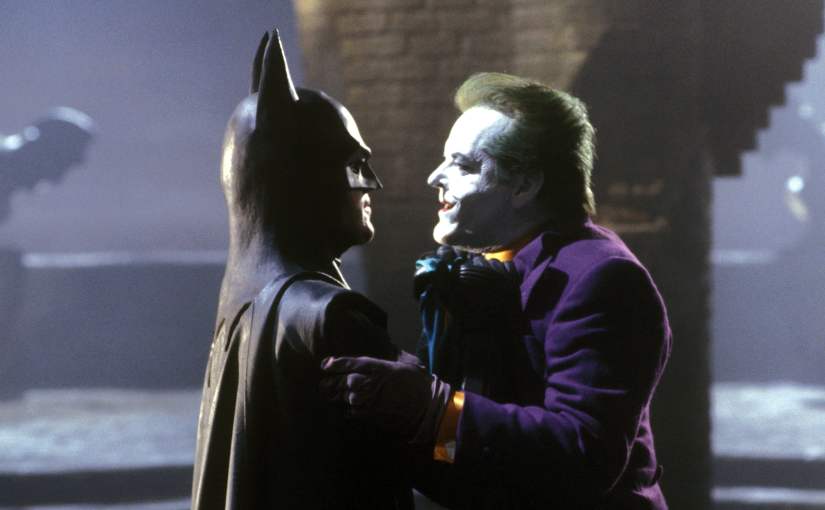
Jack Nicholson collected buckets and buckets of cash to bring Batman’s arch nemesis Joker to life.  He earned every penny.  There’s been copycat attempts (Hello Jim “Mr. Shameless” Carrey) to a handful of other interpretations of the psychotic clown, and still no one has overshadowed what Nicholson brought to the role.  His performance seems like a combined amalgamation of previous celebrated career roles from Easy Rider to …Cukoo’s Nest.  Prince served as his cheerleading entourage to compliment the purple and green color schemes.  This Joker is a perfect antithesis to the famed title character superhero.

Batman is portrayed by Michael Keaton.  Let the record show that when news broke of Mr. Mom occupying the part, I was not a skeptic.  I had seen the dark and dramatic side of the former standup comic a year prior (Clean And Sober, my review is on this site).  I knew he could pull it off.  His quiet pondering as either billionaire Bruce Wayne, whose parents were gunned down in front of him as a child, to the Batman under the cape and mask work on the opposite spectrum to Nicholson’s uncompromising insanity and hyperactivity.  

Keaton against Nicholson are a defined Yin and Yang.

The supporting cast have good moments too including the loyalty of Bruce’s butler, Alfred.  Michael Gough brings Wayne Manor alive and Burton, with a script from Sam Hamm, welcomes several spotlights from the expected council of the trusty character.  Kim Basinger is photojournalist Vicki Vale, Bruce’s love interest.  Frankly she has better scenes to share with Robert Wuhl as Gotham’s reporter.  The Batman fan in me stops short at Pat Hingle as Commissioner Gordon.  It’s not the actor’s fault however that the film offers little for him to do on screen.    Hingle never had much material to play with in the four films he occupied.  That’s regrettable.

The best supporting character is the setting of Gotham City.  With Burton’s penchant for a Vincent Price characterization, he relies on Anton Furst to bring the towering midnight blue steel, skyscraper pillars to enormous heights, reaching into the blackness of heaven.  Every street, alleyway, balcony, puddle, garbage can or mugger, policeman and cabbie that circumvent this city lend life to this hopeless, criminal world.  It’s astonishing how well constructed this Gotham is.  Designs go just as far with Wayne Manor, the underground Bat Cave and a chemical plant designed in hot steam,  with enormous barrels of rainbow, acidic liquids and rickety platforms. Even Vicki Vale’s apartment is gorgeous to look at as both Bruce Wayne and the Joker compliment it as having “lots of space.” Tim Burton and Anton Furst make certain the people who roam these environments are entirely aware of what they occupy.

Sam Hamm’s script doesn’t appear as solid as everything else on screen.  There’s never a cohesive beginning to end trajectory and a lot of the film feels like short story episodes.  Joker takes over the localized mob.  There’s that story.  Joker somehow concocts a chemical poisoning amid the various hygiene products.  Yet it only spreads to the local newscasters.  Gordon, Alfred, Vicki Vale, and certainly not Bruce Wayne ever gets exposed.  Once that storyline begins, it’s quickly disposed.  A little attention focuses on Batman’s beginnings.

The irony of Batman is that unlike other superhero films, this one does not hinge on an origin story for the good guy dressed in black.  That angle is devoted mostly towards Joker, and Nicholson makes the most of his large amount of screen time.  A favorite, sinister scene that maybe Edgar Allen Poe might have approved of is Burton’s invention for Joker to gradually reveal himself beneath the darkness.  He’s depicted sitting in a dirty office basement with an underground cosmetic doctor who witnesses a transformation in the gangster turned madman.  I just like it.  It’s hair raising.  The moment plays like Poe writing a new version of The Mask Of The Red Death.

For me, this is likely Tim Burton’s best film, just below his passion for detail in Ed Wood.  Batman offers up a lot of variety ranging from the darkness of the character to the disruptions revealed in the antagonistic, loudly dressed, Joker.  

There’s no denying how visually memorable the film remains and how quotable it is as well.  In 1989, when superhero movies were not the event release commodities they are today, the endless hype only enhanced the experience of finally seeing the movie on the big screen.  Over a year ahead of release, t- shirts, caps, action figures and costumes were of the highest demand among kids, teenagers and adults.  I actually miss the marketing blitz that overtook the finished film product.  Everyone you encountered was embracing Batman and Joker.  These might be pop culture phenomena, but they created a commonality among the masses of the world.  Batman was worthy of all its swag and endless mania.  It was a celebration of movies for people of all ages to take seriously.

Fortunately, the first half of the 1989 promotional partnerships were never squandered on a decidedly terrible movie.  The end product was immensely satisfying.

Tim Burton upheld his dedication while still a young director in a cutthroat and competitive industry.  As the later films, from a careless Joel Schumacher, demonstrated, it takes an endearing kind of passion to pull these eccentrics off on a silver screen.  Fanboys will happily toss that Bat logoed t-shirt away if they feel betrayed by the movie, they couldn’t wait to sink their teeth into.

An enormous sigh of relief came across the entire pre-internet world.  Keaton is great.  Nicholson of course.  Check out the Batmobile and Bat Jet as well!!! Prince’s music videos served as free commercialization to see the movie over and over again.  A separate record was released to highlight Danny Elfman’s work.

Rightly so!

The grand scheme of delivering Batman and Joker to audiences, was worth every second of the wait.

An astounding achievement of near perfect filmmaking, this Batman film was never overshadowed even with a better, leaner Dark Knight interpretation to arrive nearly two decades later.

Right this way Mr.  Nolan.  Your table is ready for you.

POINT BREAK (1991)

By Marc S. Sanders

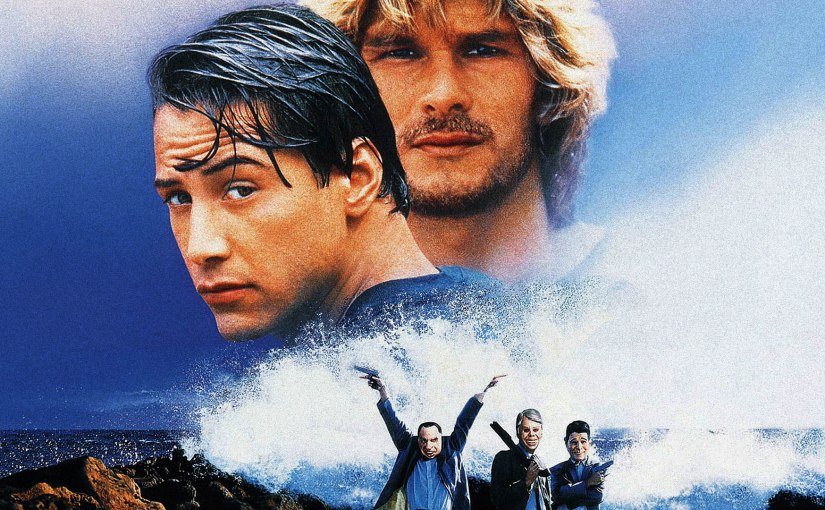
Stop me if you heard this one before.  Richard Nixon, Gerald Ford, Jimmy Carter and Ronald Reagan walk into a bank…

Yeah.  That’s right.  I’m talking about Kathryn Bigelow’s Point Break.  There’s a line in the movie where the rookie FBI hero, Johnny Utah (Keanu Reeves), is described by his new supervisor as being young, dumb and full of cumb.  Pretty fair assessment.

Much of this crime caper works despite the silly summary.  Agent Utah’s seasoned partner Pappas, played by Gary Busey, believes that a series of coastal California bank robberies are being committed by surfers who roll into town each year when the waves are at their most tubular.  They don silly looking rubber masks in the appearance of the Ex-Presidents of the United States to commit their ninety second smash and grab.  Fortunately, Johnny Utah looks and talks like Keanu Reeves who was raised in Hawaii and has experience playing a gomer like this in two other movies that were headlined by some dudes named Bill & Ted.  As well, don’t forget what he hilariously did in Ron Howard’s Parenthood.  Yes, Johnny Utah should fit right in with the California surf.

Point Break does not take itself seriously in its first half.  Johnny has to learn how to look the part of a surfer with a neon pink board amid the colony of saltwater dwellers.  Standard stuff pops up like the angry supervisor (John C McGinley) who screams about no progress being made.  Unfortunately, a romantic love interest named Tyler has to enter the fold played by an actor I’ve never been fond of, Lori Petty.  I’m supposed to believe that she is going to teach Johnny how to ride the waves and chastise him when he’s doing it wrong, and then he’s going to fall hard for her when she delivers one arbitrary piece of dialogue after another.  “What’s this pig board piece of shit?”  “Too much testosterone around here. Later!” Also, for those intimate scenes in the dark calm waters with the moon and stars gleaming in her eyes, Tyler has to ask Johnny something along the lines of “What’s that strange look you got?”  and “There it is again.”  Maybe it’s not all Petty’s fault.  The script doesn’t give her much to work with honestly.  Nothing Tyler says is relevant.  How it is delivered by Petty is not the least bit intriguing and honestly with only few nip/tucks, this character storyline could have been saved for special edition DVD featured deleted scenes that you’ll only watch once and never share on You Tube. 

On to the good stuff. 

You can see how amazingly talented a director like Kathryn Bigelow really is and it is no surprise that a couple of decades of experience led her to a well-deserved Oscar for directing The Hurt Locker.  Going all the way back to films like Blue Steel and Point Break demonstrated that Kathryn Bigelow made a name for herself based on stellar filmmaking skills.  Just look at the sky diving footage alone.  You see all the tricks as the camera follows the daredevils out of the plane and into the sunny blue sky with genuine close ups and acrobatic flips to relish in.  Sensational work.  Gorgeous photography and smooth, unshaking camera operations. Nothing artificial in these sequences.

Moreover, there is the surfing of course.  The checkered bag guy of this action picture is another variation of a dashingly handsome Patrick Swayze with shaggy dirty blond hair, dirty blond facial whiskers and his distinctive voice that if it could be described as dirty blond it would be dirty blond. Plus, a chiseled chest to show off during a karate fight scene.  He plays a guy named Bodhi.  I guess Walter, Melvin, Murray and Jack would not be cool enough.  (My dad, uncle, and grandfathers by the way.)  While Johnny maintains his undercover investigation with Pappas watching from the outside, he becomes enamored with Bodhi and his crew.  They like him in return.  Yet are these those Ex-Presidents who are robbing the banks?

Point Break is a smarter thriller than I think the filmmakers even realized because other than Lori Petty it is cast very well with Reeves and Swayze in the lead roles and a fun cooky Gary Busey on the side.  These actors are game for the quick moving adventures that Bigelow strives for.  There’s a fantastic foot chase through the back streets of Santa Monica following one such bank robbery.  This scene alone is eligible for a Best Editing Oscar with handheld Steadicams following the running players in and out of houses, around flaming gas stations and backyards with barking dogs and dense red light running traffic getting in the way.  Amazing film work.

The surfing would have to be stellar if the antagonists are in fact surfers. The photography is magnificent with narrow waves curving over the cameras directly pointing at Swayze, Reeves and cast coming right towards the screen while balanced on their boards with golden suns hovering overhead.

While Point Break does not seem to know when to end because the credits could have rolled up on three or four different occasions, at least the film insists on having fun with itself. 

I recall in The Predator Olivia Munn’s character went to MIT with a science major that somehow also included military trained special ops in its elite curriculum. I’m expected to believe that nonsense.  On the other hand, when I see Bill’s friend Ted has graduated in the top two percent of his FBI class at Quantico, Viginia, I can buy it.  I don’t have to dwell on it. Now I can enjoy the ride from a sky diving standpoint or a choppy mariner’s perspective.  My suspension of disbelief is bought, sold and paid for. 

Point Break is a smart thriller with a dangerously fun, zippy edge to it.

TWISTERS

By Marc S. Sanders

Reader, often The Two Unpaid Critics will debate the merits or lack thereof in a film.  Usually, one likes the piece while the other does not.  It’s rare though when we both find fault with a movie but for entirely different reasons…and we argue about it.

Fair warning, a poorly constructed declaration is coming your way:

Twisters is better than Twister.  

However, this is like saying cat shit is tastier than dog shit.  

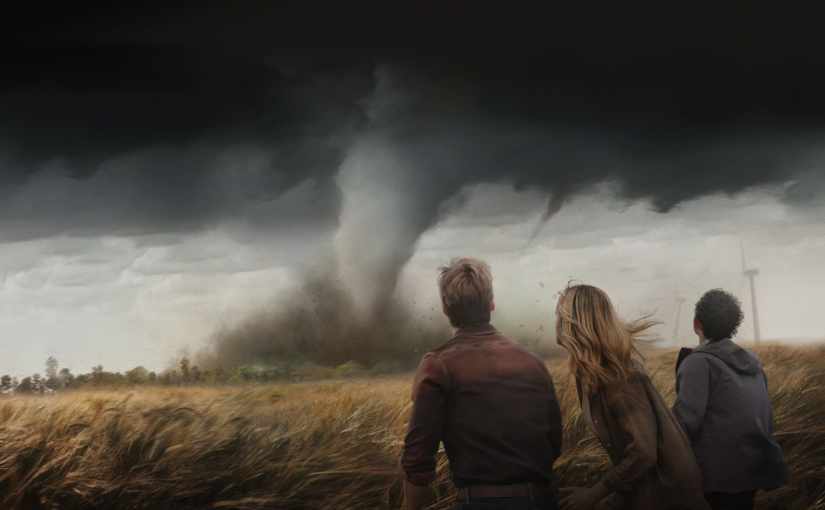
Understand, I had a grand ol’ time watching Twisters with Miguel by my side as the experience quickly gravitated to a Riff Trax viewing.  This apparent sequel to the stupidity that was released thirty years ago teaches us more about the nature of tornadoes.  Though when I insist that observation to Miguel, my comrade put me to the test and my giggles took hold of me because I couldn’t utter a single scientific fact.  Okay.  So it’s not that much brainier. Yet, it is brainier!!!

Twisters offers a background and a traumatic dimension to Kate (Daisy Edgar-Jones) who loses all but one of her entire collection of friendly storm chasers in the film’s prologue, and then weepily monologues about it later.  That’s what I wanted from Helen Hunt in the first movie.  Miguel rightfully questioned why she even needed to speak.  We were firsthand witnesses to this early tragedy.  

CURSES!!!! You foiled me again, Mig.

Okay, so with my arguments shredded to pieces within our debate, I heed to the fact that I am no Jack Kennedy.  Yet, at least I could laugh at how utterly ridiculous Twisters is.

Kate is requested back to her home state of Oklahoma to locate powerful tornadoes that now can be studied with new triangular sensors, each respectively called Scarecrow, Tin Man and Lion.  That garbage can called Dorothy has been put out to pasture.  There’s also a Wizard van. Cute wink and nod names.  No Glinda. No Witch. No Munchkin. No Flying Monkey. How lazy can a tornado movie get?

This corporation with the high-tech gear is competing against a convoy of redneck grunge daredevils led by Tyler, The Tornado Wrangler (Glen Powell).  He fits the persona with the cowboy hat that Brad Pitt wore in Thelma & Louise, along with the flannel shirts and a big ass belt buckle below his ripped chest.  

Tyler’s off road pickup is tricked out with anchors to drill in the ground holding his vehicle in place while he drives right into the middle of a storm.  He’ll also launch fireworks straight up into a funnel.  Whatever it takes to impress his You Tube followers.  

Get this!  Tyler is one of the most educated people in the world on meteorology.  Has to be true!!!! Absolutely has to be, because Glen Powell would never agree to portray a daredevil redneck without a brain to complement his chestnut hair and five o’clock shadow.

Twisters fails at suspense, but unintentionally wins at outrageous comedy when the movie opts to have its terrible tornadoes attack Americana.  As soon as they show small town USA with the little league softball game, I broke out laughing.  I was waiting for the homemaker to put out a pie on her windowsill.  Where’s Bob Seger singing “Like A Rock” from those Chevy commercials?  Tyler, Kate and the gang race to save everyone in town single-handedly without ever calling emergency services.  Only ONE COP appears in the whole movie. Fortunately, once the storm moves on from its devastation, there’s a complete clear road with absolutely no debris for the Tyler’s gang to drive on through. I mean does this movie think for itself or what?

We are treated to people flying away and a water tower toppling over.  A movie house rips apart while Frankenstein shows on the screen.  There’s the inevitable moment when a character gets a leg stuck under wreckage while the others try to get him free but can’t lift him out as the storm bears down.  But wait!!!! At just the last second– I saw this in episodes of The Incredible Hulk and CHiPs and…um…well…Twister!

Earlier in the film, Tyler and Kate have an opportunity to settle their differences while taking in a rodeo.  Of course, Tyler the redneck meteorologist and Tornado Wrangler used to be a rodeo clown as well.  

Then!!!!

What’s this?  

“We gotta get these people to safety??”  

“Is there a basement around here?”

Apparently, Oklahoma is running low on basements.  Not a single basement anywhere in the state where the wind comes sweeping down the plains!!!!!  

Twisters fails because it is paint by numbers, and it shouldn’t be.  It should never be this transparent. The most unpredictable of weather phenomena is so laughably unsurprising when it should be dazzling and frightening and nail biting.  None of it is new.  Everything you expect to happen, happens.

This picture even fails at lending a nasty bad guy to its screenplay.  The rich old guy with the bolo tie, a true indicator of villainy, tours around the devastation. He’s offering to buy the properties of people who have lost their homes so that further profitability can be made with ongoing research into tornado activity.  Yeah.  This guy is a regular Darth Vader or Hannibal Lechter, alright.  Hang him in the town square and then stone his rotting carcass.  Seriously, what’s so wrong with this guy’s intentions?  Kate is disgusted for some reason, but if I just lost my house and my farm and my crops and my flat screen and all my blu rays, heck yeah, I’ll take this fat cat’s money.  

Miguel refused to write a review for Twisters.  However, I’m taking free liberty to share his compounded thoughts. As the end credits rolled over home movie footage of the happy cast, he declared this film is devoid of any kind of suspense, whatsoever.  He’s not wrong, and neither am I.  

Twisters is better than Twister but for all the wrong reasons.

TWISTER

By Marc S. Sanders

About twenty minutes into Twister, Helen Hunt and Bill Paxton crash their pickup truck while trying to outrun the title character.  Amid the high wind, mud and rain, they take cover under a narrow bridge.  Then Hunt’s character, Jo Harding, becomes enamored, almost hypnotized, with what she sees of the powerful storm and steps out saying she wants to see more while reaching with her hand.  Paxton’s character, Bill Harding, pulls her back down.  Reader, why did Bill have to pull Jo back down?  I don’t care about Jo.  I don’t care about Bill.  They’re not characters.  They’re talking objects.  The only character given any kind of care and treatment is the twister.  The next most important character is the next twister and then after that it is the next twister.

Jan De Bont’s Twister is devoid of a brain with a big head full of wind.

A thin story is inserted to connect these talking props.  Bill needs to convince Jo to sign divorce papers.  Jo is focused on getting a tin can thing named Dorothy into the center of a tornado so it can release sensors and thus their team will be able to study the characteristics of a tornado’s behavior like wind velocity for example.  With each new tornado, their attempts fail and somehow the team has another tin can ready to go.  Where are they hauling these things?  As well, how can such a clunky thing that looks less sturdy than a beer keg offer up so much information?  Dorothy looks like it can easily get its ass kicked by R2-D2.

I guess for escapist humor, Bill brings along his fiancé Melissa (Jami Gertz).  Melissa is here for a couple of lame reasons.  One, to wear a white suit with a fashionable hairdo that you know is bound to get messed up (but actually really doesn’t).  Two, to be used as the device for the rest of the cast to explain where they are going next and what they are seeing.  After whatever explanations have been exhausted, the script literally has her exit the picture in a quick announcement. 

I have not seen the new follow up film, Twisters, but I want to and I’m embarrassed to admit that.  It’s the special effects my dear reader.  The visual effects are all that is to be cared about in these movies.  Visually and audibly these effects are unbelievably impressive and I can only expect some enhancements in the new film.  Unfortunately, once I see one twister, I’ve seen them all.  I’m risking cavities for the five minutes of flavor I get in a Starburst.

What’s regrettable about Twister is that with a good collection of actors that also include Philip Seymour Hoffman, Cary Elwes, Alan Ruck and Jeremy Davies, the acclaimed author Michael Chrichton and Anne-Marie Martin hardly attempt to insert any intelligence into the science of weather phenomena or the trauma that goes with it.  I know just as little about tornadoes as I did before I saw this film. 

A prologue scene has Helen Hunt’s character witness her father being violently taken away in a sudden storm.  However, it is never referenced again.  I started to think about that monologue from Jaws performed by Robert Shaw about his experience aboard the sunken vessel the USS Indianapolis.  The scene is an actor’s dream, but it also makes the nature of the world we live in much more personal for that character.  Shaw’s character has a personal vendetta against sharks based on experience.  That’s what is missing from Twister.  None of it looks personal. Helen Hunt is an Oscar and Emmy winning actor.  She could have had a brilliant monologue that demonstrated her need to follow tornados and learn more about their unforgiving nature.  Chrichton even lent more passion to John Hammond (Richard Attenborough) in the film adaptation of Jurassic Park.  The entrepreneur talked of aspirations for a dinosaur zoo.  Jo Harding possess neither passion nor animosity for her purpose in life.  Twister could have operated better as an observational documentary than a special effects action picture.

Since a tornado cannot have an evil laugh or a handlebar mustache, there must be another source for villainy and that falls on Elwes and his crew.  Jo, Bill and the rest of the gang do not like Bill because he leads a convoy of black (black like Darth Vader) SUVs with the most up to date technology around to study weather patterns.  Yet, what is so wrong with any of that?  We have to hate these guys because they drive shiny SUVs.  Is that all it takes?  At best, the competition heats up as the two convoys nearly sideswipe each other or cut each other off on multiple occasions.  None of this is exciting.

A beloved elderly aunt is conveniently nearby so the gang can chow down and disgust Melissa with their eating habits.  Later, the aunt’s house happens to be in the path of a storm and then a sequence is devoted to rescuing her amid the crashing debris.  We get to see the beautiful mid-west house crash upon itself because to see another twister would just be more of the same.  I hardly got to know the aunt.  So, I don’t care if she lives or dies or becomes catatonic or turns into a superhero named Storm.  This is extra cream filling in an over expired Twinkie. 

The mouth pieces of Twister just don’t matter and while I’m dazzled by seeing a tractor, a cow, another cow (or was it the same cow?), and a house fly around and topple all over the roads amid the wind and the rain, I’m just not taken with any kind of suspense or care. 

Special effects only work if they are ingredients to a story, and not just the story. 

DEADPOOL & WOLVERINE

By Marc S. Sanders

Hollywood back stories have created a quandary for the studios’ celebrated film franchises, especially the Marvel Cinematic Universe.  Disney has purchased the properties and copyrights belonging to 20th Century Fox and now, at last the X-Men can properly meet Captain America and the Hulk and Spider-Man…well only if Sony will let the wall crawler come out and play.  So, how should all these guys meet one another, especially now that some of these actors who play these superheroes have received their AARP cards?  Furthermore, some of these characters are dead…at least for now.  Marvel producer Kevin Feige has the answer.  Only Deadpool (Ryan Reynolds), the Merc With The Mouth who breaks the fourth wall at any given moment, can bring this all together.

Deadpool & Wolverine is the best of the smart aleck hero’s three movies.  Yet, it’s more of just a gimmicky flick than anything else.  This proudly excessive two-hour tentpole picture operates like a solid collection of Saturday Night Live skits, with buckets of blood to splatter instead of The Three Stooges’ cream pies.

Allow me to break down this very thin storyline.  Matthew MacFadyen is Mr. Paradox in a three-piece suit.  He informs Mr. Deadpool that his timeline is about to fizzle out of existence.  Somehow, our hero has to locate help from a Wolverine variant of another universe (Hugh Jackman, of course) to make things right again.  

There’s your open door into the silliness that normally comes with Deadpool.  Our title characters are tossed into a Mad Max kind of wasteland called the Void and an abundance of cameos commence from here on out.  The suprise appearances are a lot of fun and I dare not spoil a single one of them.  The rest of the internet did that the night before the film actually opened. I shan’t lend to that egregious violation. (I’m looking at you Variety, Yahoo and Entertainment Weekly. Was it truly necessary to go in that direction?)

I could never relate to the other Deadpool movies.  Sure, they had some hilarious wink and nod gags, at the expense of Reynolds’ career experiences with past superhero franchises.  Yet, those other films were also trying to work too hard with storylines weaved in as well.  They became tiresome and Ryan Reynolds is not the Bill Murray of yesteryear or even Robert Downey Jr. His schtick in this element was overdone.

With this third installment, the approach works with an Airplane! or Naked Gun finish.  That being said, it takes a lot of knowledge from prior Marvel films within the 20th Century Fox warehouse to get every gag.  It helps to know what other super hero movies missed out on getting green lit, which ones tanked at the box office and who are some of these very obscure characters that were churned out of the meat grinder.  If you know these guys, then you’ll applaud the purpose they serve to of any jokes or story references that allow this new picture to operate.

I found it fun.  I think most lovers of Marvel movies will too.  Yet would someone like my sixteen-year-old daughter catch every reference or cameo that walks into frame? Some characters have not appeared on screen in over twenty years.  Reynolds and company also toss out one-liners that reference dated Hollywood gossip.  There was a lot of explanation that I had to fill in for my wife on the drive home.

Beyond all this, Deadpool and Wolverine, played by Ryan Reynolds and Hugh Jackman, work really well together like a good buddy cop picture.  Get these guys back together again in a Lethal Weapon or 48 Hrs kind of movie and I’m there.  Honda might not be too fond of these guys, but their pairing is an overdue welcome to the big screen.  Why Honda? See the movie and you’ll know what I mean, but I am eternally grateful for the automaker’s contribution to this picture.

As expected, the violence is excessive.  I think I’ve had my fill of knives and claws being thrust into men’s crotches.  Seems to happen literally every five minutes.  Beheadings abound too.  Slow mo flips and bullets and bullet casings flying and dropping out of guns is never enough for these filmmakers either.  

Some will try to convince me of how tender hearted the picture is too.  Bah!!!! I know what you’re talking about, but go watch Terms Of Endearment or even Avengers: Endgame to get your tear ducts exercising.  The Hallmark moments here never carried much weight for me.

Deadpool & Wolverine is a grand time at the movies, worth seeing with an enthusiastic crowd over settling for a lonely night at home with Disney Plus.  The movie is a little too long, though.  None of the material belongs on the cutting room floor, but a good chunk of it could have been preserved for the next Deadpool blood spattered, slapsticky flick. I just didn’t need to consume all of the eggs in the basket.

My Personal Edit for the MCU: While I toss out my bravo on Marvel’s willingness for self-depreciation on a celebrity roast level with Reynolds and Jackman at the helm, it’s time to get serious again.  

Please get off this multi verse kick.  Director James Mangold (Logan, …Dial Of Destiny, 3:10 To Yuma) said it best that multi verse approaches produce lazy writing.  There’s no stakes anymore.  Hard to believe a character is dead when we watch him/her/they die.  They’ll just come back in the multi verse!!! Enough already.  

Bring back the villains who work based on sound logic like Thanos, Eric Killmonger and Obadiah Stane.  When these guys commit their worst misdeeds, know they did it for a greater purpose than just a mustache twirl and an evil laugh.  I could get behind their arguments.

More importantly, when the job is done, let it stay done.  Treat the audience fairly.  

As Annie Wilkes passionately declared: “Are you blind? They just cheated us.  HE DIDN’T GET OUT OF THE COCKADOODIE CAR!!!!”  I know exactly what you’re talking about Annie. Where’s that sledgehammer?