SPIDER-MAN: INTO THE SPIDER-VERSE (2018)

By Miguel E. Rodriguez

Directors: Bob Persichetti, Peter Ramsey, Rodney Rothman
Cast: Shameik Moore, Jake Johnson, Hailee Steinfeld, Mahershala Ali, Lily Tomlin, Kathryn Hahn, Liev Schrieber
My Rating: 10/10
Rotten Tomatometer: 97% Certified Fresh

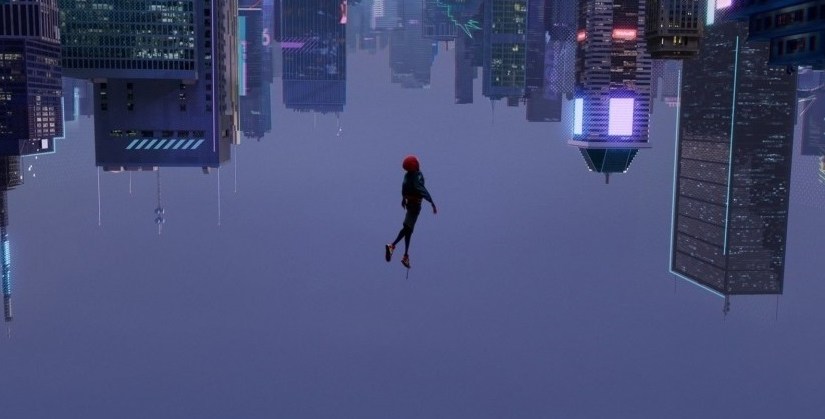
PLOT: In an alternate New York City, Miles Morales is bitten by a spider that has been strangely affected by scientific experiments being conducted by Kingpin. He soon meets other Spider-People from OTHER alternate realities who were dragged to Miles’ reality by those same experiments…


Right from the opening credits, an intense, fan-boy-level love of the Spider-Man characters (and comic books in general) radiates from the heart of Spider-Man: Into the Spider-Verse like those little squiggly lines of “spider-sense” that instinctively tells the various spider-people that they are in the presence of other spider-people.  It tells the other fan-boys, fan-girls, and fan-adults that here, at last, is a cartoon comic-book movie worthy of standing with the live-action giants of the MCU, both in terms of visual spectacle and in terms of an extremely solid, well-told story.

When I saw the first trailers for this film, I instantly dismissed it as yet another cinematic screening of a forgettable, straight-to-video animated feature.  The style looked like some kind of mish-mash of CG figures and hand-drawn faces, trying way too hard to be different without actually being effective.  The story was ultra-cheese, the kind of thing that even comic-book writers would find old-hat: a trans-dimensional rift allows Spider-People from different alternate universes to interact with each other at the same time.  And one of them is a literal cartoon pig called Spider-Ham.

Right.

So the movie gets released, and one day I take a peek at the ol’ Rotten Tomatometer, and it’s like at 95 or 96 percent.  And I’m STILL skeptical because the Tomatometer is only really accurate about 80% of the time.  But it continues to get buzz, and everyone on Facebook who sees it posts saying, “WOW, was that a good movie!”  It suddenly becomes the must-see movie of the holiday season.

So.  We saw it today, and just got home.  And WOW, was that a good movie!  It is fulfilling in just about every way a movie can be.  It had loads of humor; it was brilliantly original; it was visually stunning; it had real, EARNED dramatic moments; and it has the best credit-cookie since Ralph Breaks the Internet.

A lot of the film’s impact comes from that stunning visual style, which I initially dismissed.  As much as Sin City and Watchmen before it, Into the Spider-Verse takes great pains to recreate the look and feel of a comic book in as many ways as possible.  Speech panels appear occasionally.  Sound effects are manifested as words: “bap!” and “BOOM” and “bagel!”  (Yes, that is one of the sound effects.)  A lot of backgrounds are made to look as if they’re printed off-kilter, much like some comic books used to be printed back in the stone age.  This non-realistic style allows the filmmakers to create a crazy climax that would be virtually impossible with a live-action film; the CG would look too crazy to take seriously.

Aside from the visuals, there’s also the stunning originality with the screenplay.  For example, given the fact of many (infinite, really) alternate universes, the variations the screenwriters use are truly ingenious, particularly when it comes to the villains.  Kingpin makes an early, ENORMOUS appearance (he looks like the Hulk in a business suit), and he has a henchman that I really should have recognized earlier.  And the cleverness of Doc Ock’s arrival had me shaking my head in admiration.

The storytelling takes the time to let us get to know the inner workings of the main characters, a rarity in a non-Pixar film.  Miles Morales (the focal point of the story) is a high-school kid, loves his Latina mom and African-American dad, doesn’t love his new private school, loves bonding with his ne’er-do-well uncle…these connections are solidified in our minds so when the moment comes when a family member’s life is on the line, you feel it, man.  It’s not just drawings going through the motions.

It’s very hard for me to discuss the humor without giving away some of the best jokes.  You just have to trust me on this one, besides being one of the best comic-book movies of the year, it’s also one of the funniest.  (I LOVED the fake movie posters in Times Square.)

In closing, I can only apologize to the movie gods for completely dismissing this movie on the basis of the trailer.  Ever since that happened to me with Fight Club, I’ve tried to avoid making that kind of snap judgement.

NO TIME TO DIE

By Marc S. Sanders

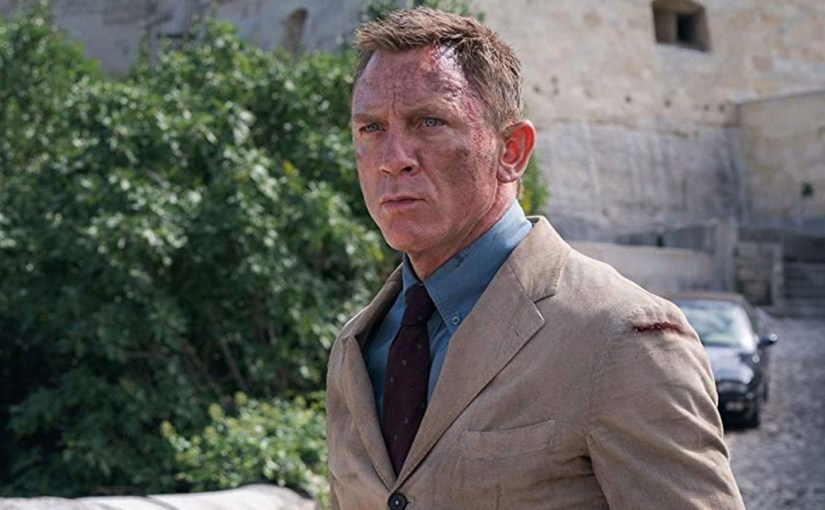
Any die-hard James Bond fan should absolutely love Daniel Craig’s final outing in No Time To Die.  Not only does the film work as a salute to the more serious aspects of past Bond films (not just Craig’s installments), but it is working with its tongue placed firmly in its cheek.  That is not to say that I still did take issue with a few narrative choices the film steers into.

Years have gone by for Craig’s interpretation of the famed secret agent.  He’s comfortably in love with Madeleine Swann (Lea Seydoux) from the prior film Spectre, and known daughter of Mr. White, one of Bond’s prior adversaries.  Suddenly though, Spectre seems to be back with a vengeance.  The imprisoned Blofeld (Christoph Waltz) somehow seems to be involved and 007 puts his guard back on opting not to trust Madeleine or anyone ever again.  The story jumps to five years later and Bond’s CIA friend, Felix Leiter (Jeffrey Wright) has convinced him to come out of seclusion and assist with recovering a kidnapped scientist who holds the formula to a deadly nanobot virus manufactured through plant life.  Bond travels to Jamaica to complete the mission.  From there, the story gets more complicated and more interesting.  Though I dare not spoil what comes next.  This film has a lot to tell in the near three hour running time.

Daniel Craig always had some sort of challenge with the general public while playing James Bond.  First, how dare he be blond?  James Bond is not blond.  He survived that ordeal to continue to make more films.  His second film suffered in storytelling due to a writer’s strike.  During press junkets for his fourth film, Craig was quoted out of context noting that he’d rather “slit his wrists” than play the character again.  As well, his films broke convention in the long running EON Production series, as each film served as a continuing story with much more serious, dramatic and sorrowful undertones than was ever presented before.  None of these challenges seemed fair to me.  After 25 films, you gotta stir the pot a little bit on a character that has been on screen for nearly 60 years.  It’s not enough that his gadgets change with the times of technology. 

I divert into this observation because No Time To Die offers some shocking developments for the Bond character, but when you return back to Craig’s first film, Casino Royale, you really start to understand why this latest picture goes in this wildly off direction.  In other words, the four films Craig performed in prior to this 2021 installment seemingly spell out the inevitable conclusion of his tenure as James Bond.  So, reader, when you go to see this last film from arguably the most controversial actor to play 007 to date, give some thought to what has already been covered before and maybe you’ll agree it beautifully makes a lot of sense.

As an action film, No Time To Die works solidly.  There’s amazing stunts and vehicles with car chases galore and nail biting shootouts.  I think this film has the longest pre-credit sequence of all the films and it’s amazing where one of the feature attractions is the famed Aston Martin DB5 against a slew of Range Rovers and motorcycles.

Rami Malek fills in as the lead villain eerily known as Safin, complete with the signature facial deformity, a shattered kabuki mask and a hell bent determination to destroy the world by means of turning people’s DNA against themselves.  Just go with it.  There’s not much weight to this dastardly mission.  It’s Malek’s performance that works. 

A new agent is also in the works and what’s this?  She is identified as 007????  Again, the newer films bravely go against convention to keep it interesting. Lashana Lynch plays Nomi.  This character was angled extensively in trailers and press junkets but honestly doesn’t live up to the hype enough.  The actor is fine.  She’s just not given much to make any kind of impact.  Ana de Armas is the actor who really makes a splash in a brief moment dressed in a gorgeous evening gown while giving high kicks to bad guys and armed with an adorable naivety about her and a killer machine gun.  Her character is reminiscent of the Bond girls who elevated the tongue and cheek elements of the series.  In a three hour film, more room should have been left for de Armas to play.

Moneypenny (Naomie Harris), Q (Ben Whishaw), Tanner (Rory Kinnear) and M (Ralph Fiennes) all return making for a solid support team for Bond.  It needs to be noted how well cast the Craig films always remained. During the five film series, each one of the characters had their memorable moments for sure.

The regrettable ingredients in No Time To Die lie in the lacking treatments of Lashana Lynch and Ana de Armas for sure.  Forgivable for the most part however.  Still, the story steers into one angle that I wish it didn’t when a young child is brought into the fold.  Children in serious peril was never part of the Bond formula.  So, while this is another new convention for the long running series, I think it was a poor choice.  I see the necessity of the young character to the story, but was it ever really necessary to put a child amid massive gun play, car wrecks and explosions.  There was something a little unsettling about that aspect of the film and the imminent danger to the girl really isn’t needed to heighten any kind of suspense.  Rather than play dramatically, it moves a little too disturbing.  Early on in the film, another child is placed in disturbing peril as well.  The story options here just don’t seem altogether appropriate.

No Time To Die is an appreciated conclusion to Daniel Craig’s version of the character.  There are great puns for Bond to deliver.  His interactions with Q and M are biting and fun.  His love story portrayal with Madeleine works more solidly here than in the last film they shared together, and his tete a tete with the villains, Blofeld and Safin, are equally strong.  These different relationships broaden the dimensions of Bond.  He’s no longer a cookie cutter character.  There’s a motivation to the guy. 

Having seen the film twice, I have an even further appreciation for this new film.  Hans Zimmer comes in to do the original score and particularly salutes the unexpected favorite among fans, On Her Majesty’s Secret Service with select notes and rhythms from that film.  Granted the script for No Time To Die makes obvious references as well.  I also appreciated the wink and nods to Bond’s very first adventure, Dr. No.  There was just a lot of smart, subtle honors presented here. 

Still, the best reference is left for one of the best lines in the film.  When Bond meets Felix’ partner ahead of a mission, Daniel Craig as 007 has to ask “Who’s the popular blond?”  After five hugely successful films, over a fifteen-year span, any one of us better know that the only blond that matters is “Bond.  James Bond.”

AQUAMAN (2018)

By Miguel E. Rodriguez

Director: James Wan
Cast: Jason Momoa, Amber Heard, Willem Dafoe, Patrick Wilson, Nicole Kidman, Dolph Lundgren
My Rating: 8/10
Rotten Tomatometer: 63%

PLOT: Arthur Curry learns that he is the heir to the underwater kingdom of Atlantis, and must step forward to lead his people and be a hero to the world.


Take the best parts of Tron: Legacy, Tomb Raider, and Disney’s animated Atlantis, and you’ll get an idea of how much fun Aquaman is.  For some people, saying it’s one of the best of the films set in the DC Universe isn’t saying much (peep that mediocre Tomatometer score), but speaking as someone who thoroughly enjoyed Justice League and Man of Steel and Wonder Woman, I had LOADS of fun watching an aquatic Dr. Doolittle kick some serious ass.

Admittedly, some of the underwater scenes are a little tricky.  It’s hard to take some of the weighty dialogue seriously when the people doing the talking are floating instead of standing, with their hair moving around like seaweed.  It’s the kind of thing that works great in animated movies or comic books, but to see it onscreen…it takes a little getting used to.

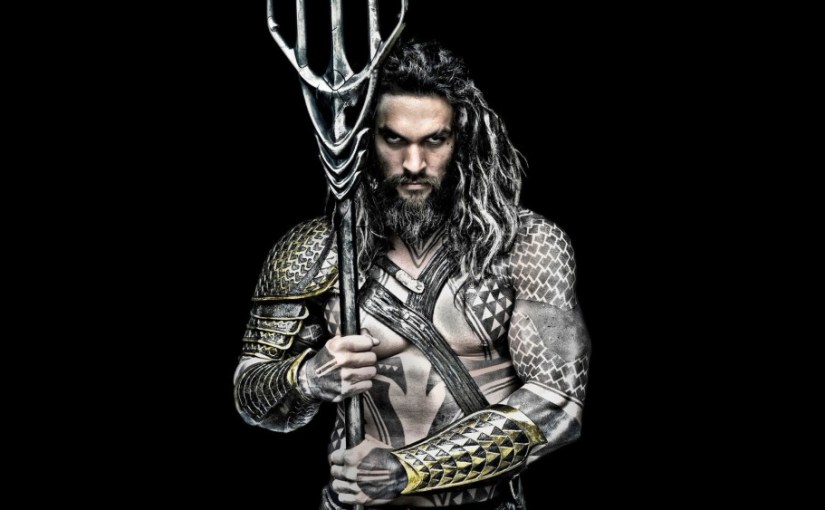
Once you get past that initial hurdle, though, this movie really cooks.  Jason Momoa was the best possible choice to make the much-maligned Aquaman character relatable to mass audiences.  He may not have the cocky delivery of a Robert Downey Jr. or a Chris Pratt, but he throws a mean glare, and, bro, dude is CHISELED.  When THIS guy emits sonar waves to talk to whales, it’s not a joke.  Hell, I wouldn’t laugh at a guy who looks like that.  “You talkin’ to fish?  Ping away, Muscles!”

The story is as ancient as Atlantis itself.  Arthur Curry returns to the land of his lineage to reclaim his birthright, but first he must overcome several trials before he can emerge triumphant.  Ho hum, been there, done that, bought the T-shirt.  But this movie really dresses it up and dazzles us with phenomenal sights.  Atlantis itself looks like someone mashed up Pandora from Avatar with the digital cityscapes in Tron: Legacy.  The various fight and battle scenes are handled extremely well, balancing clarity with incredibly elaborate CG fireworks.

(It was also nice to see one of Aquaman’s nemeses, Black Manta, rendered in a way that was EXTREMELY faithful to the source material, big head and big eyes included.  Of the actor portraying him, let it be said he was extremely adequate to the task, without really transcending the role he was given.)

Whatever gripes people may have, I would imagine it’s with being tired of overblown superhero movies, or the relatively few story gaps in the movie. (How did they get out of the desert?  How did Black Manta contact the Atlanteans in the first place?  If this is a sequel to Justice League, why are there no appearances or mention of the other members whatsoever?)  I can understand those gripes, but for me, the spectacle and the fun cancelled them out.

It’s not a perfect superhero movie; I wouldn’t quite rank it with the best Marvel films. But I gotta be honest: I had a blast.

THE CHRONICLES OF NARNIA: THE LION, THE WITCH AND THE WARDROBE (2005)

By Miguel E. Rodriguez

Director: Andrew Adamson
Cast: Tilda Swinton, James McAvoy, Jim Broadbent, Liam Neeson
My Rating: 8/10
Rotten Tomatometer: 76% Certified Fresh

PLOT: In London, during the German blitzkrieg, four children travel through a wardrobe and discover the fantastic land of Narnia.


In the ranks of books aching for cinematic adaptations, C.S. Lewis’ classic fantasy riff on Christian symbolism surely must have been at the top of Hollywood’s list for years.  With the raging success of Peter Jackson’s Lord of the Rings and the Harry Potter films, someone must have decided it was finally time to get this on movie screens.

The only problem is, TCON: TLTWATW [it’s a mouthful] will inevitably be compared to those other immensely successful franchises.  As a result, while the movie itself succeeds admirably, I find myself thinking, “Yeah…but it doesn’t QUITE pack that Return of the King punch.”

But film appreciation/criticism/whatever is not about how a movie performs in comparison with other films.  It’s about how the movie tells its own story in its own way.  So.

This first installment in the Narnia franchise is a good old-fashioned, rollicking fantasy yarn.  Elements of the film will remind people of everything from Star Wars to Spartacus, in all the good ways.  There is, perhaps, a tendency to believe this movie is only for children, particularly due to the talking animals and the fact that the main characters are children.  (There’s also the unexplained appearance of no less than Father Christmas himself.)  But I disagree.  I think the story has a lot to offer to both kids and adults.

Take, for example, the overt Christian overtones of the story.  [SPOILER, SPOILER, SPOILER, SPOILER ALERT!!!]

Aslan, the lion king of Narnia, sacrifices his life to redeem the life of Edmond, one of the Pevensie children who briefly turned traitor.  The White Witch murders Aslan in an unexpectedly creepy ritual featuring orcs, minotaurs, and what appear to be some kind of vampire hybrids.  But, because of the “old magic”, Aslan returns to life.  There hasn’t been a Jesus story this obvious since E.T.…or maybe The Matrix.

This might make some folks believe the whole film is some kind of Christian propaganda, but it’s not.  To me, it’s a way of simply re-framing an ancient story in a way that brings that story to life for modern audiences.  Robert Zemeckis tried the same thing with Beowulf, of which I can only say, hey, better luck next time.  George Lucas did it with Star Wars, Cecil B. DeMille did it with The Ten Commandments, and so on and so on.

If I’m going to be picky, I give it an “8” instead of a higher score because of the “deus ex machina” nature of the finale, which can hardly be surprising due to the Biblical influence of the story.  It feels a little too convenient.  And I thought the battle scenes, while entertaining, were a little too bloodless…but what are you gonna do, they needed to keep it PG, this is a Disney film, for gosh sakes.

V FOR VENDETTA (2005)

By Miguel E. Rodriguez

Director: James McTeigue
Cast: Natalie Portman, Hugo Weaving, Stephen Rea, John Hurt
My Rating: 7/10
Rotten Tomatometer: 73%

PLOT: In a dystopian future Britain, a shadowy freedom fighter, known only as “V” (Weaving), plots to overthrow the totalitarian government with the help of a young woman (Portman).


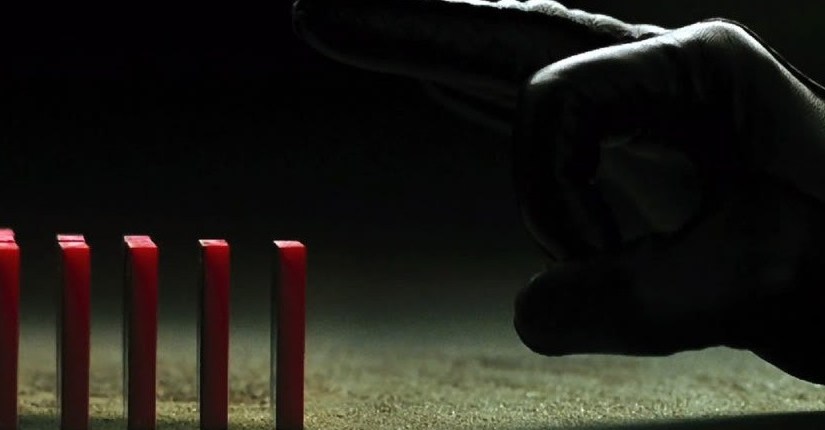
V for Vendetta is based on the single greatest graphic novel I’ve ever read, bar none.  It breaks free of the narrow term “comic book” and becomes a leaping, soaring work of fiction that should be on every serious reader’s Must-Read list.  When I heard a movie version was coming, and that it was being produced by the visionary minds behind the Matrix trilogy, reader, I will not lie…I flipped out a little.  At last, the mass market would have a chance to see what I’d been talking about all these years.

To say the movie does not exactly match up to the graphic novel seems a little unfair.  After all, I’m a chief proponent of the notion that movie adaptations of books, TV shows, et. al., deserve the chance to stand apart from their source materials.  On those merits alone, V for Vendetta works, albeit a little unevenly.

Hugo Weaving was a great choice for the title role of a masked revolutionary whose face is never fully seen, whose voice and gestures alone must carry the character for the duration of the film.  At first, one is reminded of Willem Dafoe playing the Green Goblin in the first Sam Raimi Spider-Man film.  It’s unsettling, but it works better here, due to the ambiguous nature of the mask itself, which is the traditional Guy Fawkes mask.  It’s a smiling visage, but the light-hearted nature of the face presented to the public makes it infinitely more creepy and untrustworthy.

The central story of the movie works well enough.  It’s a trope that I, for one, have always thoroughly enjoyed: the story of a man, or of people, rebelling against the dystopian forces governing their lives.  There are echoes of countless other films in this story: Equilibrium, 1984, The Matrix, Gladiator, etcetera.  In fact, although it’s set in Britain, I’d go as far as saying it’s a distinctly American story, given the history of our country’s origins.  It’s always deeply gratifying to see corrupt powers-that-be get their comeuppance by the final reel.

My reservations with the movie lie primarily with certain long stretches of expository dialogue providing vital information, particularly with the chief inspector, Finch (played by Stephen Rea), re-telling a gruesome episode involving the deaths of tens of thousands of children due to disease, and of their government’s possible role in the epidemic.  While the information is needed as backdrop for what comes later, it brings the movie to a screeching halt.  And it happens more than once.  This is the movie’s greatest flaw: the need for tons of information that is more easily conveyed in the written word than it is on film.

However, for the viewer that is not deterred by these long stretches, the movie is immensely satisfying.  It sets up a loathsome Supreme Chancellor (played with spittle-spraying gusto by John Hurt) whose primary message to his cabinet is to instill fear in the people, to “remind them why they NEED US!”  The various action scenes are expertly done, reminding me of the best fight scenes from the Bourne movies, with a little extra flair provided by V’s weapons of choice, lethal throwing knives.  And the finale is suitably spectacular…make sure your volume is turned up to eleven.

The movie contains one speech that is NOT in the graphic novel, and which troubled me greatly the first time I heard it, and is still problematic for me today.  At the opening of the film, “V” has blown up a building in London as a sign of protest, which of course parallels the face of the mask he has chosen.  Evey, a young woman who has come into his care (long story), questions him about his future plans to blow up the Parliament building:

V: “People should not be afraid of their governments.  Governments should be afraid of their people.”
EVEY: “And you’ll make that happen by blowing up a building?”
V: “The building is a symbol, as is the act of destroying it.  Symbols are given power by people.  Alone, a symbol is meaningless, but with enough people…blowing up a building can change the world.”

This was startling to hear four short years after 9/11.  Other movies had already referenced it as a historical event, but this was approaching the act itself in a deeper sense.  Here is the hero of our story talking casually, even heroically, about doing exactly what the terrorists of 9/11 were hoping to do.  In the context of the movie, he makes sense: the totalitarian villains must be sent a message that the people will be sheep no longer.  But…I couldn’t help thinking that this is the philosophy that drove Timothy McVeigh, and the 9/11 perpetrators, and the Weathermen, and Ted Kaczynski, and countless others.  Is it possible to look at this idea of “symbol-killing” in a positive light?  In this day and age, do we even WANT to find a positive spin to the idea of blowing up a building as a symbolic act?

As I said, for me it was problematic, and it cast a faint shadow over everything that came after it.  Yes, “V” is definitely the hero here, but is this line of thinking dangerous?  I dunno.  Perhaps I’m overthinking it, but there you go.

DIAMONDS ARE FOREVER

By Marc S. Sanders

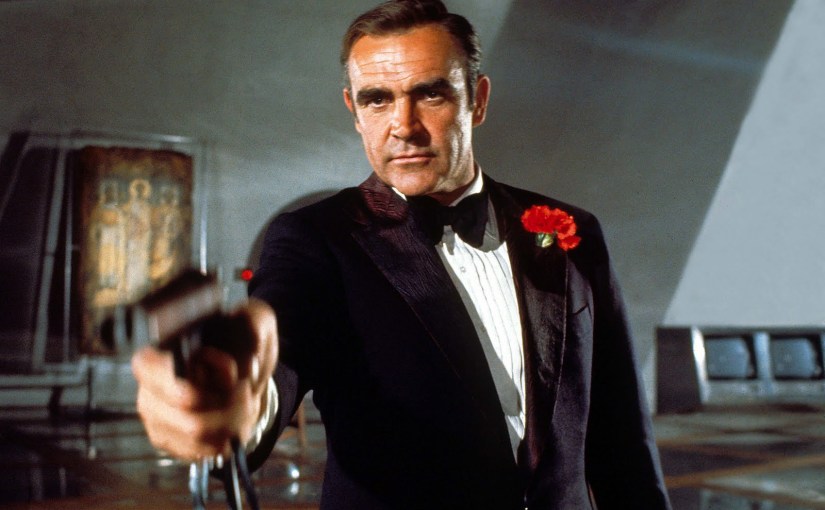
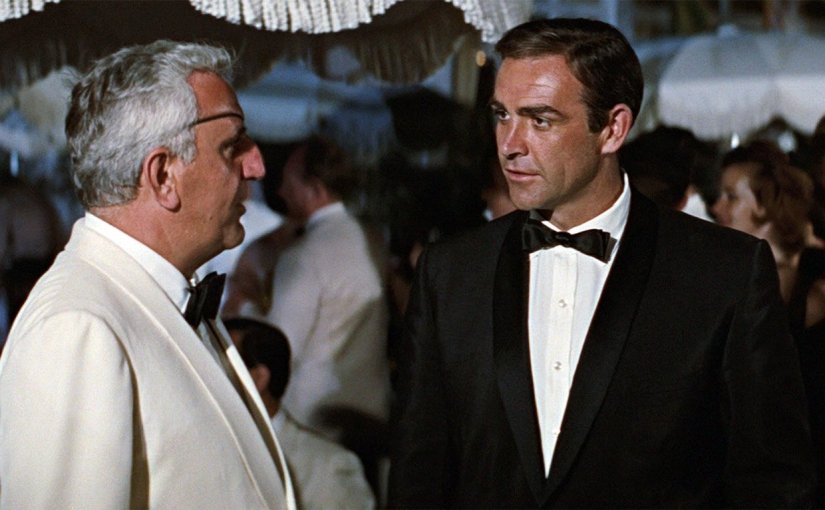
Director Guy Hamilton (Goldfinger) returns to helm Sean Connery’s final portrayal of 007 in the EON Productions series with Diamonds Are Forever. Unfortunately, this film doesn’t even come close to measuring up to Hamilton’s prior effort.

Little regard is offered to the shocking ending of the prior installment, On Her Majesty’s Secret Service. A quick opening has Bond tossing Blofeld (head of SPECTRE, here played gleefully by Charles Grey) into a lava pit. Following Shirley Bassey’s pretty good theme song, 007 is assigned to acquire diamonds that are getting smuggled from the mines of South Africa and intercepted by a beautiful American red head named Tiffany Case (Jill St. John, who is pretty fun in the role). Only problem is that nearly every person the diamonds pass through ends up dead by the homosexual henchmen Mr. Kidd & Mr. Wendt. Considering the sexual tête-à-tête the Bond films became known for by the 7th film, Hamilton and company play up these guys like a weird joke in their inflection with one another, and even the fact that they hold hands at times. The music resorts to a mischievous note on the saxophone. In 1971, this might have held for a good laugh. In the PC era, it really doesn’t feel appropriate to imply these assassins are disturbing simply because they’re gay.

Eventually, the pursuit of said diamonds moves to Las Vegas where some silly Smokey & The Bandit (which was not even close to being released yet) humor occurs. Bond pilots a moon buggy through the Nevada desert while cars that are chasing him fall apart and flip over against the sandy terrain. More silly car chases happen in the heart of Vegas. The sheriff and his men are turned into Keystone Cops. It’s a little too much slapstick actually.

Still, why the need for the diamonds and what does a mysterious, unseen, wealthy man named Willard Whyte (Jimmy Dean) have to do with it?

Bond films work best when the villains work. There’s not much given from a powerhouse villain here like there was in Goldfinger. The necessary shootout ending occurs on an oil tanker this time, and Bond is hardly threatened or under much duress. Thus, killing any kind of suspense.

Connery is fine but you can also tell his commitment is hardly in the role. He’s working just enough for a paycheck-reportedly collecting a record million dollars to return to the role one more time.

By the time the film ends, you feel ready for a drastic change in the franchise. The ‘60s camp is over with. Disco seventies is here. So you wish that 007 can make a smooth transition to the changing cultural times. We would have to wait and see what producers Harry Saltzman & Albert Broccoli could do next to reinvigorate the franchise.

ON HER MAJESTY’S SECRET SERVICE

By Marc S. Sanders

Director Peter Hunt was awarded the opportunity to take the James Bond franchise in a double curve ball direction with 1969’s On Her Majesty’s Secret Service. For the first time in the Eon Productions series, helmed by Harry Saltzman & Albert Brocolli, the role of Bond is recast with George Lazenby. Plus-what’s this? 007 falls in love????

Lazenby is serviceable in the role, seeming to have a taller and more slender appearance than his predecessor (Sean Connery), and not a huge departure in looks. Still his tongue in cheek pun delivery is no match for the original Bond.

OHMSS is a bit hit and miss. The fight scenes look great as the film starts off with Bond fending off a couple of thugs on the beach and a later downhill ski chase is exhilarating and well edited. Telly Savalas also works as a different kind of Blofeld (replacing Donald Pleasence as the cat loving villain). I just wonder why the long middle act was so cheesy, almost like a bad episode of “Batman” or “Star Trek.” The swinging ’60s might have been coming to a close but James Bond was not ready to put it behind him.

After the first third of the story establishes a love story between Bond and Tracy (Diana Rigg as the daughter of Draco, a competing criminal mastermind of Blofeld & SPECTRE), the super spy is off to Piz Gloria, a lodge located on the highest snowy mountain of Switzerland.

Bond goes undercover as a genealogist (I really don’t know why) while looking not the least bit macho in a ruffled shirt with a kilt and knee high socks adorned with red bows. It’s hard to accept James Bond in this image. I couldn’t imagine Connery adopting this get up.

At the lodge Bond uncovers a stupid plot orchestrated by Blofeld where he’s brainwashing a group of swinging girls to, I think, poison the world populace with makeup kits, or maybe bomb the population. I’m not sure exactly.

Eventually, and thankfully, Bond makes an escape in a well shot ski scene while being pursued by Blofeld and his men. It’s a fun sequence.

This film takes some odd turns. Per the prior entry, “You Only Live Twice,” Bond and Blofeld come face to face. Here, it is as if they never met before. Why the neglect for what’s already been established?

It’s also a bit curious to see Bond fall in love and (SPOILER ALERT) marry Tracy, especially when the franchise is breaking in a new actor for audiences to get used to. Were they thinking new actor means new kind of Bond?

No question OHMSS stands out from the rest of the franchise for the change in casting but also the odd story turns it takes. Not to mention, it has the most somber ending of all Bond films.

It’s worth a look even if it is not the best in the series.

I’ll be interested to see what Lazenby does in future films with the role…oh wait…. Nevermind.

YOU ONLY LIVE TWICE

By Marc S. Sanders

James Bond is murdered in a murphy bed!!!!

Thereafter, he ventures off to Japan to uncover who is capturing American & Russian spacecraft in an effort to pit the two countries in a global war. 007 already has his suspicions. Could it be SPECTRE?

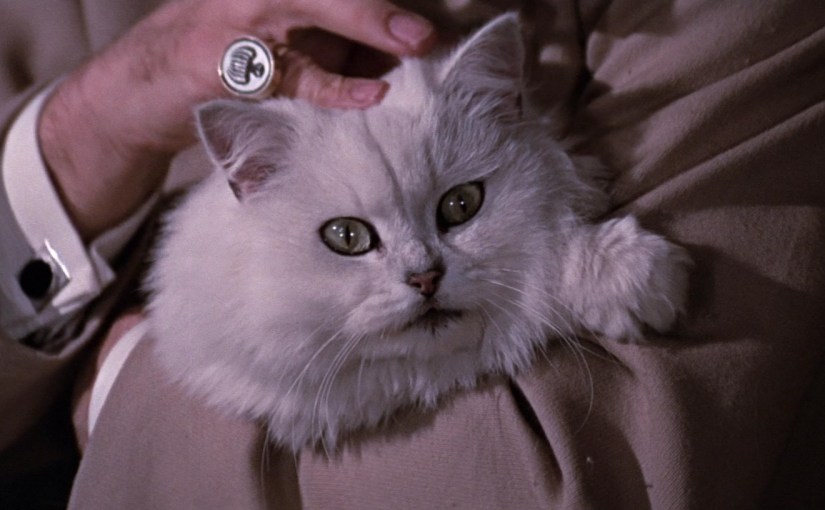
In Sean Connery’s 5th outing as the super spy, Roald Dahl (yes, the same guy who wrote James & The Giant Peach and Charlie & The Chocolate Factory) pens the script for You Only Live Twice, a story that finally reveals the architect in charge of the terrorist organization. His name is Ernst Stavro Blofeld. Donald Pleasence appears as the man with the white cat, long before he chased after slasher Michael Myers every October 31st. “Austin Powers” films have taken all of the shock & awe away from this Blofeld. You can’t help but see Dr. Evil when Pleasence appears.

Still, there is so much to be impressed with. Producers Harry Salzman & Albert Brocolli throw all the money into this film with a hidden fortress beneath a giant volcano, plus gorgeous footage of the Orient, as well as in simulated outer space and underwater, for the secret agent’s funeral.

The first two thirds are fast paced storytelling as Bond encounters one informant or enemy after another. He even gets into a great brawl with the grandfather of Dwayne “The Rock” Johnson. A large sofa makes a great battering weapon.

Regrettably, the movie languishes very unnecessarily into a silly subplot where Bond has to disguise himself as a Japanese man (Mickey Rooney may have looked better in Breakfast At Tiffany’s), learn how to be a ninja in four days (ummmmm…why????), and get married to a Japanese woman (again…..why?????). This apparently is all necessary to raid the hidden volcano fortress. Yeah. It’s ridiculous and you can almost see how ridiculous Connery thinks this is. One of Dahl’s everlasting gobstoppers might have been more useful.

Fortunately, the film redeems itself very well in its ending with an explosive battle between ninjas and henchmen. Bond serves the biggest henchman to some quick eating piranhas. That’s pretty fun.

You Only Live Twice is a gigantic production of grand indulgence largely thanks to the success of 007’s four prior large screen adventures. It’s got big moments, cool gadgets like “Little Nellie” and some unexpected surprises too.

It’s good entertainment.

THUNDERBALL

By Marc S. Sanders

Director Terence Young returns to direct the most auspicious James Bond adventure yet, Thunderball from 1965.

SPECTRE’s Number 2 officer, Largo (Adolfo Celi) captures a British jet carrying two nuclear bombs, and demands England pay 100 million pounds or he will destroy a location in Europe and the United States. Bond is on the mission heading to Nassau, Bahamas to stop Largo (complete with evil voiceover and eyepatch), and recover the plane with the bombs.

The crystal blue sea of the islands allow for a huge undertaking of underwater footage complete with sharks and fight scenes with fists, knives and spear guns. It remains dazzling how well the footage is. Bond (Sean Connery, actually underwater) is there, easily disarming countless SPECTRE agents.

A great centerpiece scene occurs when Bond gets trapped in Largo’s swimming pool with a thug and three sharks to contend with. All this while Largo covers the surface of the pool with a steel sheet. The moment seems inescapable, and Young shoots a memorably suspenseful action piece.

Connery maintains that smooth, suave composure that audiences became accustomed to in his three prior outings, even if his hairpiece is noticeable and his girth is a little wider. On the beach, Bond takes out a bad guy with a spear to the chest and utters the line “I think he got the point.” It’s perfect delivery for 007.

The girl this time around is Domino (Claudine Auger). She is not the most memorable. A beautiful redhead who is not given much to do, even with Bond.

While the underwater camera work is marvelous, Thunderball is not ranked near the best in the series. It feels a little long even when the action scenes are occurring.

Still, Bond continues to hold up as does the curiosity of SPECTRE. Just who is the man with the white cat? We’ll just have to wait and see I guess.

FROM RUSSIA WITH LOVE

By Marc S. Sanders

Terence Young returns to direct the second installment in the James Bond franchise, From Russia With Love.

Sean Connery is back as 007 and he is assigned to escort the beautiful Russian Tatiana Romonava with the Lektor, a secret Soviet computer.

Tatiana (Daniela Bianchi, one of the most beautifully charming Bond girls) claims to be wanting to defect, but she is under duress from the terrorist organization SPECTRE to trap Bond (revenge for the demise of Dr. No) and cause a conflict between England and Russia.

Ian Fleming’s story is deeply rooted in the Cold War climate of the mid 1960s. It only makes sense that SPECTRE, with leadership from the mysterious Blofeld, would become a formidable opponent to Bond. Moments like the Cuban Missile Crisis and other events of the time were on everyone’s mind. I imagine it was easy to relate to in this film.

The story primarily takes place in one of Fleming’s most favorite known locales, Istanbul, Turkey. Young has great shots within enormous cathedrals and museums and even underground in 16th century tunnels, as well as outdoors on the ferry. It’s a fascinating, scenic tour.

Connery is at his best here. He looks great in his fitted suits, letting the suave and dry humor of Bond come naturally. 007 even disapproves of one ordering red wine with fish. Yet he’s also a great player, as his chemistry with gadgets like his quick assemble sniper rifle and trick briefcase (complete with explosives, gold coins, and dagger) really works well. A great fight scene aboard a train against Red Grant (Robert Shaw, in a great toughie role, nowhere recognizable compared to his later portrayal as the shark fisherman Quint in Jaws) is brutal and bare knuckled; well choreographed within the close quarters of a small train compartment.

Another killer comes in the form of Rosa Kleb (the miserly Lotte Lenya) with the shoe knife that’ll kill you in 12 seconds. She’s a lot of fun.

From Russia With Love is the most unusual of the Connery/Moore films. There’s no giant fortress for a villain, or global domination plot that is speechified to Bond over dinner.

The film is more like a Hitchcock interpretation as a pursuit is the driving force. People turn up dead just feet away from Bond and he doesn’t confront or acknowledge the villains himself. He knows they are there, but he doesn’t pick them out of the crowd. Young’s film relies on the suspense that Hitchcock introduced time and again as in North By Northwest, for example. A great scene pits Bond against an aggressive helicopter dropping grenades.

The gadgety playfully exists however, as does Bond’s chauvinism for great puns and tongue in cheek material.

The future of the franchise was looking even more promising here thanks to Connery and EON productions upping the stakes in action and more forthright innuendo.

Bond was going to be here to stay for quite a long time.