
By Marc S. Sanders
Taika Waititi’s Thor: Love And Thunder doesn’t just operate as a standard Marvel Super Hero movie. I think it encapsulates what moviegoers treasure when watching a film, and that consists of a gamut of emotions with the opportunity to absorb the best in sight and sound. Even if we are watching a guy fly through the skies with a cape that’ll be marketed into a million toys and t-shirts, sight and sound are nothing without brains behind a script. It’s fortunate that a director like Waititi always works with that in mind. Marvel overseer Kevin Feige knows how to recruit talent behind the camera and you just can’t go wrong with the architect of a spoof on the surface, yet an all too horrifyingly real film underneath, like the widely acclaimed Jo Jo Rabbit.
I’ve always laid claim to the fact that movies largely recognized as “tear jerkers” like Steel Magnolias and Terms Of Endearment are actually comedies first, and then dramatic sob stories second. I’m serious about that observation. Why? Because if a film is going to go to great lengths to risk the outcome of one of its main characters, then it must get its audience to embrace and deeply love that person first. The best avenue to that approach is to outrageously laugh and cheer that character on ahead of what’s to come. Taika Waititi’s second film to center on the God of Thunder does just that. The best reward I got from Thor: Love And Thunder is that I laughed quite often (as the trailers imply), but I also teetered on tears as well. Good fantasy storytelling will incorporate an all too real conflict with its protagonists and then introduce the strange and unusual as an escape. The best example may be The Wizard Of Oz, and the simple set up of Dorothy and the risk of her perishing with her dog Toto in a threating tornado. More recently, I also think about Guillermo Del Toro’s Pan’s Labyrinth centering on a young girl in early twentieth century war torn Europe. Again, Waititi’s coming of age during Nazi occupation opus, Jo Jo Rabbit, follows this formula as well. Without spoiling too much from Thor’s latest adventure, Waititi presents an all too real and unforgiving circumstance for one of the film’s characters and then segues into his delightfully and never too weird assortment of settings and characters.
It’d be easy to think that by what may be the sixth or seventh time we’ve seen Chris Hemsworth in the garb of this character that anything inventive would have been exhausted by now. Not so. A new dimension in storytelling arrives midway through the film that presents a different crisis for the proud God. Hemsworth really approaches it beautifully. It was reminiscent of Christopher Reeve in the original Superman, actually.
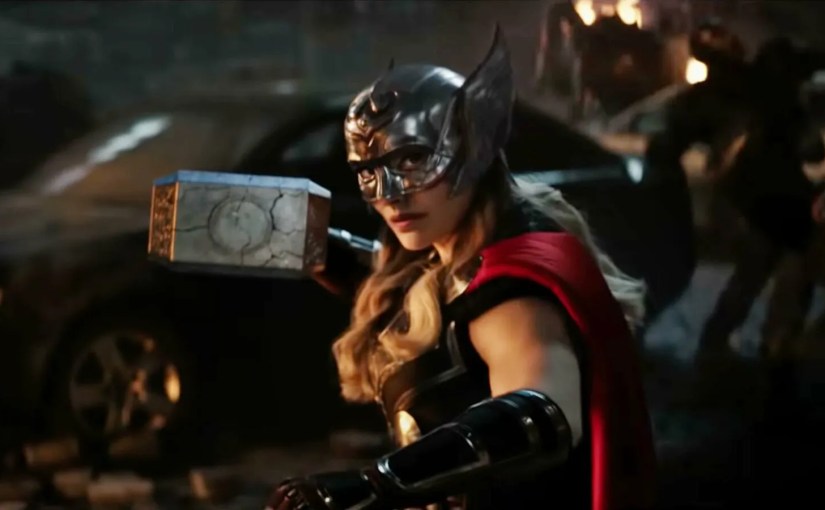
A supporting cast of return players work well together, particularly Natalie Portman, who is given a much more fleshed out and well considered character arc than her two previous Thor films. (Early on, Marvel Studios was notorious for not writing good female characters in any of their pictures. They were just presented as glamorous damsels in distress. Thankfully, that’s well behind them by now.) Portman returns as the on again/off again love interest, Dr. Jane Foster, for Thor. Even better though, Jane actually becomes Thor!!!!! (No spoiler there. Just look at the trailer or marketing poster.) There’s great on-screen interaction with Portman and Hemsworth, even when it’s a montage of past dating episodes like in ridiculous Halloween costumes or having a domestic squabble as any typical married couple might have. Hollywood should reunite these two for a romantic comedy in the vein of Rob Reiner/Nora Ephron material. Chris Hemsworth is a much better partner than Ashton Kutcher ever was in a past Natalie Portman film. Put Chris Hemsworth together with Natalie Portman again and they could become as adoring as Tom Hanks and Meg Ryan did.
By the time the fourth movie comes, does it really matter who the villain is played by? Well, when you are writing a smart script amid ridiculous visuals like Taika Waititi is known for, the answer is yes. This film surprisingly opens on a downer prologue that necessitates good dramatic acting amid silly CGI and garishly loud costumes. It’s fortunate that Christian Bale, who regularly performs on a method level comparable to Daniel Day Lewis, was available to portray the scrawny, pale and scarred Gorr The God Butcher. Bale puts all his talents into what could’ve been a throwaway role like, say a Ghostbusters bad guy. (Can anyone tell me who actually played Gozar in the 1984 film????) This is another notch in Bale’s repertoire of outstanding credits that should not be overlooked. You can sympathize with Gorr, as well as be frightened of him. There’s much range in this character on the same level as the Thanos villain from earlier Marvel films.
Russell Crowe has a fun appearance as the God known as Zeus. He looks over the top ridiculous and he works in antics that seem like they came out of episodes of Who’s Line Is It Anyway? Put it this way, I haven’t forgotten how Crowe walks down a staircase yet. If Russell Crowe is anything of an educated performance artist, then when he was getting sized up in wardrobe, I’m sure the wheels were turning and he was considering what tics could work for that of a God drowning proudly in his own vanity.
Tessa Thompson and Taika Waititi are thankfully back, respectively as Valkyrie, King of the fishing/tourist destination New Asgard, and the simply innocent rock guy buddy, Korg. The Guardians Of The Galaxy are here too. It’s a fun bit of material they have to play with.
In another director/screenwriter’s hands, any Thor film would likely get boring with its standard formal Shakespearean like vocabulary and artificial CGI. Isn’t that an ongoing problem with CGI anyway? So often it looks to fake. Because Taika Waititi opts for bright colors and odd shapes and sizes of setting and background characters, nothing could look artificial, because the fantasy is always acknowledged as over the top by the very characters occupying the space. A glass castle of pinks and purples that resembles gigantic glass Mary Jane bongs or science lab beakers is accepted in a Thor film, just as much as munchkin size, owl like creatures with small beaks are a terrorizing army in flying jet skis with mounted laser guns. Mix in a blaring rock soundtrack and Waititi hits the notes where it’s okay to laugh at the silliness of it all. In other moments, he’ll invite his audience back in from recess to take in what’s hard and difficult to live with and endure. Again, Waititi pleasantly surprised me with the balancing act of outrageous comedy against crushing drama when he made Jo Jo Rabbit. The blend works so well here in not so typical Marvel fashion.
Thor: Love And Thunder left me thinking that it is the best of the superhero’s four films. It’s measure of laughs and choked up drama kept engaged and I appreciated the experience. Remember, I recalled Steel Magnolias and Terms Of Endearment in this write up. If you don’t take that comparison lightly, then hopefully you’ll have the same experience I did with this installment of the Marvel franchise.
PS: Hats off to the trailers for not incorporating everything the film has to offer. Within the first fifteen minutes of the movie, I was actually taken aback by an element I never considered or expected. It only enhanced my perspective of the film.
PSS: Anyone that knows me, knows that I love Guns N Roses. Consider me a born-again fan. Particularly Sweet Child O’ Mine will always be one of my most favorite songs. This film reminded me that it was the first song my daughter heard the day after she was born, when I sang it to her in the hospital room.
 2 UNPAID MOVIE CRITICS!!!!