NEVER SAY NEVER AGAIN

By Marc S. Sanders

If it walks like James Bond, if it talks like James Bond, it is…STOP RIGHT THERE! 

Sean Connery in Never Say Never Again is not James Bond…at least not the James Bond that I know.

Why was this movie even made?

I know.  You don’t have to tell me. 

For the most part it was a legal blessing for a gentleman named Kevin McClory, a contributing writer to the film Thunderball.  McClory sued the Ian Fleming estate for the rights to such named properties as the villainous “Ernst Stavro Blofeld” and the organization he heralds known as “SPECTRE.”  Eventually, it came to be that none of the films could use these copyrighted terms going forward.  (Hence, why Roger Moore never uttered these names in any of his films.  He just dropped a wheelchair bound bald man down a smokestack.)  Anyway, the courts allowed McClory a second chance at his Thunderball creation by granting him the blessing to remake the film with certain moments and developments that upheld the structure of the story.  So, in 1983 a competing studio to United Artists called Warner Brothers greenlit the release of this new film and banked on Sean Connery’s return to the famed secret agent.

Frankly, the backstory is a much more tantalizing adventure than this misfire.

Never Say Never Again always eluded me.  I never had a desire to see it.  I regarded it like a generic brand.  I turn to the EON productions for my James Bond fix the same way I turn to Heinz ketchup, never, ever Hunts.  What I’d heard of this film and the scant moments I saw of Connery in the picture over the years made me question how necessary this movie ever was.  It’s like that Gus Van Sant shot for shot remake of Psycho.  Why do it?  Because you can?  Is that all you need?

So, Connery opted to return for a large salary and for the only time in history two James Bond films were released in the same year, 1983, when Moore’s Octopussy also made it to the big screen.  Connery’s picture is a direct remake of Thunderball. One of SPECTRE’s top agents Maximillian Largo (Klaus Maria Brandauer) catches possession of two United States nuclear missiles and hides them in the Bahamas.   Bond is older now, reflective of Connery’s age at the time, and practically retired as he loses a bit of his step in a training simulation.  Soon, however, he is on the case and contends with a female henchman by the name of Fatima Blush (Barbara Carrera) while also womanizing Largo’s main squeeze Domino (Kim Basinger, in a very early role).  His primary gadget is an exploding fountain pen.

Other than Carera who was Golden Globe nominated for her role, I can’t say anyone is doing anything terribly wrong here.  It is simply that this reiteration seems altogether flat.  This film is certainly missing the exhilarating pace of director Irvin Kershner’s The Empire Strikes Back.  Here, James Bond the hero just seems to walk and sit and stand in and out of frame.  A lifeless tango occurs midway between Connery and Basinger as an opportunity to share some confidential information.  I don’t care if 007 is adorned in his tuxedo next to a 1980s hair sprayed Kim Basinger, the tango is boring to watch.  It is a dance that goes nowhere or builds to anything. 

Games are updated as well.  We are not in the casino watching baccarat or poker anymore.  James Bond plays video games against Largo and the only threat is a shock on the joystick when a parlay is struck.  I can’t feel the zap that is supposed to happen, and Sean Connery is hardly displaying any anguish as Klaus Maria Brandauer smirks in triumph.  So, where’s the suspense here?  Sound effects from an Atari 2600 while the hero and villain sit at a table with joysticks doesn’t send this scene into astonishment. In 1983, in the movie theatre next door, Roger Moore is undoing a cheating Louis Jordan in backgammon while the muscle headed henchman crushes the dice into dust.  That’s much more frightening. 

A midway motorcycle moment with smoke and missile gadget tricks is fun but still not as escapist as most other Bond pursuits. Maybe it’s because 007 wears a dark helmet and thus hiding his charm.  It’s a lot more fun to see Connery or Moore give a wink and nod as the chase continues.  Here there is no reaction and no response to the environment of the Bahamas.  Couldn’t a banana tree topple over or something?  Maybe some coconuts?  Could a yacht or boat capsize?

I always remember the infamous shark scene in Thunderball as Bond gets trapped in a swimming pool with a couple of great whites.  That scene is now changed to an ocean floor shipwreck setting.  For the most part this works as Bond circumvents through the wreckage trapping one shark after another.  This is one of the film’s few improvements.

The big regret is that Klaus Maria Brandauer as the main villain Largo was not served a better product. He is gleefully good.  He’s at least trying as hard as he can. He has the evil grin and short fused temper, but he’s also sophisticated among his wealth. 

He’s certainly working much harder than Sean Connery who seems to just be going through the motions and hardly exerting himself.  The actor is much too relaxed in his role here.  It looks like he memorizes his few lines minutes before the camera starts shooting.  Then he says what needs to be said.  You can subconsciously visualize Connery walking back to his trailer take after take.  There are some decent one liners, but none of his delivery soars anymore.  I think Connery was out of the role far too long since his last turn in 1971 and he just didn’t pick up where he left off.  He’s never applying himself.  His wardrobe, from the tux to a camouflage uniform, or even his swimsuits do not seem to rest well on him.  The tailoring looks off.  He’s not wearing anything as well as he used to.  Not even his hair piece, which is far too thin and uncooperatively resting on his scalp, sits well.

Kim Basinger is the blond.  Nothing more needs to be said.  Rowan Atkinson debuted on the screen with some silly escapist humor but either he’s not on long enough or he’s there too much.  The part should have just been cut altogether.

You don’t forget Barbara Carrera but that’s not necessarily a compliment.  She’s working like a dastardly cartoon from the Adam West Batman TV show and Connery is hardly responding to her screaming or antics.  Funnily enough, the screenwriter is Lorenzo Semple Jr, writer of the Batman show and Flash Gordon, from 1980.  So, while the tongue is trying to touch the cheek it’s only reaching the roof of the mouth this time.  Carrera is a headache. She acts like a misbehaved child.  Somebody loved her though for that Golden Globe nomination.  How? Why?

Another bit of buyer’s remorse is the casting of Max Von Sydow as Blofeld.  Inspired casting.  Yet, why is he given nothing to do?  This is Max Von Sydow!!!!!  He’s been hired to watch a Sony monitor with his white cat tucked into his lap, but that’s it.  Between Brandauer and Sydow, these are some heavy hitters.  Plus, Connery, and a built-in storyline.  It should have all worked but it doesn’t.

The theme song is a painful earworm.  It is performed by Lani Hall, doing a Holiday Inn barfly lounge act that will never leave your consciousness.  You can practically see that wet, shiny lipstick slobber all over the microphone while she’s wearing a blingy sparkle dress and a red, leafy boa around her neck.

Never Say Never Again is a lifeless, uninteresting, tedious and sleep-inducing picture that no one but a Mr. Kevin McClory wanted. 

Like Jeff Goldblum would say ten years later, just because you could doesn’t mean you should.
BOND, JAMES BOND & HIS TOP TEN SONGS

By Marc S. Sanders

Recently I was asked to list what I consider to the Top Ten Songs from the James Bond film series produced under the EON production group.

To factor in this list with only my viewpoint as an authority constitutes the meaning behind each song in relation to the film it represents.  Songs are songs.  However, each song selected for a James Bond installment should have some direct correlation to the Agent 007 and/or the elements of its respective film.  Do the lyrics, tempo and rhythms work directly with the movie as a whole?  If they don’t then they need not be considered. 

For example, I like All Time High by Rita Coolidge for the Roger Moore film Octopussy.  However, to this day I cannot figure out why that song was selected for the film focusing on Cold War conspiracy with a hint of Alfred Hitchcock sensationalism and the titillation of alluring, skintight clad women ready to serve at the behest of the title character, with machine guns strapped over their shoulders and busty chests, and gorgeous hairdos right out of the glamorous times of early 1980s decadence.

I expect some readers may vent frustrations over some glaring omissions here. I did not rank a certain Beatle’s contribution to the series with Live And Let Die.  It’s likely a runner up, ranked number 11 on my list.  Why not higher?  Well, I have issues with Paul McCartney’s number.  His gorgeous voice is there for sure.  However, I feel it disrupts itself over the course of the song.  McCartney is offering up beautiful harmonies and then a cult like ritual composition interrupts the number also serving as a repetitive chorus.  Then it slows down for Paul to sing the next verse. I never understood why.  It breaks up a consistent trajectory.  As well, the lyrics lend nothing to the story or setting of the film (honestly, not one of my favorite Bond pictures).  Blaxploitation and voodoo supernatural tones occupy much of this film and McCartney is definitely not the poster boy for any of those themes.  Out of context of the film, I’m a strong advocate.  I just don’t feel it enhances the picture it is linked with.

To be an effective memorable song for a James Bond movie, the record should contain the chords from Monty Norman’s horns and bugles that declare Bond is here ready for action, danger, and sex.  The lyrics should describe the story or maybe the villain or simply 007 himself. 

And so, let’s begin…

10) You Only Live Twice (You Only Live Twice) – Nancy Sinatra’s entry in the Bond catalogue comes off like the soundtrack of your vacation to Asia.  You can almost hear it as you explore the continent.  It has a quiet hypnotic approach that works so well with the visual locales of Hong Kong and Japan where much of the adventure takes place.  It’s seductive and bewitching, allowing Bond to effectively place a woman under his spell, with permission as a male chauvinist during Sean Connery’s tenure with the role in the 1960s.

9) A View To A Kill (A View To A Kill) – Okay, my justification for it being on the list may not be consistent with what constitutes an appropriate James Bond song, but I’m allowed to break my own rules.  This is a film that rests at the bottom of my rankings.  However, who has ever forgotten the 1980’s introduction of 007 into the world of pop music, compliments of Duran Duran?  This is a far cry from the standard Shirley Bassey numbers of earlier Bond films, not to be found on the easy listening stations programmed on your radio.  Another song not directly related to film’s central theme of the criminal world existing within Silicon Valley.  Still, the rock song is entirely recognizable.  One of the best movie songs to come out of the 1980s, that featured numerous tunes from the likes of Kenny Loggins and Glenn Frey, for example.  Arguably one of Duran Duran’s most popular songs.

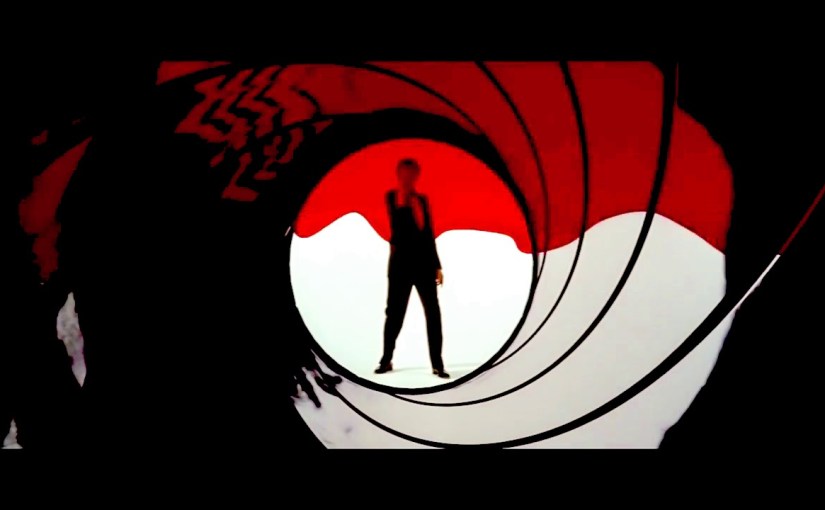
8) Another Way To Die (Quantum Of Solace) – While not a huge fan of the film, that does a poor job of hiding its flaws in story and construction, I cannot deny the single from Jack White and Alicia Keys.  White offers guitar riffs that sound dangerous and scary, like a fast-racing motorcycle equipped with machine guns firing at you.  When his vocals duet with Keys, the harmonies sound sexy and alluring like Bond would be with any of the women he meets, capable of seduction or maybe betrayal.  “A Bomb On The Table/A Woman Walking By/A Drop In The Water/A Look In Her Eye.”  These lyrics really don’t describe what is seen in the film, but they lend to the spy with a license to kill because of what he too often encounters on any of his missions.  The lyrics are chilling.  The music is treacherous; much like when Bond ritually walks into the center of the gun barrel pointing right at him at the beginning of most of the films in the series.  This song promised a better movie than we got from Quantum Of Solace.

7) Writing Is On The Wall (Spectre) – I thought all five songs from Daniel Craig’s time with the series were entirely fitting to the collective storyline of his interpretation with the character.  Spectre is a very personal film for Bond, as it reinvents the relationship he has with well-known arch villain, Ernst Stavro Blofeld.  Sam Smith has such a silky vocal to his Oscar winning song which comes off tragic for 007 as he has no choice but to revisit his past in order to accomplish his mission.  What does Blofeld mean personally to Bond?  Who will Bond have to meet up with, and what personal risks will he have to take in order to succeed?  Sam Smith’s song implies Bond was not ready for the fall, but the truth had to be met, nonetheless.

6) The Man With The Golden Gun (The Man With The Golden Gun) – I’m sorry but this film does not get enough recognition.  Neither does the song.  The theme is as devilishly entertaining as the title character’s fun house that pits James Bond in a climactic dual against Scaramenga played with wonderful glee by Christopher Lee.  While Lulu may be doing an obvious imitation of Shirley Bassey, I can’t deny the song’s recognizable musical tones from John Barry as the singer belts out how “No Hit Man Can Match Him” and “He’ll Shoot Anyone/With His Golden Gunnnnnnnn.”  With a song like this over the opening credits that follow after the character’s maniacal introduction in the opening scene, I have just been promised that 007 will come face to face with one of the most dangerous killers in the world, and it may in fact spell the end of James Bond.

5) Skyfall (Skyfall) – Daniel Craig’s films go for dramatic zeniths.  The film Skyfall certainly leaves you breathless on multiple occasions with the first time happening at the climax of the pre credit scene.  Bond has been shot, he falls from a great height and he’s presumed dead.  That hardly ever happens to 007.  Jump to the end of the film, and a personal loss occurs.  Adele’s Oscar winning song begins with a frightening declaration that “This Is The End/Hold Your Breath And Count To Ten.”  She is practically speaking to Bond himself of what’s to come from this point now that the world thinks you’re dead. Adele takes you on a narration easing you into the drama you’re about see over the next two hours. The tongue and cheek humor found especially in the days of Roger Moore may be long gone, but Craig’s interpretation of Ian Fleming’s “blunt instrument” is thankfully more serious and personal.  This is another perfect example that you will get your thrills from the super spy.  He’s just not as fancy free as he used to be, because the villains make it all the more personal.

4) No Time To Die (No Time To Die) – It may be the one song in the list that sums up James Bond’s relationship with a lover. That would be holdover, Madeliene Swann, from the prior film, Spectre.  Madeliene is the daughter of a former enemy of Bond that he just happens to fall in love with.  Billie Eilish hauntingly sings from the consciousness of 007.  “Fool Me Once/Fool Me Twice…You’ll Never See Me Cry/There’s Just No Time To Die.”  Early on, Bond has reason to suspect Madeliene has betrayed him, and he will not let it happen again because his career and mission and endgame is simply never to die by anyone else’s hand but his own.  Eilish’s song is a perfect wrap up to Daniel Craig’s characterization.  His 007 finds it hard to ever live peacefully and he will always have to keep his guard up.  If he will surrender to defeat, it is only going to be under his terms.  Madeliene, nor Blofeld, or anyone else will ever get the best of him.

3) Goldfinger (Goldfinger) – Shirley Bassey’s first of three contributions (so far) to the sixty-year-old series is her best.  She’s not singing about 007 though.  She’s celebrating one of the most memorable villains that Bond ever faced.  Auric Goldfinger is serious about his love for all things gold.  “He’s The Man/The Man With The Midas Touch.”  Wait for it, because there’s more.  “A Spider’s Touch.”  Deadly!  The fun thing about Goldfinger is that he kills just about anyone he encounters.  He’ll make his point with 007 that he’s not be trifled by suffocating his one-night stand and covering her entire body in paint, gold paint.  He happily lays down his plan for robbing Fort Knox of its entire gold supply to a bunch of hoodlum investors, but then moments later he gasses them all to death anyway.  This guy of immense wealth is proud of all he possesses and what he is capable of.  Rather than shoot Bond while he’s tied down to a table, Auric Goldfinger has the expectation of him to die by severing the spy in half with a laser beam beginning right at the “weapon” Bond carries everywhere between his thighs.  Shirley Bassey might have sung multiple times for the superspy, but in Goldfinger she’s sings from the sidelines of James Bond’s bad guy with unlimited resources.  Shirley practically implies that maybe you better sit this one out, James.

2) You Know My Name (Casino Royale) – Even if you reinvent the character, we are still going to know who you’re talking about.  Bond, James Bond.  In the opening moments of Daniel Craig’s first film, we get an overview of what constitutes Bond as an exclusive “Double O” agent for Her Majesty’s Secret Service.  Then Chris Cornell offers a hard-edged rock interpretation of what it takes to live dangerously, where agents like Bond are not expected to carry a long-life span.  We might be meeting 007 for the first time all over again, but we certainly know the man with the license to kill.  However, do we know what it means to behave like him? “Arm Yourself Because No One Else Here Will Save You/The Odds Will Betray You And I Will Replace You/You Can’t Deny The Prize It May Never Fulfill You/It Longs To Kill You, Are You Willing To Die?/The Coldest Blood Runs Through My Veins/You Know My Name.”  To be the kind of killer who does not dwell on the carnage a man leaves behind requires lyrics like this.  James Bond has to be cold like that with no time to reflect on who he dispatches in the name of Queen and Country.

1) Nobody Does It Better (The Spy Who Loved Me) – Carly Simon’s song, orchestrated by Marvin Hamlisch, arrives at just the right moment in the film.  Bond has outrun KGB agents on skis.  Yet, he’s running out of snow to escape on.  A dangerous cliff is ahead.  When I first saw The Spy Who Loved Me, my five-year-old self wondered how he would ever get out of this scenario alive.  He leaps off the mountain into the great wide open, his skis fly off his boots and Bond is left to endlessly fall…that is until his parachute bearing the Union Jack appears and his recognizable theme song kicks in.  Then Carly Simon reminds us that “Nobody Does It Better/Makes Me Sad For The Rest/Nobody Does It Half As Good As You/Baby You’re The Best.”  Can’t disagree with you Carly.  Simon and Hamlisch are playful with this crooning number, and just as mischievous as Roger Moore approached the super spy. Regardless, it never negates any of the various interpretations that 007 has offered through the years.  In sixty years, nobody has been better at the spy game than James Bond.  It’s not even a matter of opinion anymore.  James Bond is the best.

What did you think?  Am I far off from what you believe are the best Bond numbers, or did I at least get it mostly right.  Share your thoughts in the comments.  It’ll be “For (Our) Eyes Only.”

SPECTRE

By Marc S. Sanders

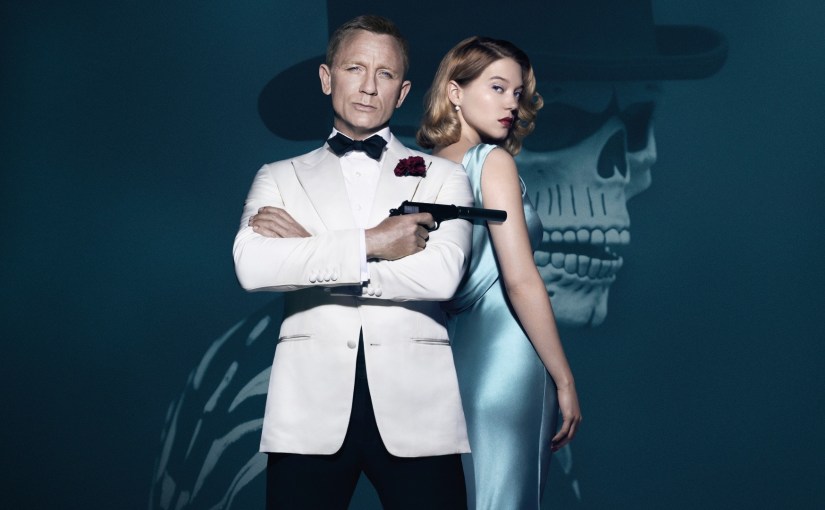
It’s fortunate that the success of Mike Myers’ Austin Powers franchise did not wash out the best features of the James Bond series. Had it done so, we wouldn’t have been treated to the outstanding production of Daniel Craig’s film, Spectre, with an opportunity to face off against a reinvented Ernst Stavro Blofeld played perfectly by Christoph Waltz. One of my few complaints however, is that we didn’t get enough material for the two-time Oscar winner.

Director Sam Mendes returns following Skyfall to reinvigorate the original traditions and blueprints that attracted audiences to 007 in 1962 with Dr. No. Blofeld lays in wait in his secret fortress of a lair housed within a desert crater (an upgrade from the volcano in You Only Live Twice), ready to offer exquisite hospitality to Bond and his love interest before providing an unrequested guided tour of his technology and hideous plots. No, he never had to show Bond anything. Yet Blofeld was never bashful, with or without his cat. Waltz is the right choice for this 21st century iteration of the staple villain. Gone is most of the camp presented in the character during the later Connery films. Most of the camp actually. He does still have the white cat after all.

Craig remains a great 007. The role is not a mimic of past Bonds. Craig is everything of the “blunt instrument” that author Ian Fleming described. Thanks to his physique and some great fight choreography, a marvelous fisticuffs scene occurs between him and brutish Dave Bautista aboard a moving train. Craig always looking great in the white dinner jacket tux, even while he’s getting pushed around.

Lea Seydoux is serviceable as the Bond girl, Madeline Swann, daughter of an old enemy of Bond with information necessary in the pursuit. Seydoux is not the best Bond girl. Others have offered more intellect beyond the beauty. Still, that might only be due to the limits of the script. She’s a good actor nonetheless.

Ben Whishaw and Naomie Harris are great as Q and Moneypenny. The roles have stepped up in frankness and skills that stretch out more than a traditional one scene cameo. Whishaw as Q is more of a know it all and Harris as Moneypenny reminds the audience that she has a life outside the office.

Ralph Fiennes is good too as M. Though I do wish his storyline was better here where he is dealing with an over abundant policy in complete government surveillance. The antagonist against Fiennes is nothing special and as quick as this storyline started, you knew how it was going to end. Still, I like watching Fiennes in the role.

Spectre has great scenes, most especially the signature opening taking place on the Day of the Dead in Mexico City that culminates in the destruction of a city block before Bond disables two bad guys aboard a spiraling helicopter. Steady cam and very clear edits make this a knockout.

I also appreciate the gag that not all things work accordingly for Bond. He orders his signature Vodka Martini, shaken not stirred, and is denied as he is at a bar located in an isolated strict health retreat. As well, his Aston Martin is not as reliable thanks to empty hidden machine guns hidden behind the logo in the trunk. Not everything comes as easy for Craig’s Bond, and that allows for some tongue in cheek humor.

I liked Spectre more on a repeat viewing. Mendes shot a gorgeous looking globetrotting picture of Mexico City, Rome, Austria, Tangiers and clear evening London.

Considering the next installment is likely to be Craig’s last film is disheartening. With Spectre, a summation of all the prior Craig films is assembled leading to what has been a great miniseries within the storied franchise. I’ve liked following this James Bond. There are revelations about the character including his orphan history, his faults and his coldness that only serves to protect the Queen’s country. The Daniel Craig Bond is the best following the very different albeit wry interpretation of Sean Connery.

Still, I’ll take what I can get, and once again happily look down the target scope aimed right for 007 before the blood comes pouring down.

SKYFALL

By Marc S. Sanders

Skyfall is a great James Bond film. One of the best. However, …it has one major shortcoming that always gnaws at me. Regrettably, it has a contrived middle section that steals some of the magic away from the film. Yes, for a moment, my suspension of disbelief is robbed from me.

Daniel Craig’s third outing as 007 has become a favorite among fans and movie goers. Craig is magnificent in a primarily dramatic turn in the part. Following a fantastic action packed opening where Bond pursues an assassin through the streets of Istanbul, Turkey (widely known as a favorite locale of Ian Fleming), the chase involves cars, motorcycles, rooftops, fruit stands and trains for well edited shootouts and fist fights. Alas, the assassin gets away and Bond is left for dead.

Following an attempt on the life of M (Judi Dench in her absolute best portrayal in the role), Bond returns for active duty. However, he’s not what he used to be. His aim is off and his body is worn. The question remains if Bond is ready to be back in the field.

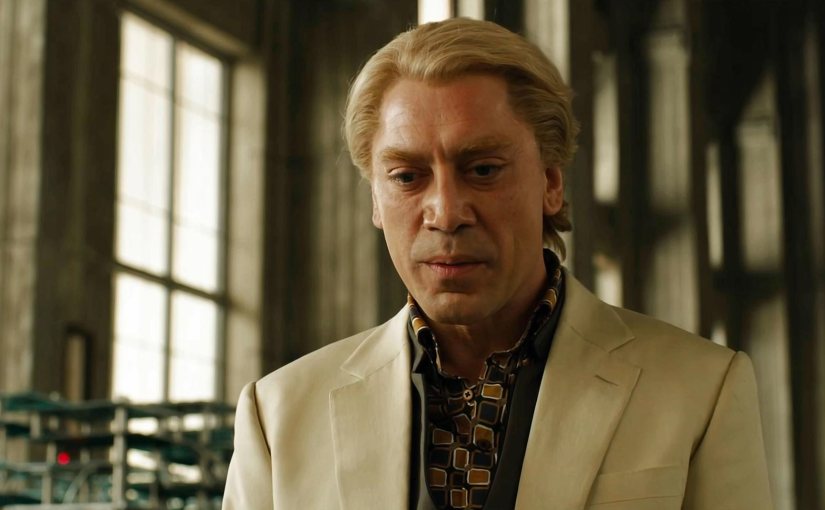
The plot centers on a bitter former MI6 agent named Silva (Javier Bardem in a potentially Oscar worthy performance) out to seek revenge on M for the sins he believes she’s committed.

It’s funny. The Austin Powers films, and even film critic Roger Ebert, would always draw attention to the fact the villain would just longingly speechify when they have all the time in the world to just shoot Bond dead and move on with their devious plot. Silva is a response to that issue. He has a mutual respect for Bond, and you can see he’d rather keep him alive for the time being to allow the game to keep running. It’s not said outright, mind you. Yet that’s what I took away from the character. A superbly written monologue to introduce Silva at the midway point of the film compares him and Bond to the last of two rats surviving a trap. Which rat will win out?

It’s also quite special that Bardem shapes his villainous role with a homosexual tendency. Silva is fashionable and proudly dons a bleach blonde hairstyle. He gleefully rubs Bond’s legs and opens his shirt to examine his scarred chest, pronouncing that Bond must ponder his “training” at the moment. Silva is beyond the typical femme fatale. It’s different and it’s time the Bond franchise acknowledges the differences in people. A welcome trait for a major character.

The plot set up of Skyfall‘s devices are ingenious in simplicity with a basic revenge tale but also with broadening the legacy and responsibilities of the M character. What Casino Royale did for a story arc for James Bond, Skyfall does for M, and with Dench in the role it works beautifully. She must answer to superiors, like a very welcome Ralph Fiennes, for the death of several agents and a bombing of MI6 headquarters. She must resist the pressure of early retirement. This is the most that M has ever had to contend with personally, and it’s here at last.

My one reservation with the film occurs just after the midway point. Silva somehow arranged to get apprehended and then managed to escape, don a police uniform, travel through London’s tube, and time an explosion on a runaway train ready to crash into James Bond who is on his trail. Thereafter, he’s able to locate the interrogation session where M is making a public statement in her defense and try to kill her. There are way too many factors at play that work too conveniently to Silva’s advantage. It’s a tension filled sequence. It looks great. It has great action and effects, but it’s overly contrived. I wish the script from Neal Purvis, Robert Wade and John Logan made this middle section a little more believable.

Sam Mendes (American Beauty) directs a terrific, action-packed film filled with more drama and minimal tongue in cheek that the series is primarily known for. I was grateful for the more serious Bond. Like the other Craig installments as well as the Dalton films, Skyfall offers a different and fresher approach.

Granted the ending plays more like an Arnold Schwarzenegger action piece from the 1980/90s, but it’s highly entertaining, well edited and well shot, nonetheless.

I highly recommend Skyfall for its outstanding cast that also includes Ben Whishaw as a nerdy variation of Q, the gadget man, and Naomie Harris in a secret role that has a satisfying payoff. As well, the standard revenge story works quite well here when you have Bardem, Fiennes, Craig and most especially Dench doing some really top notch acting with terrific dialogue. Mendes is a stage director first, and it shows quite admirably here.

Again, Skyfall is not the best Bond film but it’s at least one of the best.

QUANTUM OF SOLACE

By Marc S. Sanders

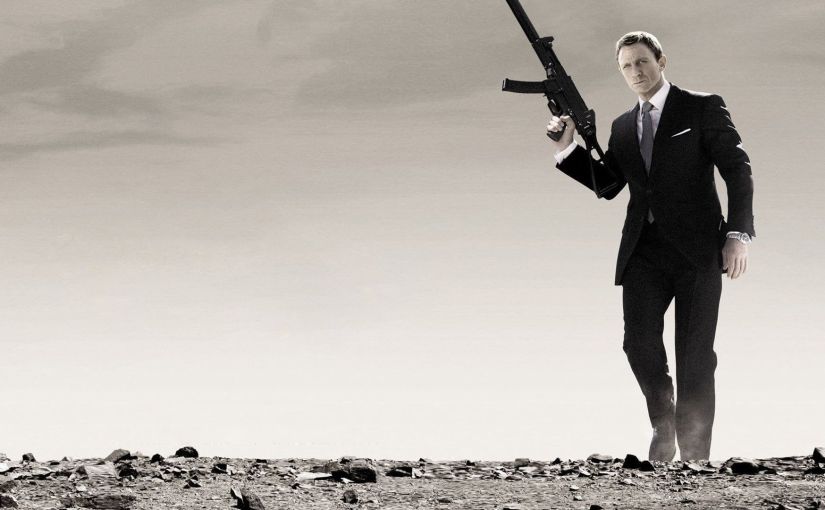
A writer’s strike never bodes well for a film. So the 22nd installment in the James Bond franchise, Quantum Of Solace, suffered because of it. Daniel Craig returns in his second film as Bond which begins as a direct sequel to my favorite film in the series, Casino Royale. Marc Forster (Finding Neverland) directs, but not very well.

Much of the action scenes are very shaky and choppy. Forster seems to have adopted Paul Greengrass’ technique that works so effectively in the Jason Bourne films and United 93. However, Forster does not make clear what is occurring. You can’t recreate Picasso with crayons.

The opening is a rush job of a car chase as Bond races away from enemies in his Aston Martin. Machine guns and heavy traffic and construction sites make way for his car to gradually fall apart but it’s hard to really see how the car becomes damaged in the first place. Just when exactly did the driver’s side door come off? There’s lots of spinning out of control and dirt flying with bombastic gun fire and engine revving. It’s all sensory overload to hide the preciseness in the high speed chase.

Later, Bond is attempting to rescue the girl Camille (boring name, boring girl) played by Olga Kurylenko when she’s held captive on a boat. He jumps into a motor boat and the chase is on. Bond fends off the bad guy by tossing a rope with a hook on it. Just tossing it up. Suddenly the bad guy’s boat flips over. What exactly happened here? How did the rope take out that boat? I didn’t see the connection. Film is visual. So show me the fundamentals from A to Z, please.

The story involves Dominic Greene (Mathieu Almaric) who appears to be an environmentalist with interest in a pipeline in Bolivia. (Bolivia????) At first Bond is under the impression this pipeline must be for oil. Later, it’s realized that Greene intends to charge the country enormous prices as he takes over the water supply. (Roman Polanski’s Chinatown did this all much, much better.). In exchange, Greene will assist a tyrannical Bolivian General in becoming President. This General raped and murdered Camille’s family. Naturally, she wants revenge. As Bond pursues Greene, he comes to learn that Greene is a member of a secret organization called Quantum. Hence the strange title.

Bond follows through with this assignment while trying to determine why his past love (Vesper Lynd from Casino Royale) was murdered, and after MI6 is infiltrated.

The story is kind of all over the place. It has a lot of interesting threads like Bond’s need for revenge, Camille’s need for revenge and a secret organization that MI6, nor the CIA, were ever aware of. Threads remain hanging as threads though if a writer’s strike interferes.

The story for Quantum Of Solace hardly gets fleshed out. We learn nothing of the organization, Quantum. When Bond finishes his mission with Camille, she just gets out of the car and walks away into the middle of nowhere. Where is she going exactly? The climactic battle takes place in a luxury hotel located in the middle of the desert. Unless this is Las Vegas, who goes to a hotel in the middle of the desert? I mean like ever?????

The film is a tremendous disappointment after the creatively artistic success of Casino Royale. Often sequels do not live up to their predecessors, but Quantum really goes off the rails. This film was a make-up as you go.

Craig is fine in the role of Bond; consistent with his first film. Almaric is okay as the villain, but never given much to do. A second woman comes into play, named Fields played by Gemma Arterton, assigned by M to bring Bond out of service. She seems to have a personality that the Camille character lacks, but she’s hardly given much screen time, save for a nightcap with Bond and later an image that harkens back to Goldfinger.

Jeffrey Wright (a great Felix Leighter, that I have not talked about yet) is belabored to share scenes with an obnoxious CIA partner played David Harbour. These two guys seem to be acting in a different movie.

Marc Forster was given a toolbox but didn’t know which end of the hammer to hold with Quantum Of Solace. There are too many things wrong with this film to justify any merits it may have.

Maybe the most interesting moment happens in the epilogue scene as we learn more about Vesper’s past. The scene has next to no relevance with much of the main story beforehand. Still, why couldn’t this film simply stay on this trajectory from the beginning? This is a thread worth pulling on and then tying off.

In other words, Vesper Lynd is far more interesting than the water supply in…ahem…Bolivia. 

CASINO ROYALE

By Marc S. Sanders

Casino Royale from 2006 is the one film in the entire James Bond series that gives the MI6 agent a complete character arc, and for that reason alone, it is also the best film to date in the franchise, and another of my most favorite movies.

Bond becomes a different person, and a different agent by the end of this film. It’s a pleasing and unexpected surprise.

Following the misfire of Pierce Brosnan’s Die Another Day, the franchise was wisely reinvented, going back to the origins of 007 and how he earned his well-known license to kill. Fans immediately protested the casting of a blonde-haired Bond with relatively unknown Daniel Craig. Yet, as soon as the film was released, tensions were overall subdued.

Martin Campbell (Goldeneye) returns to direct the EON Production’s adaptation of Ian Fleming’s very first Bond novel. The super spy quickly completes the necessary requirement of two kills to earn his 007 status and is assigned by M (Judi Dench, still so good in her role) to pursue LeChiffre (Mads Mikkelsen), a mathematic genius and money launderer for high priced terrorists. Bond engages in a high stakes’ poker game at the renowned Casino Royale where he must beat LeChiffre’s bluff or monies from his Majesty’s government will have directly funded terrorism. Along the way, Bond falls in love with the treasury agent, Vesper Lynd (Eva Green), who is assigned to fund his poker buy in.

This film offers a James Bond with faults and mistakes to learn from. He’s never completely perfect and he is subject to losing a bluff in more ways than one, albeit at the poker table or in the face of love. As well, Bond doesn’t necessarily think far enough ahead, as his kill ratio continues to rack up. To M’s displeasure, she wishes he’d have some reservations so that they can question who he comes in contact with. Bond doesn’t seem to consider that.

Daniel Craig gives a brilliant performance of a man who believes he is even wiser than the reputation moviegoers have been accustomed to for over 40 years prior. By the time the film reaches its climax in an action paced shootout within a floating building along an Italian strait, Bond’s steely armor is donned against affection or distraction. James Bond becomes humbled by personal betrayal. I never would have imagined. Death will never affect him again. Love won’t either. This James Bond makes mistakes, but never will he make the same mistake twice.

Mikkelsen is a great villain as the bad guy who gets in over his head. He is not trying to dominate the world. He’s only interested in a profitable return from his dealings with terrorists. James Bond can’t interfere. LeChiffre is a new brand of villain, but still written with a trademark deformity of weeping blood uncontrollably, plus a case of asthma. A far cry from metal teeth and hooks for hands. Mikkelsen plays LeChiffre as cold and terrifying, almost like a vampire with a winning hand.

Eva Green is the best Bond girl of the series. There’s a mystery and a dimension to her performance. Something is driving her and it may play against Bond ever succeeding. Green portrays Vesper as lovely, graceful and suave like her partner, but she is incredibly smart too. She is evenly matched with Craig’s Bond. A great moment occurs when James & Vesper first meet for dinner on a train and size each other up. Eva Green is precise in monologue delivery. She is assured and confident. This woman is able to read Bond before Bond is given the opportunity to seduce her.

Campbell puts together real looking and tangible action sequences where 007 pursues a bomber specializing in parkour, a sport of climbing and leaping on and off of objects within a construction area. There’s also a well choreographed fight scene in a hotel staircase.

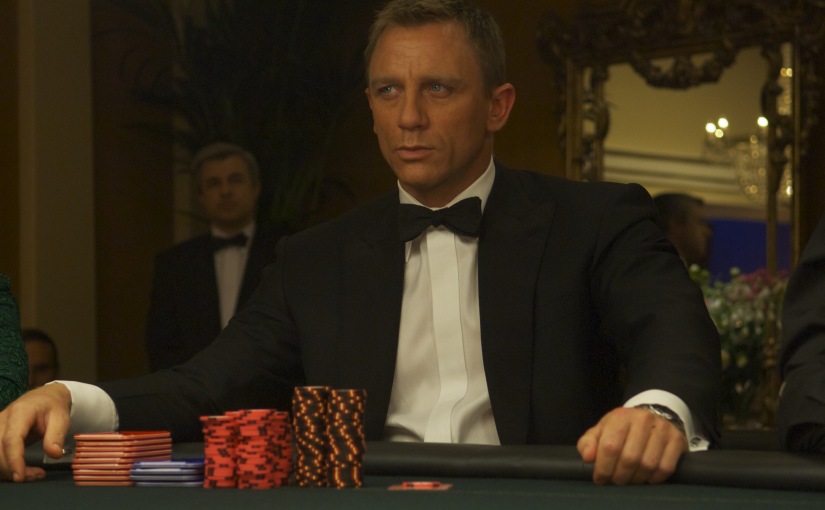
The best moments are reserved for the poker match however. Campbell amps up the tension with these ridiculous hands the players have in a fierce match of Texas hold ‘em. Bond gets sidetracked with sword wielding killers and poisonous drinks, but still manages to return to the table time and again with his tuxedo neatly pressed. The interplay at the table with or without dialogue is mesmerizing.

Daniel Craig went entirely different with his James Bond. The wit is there, but the tongue in cheek is not missed. This James Bond doesn’t give a damn if his vodka martini is shaken or stirred. Most of the prior Bond films had the super-agent without any scruples or demons in his closet. World domination, death and casual sex were just all in a day’s work. This 007, however, comes with a heavy background. Craig is great with his silent, seemingly guilty regard for killing someone whether it be by drowning a thug in a flooded bathroom sink or stabbing another one to death amid a museum crowd.

Screenwriters Paul Haggis with Neal Purvis and Robert Wade write a dramatically induced James Bond story. A tale not easily forgotten. It was time to reinvigorate the franchise that was going off into the absurdity of invisible cars and over the top gadgets. The puns are still here, but they serve more as a cover of a necessary internal pain for Bond, rather than disregard for his actions.

Casino Royale is one of the best films ever made. No qualms about me saying that. It’s hard to find great relationships among characters with huge risks at play, and magnificent chemistry for one another, as well as the story that serves them.

Casino Royale is an absolute winning hand at any table.

DIE ANOTHER DAY

By Marc S. Sanders

Once the 2nd half of Die Another Day arrived, Pierce Brosnan’s interim as James Bond was all but wrapped up. This was gonna be his last film after this misfire, and the craftspeople at EON Productions knew something had to change.

What happened here? Director Lee Tamahori was on the right path from the get go with some real world parallels and surprising elements for the long lasting franchise. Then, the film goes sci fi gonzo with some kind of robotic armor for the villain, a space satellite that harnesses the power of the sun, a palace literally held together by ice, an invisible car, DNA switcheroos, and James Bond kite surfing to avoid a solar laser beam.

This movie got ridiculous really, really fast.

Early on, 007 covertly surfs his way onto the coast of North Korea to intercept an arms trade in exchange for diamonds. He’s captured and held for the following 14 months. When the British make a trade for Bond with a North Korean prisoner with a bad case of facial diamond acne, Bond is no longer trusted by M (Judi Dench) and he must become resourceful on his own in stopping whoever betrayed him before his capture. He also needs to figure out what a wealthy industrialist named Gustav Graves (Toby Stephens) is conjuring up in Iceland, with a literal ice palace hosted to Bond as well as a slew of investors and dignitaries.

Die Another Day began with a grounded intent. However, the stunts and gadgets that are introduced later in the film fly way off the rails, even for a James Bond film. Bond has always completed his mission by ridiculous measure. However, when your hero and villain are on an out-of-control airplane that is being torn apart by a solar beam from space, ala hammy CGI, well, reader how does 007 even survive that?

Another ridiculous plot element involves DNA transfers. So Gustav Graves, a man who claims he never sleeps, may not be who he claims to be. Graves is the villain here and Stephens plays him like a spoiled brat. I didn’t like him and the best Bond films are primarily weighted by the bad guy. For some reason he has to wear this bionic suit of some kind to control the satellite. A keyboard and mouse weren’t as efficient, I guess. It’s also capable of electrocuting Bond; lots of zig zaggy tesla/lightning bolts surround Bond and so on. You really don’t have to see it to believe it.

The Bond girl is Halle Berry and she’s pretty good as an American agent who goes by the name of Jinx. Yes, there’s time made for the two agents to have some flirtations together, but like Michelle Yeoh before her, Berry gets in on the action.

Man oh man! WOW!!!! Die Another Day started so good and then it fell apart. While I don’t think it is the worst of the series, it borders towards the bottom of the list. It’s a shame really. If only it stayed a little more grounded, maybe it wouldn’t have died on any day.

THE WORLD IS NOT ENOUGH

By Marc S. Sanders

The 19th installment in the James Bond series is The World Is Not Enough from 1999. By now Pierce Brosnan is comfortably established in the role and an expert at pun delivery and suave debonair swagger.

Michael Apted more or less delivers a standard fare. Nothing new here, really, with the exception of John Cleese (perhaps playing the role of R) as the would be successor to exiting mainstay Desmond Llewelyn as Q, the gadget specialist. I wish Cleese could have lasted longer than just his two film internship. He’s hilarious and well suited for the super spy’s tongue in cheek universe.

The story is similar to other Bond films. The one who we eventually realize to be the main villain wants to wipe out oil pipelines so that only their pipe is the only one exclusive to the region in the European west of the world. Auric Goldfinger had a similar idea with his affection for gold. A View To Kill aimed for this with Silicon Valley. Gold, silicone and now, here the commodity is oil.

The World Is Not Enough has a lot of crazy stunts and gadgets that we are always eager to see, such as a boat chase along the Thames River, snow ski escapes from parachuting snow mobiles (a fun sequence), deactivating bombs within underground mines and pipelines, underwater heroics in and out of a submarine and another buzz saw device, only this is a big one connected to a helicopter that is not just for cutting down forestry. BMW also makes its 3rd appearance in the franchise with a spiffy convertible.

The Bond gals are also up to the task. Sophie Marceau is Electra King. A one time kidnapping victim, she has taken over her father’s oil business following his assassination, which Bond is investigating. Marceau is beautiful as expected, but she’s got a great, mysterious way about her.

Denise Richards is fine (QUIET, you haters!) as a geologist swept up in assisting Bond. Her name, Dr. Christmas Jones, is deliberately laughable but she’s works well with Brosnan because there’s hardly any approach at seduction. They’re partners more than anything else. At least, they are until the end of the picture.

I do wish there was more to do for Robert Carlyle, though, as the bad guy Renard. He is impervious to pain thanks to a bullet resting in his brain. He is rapidly heading to death without any sensory feeling, but he gradually gets stronger with each passing day. I don’t know how you diagnose that, but in a James Bond picture, you take it at face value. Carlyle looks perfectly dastardly but he’s hardly on screen and has barely any exchanges with Brosnan’s Bond. When the real villain is finally revealed, Renard doesn’t serve much purpose any longer.

Judi Dench is back again as M. She is positively one of the best casting choices in the entire franchise. Bond remains a chauvinist (early on seducing his gorgeous doctor during an examination), but Dench as M counterpoints that stance and it is more than welcome. She is given more material here as well.

The World Is Not Enough didn’t reinvent the passenger ejector seat or the exploding pen per the nature of 007 films. Yet, it has a neat twist midway. Yeah, you might see it coming, but still it’s appreciated to keep the story developments ongoing. As well, the action plays well with a very good cast.

Brosnan was 3-0 by this point with the franchise.

TOMORROW NEVER DIES

By Marc S. Sanders

Pierce Brosnan’s second outing as James Bond is Tomorrow Never Dies and it is his best appearance in the series.

Bond faces off against Elliot Carver (a gleefully bloodthirsty Jonathan Pryce), a global media mogul who enjoys creating worldwide conflict for the best news headlines in print, television and the newfound medium of something called the internet. His pawns are Great Britain and China, and just like any worldwide media mogul he has his own stealth war ship for apprehending missiles and using them against the nations. This ship also has a massive drill that can penetrate a ship’s hull. Oh yeah, Carver also has the means to redirect a sea vessel into enemy territory. Bet Ted Turner or Rupert Murdoch could never do any of these things. Carver also has a big, blond bruiser of a guy called Mr. Stamper (Gotz Otto) – another in a long line of big, blond bruiser guys to face off against 007. Stamper is nothing compared to Robert Shaw in From Russia With Love, though.

Dame Judi Dench is back as M. I like how she holds her own too. As an actor, Dench has such command of any role she plays. If she is in a scene, everyone listens to her primarily. Even in a goofy Bond movie, Dench puts these films above the standard fare.

Teri Hatcher is also good in a small role as Carver’s wife Paris, and a former flame of Bond’s. M encourages Bond to “pump her for information.” Ahem!

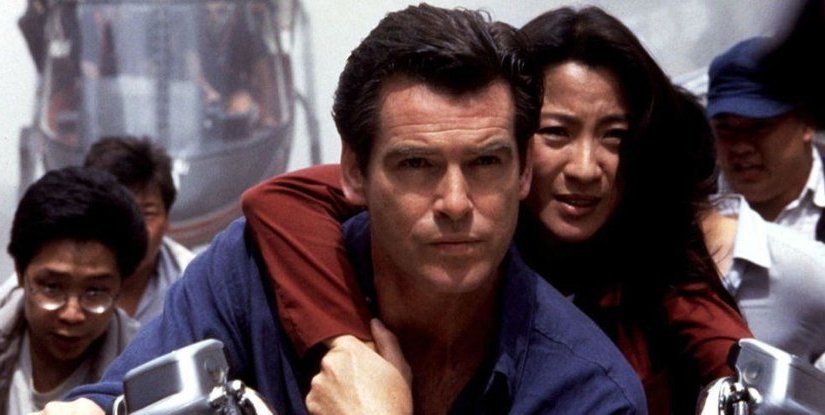
With the Brosnan entries from the 90s, the series was updating itself for a more mainstream feel. So the female stand-in is Michelle Yeoh as a Chinese agent named Wai Lin. Yeoh plays one of the best sidekicks/Bond girls of the series. This agent can hold her own while firing off two machine guns, one on each arm and offering up a great display of karate moves. Yeoh works well with Brosnan especially when handcuffed together while riding a BMW motorcycle and evading machine gun toting cars and a massive helicopter terrorizing a bustling Vietnam village. A fantastic sequence.

Before that, Bond pilots his BMW 700 series from his backseat on his cell phone pad, within a parking garage. Bazookas, guns, crowbars, sledgehammers and missiles can’t stop this luxury car though. After all, the Germans do make some of the best automobiles. Another really entertaining action scene.

I think this is a better film than GoldenEye. Brosnan appears more comfortable with the role and his humor is funnier. He rides the motorcycle through a laundry clothesline and Wai Lin tells him to go faster. Bond’s response: “Alright. Keep your shirt on!” I liked it. I was having a good time with the film.

Roger Spottiswoode was the director this time and he does a fine job. All of the action scenes are well orchestrated and edited.

I’ll also give props to Sheryl Crow for her alluringly sexy and haunting title track. I have never forgotten the song since I saw the film.

Tomorrow Never Dies is a great action film worth checking out whether you’re a James Bond fan or not.

I really like this entry.

GOLDENEYE

By Marc S. Sanders

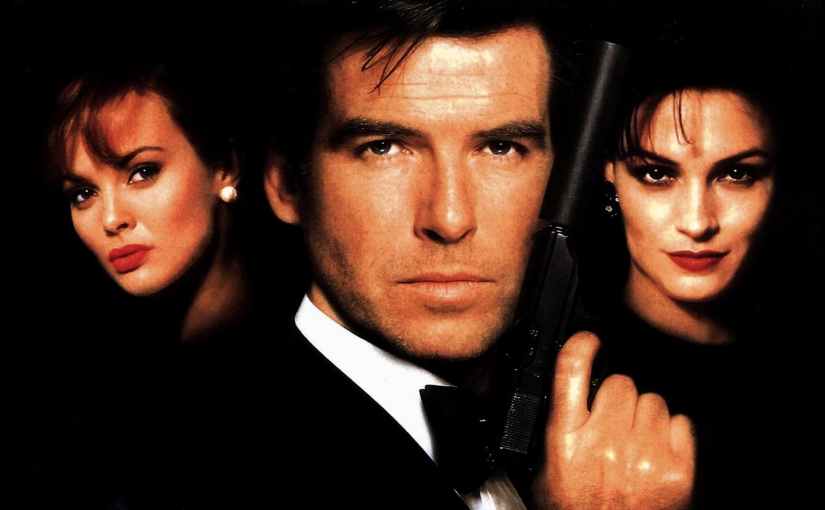
Over six years went by following Timothy Dalton’s last appearance as James Bond. He wasn’t likely to come back and the big question, besides if we’d ever see another film, was who would carry the Walther PPK pistol next as 007. Pierce Brosnan was not a likely choice as I recall, having missed out on the opportunity before with a flimsy Remington Steele contract commitment with NBC. Yet, one day my brother called me at work to share with me the news that Brosnan had signed on. His first film in the everlasting series was Goldeneye directed by Martin Campbell (eventual director of Casino Royale and Green Lantern). It was a welcome debut for the former odds-on favorite contender.

Bond goes up against the Russians in a post-Cold War 1990’s era, with Sean Bean as his adversary, also once known as Bond’s ally, Agent 006-Alec Trevalyen.

With Famke Jannsen as sidekick Xenia Onatopp (holding on to the sexual innuendo tradition), Alec steals a super helicopter that allows him to take possession of the Russian Goldeneye disc. Dame Judi Dench, making her first appearance as M, assigns Bond to locate the disc and find out what Alec intends to do with it. Forget about what the disc is for; you don’t uncover that until the end of the film.

Brosnan is a good physical Bond and he does the tongue in cheek well, sounding much like his Remington Steele character. Screenwriters Jeffrey Caine and Bruce Fierstein provide a wealth of signature puns for Bond to deliver. Onatopp can masterfully kill someone by squeezing a victim between her thighs. Bond’s observation: “She always liked a tight squeeze.”

The film has an outstanding but unrealistic opening scene with a motorcycle trying to catch up to a descending airplane. There’s also a fun tank/car chase in Red Square, and a great action-packed ending in Cuba where a satellite is hidden to aid Alec in his plot.

Bean’s role, like most of those on his resume, makes for a great villain – a real equal to Brosnan in physicality and wit. A great match up.

The Bond girl is also very good. Beautiful but not exuding too much sexiness. More so, actor Izabella Scorupco as Natalya, the Russian computer analyst, is an intelligent addition to the story. Alan Cumming is fun as a nerdy analyst as well. I love when he consistently boasts “I AM INVINCIBLE!!”

Goldeneye was well celebrated upon its release. James Bond was back and updated for the modern action film. The first scene of the film cemented Brosnan as the super spy with a true to life stunt where 007 bungee jumps off of a high-altitude water dam, with just enough time to take out his cable pistol. As soon as the scene graced the screen, fans sat up with attention.

This was a James Bond everyone could love.