
by Miguel E. Rodriguez
DIRECTOR: Wes Anderson
CAST: More Actors Than You Can Shake a Stick At
MY RATING: 5/10
ROTTEN TOMATOMETER: 76% Certified Fresh
PLOT: In the mid-1950s, a roadside motel in a fictional mid-Western flyspeck plays host to a junior stargazing event that unexpectedly escalates, changing everyone’s world view forever. …sort of.
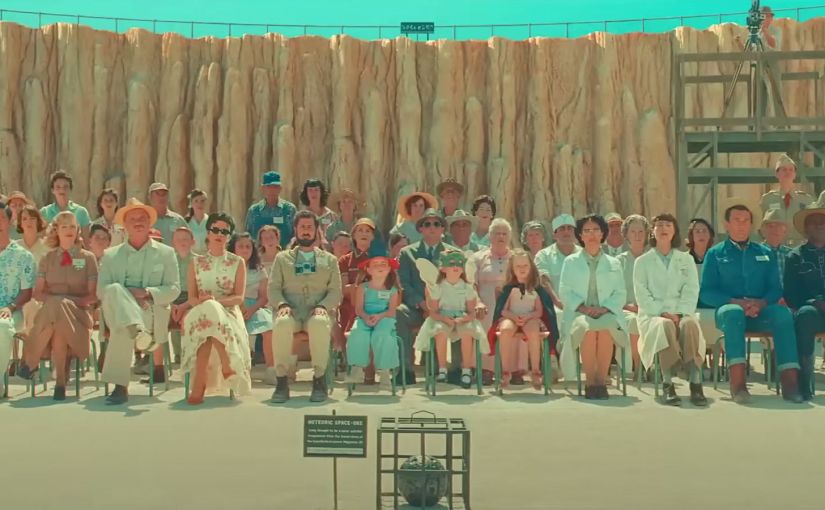
Asteroid City, Wes Anderson’s latest film, feels like a collector’s edition box of Cracker Jack with no prize inside. Or a cake that has prize-winning decorations, but it’s hollow inside. It looks phenomenal; one of my fellow cinephiles, Anthony, predicts it will be nominated for cinematography and production design, and I agree with him. But where the heart of the film should be is simply a crater like the one around which the fictional town of Asteroid City was built. This is yet another star-studded cast for Wes Anderson, but Anderson has given them very little to do other than wear colorful costumes, look solemnly into the camera, and speak in very precise phrases.
This strategy has served him very well…no…EXTREMELY well in the past. Moonrise Kingdom (2012) and Grand Budapest Hotel (2014) spring immediately to mind. But some crucial piece of machinery is missing from Asteroid City. The characters are colorful and quirky, but at the end of the day, I simply didn’t care about what they did or said. (Well…except when actress Midge Campbell [Scarlett Johansson] decides to rehearse her nude scene for her next-door neighbor…I did care about that.)
The film opens with a pillarboxed segment in black-and-white. Our host (Bryan Cranston) explains that we’re about to watch a staged presentation of the newest play from author Conrad Earp (Edward Norton), who proceeds to lay out the “set” for us. “Upstage right is the crater…upstage left are the motel cabins”, etc. Then the screen expands to full letterbox and we are treated to eye-popping Kodachrome desert landscapes as we follow a 165-car freight train as it passes by Asteroid City. Well, “City” should be in quotes…the population is officially listed at eighty-seven.
This is some wacky city. It’s as if Wes Anderson watched every Coen Brothers film set in the Midwest, from Raising Arizona to No Country for Old Men, and filtered them through a Looney Tunes cartoon written by Charlie Kaufman. Vending machines on the porch of the rental office sell everything from snacks and drinks to martinis and parcels of local real estate. (Cost for the real estate parcels: forty quarters…they’re not big parcels.) An abandoned highway overpass lurks on the outskirts. Periodically, a police chase roars down the otherwise empty highway, guns firing and sirens blaring. The residents say nothing about this phenomenon. And every now and then, the town shakes from nuclear testing being done hundreds of miles away, but close enough that the mushroom clouds are visible.
Man, I love this kind of thing. The stage is set for one of the all-time great satires, or maybe just a flat-out fairy tale. We meet the cast of characters who have congregated here to honor young geniuses who have invented everything from rocket packs to particle guns to a projector strong enough to project an image on the moon. A full rundown of all these characters would wind up being a novella, but if you’re acquainted with Anderson’s work, they will all be familiar to you in one way or another. (Not least because many of them have worked on Anderson’s other films.) They have also gathered to witness a rare astronomical event: a solar ellipse. Not an eclipse. An ellipse. The mechanism required to view an ellipse without damaging your retinas looks like something out of Brazil.
Again, I normally love this kind of stuff, really, I do. But…okay, look, first of all, the film intermittently takes a break from the movie itself to yank us out of the story and show us an event in the playwright’s life that led to the casting of Augie Steenbeck. Or to show us a rehearsal where an acting coach (Willem Dafoe) encourages the actors – that we’ve already been watching perform in the movie/play – to improvise what it’s like to wake up by first falling asleep. There’s even a moment where the host shows up where he really shouldn’t be. And when one of the actors has a moment of existential crisis concerning the character he’s playing, he simply walks off the set, goes backstage and asks the director (Adrien Brody) why he’s doing what he’s doing.
…I mean…what IS this? Conceptually, I get it, even if it’s a little heavy-handed. (“What’s my motivation?” “You’ll have to figure it out as you go along.” “That’s too hard!” “Well, that’s life.”) But…why is it here? Anderson worked with non-linear structure before in Grand Budapest Hotel, and it worked marvelously. Here, it feels indulgent. In fact, many of the scenes in the movie feel that way. There’s a moment where an army general (Jeffrey Wright) announces he’s going to deliver a speech he’s prepared for the occasion of the “ellipse.” But this is no ordinary speech. It’s practically beat poetry, delivered with the kind of conviction that only Jeffrey Wright’s magnificent voice can provide, but…but…why is it here? Even in this weird, cotton-candy, retro-fever-dream of a movie, this “speech” felt out of place and just plain goofy. In fact, quite a lot of the scenes between characters felt less like story and more like the kind of dialogues you find in source books for actors. (101 Scenes for Two and Three Actors…that kind of thing.)
I will provide full disclosure and say the movie did deliver some decent laughs and chuckles. There is an event that occurs during the ellipse (I’ll have to tread carefully here) that may not be entirely unexpected, but it’s executed and timed so well that I laughed pretty much through the whole scene. It’s the kind of thing I imagine Buster Keaton and Charlie Chaplin would have thoroughly enjoyed, if I may be so bold. There is also the problem of the disposition of a Tupperware container holding a valuable, ah, keepsake. Oh, and that roadrunner was awesome.
But by the time Asteroid City rolled credits, I didn’t feel like I had seen one of Wes Anderson’s best films. (The Royal Tenenbaums remains his best film, in my opinion.) This almost felt like a movie made on a whim, kinda like, “Hell, I don’t know if this’ll work, but if I get enough star power behind it, this may turn out to be something.” Alas, it did not.

 2 UNPAID MOVIE CRITICS!!!!