

By Marc S. Sanders
Gone With The Wind is probably the first of the sweeping epic. It spans a transitional period in history from the American Civil War and through the aftermath known as Reconstruction. Contained within these historical contexts are the prominent Georgian Southern Plantation residents. They court and romance one another ahead of the war. They celebrate with welcome glee, ready to fend off the horrible Yankees of the North who desire to put an end to black slavery. Nearly ninety years later Victor Fleming’s film, based on Margaret Mitchell’s bestseller, is an impressive piece of movie making with set designs and shots that remain superior to many modern films of today.
At the top of the character pyramid is young Scarlett O’Hara (Vivien Leigh), the spoiled Southern Belle of a wealthy Irish plantation owner. Her spoiled livelihood pines only for the noble and dashing Ashley Wilkes (Leslie Howard). Yet, he has committed himself to his cousin and Scarlett’s best friend Melanie (Olivia de Havilland). Enter Rhett Bulter (Clark Gable), a self-made wealthy prospector who is taken with Scarlett. She gives him the coldest of shoulders as she waits for Ashley to leave Melanie and have him all to herself.
Before the soap operas of radio and television arrived, there was Rhett and Scarlett in a competition of romantic swordplay. As you watch Gone With The Wind, you see how the relationships change with marriages and children, along with death as a cost of war. If it wasn’t for how well this collection of actors perform, all of this storytelling would feel quite hammy by today’s expectations. Yet, Clark Gable is undeniably handsome and confident as Rhett. His stature is so impressively consistent with that pencil thin perfect mustache to enhance his proud grin. He doesn’t wear the costumes of 1860 regality. The costumes wear Clark Gable. If the film were ever to be remade, no one could match what Gable delivered. Vivien Leigh is also unforgettable. Scarlett is hard to like, though amusing in how she holds to her convictions of rejecting Rhett’s advances while still obsessing over Ashley. Sometimes you want to shake this spoiled brat down to reality. Yet, as the film demonstrates, reality shellshocks the young lady as the war overcomes and she must learn to fend for herself and those closest to her. Viviene Leigh is radiant, and she epitomizes this character amid the vibrant colors of her dresswear and her piercing eyes that focus on what is important to her. Whether it is schoolgirl flirtations or determined survival, Viviene Leigh is always focused on Scarlett’s stubborn strengths, which at times are also her weaknesses.
The construction of Gone With The Wind is what stays with me most. Knowing what we know of our country’s bloody history, it’s surprising to see how excited the men of the South are to enlist in the Confederate Army, defending their ways of Southern gentility and slave ownership. Yet, even for a film, Victor Fleming does not shy away from the atrocities of war. Before Oliver Stone demonstrated the false heroism that a man like Ron Kovic expected to find in Vietnam (Born On The Fourth Of July) or even what could be found in the first acts of All Quiet On The Western Front, Gone With The Wind was there to flip the coin first. The same men who bucked their horses and fired their pistols in celebration of going off to fight either never returned or they came back to a thinly spread, elderly doctor ready to sever their limbs.
The most unforgettable shot of this film occurs when naïve Scarlett traipses across a long block of wounded men to find the doctor and insist he tend to Melanie who is about to deliver a child. The number of extras and the amount of detail and design in this one scene is astounding. It’s truly a walk back in time and it never glamourizes an unforgiving history. You cannot help but be marveled at this wide shot; one of the best I’ve ever encountered.
Following this moment, Scarlett is forced to grow up as Sherman’s forces advance through Atlanta and Savannah burning everything in sight, including what’s most precious, her plantation home known as Tara. The art design of Tara should be studied in film school. Victor Fleming’s crew show a beautiful expanse of land and prominence to open the film, just ahead of the Civil War, then it is followed by a pillaged and burn stained remnant of invasion that could not be fended away. Fleming also captures stunning silhouettes of Scarlett and others with the foreground bathed in a burnt orange sunset or a grey and gloomy sky. An unleafed oak tree is off to the side lending to the foreground and implying a current barrenness of what was once a luxurious South. Just ahead of the film’s intermission, Victor Fleming completes his canvas on film showing a defiant Scarlett with a raised fist delivering her self-sworn testimony to reviving Tara for a new day. It’s just another unforgettable moment in all of film history.
The length of Gone With The Wind feels overwhelming clocking in at just under four hours. Still, the picture moves and progresses through historical landscapes and the developments of young Scarlett as she moves from her unquestioned reliance from Mammy, her house servant (Hattie McDaniel, the first African American to win an Oscar) and on to her courtships and marriages. During her transitions, she must contend with lack of food, money and resources for herself and the slaves she’s grown up with at Tara, as well as the other plantation widows and wives. Scarlett also must grow up quickly to find ways to fend off tax demands of Union Carpetbaggers. All of these character developments hold my interest much more than the battle of the sexes engaged between her and Rhett. These characters are wonderful. Pure cuts of cinema grandeur. However, I was caught up more in their recoveries following an undeniable defeat at the hands of war and what little was left behind.
When the film returns to the soap opera chapters, it is not so much that I am admiring Vivien Leigh, Clark Gable, Olivia de Havilland or Leslie Howard. I am much more engaged in the backgrounds they occupy. The rubble of carnage followed by the grand reconstructions that remedied their new situations. Rhett and Scarlett fight for common ground in their eventual marriage, have a child and then emotionally toy with one another. It’s nothing boring. However, it is a lot of same old, same old and Margaret Mitchell’s sweeping epic finds sad resolutions to their dilemma of uncommon grounds with each other. Arguably, these resolves in the storylines are a little too convenient as the story works to draw your tears while keeping you engaged in the drama. Gone With The Wind is so legendary though, and still one of the biggest revenue earning films of all time. It is likely had I seen this film at the end of the 1930s when technicolor films were rare treats, that anything put on the screen would take me away in the splendor and heartache. I reflect on the film after watching it for a second time and I still do not like Scarlett. However, I admire what she endures and how she persists.
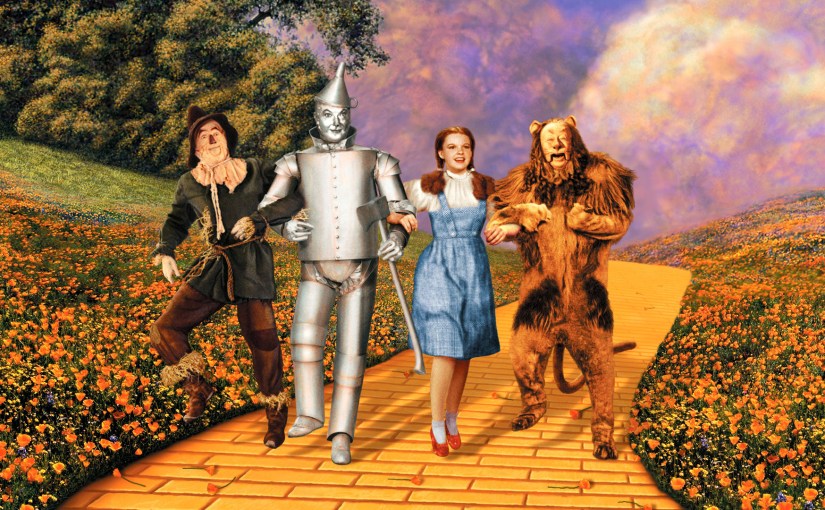
In 1939, Victor Fleming directed both The Wizard Of Oz and Gone With The Wind, two films with only the commonality of technicolor achievements. They remain two of the greatest cinematic triumphs of all time and will always carry that honor. I’d argue that Fleming was a Francis Ford Coppola, or a James Cameron or George Lucas of his time. A pioneering and aggressive filmmaker looking to invent a new way to absorb moving images on a screen, accompanied by grand instrumental soundtracks and actors who complimented zoom ins and outs with his camera. Victor Fleming is a director who truly remains unmatched. When you watch these two films, you are carried off into unfamiliar times and places. You are forced to observe beyond what appears closest to you. The immediate stories do not stop with Dorothy or Scarlett. Look at Munchkinland or war-torn Savannah as far as your eye can take it. Fleming has something all the way back there, that far out, for you to see and collect in your consciousness.
Today, Gone With The Wind is accepted as a piece with an asterisk next to its title. The treatment of African Americans in the film along with their dialects and appearances is held into question. Should these people be depicted in this manner? Ahead of the film, streaming on MAX currently, there is a warning label of what some may consider inappropriate content even though the film remains preserved in its original final edits. It should be. How blacks were cast in films and how blacks were treated in history can not be changed and if we are to improve on our future of filmmaking and the histories that have yet to come, then the worst thing we could ever do is disregard the errors of our ways and whitewash over how any people were regarded and what our perspectives looked like. Hattie McDaniel’s character may be the most beloved and memorable character in Gone With The Wind. She’s a scene stealer whenever Gable or Leigh share a moment with her. It speaks volumes that she could win the Oscar during a time when overt prejudice was never subtle. She was not even permitted in the theatre to accept her trophy. Clark Gable almost didn’t attend the ceremony in protest of her restriction. McDaniel held that he go in honor of the film. Still, Ms. McDaniel insisted that she’d rather play a maid on screen a hundred times over than live the life of a real maid fulfilling the servitude of someone else’s demands.
Ahead of the challenging progress that came over twenty years later with the civil rights movement, McDaniel demonstrated a need for people of color to connect and relate to any kind of movie watcher. Gone With The Wind would not have the reputation it has always held without Hattie McDaniel or Butterfly McQueen (as Prissy, another house servant). To wit, these actors upheld what was being fought for within the Civil War and how those of the deep south lived and treated one another. While we should be sensitive to how blacks were treated at this time, I am also grateful for their contributions into a historical depiction of a violent and unfair period.
Gone With The Wind takes commitment to watch. Yet, it is such an important masterpiece in filmmaking. It carries an immense significance that I believe it is one of a select number of films that must be watched in everyone’s lifetime. I expect to still be breathing when the film reaches its one hundredth anniversary, and while some critics and skeptics poke at its shortcoming in sensitivity, I also hope that those who wish not to censor or erase an often-cruel history will give the picture its ongoing salutes and applause. I’ll be at that Fathom event in the movie theater for that one hundredth anniversary. This film was made to last a full century after its debut and then to last another hundred years thereafter.
It’s a masterful, epic and unforgettable piece of movie making.
 2 UNPAID MOVIE CRITICS!!!!