

By Marc S. Sanders
A blaring piece of pounding piano music from Marcelo Zarvos hearkens awake the silent opening few seconds of Todd Haynes’ May December against that of a caterpillar/butterfly terrarium. I don’t like the music and I’m immediately reaching for the volume control on my remote. It’s only as the film progresses, however, that I develop a grateful appreciation for the often-disruptive soundtrack.
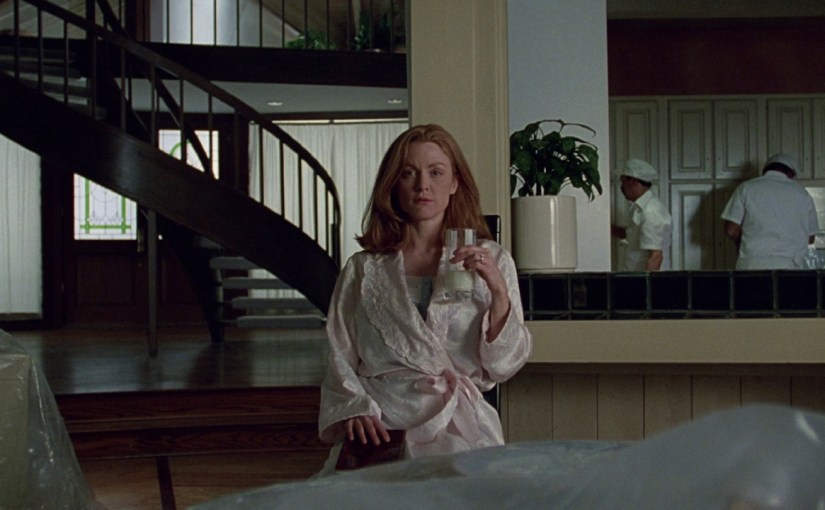
Julianne Moore and Charles Melton are Gracie and Joe Yoo, the relationship referenced in the film’s title. Twenty years prior, Gracie, at age 36 who already had children and a husband of her own, had an affair with Joseph, a 13-year-old seventh grader at the time, in the storage area of a Savannah GA pet shop where they worked together. Gracie went to prison for the crime of statutory rape and delivered their baby while serving her sentence. Once her term was finished, the two continued their relationship and got married, bearing a set of twins, a boy and girl.
As the twins are approaching graduation, a television actress named Elizabeth (Natalie Portman) has arrived in town to do observational research and interviews to prepare for her portrayal of Gracie in a made for TV account of what occurred. On the surface, all seems calm with the past put behind everyone. Townsfolk will say that Gracie and Joe are so appreciated and loved in the community, and they love each other. However, the script from Samy Burch will reveal otherwise as Elizabeth develops different kinds of connections with Gracie and Joe, respectively, as well as others she speaks with in town, including Gracie’s attorney, her ex-husband, the pet shop owner, and Gracie’s now adult son from her first marriage. His name is Georgie (Cory Michael Smith) who was close friends with Joe until the affair was revealed, and now let’s everything hang out avoiding any kind of subtlety. He’s even candid about what he believes occurred in Gracie’s childhood that could have dictated why she committed her act.
Todd Haynes’ picture is a complete character study of a story that many would regard as sordid or seedy trash material to talk about over dinner with friends. People like Gracie and Joe may seem real to any of us who live in another part of the country. We will never have any kind of relationship with them. They are meant for cover stories in People magazine and The Inquirer. It’s soap opera junk or trashy romance novels brought to reality. It’s easy to judge the kind of person Gracie in particular is because what she has done is wrong and disturbing. All these years later and they are still receiving packages on their doorstep that contain feces. Gracie committed a terrible crime, but what does an act like this say about someone who would go to that length, so many years later?
The performances in this film are astounding. Charles Melton especially. Samy Burch writes a disturbing and well-drawn character with Joe. He’s thirty-six years old now, in 2015 when this story takes place, and as his children are graduating and are about to make their home an empty nest, he seems so much more immature than them. A telling scene occurs when his son takes out a joint and practically instructs Joe on how to use it. Joe coughs uncontrollably. He gets ill, and it is his son who is calming him down. Gracie also appears to treat Joe like the child she bedded all those years ago, instructing him to straighten up the house and put away his butterfly garden, or not to get into bed because he reeks of the BBQ he used earlier in the day. Joe lives in an adult body, but he skipped his progressive years to go straight into marriage and fatherhood, and therefore he has not had an opportunity to grow up.
Julianne Moore plays delusional all too convincingly. She might have confessed guilt to her crime. She served her time, but as her attorney and Georgie will imply, none of that means anything if she still believes she did nothing so terrible. She’s now married to Joe, who is now well past legal age and has had a twenty-year relationship with him, as well as the children they share. Gracie happily accepts her new role as a baker in the community. Yet, it doesn’t even occur to her that some acquaintances merely place orders just to keep her occupied. Either Gracie chooses to wear blinders or she’s truly unaware of how she’s considered; still remaining a pariah within her social circle. It’s devastating when someone cancels a cake order, tells her to keep the money that was paid for the work, but is also told that the cake no longer needs to be baked. Especially now, as her children from her second marriage are leaving the home for college, she is realizing that she has no worth or value to anyone anymore. No one even wants to sample her cake any longer. Part of me wants to say it serves her right, but with Julianne Moore’s performance, it’s also terribly heartbreaking. There are acts we commit in our lives that we will never, ever recover from.
Natalie Portman adds another accomplished performance to an outstanding resume. Todd Haynes assists with demonstrating how manipulative and subtle Elizabeth, the starlet actress, is supposed to be. When she first arrives at the couple’s home for a summer barbecue, Haynes captures Elizabeth with no jewelry on and wearing a hat and sunglasses that she never takes off. Gracie, Joe and the others come to greet her and offer her a hot dog, but Elizabeth doesn’t reveal herself. She keeps herself hidden. She’s begun a camouflage as she initiates her observations. As the story moves on, we get to see how perhaps a Julliard trained method actor prepares. She begins to apply her makeup just like Gracie would. Elizabeth dresses like Gracie. She wears her hair like Gracie. Elizabeth duplicates Gracie’s hand gestures captured in news articles. Most significantly, she develops a bond with Joe, just like Gracie did. A crumpled-up letter from Gracie that Joe has held on to since they began their affair twenty years ago, is reintroduced later in the film that Elizabeth pounces on. Todd Haynes captures an unbroken take of Portman reciting the letter in a mirror and it’s an eye-opening moment for the character. Suddenly, I don’t see Elizabeth anymore. I see Gracie, and Natalie Portman is playing the predatory sex deviant.
By 2015, this story is a been there/done that. The general public has stopped caring. Only a few still carry an anger with those packages that are left on the doorstep. Otherwise, there’s nothing left to share or care about. Yet, May December does a fine job of showing the residual detritus of what’s come from such an illicit affair. Gracie’s husband before the affair will say he’s over the betrayal and humiliation, but clearly he’s not. Gracie now has two families. The first family from a standard marriage with adult and teen children she greets as if they are neighborhood kids. She’s on the outside of what she used to have as a mother. Then there is the second family consisting of the college age daughter she delivered while in prison and the twins that came thereafter. An awkward moment occurs in a restaurant when the two families run into one another. No one is well recovered from Gracie’s transgressions, even if she served her time.
Reflecting back on the music, I wondered why it made such a presence in this intimate, quiet drama. It literally pounds at you every time it is reintroduced. I believe it first serves as an abundance of the cheesy melodrama that naturally spawns from an unwell story like this. Elizabeth is set to appear in a television movie adaptation of this ripped from the headlines account, much like a Lifetime movie of the week which shamelessly thrives on this kind of gossip trash. The music seems to tell me to “LOOK AT WHAT SHE DID!!!!!!” Later though, Marcelo Zarvos’ composition seems to remind me that this is not just “another story” as Elizabeth freely dismisses it when talking to Joe during a personal crisis of insecurity. Joe immediately snaps back at her that this is not just some story. “This is (his) life!!!!!”
Before Todd Haynes’ film begins, terrible acts have occurred. During the course of the movie, we see that terrible results remain. The narrative of May December is kept interesting because we don’t learn everything at once. There is exposition to uncover as soon as the film begins all the way to the very end where Gracie undoes all of Elizabeth’s prep work with a curveball truth. Then, we witness Elizabeth do one take after another on a soundstage with a pet shop prop snake twisting around her arms as the seduction of a young, teenage boy is reenacted. I don’t think Elizabeth got a convincing grasp on what makes Gracie and Joe tick, and now she questions what she invested in and what she sacrificed of herself in order to learn about the character she committed to portraying.
It’s disturbing what Gracie did. Perhaps it’s at least as ominous that it is now being duplicated for the sake of entertainment in front of a worldwide audience.
 2 UNPAID MOVIE CRITICS!!!!