
by Miguel E. Rodriguez
DIRECTOR: Terence Davies
CAST: Freda Dowie, Pete Postlethwaite, Angela Walsh, Dean Williams, Lorraine Ashbourne
MY RATING: 10/10
ROTTEN TOMATOMETER: 80% Certified Fresh
PLOT: A brief family history told in two parts. Distant Voices focuses on the father’s role, while Still Lives follows the children into adulthood and marriages of their own.
About a year-and-a-half ago, I was challenged by a friend to compile a list of my 100 favorite films. If I were asked to do it again today, Terence Davies’ masterpiece Distant Voices, Still Lives would be on that list. Here is a movie that is not even ninety minutes long, but it encompasses as much emotion and history as any epic by Bertolucci or Bergman.
The film’s strategy of dividing itself into two distinct sections is crucial. The first half, Distant Voices, gives us the fragmented, free-associative memories of three children remembering their abusive father and long-suffering mother. The second half, Still Lives, follows the children as they mature, marry, and cope with their buried emotional issues.
I’m going to attempt to describe how the film works, but it’s a miracle and a mystery to me why it works. It does not lend itself well to a verbal description. It’s something you have to see for yourself.
First, music and song play a huge role in both sections. The movie is by no means a musical, but I’ll bet there aren’t five minutes strung together in the movie where someone isn’t singing or listening to a song on the radio. Music is either a trigger for distant memories or a catalyst for creating new ones. I could say the same thing about myself and movies. Ask me when or where I met some of my oldest friends and I may not remember accurately, but I can tell you exactly when and where I saw Star Wars for the first time, or what my first R-rated movie was (Fort Apache: The Bronx) and who I saw it with. Distant Voices, Still Lives taps into the mystery of memory and employs an editing strategy that brings it beautifully to life.
In the first section, Distant Voices, time shifts freely back and forth between the ‘40s and ‘50s, between when the three siblings – Eileen, Tony, and Maisie – are young children and adults. A shot will show the three of them and their mother dressed as if for a wedding. One of the daughters wishes her dad was here. The next shot shows a hearse pulling up outside. It’s the father’s coffin. The family solemnly piles in. The next shot we’re back to the wedding preparations as one daughter thinks to herself, “I don’t. He was a bastard and I bleedin’ hated him.” Then we flash back again to the past as the father (Pete Postlethwaite) viciously torments her and beats her with a broom. Then forward again, and back and forward, and so on.
By that description, I worry that some readers will think the movie is chaotic and impossible to follow. Not so. It follows the same kind of free-associating logic as our own memories. I was blessed to have a mother and father who never abused me in any way, but they weren’t perfect. As I sit here, I am remembering all the good things and bad things that happened years ago, and if you think those memories are streaming through my consciousness in any linear way, you’re fooling yourself. Memory only takes a linear form after careful editing. When you’re in the actual process of remembering, everything is jumbled, out of order, but you always come back to yourself in the present.
That’s what this movie evokes, better than any other movie I can remember: the simultaneous juxtaposition of good memories on top of bad ones. One brilliant sequence shows the three kids sleeping in bed on Christmas Eve as their father tenderly places their meager presents in a stocking at the foot of the bed. The very next shot appears to be the following morning, the three children sitting nervously at the breakfast table, a meal spread out, and the father sitting at the head of the table, his hands trembling with rage before he pulls the tablecloth to the floor, plates, food and all, and yells off camera, “CLEAN IT UP!” What a loathsome man.
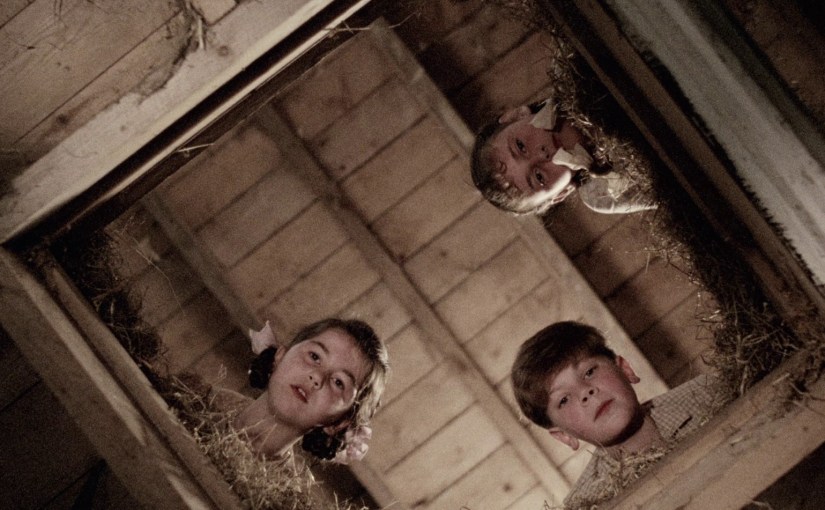
Another brilliant scene: the father sings softly to himself while grooming a horse. The three young children quietly climb to the hayloft and watch him silently from above. What’s going through their heads? I can remember doing something similar when watching my father work under the hood of his beloved Coronet 500, or when he was stretching before his daily runs. It was a glimpse of a man at peace with himself when he thinks no one else is watching. The attention to detail in each little scene is meticulous and absolutely accurate.
All these scenes and more build up a precise image of the man who will loom large in the memories of all three children and their mother during the second half of the movie. A daughter marries and has a child. The other daughter marries and is happy at the ceremony, but her husband reveals himself to be a selfish man. The son fends off marriage as long as he can. A baby’s baptism and the ensuing celebration at the local pub becomes the focal point of the story as memories and flashbacks branch off to flesh out their personal lives. A moment occurs that is worthy of comparison to Scorsese or Coppola, but I don’t even want to hint what it is because of its immense visual power.
And always, in at least every other scene, are people singing: gospel tunes, hymns, drinking songs, Broadway tunes (“Buttons and Bows”), Bobby Darin, children’s songs, until it gets to the point where a scene feels almost incomplete when someone isn’t singing. I may be exaggerating a tiny bit, but not much. It’s almost like the songs release any tension that existed in the scene before it. It’s one of the best uses of music in a non-musical that I’ve ever seen.
And what of the mother in all this, whom I just realize I’ve barely mentioned? Despite all the abuses heaped upon the children by the father, she is clearly the one who suffers most of all, both physically and emotionally, but you’d never know it. When the angry adult son demands to have a drink with his father, and his father refuses, the mother’s voice tenderly urges him to do so. When her adult children ask her why she married such a man in the first place, she says, “He was nice. He was a good dancer.” She suffers in silence, never saying a bad word about her monster of a husband, not even to her children, and when she sings, any happy words are tinged with regret.
When this film was over, I felt like I had watched an epic miniseries. I don’t mean that in a negative sense. I mean that, through the economic storytelling and direction, I felt like I knew every sibling, the mother, and most of their friends inside and out. I may not remember all their names, but I remember their faces, their personalities, their hopes and dreams, their regrets, and how their father’s memory affects them even now. For eighty-four minutes, they were people as real as you or me.
One of the last shots of the movie shows the son, on the brink of marriage, standing in the pub’s doorway, weeping. We do not get a contrived scene where a sister or the mother comforts him and asks him what’s wrong and he tells us. The static camera shot just shows him as he weeps while behind him, in the pub, people sing and sing. There is more emotional depth in his silent weeping than in fifty monologues. Distant Voices, Still Lives is one of the best family dramas I’ve ever seen.
 2 UNPAID MOVIE CRITICS!!!!