TOOTSIE

By Marc S. Sanders

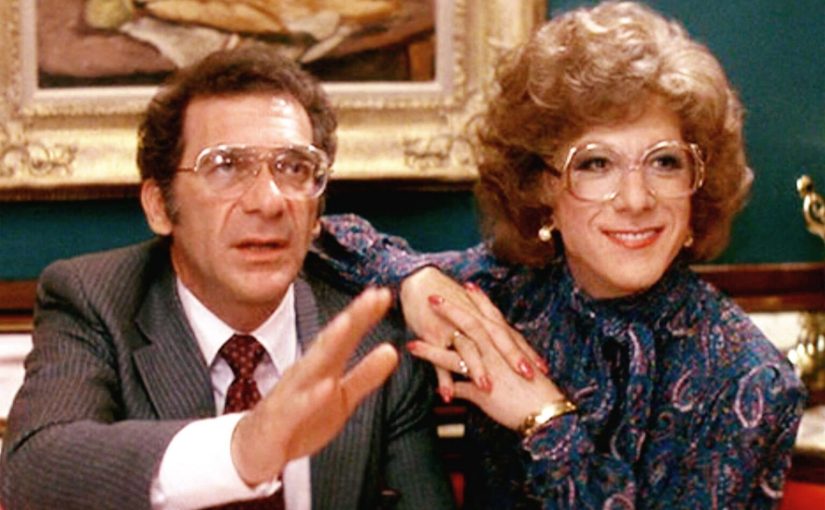
Tootsie is my favorite comedy of all time.  At age ten I saw it on Christmas Eve with my family and beyond the Star Wars and Rocky films, I had yet to see an audience respond, or more specifically laugh, so uncontrollably for two hours straight.  I might not have recognized all of the innuendo and I was not yet alert to the idea of women feeling belittled while knowing they should be entitled to equal respect, but the performances, especially from Dustin Hoffman were entirely genuine.  Tootsie still remains the only film where I can forget that a man, a not so attractive or sexy man, is convincingly disguising himself as a woman who possesses internal strength and gusto.

Whether directing or acting on screen, Sydney Pollack was not someone well known for overseeing comedy at the time.  Yet, that’s an attribute to the end product of this celebrated movie.  Other than a typical Bill Murray routine in an uncredited role, no one in this picture is waving their hands in the air to insist they’re funny.  The humor of Tootsie bears from true, raw emotion, fear and desperation.  No one is doing Saturday Night Live sketches and building up to the next punchline.  Despite the cross dressing, Tootsie is not even a farce.  A guy gets a job wearing the necessary garb and modifying his verbiage, but only to earn enough money to survive.  However, it also doesn’t help that he’s falling for his co-worker.  

Dustin Hoffman is an actor living in New York City named Michael Dorsey.  He’s a great, learned performer, especially on the stage, who lives with his playwright buddy Jeff (Murray) in a crummy apartment in the meat packing district.  They need to raise enough money to put on Jeff’s play in Syracuse.  

The problem is that Michael can no longer get cast in anything.  Not on stage or even in a commercial.  His agent (Pollack) says it point blank that nobody will hire him.  He’s just too difficult with short bursts of temper and no tolerance for others who work in the field.  

So, Michael surrenders to desperation and puts on the guise of a character actress named Dorothy Michaels.  As quick as she stands up for femininity against a chauvinistic TV director (Dabney Coleman) she is cast on the most watched daytime soap opera.  As long as Michael can perform off and on camera as Dorothy he should be able to earn more than enough money for Jeff’s play.

Complications arise though when he becomes protective of his co-star, Julie (Jessica Lange, in her Oscar winning role), against her unfaithful boyfriend, the TV director.  Julie’s widowed father, Les, is falling for Dorothy though, and then there is Michael’s friend Sandy (Teri Garr) who lost out on the part that he earned, and to keep things maintained has been seduced by Michael into a romantic relationship beyond just their friendship.

With me so far?  I hope so because there’s even more obstacles to overcome.  Tootsie is very economical in its story development, but it’s also a very crowded film.

Don McGuire and Larry Gelbart (TV’s M*A*S*H) wrote this Oscar nominated script with a brilliant collection of characters.  The blessing is while it sounds like farce, Tootsie is never delivered with a slapstick tongue.  In order for the film to work, Dustin Hoffman especially had to portray Michael Dorsey as a guy with natural ticks, motivations and fears.  He accomplishes that because Michael always ensures that Dorothy is as real as she can ever be.  When Dorothy hails a cab or shops for clothes the southern accent must hold while perusing through the city streets in heels.  Michael gets frustrated over what to wear for a dinner visit at Julie’s apartment.  Especially when Julie opens up her heart, Hoffman is precise to make sure Dorothy approaches with a low whispered approach to simply be a consoling girlfriend.  

The comedy arrives when Michael has no other choice but to break this strong powered female persona.  Dorothy will call for a cab but if it just won’t stop, then a deep voiced, bellowing New Yorker will come out of this woman’s mouth with an angry “TAXI!!!”  I like to believe that Sydney Pollack deliberately arranged for Dorothy to yank a Woody Allen lookalike out of a cab that was about to be taken from Dorothy too.  Dustin Hoffman knows Michael Dorsey is such a committed method actor that he has to convince all eight million people in New York he is strong willed Dorothy Michaels – a character actress capable of playing the new Hospital Administrator on Southwest General

There are so many fleshed out pairs of relationships in Tootsie – all going beyond the cross dressing of the film’s main character.  All of these people could get along forever if only for the fact that some characters have befriended a man while others truly believe they have made a connection with a woman.  How long can we have it both ways?  The facade has to undo itself, right?  True.  Thankfully it occurs at the end when every single character can have it explained to them all at once.  I’ve never forgotten the roars of laughter from my mom, dad and grandmother as the end of Tootsie arrived.  Well-placed close-up shots of every actor who had a speaking role in this movie is covered (well except for Sydney Pollack as Michael’s agent). On Christmas Eve in 1982, the packed movie house at the Forum Theater on Route 4 in Paramus NJ only amplified the shocking reactions.  Tootsie is a reason why you sit among a crowd at a movie theater.  

This is Dustin Hoffman’s all-time best performance.  He was nominated against fierce competition from Paul Newman in The Verdict, Jack Lemmon in Missing, and Ben Kingsley in Ghandi (who took home the trophy). Michael Dorsey/Dorothy Michaels is a much more challenging role than what Hoffman superbly accomplished in his two Oscar winning roles (Kramer Vs Kramer, Rain Man).  Robin Williams or Tom Hanks could have played Michael Dorsey who invents Dorothy Michaels.  Yet, what Hoffman emotes are the natural tics of a guy who is constantly broke while he charms an array of women at his birthday party, only with the intention of bedding them and hardly ever listening to what these ladies have to say.  When Hoffman puts Michael literally in a pair of woman’s shoes though, he begins to identify the lack of respect that women endure on a daily basis.  

Watch Dustin Hoffman’s body language.  He becomes angered with his agent upon learning that he lost out on a role which somehow leads to a debate about whether a tomato should walk or talk or sit or stand.  That back and forth is outrageously hilarious.  Having seen Tootsie hundreds of times though, I now appreciate how a schleppy looking Michael hustles across the streets of New York, avoiding traffic and then marches down the hallway to his agent’s office.  Hoffman twitches his head and shrugs his shoulders as if he’s prepping to give the agent a piece of his mind.  Hoffman is so absorbed in this guy he’s playing.  I am not recognizing any other kind of Dustin Hoffman that I’ve seen anywhere else.

Sydney Pollack is also attuned to the cutthroat atmosphere of desperate theater folk trying to survive in this concrete jungle.  Tootsie opens with a montage of quick episodes for Michael.  He is leading a workshop while being candidly ugly with his fellow thespian students about how challenging it is to get work.  In between, are auditions that he goes on where there is one reason after another why he can’t land a role.  Michael Dorsey is an incredibly skillful actor, but that means nothing for this role or that role.

On this most recent viewing I caught on to a detail that never occurred to me.  Bill Murray as Jeff, the broke playwright, is snacking on lemons and wincing while he talks to Michael.  Now I don’t know if this is in the script or if this was Pollack or Murray’s idea.  Nevertheless, it’s a brilliant detail.  These guys are so broke that they have resorted to smuggling lemon slices out of the restaurant they work at to live off of.  Another actor or filmmaker would have used an orange or cookies.  Who snacks on lemons?  Only those with nothing else to rely on.  

Makeup bottles with spirit gum, cannisters of fake blood, prosthetic teeth, props and sloppily hung costume wear are all given focus beyond the broad comedic storylines.  Sydney Pollack pans his camera over all of these items with no actors in frame because he wanted to ensure that being an actor or a playwright in New York is nothing glamorous.  It’s a world of unending torment. All of these nuances and details justify the extremes that Michael has to go through to achieve his goal.  

Jessica Lange never plays her role for laughs.  Her portrayal of Julie, the beautiful, blond celebrity of daytime television, is authentic and she inherits a new girlfriend to confide in. Finally, Julie can share what she values and holds dear.  You can’t not fall in love with someone who only treasures the best parts of her young life and yet only seeks a companion to chat with.  A humble celebrity is hard to find and that is one reason Michael falls hard for her.  Lange is outstanding while being so heartfelt.

Teri Garr’s comedy stems from the insecurities of actors.  Sandy is described as someone who wants to commit suicide at a birthday party.  Doing community theater for over thirty years I know precisely who this person is.  I’ve been this person, and I’ve encountered hundreds of these people.  It’s hard to be a big fish in the small pond of community theater.  Imagine trying to hold on to your sanity when you have to compete with all of New York.  Teri Garr was rightly Oscar nominated for what could have been a throwaway part. Like Hoffman she also has these little gestures that suggest her lack of confidence. After she sleeps with Michael and he’s getting ready to leave, Garr peaks at her naked chest hidden underneath the sheets.  It’s as if she’s wondering was I not attractive enough.  She’s hurting. No matter if she just had sex with one of her favorite people, she is still suffering.

Charles Durning is familiar for having the tough guy, intimidating persona because he’s usually so much larger than life.  However, he offers a sweetness to this guy who’s ready for companionship.  You don’t want Michael or Dorothy to let him down.  Les doesn’t deserve to get hurt.

Again, as I described any of these characterizations, none of it is funny.  They are wrapped in sensitivity. There’s a lonely sadness to people like Michael, Jeff, Julie, Sandy and Les.  Yet, when this variety of sorrow and anguish collide, while poor Michael is only trying to make some money, does it all combust in hilariously, unwinnable scenarios of tremendous proportions.

Tootsie is an amazing film.  It is one of the smartest, most insightful scripts ever written and it is blessed with a cast and director who mastered how to live in an unforgiving and unsympathetic industry.  This picture offers lessons in the human spirit while demonstrating the lengths and boundaries that must be broken in order to survive.  By practically not performing as a comedy, it only becomes that much more funnier and wiser.  

Tootsie is a perfect film!
THE FIRM

By Marc S. Sanders

Sydney Pollack was the first director to take a crack at adapting one of John Grisham’s best-selling books, namely the still most popular novel, The Firm. Wisely, and with a measure of risk, Pollack took the script from David Rabe, Robert Towne and David Rayfiel and maintained a true adaptation for the first hour of the film while inventing a new kind of second half that I think improves upon Grisham’s story.

Mitchell McDeere (a well cast Tom Cruise) is the most sought after Harvard law graduate in the country. A small Tennessee firm makes an offer to him that outbids any of the big leaguers. Considering that Mitch comes from a poor broken home with a brother (David Strathairn) currently in jail for manslaughter, the offer and treatment given to Mitch and his school teacher wife Abby (Jeanne Tripplehorn) could not be more enticing. A house, a car, school loan payoffs, and a near six figure salary in the first year is not something anyone would walk away from.

Once the happy, young couple are comfortable though, a curious FBI man (Ed Harris, an MVP of this stellar cast) inquires if Mitch finds it odd that this firm has four of its lawyers dead within the last ten years. The two most recent casualties perished in a boat accident.

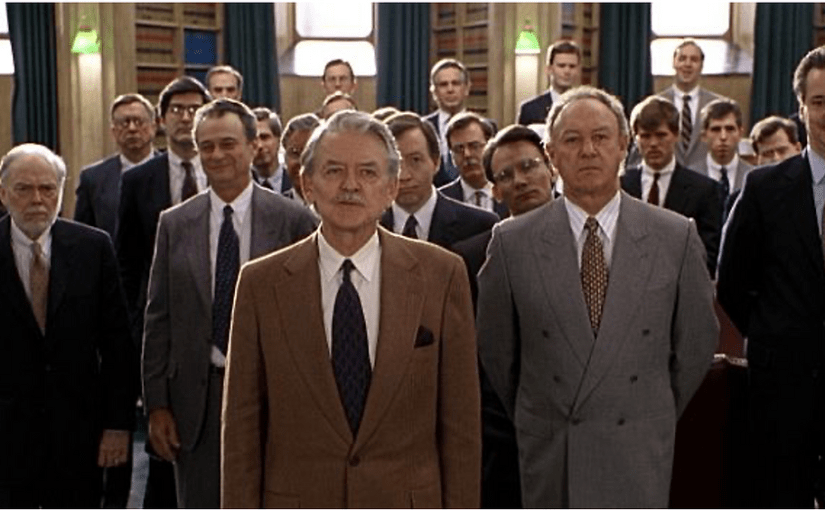
The sharp minded Avery Tolar (another welcome performance from Gene Hackman) is assigned to make sure Mitch follows the path the firm expects of him. Avery also has his sights set on Abby. For a guy who has never been regarded as good looking, Hackman plays a pretty effective flirt.

The firm, led by a seasoned Hal Holbrook with a charming Mark Twain like bow tie, and a perfect henchman villain played by Wilford Brimley (definitely on my top list of best bad guys) are involved with the Mafia and their shady dealings of money laundering, racketeering, murder and embezzlement. Now Mitch is stuck.

The FBI want to use him to uncover the firm’s activities but that risks blowing his career and maybe his and Abby’s life. If he doesn’t cooperate, then the Feds will run him in with the rest of the gang.

A second hour focuses on a complicated way for Mitch to get out of this ordeal. It means a lot of white collar work and contrived timing in the script. Fortunately though, Pollack builds suspense with foot chases and some allies on Mitch’s side, including Holly Hunter as an hourglass figured, bombshell secretary to a private investigator (Gary Busey) that Mitch went to see. His plan involves traveling to and from the Cayman Islands, and making copies of legal documents to build evidence of mail fraud against the firm.

Mail fraud???? That’s right mail fraud. It’s not a sexy crime, but the script with Pollack’s direction and a hard pounding piano soundtrack from Dave Grusin manage to keep the suspense up and alert.

Pollack directs Cruise to sprint across downtown Nashville for some great sights and hideouts in broad daylight. Your adrenaline moves with the film even if you can’t connect all the dots of Mitch’s complex plan.

In fact, it’s best to just give up on following every little step Mitch and his team take to stay ahead of the firm. What works best is the seemingly no win scenario for Mitch and Abby. Pollack follows a Hitchcock trajectory. He leaves the bomb on the table but doesn’t detonate it right away. Thus the suspense holds steady.

So, the best kind of counsel I can give is to just enjoy The Firm as it runs through its paces. It’s a solid white-collar thriller.

THREE DAYS OF THE CONDOR

By Marc S. Sanders

Sydney Pollack is such a hero of Hollywood filmmaking. He was a terrific actor and a better director. As Three Days Of The Condor opens I got completely engrossed in its simple, yet frightening set up.

Joseph Turner (Robert Redford) arrives at his office where he works day to day as a “book reader.” He chats a little with his colleagues, jots a few notes down, and steps out the back door to pick up lunch for everyone. When he returns, he finds the entire office staff has been shot to death. This seems like a common day in the life of an Everyman, until it’s not. Alfred Hitchcock capitalized on this motif over and over again.

Turner makes a phone call and is asked for his code name, but before he reveals he’s known as “Condor,” he asks a very good question to the man on the other end of the line. Why is it so important that Turner reveals his code name, but the man he called doesn’t feel the need to share his own?

Having recently watched the film adaptation of The Firm with Tom Cruise, made almost twenty years after this film, I can see that Sydney Pollack knows how to not only build suspense very, very quickly but also how to maintain it too. Still, in both films the complications of the why and how become overbearing. With Three Days Of The Condor, it’s best to just watch the tight editing and well drawn characterizations all the way from Max Von Sydow as a disciplined assassin to John Houseman as the elder authority who relaxes himself with his tweed suit and bow tie behind a large table as the problems unfold. Cliff Robertson is Higgins, the contact for Turner. He’s serviceable in the part.

The entire first hour of the film is perfection; taut and gripping as we uncover what purpose Turner as a book reader serves, and for whom. The second hour found me feeling less engaged, regrettably. To aid himself, Turner kidnaps a woman shopping in a sporting goods store. Faye Dunaway plays Kathy Hale. He forces Kathy to take him back to her apartment where he hides out. Never would it occur to me that these two characters over the course of a day and a half would fall for one another and make passionate love. This is not that kind of movie, and yet there it is. Some producer must have said “Fellas, we’ve got Dunaway and Redford on screen. This is a no brainer.” Faye Dunaway is fine in the part. I bought that out of desperation Redford would hold her at gun point and force her to help. But, c’mon! Really? They gotta bang each other too????

As for the plot behind killing people, the film doesn’t work its way into car and foot chases. It relies on its wording. The problem for me is that Turner works it all out himself. There’s little reference back to earlier moments for an audience to connect the dots along with the hero. So when Turner realizes one of the motivations is in regards to oil trading, I was trying to figure when anyone said anything about oil to begin with. Revelations just seem to be pulled out of a rabbit’s hat at times. They could have said people had to be murdered because the price of milk went up by fifty cents, and that would’ve held about just the same amount of weight as oil. What ABOUT oil????? Nothing ever needed to be so explicitly discussed here.

Part of the fun sometimes in Hitchcock films, for example, is simply seeing the man unexpectedly on the run and then watching how he outwits his adversaries. Harrison Ford does that in The Fugitive. Tom Cruise did it in The Firm. Cary Grant did it plenty of times with Hitchcock. In this film, however, I never felt there was any need to explain. Once it tried to grow a brain, I thought sometimes less is more, because now I’m stuck feeling frustratingly confused amid a lot of convoluted mumbo jumbo, on top of an out of left field, unsubstantiated love sequence.

Three Days Of The Condor was one of the best, edge of your seat suspense stories I’d seen…until it wasn’t.

OUT OF AFRICA

By Marc S. Sanders

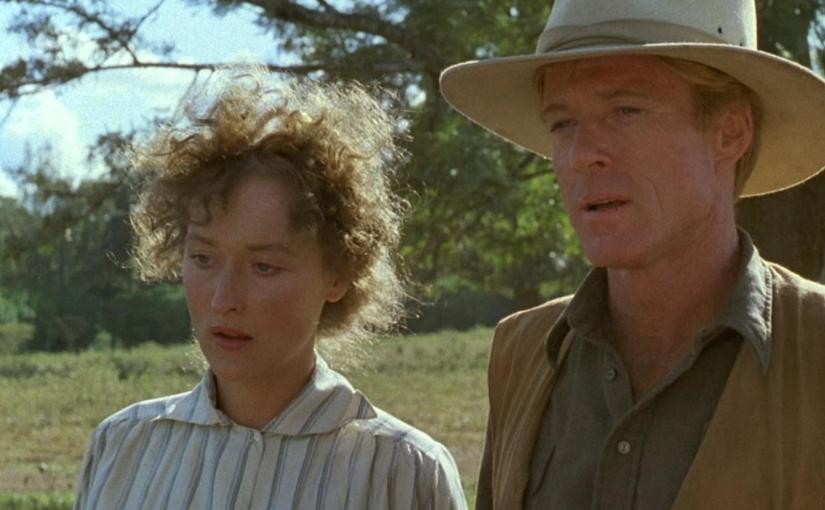
Sydney Pollack’s Out Of Africa might seem like a whirlwind romance if you’re only looking at the top billed names of the cast, Robert Redford and Meryl Streep, but it’s much more than that. It’s an education of the African continent beginning in 1913 when World War I was on the brink, and the British monarchy appeared to become territorial of its lands.

Karen Blixen (Streep) is a Danish Baroness who marries a Swedish nobleman, Baron Bror Blixen (Klaus Maria Brandauer) out of simple convenience. She plans to begin a cattle farm outside of Kenya to manage with Bror. To her unfortunate surprise, Bror has invested her monies in harvesting coffee on the land, which is much more difficult to produce at the altitude where they settle. Bror is also not so concerned with growing to love Karen and would much rather hunt on safari and be a womanizer, while welching off of Karen’s enterprise.

Karen grows to love Africa with its wildlife, as well as the local people whom she does not object to them squatting on her property. She provides medical aid and schooling for the children, too.

Karen also encounters the dashing adventurer, Denys Finch Hatton (Redford). Denys comes in and out of her life where he welcomes her on expeditions that are up close with lions and rhinos. He also takes her in his biplane to get God’s perspective of the lush scenery, a major centerpiece of the film. Denys, however, is not concerned with offering the full commitment Karen seeks. He’s happy to carry on with his safari treks only to return on occasion.

Clocking in at nearly three hours, Pollack’s film gives plenty of time and footage to absorb gorgeous landscape views of Africa from above and across the plains. The cinematography is on par with some of the best I’ve ever seen in a motion picture, compliments of David Watkin. The colors of sky with green, brown and yellow landscapes are breathtaking. Sunsets are spectacular with Redford’s silhouette in the foreground. Herds of cattle consisting of oxen, gazelles and lion feel so up close and personal. The production design of Karen’s home and coffee farm are also noticeably authentic. The home feels comfortable.

Out Of Africa is based on the stories told from Isek Denisen, Karen’s pseudonym. Like many of these sweeping epics, I find that I need to get accustomed to the nature of the film first. Dialects, when done authentically like Streep always strives for, are challenging for me to understand initially. The African people are hard to understand at times. As well, this is a period picture in a territory that I’m mostly unfamiliar with. So, I find that I have to adjust to the habitat and culture of the characters. Frankly, the first half hour or so was a little tough for me to stay with the picture. Once I got my footing with the film, though, I could not get enough. I felt terrible for Karen when she contracts syphilis. I was truly annoyed with how the Baron treats Karen with such disdain. It’s also heartbreaking when Karen and Denys are in disagreement with one another, simply because I loved the chemistry between Redford and Streep. Later setbacks feel tragic, especially as you feel like you’ve traveled through the progress and impactful differences that Karen affectionately made for Africa and its people.

Out Of Africa is an outstanding piece of filmmaking. It’s another example of a film where the setting is as much a character as the leads who carry the story. Sydney Pollack and his crew, which includes grand horn and string chords from Oscar winning composer John Barry present a captivating story that also feels rich in a documentarian point of view. A restored copy of the film on a large flat screen TV is a must see.

MICHAEL CLAYTON

By Marc S. Sanders

The corporate world can be murder sometimes.  Just ask a well known “fixer” like Michael Clayton. 

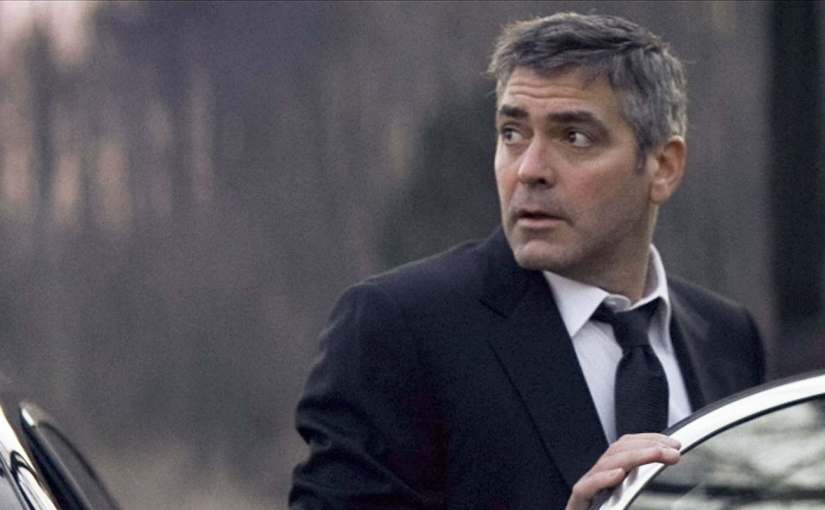
George Clooney plays the title role that’ll leave your head spinning while watching the film, and thereafter keep you thinking about how frighteningly true much of what you’ve seen, in this fictional account from master writer Tony Gilroy, could potentially be all too real.

Michael Clayton is a lawyer who does not practice law but rather “fixes” sticky situations for his law firm.  When the attorneys of the firm don’t have enough imagination to swindle their client from bearing responsibility or surrendering to guilt, they turn to Michael.  Michael will know what to do.  Ironically, Gilroy’s script (which is also his directorial debut) will have you believe that Clayton is at a career midlife crisis moment where he understands that nothing really can be fixed or simply swept under the rug.  Not even money can buy any of us out of a guilty situation when there’s nothing to work with but the black and white facts of actual guilt.  Early on in the film, Michael explains to an aggravated high-priced client that there’s no getting out of the fact that a late-night hit and run is nothing else but a late-night hit and run.  Can’t undent a car.  Can’t bring a bicyclist back to life.  Can’t fix what is permanently broken.

Moving on to the main storyline will demonstrate the same ideal.  If knowing admission of guilt and wrongdoing is documented on paper in plain English, then there’s no getting around this.  Moreover, there’s no getting around the fact that one of the best lawyers in Michael’s firm, played expertly by Tom Wilkinson, is consciously arrested in his own guilt of ethics violation.  To be considered one of the greatest lawyers in the country, would you factor in how to squeak out a win at no costs? Would it be when you can accept that your own client is guilty of wrongdoing and help them from that point?  I don’t know.  I’m not a lawyer.  The point is that Tony Gilroy implies that Wilkinson’s character, Arthur Eden, was once considered among his peers in high esteem in order to earn the reputation he has. Then another way when perhaps that reputation was based on actions not so honorable.  As Arthur struggles with this conundrum, maybe it’s only telling that his wealthy corporate client, an environmental weed killer manufacturer and his law firm colleagues easily think it’s nothing like that.  Arthur must be literally losing his mind.  It’s the only explanation.  He’d have to be crazy to literally strip his clothes off in the middle of a witness deposition, and later run after the witness in a freezing cold parking lot, while stark naked.

The pawn of the corporate client is represented by a shark named Karen Crowder (a brilliant Tilda Swinton, putting on the American Ivy League grad persona).  Karen is only insecure in how capable she’s actually considered when behind her closed doors.  She nervously practices what she will say at presentations for the corporation or interviews that hold her client in the highest regard.  She’s also desperate to maintain a calm and unpanicked appearance of this firm who clearly caused the death of many people that were exposed to their product.  Karen will make certain this knowledge never sees the light of day.  Karen talks to her mirror while stuttering over her lines.  By the way, if Karen was so confident in what her corporate client stands for, then would she even have a stutter to begin with?  This is where Tilda Swinton is great with Gilroy’s script.  What she knows would be the death of her career. Then again, this is her career we are talking about here. 

Tony Gilroy’s script is deliberately muddied in its first act.  Random scenes that carry no relevance to one another occur.  Michael sits at an underground poker table. Arthur spews off endless speeches that give a voice to madness. An army of lawyers led by a shrewd Sydney Pollack are up late at night sifting through piles and piles of documents.  Karen talks to herself while smoothing out the wrinkles of her suit while getting dressed in the morning.  Then a car explodes, and the movie sends us back in time to four days prior.  This might seem frustrating on a first viewing, but I urge anyone interested in seeing the film to be patient.  Gilroy demonstrates that if crime truly occurs within the offices of corporate high-rise buildings, then it’s not going to be anything but complex.  It’s only when it is gradually simplified like a math equation, do we see how justifiable the desperation of these crimes really are.  Murder and attempted murders and violations of law and ethics are committed in the film Michael Clayton, and yet no one is carrying a gun. 

This film boasts a brilliant cast ready for complicated characters.  Clooney is far from his charming other characters that evoke cuteness and handsome tuxedo clad appearances.  He’s a tired professional soul, exhausted on the heavy lifting he does for his firm and their apathetic clients.  He’s failed at his dream of running a New York City restaurant with his recovering alcoholic brother and he’s mounted in debt to loan sharks.  Wilkinson is old and past the age of winning at all costs.  He can’t sleep with the contributions he’s lent to criminals he’s legally served and rescued on paper.  Swinton is the younger one of the trio with a massively rich and successful future ahead of her, while holding on to the same mentality of what Clooney and Wilkinson’s characters once had.  The only issue is that maybe she’s taking a few too many steps way too far. 

Tony Gilroy has written brilliantly faulty characters who must function with strength, but are weakened by their lack in morale or inability to recover from never having morale, and the actors he’s directed in this film deliver the message sensationally.

Michael Clayton is a smart film, and Michael Clayton is a great, great film.

ABSENCE OF MALICE

By Marc S. Sanders

Maybe more often than not, the films I see about journalism seem to convey the reporters as heroes seeking the truth despite the threats and the strict laws of the first Amendment and so on.  They meet informants in dark garages and outrun speeding cars trying to run them down before the story hits the papers.  They accept being held in contempt of court to avoid revealing a source.  They’re heroes!!!! It’s movie stuff, right?  We’ve seen it all before.  What about films where the newspaper writer gets it wrong from the start, and then sees the ramifications of the recklessness committed?  Absence of Malice, from 1981, is that kind of picture.

Sally Field is a hungry thirty something reporter named Megan Carter with connections in the Miami prosecutor’s office.  When she gets a whiff of a story that implies a man named Michael Gallagher (Paul Newman) is the prime suspect in the disappearance of union head, she runs with it and her editor is happy to make it front page news.  However, just because Mr. Gallagher is the son of a deceased and reputed bootlegger with mob connections doesn’t make him guilty of anything.  Also, has an investigation into his affairs even begun to happen yet?  Just because it walks like a duck, well….

Sydney Pollack goes pretty light on a serious subject matter here.  It’s just awful to see a film legend like Newman be a cold blooded killer.  Worse, it’s beyond reason to see Sally Field as a woman without scruples.  They’re too likable.  So, Pollack with Kurt Luedtke’s Oscar nominated screenplay, play it safe.  Forty years ago, when this film came out, I might have accepted what’s on the surface with Absence of Malice.  Today, however, I appreciate the conundrum, but the residual effects offered up by the film never seem to carry much weight.  The stress doesn’t show enough on Newman and Field.  A suicide of another pertinent character hardly seems monumental to either of them.  Heck, there’s even time for romance between the two leads despite the slander committed by one against the other.  Another film by Pollack, Three Days Of The Condor, committed this same mistake.  It’s hard to accept a romantic angle when the characters barely know each other and what they do know of one another is hardly favorable for each of them.  I can imagine the marketing campaign for this ahead of the film’s release.  If you got “Blue Eyes” and “The Flying Nun” in a film together, well then, they gotta hook up and never, ever make them ruthless.  Audiences would hate that!!!!

The film reserves the shiftiness of the situation for other actors in the film like Bob Balaban.  He certainly plays the part well as a manipulator in search of a guilty party, even if it means indicting an innocent person.  The best surprise is the appearance of Wilford Brimley in the big close out scene who sums what has occurred and then lays out who is responsible for what and who is not responsible.  It’s the best written role in the film and it reminds me what a shame it is that Brimley did not get any Oscar recognition during his career.  (I still say he was one of the greatest unsung villains in film for his turn in Pollack’s The Firm.)

Even the soundtrack music from Dave Grusin feels inappropriate here.  It’s too energetic and full of life with piano and trumpets.  When you consider the term “absence of malice” and what it means to a reporter questioning her journalistic integrity, and then furthermore what significance it has to a newspaper article’s bystander, it seems to hold a lot of weight with disastrous repercussions.  Grusin’s music says otherwise.

It’s always a pleasure to go back and watch Paul Newman, and Sally Field in her early career.  These are great actors.  They do fine here, but the material is not sharp enough for what they can do.  They’re too relaxed.  On the other hand, the subject matter is perfect for heightened movie drama.  I can only imagine what Sidney Lumet would have done with this picture, considering films like Network, Serpico and The Verdict.  The execution of Pollack’s film simply does not live up to the terrible dilemma of an innocent man being publicly smeared.  Think about it.  At the end of Absence of Malice, I don’t think the intent is to wish and hope and yearn for Paul Newman and Sally Field to sail away on his beautiful boat into the sunset.  Yet, that’s what Pollack and Luedtke seem to have left us with.