THE SUGARLAND EXPRESS

By Marc S. Sanders

Steven Spielberg’s second film, and first full-length theatrical release, is The Sugarland Express.  It’s inspired by real life events that consisted of a convict couple making their way to the Sugarland estate, located in Texas, to reunite with their toddler child living with foster parents.  Goldie Hawn played the mother, Lou Jean, who easily springs her husband, Clovis (William Atherton) from a pre-release penitentiary.  Clovis only had four months to go before a full release.  Once they’re out, they hijack a police car with the deputy driving and make their way across the state for Sugarland.  The rest of the police force, along with out of state authorities, are hot on their tail.  Pitifully speaking though, this becomes a long, drawn-out slow car chase.  It’s a pretty dim-witted story, but because it’s based on fact, well, some thought it’d make for an interesting two hours on film.

Unlike Spielberg’s first film, Duel, I didn’t find much inventiveness with The Sugarland Express.  If anything, it was likely green lit following what the director accomplished so well, at such a low expense, with his first film.  Car crash/car chase movies were also becoming trendy in the early ‘70s with Steve McQueen’s Bullitt becoming such a pioneering film of incredible automobile stunt work.  The French Connection would go on to win Best Picture a few years later with a centerpiece car chase to hang its hat on as well.  The Sugarland Express however is quite silly and very inferior to those pictures, though.

I was impressed with the infinite number of cars at Spielberg’s disposal and many of them get bashed up and crashed up in so many ways.  Yet, I grew tired of the novelty too.  The stakes didn’t seem so high with this film.  It is perhaps a film of its time.  After so many on the run pictures that were made with much better sophistication in the decades that followed, Spielberg’s film often feels unconvincing and unintentionally silly.  A funny moment occurs when Lou Jean needs to finally pee following miles and miles of endless driving.  The outlaws force the police led by Ben Johnson, in a nothing role with a big cowboy hat, to bring in a port o potty in the middle of an open field.  Cop cars are everywhere.  It’s clear as day outside.  Yet no one takes the opportunity for aggressive action.  Lou Jean gets to relieve herself.

As the pursuit carries on, Lou Jean and Clovis become celebrities, and crowds of townsfolk approach the car they occupy to lend them money and good wishes and even a pet pig.  Silly stuff mostly, but just not very amusing to me, and Goldie Hawn, who is normally a natural and adorable comedienne, is not very endearing here.  Lou Jean mostly screams in her redneck dialect and as a former beautician, styles her hair in the back seat applying endless amounts of hair spray to irritate Clovis and the deputy.

I didn’t find much camera work to impress me from Spielberg either.  I appreciated one moment in time however.  As the characters manage to hide out in an RV parking lot overnight, they watch an outdoor screening of a Roadrunner cartoon short out their back window.  Wile E Coyote falls victim to one of the Roadrunner’s tricks, and Spielberg captures a close up of Atherton with a foretelling expression of doom cross over his face.  It’s a nice moment that brought me back into the film, but then the ongoing themes of the film return thereafter.

I don’t care if it’s a true story.  I don’t care how ridiculously absurd it all amounted to.  The Sugarland Express was just noise for me.  Other absurdist stories of the 1970s, approached their subject matter better.  Films like Dog Day Afternoon whereas the ordeal continued to prolong, so did the mental exhaustion and desperation of the characters.  I’m afraid Spielberg just didn’t capture any of that here.

DUEL

By Marc S. Sanders

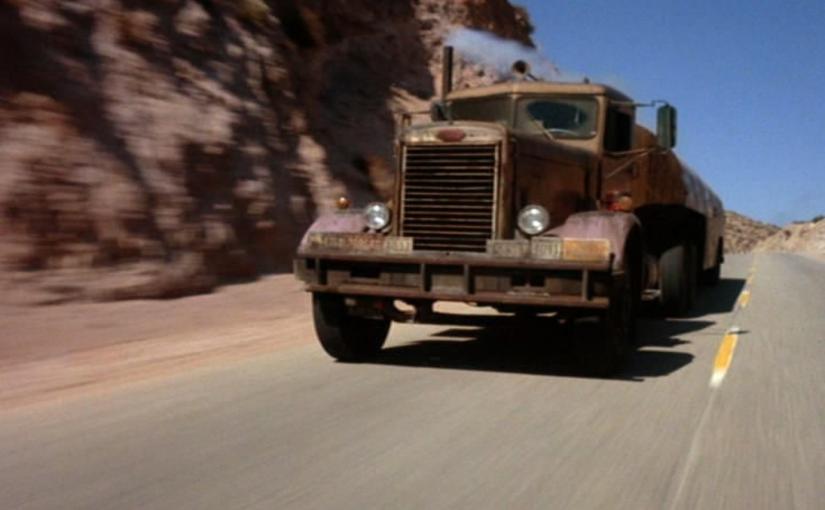
Duel – Steven Spielberg’s first full length film which he directed in 1971.  While it was originally a television movie in the United States on the ABC network, the feature made its way to European cinemas after Universal requested that Spielberg shoot additional scenes to bring the running time up to at least ninety minutes.  The final product still holds as a tight and intense depiction of nail biting, paranoid suspense.

The story couldn’t be simpler.  A sales man (Dennis Weaver) driving a red Plymouth sedan across a never ending California highway comes up behind a grotesquely, offensive looking, smoking oil tanker.  He takes it upon himself to pass the truck on the left to continue his journey to his next appointment, and either a road rage from the unseen truck driver, or just a need to play cat and mouse begins.  No matter how fast and far the man’s car goes, the hulking, angry truck is terrorizing him to no end.  The truck will tailgate the car, or cut it off, or even just wait silently up ahead as the car continues on its path.  The salesman cannot understand the madness behind this unexpected scenario. 

As a film lover, what’s most fun about Duel is easily recognizing Spielberg’s attempt of building fear within his audience.  Steven Spielberg always has a unique approach to thrilling audiences.  He believes that what you don’t see is scarier than what you look at plain as day.  Like his eventual third feature film, Jaws with the submerged great white shark, along with Close Encounters Of The Third Kind and the unknown aliens that are blinded out by colorful light, or the hidden dinosaurs of Jurassic Park, and even Saving Private Ryan with the gear, grinding, at first unseen, German tank that occupies the final act of the film, with Duel you may get a look at the monster at play but you never get to meet the mind of the monster.  At best all that you see of a sinister truck driver is his left arm waving out the window or his cowboy boots.  Soon we learn that left arm is only baiting the salesman to drive into oncoming traffic destined for a violent collision.  (The shark’s fin in Jaws teases its hunters into similar kinds of danger as well.)  Otherwise, this mysterious truck driver has no dialogue, and expressions of evil come through close up and advance shots of the “face” the front of the truck seems to have with a long snout like extended hood for a nose/mouth and the dirty windshield for its eyes.  This approach alone is what keeps you glued until you reach the picture’s climax.

After the man is driven off the road the first time, Spielberg depicts the protagonist’s fear with a long hand-held camera that follows him walking from his crashed car into a diner across the street, past folks eating lunch, into the wash room and then back out again, only to end the shot on the enemy truck resting outside the restaurant as if it is waiting for its new found prey.  This truck is as scary as Spielberg’s shark or his dinosaurs.  The film was made long before the age of Steadicam, and this moment serves as a masterful sequence.  The poor guy is a stranger in an even stranger situation, and because none of us have seen what this terrorizing truck driver looks like, we are no wiser than this guy who is being victimized.  A voiceover of his thoughts plays out where he tries to reason with himself if what he did is so bad, or perhaps it’s all over and this crazed driver will let him go on his way now, or which one of the men sitting at the counter could possibly be the driver of this rusted, greasy, metal monster.  Even if he wanted to, the salesman can’t reason or negotiate with his new found enemy.  The paranoia is very real. 

Reading up on the background of Duel, many film critics and admirers seemed to have found certain symbolism with the film ranging from comparisons of status symbols of the car vs the truck, or between the two drivers.  The salesman’s name is David Mann. Is this biblical perhaps, like David vs. Goliath? Plus his last name is so simple – Mann. Observers even took note of a small early scene where the salesman has a tiff with his wife over the phone.  When he hangs up, the wife is long gone from his mindset and he’s left on his own to survive anything that comes his way.  I, however, didn’t regard the picture with much depth other than that Spielberg shot a taut film in just 12 days.  I didn’t need to look for much else.  My heart was racing.  My curiosity to see the truck driver stayed hungry and my need to know how or if this poor guy was ever going to escape this daylight nightmare persistently held strong.  

As well, I was amazed at the camera work on display.  No two shots of the vehicles appear the same.  Spielberg positions his camera on a low moving motorized crane (first used in the film Bullitt) to keep pace with the truck for upward facing perspectives.  He’s got overhead shots, perspectives from the rear and the sides and then of course the front with zoom close ups to bring a visual, frightful roar to the big rig.  The Plymouth also has its own blend of camera work that’s very effective.  Dennis Weaver as the salesman is seen looking in the rear-view mirrors.  Spielberg captures paranoia from inside the car underneath the steering wheel looking up and next to the actor from the passenger side or from the back seat.  He’s got close up shots of Weaver in sweat inducing paranoia.  For a car chase picture, every sequence looks new and different from what you see earlier in the film.  A young Steven Spielberg was always reinventing himself.

Though the film was made 50 years ago when the term “road rage” was not even thought of, the situation seems all too real and quite possible when watching it now.  The man relies on telephone booths or stops at gas stations to try and help his situation.  Not much good comes from that though.  Had Duel been made today, the car driver would use his cell phone and he’d likely drop it by accident or the battery or signal would die.  The point is at given moments in life, we are all left to our own devices and completely alone.  On a lonely, endless highway help is not necessarily something to count on.  Police cars are not to be found at any given moment.  The man finds opportunities to see if locals or another passerby could help, but no one is so inclined.  How often do you help a stranger that comes upon you on a desolate road?  So, you are left to fend for yourself where a vicious beast need not concern itself with the boundaries of law or morals.  The second half of Jaws would follow this theme as well.  Out in the middle of nowhere with no one around, what do you do when it only comes down to you and the terror that hunts you?

I believe Duel is essential viewing for any film lover.  More than standard schlock slasher films, Steven Spielberg’s film offered the new wave of presenting an effective thriller like Alfred Hitchcock had built his reputation on.  There’s nothing supernatural in this film.  This could happen at any given time.  People face insurmountable bullies or challenges that are never welcome and the strength of ourselves is tested when we realize we need to overcome these obstacles alone, without a hand to hold or a guide to steer us to safety.  It happens when we lose a loved one.  It could happen in a boring office job when the work is piling on or during finals week in school or while driving on a lonely stretch of highway.  When the challenge does occur though, and you are unfairly never given all of the facts, how will you react?  What will you do?

READY PLAYER ONE

By Marc S. Sanders

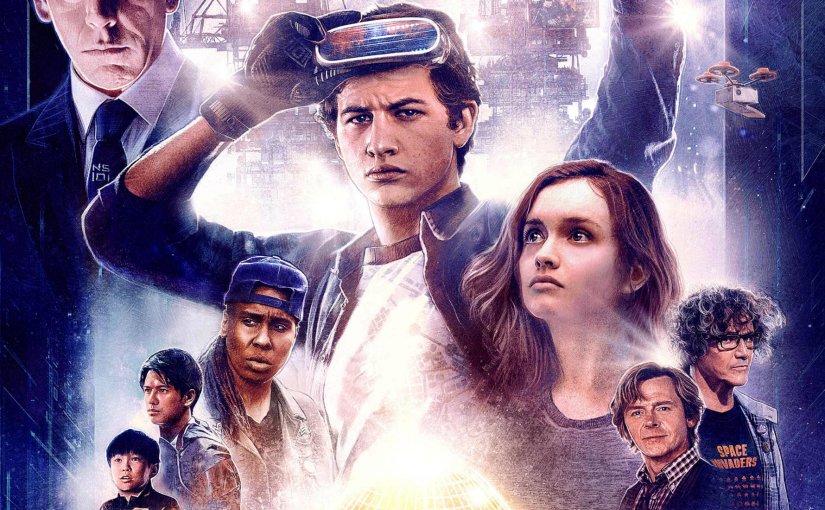
Steven Spielberg’s masterpiece, Ready Player One is the best Easter Egg to search for today.

As a huge fan of Ernest Cline’s novel chock full of pop culture salutes, this latest effort from Steven Spielberg is the film I was looking forward to the most in 2018; more than Solo and definitely more than Avengers: Infinity War.

The film adaptation almost completely succeeds. It is very well cast and the expansive imagination of Spielberg and his crew get everything right. It’s the greatest amusement park for the eyes. When there are not hidden gems to look for, I still found the young cast of characters portrayed by talented unknowns to be engrossing, and more importantly endearing to those cinematic kids of the ‘80s from John Hughes films, as well Spielberg’s other classics.

Authenticity was also truly a priority for Spielberg. I dare not spoil the highlight of the film’s second act but let’s just say the attention to detail was perfection to every minute crammed on the screen. You can’t help but laugh, grin and slap your knee. In fact, you really do it through the whole film practically, but Act 2 really reaches for the skies.

Now the one issue I have. Like Spielberg’s Jurassic Park, the villain was pulled back in their deviousness from the original source material. The danger did not feel threatening enough for me. Here the antagonist is this large conglomerate run by a CEO, and I’m afraid that’s all that Ben Mendelsohn is sadly reduced to. The stakes didn’t seem high enough. Cline’s novel made sure that your life could end as you got closer to solving the puzzles of the “Oasis,” the interactive virtual world that everyone willingly engulfs themselves in. The threat was more convincing in the novel. In the film, I’m afraid it’s a little too watered down.

Still, Ready Player One is incredibly fun with an awesome soundtrack; “Staying Alive” by The Bee Gees will always be the greatest song to bless any film, ever. This film especially supports that argument.

“LET’S SAVE THE OASIS”

WEST SIDE STORY (2021)

By Marc S. Sanders

Okay!  Let’s get the comparison out of the way first.  Steven Spielberg’s interpretation of West Side Story far exceeds the original 1961 version from Robert Wise and Jerome Robbins that won the Best Picture Academy Award.  I strongly encourage you to see this new film in theatres before it’s gone.  If you miss it, be sure that when you watch it at home, you have the highest upgraded flatscreen with the most enhanced sound system imaginable.  West Side Story of 2021 is a gift of sight and sound.

What Spielberg accomplishes with an updated and outstanding script from Tony Kushner is a more fleshed out, grittier and honest account of territorial entitlement and heated prejudice when the west side of New York City was on the brink of catering to a wealthy white populace and the Puerto Rican community had become established as Americans, even if they were never considered equals.  )The best promise the Puerto Ricans have here for a life is to live as doormen and housekeepers.)  The music and lyrics are more meaningful than ever before.  The characters are given more depth.  The settings become characters themselves.

West Side Story is another example of solid evidence that Steven Spielberg is our greatest modern director.  He not only focuses on the positions his characters hold, allowing them to act with passion and humor and heartache and despair, but he also takes advantage of the props and settings allowed to him beyond limits.  To watch classic numbers come alive not just with the outstanding vocals and dancing, but to see everything in the frame serve a purpose is so gratifying. 

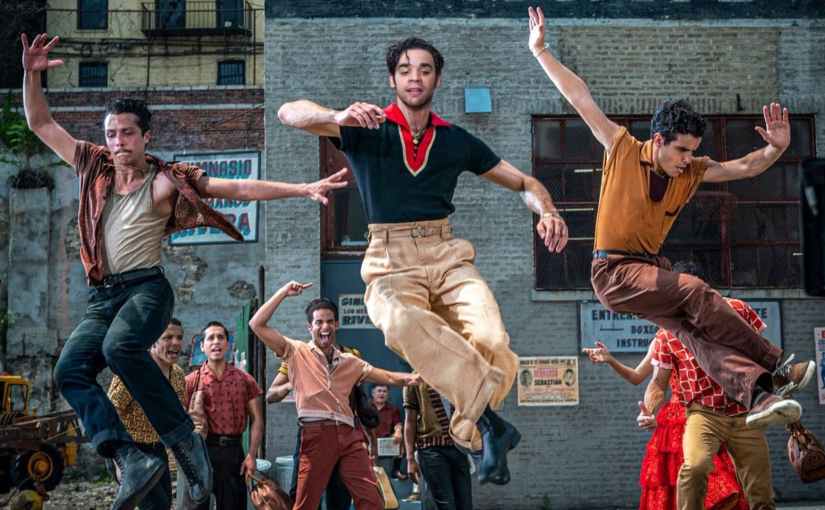
When the Jets strut and ballet down the city streets claiming their elite status in song, Spielberg makes sure these guys literally stop traffic.  Unlike the mundane placement of the winning song “Officer Krupke,” in the original film which only happens on a sidewalk, Spielberg place the boys in the police station where the props of papers and office supplies along with the furniture pieces serve to lampoon the city judge, the cops, the psychiatrists and even themselves.  Maria (20-year-old sensation, Rachel Zegler) owns her rendition of “I Feel Pretty” while the picture enhances the performance with a run through the dress department of Gimbell’s.  Clothes and accessories fly off the racks to send Maria’s enthusiasm of love and happiness into the heavens.  Kushner and Spielberg make a very wise modification to have “Cool” performed by the romantic lead Tony (Ansel Elgort) as a means to calm down his buddy, Riff – leader of the Jets (Mike Faist), before going into a head-to-head rumble with Maria’s brother, Bernardo, leader of the Puerto Rican gang known as the Sharks. Spielberg places these guys on a rickety old dock complete with wide gaps in the floor for the boys to leap over along with smooth planks to slide around on while tossing a gun around like it’s a football.  These characters teetering on manhood beautifully display their recklessness for danger and pride.

Rita Moreno is the significant attraction early on as she fills the Doc mentor role in the local drug store.  Wise & Robbins’ film never made Doc into much of a mentor.  Moreno fills that void.  She portrays a new character named Valentina, the widow of Doc, and the film’s tool of sensibility during these troubled times.  Kushner creates a fleshed-out character who explains that while she married a Gringo, she remains a Puerto Rican and there’s no room for bloodshed.  She has learned to live with others, and now Tony and Bernardo and Riff and the rest need to do so as well.  In another writer’s hands, this might come off preachy.  Not with Kushner’s dialogue though.  The background of Valentina is paved out early on and her elderly physicality can only do so much.  She can’t disarm the toughies, but she won’t stand for their stupidity either.  It’s Moreno’s presence that brings the chaos to a halt even if she knows it’ll never end the senseless war.  She is sure to get an Oscar nomination and like her win as Anita in the original film, she’s likely to win the award here as well.  (The only Hispanic woman to win an Oscar since 1961, and she’s likely to repeat that accomplishment again.)

Another fleshed out character that I really appreciated is that of Chino (Josh Andres Rivera), the nerdy student and best friend to Bernardo.  He’s studying accounting and calculator repair, but Chino wants to join the Sharks and fight for their cause. Bernardo, the tough guy boxer, wants none of that for his friend.  He wants Chino to date Maria.  There’s multi dimension to Chino now that I never saw before, and it is so very necessary.  The character puts a heartbreaking seal on the end of the film or play, whichever you are watching.  With Spielberg’s film, we get more of Chino’s motivation.  We now can understand why it is Chino that really delivers the final punch of the show.

Ariana DeBose plays Anita, Bernardo’s wife, and she’s spectacular as well.  I could watch her lead “America” through the colorful, daylight city streets over and over again.  In her yellow dress, with red lace underneath, and her magnificent energy, she’s a powerhouse of magnetism.  She leads a company of dancers with such a drive.  Again, Spielberg uses the environment of these characters to build them up and Anita dueling with Bernardo during this song in broad daylight (as opposed to just an evening rooftop from the original) is sensational.  Clotheslines and soft fabrics of pink, yellow and blue even sway to the pounding drum of the number from Leonard Bernstein, along with Stephen Sondheim’s original lyrics.

Having seen this film twice, I now recall when I watched it the first time how inappropriate it really was to have Natalie Wood cast as Maria in Robert Wise’s film.  Beyond the fact that she was never an accomplished singer or dancer, she is certainly not the correct ethnicity.  Her skin complexion was actually bronzed for the role and she lip synched her dialogue and singing.  Obviously, she was a marquee name at the time and the bills had to be paid while profits were collected.  Still, what an insult to point of the piece.  West Side Story’s conflicts hinge on racial and ethnic divides.  With Spielberg’s film, he went so far as to not even include subtitles for the Spanish dialogue.  I don’t speak Spanish, and yet while I can not translate, I could understand the emotions and motivations among the Puerto Rican populace.  Why should subtitles be provided?  Why should whites play Hispanics?  It’s a disgrace to consider, especially in a film that relies on ethnic identity.  Often, the Puerto Ricans are reminded by the cops or among themselves to speak in English.  Yet they continue on with the primary language.  Bravo.  Just because the soon to be famed Lincoln Center will be erected on these grounds doesn’t erase a heritage.  You can not whitewash a culture within a melting pot, and you cannot change a mentality that really doesn’t need to be altered.  Puerto Rico is America and Puerto Rico, within the confines of this film’s New York is here to stay.  Spielberg, the Jewish, typically non-musical director, ensures an equal playing field among the divided cast.

The chemistry among the cast has to be celebrated.  The Jets and Sharks work in pitch perfect precision with one another.  You only need to watch the high school dance to recognize that.  Moreover, look at the balletic fight scenes among the Jets in blue and the Sharks in red.  Elgort and the physically much shorter Zegler work beautifully as a couple forbidden to love, much less talk with one another.  Spielberg makes up the odd height differential by placing Tony on a ladder below Maria, who stands assuredly on a balcony or simply by seating Tony while Maria stands, thereby allowing their duets to work nicely in sync as they beautifully gaze upon one another.

2021’s version of West Side Story is an absolute masterpiece.  It is one of Steven Spielberg’s best films.  It’s entertaining, funny, celebratory and authentically heartbreaking. It’s the film I never, ever realized was needed to be conceived again.  West Side Story was the very first stage musical – Broadway musical – I ever saw and it always remained my favorite.  Yet, until I finally saw what Steven Spielberg could do with West Side Story, I actually never realized I hadn’t seen all of West Side Story.

QUICK TAKE: Munich (2005)

By Miguel E. Rodriguez

Director: Steven Spielberg
Cast: Eric Bana, Daniel Craig, Ciarán Hinds
My Rating: 9/10
Rotten Tomatometer: 77% Certified Fresh

PLOT: After the terrorist group Black September kills Israeli athletes at the 1972 Olympic Games, Israel responds by sending covert hit squads after the men responsible.


Munich is an engrossing film that doesn’t pretend to have easy answers.  Anyone who comes out of the movie thinking that Spielberg has either denounced or commended Israel’s actions in the aftermath of the 1972 attack wasn’t paying attention.  The film simply portrays the aftermath in an extremely even-handed manner, presenting both sides of the argument without making a judgement call itself.  If there’s a judgement call to be made, that’s on you.

To make a movie that hinges on an attack by Arab terrorists just four years after 9/11 was a risky move.  Four years sounds like a long time, but I can assure you, it was still fresh in everyone’s minds at the time.  The film closes on an image of the New York skyline as it appeared in the ‘70s, complete with the digitally restored Twin Towers.  Aside from being an extremely effective visual statement tying the events in the film to today’s world, it was a little eerie.

Eric Bana is a mass of contradictions, a committed Israeli soldier who leads a squad of assassins, but who starts to have misgivings after a couple of close calls.  Their targets are essentially assigned via a safety deposit box.  No questions, no discussion: kill these men. But he starts asking the very questions that can’t be answered.  He wants proof that these assassinations are making a difference.  All he sees are newly vacant spots in the organization being filled by terrorists even MORE extreme than the one before.  So what’s the point?

Suffice to say, it’s one of Spielberg’s finer efforts, and it will challenge you to think critically about your deeply held views, whatever they may be.  And isn’t that a workable definition of “art?”

THE COLOR PURPLE

By Marc S. Sanders

Steven Spielberg’s production of The Color Purple, adapted from Alice Walker’s novel is an absolute triumph of the human spirit. It is evidence that physical and mental beatings cannot break a person’s determination to live her life to the fullest.

The film takes place over roughly forty years during the early part of the 20th century in the rural plains of Georgia. The community consists of African Americans who own property farm lands where men feel justified in requesting possession of young girls. Celie, along with her sister Nettie, are two of those girls. Both girls were molested by their father. Celie was forced to give up the two children she carried.

A landowner named Albert (Danny Glover) takes Celie to live on his property as a means for endless housework and upkeep, and to use as a disposal for his sexual gratification. Albert also violently forces Nettie off his land when she refuses his advances. The sisters are separated from that point on.

Celie in her teen years through adulthood is astonishingly played by Whoopi Goldberg, and this must rank as one of the greatest all time debut performances on film. Like most of Spielberg’s heroes, Goldberg looks perfect in the director’s signature close ups of light. Watch as Goldberg gives a radiant smile or a wise look from behind her glasses. Spielberg’s camera is owned by the protagonist.

Beyond that, is Goldberg’s performance. There are so many reactions to play with here. She is a victim to Albert’s cruelty. She only will address him as “Mister.” Yet, she’s also denied the right to any kind of personal value or confidence. Albert pines for a traveling lounge singer named Shug (Margaret Avery) who drunkenly calls Celie ugly when they first meet. That’s more crushing to Celie than Albert’s beatings. Perhaps because the observation comes from another woman of color and not a blatantly obvious cruel man. Later, Shug finds the undeniable warmth within Celie and in a tender moment together demonstrates the personal worth that Celie has, as well as how to feel treasured in a sexually intimate moment. It’s a major turning point for Celie who eventually builds up her own strength to fight back against Mister’s oppression, and declare her independence.

Contrary to Celie’s plight is Sofia (Oprah Winfrey in her own magnificent debut role). Sofia is introduced as nothing but solid strength. Nothing will topple her spirit. Not even Albert when he objects to Sofia’s marriage to his son, Harpo (Willard E Pugh), a weak man who only knows to resort to Albert’s ways with treating women. Albert learned his own means of abuse from his father. Sofia won’t tolerate any of that, and leaves with their son. Later, upon telling the prejudiced white mayor and his wife to go to hell with a punch, she is sent to jail for a number of years, blinded in one eye. Afterwards, she is forced to degrade herself as the personal servant to the mayor’s unaware and over the top, ditzy wife. This once immovable object to outside forces is absolutely broken.

In this rural south, Celie ascends from weakness to strength, while Sofia takes a very surprising and heartbreaking descent.

Spielberg offers gorgeous landscapes of wide open fields and grassy plains, particularly areas of purple flowers for the sisters to escape to and dance together. The flowers may have been delivered by God whom Celie resorts to writing to since she has no idea where her loving sister is located. Albert is cruel enough to hide Nettie’s letters from Celie. Spielberg has a few breathtaking shots of a perfectly round and orange sun, choosing even to close his film on that sun in the background of his final shot. His treatment of the sun in this particular film reminded me of his famous decor of a full moon in E.T. The Extra Terrestrial. There are a few parallels with both films. Broken homes and personal connections or the want for personal connection are thematic in both pictures. Celie is denied to be with her loving sister Nettie, or even to know her whereabouts. Elliot in E.T. is eventually denied his bond with his new alien friend. Through an earthly environment within nature do the pairs of characters within each respective film eventually get their personal moments together. When they’re torn apart from one another, it’s absolutely crushing. Spielberg has a way of putting you in the place of Celie and Elliot, where you can almost imagine those perfectly quiet and treasured moments you’ve experienced with your loved ones, and then the heartache of being torn apart from them. When those characters can be reunited at last it is an absolutely rewarding experience. It’s a moment when you cry tears of joy.

The Color Purple is inspiring for anyone suffering from loss or weighed down by what seems like the most insurmountable obstacles. There are thrilling scenes within this film that’ll make you applaud at Celie and Sofia’s will to lift themselves up and declare their freedom. It couldn’t be more evident during one of the best dinner table scenes I’ve ever seen. There’s a force of genuine power and might in that scene.

There are also great opportunities for laughter. Spielberg reminds you that humor and music, compliments of Quincy Jones and company, are part of what keeps us alive.

These women are told they are nothing and worthless. Their only purpose is to serve the men forced into their lives and to be used for unconscionable abuse. Yet Spielberg demonstrates with Menno Meyjes’ script that each time they are reminded of their lack of self worth, they are only made that much stronger.

Again, The Color Purple is a triumphant film.