SCHINDLER’S LIST

By Marc S. Sanders

Oskar Schindler was a handsome, well dressed man. A man of wealth, power, and influence. A successful businessman. He was a womanizer. And Oskar Schindler was a Nazi who saved 1100 Jews from the atrocities of the Holocaust.

On a filmmaking measure alone, Schindler’s List is one of the best pictures to ever be made. Steven Spielberg’s production value is incomparable. Nothing I can recall appears as grand (not sure that’s the appropriate word here???) and authentic as Schindler’s List. How did Spielberg pull off this feat? How did he direct hundreds, thousands maybe, of extras to reenact the vilest human suffering that a generation of people could ever encounter? I’m astounded. Positively astounded.

This evening was only my second time seeing the film. I always put off watching it over the last 30 years; reluctant maybe to see a horrifying truth. The first time I saw the film was on Christmas Day, 1993 at the Hyde Park cinemas in Tampa, Florida with my father. I didn’t realize it at the time, but I was in the beginning stages of the flu with a high fever. Midway through the film, I had to leave the theatre as my illness caught up with me. I mustered the strength to return to watching the remainder of the movie, as I recall I could not go without finishing this masterpiece. I was horrified and yet amazed; amazed that this moment in world history could have ever occurred.

To see a man like Amon Goth (brutally and uncompromisingly played by Ralph Fiennes), a high ranking Nazi, excuse himself from his nude mistress’ bed and perch himself on his balcony to sniper random Jewish prisoners as a means of sport was sickening and twisted to me. Twenty five years later, it is this moment that has always stayed with me, as much of the story and scenes left my memory from so long ago. This moment as well as Spielberg’s choice to highlight a young girl in a red coat amidst a most somber black and white picture have stayed with me all these years. The glimpse of red serves as a truth to Schindler’s naivety. Spielberg is a thinking director. He never follows the manual. He chooses to think outside the box. A glimpse of a child dressed in red in a sea of black and white where mutilated corpses and possessions are aimlessly strewn about. It’s a marvelously telling moment.

Liam Neeson plays Schindler. It will likely be the greatest role of his career. Schindler is a man who even fools the audience until the very end when he reveals that the war has ended and his salvation has rescued these 1100 souls. Finally, his humanity no longer hides and he weeps to his accountant and accomplice, Itzhak Stern (played subtly and beautifully by Ben Kingsley). Schindler weeps for he could have saved more. Neeson is superb in this moment. His commanding stature crumbles, his materialism and wealth have disappeared. Neeson translates all of that clearly, and finally my tears arrive. Prior to this moment, I was numb to the Nazi tactics of gas chambers, careless bloodshed and apathetic separation of families and friends; perhaps because I’ve extensively studied it during my years in Yeshiva. Before Schindler’s List, much of the history on the Holocaust seemed like textbook fare to me. Spielberg made its terrifying and tragic reality real.

Ben Kingsley’s performance is so important as well. The architect behind the list, his portrayal of Stern is countered with contained fear and leveled sensibilities amid the senseless intentions of a dominant force of evil. His instincts kept him alive so that only he could help keep his comrades alive.

Schindler’s List won the Best Picture Oscar for 1993, only 50-52 years following the events of the Holocaust. Many survivors thankfully remained to see Spielberg’s epic premiere. People who I share this planet with experienced the most insane and heinous evil ever encountered. They were well to do people living normally until they were violently pulled from their homes, stripped of their possessions, separated from their families, suffered at the threat of murder, witnesses to other murders and hate crimes, humiliated, beaten, forced into slave labor in tightly contained ghettos and eventually thrust into concentration camps. Yet, these few survivors lived to carry on with their lives and deliver new generations, beyond this morally ugly and evil historic episode.

I’m being redundant as I’ve said it many times before, but isn’t that the point? The Holocaust and the Nazi regime only occurred around 85 years ago. This happened before. This can happen again.

Thank you, Steven Spielberg for Schindler’s List.

I don’t consider myself to be very religious anymore. Because of moments like the Holocaust, I question how a God could ever be possible. Still, for the survivors and those that perished, I can only say Baruch Hashem, and L’Chaim. 

Peace.  Progress.  Love.
JURASSIC PARK

By Marc S. Sanders

Michael Crichton’s best-selling novel, Jurassic Park, is my favorite book of all time.  I recall reading it in one Friday night a week before the Steven Spielberg adaptation was released in theaters.  It was the easiest book to breeze through and I never stopped thinking about Crichton’s approach to a what if scenario where dinosaurs are resurrected in the name of scientific discovery and profitability.  Ideas related to chaos theory and DNA experimentation were considered against the mayhem of people running for their lives in an amusement park attraction.  Amid the action, there was opportunity to think and consider.  Spielberg’s film doesn’t offer enough time for ponderance.  It starts out that way, but it doesn’t finish its thought.  That’s always been a hinderance for me.

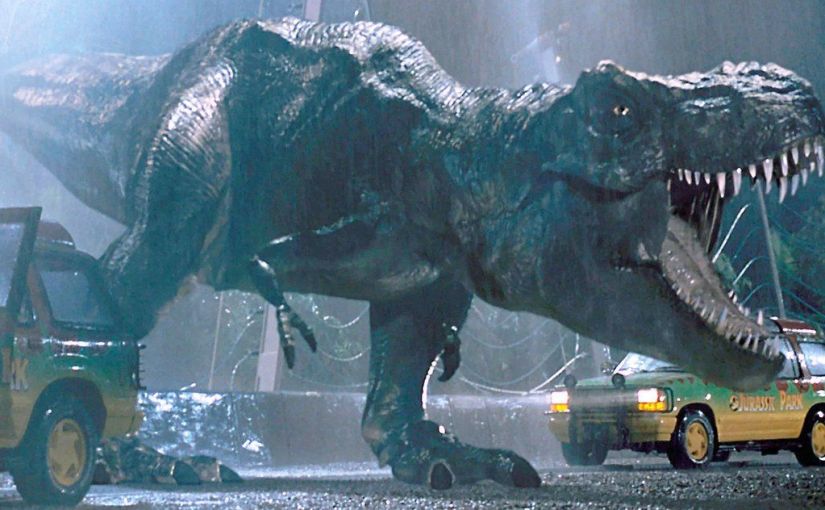
There’s no question regarding the immense thrills the film brings, even thirty years later.  Effects and puppeteer wiz Stan Winston (how I wish he hadn’t passed away so soon) outdid himself following memorable recreations from films like Aliens and Predator.  The centerpiece of the blockbuster is of course the T-Rex.  Spielberg follows his age-old approach of not showing the monster right away, though high publicity and massive merchandising of the early 1990s never kept this cat in the bag anyway.  Oh well!  Yet, when the humungous, twenty-ton dinosaur puppet makes its grand entrance midway through the film, it still holds as a spectacular scene, especially because two fine child actors (Ariana Richards, Joseph Mazzello) with high pitched screams heighten the terror.  Look, you should know by now.  If Steven Spielberg is aiming for the rafters of box office thrills, he’s gonna put the kids in danger first and foremost.

Velociraptors are the other big stars of this creature feature and the behavior of these CGI animals is magnificent as we observe them communicate with one another.  Like the T-Rex, we don’t get an immediate first glance of them either, but their squeals and screeches as they leap in for a monster mash smorgasbord get us to jump in our seats.  When the veil is lifted on these guys, Spielberg and his effects crew go further by granting them with quick agility.  Before all this, we are told by the science experts of how they are strategic pack hunters with cheetah like speed and how they tear away at flesh as they pounce on live prey.  You wince as you imagine.  They are also smart too.  These dogs can open doors! 

Again, all good stuff here.

The best character is the sarcastic mathematician, Ian Malcolm (Jeff Goldblum), who insists resurrecting dinosaurs is a terrible idea for the modern age.  Goldblum is so good with the script written by David Koepp that my favorite scene in the picture is when the main characters sit around the dinner table to discuss what has surprisingly been thrust upon them.  I yearned for more scenes like this.  Ian Malcolm offers up a new iteration of “Matt Hooper” (Richard Dreyfuss in Jaws) that I just didn’t get enough of.  Only the surface is scratched on the argument of intelligence versus stupidity.  In Jaws, we got nearly a full hour of this welcome back and forth.

What lacks is what Jaws provided over a decade earlier.  The debates of how to live (or die) with dangerous animals begins, but doesn’t finish in Jurassic Park.  It merely gets started, and then the argument gets abandoned to allow for unending carnage.  Don’t get me wrong.  I love carnage in my movies.  However, Crichton illustrated an even amount of attention to chaos blended with intelligence (or ignorant lack thereof) when he wrote his book.  I got a textbook education from Michael Crichton.  From Steven Spielberg and David Koepp, I just got a thin dog eared comic book.

Goldblum is third in line in the cast credits behind Sam Neill and Laura Dern as Alan Grant, a paleontologist, and Ellie Satler, a paleobotanist.  They, along with Malcolm, are cordially invited by billionaire entrepreneur John Hammond (Richard Attenborough) to visit his private island that is soon to be converted into Jurassic Park, a zoo/amusement park consisting of live dinosaur attractions.  The dinner sets up the debate of Hammond versus the three scientists.  Is anyone being responsible with the potential to act upon breakthrough discoveries?

Granted, if Hollywood was going to make a dinosaur movie, then it was going to be catered to children age 10 and up.  Kids and families of four or more sell tickets.  The novel doesn’t aim towards that demographic, however.  It is darker and the Hammond character is more sinister and greedier.  He’s not a fleshed-out villain in the film.  He’s lovable.  The film simplifies itself too much as it devolves into a run and chase and chew and chomp adventure of screams and outstanding John Williams music.

I watch the film over and over again because visually it remains magnificent, but I still remind myself that it is not enough.  Steven Spielberg’s film is admired and so well regarded and perhaps it is deserving of its legacy, thirty years, five sequel films and a couple of Universal Studios attractions later.  On the other hand, I wish it allowed its brain to develop a little bit more. 

Steven Spielberg’s interpretation of Jurassic Park could’ve been as smart as a velociraptor.

INDIANA JONES AND THE LAST CRUSADE

By Marc S. Sanders

Steven Spielberg is great when he takes advantage of a silhouette. His best example of this is with Indiana Jones. He’ll hide the character in deep sun so you only make out the recognizable shadow of his famous fedora hat and bullwhip by his side. I treasure a moment like this as Indiana Jones And The Last Crusade approaches it’s closing credits and he rides off into the sunset along with his father and their trusty companions. (Other great silhouettes happen in Raiders Of The Lost Ark – when he first meets Marion, or when he’s traversing through the South American jungle or when he’s digging towards the Well Of The Souls. I love it every time I see it.)

The Last Crusade no longer offers the mystery of the famed archeologist. Unlike Raiders where Indy only says what is necessary and his past experiences remain unknown, this story offers a background. How does Indy first dabble into the world of rare antiquities and what did he miss out on as a child followed by an adventurous transition into adulthood? How about that scar on his chin? There are some answers here.

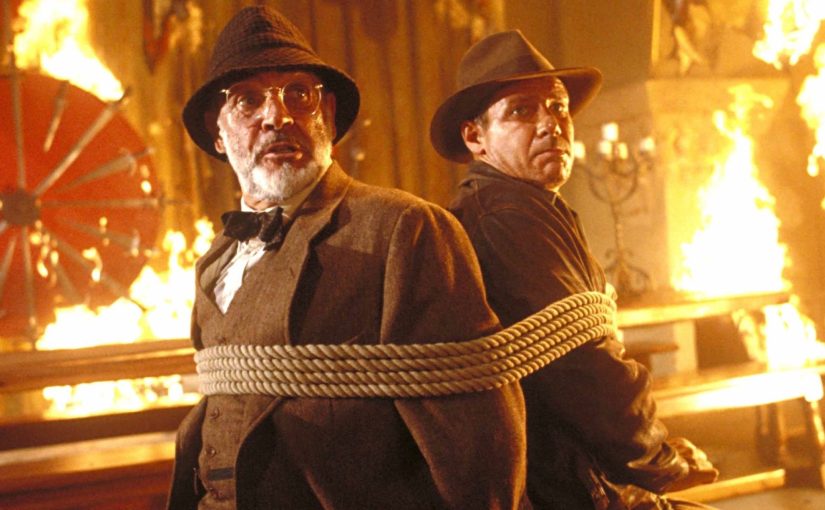
Harrison Ford keeps Indy stoic and only amusingly frustrated when interfered with by pesky Nazis and a wonderfully naive and innocent Sean Connery as his father, Henry Jones. Their pursuit of the Holy Grail, the cup that belonged to Christ at The Last Supper, is a similar narrative sequence of events to Indy’s first adventure. However, what sets it apart here is the relationship between father and son. I imagine it’s a similar connection between a lot of dads and their sons, and therefore I have a nice affection for the film.

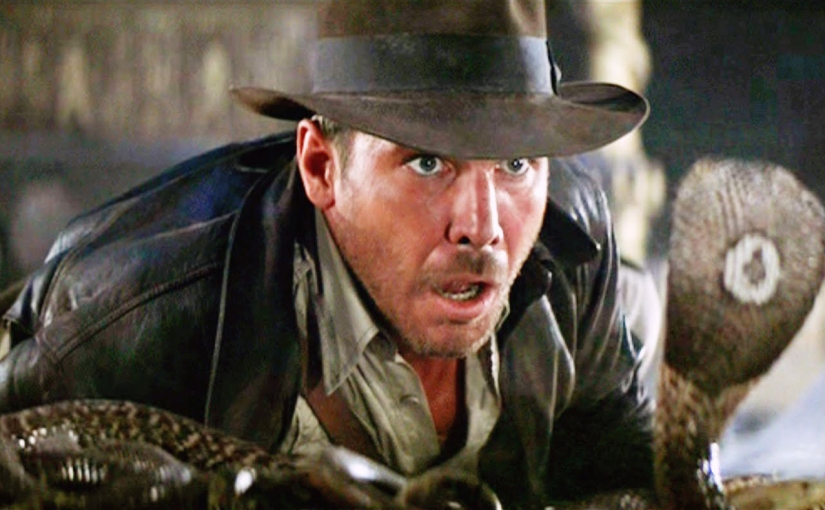
Spielberg continues to be great with his action moments by keeping it light and fun. River Phoenix echoes a young Indy as Ford would have played it as a pre teen. It’s a convenient short story to show how the character earns the hat, the jacket, the whip and even his infamous fear of snakes.

Boat chases, underground relics, rats and fist fights atop a tank are well edited and clearly shot.

The 3rd of four wonderful adventures (soon to be five) is still fun to watch and offers enjoyment that many of today’s blockbusters have simply forgotten.

It’s always exciting to ride alongside Indiana Jones.

EMPIRE OF THE SUN

By Marc S. Sanders

Empire Of The Sun is a marvelous film.  Finally, I got to see it, and now I consider it to be Steven Spielberg’s transition film within his storied career. It’s also one of his best cinematic achievements.

Other than The Color Purple, the majority of his directorial work up to this point in 1987, consisted of adventure and escapism found in cliffhangers and children with the innocent curiosities to uncover what is underneath.  Empire Of The Sun contains all of these elements, but as the film progresses, it matures and grows up right before your eyes. 

Christian Bale makes his introductory role a performance to remember as young Jamey Graham.  He is a British child of unlimited privilege living in Shanghai with his parents, naïve and sheltered from the gradual Japanese occupation taking place in 1941 when China and Japan were in conflict with each other.  Jamey happily plays and gets into adventures with his model airplanes and his imagination of heroics.  One day, while at a costume party, he discovers a crashed war plane and then envisions his fantastical heroism.  Shortly thereafter, the fantasy becomes real when he comes upon a Japanese battalion, just yards away.  With his parents, they make a desperate escape from the city they and their ancestors have called home.  However, Jamey becomes separated from them amid the chaos within the surmounting crowds.  Now, this young child with no sense of self reliance has no choice but to become resourceful if he is to survive and reunite with his mom and dad.

Eventually, Jamey meets up with two Americans named Basie (an outstanding John Malkovich) and his sidekick Frank (Joe Pantoliano).  The three are sent to a Japanese Internment Camp forced to live and survive on bare necessities as the second World War rages on with the Americans joining the fight.

Spielberg treats his protagonist the same as he did with the Elliot character in E.T. The Extra-Terrestrial.  Jamey happily lives in his own imagination until it is disrupted by an intrusion.  For films like Close Encounters Of The Third Kind and E.T., an alien of fantasy interrupts the protagonist’s lifestyle.  For Jamey, however, the reality of war harshly takes over.  It fascinated me how Empire Of The Sun, with a screenplay adaptation by Tom Stoppard of J.G. Ballard’s biographical account, seems to follow a familiar formula to Spielberg’s other pictures, and yet it reinvents itself with reality as opposed to fantasy.

Furthermore, Steven Spielberg does not abandon one of my favorite tropes of his as he makes the unseen the antagonist of the film.  When the veil is lifted, you can’t help but gasp.  Everyone knows he followed this approach in Jaws.  I also like to think he did this effectively with the German tank in Saving Private Ryan.  Here, he caught me completely off guard.  Young Jamey is dressed like Sinbad for Christmas jubilation at a costume party.  He’s happily tossing around one of his model planes and then when it flies out of sight over a grassy ridge, he runs over to the edge and finds something shocking beyond his treasured toy.  It’s a moment that happens early in the film and immediately tells me that this story will be bigger and more frighteningly real than meeting a cute, strange friend from another planet willing to eat my Halloween candy.

Spielberg’s production value is eye opening with thousands of extras within the scenes of mass exodus from Shanghai or within the internment camp.  Especially impressive is how he directs his extras to seem so overwhelming against young Christian Bale.  The child actor really followed direction, but more importantly it’s easy to see how method Bale might have been even at this young age.  He gets pushed and pulled and tugged on like I can only imagine an unforgiving circumstance of war would present itself.  Cinematics often praise Whoopi Goldberg’s debut in The Color Purple as one of the greatest introductions ever.  I have to put Bale’s performance up there as well.  The character arc that young Jamey experiences is well drawn out within Stoppard’s script, but Bale really performs the gradual change of a spoiled brat forced to become resourceful for not only himself but his comrades within the camp.  A director can tell a child actor where to walk or to sit or to stand.  A director can discuss the motivations of a particular scene.  With Christian Bale though, his performance throughout the film seems to remember where his character left off earlier in the story, where it has currently arrived and where it hopes to end up.  This young actor is so in tune with his character’s story. 

You may say John Malkovich serves as the staple mentor that every child protagonist has in so many other stories.  Basie is not that simple though.  A child will be quick to trust anyone he comes in contact with.  Spielberg and Stoppard know it’s not that easy though.  Malkovich is that dynamic actor who never seems forthright with his portrayals.  There’s something he always seems to hide from the audience.  Is he a snake ready to strike?  Is he a gentle pup ready for an embrace?  I never trusted how Basie would end up with Jamey by the film’s conclusion.  Malkovich delivers unpredictability so well.

Miranda Richardson is credited as a once wealthy friend to Jamey’s parents.  She’s not given much dialogue or scene work, but with the times she appears on screen Spielberg gradually breaks her down.  At first, she is well dressed in her finest linens insisting that her husband explain who they are to the Japanese forces.  Later and later in the film, the strength of her proud stature slowly crumbles.  It’s nice work and it’s crushing to watch.

Notable “tough guy” Joe Pantoliano goes through a similar transition.  A capture of him with Spielberg’s camera eventually focuses on a weeping and weak man.  Like much of the film, it is so unexpected.

There are epic overhead shots of panic and riots within the streets of Shanghai.  There are amazing moments where aerial attacks coming from nowhere with Jamey depicted running in a parallel line along the trajectory of a bi-plane.  It’s such a sweeping, personal story but the visual effects and camera work are so impressive as well.  The photography is striking in bright sunlight amid fireball missile strikes.  It is dazzling to watch.

As I noted earlier, Empire Of The Sun is Steven Spielberg’s transitional film.  Once again, he focuses on the innocent, young and unaware hero who is forced to become wise and most especially sensitive to a change in setting and circumstance.  With Empire Of The Sun, Steven Spielberg demonstrated that he could mature himself away from fantasy and embrace reality. 

I think Empire Of The Sun is an absolute masterpiece.

INDIANA JONES AND THE TEMPLE OF DOOM

By Marc S. Sanders

Steven Spielberg’s second installment in the Indiana Jones series of films deserves more credit than it has received, nearly forty years later. Spielberg isn’t even fond of his film, and I think he needs to reexamine his own self-criticisms.

By the time he’d make this prequel, he was already a master filmmaker (followed by Close Encounters…, Raiders Of The Lost Ark, and E.T. The Extra-Terrestrial). Temple of Doom almost seemed easy for Spielberg to construct. He just filled in the holes from one scene to the next and he’s so natural in his instincts that the thrill of adventure never wavers, and it always feels new and fresh.

Think about it!!! He accompanies a John Williams led rendition of a Busby Berkeley number while Indy tries to escape from machine gun toting baddies in a Shanghai nightclub (called “Club Obi Wan”; nice wink and nod there).

That’s followed by an unlikely jump out of an airplane with only an inflatable water raft to glide through the heights of the sky. Reader, I bought it, and only because Spielberg shot it. He just knows what looks good on film.

The main crux of the film focuses on rescuing the enslaved captured children of an Indian village from a bloodthirsty cult while also retrieving sacred stones. Over the years as we’ve approached an age of a PC climate, many take issue with racial prejudice overtones. Do Indians eat monkey brains for dessert, and rip beating hearts out of the chests of men? I don’t care, and I don’t associate these horror/comedy moments with people of a certain race. I’m not foolhardy enough to do that.

However, I do correlate this material with what inspired the Indiana Jones character in the first place, and that is the serial cliffhangers of a forgotten age. Ridiculous stunts and outrageous visuals kept the attention of the viewer and that is what Spielberg, along with creative partner George Lucas, accomplishes here.

So you are treated to thousands of icky, crawly bugs, a screeching, off the rails mine car pursuit and a “snake surprise” as a main course dinner entree.

It’s all in good fun and it’s all shown in the campy adventure thematics that Indiana Jones was always recognized for.

Just go get your jolts every time he cracks the whip. That’s all Indiana Jones And The Temple Of Doom was ever meant to be.

E.T. THE EXTRA TERRESTRIAL

By Marc S. Sanders

It’s easy to give credit to a magnificent script by Melissa Mathison when talking about E.T. The Extra Terrestrial.  However, director Steven Spielberg clearly invented tricks of his own off her page.  Thus, E.T. strikes a chord with me on a very personal level. 

While my parents never separated or divorced, in my adolescent years I did not have any kind of relationship with my father.  He left for work at 4:30AM and would not come home until nine at night.  He worked Saturdays as well.  I hardly saw him.  He hardly conversed with me.  One time, later on in life, he explained to me that he just never knew how to connect with a child.  It was only then that I understood why his response of “Oh wow!” amazement seemed so fake when I showed him how the wings pop off of my Star Wars TIE Fighter.

Mom was the constant in my life with regular Saturday trips to Burger King, and the comic book and toy stores, while singing along to Barry Manilow in the car.  The adults I viewed in my childhood were mom and my grandmother, Helen.  So, I understand why Steven Spielberg opts to only include Mary (Dee Wallace), the one adult in full focus through most of his picture.  Mary has recently separated from her husband leaving her to tend to their three children. Gertie (Drew Barrymore) is the youngest. Michael (Robert MacNaughton) is eldest.  Elliot (Henry Thomas) is the middle child and main character of the story.  These kids have no other important influence in their lives except their mom and maybe Michael’s buddies.  Their father is only mentioned to be vacationing in Mexico with his new girlfriend, but never seen.

After an alien ship departs Earth while looking for plant life in a California forest, one of the passengers is sadly left behind.  Through a series of suspenseful moments, Elliot welcomes the stranger from a strange world into the comfort of his room full of toys and games.  A connection is immediately made of trust and friendship, but on a science fiction level, there is also psychic bond.  Somehow, Elliot and E.T. share one another’s thoughts and can feel what the other feels.  In a humorous moment, E.T. gets drunk on beer while being left at home alone.  This leads to disruptions caused by Elliot during a frog dissection scene in science class.  Even deeper though is that E.T.’s biological make up doesn’t appear to be suitable for a long stay on Earth.  As E.T. gets more and more ill, so does Elliot.  It is up to him and his siblings to help their new friend “phone home” so he can be rescued. 

The interference in all of this are the government officials who are surveying the suburban neighborhood for clues on E.T.’s whereabouts.  Wisely, and because Mathison’s story is told primarily through the perspective of children, Spielberg shows these men from the waist down.  After all, if Elliot and the others can’t identify with these adults, why is it necessary to show their faces? (In Jaws, the townsfolk can’t identify with the man-eating instincts of a great white shark.  So, why is it necessary to show the animal?)  One adult in particular is a man who has a keychain clipped to his waist.  The film credits the character simply as “Keys” (Peter Coyote).  Only when the safety of Elliot, E.T. and the family are intruded upon in their home, does Spielberg show the faces of these scientists and G-men.  Still, most of them are displayed with intimidating radiation suits and masks on.  If they absolutely have to be shown, then they are going to look more obscure and threatening then any alien from outer space.

E.T. The Extra Terrestrial will always remain as of one Steven Spielberg’s greatest achievements.  That’s saying quite a lot considering his other films like the Indiana Jones series, Schindler’s List, Jaws and Saving Private Ryan.  What sets this picture apart from those others is the gamut of emotions it sends to the generations of audiences that continue to watch the movie over and over again.  It’s very funny at times.  It’s also very scary, and it can be very sad as well.  At one point, Elliot has to explain why a daring escape for E.T. must occur because “This is reality, Greg!”  Of course it is, no adult would ever believe what they’re involved in.  It takes a child to comprehend this wonderment.  The unknown is frightening as well.  What exactly is leaving footprints behind in the shed?  Is it a goblin?  Also, why are frightening looking figures with helmets and astronaut suits barging out of bright light into every doorway of their home?  As well, how does someone from another place adapt to a foreign environment of stuffed animals, flowers, and what’s on T.V. or in the refrigerator?  In two hours time, Spielberg answers for all of these dynamics. You develop a kinship with not just E.T., the cinematic creation, but also the kids who snap at each other and sometimes affectionately curse and tease one another. 

You also feel the sadness of a mother who is trying her best to uphold a home while hiding a sense of abandonment herself.  E.T. was left behind, but so was Mary.  Dee Wallace provides an exceptionally tear-jerking experience on Halloween night.  The following morning, she is distraught to find a missing Elliot finally return home with a high fever.  I see my mother in that scene each time I watch it.  Now that my mom is gone, it’s even more meaningful.

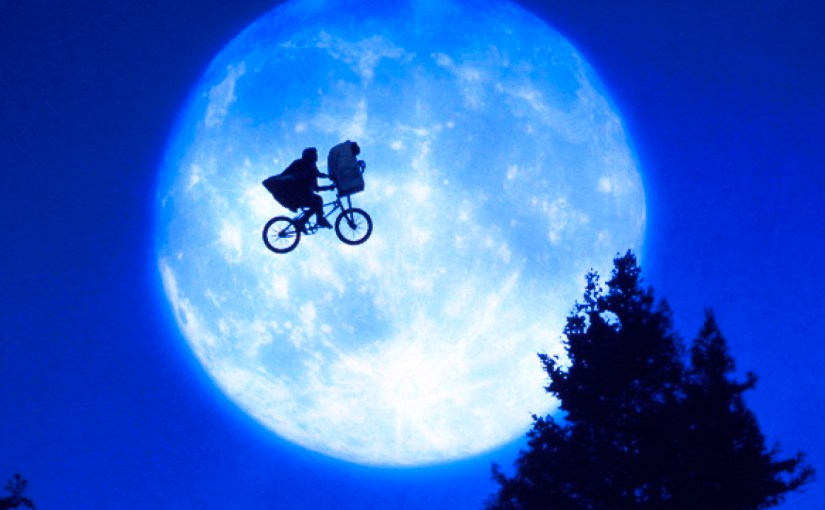
Spielberg’s film also works beautifully with an original score from John Williams.  Williams’ music speaks a language for the characters of the film.  Sometimes, his orchestration is foreboding as someone unseen lurks nearby.  Other times, it soars as the adventure kicks into gear with an outstanding bicycle escape from the government.  Williams also relaxes the pulse of the audience for the tender moments while a friendship of love and support is being built.  Watch how the score enhances the fantasy when E.T.’s fingertip glows and heals a cut on Elliot’s hand.  Williams hits a note that is in sync with Henry Thomas’ amazement.  The best sample of Spielberg’s craft blending well with Williams’ work is when Elliot’s bicycle soars into the sky with E.T. as a passenger.  As they ride across the backdrop of a full moon midnight clear, this movie provides one of the greatest shots in film history.  If there was ever a reason to prove why an original score is so necessary in film, it’s important to use E.T. as an example.

Steven Spielberg was especially sensitive when making E.T. The Extra Terrestrial.  I saw an interview with him where he decided that once E.T. departs the children of the story, the actors themselves would never see him again.  He insisted on that with young Drew Barrymore and Henry Thomas, and he warned them in advance.  Because he was steadfast in that decision, their performances were all the more genuine.  Their tears of love and sadness were kept authentic.   In one documentary, footage following the end of shooting with E.T. shows Barrymore completely distraught in the comfort of Spielberg’s arms.  Spielberg knows that everyone suffers loss.  It’s a rite of passage in life.  My first loss was my grandfather at age 9.  Imagine coming to the understanding for the very first time that someone you’ve grown close to will never be seen ever again. 

That’s the magic that Steven Spielberg possesses.  He can make anything feel real.  His fantasies and frights are true in nature.  Nothing appears ham-handed.  When watching a film from Spielberg, you’re enveloped in its environment.  What’s in front of you is what will terrify you or laugh with you or make you cry.  What you are seeing, and hearing will allow you to reminisce on a time in your life when you were scared or sad or happy or lonely.  Steven Spielberg might have used people from outer space in his films to tell us that we are not alone.  However, we are also not alone in our feelings.  Steven Spielberg reminds us that we all encounter these emotions at point or another and therefore, there’s nothing wrong with responding like any other human being would. 

RAIDERS OF THE LOST ARK

By Marc S. Sanders

Raiders Of The Lost Ark remains as one of the greatest films of all time. There’s nothing not to like about it and the accolades go to Steven Spielberg, George Lucas, Harrison Ford, Lawrence Kasdan and John Williams, along with a sensational cast of still unknown actors that owned their roles with absolute authenticity.

Ford became a great action film star due to Indiana Jones and Han Solo. This film is an example of his best work. He’s the best at facial expression during high action moments. Watch the truck chase during the second half of the film. As he is careening a truck through the sand streets of Cairo, he winces in pain, evokes anger and dons a toothy grin as he shakes Nazis off the vehicle, and throws them through windshields.

He’s got the perfect delivery of lines as he love/hate banters with Karen Allen as tough broad Marion Ravenwood (Jones’ best gal pal of the series). Their chemistry is great because they are two loudmouths who work off insulting and shouting at one another. They are one of my favorite on screen couples; like two Oscar Madisons who belong together.

Recently Ford said no one else can play the role; the role dies with him. He couldn’t be more right. Indiana Jones is not an interchangeable part like James Bond or Batman. Those roles change with the times and technology. Jones remains in history with a trusty whip, a sign of the times fedora hat and a drive to uncover the great unknown. None of these films work unless Harrison Ford is Indiana Jones.

John Williams also needs recognition. Who isn’t familiar with the famous build up horns calling for adventure? His composition just puts a smile on your face. Dialogue isn’t at play much during one of Spielberg’s well orchestrated action scenes. So we rely on the march of Williams’ efforts to relish in the fun of a foot chase through a Cairo marketplace or to thrill at a fast rolling boulder chasing the famed archeologist after he snatches his prized booty.

Spielberg and Lucas always get praise for their brilliant imagination. I venture to guess how many people were aware of the occupation of archeologist before the film’s original release in 1981. Sure, this isn’t what the job realistically entails, but the film opens your mind to what is out there and what we can learn more about from our past.

A great moment in cinematic exposition is when Jones explains the power of the famed biblical Ark of the Covenant. The dialogue works great here, thanks to a winning script from the great Lawrence Kasdan, and it has the audacity to convince an audience that some MaGuffin we read about in Sunday school could actually make Hitler’s Nazi regime invincible. Seriously? What?!?!? When you blend Spielberg and Lucas’ bravado, Williams’ eerily quiet thinking music, and Ford’s professor obsessed role with Kasdan’s efficiency for description all in one scene…yeah…you believe this could be a very, very real threat.

Every scene is different. Snakes, truck chases, spiders, foot chases, bottomless pits, bar shootouts, Nazis, the power of God, and a wide variety of antagonists all used to build the structure of two of the best hours in a film. It’s all brilliantly weaved together with transitioning red lines across a traveling map on screen. This is great editing, people.

Nothing has ever come close to Raiders Of The Lost Ark. Nothing ever will. It is a perfect film.

“Trust me.”

1941

By Marc S. Sanders

Steven Spielberg’s first critical and box office flop, 1941, is a splattered mess of slapstick hysteria set a week after the Japanese attack on Pearl Harbor.  Residents of the California coast line prepare to be the next target.  Ahem!!!!!  Well, that’s it for the story…Goodnight.  Tip your waiters.

Just a year ahead of the Zucker brothers with Abrams comedy team that’ll deliver Airplane!, Spielberg opted to direct a spoof script penned by Robert Zemeckis and Bob Gale (Back To The Future).  1941 is full of gags galore beginning with a reference to the director’s most successful film to date, Jaws.  For me, seeing actress Susan Backline on screen again for another ocean skinny dip only to be intruded upon by a rising Japanese submarine was the second best joke of the film.  Once that was over, I had two hours left to go.  A long two hours. 

I’ve noted before that satire or spoofs are the riskiest genres to produce.  They can succeed with a picture like Dr. Strangelove…, or Network or Airplane!  Satire can be divisive too though, and thus only one half of your audience will appreciate the poke and prod.  Even worse, satire can just be unfunny across the board no matter which side of the aisle you lean on.  That’s 1941.  It plays too much like a Three Stooges series of slapstick violence.  Reader, even Steven Spielberg cannot capture the magic of the Three Stooges.

Zemeckis and Gale opt to poke a little fun at the Puerto Rican zoot suit riots vs the Enlisted men ahead of America’s entry into World War II.  So, when army soldier Treat Williams gets jealous of one handsome zoot suit dancer flirting with his girl, a fight breaks out which eventually populates two thirds of the film as it escalates all the way over to Hollywood Boulevard. Now thousands of stooge wannabe extras are walloping each other from one side of the street to the next. 

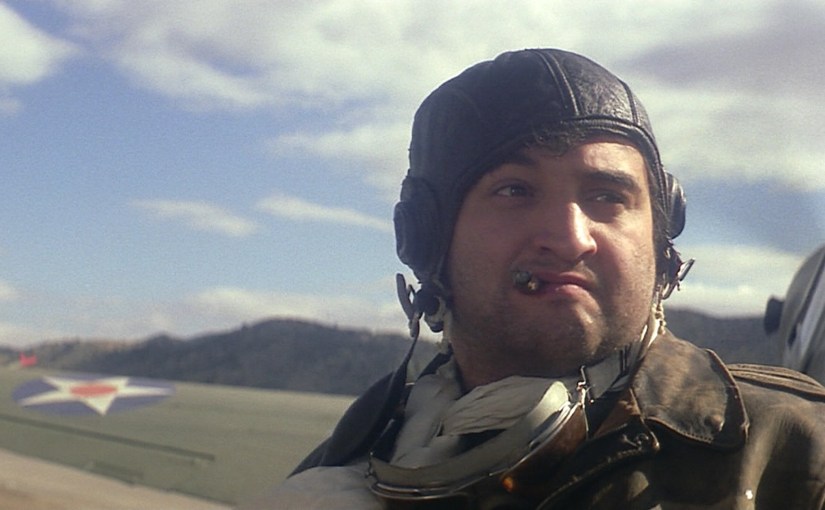
To allow a breather from this, the writers sidetrack over to Tim Matheson and Nancy Allen getting frisky in an out of control bi-plane while being mistaken for the enemy by John Belushi doing a very poor resurrection of his Bluto character from Animal House.  As Captain Wild Bill Kelso, Belushi’s pursuit fires upon everything else in sight, especially Hollywood Boulevard, but misses the plane occupied by Matheson and Allen.

The third point of this rectangle concerns Dan Aykroyd with John Candy and a whole platoon opting to set up a military cannon along the ocean view property belonging to Ned Beatty and Lorraine Gary in anticipation of the Japanese invasion.  Ned Beatty is the best stooge of the entire cast as the nerdy resident determined to protect his home while exercising his patriotic duty.  Gary’s response to Beatty’s ineptitude cracked me up as well.  The house wreckage of The Money Pit has nothing on what occurs in 1941.

The fourth storyline focuses on the enemy with a German speaking Nazi portrayed by Christopher Lee debating with the captain of a Japanese submarine (Toshiro Mifune) plotting to bomb Hollywood.  Somehow, each foil understands the other’s language.  These guys are just here to scream at one another.  There’s nothing funny about them.

Oh yeah.  Robert Stack is the Army General who watches Dumbo in the movie theatre while Hollywood Boulevard gets demolished outside.  Ho! Ho!

Often, I compliment Spielberg for his reliance on the sets he provides.  Everything you see on the screen serves a purpose to his films.  It happened as recently as with his remake of West Side Story in 2021, and it’s effectively used in Close Encounters…  He uses the same approach with 1941.  In this film though, there’s no pulse or significance to the props and pieces that are used.  The house is demolished.  So is the storage shed.  So is the movie theatre.  So is the Ferris wheel.  Yes.  What you’ve already seen in endless Looney Toons cartoons occurs here with a miniature model.  The Ferris wheel comes off its hinge and rolls across the beach side dock into the water along with Murray Hamilton and Eddie Deezen in tow.  When it happens, you’ll tell yourself I was waiting for that to happen.  What you expect to happen, happens, but you’re not laughing at it.

None of what you see in 1941 are terrible gags.  If you watch one scene out of context on a four minute You Tube channel, you may chuckle.  The problem is that every scene is treated like throwing spaghetti at a wall and seeing what will stick.  Mashing all of this together is not appetizing.  I like ice cream and I like steak.  I don’t like my ice cream on my steak.  Any idea of development is completely ignored.  The film can’t even work like a collection of skits.  Even Airplane! had a romantic storyline trajectory to perform with.  Here, two jealous guys have a fist fight and it more or less stretches that fight for an entire two hours.  The Three Stooges knew when to eventually quit.  Spielberg, Zemeckis and Gale didn’t. 

As soon as I saw Belushi on screen, I laughed.  It’s Bluto again.  Yet, the appearance wears off very quickly.  He has little dialogue and is limited to chomping on a cigar while grunting and groaning as the fighter plane he occupies wobbles around shooting at everything in sight.  When he eventually crash lands, Belushi continues to chomp on the cigar and grunt and groan.  Only now, he pratfalls as well…badly.

Ned Beatty is the real star here.  The ultimate nerd is also limited in dialogue. Still, to watch his body language with his glasses and bow tie and pear-shaped physique, accompanied with Lorraine Gary’s helpless gasping wife responding to the damage he commits with the cannon is hilarious.  Absolutely hilarious.  Tape all of their scenes together and make it a short to present ahead of the main attraction in a movie house. The audience will have a great time.

Otherwise, the only other fun I got out of 1941 was spotting the stars that were relevant at the time of its release.  Candy, Aykroyd, Frank McRae, Slim Pickens, Christopher Lee, Robert Stack, the cute blonde daughter from Eight Is Enough.  Even Penny Marshall has a quick blink and you miss it moment.  Oh, and look, there’s Lenny and Squiggy!

I think Zemeckis and Gale were on to a real smart idea here.  They maybe should have consulted with Harold Ramis and his National Lampoon’s crew however, because that’s the direction Spielberg’s film was aiming for.  What sets a film like Animal House apart from a 1941 though is in the set up.  Dialogue also helps.  1941 lacks set up.  1941 lacks dialogue.  It’s all visual and noise and more noise and more noise. 

1941 begins at letter A, and stops at letter A, never making it to B, and definitely never reaching Z.  An idea with potential was put down on paper.  The problem is these guys stopped writing after the first sentence.

CLOSE ENCOUNTERS OF THE THIRD KIND

By Marc S. Sanders

Close Encounter of the First Kind – Sighting of a UFO.

Close Encounter of the Second Kind – Physical Evidence.

Close Encounter of the Third Kind – Contact.

Music is the most universal of all languages.  Steven Spielberg’s Close Encounters Of The Third Kind demonstrates that claim. 

I appreciate how Spielberg’s script, along with his direction, opens the film.  It takes place during a sun swept sandstorm in New Mexico.  At first, hardly anything but sand blowing can be seen, along with the high volume of wind breezing about inconveniently.  You are not even sure what you are looking at.  Then, headlights from a vehicle appear and a group of men assemble.  We come to find the main character of this scene is a French scientist named Lacombe (Francois Truffaut).  He only speaks French and hardly understands any English.  He is in need of an interpreter (Bob Balaban) to translate to American men who are accompanying them.  After we’ve established French and English are in the fold, we then realize that Spanish must enter the conversation amidst the overwhelming winds from the blinding storm.  An occurrence must have happened here recently, because Lacombe and crew interview some of the locals who are trying their best to define what took place the night before.  An elderly man is mysteriously sunburned on only one side of his face.  Thereafter, a grouping of bi-planes last seen flying over the Bermuda Triangle nearly forty years earlier come into focus.  No matter how you learn, communicate or understand, the confusion depicted is a perfect match for each of the men occupying this space.

A parallel story begins after this opening in the state of Indiana.  Sightings by airline pilots, as well as residents, are discovered in the skies above.  Blackouts occur everywhere.  The experiences of two residents, a young boy named Barry, and a utility worker named Roy Neary (Richard Dreyfuss), are who Spielberg uses to guide us through these strange episodes of phenomena.  They are being drawn towards a calling or an image and they become entirely focused upon what has happened to them.  Barry’s mother, Jillian (Melinda Dillon), while trying to reign her son back home has also been delivered a message from unusual spectacles in the skies. 

Soon after, these people cannot help but focus on a shape that they know they’ve seen before but can not place it.  Roy sculpts the shape in his shaving cream and his mashed potatoes.  He becomes neglectful of his work, his three children and his wife, Ronnie (Teri Garr), who refuses to take him seriously.  Barry’s young age allows him to avoid understanding the meaning of any this.  So, when the blinding “lights,” of whatever these entities could be, come towards his home in the middle of the night, he happily welcomes them, and willingly accompanies them back to wherever they came from.

I know this science fiction film is a highly regarded classic.  It’s earned the right to be considered as such, and so many have seen it.  Yet, I also know that I appear vague in my description of the film here.  I choose not to expound on everything going on in Close Encounters…  Steven Spielberg would want it that way, and I hate spoiling any movie.  A movie not seen is new to any of us. 

The residents of Indiana insist to higher governmental and military authorities that they have witnessed unidentified flying objects.  What those UFOs are, or where they came from, or why they visited their home state is unexplainable.  Spielberg intentionally avoids definitively explaining what’s occurred.  After all, if aliens are visiting our planet Earth, then who’s really to say we understand what they want or why they’ve come here?  Like the rest of the countries of the world, it’s fair to say that inhabitants of another planet in our galaxy would likely have their own way of communicating or speaking that’s entirely different from English, or French, or Spanish.

Spielberg goes even further to distance any understanding among ourselves or with these new entities that we are encountering.  A cargo sea vessel appears out of nowhere in the most unlikely place, the Gobi Desert of Mongolia.  Why?  How?  The people of a village within the continent of India are harmonizing a tune over and over again, in unison.  Lacombe along with his interpreter, and their American crew, attempt to decipher why these episodes have occurred as well.  The harmony must mean something.  What’s the message?  The world must learn to communicate with one another if they are to understand why these strange happenings continue.

Once Spielberg introduces the Indian village’s response to their experience, oddly enough Barry becomes obsessed with the tune as well.  Lacombe believes he’s recognized the tune as a means to speak with the visiting entities.  Again though, what is the message within the song?  In addition, Roy and Jillian are beginning to understand their obsession of the shape.  “This means something.  This is important.”  The script for Close Encounters… does not take for granted the repetitive significance of this line.  It is uttered a few times at different moments, by both Roy and Lacombe.

Close Encounters Of The Third Kind functions as a riddle, and yet it all makes sense in a breathtaking ending that occupies the last 30-40 minutes of the picture.   I hope there will be readers of this column who have yet to see this film.  It is better to go into it by knowing as little as possible.  Only then can you truly experience the maternal frustration that Jillian has for her young son’s insistence on going towards the lights, or Roy’s obsession with what dwells in his mind following his encounter.  With knowing as little as possible, can you become all the more curious at Lacombe’s pursuit.  When Spielberg gradually pulls the curtain away, it is such a satisfying relief and a feeling of fulfillment to have taken the journey with these characters. 

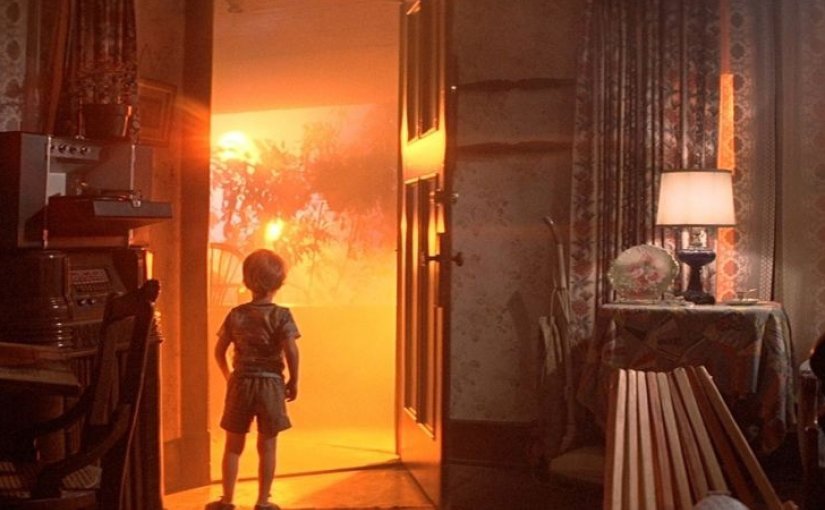
The construction of Spielberg’s first of many sci-fi films is magnificent.  It performs as if it is operating with real world science and language.  Yet, I have to draw attention to a scene that arrives in the middle of the picture.  Barry’s innocent, but youthful obsession, is tested within the home, beside Jillian’s fear.  Spielberg uses every prop and device available within the set of this scene.  Battery operated toys come alive.  The record player goes off.  The stove turns on. The dishwasher opens and closes. Blinding lights bleed through the curtains, chimney and keyholes.  The echoing sounds become overpowering.  What’s come to the house can’t be explained.  However, one person is thrilled by it while another is terrified.  It is such a well edited scene of terror at the unknown, that for me still remains as one of the most suspenseful moments in film history.  Steven Spielberg is bringing life to a “boogie man.”  When I showed my daughter this picture during a re-release in a Dolby movie theatre, I held her 11-year-old self in my lap concerned she’d become frightened of the scene.  It’s as thrilling as going on an unpredictable roller coaster for the first time.  The scene occurs out of nowhere, with no convenience of foreshadowing.  Once again, as he did with Jaws and somewhat implied with Duel, Steven Spielberg does not show you the terror or the invasive entity.  He allows the viewer’s subconscious to draw its own conclusion.  This is master craftsmanship.

Close Encounters Of The Third Kind remains as one of the best science fiction films of all time.  Nearly forty years later, despite its fiction, it still feels like it’s real.  It all feels like it means something.  It still feels like its important. 

JAWS

By Marc S. Sanders

Steven Spielberg’s third film, Jaws, is more than just an adventure or thriller piece of filmmaking. I believe it explores the dichotomy of motivations by man versus the intrinsic behavior of nature. In other words, in the peak season of summertime a great white man-eating shark will never care about how important it is for a small harbor town to sell the necessary amount of ice cream cones or hotel bookings to make an annual profit. You wanna swim with nature, then die by nature.

The New England coastal town of Amity Island has a new Police Chief named Martin Brody (Roy Scheider). When he comes upon what’s left of a girl’s mutilated corpse on the beach, he takes it extremely seriously when he learns the cause of death was a shark attack. The Mayor (Murray Hamilton) cannot afford to be mired with the inconvenience of a large fish just before the always profitable 4th of July weekend. So, the beaches must continue to stay open.

When the town gets a bloody public viewing of the problem at hand, a young, wealthy, educated oceanographer named Matt Hooper (a perfectly cast sarcastic and smart Richard Dreyfuss) is recruited. His knowledge with the science of shark behavior is not very welcome to anyone but Brody.

One dynamic of Hooper is his reliability of technology. Will any of his expensive tools be enough to rid the town of this shark?

As well, will a bounty hunt worth $3,000 satisfy? Any Joe Blow fisherman will take a crack at it. Spielberg’s film explores Hooper’s intellect of sea life, against the buffoonery that follows from others both near and far. Why not randomly toss some sticks of dynamite in the water or bait the animal with a pot roast while you’re at it? Maybe that’ll work. It’s money and technology in the face of one of nature’s most dangerous creations.

Will a sea faring Ahab like fisherman named Quint (Robert Shaw playing one of the greatest characters ever on screen) do the trick? His philosophy stems from his experience with the might of sharks in general. An illustrious monologue from Shaw describing Quint’s harrowing experience aboard the USS Indianapolis confidently tells us he’s seen what sharks can do. He’s floated in the blood red waters that sharks leave behind. Therefore, Quint has devoted his life to hunting one shark after another, boiling their large jaws of teeth for trophy hangings. He’ll win battle after battle, but never will he win the war with the nature of the ocean water.

Brody might be the only sensible guy, though. He fears the water and won’t go near it. He’s over with danger, leaving the cop’s life behind in the city for what he expected of the tranquility of ocean front real estate.

A mounting pressure always exists in Jaws. The townsfolk are hard pressed resistant to allow their businesses to avoid prosperity because of something as silly as a shark that isn’t even known to swim in these waters normally. Money is what matters. Money is what’s needed to live. During the age of quarantining with the spread of Coronavirus, Jaws is a fair allegory for the argument of staying at home or going back to work. You could die, but it’s still expensive to live.

The other argument lies in what’s more appropriate for this problem. Hooper’s technology or Quint’s hunter instinct. A metal “anti shark cage” with a spear of poison vs tying barrels to the predator and drowning him out in the shallows.

Spielberg with a script by Carl Gottlieb adapted from Peter Benchley’s best selling novel proposes no easy answer to ridding an ocean area of a man eating, uncompromising animal. That’s the thrill that keeps Jaws alive for over 45 years. Sharks will never change. Man might, but nature’s creatures will consistently emote the exact same patterns of behavior.

Unlike the fantasies of Jurassic Park or a Friday The 13th picture, a beast born of nature with enormous strength will always be unpredictable performing on God’s purpose. It will never be negotiable. If you’re a raggy fisherman like Quint, your old, leaky boat might keep you afloat for so long, but a shark will also not feel intimidated, no matter how many others of its kind this hunter might have conquered before.

Experience, technology or disregard for the elements of nature will not always win. Something unconquerable will come along.

To maintain the strength of the film’s monstrous antagonist is to watch the movie with your own most frightening, worst case scenario in mind. Hence, Spielberg gratefully never shows the great white until long after half the film is over. Masterful shots occur where his cameras seem positioned just at the surface of the water. When swimmers make desperate runs for the shore, away from danger, it feels as if the viewer is frozen in fear and getting trampled on by the panicked extras cast in the picture. What could be so terrible that these people are swimming and running away from? When Spielberg finally shows the gigantic shark emerge from the water, Scheider’s shock with his suggestion of needing a bigger boat assure you that, yes, this problem is actually this insurmountable.

Additionally, Spielberg uses props to keep the mystery of his beast alive. When the shark pulls a dock off its moorings with his bait, we know the fish is turning around to pursue its next victim as the wreckage now floats in the direction of a man’s panicky, desperate swim.

Most effectively beyond Steven Spielberg’s camerawork, has got to be the pulse pounding and blood curdling soundtrack from John Williams. (Cliche descriptions they may be, but I’d argue Williams’ score created the terms, nonetheless.). Without his music, the narration of the story would be a little lost, I’m sure. John Williams’ repetitive string notes that build, feel like the dialogue of the underwater monster. His music goes beyond the short rhythm everyone is familiar with. Looking at the opening scene with Susan Backline portraying the moonlight skinny dipper in the opening scene of the film, Williams brings in a variety of different sounding instruments that leave an impression of her body being torn apart by something she’s truly not aware of. Splashing, screams, body thrusting and harsh chords of long strings with percussion the emote panic and anarchy make for one of the most memorable opening scenes of any film. Spielberg with a collaboration of cinematography from Bill Butler and Williams orchestration make for an arguably unforgettable and frightening scene on the same level of the shower scene in Psycho.

Jaws transcends generation after generation. Everyone eventually has some kind of familiarity with the film, even if they’ve never seen it. People have seen the poster, heard the music or truly refused to step in the water off a coastline out of fear for what can’t be seen. Few films ever leave a subconscious effect on a viewer or a general public, but Jaws is most definitely one of those exceptions.