
MISERY

By Marc S. Sanders

The worst thing that could have happened to Paul Sheldon is that Annie Wilkes saved his life.

Rob Reiner breaks away from innocent romantic comedy to deliver a violently cruel kind of intimacy. He directs his second Stephen King adaptation, Misery.  (His first was based off King’s novella The Body, which became Stand By Me.)  With next to no prior record with horror or disturbing psychosis, Reiner achieves greatness with this film.  Much like Martin Scorsese, he focuses quite a bit on props that offer no dialogue but say so much.  A cigarette, a match, a champagne flute, a bottle, a beat-up briefcase, a clunky Ford Mustang, along with a gun, a two by four block of wood, a portable grill, a knife, a syringe, a sledgehammer, and a porcelain penguin.  Barry Sonnenfeld is the cinematographer offering brilliant clarities of color for mundane and endless discomfort.

Before leaving his mountainous Colorado cabin, Paul has smoked his cigarette and savored his glass of 1982 Dom Perignon.  He has just completed a new manuscript; a big departure from his best-selling series of novels focusing on his beloved heroine Misery Chastain.  Lady Misery is not how Paul wants to be entirely defined as an author.  

Unfortunately, on his way back down the snowy mountain, he veers off the road and lands upside down in his Mustang, buried within a blizzard.  A hulking figure carries him back to a peaceful, isolated cabin in the woods.  When he awakens two days later, he meets Annie who has already begun to nurse him back to health following two very damaged legs and a popped shoulder blade.  By his grogginess, he might have had a concussion too.  Lucky for Paul because apparently, he cannot reach a hospital or get a call out to his family or literary agent (Lauren Bacall) due to the harsh weather conditions.

It’s also convenient that Annie is quite the fan of Paul’s work, particularly his series of Misery novels.  She has a maternal bedside manner, but oddly enough she becomes irascible at any given moment.  After honoring Annie’s request to read his untitled manuscript, Paul realizes that might have been a mistake.  Annie can easily get unhinged to say the least, and that temper…

Paul Sheldon is portrayed by James Caan, and he was one name on a long list of leading actors considered for the role including Warren Beatty, Robert Redford, Harrison Ford, Robert DeNiro, and Jack Nicholson.  Any one of these guys could have done the part.  However, I can now only see James Caan.  He beautifully plays stationary vulnerability as he’s anchored to a bed for most of the film.  Ironically, for a writing master of words, Caan’s dialogue is not even half of the script that belongs to his counterpart.

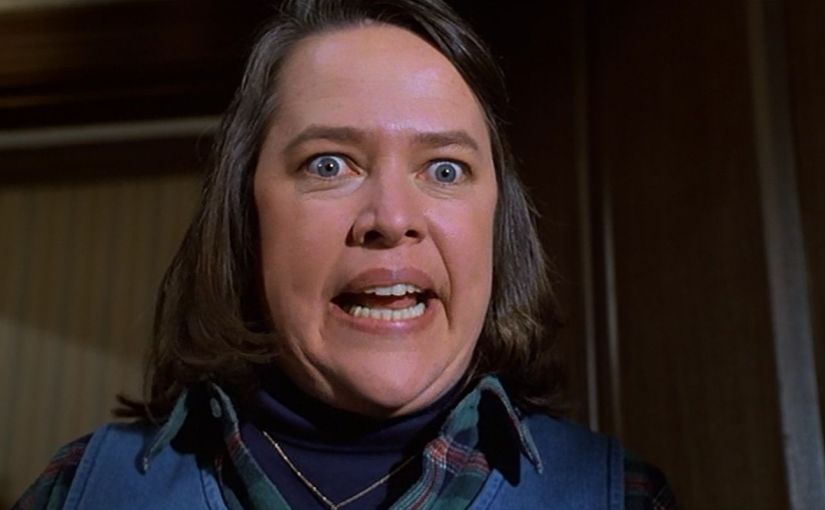
Kathy Bates was deservedly awarded the Oscar and a slew of accolades for her role as Annie Wilkes.  This role put Bates on the map.  Her portrayal is timed so authentically with changes in tempo from childlike enthusiasm to demented rage that she only makes Stephen King seem like that much better of an author than he already was at the time.  Actually, I’d argue that before Misery hit theaters, the Stephen King factory of film adaptations was churning out subpar products like Cujo, Firestarter, Christine, and his own film that he directed Maximum OverdriveMisery elevated the author’s brand back to when it was celebrated with Brian DePalma’s Carrie and Stanley Kubrick’s unforgettable interpretation of The Shining.

I believe what helps is that of all the varieties of horror the author was delivering, Misery did not hinge on the supernatural.  Annie Wilkes is a very real embodiment of capable terror and disturbing psychological handicap.  Kathy Bates effectively demonstrates byproducts of schizophrenia and obsessive, compulsive disorders.  Living alone in the woods with the subconsciousness of an author speaking to her through the pages of his fictional hardcover novels only feeds the beast that she’s become. 

I’m not a big fan of Stephen King’s works.  Often, I find his material of gore stretches too hard for shock value, and hardly ever achieving insightful originality.  To the best of my recollection, I’ve only read Misery, The Stand and It.  That’s enough for me.  I read that as he was writing Misery, he was emoting his alcoholic demons that left him obsessively challenged.  Annie Wilkes developed into that tangible, physical fiend.  This story takes a far step away from the macabre world that built his literary empire.

Rob Reiner does not go for any kind of novel inventions with his film.  He’s simply telling a story with the tools provided by celebrated screenwriter William Goldman (The Princess Bride, Butch Cassidy & The Sundance Kid, All The President’s Men) and his wise adjustments from King’s piece.  Goldman and Reiner wisely cut out a lot of King’s gory schlock.  (That foot scene, for example.  Either way?  YEESH!!!) Smart move, because Annie Wilkes is such force of power personified by the hulking physicality (by choice of Reiner’s lens) and range of Annie Wilkes.  Even though Kathy Bates is short, she is a hulking menace here. Kathy Bates is doing stage work in front of a camera.  I’d argue her performance inspired the idea of eventually converting Misery into a Broadway play that featured Laurie Metcalf and Bruce Willis in the roles.  I wish I could have seen that. 

Goldman wisely allows the picture to move on with another perspective in the form of two characters that were not part of King’s story.  A perfect casting of Richard Farnsworth and Frances Sternhagen as the local sheriff and wife advance the curiosity of Paul’s absence from the world.  They speak for the surrounding areas that don’t reveal what is beneath the blankets of snow where few clues remain, and not even a missing 1965 Ford Mustang can show itself.  They’re funny, quirky, and unusual, almost like a combination of Jessica Fletcher or Miss Marple seeking to resolve the mystery.

Props like a gun and a knife along with visuals like uncontrollable fires and fight scenes are nothing new.  However, it’s when these scenarios are paired with Kathy Bates to victimize a small, weakened James Caan that these items become well filmed properties of Rob Reiner.  So again, I focus on the inanimate objects of Misery because Reiner lends a lot of footage to all of these working pieces.  This revolver suddenly has dialogue of its own through one of Annie’s personalities.  The knife works like a guard dog for Paul.  The aluminum can of lighter fluid sadistically squirts itself to tickle or tease an extreme point for Annie.

The cigarette and champagne flute emote those small, cheating, harmless vice escapes from commitment that awards Paul. 

The sledgehammer puts its foot down.

The match plays both sides of the duality during different points of the film.

Misery is that film that works with a small cast, but with a wide population of environment, in a snug, confined space.  I describe the picture this way because like Annie Wilkes, this exploration in psychological terror operates without fair balance.  When an animal cannot control and subdue its instincts, there’s no telling what to expect, and an unpredictable Annie Wilkes might be one of the scariest personifications any one of us could ever encounter.

WHEN HARRY MET SALLY…

By Marc S. Sanders

Two years after my family and I moved from New Jersey to Florida, I was age 16 and still felt lonely. Very lonely.  I was not prepared for the culture shock of leaving a primarily Jewish community and transitioning into a mixed bag of different cultures and mentalities.  I couldn’t adjust and the only people I could understand in 1989 were Batman, Indiana Jones and Harry & Sally.

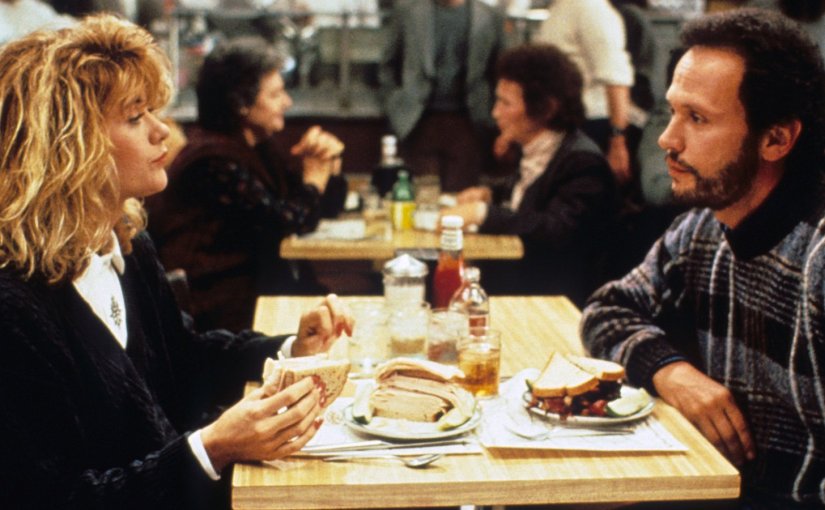
The script written for When Harry Met Sally… focuses on the title characters adjusting to life in the decade following college graduation, where their paths cross periodically and they debate the aftermath of Casablanca, as well as what it means to sleep with someone or not.  More importantly, they are often returning their attention to whether a man and a woman can be friends without any temptation for love or intimacy, no matter how attractive they find each other to be.  Boy oh boy, that’s a loaded observation, isn’t it?  It is so consuming that as close as Harry (Billy Crystal) and Sally (Meg Ryan) become with one another as best friends, no matter how many people they date, they still couldn’t be any lonelier.  At the time, I could understand their dilemma.  I had a terrible crush on a girl at school. We were close friends who could laugh with each other.  Yet, I never took it to the next step.  I should have asked her to the homecoming dance in our sophomore year.  I really should have.  The risk, though, is the change in the comfortable dynamic we had.  I didn’t want to lose that.  Harry and Sally are attractive to one another.  Rob Reiner includes great close ups of the two actors looking at each other, wondering who is going to make the first move.  Will they bring this relationship to a new level?  It may never happen.  It didn’t for the girl I thought I could fall in love with.  At least Harry and Sally had each other’s shoulders to cry on. I adore this film, directed by Rob Reiner, because I yearned for what they had in friendship first, and as a relationship second.

Sally and Harry couldn’t be any different.  He is of the mindset that any woman he encounters is destined to be slept with, or more simply put, men and women could never be friends because at the bare minimum, men are thinking about sleeping with every woman they come across.  Sally can’t understand that, but when Harry shares his philosophy with her the first time they meet, while on an 18-hour drive from the University of Chicago to New York City, she can’t help but suspect that it just might be possible.

The two depart from one another to start their new lives in the big city, and come across each other five years after that on a flight they inadvertantly share, and then another five years later when they are given an opportunity to catch up on their relationship status.  In present day, 1988, Sally has just broken up with her longtime boyfriend.  Harry has gotten a divorce.  Ephron has written these characters to ultimately need one another.

When Harry Met Sally… is certainly a comedy, but more than likely it’s because Billy Crystal’s quick wit and delivery comes off familiar from his other career accomplishments.  Meg Ryan works beautifully as a scene partner that debates Harry’s cynical view of people with Sally’s natural positivity.  Their mentalities go in opposite directions, but the film continues to imply that these two couldn’t be more perfect for one another.  Chalk that up to Meg Ryan and Billy Crystal’s chemistry.  They are one of the all-time great on-screen couples.  These two actors are my friends.  I want it to work out for them.  When I saw the film three times in the theatres, I wanted to experience what they experienced.  Their story has bumps in the road.  They get mad and upset with each other.  They debate with one another, but they amuse one another too, and what a romantic adventure they share together.

A terrific novelty of Reiner’s film is when he cuts away to elderly couples with rich histories of how they met and stay together for decades after.  We weren’t there to see these wonderful people kindle their relationships, but we’ll see how Harry and Sally come together.  I remember long ago, that my father told me that when you get married, make sure you are marrying your best friend.  He said love is important, but you have to like each other first.  I did marry my best friend and I like her.  I love her too.  We drive each other crazy.  We have very different interests.  We even live in our home differently, that we share with our daughter and dog, but we want to be with each other and no one else.  No one else factors.  When you watch When Harry Met Sally… you see why two people continue to be with each other, first as friends, and maybe as lovers later.  When you have a best friend in your life there’s no one else you want to laugh with or cry with more often than that person.  There’s no other hand you want to hold.

A brilliant midway scene in the film occurs when Harry and Sally have the misguided idea of setting up their other best friends with each other.  Harry’s buddy Jess (Bruno Kirby) may be a good fit for Sally.  They are both writers, after all.  Sally’s girlfriend Marie (Carrie Fisher) has a keen interest in conquering married men, not far off from how Harry routinely proceeds with one relationship after another by sleeping with the women he dates.  He’s not in love with them, but of course he’ll sleep with them.  The irony comes when both Harry and Sally could never fathom that Jess and Marie find each other attractive, not the ones they were originally intended for.

There’s much heightened romanticism to When Harry Met Sally… I won’t claim it to be very realistic with how life works out for many of us.  Look at the famous deli scene where Meg Ryan demonstrates for Crystal’s character that a woman can convincingly fake an orgasm.  It’s a hilarious scene.  One for the ages.  However, a scene like that wouldn’t happen.  If a scene like that did occur in real life, the woman would be asked to leave the premises immediately.  It’s not the point though. 

Love and happiness should consist of elevating ourselves to a delightful fantasy of joy, affection and laughter.  Love should also guide us to carry our best friends through sadness and frustration.  We can’t survive this challenge, we call life, alone.  I realized that first hand when my innocent, naïve and unsure teenage self watched the movie for the first time all those years ago at the Mission Bell movie theatre in Tampa. 

People need someone to grow with.  We need someone to continue to teach us while we teach them in return.  Most importantly, as it becomes a running theme in When Harry Met Sally…, we need someone to kiss at midnight every New Year’s Eve. 

THE WOLF OF WALL STREET

By Marc S. Sanders

When a person carries on with his/her life knowing full well that practically every action is illegal, immoral and harmful, it’s a story that must be told. Jordan Belfort, The Wolf Of Wall Street is such a person.

Leonardo DiCaprio explodes with rages of drug use, drinking, more drug use, banging prostitutes, even more drug use and pink slip stock trading along with some drug use. To get this manic, this wild, and this crazy requires a certain kind of energy to perform. The real Jordan Belfort must have had a massive amount of stamina to live this life. After all, he’s still alive today. DiCaprio, portraying the on-screen persona, throws himself into it. There’s no way he got to this pinnacle of hyperactivity on cue, with director Martin Scorsese’s call for action. DiCaprio had to thrust himself into this debauchery. It takes a certain skill to not let up on this. Pay attention to a hilarious scene where his quaaludes have paralyzed him to the point where he can’t even crawl to, much less open the door to his car. It’s a hilarious display of crippling physicality. DiCaprio maxed out on his Belfort portrayal, thereby earning his Oscar nomination. I thought he should have won that year. He lost to his cameo co-star, an excellent Matthew McConaughey for Dallas Buyers Club.

DiCaprio is so good that he yanks the entire cast into comparable craziness as well. Jonah Hill plays Jordan’s sidekick Donny: a buffoon of a guy who’ll whip out his member at inopportune times for attention and display. Hill doesn’t hold back either in his earned second nomination as well.

Scorsese, with a script by Terrance Winter based on Belfort’s book, is not concerned with necessarily showing a story arc where characters question their actions. Instead, he focuses on the hubris of all of this. Crashed helicopters, crashed cars, crashed planes and crashed luxury yachts not to mention endless office orgies, including one in first class on a commercial flight to Switzerland. It’s filmed very well, and while it is one over the top thing after another, it is nonetheless very funny and very entertaining.

The nerve of this guy, right? Yet that’s the thing about The Wolf Of Wall Street. Right from the get-go, Belfort is strongly urged to let up as the FBI easily closes in, and he doesn’t. It’s kinda crazy, really. Belfort put himself in an unwinnable situation and his addiction to money, drugs, ridiculous sex, and the ease by which he does it all calls to him to stay in the game until the lights just turn off.

This film marked the highly visible introduction of Margot Robbie as Jordan’s wife. She’s excellent with a New York accent (Robbie’s Australian) who loves the money and glamour but is not so stupid. Following up with a nominated role in I, Tonya (which she should have won against an aggravating Frances McDormand in Three Billboards…) and offering the best moments of Suicide Squad, it is easy to believe that she could go toe to toe with DiCaprio here. They have great arguments on screen together; funny but true.

Scorsese offers up his signature narrative voiceover from DiCaprio just as he did before in Goodfellas and Casino. His editor Thelma Schoonmaker is great at keeping the energy alive by taking advantage of the legendary director’s quick cuts and great music samplings.

The cast is just right with memorable moments from Jon Bernthal as Jordan’s tough guy friend and errand boy, Brad. (Bernthal is a great character actor all together. Check him out in Baby Driver, too.). Kyle Chandler is the modest element as the FBI agent who brings it all down. He knows he doesn’t have to exert himself too much. Belfort is doing all the work for him. Still, he spells it out harshly and honestly. No bullshit. He just cuts to the chase.

Other great appearances include Rob Reiner, Jon Favreau, Jean Dujardin, Joanna Lumley and I have to recognize Stephanie Kurtzuba. She offers a scene not widely recognized, as a disciple of Belfort’s team who is full of pomp, and confidence that far exceeds any of the guys alongside her. It occurs midway through and it’s an important moment because it really shows the power of influence Belfort had with his stockbrokers. He made them criminal millionaires overnight and to them he’s a Messiah. When Kurtzuba’s moment occurs, she solidifies the power of Belfort’s misdeeds.

It’s very easy to succumb to this lifestyle. Scorsese and Winter show how easily and quickly lots of unclaimed cash can be made at the expense of innocent people. It’s really fascinating. There’s no dimension to Belfort and his cronies of losers who would follow him anywhere despite the cost and the damage. That’s okay for me here. Simply because it fascinates me that he had the chutzpah to continue on with this immoral trajectory.

The Wolf Of Wall Street is a no holds barred, great film.

A FEW GOOD MEN

By Marc S. Sanders

A Few Good Men really does hold up.

Anyone with even minimal movie going experience can predict how it is going to end almost as soon as it starts, but that doesn’t take away from Aaron Sorkin’s first screenplay based on his original stage play.

It is well cast. For the film, no one else could ever play the intimidating and terrifying Colonel Nathan R Jessup other than Jack Nicholson. It’s not that it is just him in the role. It’s really Nicholson’s whole career legacy against the arguably still ripening careers of Demi Moore, Kiefer Sutherland, Kevin Bacon, Kevin Pollack and Tom Cruise. Nicholson’s timed grandstanding is necessary for the role to work.

Cruise on the other hand left me feeling a little too overplayed. The role calls for cockiness, yes, but is Cruise too cocky? Some of the gags he does work. Some don’t, like impersonating Nicholson momentarily (leave that for the guys on SNL, Tom), or when he’s poking fun at Moore’s character to his own delight. It’s a little too much. Still, his courtroom scenes are like watching the best in live theatre. Those scenes play like great sport, notably thanks to Tom Cruise.

Major props go to JT Walsh as a conflicted witness. When I say conflicted, I mean he authenticates a seriously valid and personal dilemma beautifully. Had it not been for Jack Nicholson, Walsh might have had an Oscar nomination. A shame he didn’t come close to such recognition while he was alive. He was such a great character actor.

Recognition also goes out to Kevin Bacon as a well versed prosecutor/Marine. His timing exudes the experience his character has, despite his youthful appearance.

Demi Moore might be caught trying too hard, I think. Kevin Pollack is the wise mentor sitting quietly waiting for his great moments. Kiefer Sutherland is great in almost anything he does. He doesn’t ever steal the spotlight like Cruise, Nicholson or Moore but he makes a great presence; conniving and bold.

The direction is nothing special really. Rob Reiner does fine but honestly Sorkin’s script sells itself.

Yeah, yeah. “You can’t handle the truth.” Great line, but I got news for you. I’d argue there’s even better lines in this 1992 film. It’s worth revisiting.

STAND BY ME

By Marc S. Sanders

I’m not embarrassed to say it.  I’ve experienced a mid-life crisis.  Last night, I watched Rob Reiner’s Stand By Me, and I absolutely broke down in tears when it finished.  As I approach age 50 later this year, the most recent viewing of this film alerted me that my childhood memories are further away than I ever realized before. 

Reiner lifts this coming-of-age story from Stephen King’s novella entitled The Body. Four boys spend the long and hot dog days of summer in Castle Rock, Oregon (it was Maine in King’s story) in their tree house smoking cigarettes and discussing important topics like Annette Funnicello’s breast size on The Mickey Mouse Club and the recent disappearance of a twelve-year-old kid.  Yackety Yak and Lollipop play on their transistor radio in the background.  The wimpiest one of the pack, Vern (Jerry O’Connell), overhears the location of the kid’s body is off the side of the railroad tracks, about twenty miles away.  Teddy (Corey Feldman), along with best friends Chris (River Phoenix) and Gordon (Wil Wheaton) decide to embark on the search for the body and get their picture in the paper, labeled as heroes.  It’ll take them the Labor Day weekend to carry out their quest.

During their long journey across the railroad tracks into the woods, the four boys will discover what concerns them, like figuring out if Goofy is a dog and who could win in a fight; Superman or Mighty Mouse.  As well, they’ll uncover what gives them anxiety ahead of their entry into adulthood.  Gordon lives with being unloved by his parents both before and following the accidental death of his older brother (John Cusack).  Chris lives with being unfairly labeled as a young hoodlum.  Teddy endures the aftermath of an abusive military father currently living in the looney bin.  Vern suffers from a hesitancy to live for adventure and risk due to ongoing fear. These boys had a future that awaited, but for some it seemed like there was no escaping the destiny the locals of their small town had already mapped out for them. 

In the last few years, I reconnected with a childhood friend by means of social media.  Visiting New York City annually over a three-year period, I got to see Scott in person and recollect on our times together.  It had been over thirty years since we had seen or spoken with one another.  We reminisced about tormenting the substitute teachers, and our first crushes.  We reflected on favorite movie scenes that we acted out in between classes.  We are different now, though.  Nowhere near the same as we were at age 12.  We have families and careers and responsibilities.  Yet, our memories of trading comic books, talking dirty, going to movies, and acting out cops and robbers shoot outs in the backyard all remain. 

When Stand By Me opens, a present day adult (Richard Dreyfuss) is shown reflecting in the distance following reading an article about a lawyer who was killed in a restaurant.  This narrator then flashes us back to the year 1959 when this adventure between him and his three friends occurred.  One of those friends was the lawyer who was killed.  A piece of his history has ceased to live and continue on.  That terrifies me personally.  Friends, and family, and people I’ve encountered over my half century will leave my presence, never to be seen or spoken to again.  I’ll never get the opportunity to reflect with them again, much less make new memories.  I’m now living in an age where Facebook comments seem to weekly consist of saying “very sorry for your loss.”  Friends are losing their parents.  Some are passing away themselves.

Stand By Me might not be altogether realistic.  The boys are getting overpowered by a sinister Kiefer Sutherland, who’s not afraid to use a switch blade and cut one of the kids’ throats.  King’s story also feels like an elevated Hardy Boys or Tom Sawyer kind of adventure.  I don’t know of anyone who went looking for a mutilated corpse during my summer days living in Wyckoff, New Jersey.  The adventure conceived by Stephen King serves as a thrill that you imagine as you read it off of the page.  My upbringing consisted of play dates and sleepovers with Scott, Star Wars toys and Saturday morning cartoons.  Yet, the connections that thread the main story together are what’s to treasure in Rob Reiner’s film.  The friends we make in grade school before becoming interested in high school, alcohol, sex, and career planning, are the most important people we know and first encounter in our lifetimes.  It’s impossible to forget them or the impact they had on our lives.  Scott certainly had an impact on my life.  I credit my sense of humor to him, and his carefree attitude to the ugliness of this world.  Sometimes that’s all we have to survive.

King and Reiner use the body that is being sought as a device to drive the characters.  What’s going to bring these boys together with no outside influence?  How can young Gordon deliver his revered sense of imagination as the writer he’s to become?  The best way is to put the boys around a camp fire.  Gordon can then entertain his pals with the story of an incredibly fat kid who got his revenge on the locals during a pie eating contest that results in a massive “Barforama.”  It’s silly and sophomoric and childish fun, but for 12-year-olds, it’s the best thing imaginable.  Teddy dreams of being an army hero storming the beaches of Normandy like his father was rumored to have done.  His sleeping bag is his machine gun mowing down an oncoming train.  Vern’s favorite food?  Watch the movie to find out.  Chris might be regarded as the outlaw, but he’s also the most mature, and perhaps the mentor to Gordon who suffers from the loss of the brother he loved, as much as he suffers from the neglect of his mother and father.  At age 12, in 1959, Chris was all that Gordon had.  I may have had more than Gordon at that age, but whenever I was with Scott, he’s all that I had.

Ultimately, Stand By Me is not an adventure or a silly comedy about boys being boys.  It’s a character study of kids just outside of their formative years.  It’s a film that captures a single moment before friendships inevitably expire.  It’s a reminder to embrace those you’ve treasured over your lifetime, because we cannot be twelve years old forever.