
by Miguel E. Rodriguez
DIRECTOR: René Clair
CAST: Henri Marchand, Raymond Cordy, Paul Ollivier, Germaine Aussey
MY RATING: 7/10
ROTTEN TOMATOMETER: 100% Fresh
PLOT: A convict escapes prison and becomes a wealthy industrialist, but his life of leisure is threatened when his former cellmate turns up unexpectedly.
À nous la liberté (rough translation: “freedom for all”) is a charming, if slight, romantic farce from celebrated French director René Clair, who would later make his mark in Hollywood films with I Married a Witch (1942) and And Then There Were None (1945) before returning to French cinema for the rest of his career. It won’t go down as my favorite French film, or classic film, or anything like that, but as a snippet of cinema’s early years, along with some mildly scandalous history of its own, it’s worth a look for cineastes.
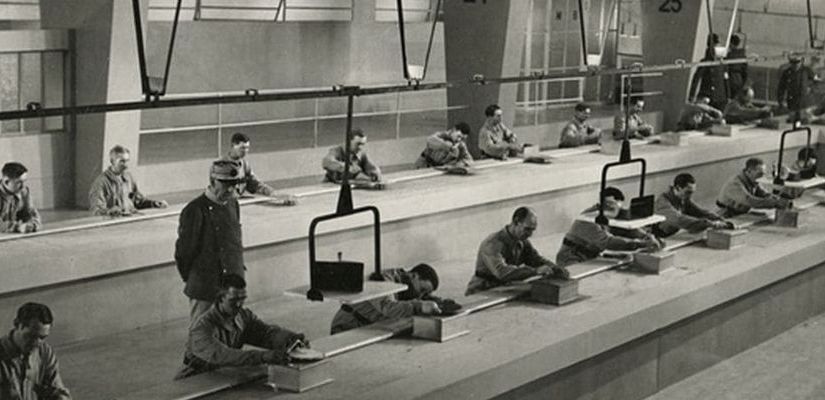
Louis and Émile are cellmates in a French prison. Their daily routines are marked by hours and hours of assembling children’s toys on an assembly line that looks and feels a lot like the one from Chaplin’s Modern Times (1936) or even that one at a chocolate factory in a famous episode of I Love Lucy – but we’ll come back to that. They sing, too, while toiling. There’s a LOT of singing in À nous la liberté, not all of it clearly motivated, but serving as a kind of punctuation mark or accent piece to various scenes.
Émile and Louis attempt to escape their prison, but through no one’s fault, only Louis gets away, while Émile remains behind. After some amusing episodes involving Louis trying to blend unobtrusively back into society, he lands a job hawking phonographs to pedestrians for a department store. He gets so good at it that eventually he’s running the store…and eventually, improbably, he becomes the owner of the factory that BUILDS the phonographs, making him rich beyond his wildest dreams.
Trouble arrives in paradise when Louis’ cellmate, Émile, unexpectedly shows up, recently released from prison. But he’s not looking for a job or to “touch” an old wealthy friend. He’s in love with a girl who works at Louis’ factory, and getting a job there is the easiest way to stay close to her. (I don’t THINK her name is ever said aloud, but she’s listed on IMDb as “Maud”, so that’s what I’ll call her.) If Émile’s behavior sounds mildly stalker-y, well, it is, but what are you gonna do, love is love, and I’m sure I could dig up a modern rom-com or two that feature stalking as a romantic element. Somehow.
Plus, there’s this whole ironic subtext that shows how the assembly lines at Louis’ phonograph factories are no different from the assembly lines at the prison. The movie is not subtle about their similarities, but how could it be? This fluffy material is corny as all hell, but the movie never gets too schmaltzy. And if you think you know how the romantic subplot plays out in a romantic comedy from the 1930s, check your assumptions.
The centerpiece of the film is an assembly line sequence at the phonograph factory, a scene that has been imitated many times. More modern movies and TV shows may have improved it, but having seen this movie, it’s clear where their inspiration came from. In fact, the most interesting backstory of À nous la liberté is the fact that, after Charlie Chaplin released Modern Times in 1936, the producers of the French film sued Chaplin for plagiarism. Both films feature bumbling but charming protagonists who wind up working on, and screwing up, assembly lines, and both films were making a point about the increased mechanization and dehumanization of the labor force. After dragging on for ten years, Chaplin ultimately settled (without admitting guilt), but remained friends with René Clair for years afterward.
Having seen both films now, my opinion is that the similarities between the two films are purely incidental. You might as well say that Star Wars plagiarized Star Trek because they both have “Star” in the title. Modern Times is funnier and faster-paced, while the most farcical scenes in À nous la liberté are played, not for laughs, but smiles, if that makes sense. It does to me, so I’m sticking with it.
It’s also interesting to observe how Clair used sound in this film from sound’s early years. As I said before, there’s a lot of singing, but scenes with dialogue are few and far between. Ambient sound is almost non-existent. Where you might expect to hear lots of noises – scenes on the assembly line, for example – we only hear background score. It’s almost startling when one scene plays street noises during an outdoor shot. It’s almost as if Clair – like Chaplin – was reluctant to completely abandon silent storytelling in favor of this new sonic “trend.” As a result, while it’s not a laugh riot, the film does have a quaint likability that is hard for me to describe.
À nous la liberté is an interesting peek backwards in time to when many of the film tropes we take for granted today were shiny and new. It didn’t get me all “riled up” at an emotional level, but it wasn’t a waste of time. And, like I said, there are one or two surprises story-wise. That’s never a bad thing.
 2 UNPAID MOVIE CRITICS!!!!