
By Marc S. Sanders
Steven Spielberg’s first critical and box office flop, 1941, is a splattered mess of slapstick hysteria set a week after the Japanese attack on Pearl Harbor. Residents of the California coast line prepare to be the next target. Ahem!!!!! Well, that’s it for the story…Goodnight. Tip your waiters.
Just a year ahead of the Zucker brothers with Abrams comedy team that’ll deliver Airplane!, Spielberg opted to direct a spoof script penned by Robert Zemeckis and Bob Gale (Back To The Future). 1941 is full of gags galore beginning with a reference to the director’s most successful film to date, Jaws. For me, seeing actress Susan Backline on screen again for another ocean skinny dip only to be intruded upon by a rising Japanese submarine was the second best joke of the film. Once that was over, I had two hours left to go. A long two hours.
I’ve noted before that satire or spoofs are the riskiest genres to produce. They can succeed with a picture like Dr. Strangelove…, or Network or Airplane! Satire can be divisive too though, and thus only one half of your audience will appreciate the poke and prod. Even worse, satire can just be unfunny across the board no matter which side of the aisle you lean on. That’s 1941. It plays too much like a Three Stooges series of slapstick violence. Reader, even Steven Spielberg cannot capture the magic of the Three Stooges.
Zemeckis and Gale opt to poke a little fun at the Puerto Rican zoot suit riots vs the Enlisted men ahead of America’s entry into World War II. So, when army soldier Treat Williams gets jealous of one handsome zoot suit dancer flirting with his girl, a fight breaks out which eventually populates two thirds of the film as it escalates all the way over to Hollywood Boulevard. Now thousands of stooge wannabe extras are walloping each other from one side of the street to the next.
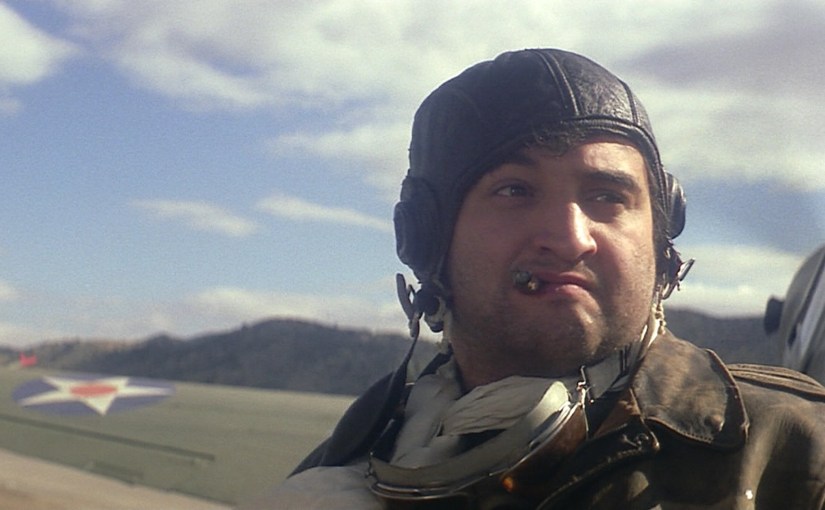
To allow a breather from this, the writers sidetrack over to Tim Matheson and Nancy Allen getting frisky in an out of control bi-plane while being mistaken for the enemy by John Belushi doing a very poor resurrection of his Bluto character from Animal House. As Captain Wild Bill Kelso, Belushi’s pursuit fires upon everything else in sight, especially Hollywood Boulevard, but misses the plane occupied by Matheson and Allen.
The third point of this rectangle concerns Dan Aykroyd with John Candy and a whole platoon opting to set up a military cannon along the ocean view property belonging to Ned Beatty and Lorraine Gary in anticipation of the Japanese invasion. Ned Beatty is the best stooge of the entire cast as the nerdy resident determined to protect his home while exercising his patriotic duty. Gary’s response to Beatty’s ineptitude cracked me up as well. The house wreckage of The Money Pit has nothing on what occurs in 1941.
The fourth storyline focuses on the enemy with a German speaking Nazi portrayed by Christopher Lee debating with the captain of a Japanese submarine (Toshiro Mifune) plotting to bomb Hollywood. Somehow, each foil understands the other’s language. These guys are just here to scream at one another. There’s nothing funny about them.
Oh yeah. Robert Stack is the Army General who watches Dumbo in the movie theatre while Hollywood Boulevard gets demolished outside. Ho! Ho!
Often, I compliment Spielberg for his reliance on the sets he provides. Everything you see on the screen serves a purpose to his films. It happened as recently as with his remake of West Side Story in 2021, and it’s effectively used in Close Encounters… He uses the same approach with 1941. In this film though, there’s no pulse or significance to the props and pieces that are used. The house is demolished. So is the storage shed. So is the movie theatre. So is the Ferris wheel. Yes. What you’ve already seen in endless Looney Toons cartoons occurs here with a miniature model. The Ferris wheel comes off its hinge and rolls across the beach side dock into the water along with Murray Hamilton and Eddie Deezen in tow. When it happens, you’ll tell yourself I was waiting for that to happen. What you expect to happen, happens, but you’re not laughing at it.
None of what you see in 1941 are terrible gags. If you watch one scene out of context on a four minute You Tube channel, you may chuckle. The problem is that every scene is treated like throwing spaghetti at a wall and seeing what will stick. Mashing all of this together is not appetizing. I like ice cream and I like steak. I don’t like my ice cream on my steak. Any idea of development is completely ignored. The film can’t even work like a collection of skits. Even Airplane! had a romantic storyline trajectory to perform with. Here, two jealous guys have a fist fight and it more or less stretches that fight for an entire two hours. The Three Stooges knew when to eventually quit. Spielberg, Zemeckis and Gale didn’t.
As soon as I saw Belushi on screen, I laughed. It’s Bluto again. Yet, the appearance wears off very quickly. He has little dialogue and is limited to chomping on a cigar while grunting and groaning as the fighter plane he occupies wobbles around shooting at everything in sight. When he eventually crash lands, Belushi continues to chomp on the cigar and grunt and groan. Only now, he pratfalls as well…badly.
Ned Beatty is the real star here. The ultimate nerd is also limited in dialogue. Still, to watch his body language with his glasses and bow tie and pear-shaped physique, accompanied with Lorraine Gary’s helpless gasping wife responding to the damage he commits with the cannon is hilarious. Absolutely hilarious. Tape all of their scenes together and make it a short to present ahead of the main attraction in a movie house. The audience will have a great time.
Otherwise, the only other fun I got out of 1941 was spotting the stars that were relevant at the time of its release. Candy, Aykroyd, Frank McRae, Slim Pickens, Christopher Lee, Robert Stack, the cute blonde daughter from Eight Is Enough. Even Penny Marshall has a quick blink and you miss it moment. Oh, and look, there’s Lenny and Squiggy!
I think Zemeckis and Gale were on to a real smart idea here. They maybe should have consulted with Harold Ramis and his National Lampoon’s crew however, because that’s the direction Spielberg’s film was aiming for. What sets a film like Animal House apart from a 1941 though is in the set up. Dialogue also helps. 1941 lacks set up. 1941 lacks dialogue. It’s all visual and noise and more noise and more noise.
1941 begins at letter A, and stops at letter A, never making it to B, and definitely never reaching Z. An idea with potential was put down on paper. The problem is these guys stopped writing after the first sentence.

 2 UNPAID MOVIE CRITICS!!!!