FLAGS OF OUR FATHERS

By Marc S. Sanders

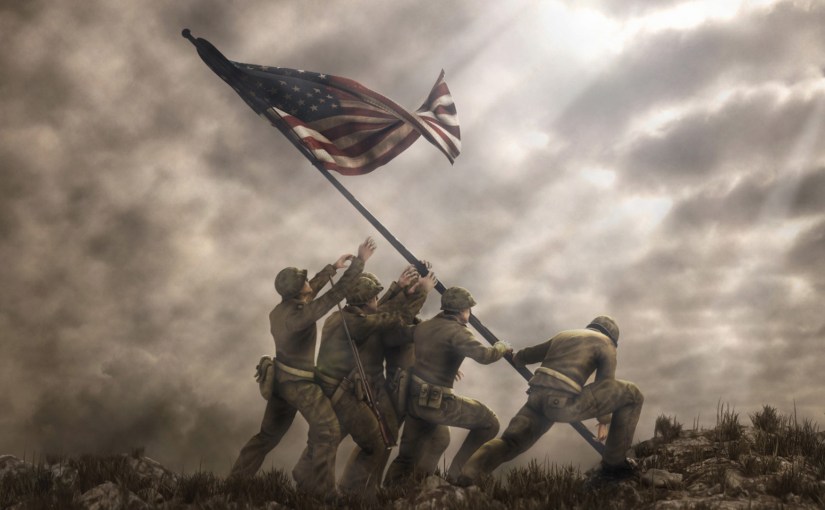
Arguably the most famous photograph in American history is that of the six soldiers raising the flag on the island of Iwo Jima while battling Japanese forces during World War II.  I remain fascinated by the image.  

I recall visiting the landmark statue in Washington DC when I was traveling by myself.  I took countless pictures of the piece.  I got close ups, wide lens shots, pictures of the flag and pictures of each sculpted soldier.  It’s heroic in any aspect.  It looks like something out of a Superman comic book.  As it turns out, the famed image was just a happy accident during a violently terrible time in twentieth century history.  Photographer Joe Rosenthal didn’t even realize what his camera captured until his film was later developed.  Turned out this was the second attempt at raising the flag.  Furthermore, this occurred on the fifth day of the conflict – with thirty-five days still to go before the Americans could claim victory over the bloody crisis.

So, while Rosenthal’s image seems to declare American patriotism at its finest, the real story is not as romantic.  In fact, one of the narrators of Clint Eastwood’s film, Flags Of Our Fathers, suggests that there are no heroes to celebrate.  Whoever the men in that picture were, they were not so much fighting for their country as they were trying to stay alive and look after the comrades ahead and behind them.

Flags Of Our Fathers has a very reminiscent feel to producer Steven Spielberg’s Saving Private Ryan with unforgiving battle scenes of blood, death, bombings and young soldiers storming a beach while screaming for their buddies.  Spielberg might have impressed me first, but Clint Eastwood masterfully shoots wide landscapes and up-close turmoil with his reliable strategies of shooting in shadows and silohouettes.  Eastwood’s film, scripted by Paul Haggis and William Broyles Jr veers into a unique direction though as Rosenthal’s picture takes on a life of its own back in the states.  It makes the front page of every paper.  Harry Truman stands proud of it along with all the decorated military leaders.

Now that America has entered the war, it is appropriate to ignite a propaganda campaign.  This picture of the Stars and Stripes getting elevated into the sobering, smoky war-torn skies will motivate citizens to buy war bonds to further fund the war effort.  The spokesmen will be the ones believed to be the remaining surviving three of the six in that image.  Ryan Phillipe is Navy enlisted John “Doc” Bradley.  Jesse Bradford is Rene Gagon, and Adam Beach plays Native American Ira Hayes, both of the Marine Corps.

I believe Flags Of Our Fathers embraces what every enlisted person did to serve the efforts of America during the war, and the picture mourns the countless sacrifices and losses that occurred.  However, it frowns upon the domestic response to what really went on overseas.  Those that returned carried terrible and unforgettable trauma based on their experiences.  Yet, the three thought to be part of the flag raising were pushed to celebrate their achievements summed up in a split-second image.  Bradley, Gagon and Hayes were skeptical if they were the ones in that picture.  Government Bureaucrats could care less.   There were others on that hill who cannot speak for themselves, but officials in suits and ties will insist otherwise to uphold a countrywide tour complete with recreations of the hill they ran up on that fateful day.  Even desserts are crafted like the famed image.

Ira Hayes is the one who is especially conflicted with his new responsibilities to the governing body that historically acquired his ancestors’ territory.  Adam Beach portrays a torn individual who is limited in celebration by the United States and certainly patronized.  Who he stems from does not matter.  He represents a false interpretation of the English acceptance of his Native heritage.  His obligation to this machine of propaganda only doubles the exaggeration that his other two peers are coerced to parade with marching bands and fireworks.  All that the ongoing extravagance does is keep him absorbed in the Japanese lives he brutally slaughtered and the bloodshed that surrounded him.  It’s a heartbreaking performance told with an absence of true appreciation for what Hayes gave up on that battlefield.

I learned much from Flags Of Our Fathers, but I had issues with comprehending everything.  While the immense war footage is chaotic with sharp editing and camerawork, it’s challenging to match names with faces in the picture.  There are two elderly men who are recounting what occurred and what happened to these men and their families long after the incident was over.  It was hard for me to line up which older man was who, on top of who they are talking about at times.  Paul Walker is one famous face in the crowd.  So is Barry Pepper but I could not identify the names of their characters until the film was arriving at its conclusion.  It was not until the epilogue of the movie arrives that it became a little clearer.  I also had to later reference what is listed on IMDB.  

The entire design of Eastwood’s movie is authentic from the battles staged for the Iwo Jima conflict to what mid-1940s domestic life looked like back home.  Truly absorbing while both storylines seem so different.  Clint Eastwood also wrote the soundtrack composition, and it is truly sobering.  His son Kyle performs with the orchestra.  

Flags Of Our Fathers partnered with Clint Eastwood’s follow up later in the year, Letters From Iwo Jima, which offered the Japanese perspective of the incident.  Bridge the films together and you get an incredible cinematic experience.  So many war pictures are one sided.  In all fairness, most movies do not have the time, luxury or finances to expand their palettes from one side to the other.  Because these two films are companion pieces, the viewer gets a fair account of how this battle, located on a tiny island, treated the men on the ground while their governing bodies celebrated their stands for patriotism, victory and monetary funding.

Eastwood demonstrates that the war destroyed practically everyone who was engaged in it regardless of the countries these soldiers served.  Many were slaughtered, but the innocence of those that physically survived died with everyone else during this period of time.  Clint Eastwood directed two films that explain this never-ending atrocity.  These men eventually laid down their weapons, but they never left the war.

MILLION DOLLAR BABY

By Marc S. Sanders

Clint Eastwood has one of the most remarkable careers in Hollywood history.  As his appearance has aged, so have the roles he’s occupied. He’s got these long lines that run down his cheekbones and across his forehead that compliment his signature scowl and white hair.  These facial features lend to a background in many of the characters he’s portrayed over the last thirty years ranging from a “Frank” in In The Line Of Fire to a “Frank” in Million Dollar Baby, his second film to be a recipient Oscars for Best Picture, Best Director, and Best Supporting Actor.  A Best Actress Oscar was also garnered for Hilary Swank. 

Swank won her second Oscar as Maggie Fitzgerald, a backwoods product of a hillbilly upbringing, who only lives for one dream and that is to be a championship boxer.  When she’s not waitressing to collect coins and singles for tips, she is spending every waking moment at Frank’s boxing gym, The Hit Pit.  Maggie keeps to herself by punching a bag, but she is persistent at convincing a closed off Frank to become her trainer.  Frank has no interest in training a girl, but maybe there’s more to why he’s reluctant to take her on.  The lines on Eastwood’s face seem to metaphorically hint at a challenging past.

Frank’s best friend is Eddie, or otherwise known as “Scrap Iron,” played by Morgan Freeman in a very long overdue Oscar winning role.  Some may argue that Freeman was bestowed with an award for such an illustrious career.  That’s fine.  I still believe that this performance is just as worthy as his other celebrated works (Driving Miss Daisy, The Shawshank Redemption).  Eddie lives in a small room in the gym and manages the place by day.  Frank is a crank towards Eddie, but they’re the best of pals. Frank carries the responsibility for Eddie losing an eye in the ring while under his coaching. 

Frank also suffers from the loss of a relationship with a daughter.  He writes her but the letters come back “return to sender.”

Million Dollar Baby is a boxing movie but the film, written by Paul Haggis, serves a much deeper and intimate purpose.  Eastwood, as director, gives beautiful and sensitive focus towards a relationship between Maggie and Frank.  Maggie has an ungrateful family with a mother (Margo Martindale) who spits the gift of a purchased home back in Maggie’s face.  Hilary Swank offers silent, yet agonizing hurt at the rejection and Haggis writes a simple line for her to share with her coach by asserting “You’re all I have, Boss.”  In turn, without his daughter, Maggie is all Frank has.  Their commonality is “Scrap Iron” who is there to offer insight into what Maggie needs from Frank, and what Frank needs from Maggie.  As well, Scrap even suggests that Maggie seeks out another manager to salvage both of their souls.

Haggis and Eastwood go even further with the setting of The Hit Pit.  A mentally disabled kid who proudly identifies himself as Danger (Jay Baruchel) relies on the gym for his own personal glorification.  Danger is a kid with no experience and no business being a boxer, but he glorifies himself as the next all-time great champion while the other boxers (Anthony Mackie, Michael Pena) tease and jeer him.  Frank hems and haws at Scrap Iron to get rid of him.  Danger doesn’t belong here.  Scrap Iron just lets the kid come and go.  The two old guys are both protecting Danger.  One doesn’t want to see another kid get permanently injured, but the other is well aware this kid has nowhere to go.

Million Dollar Baby is a film of acceptance when every other direction leads to rejection for its characters.  Every main character is destined to serve a purpose for another character.  The surprisingly heartbreaking third act is an ultimate test for a dare-to-dream fighter and her coach, however. 

A grizzled old trainer like Frank will laugh in the face of one of God’s ministers with his daily visits to Mass to hide the guilt he feels responsible for, while a girl boxer who wasn’t even much of a fighter until Frank reluctantly accepted her is forced to question how useful she is for herself or Frank or Scrap Iron after she’s been trained to be an elite.

There is so much to appreciate of the sins and curses that weigh on Frank, Scrap Iron and Maggie.  Accompanied with their anguish is a quiet, tearful piano soundtrack composed by Clint Eastwood, himself.  To complete the picture is the dark shadowed cinematography from Tom Stern.  So often, Eastwood with Stern shoots the cast in silhouette. A narrow beam of white light points down on Maggie punching the bag with earnest, but no rhythm.  It could also be Scrap Iron looking from a window upon his friends who accept the pain they live with.  The characters show only a small portion of profile while they are involved in their character.  You’ll catch a glimpse of Frank’s chiseled lines, or Maggie’s black eye and broken nose, or the rough texture of Scrap Iron’s dark complexion.  Other moments, Eastwood follows himself walking through the front door of Frank’s home to find another letter on the floor coming back to him, unopened, returned to sender.  The pain never gets numb.  The darkness of Stern’s photography is haunting, and yet it’s blanketed as comfort for these lonely souls.

Morgan Freeman as Scrap Iron narrates this bedtime story, and we eventually learn who he’s actually speaking to.  It’s the last element of the picture needed to complete Million Dollar Baby.  Freeman is the best candidate for any kind of voiceover.  He only draws attention to these people, in this beat-up old boxing gym, who never acquired acceptance from who they once thought should matter most in their lives. 

This film takes place in and out of a boxing ring.  However, it’s not so much about the sport as it is about surviving through personal battles that’ll never be won. 

Million Dollar Baby is one of the best films Clint Eastwood directed as well as performed in, and it belongs at the top of Freeman and Swank’s career best as well.  It’s just a beautiful piece.

CASINO ROYALE

By Marc S. Sanders

Casino Royale from 2006 is the one film in the entire James Bond series that gives the MI6 agent a complete character arc, and for that reason alone, it is also the best film to date in the franchise, and another of my most favorite movies.

Bond becomes a different person, and a different agent by the end of this film. It’s a pleasing and unexpected surprise.

Following the misfire of Pierce Brosnan’s Die Another Day, the franchise was wisely reinvented, going back to the origins of 007 and how he earned his well-known license to kill. Fans immediately protested the casting of a blonde-haired Bond with relatively unknown Daniel Craig. Yet, as soon as the film was released, tensions were overall subdued.

Martin Campbell (Goldeneye) returns to direct the EON Production’s adaptation of Ian Fleming’s very first Bond novel. The super spy quickly completes the necessary requirement of two kills to earn his 007 status and is assigned by M (Judi Dench, still so good in her role) to pursue LeChiffre (Mads Mikkelsen), a mathematic genius and money launderer for high priced terrorists. Bond engages in a high stakes’ poker game at the renowned Casino Royale where he must beat LeChiffre’s bluff or monies from his Majesty’s government will have directly funded terrorism. Along the way, Bond falls in love with the treasury agent, Vesper Lynd (Eva Green), who is assigned to fund his poker buy in.

This film offers a James Bond with faults and mistakes to learn from. He’s never completely perfect and he is subject to losing a bluff in more ways than one, albeit at the poker table or in the face of love. As well, Bond doesn’t necessarily think far enough ahead, as his kill ratio continues to rack up. To M’s displeasure, she wishes he’d have some reservations so that they can question who he comes in contact with. Bond doesn’t seem to consider that.

Daniel Craig gives a brilliant performance of a man who believes he is even wiser than the reputation moviegoers have been accustomed to for over 40 years prior. By the time the film reaches its climax in an action paced shootout within a floating building along an Italian strait, Bond’s steely armor is donned against affection or distraction. James Bond becomes humbled by personal betrayal. I never would have imagined. Death will never affect him again. Love won’t either. This James Bond makes mistakes, but never will he make the same mistake twice.

Mikkelsen is a great villain as the bad guy who gets in over his head. He is not trying to dominate the world. He’s only interested in a profitable return from his dealings with terrorists. James Bond can’t interfere. LeChiffre is a new brand of villain, but still written with a trademark deformity of weeping blood uncontrollably, plus a case of asthma. A far cry from metal teeth and hooks for hands. Mikkelsen plays LeChiffre as cold and terrifying, almost like a vampire with a winning hand.

Eva Green is the best Bond girl of the series. There’s a mystery and a dimension to her performance. Something is driving her and it may play against Bond ever succeeding. Green portrays Vesper as lovely, graceful and suave like her partner, but she is incredibly smart too. She is evenly matched with Craig’s Bond. A great moment occurs when James & Vesper first meet for dinner on a train and size each other up. Eva Green is precise in monologue delivery. She is assured and confident. This woman is able to read Bond before Bond is given the opportunity to seduce her.

Campbell puts together real looking and tangible action sequences where 007 pursues a bomber specializing in parkour, a sport of climbing and leaping on and off of objects within a construction area. There’s also a well choreographed fight scene in a hotel staircase.

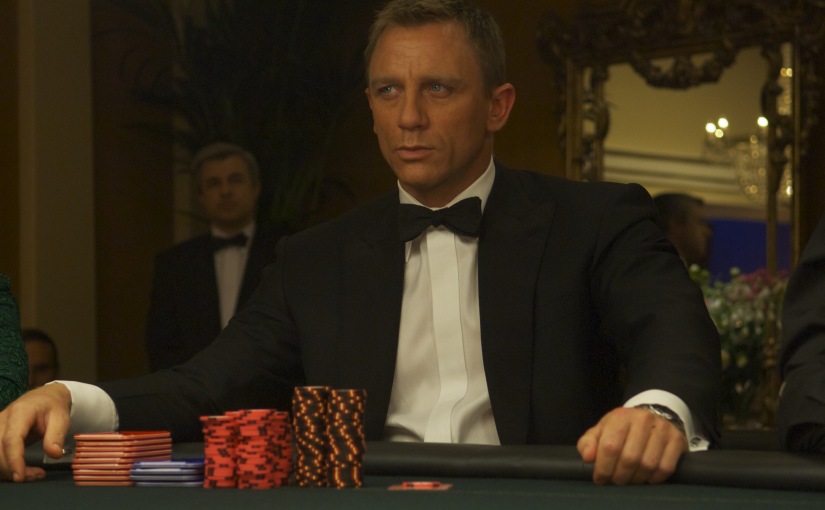
The best moments are reserved for the poker match however. Campbell amps up the tension with these ridiculous hands the players have in a fierce match of Texas hold ‘em. Bond gets sidetracked with sword wielding killers and poisonous drinks, but still manages to return to the table time and again with his tuxedo neatly pressed. The interplay at the table with or without dialogue is mesmerizing.

Daniel Craig went entirely different with his James Bond. The wit is there, but the tongue in cheek is not missed. This James Bond doesn’t give a damn if his vodka martini is shaken or stirred. Most of the prior Bond films had the super-agent without any scruples or demons in his closet. World domination, death and casual sex were just all in a day’s work. This 007, however, comes with a heavy background. Craig is great with his silent, seemingly guilty regard for killing someone whether it be by drowning a thug in a flooded bathroom sink or stabbing another one to death amid a museum crowd.

Screenwriters Paul Haggis with Neal Purvis and Robert Wade write a dramatically induced James Bond story. A tale not easily forgotten. It was time to reinvigorate the franchise that was going off into the absurdity of invisible cars and over the top gadgets. The puns are still here, but they serve more as a cover of a necessary internal pain for Bond, rather than disregard for his actions.

Casino Royale is one of the best films ever made. No qualms about me saying that. It’s hard to find great relationships among characters with huge risks at play, and magnificent chemistry for one another, as well as the story that serves them.

Casino Royale is an absolute winning hand at any table.

CRASH (2005)

By Marc S. Sanders

Paul Haggis’ vignette themed script for Crash should not have won Best Screenplay. The film he directed should not have won Best Picture. Could it be that because this picture is masked as that special movie with that especially poignant message that it got the recognition I don’t think it ever deserved? I can appreciate the attempt at bringing hot button social issues like racism and injustice to light, but it does not need to be as immaturely contrived as this picture.

Crash occurs over two days within the city of modern day Los Angeles. A select group of characters of different social classes and ethnicities are covered, and the film circumvents back and forth among their perspectives. For the most part, all of these people have major social hang-ups with people outside their race. The first example shows us that if a white woman who is simply cold on a winter night hugs her husband tightly for some warmth, apparently a couple of black men will automatically believe this woman is fearful of their approach.

Especially today, I know that prejudice exists, but to this extreme and this contrived…I’m not sure. I guess I’m not sure because I have not experienced it enough to be convinced yet. When I read a friend’s testimony of falling victim to racial prejudice I lean towards believing everything they tell me. I guess it’s this movie, Crash, that left me feeling dubious and maybe that’s because the circumstances seem way too forced.

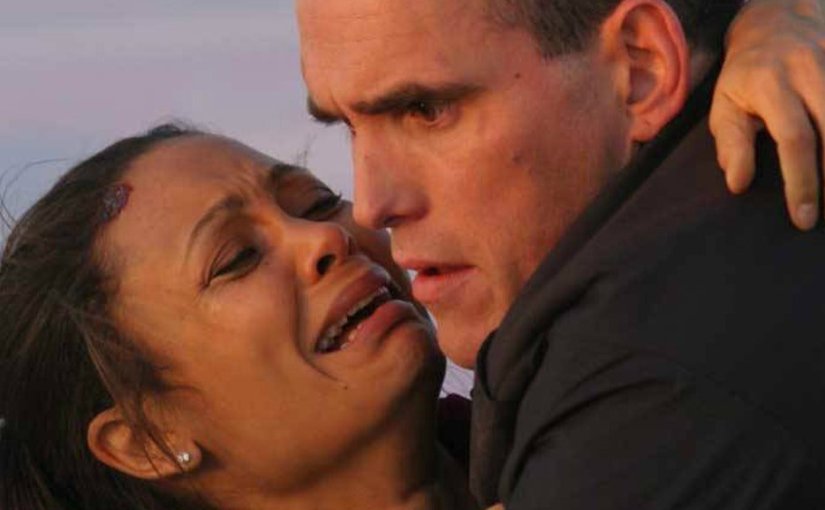
A racist cop (Matt Dillon) will pull over a well to do Muslim man (Terrence Howard) driving a high priced SUV and perform a sobriety test for no reason. Then the cop will deliberately frisk the man’s wife (Thandie Newton) with digital penetration. The next day, it’ll just happen to be that this woman will have no choice but to be rescued from a burning car by this same racist cop. Now I’m supposed to believe that the racist cop is not so bad, and the woman learns to become more tolerant. Well gee, thank heavens for coincidences!

The Muslim man (a television show director) gets car jacked the following day, and in a tense pull over moment he’s mistaken as the criminal. Fortunately, the partner of the racist cop (Ryan Phillipe) is there to subdue the situation. I’m sorry, but life doesn’t work out to be this tidy. Call me cynical, but more often than not we are not given a second chance at first impressions.

One of the real car jackers (Chris “Ludacris” Bridges) gets a moment of clarity and suddenly he’s generously giving out his last forty dollars to a group of Asian people being held in a van for human trafficking. Forgive me. If I want to begin respecting this car jacker who has held multiple people at gun point and even runs over a man, only to toss him out on the drive up to the Emergency Room, I’ll be more apt to do so if the criminal turns himself in.

I dunno. Maybe I’ve got a personal issue with Crash. It could not be more apparently preachy in how it patronizes me to simply understand the seething hate and criminal violations of its characters. I’m supposed to empathize with the racist cop because his ill father can’t get the health care he’s entitled to? I’m supposed to understand the prejudicial anger that the WASP wife (Sandra Bullock) of a District Attorney (Brendan Frasier) expresses because she no longer trusts her dedicated Hispanic housekeeper or the locksmith (Michael Pena) changing the locks on their house following a car jacking?

No. Paul Haggis didn’t earn that response from me in almost all of the short story scenarios his film offers. Maybe it’s because I tend to compartmentalize my episodes. I like to think that I don’t allow one experience with one kind of person cloud my judgement on the next person I encounter. A waiter can totally screw up my order and can even mouth off to me in a heated moment. Yet, I’ll return to the restaurant on another occasion because it’s likely I’ll run into a different waiter.

Haggis depicts people who appear to have a blanket opinion of other people with different backgrounds. These are all extremely prejudiced people with next to no understanding of where each of them stem from. An angry Persian man (Shaun Toub) puts blame on the locksmith after his convenience store is ransacked. The locksmith was only trying to explain that the back door needed to be replaced. The Persian refused to listen because his English is limited. So he just gets angry and curses the locksmith out. Haggis opts to insert a language barrier between the two men to serve up an eventual tense and dramatic moment in a neighborhood driveway with a loaded gun and a little girl. A loaded gun and a little girl! Yup, I think they teach these are the true ingredients for effective drama on the first day of screenwriting class. Again, it all comes about a little too forced.

The conveniences and ironies that bubble up at times are surprising. “Oh that guy is that guy’s brother! I see.” Things like that. However, I don’t think that is necessarily the strength of the picture.

In a film like Magnolia, we are treated to the vignettes of a handful of people too. However, not every single one of those people are sketched by means of their prejudiced natures. They are drawn by a variety of different elements whether it be a traumatic past or an inclination to do good. Then it’s kind of fun to uncover how each player is connected to one another.

In Crash, the players are only connected by the hate they carry within themselves, and Paul Haggis forces a redemption upon most of them with small gestures or a line of dialogue or the purity of a welcome snowfall to close out the film. Sorry, life is lot more messy and complicated than that. I guess I’m saying I may have learned a lot more about human nature from a downpour of frogs than a downpour of snow.