
By Marc S. Sanders
Fantasy of the supernatural or science fiction work best when the writer can teach the reader or the viewer how its foreign worlds work and how the characters who occupy the environments function and live. Anne Rice had her own interpretation about how creatures of the afterlife live by night. Her vampires possessed theatricalities. Some were charming and sophisticated, and relished how they lived immortally while satisfying a hunger for the blood of living humans. Some struggled with the discomfort that comes from being a remorseful bloodsucker. The first of Anne Rice’s series of vampire novels, Interview With The Vampire, runs a very wide gamut of perceptions. By the end of the film adaptation, directed by Neil Jordan, I’ve earned quite an education. (Frankly, Rice’s novel was tediously slow moving and bored me to tears.)
In present day San Francisco, a young man (Christian Slater) sets up his tape deck to record a conversation with a soft spoken pale faced man in a dark suit with a neat ponytail in place. This mysterious person is Louis, played by Brad Pitt. His story begins two hundred years earlier, in New Orleans, back to the day when he was incepted into an immortal life as a vampire. His agent of delivery is the devil-may- care and mischievous Lestat, one of Tom Cruise’s most surprising and unusual portrayals. He gives a brilliant performance that’s as far a cry from his lawyer roles or his Maverick and Ethan Hunt heroes as possible.
Lestat is eager to guide Louis into the benefits of vampire life. Louis, having already been depressed following the loss of his wife and daughter during childbirth, cannot grow comfortable with Lestat’s insatiable appetite to feast on aristocratic figures or plantation slave servants. This is not a match made in heaven and their chemistry as a couple is tested. Louis would rather miserably feast on chickens and rats, while Lestat grows frustrated by unsuccessfully swaying his partner to taste the sweet nectar of blood dripping from the wrist of a lovely young lass. Lestat turns towards a grander extreme to maintain his embrace of the morose Louis.
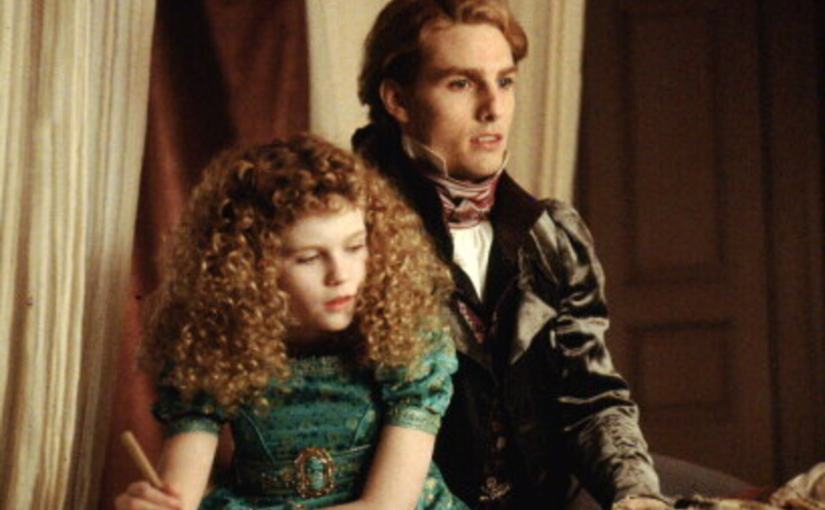
Through deception, the men welcome an eleven-year-old “daughter” into their underworld. Her name is Claudia, played Kirsten Dunst in her introductory role. I still believe this is her best performance, worthy of an Oscar. The life of a vampire is delightful to the child, the same as Lestat perceives it. However, as the decades move on, with changes in fashions and industry quickly developing, so does Claudia’s understanding. Her body never matures, destined to always remain within the shell of a preteen child, and thus she commiserates with Louis.
It appears like I’ve summarized Anne Rice’s entire story, but I have not even come close. Interview With The Vampire is to gothic horror the same way The Godfather is to mafia gangster life. Both communities victimize people of an innocent world, but their members are expected to follow codes of decorum and respect. The conflict lies in living as a bloodsucking vampire or a criminal gangster. When a peer interferes or does not cooperate, then the individuals of these respected worlds become violent unto each other. The viewer/reader observe how their patterns of behavior all play out and how one action or policy generates one response after another. These films are high ranked authorities on their subject matters.
Louis explains to his interviewer how Bram Stoker’s celebration of vampires is dreamed up escapist fiction, though coffins and the avoidance of sunlight are absolute necessities to carry on. Just like any person, vampires want to live happily, but life gets in the way and that can be frustrating on any number of different levels.
Neil Jordan’s film is a marvelous exploration into the mindset of being a vampire. Tom Cruise perfectly exudes Lestat as a vampire ready to joyously live with sin while he savors and lives a life of eroticism and material wealth. A child like Claudia sees the attraction of being spoiled and spoiling herself, and she cannot get enough consumption of blood. Eventually though, her mentality outgrows what becomes redundantly mundane. Louis is relatable like many people. He is unhappy living the life he was born into. Lestat grows aggravated with his family’s resistance to partake of what he relishes. There is an extensive range of emotions on display with Interview With A Vampire. To be a vampire can be a privilege or a curse. It all depends on who you interview.
The look of this film is astonishing. I know it was shot within New Orleans, Paris and San Francisco locations. However, I can easily recognize some sound stage locales, and I have no complaints. The art designs from Dante Ferretti are thoughtfully crafted with lantern lit, rain-soaked cobblestone streets of the seventeenth century to mucky, moonlit swamps. Horse drawn carriages transporting abundances of coffins serve a purpose of humor and narrative as character misdeeds are routinely committed by Louis, Claudia and especially the trickster Lestat. The furnishings of the aristocracy are embracing too. It’s a remarkably convincing step back in time.
The periodic costume wear by Sandy Powell completes the settings with colorful, silk garments, white ruffled shirt sleeves and buckled shoes for both the men and women as well as for Kirsten Dunst and some cherub cheeked children who come into play. Everything looks so rich. The whole picture feels like stepping into one of those late-night ghost walking tours I’ve taken in small southern towns like Savannah and St Augustine. Every scene, even when the film jumps to late twentieth century, is immersive.
Anne Rice’s screenplay adaptation tells so much within two hours. She allows time for the characters to sail to Europe seeking out others like them. The second half of the film teaches us more about what it means to uphold oneself as a vampire.
Neil Jordan sometimes delivers his film like a how-to documentary because you are consistently learning new details, not so much about plot but about a people you are not as familiar with. Often, the film segues into theatrical play as you might expect from Phantom Of The Opera. It’s no wonder since eventually Anne Rice puts us in touch with the cabal known as Theatres des Vampires. Stephen Rea and Antonio Banderas get to take center stage within a literal theater where the facade of behaving like a vampire can be executed beyond the suspicions of a – ahem- live audience.
Rice and Jordan get playful while also performing with horrific familiarity. The bites on the neck are known to many of us for drinking blood. Did you also realize that a vampire can drink from a crystal wine glass? There’s an elegance to how the actors’ characters consume the blood of humans. Cruise and Pitt begin by going in for a passionate kiss, either on the neck or the weightless wrist of a victim. Lestat is more aggressive. Louis caresses his meals on the rare occasion he dines. Claudia gives a puppy love bite. Cruise especially finds new and titillating ways to dine with each new feast. Both actors are deliciously homoerotic, but on different parental planes with their child. Their love/hate relationship operates like Shakespearean stage work. That’s why I really take to Neil Jordan and Dante Ferretti’s choice of soundstages.
I’ve become so bored with zombies and vampires. How many iterations must be churned out of the same kind of monster. This year’s horror hit, Sinners, was superb until it stopped being eye opening with surprise. It eventually became the same old thing and offered nothing new to show me in its final blood-shedding act.
Interview With The Vampire is one of the best vampire films though. The film never ceases to speak directly to its audience. The settings describe how life is lived. The characters grapple with both internal and external struggles.
It’s one shortcoming is that Anne Rice, Neil Jordan and cast/crew did not follow up with the author’s subsequent tales. The subtitle, The Vampire Chronicles, seemed to promise an extension of this universe. I know of other Anne Rice film adaptations that chose not to continue on from what was done here, and the execution was terribly poor and disappointing. There’s a biographical intelligence to Neil Jordan’s film that many films of all genres lack.
Anne Rice’s first film adaptation set the standard on vampire culture, and I have trouble thinking of anything since its release that closely matches it.
Interview With The Vampire is the only one with a blood curdling bite.
 2 UNPAID MOVIE CRITICS!!!!