
by Miguel E. Rodriguez
DIRECTOR: Marcel Ophüls
MY RATING: 8/10
ROTTEN TOMATOMETER: 100% Fresh
PLOT: An in-depth exploration of the various reactions by the French people to the Vichy government’s acceptance of the German invasion.
When writing this review, I initially tried to provide a background to the film’s topic, attempting to summarize what Vichy France was, who General Petain was, and how bitterly French resistance fighters resented Petain and others who believed that acquiescence to the conquering German army was key to survival and avoiding further destruction. That attempt at a “brief” summary ran to two full pages. So, rather than teach a history lesson, I thought it better to just review the film and assume that readers will have an even better grasp of history than I do. So here goes.
My enthusiasm for The Sorrow and the Pity, another sprawling film from documentarian Marcel Ophüls, is tempered slightly by my tenuous grasp of French history during World War II, and by the fact that, at least at FIRST, I did not feel I could pass judgement on the people involved. One English interviewee says exactly that, in response to a question about whether he felt Petain’s life sentence after the French Liberation was unfair: “It is not my place to judge whether or not people’s anger was justified. We haven’t been through it, so we cannot say.”
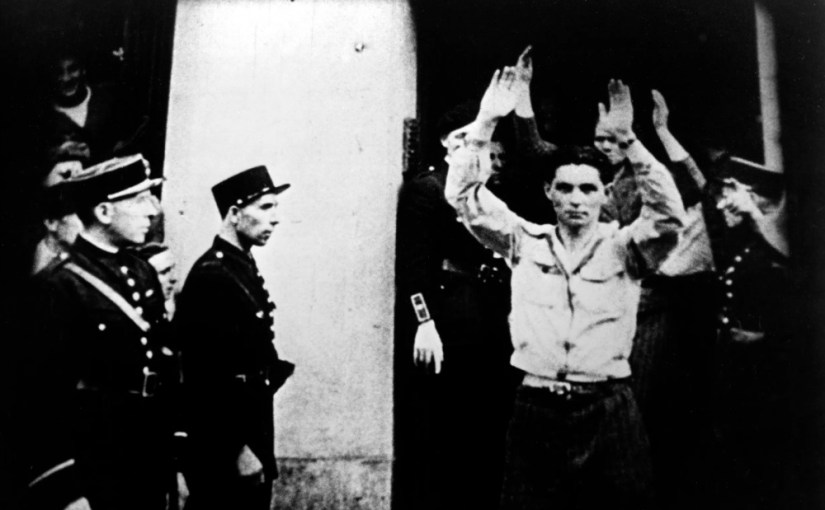
After watching the complete film, I have changed my tune a bit. Under Petain’s leadership, Vichy France did indeed escape total destruction, but since they were essentially under German rule, they did end up deporting approximately 76,000 Jews to concentration camps during World War II. Only a small percentage survived. French Resistance fighters attacked when and where they could with immense dedication, believing it was better to fight and die than to live under the thumb of Nazi Germany. Pro-Vichy Frenchmen denounced anyone they believed was a member of the Resistance. In the documentary, the bitterness felt by surviving Resistance fighters towards surviving collaborators is palpable.
This documentary was (I believe) the first from a French filmmaker to openly discuss, on a world stage, the conflict between the Resistance and the collaborators. Up to that time, it had been a virtually taboo subject, something swept under the rug or kept in the basement. The attitude was one of, “Why bring up such a painful subject? Why go over something so historically embarrassing? Let’s just move on.” This attitude reminds me of the thinking behind those who are in favor of redacting your kid’s history textbook or banning certain books from the school library. The people interviewed in the film – people on both sides of the debate, mind you – demonstrate clearly that a national policy of polite silence on the matter is unacceptable.
In this way, The Sorrow and the Pity functions less as a film, an entertainment, and more like a historical record, the kind of thing you might see at a museum or on a college campus as part of a homework assignment. I can’t promise watching this film will be as gripping as a typical Hollywood war film, but I can say I was never bored during the film’s running time. I found myself intrigued by the fact this film was released in 1969, just 25 years after the end of the war in Europe, so the people appearing in the film were not just experts or college professors. They literally lived through the events they were discussing.
A woman who sided with Petain was tortured by Resistance fighters after the Liberation; she still holds to her belief that Petain was a good man. A Resistance member who was denounced and sent to prison returns and is told by a friend that he knows who denounced him and he will avenge him with a nod of the head. The man refuses to allow that to happen, even though he knows who the denouncer was; in fact, he still lives around the corner from him. “It’s something you can’t forget. But what can you do?”
A former Nazi soldier is interviewed at his daughter’s wedding reception. (I would LOVE to hear how Ophüls managed to wrangle this particular interview.) Ophüls asks why he still wears his military medals when many Germans refuse to wear them because they were awarded by a Nazi state. The former soldier says the only people made uncomfortable by them are men and women who never fought.
Another former soldier (now apparently a waiter in a pub) makes this startling statement: “We’re not stupider than anyone else, and yet we lost the war. Nowadays we have to wonder if we’re not better off like this. After all, if we had won, Hitler may have continued, and where would that leave us today? Perhaps we’d be occupying some country in Africa…or America.” It’s hard to tell whether his statement is remorseful, grateful, or wistful.
The Sorrow and the Pity is a remarkable record of a time when a nation had to choose between subservience or resistance. That some chose resistance is not hard to fathom for Americans, whose existence is founded on resistance to tyranny. That some chose to collaborate is perhaps unthinkable, but if I look inward, can I say with certainty I would have chosen differently? I’d like to think so. I hope so.
Just recently I was looking at a bookstore’s window display with a “banned books” shelf filled with novels that have recently been banned by school libraries in several states. A woman walked by, noticed the display, and said as she walked away, “This store is degenerate. I can’t believe they’re glamorizing this shit.” I found myself wondering how many of those volumes she had read herself. I wondered which side she would have taken in France when Nazi policies banned certain texts. It never occurred to me to start an argument with her right there in the street. Will there come a time in this country when it becomes our duty to openly oppose those who support totalitarian policies? I don’t know, I’m not a political Nostradamus. But The Sorrow and the Pity argues that, if that time does come, sitting on the fence should not be an option. And the world will not soon forget those on the wrong side of history.

 2 UNPAID MOVIE CRITICS!!!!