
by Miguel E. Rodriguez
DIRECTOR: Krzysztof Kieslowski
CAST: A host of Polish actors unknown to me
MY RATING: 8/10
ROTTEN TOMATOMETER: Not Rated
PLOT: Director Krzysztof Kieslowski presents ten short films, each related in one way or another with one or more of the biblical Ten Commandments.
Nearly every review or description I’ve ever read of Kieslowski’s Dekalog states that the ten 1-hour films in this ambitious cycle are each based on one of the biblical Ten Commandments. Not so. I also assumed that each film would somehow be a moral tale ending with an unequivocal statement about right and wrong. Also not true. These films are the most mature and literate explorations, not of morals, but of ethics, that I’ve ever seen. We believe we know what’s right and what’s wrong, and that we would have the ethical fortitude to do what’s right, given the option. Dekalog argues that, in today’s world, whether it’s late-1980s Poland or present-day America, the moral absolutes dictated by the Ten Commandments are unachievable. All we can do is choose what we believe is the right thing and hope for the best.
Kieslowski, much better known perhaps for his Three Colors trilogy, seems to have written these films, along with Krzysztof Piesiewicz, as case studies or thought experiments for ethical quandaries. In Dekalog Two, a woman has a semi-comatose husband. She approaches the doctor with a dilemma: she is pregnant with another man’s child, so she must know whether her husband will recover or if he is beyond hope. If the doctor says he will recover, she will get an abortion. If the doctor says he will die, she’ll keep the baby. Now the doctor has two lives in his hands.
In Dekalog Four, a young woman’s father is away on business. She discovers a letter, hidden by her father, from her dead mother, that says, “Open after my death.” She opens it (dishonoring her father’s obvious wish that it not be found), and what she finds could radically redefine her relationship with her father, along with resolving some sexually ambiguous feelings she’s been having lately.
I could go on and on. For the curious, a full synopsis of each film in the cycle can be found online. But you get the idea. Each self-contained story is a “what would you do” scenario where your answer may tell you more about yourself than you anticipated. They seem more inspired by the format of Jesus’ parables instead of Moses’ tablets, just without the neat and tidy ending. (Well, Dekalog Ten’s ending is cut-and-dried, but that’s all you’ll get out of me in terms of endings.)
For me, the weakest of the ten films was Dekalog Two, despite its sensational premise. It gets a little too mystical for its own good at one point. But setting that one aside, I was amazed at how enthralled I was while watching each chapter. Kieslowski begins each film almost as if you were walking into the middle of the story instead of starting cleanly at the beginning. Characters are introduced who appear to have no connection whatsoever, and you must be a little patient as the story develops. At first, I found this approach a little discombobulating, but as I got more accustomed to it, I thought I could see its purpose. This is real life, not the kind of storytelling we are accustomed to from Hollywood and (let it be said) elsewhere. The stories we remember and retell from our lives don’t begin with a lovely credit sequence and stirring music. It’s usually something like, “So there I was, at the doctor’s office, and he told me I was impotent…”
This method also had the effect of sharpening my attention as each film began. Since I wasn’t being spoon-fed the story, I paid close attention to each shot, trying to memorize a face or recall a name. And each story had this remarkable ability to lure me into complacency or banality, and suddenly BANG, a monkey gets thrown into the wrench, reshaping everything you just saw, or what you thought you were going to see. I’m thinking especially of Dekalog Four, with the dead mother’s letter; Dekalog Seven with the ostensible kidnapping with hidden motives; and Dekalog Ten where a father’s death brings two estranged brothers together for one last surprise in his heavily secured apartment.
Because I was watching so carefully, there were several things I noticed that carried over from one seemingly unrelated tale to the next:
- REFLECTIONS: Every film makes liberal use of reflections for some compositions, whether it’s a scene shot in a mirror or a pane of glass or a puddle or even just reflections on the lens of the camera. I am not enough of a film scholar to elaborate what that could mean, aside from the obvious: these films are intended to elicit self-reflection from the viewer. Passive viewing of these films simply will not do.
- CAMEOS: All ten films take place mostly in or around the same imposing apartment complex in Warsaw. (Look closely at the structures and the beams for the outside porches resemble church crosses.) As such, characters from one chapter will “bleed” into at least one of the others. The father in Dekalog One appears near the beginning of Dekalog Three. The pregnant wife in Dekalog Two is trying to catch a cab in Dekalog Five. The impotent husband in Dekalog Nine shows up in reverse order as a bike rider in Dekalog Six.
- EXTERIORS: I cannot recall more than two or three shots in all ten films that showed an unambiguously sunny day. Daytimes in Dekalog are invariably overcast and gloomy. If we are meant to interpret that as a symbol, and the apartment complex is the world we all inhabit, then Kieslowski seems to be saying that the world is a dark and dreary place, indeed. Is there any hope at all in this gray cycle of films? I think so. Many of the films end on, if not exactly a happy note, then at least a hopeful note. For myself, I watch the credits roll on each one and I imagine the characters making peace with their choices, because…well, that’s what I have to do daily. If I can do it, they can do it. Or vice versa.
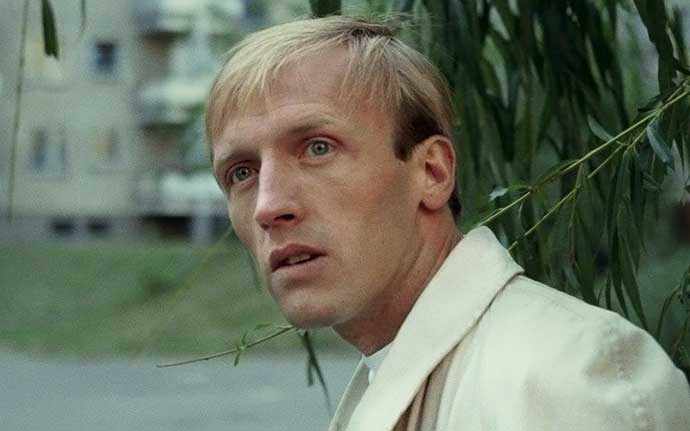
- THE WATCHER: There is one actor who appears in nine of the ten films in Dekalog. He never speaks, is never named (on IMDb, he is credited simply as “Young Man”), and never directly interacts with any other character. I took to calling him The Watcher, after the Marvel Comics character who is doomed to spend eternity witnessing human history without the ability to help in any way. What does he represent? Is he an angel, in keeping with the cycle’s biblical name? He seems to appear whenever a main character is about to make a choice of some kind; in one instance, he gives an almost imperceptible shake of the head as if to say, “Don’t do this.” If you ask me, I would say the Young Man is the embodiment of guilt, a warning stare from some cosmic force that is saying, “Can you live with what you’re about to do?” The main characters make their own choices, deciding what they can or can’t live with. Discuss.
I hope all this mumbo jumbo hasn’t deterred you from seeking out this series and giving it a go. All the same, as much as I do recommend Dekalog, I’m a little stuck on who exactly I would recommend it to. All told, it’s a 9-hour-34-minute excursion into the kind of ethical dilemmas that could occupy an entire semester at a film school…and probably has. On the other hand, with streaming popularity at an all-time high (depending on who you ask), one can think of it as a 10-part HBO miniseries…in Polish. After all, that’s how it was originally envisioned anyway, as a limited series for Polish television. Take a chance. Find a copy to buy online. Or stream it if anyone is offering it. I promise, you will be mulling over these films long after the latest Venom movie has faded from memory. (Sorry, cheap shot, couldn’t resist, but you know I’m right.)
 2 UNPAID MOVIE CRITICS!!!!