
By Marc S. Sanders
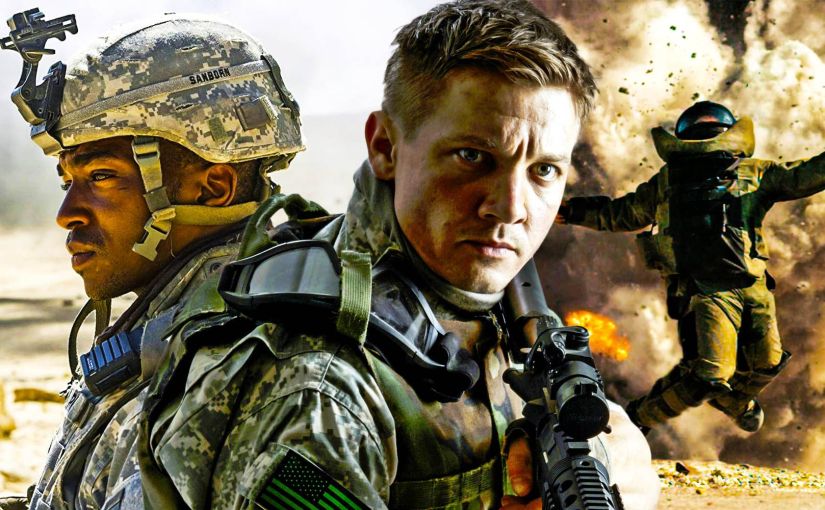
Often the most effective war movies hardly focus on the enemy. It’s the environment that keeps us on our toes. Like Oliver Stone’s Platoon, Kathryn Bigelow’s The Hurt Locker is a widely acclaimed depiction of the Iraq War, centrally located in Baghdad in 2004. Her film follows a frighteningly tense perspective of three members of Bravo company – a bomb disposal team.
After their leader perishes in a surprise attack, Sergeant J. T. Sanborn and Specialist Owen Eldridge (Anthony Mackie, Brian Geraghty) welcome Sergeant First Class William James (Jeremy Renner) to the squad for the remaining thirty-eight days of their rotation. Beyond evading suicide bombers and questionable Iraqi civilians who observe from the sidelines, Sanborn and Eldridge fear they’ll have to survive James’ maverick approach to deactivating sophisticated bombs that hide in the scorching hot desert area. William James claims to be responsible for shutting down eight hundred and seventy-three explosives in his young career. He’s good at what he does but he disregards the best interests and care for others within his vicinity.
The art direction for The Hurt Locker is most impressive. The expected sand rubble and distressed tenement buildings are convincing as Jordan stands in place for the film’s Baghdad. Bigelow’s team goes to great lengths with sophisticated explosives. An early moment has James gently tugging on a red cord that eventually leads to other cords and then what comes out of the desert sand is six identical underground bombs surrounding him from all sides. With her camera positioned overhead, pointing down, this feels like a monster movie with tentacles springing out in a circumference around the hero.
Another early scene has James recklessly undressing from his bulky, anti-bomb suit, and disassembling an abandoned car to look for the suspected device that’s hidden inside. With Eldridge and Sanborn remotely demanding updates, the wild man chooses to toss his headset away to focus on his dire circumstance, solo.
Ahead of the film’s thrilling opening, a quote from someone named Chris Hedges appears: “The rush of battle is often a potent and lethal addiction, for war is a drug.” A more appropriate phrase would not describe Jeremy Renner’s character any better. There’s no denying this guy is an expert and the best of the absolute best. However, he’s positively the worst at accounting for his team or the environment around him.
Kathryn Bigelow is an outstanding director who gets better with each passing film. The Hurt Locker elevates her finished products that began with cops and robbers fare like Blue Steel and Point Break. Bigelow is not aiming for laughs or Hollywood shootouts. With Mark Boal’s Oscar winning script, the filmmaker zeroes in on how someone so proficient with dangerous work pushes beyond limits of caution. The three characters covered within this tiny sliver of a larger war find themselves tested with each passing day.
There’s a routine to these guys as they respond to other desert platoons as the sun rises. They are summoned to come upon bombs and mines and people strapped to bombs and mines. They load up in their Humvee, drive to the next site and do what is expected of themselves like firefighters would in any neighborhood. The conflict is these guys just do not work in sync with each other. At night, they return to base following a full day’s work to play shoot ’em up video games, drink, and roughhouse with each other as a means to grasp who is the dominant one of the trio.
Psychologically, James, Sanborn and Eldridge are not on similar planes. Eldridge is the frightened one who confides in a Colonel with an empathetic, bedside manner. Sanborn is the sensible levelheaded one. James seems to lack priority for anyone including his on again/off again girlfriend back home (Evangeline Lilly) and the child they share together. He’s bent on conquering the next sophisticated, wired device. It only gets personal for him when one of the few kids in the area meets a gruesome demise and James goes lone wolf at night, within the towns, even though he’s not covert ops. His risks are too great for this war, his squad, and maybe himself.
Kathryn Bigelow effectively sets up environments that’ll rattle your nervous system. Using handheld cameras, this film often works like documentary footage with quick cuts to citizens of Baghdad who may be staring at what this squad is doing, or maybe they are waiting for their cue to detonate something nearby and trap them. A local butcher with a cell phone in his hand feels like the worst kind of threat. A kid with a soccer ball seems untrustworthy. A guy in a suit pleading for desperate help at the other end of the street is a person I wouldn’t want to stand next to. There’s an abundance of desert citizen extras to look for and hypothesize about. Is it that guy with the trigger or maybe it’s that kid or that woman? Most of these people do not even speak. Their glazed, war torn and dusty expressions say so little while the powerful machine guns held by the Americans will not do much to prevent a horrifying possibility.
The extensive footage of explosions is very impressive. I read that Bigelow wanted to display what a real detonation would look like, and not with Hollywood fireball extravagance. Accompanied with Oscar winning sound editing and mixing, the bombs in this movie lift the dirt and dust particles off the ground, building and automobile surfaces and then plume into mushroom clouds that expand beyond the limits of city blocks. The Bravo Company men even predict how the blasts will take off and where exactly the shrapnel and debris will reach and descend. They think they have this down to a science. This material is entirely different than what other action or war pictures typically show.
Sniper fire comes at unexpected moments. An open desert plain actually has an enemy concealed somewhere and quick pierces of sound drops a someone who you might think controls the scene. Then the next someone. The shock of how quickly it’s edited together plays with your senses. Bob Murawski and Chris Innis are the award-winning film editors of this piece. They complete their job to the fullest. This all looks so real and not a product of art.
The Hurt Locker is term to describe where a militant solder will go to when living with internal pain and conflict. The soldier goes to his hurt locker. This war puts each of these three guys in their own kind of hurt locker, but perhaps they force their situations upon themselves and each other. Mark Boal and Kathryn Bigelow’s film do not just devote time to the three characters who are most at play, but also to devices of war and destruction that drastically change these men.
The Hurt Locker is one of Kathryn Bigelow’s best films.

 2 UNPAID MOVIE CRITICS!!!!