
By Marc S. Sanders
Rudolph Höss, and his wife Hedwig, have five children and they seem to live in peace and serenity within a beautiful home that contains plenty of bedroom space, sunlight, a vegetable garden, a pool to splash in and a babbling brook to fish and swim in. You might say it is The Zone Of Interest that keeps their life so fulfilling. Yet, beyond their pleasures is the Auschwitz concentration camp conveniently located next door for Rudolph to carry out his responsibilities as a Nazi Commandant.
Jonathan Glazer writes and directs this quietly effective piece while breathlessly showing a flawed ignorance and apathy for the countless Jewish lives lost during the Holocaust. The tactics Glazer uses in his film work on your senses first. Following a long series of production company names that herald from America, England and Poland, the title of the movie appears in big white thin letters against a black screen. Slowly over a long 3-4 minutes the letters fade as faint music and sound transition. The music gets softer, as birds chirp and then there are faint gunshots in a distance. A picture finally appears, and we see the Höss family basking under blue sky and sun while picking flowers alongside the brook. It’s not even possible to identify the time or setting of this story yet. Soon after, Rudolph (Christian Friedel) is stepping out of his home in his full-dress Nazi uniform on the morning of his birthday. Hedwig (Sandra Hüller, Oscar nominated in Anatomy Of A Fall) and the children gift him a beautiful, freshly painted kayak. Glazer then changes the position of his camera in the opposite direction and the towering wall of the concentration camp is just beyond the pretty stone walkway and front yard that leads out from the family cottage. Black smoke billows from the smokestacks beyond the wall, and none of this is even remotely disturbing to the family. The pops of gunfire are heard beyond.
The Zone Of Interest does not focus on the suffering of the European Jews during the Holocaust. Jonathan Glazer’s script is wise enough to know his viewers are aware of what occurred even if the mass genocide seemed to have no imaginable end. He never shows footage of activity inside the camp because this story is told through the eyes of a family who chose not to become aware or alarmed at that massive amount of death and torture that was happening. The Holocaust was simply a way of life.
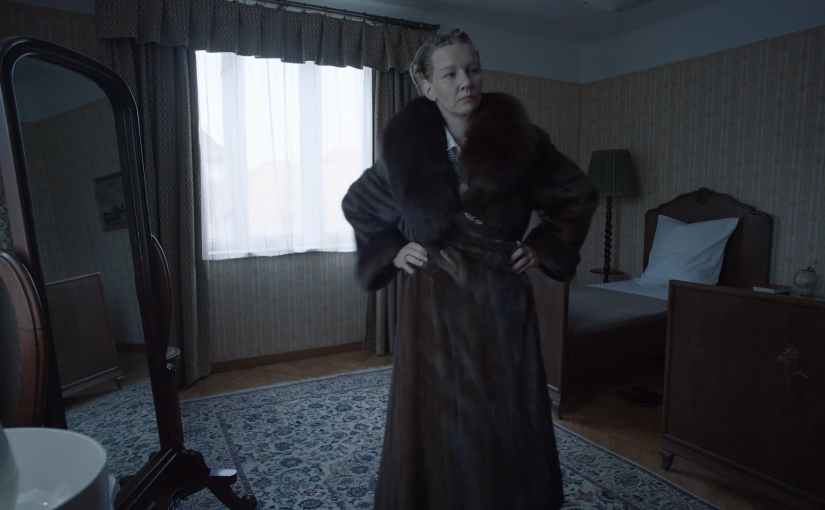
A sack is delivered to the Höss home which contains slips and nighties for Hedwig to rummage through for her use. More interesting is a beautiful fur coat. Hedwig tries it on for a personal fitting and looks upon herself in her bedroom mirror. She finds a lipstick in the pocket. Does she like the color? She’ll have to see and draws it across her hand just like my wife and mother would do in a shopping mall. All the while, the undisturbing (to Hedwig) next-door sounds continue on.
Miguel and I went to see this film together and had an extensive discussion afterwards. To Miguel’s advantage, he had absolutely no idea what this film was about. Didn’t know it was another Holocaust picture. He didn’t know who directed it. He didn’t know the cast. I only knew that Jonathan Glazer wrote and directed, though I’m not as familiar with his work as Miguel is, and that it took place during the time of the Holocaust. To observe my colleague’s surprise early on in the film gave me an interesting experience. Miguel first witnessed the serenity and peace among the family, and then realized the sinister world that surrounds them and which they choose to be naïve towards.
The Höss family will have you believe they experience the same challenges that any ordinary family encounters. Beyond what I have described, there are two other scenes that stay with me.
Rudolph holds a meeting in his home. An architect/scientist is describing the effectiveness of a new model oven that will efficiently slaughter hundreds of Jews per day. He provides well designed blueprints. Rudolph asks for a closer estimation. The architect says it is likely a thousand can be taken care of in one day. Seems satisfactory. Take a conversation like this out of the context of the picture and these men could just have easily been talking about an assembly line in a chocolate factory.
Another moment occurs between Rudolph and Hedwig. The husband explains that because he’s been so good at his job, he’s been promoted to oversee the operations of all the concentration camps and therefore the family will have to relocate. Hedwig is not happy about this as they have begun their new life here in their beautiful home (located next to Auschwitz). The wife insists her husband speak to Hitler about this and request he reconsider. Any of us would know it’s not that simple. “Oh, excuse me Mr. Hitler…” Uh uh! Would not work so easily.
Jonathan Glazer demonstrates how simple dilemmas and pleasures that come with a happy home life can appear common. Yet, in this case, should it?
The Zone Of Interest may be a period piece. Yet, what you witness when you watch this film is all too similar to what often occurs today. The world has gotten smaller with information coming to us quickly by means of the internet that can update me on Middle Eastern wars or American immigration or the spread of white supremacy as quickly as developments take place. However, I believe many still remain ignorant, often by choice, of what is presently happening. Mass suffering and totalitarianism still runs easily and freely, but what remains important to us are the vast luxuries we treat ourselves to while hardly giving a care of what goes on outside our bedroom windows. Our toughest challenges are our inconveniences.
I’m not chastising anyone, Reader. We deserve our peace, our solitude, and our happiness. The Höss family is something else altogether, though. They live in prosperity right next to the worst way of living imaginable and the patriarch is primarily responsible for that experience. Yet, as their comfort becomes so commonplace, the naivety only increases. Their children grow only knowing that a train arrives on a frequent basis, with chimneys exhausting black smoke and there are distant pops on the other side of a brick wall. It simply goes with splashing around in the garden pool or making mud pies on the edge of the brook. The title of Glazer’s film serves the perspective of a family who are being raised not to know any better.
Miguel asked me where I would rank the picture. At the time I gave it a middle grade. It is a slow-moving piece. It is not accompanied by a soundtrack of music to easily cue my emotions. There are no big, momentous monologues. I found the ending a little ambiguous but perhaps I was not concentrating enough, and Miguel had to explain something to me. However, two days after watching the piece while also doing some background research on the film, it is worthy of a better grade than I originally gave it credit for while walking out of the theater.
Glazer will set up scenes where nothing happens for the longest time and then an eye opening and very uncommon discovery is made. A particular moment happens while simply watching Rudolph waist deep in the river while fishing and wearing an SS t-shirt. Again, out of context, this t-shirt could have been a Tampa Bay Buccaneers shirt. There’s a disturbing comfort to moments like this before anything is revealed.
The writer/director positions his camera like a documentarian. There are no steady cams. Often shots are from a far end of a hallway or outside a door frame simply to witness the commonplace activities of the family while the horrifying sounds of Auschwitz carry on in the near distance. Miguel noticed a horizontal technique. Glazer must have put his camera on a track to follow Hedwig as she walks off her property and marches parallel across the outside wall of the concentration camp. She is undisturbed by anything happening on the other side of that brick structure laced with barbed wire at the top.
This is a disturbing piece that effectively shows a lack of care for suffering and horrific execution while a family attempts to live their best life and circumvent around common issues like job promotions or gardening or family time or valuing someone else’s belongings to accommodate them. The Zone Of Interest is a haunting film and Jonathan Glazer has accomplished a tremendous feat, showing comfort just outside of a world of treachery and genocidal productivity. This is a must watch film.
PS: My recommendation is to watch The Zone Of Interest without taking a break or taking a pause in the picture. Watch it all the way through, unstopped. I believe it is necessary to judge the film as a whole rather than in just parts. As I reflect, it feels like one ongoing hour and forty minute scene.

 2 UNPAID MOVIE CRITICS!!!!