GUNFIGHT AT THE O.K. CORRAL (1957)

by Miguel E. Rodriguez

DIRECTOR: John Sturges
CAST: Burt Lancaster, Kirk Douglas, Jo Van Fleet, John Ireland, DeForest Kelley, and a young bit player named Dennis Hopper
MY RATING: 8/10
ROTTEN TOMATOMETER: 87% Fresh

PLOT: Lawman Wyatt Earp and outlaw Doc Holliday form an unlikely alliance which culminates in their participation in the legendary Gunfight at the O.K. Corral.


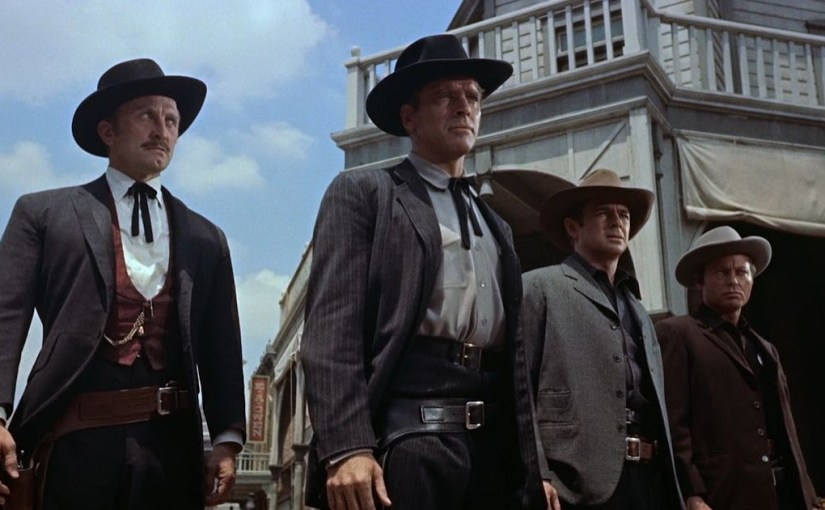
In real life, the legendary gunfight at the O.K Corral in the frontier town of Tombstone lasted thirty seconds, but what kind of movie would that be?  (Kill Bill: Vol. 2 springs to mind…)  A 1950’s Western requires a long-to-medium shot of the good guys – Wyatt Earp, his brothers, and Doc Holliday – striding down the street to meet the challenge of the dastardly Clantons, who had gunned down Wyatt’s youngest brother in cold blood.  We need a gunfight, not too long, but longer than 30 seconds.  And we need to make sure the ratio of surviving bad guys to good guys is just right: 0 to all.

John Sturges’ Gunfight at the O.K. Corral delivers the goods in a remarkably mature film for its time, free (for the most part) of cheap sentimentality and distractions from the main plot.  That’s a double-edged sword, though: we rarely leave the side of either Wyatt Earp or Doc Holliday, but the result is we get little to no information about Earp’s brothers until the final reel, nor do we get many details about Earp’s romance with the lovely Laura Denbow, a high-class gambler who knows enough about cards to beat the men at their own game.  We only find out they’re engaged as an afterthought, it seems.

As for Doc Holliday’s relationship with Kate Fisher (Oscar winner Jo Van Fleet), the word “dysfunctional” is woefully inadequate.  Loosely based on Holliday’s real mistress, referred to only as “Big Nose Kate” on Wikipedia, she seems to exist only to serve as Holliday’s psychological punching bag when required.  Her emotional yo-yoing gave me whiplash: she pledges her unending devotion in one scene, tries to stab him in another, helps him escape a lynch mob, takes up with the loathsome Johnny Ringo after yet another fight, begs to be taken back, and eventually tells him, “I’ll see you dead!”  With friends like these…

But even that kind of sordid melodrama is not enough to derail the throughline of the film, which is focused intently on establishing the rocky relationship between the morally good Wyatt Earp (Burt Lancaster) – who nevertheless wears a black hat the entire film – and the morally chaotic Doc Holliday (Kirk Douglas), a professional gambler who leaves a string of dead bodies behind him, all killed in self-defense, of course.  Earp also helps get Holliday out of town before a mob can lynch him, so Holliday decides to stick around until the debt is paid.

I think the essence of their relationship is summed up in a scene where Earp is forced to deputize Holliday when no other options are available.  Earp reluctantly walks up to Doc, tells him to raise his right hand, and says, “Do you solemnly swear to uphold…oh, this is ridiculous.  You’re deputized.”  Doc: “Wait a minute, don’t I get to wear a tin star?”  Earp: “Not on your life!”  Both men are torn between their philosophy and their sense of honor.  Holliday is no hero, but he’ll help Wyatt until his debt is paid.  Earp despises Holliday’s moral code, but he’s the best gunslinger in town.  What can you do?

All of this is handled in dialogue that seems mostly uncluttered by the hokey clichés I’ve heard in so many other films of the 1950s, even some of the great ones.  This may perhaps be due to the fact the screenplay was written by Leon Uris, a novelist who would eventually go on to write, among many others, Exodus, Topaz, and QB VII.  Listening to the characters talk, it was interesting to hear how natural they sounded, compared to the overblown melodrama of so many other westerns and dramas of that era.  The dialogue was clearly written by someone with a writer’s ear, who wants to get to the point of every scene with a minimum of fuss or flowery exposition.

As I mentioned, however, this quest for directness means we spend all our time with Earp and Holliday and almost no time at all with the Clantons or Earp’s brothers or anyone else.  By the time we hear Wyatt’s brother, Virgil, is in trouble, we’ve almost forgotten he HAS brothers.  As far as the Clantons go, we hear everything about them secondhand until we finally meet them in Tombstone.  We never even see Wyatt propose to Laura; we barely even see them courting (their courtship appears to consist of one false arrest and one kiss in the moonlight).

And I would be remiss if I did not mention…that song.  I learn from IMDb that the song, “Gunfight at the O.K. Corral,” that plays over the opening and closing credits, and which also plays over any transitional scene as Earp moves from one town to the next, was one of the inspirations for the theme song for Mel Brooks’s parody Blazing Saddles.  Brooks even got the original artist, Frankie Laine, to sing for his own movie.  It is so corny and earnest, juxtaposed against the gritty characters and scenery, that any sequence featuring that song loses all credibility.  If the filmmakers had just ditched that song, I might consider this one of the greatest Westerns of all time.  (see also Rio Bravo with Ricky Nelson’s crooning.)

But…having said all that, I must report that Gunfight at the O.K. Corral was entertaining from start to finish.  By avoiding the temptations to give in to melodrama and hokeyness, we are presented with a surprisingly solid Western drama that culminates in a decent (for the late ‘50s) gun battle.  It’s not as flashy as anything from one of Eastwood’s spaghetti westerns, and it’s not quite as thrilling as the one at the end of 1993’s Tombstone, but it’s satisfying, nevertheless.

(And for the record, when it comes to memorable lines, against Val Kilmer’s immortal “I’m your huckleberry”, I would gladly put Kirk Douglas’s venomous, “You slut!” …you have to see it in context, trust me.)

JOE KIDD

By Marc S. Sanders

Joe Kidd is not one of Clint Eastwood’s best westerns.  In fact, it might be his weakest of the sort.  The film arrived at the tail end of director John Sturges’ (Bad Day At Black Rock, The Magnificent Seven) career and through my research it seems that Eastwood did not get along with him.  Sturges was rumored to be an alcoholic providing limited focus on the film in question.  I’m apt to believe that theory.  Joe Kidd, which was scripted by Elmore Leonard who would go on to write Get Shorty, is full of enormous plot holes. 

Eastwood is a welcome sight at first, handcuffed in the Sherrif’s jail until he’s unlocked to attend his court hearing.  Before leaving, in typical quiet, tough guy style, he demonstrates to an annoying cellmate that he won’t be intimidated by splashing the guy’s stew in his face and then denting the pot over his forehead.  It’s a great introduction for a title character.  I laughed.  I clapped.  After that, however, the movie fell apart.

The structure of Joe Kidd seems to start in the middle of a story that opted not to go back to the beginning.  A Mexican rebel leader named Luis Chama (John Saxon) causes some ruckus in the courtroom and around town, and then he flees into the nearby mountains.  Joe manages to shoot one gang member who enters the saloon.  Thereafter, a wealthy landsman named Frank Harlan (Robert Duvall) arrives and after paying for Kidd’s bail, he hires the ex-bounty hunter to accompany his posse and bring back Chama and his squad.  According to Harlan, Chama is occupying a large chunk of valuable land and therefore has to be taken out of the equation.  Okay.  Simple enough.

However, the narrative zig zags from that point.  First, Joe declines the offer from Harlan.  Then he discovers that Chama has tied up one of his ranch hands in barbed wire.  So, he dons his perfect tough guy cowboy duds (his hat looks great on his head) and off he goes with Harlan.  Midway on their journey through the mountains, they set up camp at a Mexican church.  Harlan announces into the wide expanse, for Chama to hear, that he will kill five people in the church if he does not surrender himself.  After a period of time, he’ll kill five more until the Rebel gives himself in and so on and so on.  Joe Kidd does not agree with this arrangement, gets fired by Harlan and eventually sidles up with Chama.  What’s going on here?  Didn’t Joe want to even a score with Chama after what he did to his ranch hand?  In a short ninety-minute running time, set ups occur only to be undone minutes later, and I’m starting to question my ability for basic comprehension. 

To date, of all I’ve seen in Robert Duvall’s illustrious career, this is hands down the weakest character he’s portrayed.  He’s not a terrible actor here.  He just has nothing to do except look like a greedy landowner with a mustache and a six shooter on his hip.  He’s not given any dimension of material to play with, and thus comes off like a bad guy of the week on an episode of The A-Team.  John Saxon actually guest starred a few times on that show as a variety of different bad guys.  The only new thing I see from him in this picture is his unconvincing Mexican accent. 

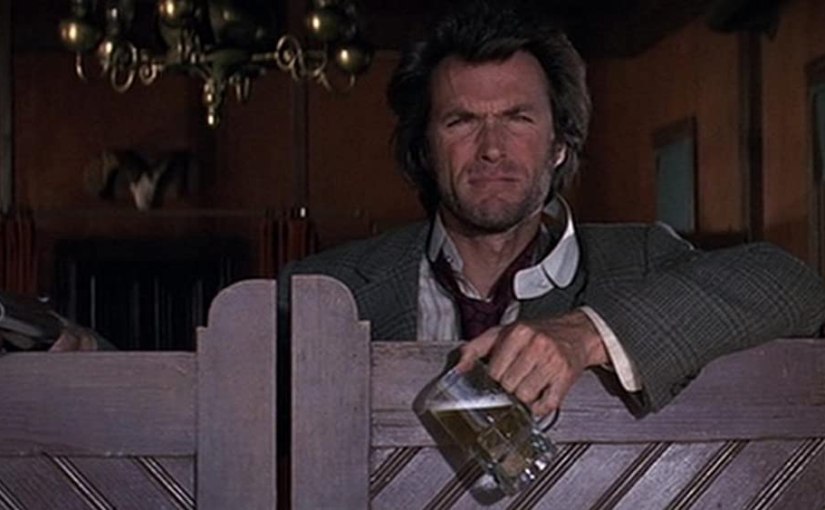
Clint Eastwood is playing his typical westerner.  He looks great with the hat and stature and the gun in his hand.  Yet, the novelty looks tired here.  As if we’ve already seen him in other classics like the Dollars trilogy, and High Plains Drifter.  There was nothing new to offer with Joe Kidd.  A diversion occurs early on where Kidd is about to take advantage of Harlan’s girl.  That goes nowhere and serves no purpose.

I imagine there was a better and more fleshed out script here that never materialized.  A friend of mine recently asked me if it would make sense to remake films with potentially good ideas that were poorly executed.  Seems logical to me, and then he asked me to name some examples.  On the spot, I could not come up with one.  Howard The Duck? Never!  Green Lantern?  Yeah, that’ll likely be done eventually anyway.  However, I think I have come across a good one to consider.  How about remaking Joe Kidd

You know what?  Wouldn’t work.  There’s a tone to the piece that seems a little prejudiced and not appropriate for present day. More importantly, on another try, it wouldn’t have the main attraction. 

Has anyone remade a Clint Eastwood picture? 

My point exactly!