
ROCKY

By Marc S. Sanders

Rocky is a story about a bunch of losers.  It really is. It’s actually a film that does not represent or follow the standard ho hum formula that so many other well-recognized sports films that are so familiar, since it premiered on screens in 1976. 

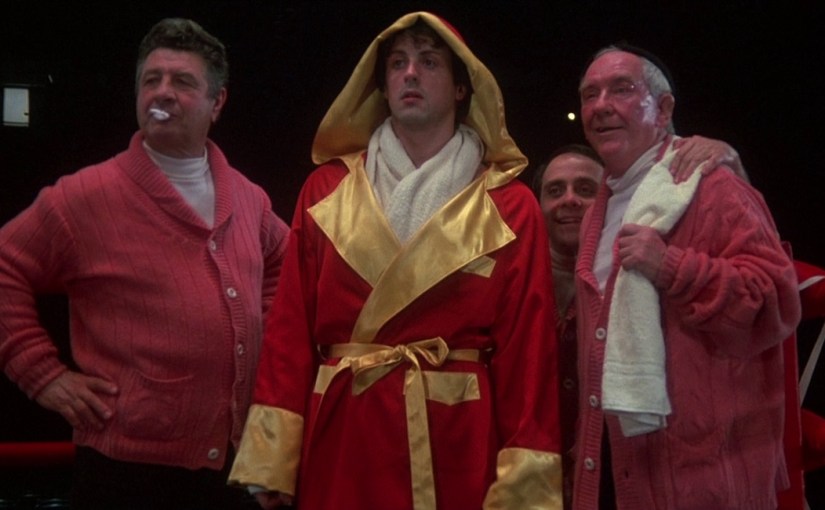
If you examine Rocky, what you’ll find is a story about a boxer by the name of Rocky Balboa (Sylvester Stallone in a role that broke through everything for him), who is not shown doing much boxing or even training.  Instead, the southpaw boxer known as The Italian Stallion, is displayed as a heavy collector for a loan shark in and around the south side of a dirty Philadelphia.  Early on in the film, Rocky delivers monies to the loan shark and his driver asks Rocky “Did ya get the license plate?”  Rocky asks for what, and the driver snaps back with “For the truck that ran over your face.”  It’s delivered with a little humor but it’s also sad.  Is there anyone to uplift poor Rocky’s spirits?  His one-time trainer, Mickey (Burgess Meredith), kicks him out of the gym because he’s tired of Rocky at age 30 wasting his life with the scum of the streets.  Rocky lives in a filthy apartment barely making scratch from underground fights.  About the only redeeming quality Rocky seems to show is his tender loving care for his two turtles, Cuff and Link.  So, it is surprisingly charming when he sweet talks a mousy, petite woman named Adrian (Talia Shire, truly in an underrated performance) for a date. 

Adrian is also a loser, or at least she’s treated like one by her brother, Paulie (Burt Young).  He’s constantly putting her down for her looks and lack of men in her life and any other opportune moment he can find.  It’s the only way that Paulie can build confidence in himself; by putting his sister down.  Beyond that, all he has going for him is his job in the meat locker.  His one dream is for Rocky to give him a job working for the loan shark.  Such aspirations.

By luck, Rocky is called upon by the Heavyweight Champion of the World, Apollo Creed (Carl Weathers), to fight him in the ring.  Anyone else would jump at this chance.  For Rocky, it’s just a way to earn a fast $150,000 and use his face as a punching bag for Creed on live television.

All of these characters within this circle come out of their shells once Rocky is given the opportunity of a lifetime.  The first win for Rocky is when he wins over Adrian on an adoring, near penniless date when he takes her ice skating on Thanksgiving night.  They’re only given ten minutes to skate together.  The transition thereafter is quite revealing.  Director John G. Avildsen transforms Adrian’s appearance by removing her ugly glasses and hat.  Rocky is pleasantly surprised by the red winter coat she wears later in the picture.  Adrian becomes more talkative and expressive.  Initially, she couldn’t even look Rocky in the eye.  When Rocky gives her a shout out at a press conference on TV, Adrian laughs and cuddles up next to Rocky.  Someone has finally treasured her and she adores it so appreciatingly.  Shire really demonstrates a nice character arc, where she comes out from under the strong arm of her brother to find her independence and make choices for herself.  An amazing scene occurs near the end between Shire and Young.  The pent-up frustration the siblings have for one another finally boils over.  This scene is what won both of these actors their Oscar nominations.  It’s a moment in all of the Rocky films that doesn’t get enough recognition.

Mickey is the one who gives tough love to Rocky.  He shares with Rocky his own battles in the ring during the first half of his near 50 years in boxing.  All of the blood and sweat didn’t amount to much beyond the gym he has for the local fighters.  What he earned as a fighter was a cauliflower ear and no family except the poor kids who go in and out of his southside gym.  Now he has a chance at the big time and he has to win over Rocky’s affections so that he can train him properly for the fight that’s coming up.

The biggest loser of course is the title character.  Credit must first go to Stallone for an outstanding insightful script that looks much deeper than any of the numerous sequels that followed this film.  The original Rocky is not about punches.  The script eventually transitions into determination with Rocky giving a sorrowful monologue to Adrian acknowledging he’s a loser with no chance at beating Creed.  At the very least, all he wants to do is settle for going the full 15 rounds with the champion and never falling down on the mat for a count of 10.  Only then can Rocky triumph with a personal victory.

Rocky won the Oscar for Best Picture and Avildsen won Best Director in 1976, beating out incredible films like Network, Taxi Driver and All The President’s Men.  I’ve thought about this endlessly over the years.  Why did it win?  I mean look at the competition it had.  The script for Network is one of the most admired and amazing scripts in Hollywood history; now it’s regarded for how prophetic it has become.  The other two films gave brutally honest, yet cynical portraits of the lack of innocence in the United States.  These other films rightfully question if America is the greatest and most thriving country in the world.  Just writing this, I think I answered my own question, though I will endlessly ponder anyway.  Rocky is the one positive entry of nominated films that year.  Rocky Balboa put aside the differences he had with others and overcame the adversity of those that would antagonize and guide him down the wrong paths. 

It’s totally cliché now to say this but Avildsen’s film, Rocky, is an awe-inspiring triumph.  It’s still okay to identify the picture as such, because it was the first to do what only so many imitations thereafter tried to duplicate.  The outcome of the fight within the film was not about winning the belt and the fortunes of money.  It was a breakthrough from a wasted life – the life of a loser; the lives Rocky, Adrian, Paulie and Mickey were all sadly living before the chance opportunity of supporting one another came to pass.  As Bill Conti’s unforgettable soundtrack closes out the picture, you are not just crying for Rocky and Adrian as they profess their love for one another in the middle of a crowded boxing ring.  You are crying because you realize you can believe in changing your life with will, stamina, endurance, personal strength, confidence and then…finally…love.
THE KARATE KID (1984)

By Marc S. Sanders

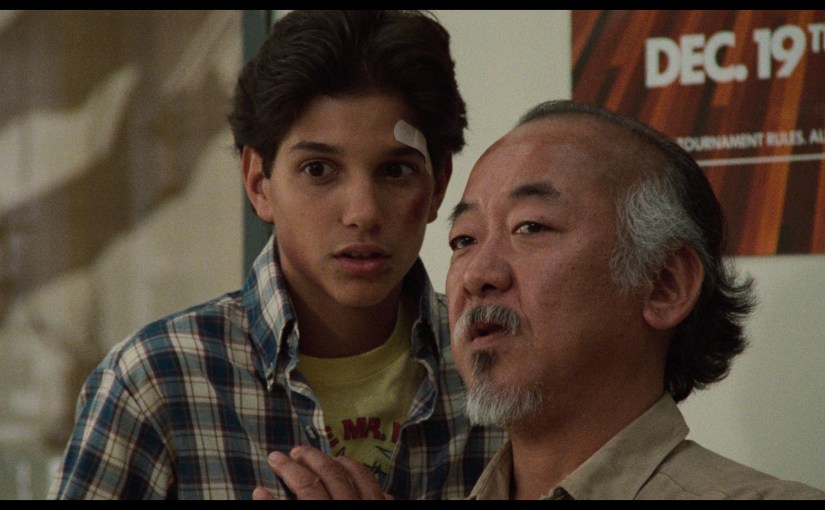
Though it may feel like an After School Special at times, there’s always been a charming quality about The Karate Kid, and that stems from the relationship between Daniel LaRouso (Ralph Macchio) and his elderly Asian mentor from Okinawa, Mr. Miyagi (Oscar nominee Pat Morita).

John G. Avildsen, director of Rocky, is harsh in the expository bullying that Daniel endures when he moves from Newark, NJ to California. The Kobra Kai kids led by William Zabka (your go to bully for 1980s films) are brutal in their fighting skills as they use Daniel as a means to exercise their Sensei’s philosophy of “No Mercy!” The Sensei is played very frighteningly by Martin Kove.

What’s hard for me to digest with The Karate Kid is that Macchio is not very good in the role. He kind of comes off as a kid I’d never want to hang out with. He tries too hard to be cool, but he doesn’t look cool. His sense of humor is really never funny. It’s too hokey really when he puts the charms on his crush Alli (Elisabeth Shue). While Shue is fine her in her sweetness, Macchio is really why I never found any chemistry between the two actors. He comes off like Shue’s little brother more than a high school crush. He’s a twerp. What saves me from giving up on Daniel, or Macchio in the role, is the maintenance man who steps in to rescue Daniel from another beating.

Pat Morita is excellent as Mr. Miyagi and has truly created one of the most pop culturally significant characters in film from the last forty years. There’s an authenticity to his role. Most importantly, he’s a veteran of World War II who suffered loss. A great scene occurs mid way through the film where Daniel finds a drunken Miyagi commemorating the death of his wife and newborn both lost due to complications in childbirth while he was away in service. Screenwriter Robert Mark Kamen brought a depth to the Miyagi role. Along with Morita’s performance, he allowed a likability in Daniel that eventually catches my interest. Daniel eventually appreciates the elderly man beyond his devotion of karate. When Macchio is responding to Morita, I like him. When he’s responding to any other character in the film, I don’t like him.

The centerpiece of the film is the mundane training that Daniel endures. “Wax on. Wax off,” and so on. It’s hardly forgettable but it’s also a little slow moving. Still, I like the lesson. Miyagi demonstrates that the best way to learn karate is ironically when you have no inkling that you’re learning karate. Use the fundamentals of any skill and apply it to the art of karate. Karate doesn’t stem from an urge of violence. It comes from something more intrinsic. Karen’s script with Avildsen’s direction never forgets that.

The payoff moment is when it dawns upon the very naive Daniel of what Miyagi was teaching him all along. Daniel might be painting the house and sanding the floor and waxing the cars on Miyagi’s property, but is that all he’s doing? Soon we discover the significance of this drawn out sequence. Morita opens your eyes when he throws punches and kicks at a frustrated Daniel, and it dawns on the kid that he suddenly knows how to defend himself. Avlidsen films a hair raising scene at this moment. Its like when the frail Yoda uses the Force to lift Luke’s X-Wing fighter out of the swamp. It’s another layer revealed in the Miyagi character.

So, without Mr. Miyagi The Karate Kid plays like a cheesy home room, early 80s lesson film. When a scene includes Morita, the wow factor is front and center. Often I talk about the best characters are the multi dimensional ones. Mr. Miyagi is the perfect example. We see him as the quiet maintenance man, then he’s the master fighter, then he’s the guy with a healing skill, then he’s the guy who’s got the secret crane technique for delivering a kick, and then he’s the guy with a sorrowful past and finally he’s the mentor and most importantly, he’s the friend. All of this crammed into one little old man from Okinawa. Pat Morita is the reason to watch The Karate Kid.

LEAN ON ME

By Marc S. Sanders

The career of director John G. Avildsen is best defined by his inspirational stories of athletic prowess for the underdog, particularly The Karate Kid from 1984, and the Oscar winning Best Picture sensation, Rocky.  Both films follow similar formulas once the exposition phase is completed.  Music montages fill the screen with endless training with the protagonists giving it their all.  Avildsen’s film, Lean On Me, teeters on these conventions and it tells me one thing.  Training montages belong in the field of physical activities, not with tests of intelligence and academics.

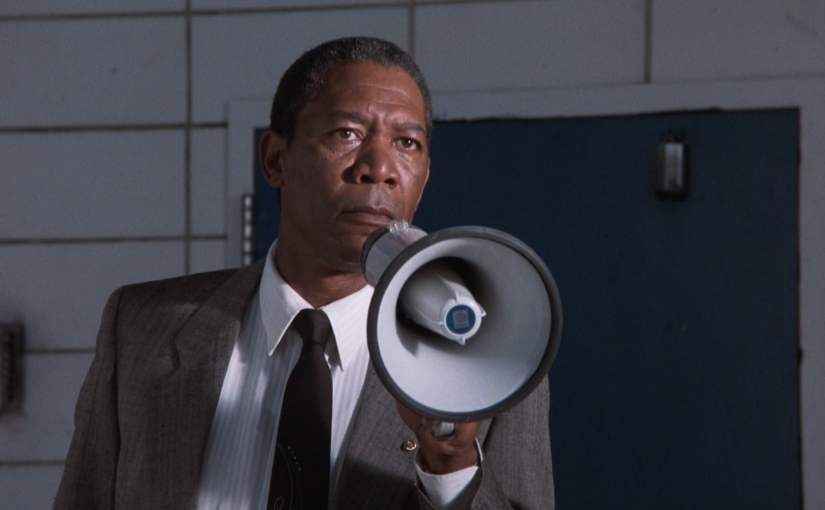
Morgan Freeman portrays Joe Clark, or Crazy Joe Clark with the baseball bat, who singlehandedly (at least according to the film) turned around the Eastside High School of Paterson, New Jersey from a hell hole of violence, drugs and terror into a respectable institution of education.  Eastside, where the actual film was shot, is depicted as the absolute worst.  You can’t even tell the original paint colors of walls because they are covered in so much graffiti.  Early in the film, a teacher’s head is bashed into a puddle of his own blood while trying to break up a fight among the students.  Drugs are exchanged out in the open.  This is a dangerous place. How dangerous?  “Welcome To The Jungle” by Guns N Roses is playing over all of this footage. 

Worst of all, however, seems to be the last place ranking of the school’s score on state’s standardized test for basic education.  After all that I saw in the first ten minutes of the film, that is the biggest concern? 

Joe seems to be the one and only candidate to get in there and clean this mess up.  His tough exterior and reputation for not getting along with his superiors or his peers is a gamble but what other choice does the mayor have at this point.  The first move that Joe carries out is to have all the drug pushers and criminals explicated from the school immediately.  His second move is to chain every door in the school to keep this riff raff out, which only ticks off the fire marshal and a firebrand activist mother who wants Clark terminated.  While I thought the mother was needlessly a pain in the ass, only to serve as a poorly written antagonist, I can’t help but empathize with the fire marshal; cuz, yeah, what would happen if there was an actual fire?

In between all of this, Crazy Joe bullies, berates and screams at his teaching staff and administration while the students paint over the graffiti.  Some of the staff scream back or toss over desks.  Morgan Freeman is such a capable actor and you can’t take your eyes off the energy he brings to his roles, whether they are subdued like in The Shawshank Redemption or Driving Miss Daisy, or they are out of control hyper as on display here.  Yet, I didn’t feel fulfilled or inspired by his portrayal of Mr. Clark or the film as a whole.  It’s not his fault.  Rather it’s the outline of the script.

A running theme here focuses on the scores of the test.  Joe is first mad as all hell at the low score of the practice tests.  We eventually reach the actual final exam.  Much has been cleaned up at Eastside and Joe screams like a hyped-up football or wrestling coach to the entire study body about how important it is to pass the exam they are about to take within the hour.  The students clap and applaud and sing the title song in harmony.  This scene supplies the inevitable and inspiring training montage that Avildsen relies on.  You know what’s going to happen, right?  They pass of course!  Yet, how did they really pass this exam within the ninety days that the film tells us they have to study?

Lean On Me gets distracted with its other problems such as single mothers who kick out their children and drug pushers who manage to get back into the school, where Crazy Joe disarms one of them threatening with a switch blade.  Late in the film, a teenage student gets pregnant, only to have this storyline abandoned thereafter.  The debate with the erratic mother and the fire marshal takes up large portions of the film as well, and when they don’t, Joe is screaming at his band of teachers making sure they know it is their own fault that the students are failing.  All of these moments are meant to get the audience to nod and shake their heads at how much the world is falling apart, while getting tearfully inspired by the angry, tough love of Mr. Clark.  Right on Joe!!!! It’s like a bad afterschool special, really.  I’m not in denial of the endless variety of problems our schools encounter.  However, this film is less than two hours, and these kids have a test to pass, people!

I just think the wrong movie was made here.  I recall from the late 1980s, the real Joe Clark on the cover a Time Magazine defiantly holding his baseball bat.  My teenage self found the cover shocking.  Having gone to private schools full of unspoken discipline, I’d never imagine a teacher brandishing a bat to make his point.  So unusual was this to me that naturally Clark’s story should be made into a movie.  Yet, the triumph of Lean On Me depends on the passing score of the state exam.  Only, just how did these students pass this exam? 

It’s easy to compare Lean On Me to the film Stand And Deliver.  It’s also easy to see which is the better film.  The latter film focused on underprivileged and uneducated Southeast Los Angeles students who triumphantly passed the most difficult of standardized mathematic exams.  When the passing scores arrive at the end, though, I believed the truth of it all because the film focused on the inspiring teacher Jaime Escalante and his methods for teaching algebra and calculus.  Stand And Deliver showed how those students sacrificed their Saturdays to attend class and studied while working or tending to their families.  In Lean On Me, I don’t recall one student opening a single book or any teacher even writing on a blackboard.  They did learn the school song though.

I don’t disagree with anything that Avildsen’s film offers.  Joe Clark saw the importance of learning the school song to build up pride among his students.  He saw the necessity in painting over the graffiti to maintain the image of a proper institution for learning.  He went to desperate and defiant measures to protect the integrity of Eastside High School.  My problem is the means don’t justify the end.  How does chaining doors, painting over graffiti, and singing the school song, accompanied with endless screaming measure up to passing a standardized test?  Did it all just hinge on one proud moment ahead of taking the test with a beautiful and soulful rendition of the song “Lean On Me”?   I know the passing scores were all achieved in real life.  I just wish I got to see it on screen.

Note: Eastside High School is where my mom graduated from.  It did her proud to see the school recover to its original reputation.