
by Miguel E. Rodrigugez
DIRECTOR: John Frankenheimer
CAST: Burt Lancaster, Kirk Douglas, Fredric March, Ava Gardner, Edmond O’Brien, Martin Balsam
MY RATING: 9/10
ROTTEN TOMATOMETER: 91%
PLOT: United States military leaders plot to overthrow the President because he supports a nuclear disarmament treaty, and they fear a Soviet sneak attack.
Barely two years after The Manchurian Candidate shocked audiences, director John Frankenheimer delivered the goods again with a political conspiracy thriller that is the equal of Candidate in almost every way. Were it not for some overcooked sermonizing during a transitional scene, I would almost call Seven Days in May a perfect example of the genre. I’m frankly a little surprised it’s not mentioned more often in the same breath with other similar thrillers like Fail Safe, The Parallax View, and Three Days of the Condor.
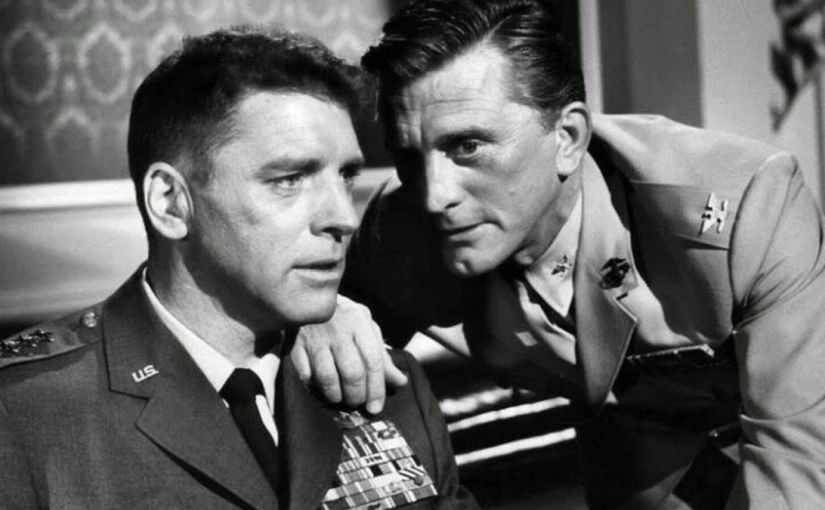
The action starts on a Monday and, predictably, spools out over the next seven days. We learn that the current American President, Jordan Lyman (Fredric March) has just signed a nuclear disarmament treaty with the Soviets, this being the height of the Cold War in the early 1960s. His actions have brought his approval ratings to a record-setting low, and demonstrators outside the White House express their desire to see someone else in the Oval Office: General James Scott (Burt Lancaster), a hawkish individual who sees no evidence the Russians will ever honor such a treaty. General Scott’s aide is Colonel “Jiggs” Casey (Kirk Douglas), a soldier who disagrees with Scott’s views privately, but who knows his duties and performs them admirably.
Over the next couple of days, Casey picks up scraps of conversations from senators and other generals critical of the President. There is talk of the President attending an “alert”, or an exercise in which armed forces are scrambled in a drill; uncharacteristically, he’s attending alone – no press. A friend of Casey’s mentions something called “ECOMCON”, a secret Army base in El Paso, and a mysterious “Site Y.” A Pentagon messenger relays a teletype message from General Scott to other members of the Joint Chiefs about who’s placing bets in the Preakness pool…then gets transferred to Pearl Harbor. Casey wonders why questions about a horse race would be broadcast over Top Secret channels…
Watching Casey piece the clues together is one of the pleasures of this movie. It never talks down to the audience, depending on them to follow Casey’s line of reasoning while he draws his own conclusions. Once he brings his suspicions to the President, and the President elects not to attend the alert, things start happening very fast. It’s here where the height of suspense occurs, as three men are sent in different directions to accomplish three separate fact-finding missions. As each man got closer to achieving their goal, there was a feeling in the air, a vibe, a tone that felt like disaster was just around the corner, knocking on the next-door window. A man drives his car into the desert in search of the secret base in El Paso, and I half-expected the sands to just open up and swallow him whole.
Frankenheimer always was an expert at that kind of suspense generation. Second only to Hitchcock among his contemporaries, he was a genius at creating tense situations with a minimum of flash, depending on strength of story and screenplay, and his actors, to generate a nervous tension in his viewers. Those powers are on full display here.
It’s odd…Seven Days in May is a political thriller that doesn’t have any real action scenes or sequences. A plane crash is referenced but never seen, as opposed to today’s films that would make room in the special FX budget to show audiences the crash. At least in this film, it’s far more effective when it’s revealed but never seen. That’s pretty gutsy. There are no pumped-up chase scenes between a guy with crucial evidence and the shadow forces trying to keep it a secret. It’s all handled very simply, which makes everything more plausible…and, as a further result, much more suspenseful.
I haven’t mentioned Ava Gardner’s character yet, Eleanor Holbrook, a former lover of General Scott’s. How she figures in Casey’s plans to uncover evidence of Scott’s treason leads to a devastating scene involving old love letters and mistaken assumptions. It’s some brilliantly incisive writing, and another example of how the movie achieves plausibility through simplicity.
Any further discussion would necessarily involve spoilers, so I’ll stop here. Seven Days in May is a prime example of a good story told well, with hardly any bells or whistles. It reminded me, for some reason, of some of those classic ‘80s thrillers where their only reason for existence was to turn up the tension without getting bogged down in subtext (Body Heat, No Way Out, Blow Out). There is that one sermonizing speech, as I mentioned before, and I cringed a little when it happened, but it’s a minor quibble. This is a superior thriller that deserves to be seen.
 2 UNPAID MOVIE CRITICS!!!!