FURIOSA: A MAD MAX SAGA

By Marc S. Sanders

George Miller has never gone deep with his Mad Max movies.  The director treasures the inventions of his auto chases and the tricked out diesel junk contraptions that participate in high speed pursuits through his apocalyptic desert wasteland.  The more outrageous the vehicles and the crazier the stunts are, the more fulfilled Miller appears to be with his filmmaking.  However, the fifth film within this gonzo world of barbaric S & M dressed drivers invites us to explore the past of a surprisingly treasured character,  introduced in the prior film.  Her name is Furiosa and this time we see what she experienced as a young child (Alyla Browne), followed by what she learns as a young adult (Anya Taylor- Joy).  This fifth film in the franchise serves as a prequel to the last film, Mad Max: Fury Road.

As a pre-teen, Furiosa is abducted by the bandits who serve under the pompous and proud Dr. Dementis (Chris Hemsworth, playing his Thor role as if the Marvel character was a celebratory villain). A thrilling prologue covers this sequence of events with rescue efforts from the would-be heroine’s mother to save Furiosa and bring her back to their secret home of green vegetation located beyond the desert plains.  There are heart stopping motorcycle chases with the warrior mother bearing a sniper rifle and fighting with her last breath through the whole sequence.  Charlee Fraser portrays the title character’s mother. Thanks to her performance, she had me convinced me that the rescue will deem successful, accompanied by Miller’s reliable direction.  An absolutely thrilling opening.

Dementis rides his esteemed tri-motorcycle chariot steed, inspired by the sword and sandal adventures of Ben Hur and Gladiator.  A hilarious over the top vehicle to see Chris Hemsworth piloting.  His biker gang is in tow along with young Furiosa as they journey to the Citadel, first seen in Fury Road.  Dementis puts his conceit against that of Immortan Joe (Lachy Hume) the skeleton masked ruler of The Citadel for a chance at…what else?  Conquest and power.

Furiosa grows up a few years and gets mentored by a trucker named Praetorian Jack (Tom Burke).  I still love these character names by the way.  The truck chase is the highlight of the picture, with paragliding motorcycle riders swooping in like large attack birds trying to sabotage the weaponized rig full of delightful surprises that’ll make you shout “OH!!!” in the middle of the theater.  It is sequences like this that audiences adore in the Mad Max pictures. 

Unlike the other films though, Furiosa gets a little lethargic during the story set ups which are angles that never anchored the other better installments, The Road Warrior and Fury Road.  Reintroducing the Immortan Joe character is not as interesting this time and this desert picture gets a little too waterlogged when he enters the story.  He just doesn’t feel very necessary.  The two younger Furiosas and the self absorbed Dementis are plenty with just enough story opportunities to make a solid movie.  Retreading on other characters slow this fifth installment down a bit.

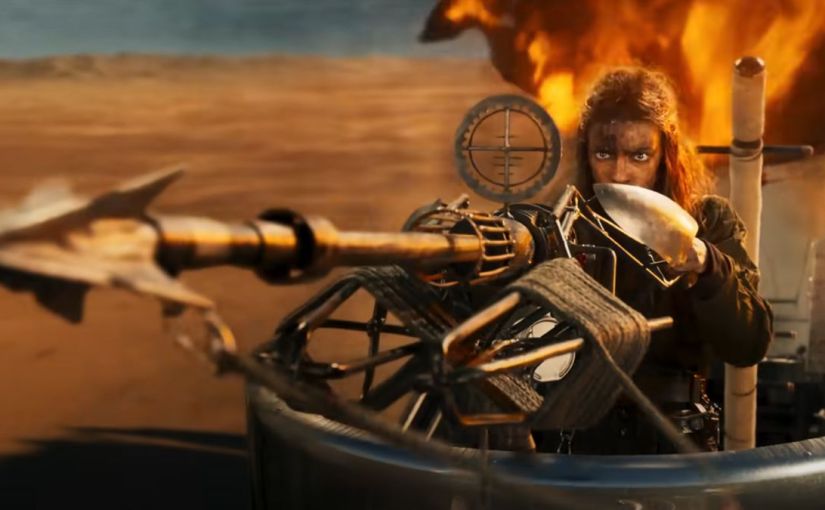
The whole cast looks great.  Anya Taylor-Joy is the best bad ass version of a younger Charlize Theron, who originated the role.  She hardly has any lines but her expressions on camera beneath the war paint, grease, dirt and long hair extensions look awesome.  Though the lead actress is hilariously dwarfed by Hemsworth’s Dementis, they make for a great dichotomy of hero vs villain.  She’s the quiet reserved David.  He’s the proud Goliath.  This is a dream casting pair.

Practical stunts are done once again and George Miller does impressive work with his camera.  His tactics for filming action scenes demonstrate why a Michael Bay normally fails.  Nothing is a quick take edit.  You watch these motorcycle riders and Furiosa hold onto to the bottom of the speeding truck and Miller will circle the camera, with no cuts in the take, so we see what is happening next to both sides of her profile.  The camera will then swoop up to see who’s running and holding on to the top of rig or who is parasailing from a great height while tethered to some kind of buggy vehicle below.  Amazing work.

However, seeing Furiosa on a large Dolby screen, it’s not hard to see a computer enhanced finish applied to the photography.  It’s very glossy and nowhere is it grainy like the very early Mad Max films from over forty years ago.  Yet, as dirty as these vehicles and characters are, the cleanliness of the cinematography sometimes does not clash well with what’s on the screen.  It’s a little distracting honestly and that was a surprise to me considering how perfect Fury Road looks on my 65-inch flat screen at home.  This one looks a little too perfect.  This might be that film where less may have been more.  

The background story work on Furiosa is not a terrible grievance.  The final print of the picture is acceptable.  All of it is definitely worth watching and I hope box office picks up following a sluggish opening weekend because I encourage anyone to see Furiosa: A Mad Max Saga on a big screen first.  I just think George Miller and company may have leaped much further than necessary this time around.

MAD MAX: FURY ROAD

By Marc S. Sanders

After watching Mad Max: Fury Road, you will feel like you need a shower.  Strike that, you will need a shower in aloe first, then a traditional shower and then a weeklong bath in aloe.  It’s a baked in environment that gives you the feel of grainy sands and burning sunbeams.

George Miller’s return to the gonzo, apocalyptic diesel future franchise is exciting from the moment the Warner Bros logo appears with the vroom vroom blaring through your sound system’s speakers.  Miller hardly surrenders the breakneck speed of his two-hour picture to let an audience catch a breath, and because the director is so unforgiving it makes this a tour de force of action entertainment that other adventure films can only strive to at least match.  Still, the movie has next to no story, and that’s fine.

Up until this 2015 reinvention, Mel Gibson was the Aussie Road Warrior donned in leather fighting to survive against lawless bandits coming from any direction in the sand swept plains of an earth afterlife.  Now Tom Hardy takes over the role.  Frankly, it could have been anyone who got recast in the part.  Hardy has few lines and for half the film his face is caged in a grotesque, steel bar mask while he is strapped to the front of a hot rod, gear grinding, amalgamation of a vehicle, simply to be a kind of three-dimensional hood ornament.  This Max is suffering through high-speed chases with his head trapped in animalistic headgear and his arms and legs bound behind his back while he’s tethered to this four-wheeler.  It’s brutal and we can feel how tortuous it is for Hardy’s character.  Yet, we love it!!!!  Keep it going, George!

The real star of Fury Road is Charlize Theron as a one arm rebel caked in black grease with a shaven head.  Her name? Imperatour Furiosa.  What a name!!!!!  Furiosa attaches a steering wheel to the driving hilt of an 18 – no 20, maybe 24-wheeler (it could even be 36) big rig with a big ball of fuel hitched to the back. She detours away from a band of outlaw drivers ruled over by Immortan Joe (Hugh Keays-Burn).  Yes!  His name is Immortan Joe. 

In tow with Furiosa are Joe’s pregnant concubines whose fetuses are declared his property.  These lovely lasses dressed only in bed sheets have names like Capable, Cheedo The Fragile, The Dag, Toast The Knowing and The Splendid Angharad (Riley Keogh, Courtney Eaton, Abby Lee, Zoë Kravitz and Rosie Huntington-Whitley).  What is the point of listing off these ladies’ identities? Well, the script for the film doesn’t do so. Yet, the end credits do in a heavy metal kind of font, and it is clear that George Miller is proud of every name, every piece of junk that flies through the air in one crash and bash after another, and every flame that exhausts out of a pipe or even a death metal rock guitar orchestrated by a guy simply known as The Doof Warrior (played by a musician named Iota).  Incidentally, The Doof Warrior is garbed in red long johns and tethered by chains to a big rig with the biggest, blastiest speakers known to man.  The Doof Warrior serves no purpose except to scratch on the guitar while flames shoot out of the stem.  I’m laughing as I type this all out.  This whole display is thankfully ridiculous while all of these figures have the most outlandish and greatest names of all time!!!!

When Furiosa diverts away in the mighty big rig with the pregnant women, Joe follows suit with his endless band of albino crazies in one tricked out vehicle after another.  One car has the chassis of a Mercedes wedged on to the fattest wheels ever conceived.  Another is a Chrysler (I think) resting atop a pair armored tank tracks.  Joe’s automobile looks like it got disqualified from a monster truck rally because it was caught taking diesel steroids. 

Anyway, Mad Max eventually catches up with Furiosa and the ladies.  His last name is not something simple like Jones, Smith, Sanders or Rodriguez.  It’s ROCKATANSKY!!!!!  BOOM! That is awesome!!! A one-time underling of Joe’s, named Nux (Nicholas Hoult), eventually sways over to the heroes’ side as well, and the pursuit carries on.  Furiosa’s destination is a location of green, beyond the desert wasteland.

It’s a wonder that Mad Max: Fury Road was applauded so much in 2015.  However, take a moment to consider the construction of this two-hour operatic noise fest and you cannot help but salute all the merits that went into the final product.  First the nominated visual effects are primarily practical with little to no CGI.  If George Miller is going to make another Mad Max film, he’s going all the way.  The cinematography is gorgeous in a tan, orange, and yellow sun burning desert, while the night scenes are unhidden due to a pure, bright blue.  The interior of the truck seems cramped and uncomfortable, and yet Miller leaves enough room for the viewer to sit inside and uncover every hidden firearm plus get up close with the driver and the lady passengers.  There’s even a cool weapon found in the stick shift.  Wait until you see that!  The editing is relentless with perfectly captured close ups of so many character drivers and passengers all in a matter of seconds.  Plus, wide overhead shots and extended ground captions make it easy to understand just how many vehicles are included in this endless demolition derby.  I’m talking hundreds of monster machines ready for weaponized destructions. The choreographed action scenes of gun shots firing and vehicular collisions is like a ballet of a perfect derby show.  Monster razor blades are given their due, along with an assortment flame throwers. Also, kamikaze suicidal albinos are ready to act like destructive grenades.  Not one scene or shot in a Transformers CGI picture of metal vomit comes close to a millisecond of George Miller’s craft.

No other film could be as deserving of Academy Awards for sound, cinematography and editing as well as nominations for Best Picture and Best Director.  Even the warped-out S&M costume designs and make up are eye popping; merits that also earned Oscars.  You might have a fondness for art house cinema like Fellini or perhaps a Daniel Day-Lewis piece that invests in the method of caliber acting performances, but you cannot deny the artistic efforts vested by George Miller, his editor wife Margaret Sixel, and the rest of the crew. Mad Max: Fury Road was placed on so many top ten lists in the year 2015, and its because the film succeeds in the best of technical achievements. 

George Miller operates like that nasty kid named Sid from the Toy Story pictures.  He assembles his set pieces in the most tricked out, ugly and grotesque combinations of auto body parts, gives them engines that breathe fire and roar like vicious beasts that smell like diesel and then collides them altogether in a wide open plain.  Try to imagine Miller as a young child with his Matchbox cars on his bedroom floor.  His parents might have had some concern while observing his play activity.  What’s appreciated though is that this director never settled for simple with his Mad Max films and he never repeated what he’s already demonstrated.  No car crash looks the same.  No single shot is  repetitive.  This is how a director of any film genre should operate.  When they take attentive care to every frame they capture with their camera, then they get a Mad Max: Fury Road

One of the best films of the twenty-first century!

NOTE: I originally saw this film in 3-D in the theaters.  Wanna know my sentiments towards 3-D? Well, I hated this film after I saw it.  I gave up five minutes into the piece because the 3-D was unforgiving in distraction and dark beyond comprehension and measure.  Watching Mad Max: Fury Road again, a number of years later in a standard 4K on my 65-inch flat screen, you can likely tell by my write up that my sentiments have drastically changed for the picture.  It’s also telling to note that the new prequel film Furiosa is not being presented in 3-D.  Unless it is a James Cameron film or a special exception like Ridley Scott’s Prometheus, modern 3-D is as big a failure as the new formula Coke was back in the 1980s. 

THE ROAD WARRIOR

By Marc S. Sanders

An Australian post-apocalyptic desert wasteland is the setting of George Miller’s B movie classic The Road Warrior.  It’s a film deliberately short on depth, but big on mash ‘em up, bash ‘em up high-speed hot rods, muscle cars, motorcycles and one big rig truck.

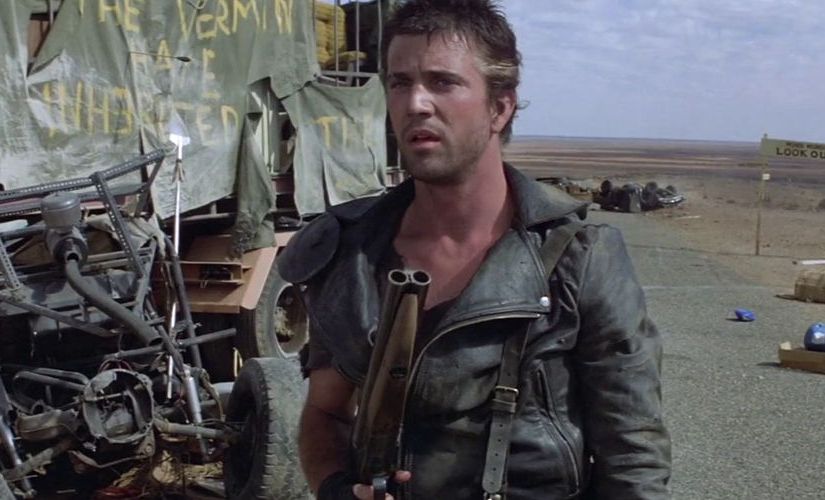
Mel Gibson returns as Mad Max, the leather wearing drifter driver who patrols the endless roads.  A brief narrative at the beginning recaps some of the events of Miller’s first film in this series, Mad Max, explaining that the governments worked against one another, riots ensued, and a nuclear holocaust left little of the population to survive with a shortage on the most precious commodity, fuel.  Max was a policeman whose wife and child were slaughtered by the way, but that’s not relevant here.

The center of the film focuses on a small community of people dwelling in maybe the last known functioning oil refinery.  However, barbarians led by The Humungous (Kjell Nillson) who wears a hockey mask and S & M straps over his bare body are intent on taking over the precious area.  The Humungous’ second in command is a red mohawked freak named Wez (Vernon Wells).  Everyone else in the gang is dressed in the same thematic sex play costume wear with their ass cheeks on display. 

Following some episodes of havoc, Max, along with his dog named Dog, form a contract with the oil refinery dwellers to get the big rig, fuel it up and attach it to a tanker for a journey across the wasteland towards a paradise of ocean blue oasis.

Max has sixteen lines in the whole film.  I’ve expounded on this movie more than he ever could.  In fact, Dog has more dialogue. George Miller knew he wasn’t writing anything of multi dimension or fleshed out characterizations.  You can hardly understand anything that The Humongous has to say or bellow.  It doesn’t matter.

What’s important is the demolition derby footage contained in The Road Warrior.  It’s thrilling.  Bodies get bashed by metal and caught in barbed wire.  Explosions go off in huge fireballs against a scorching sun.  Max fires his sawed-off shotgun at these gonzo gangsters.  They fire crossbow arrows in return.  Some of them use inventive gladiator kinds of weapons with sharp blades and spikes. 

Miller’s frames per second accelerate the various chases.  Multiple collisions end up in a sand dune or turning someone’s ugly sunburned face into hamburger.  The editing of these scenes is magnificent.  Every crash is pieced together cohesively.  Zoom in close ups are spectacularly orchestrated and the cinematography holds up for welcome daylight action where you can easily make out who is who and what is where. 

The inventions of these junk machine jalopies are quite fun too.  Syd from Toy Story must have taken inspiration from this movie when he assembled his freakazoid toys that tormented poor Woody.  Other than Max’s black muscle car and some motorbikes, everything else looks drilled and fused together for relentless mayhem.  Sedans, SUVs, and station wagons would never survive.

George Miller’s world may seem a little prophetic these days.  It’s not that there’s such a rarity of gas, but the need among the masses to hoard fuel is there considering the inevitable price hikes spread around the globe.  Oil will always be a precious dependent.  Environmentalists, I feel for your crusade but be damned. Oil powers so much in and out of this planet.  Electric cars and the few power-up stations are not the dominant alternative yet and won’t be for a while.  Their longevity has not been proven.  Even the disposal of their expired parts has not yet been considered.  So don’t hate me Elon Musk.  I’ll happily eat my words one day, though, I’m sure.

As thin as the storyline may be, George Miller created this dystopian era for Mad Max to drift through and I commend the imagination of the MacGuffin.  Oil is what we rely on, and the setting of The Road Warrior may not be so far-fetched if it ever came to be that we were short on it.  However, I’m not running out to get my masochistic leather body armor just yet.

Wez, The Humungous and their bandit barbarian warlords may be fearless nut jobs, but I get their motivation.  You never know when rush hour may rear its ugly head in a post-apocalyptic age.  So, you better fuel up your Harley, BMW and Toyota because the boss is still gonna want you sitting at your desk by nine.

MAD MAX

By Marc S. Sanders

What is the fascination with George Miller’s original 1979 film, Mad Max?  I don’t get it.  I know this film shot in the Australian outback was made a on budget less valuable than even a shoestring.  The fast-paced camera shots of cars careening down long stretches of highway are high octane (pun, most certainly intended) and the crashes are completely in your face.  Yet, I need more than this. 

When the film pauses for albeit very brief moments of storytelling such as a motorcycle gang apparently out for revenge against dystopian future cop Max (Mel Gibson’s breakout role), how is this ever even learned among the characters?  When Max opts to resign from the police force and take his wife and young son on holiday, how does this motorcycle gang led by a savage named The Toecutter (great name) catch up with them, and then after a narrow escape, how do they catch up yet again with one another, while making a sudden appearance on the back of these noisy motorcycles?  Miller’s film never goes from A to B to C.  Rather it goes from W to S to Q and then Z.  It’s a mixed up mess.

I’m all for throwing logic out the window when watching a thrilling action piece…if it’s thrilling.  When it’s not, well then, I’m asking for the logic.  Miller’s film feels like a bunch of want ads cut out of old newspapers, and then scotch taped together into a film reel.  I’d be curious to see an original script.  I can only imagine it being no more than three pages long. 

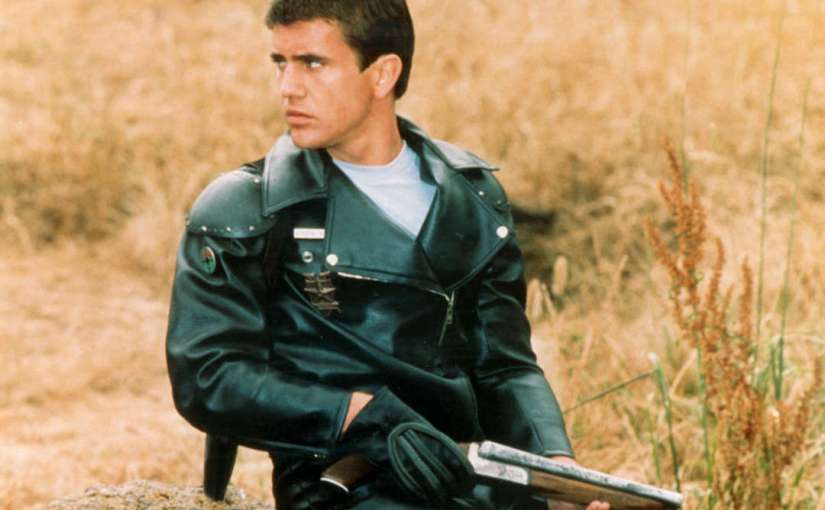
The appeal in 1979 and the years thereafter when the Max character blossomed into a franchise must have come from Gibson on film.  Yes, the stunts in this film with quick edit action pieces are daring.  I still think so forty years later.  This wasn’t CGI after all.  This was all the crunched up metal, rubber tires and flames that Miller could muster.  Still, the one artistic achievement had to be Mel Gibson’s image.  He wears the costume well.  A blue t-shirt enhancing his blue eyes under all black leather with a sawed off shotgun in his right hand while driving a souped up black Pursuit Special automobile with the engine sticking out of the hood.  Just writing that out reminds me of how iconic that image is, and this is before the similar looking Terminator that came along a few years later. Still, that’s where George Miller’s inventiveness stops. 

There is nary a character to consider.  The villains are nothing more than leather clad with bleached hair and dark mascara under the eyes riding Kawasaki bikes.  I know this was made with next to no money.  These guys don’t have to look like Darth Vader, but could they at least offer up something interesting to say?  Max has a couple of partners in the police squad.  They have no camaraderie.  One of them gets burned to a crisp.  Max takes a look at him in the hospital.  Why should I care though?  It’s not like I saw these guys share a Coke together.  Max is married.  They lie side by side each other in bed and their toddler sits on the floor nearby.  So?  Anything else?  Could one of them start a pillow fight or kiss or something, please?  A shoestring budget can still allow relationships to happen.  Miller doesn’t care about that though.  John Woo may show a nonstop bloodbath in any of his films with next to no story.  His films can work however, because he won’t get sidetracked with showing two people in their bedroom doing nothing.  He’ll remain focused on the mayhem.  Miller is not doing that here.  He shows a house with a bedroom.  Yet he doesn’t show the story in that bedroom that’s in that house.  That’s the difference.

I know the subsequent films in the franchise vastly improve upon the original Mad Max.  I’m just amazed they ever saw the light of day.  I’m more amazed that this became one of the most profitable films in worldwide history.  How did 1979’s Mad Max have the legs…no…the wheels…to maintain this ongoing velocity of interest?  What do I know?  I guess I’m a Debbie Downer for wanting people to talk to one another before handcuffing them to a gas guzzling fiery wreckage.  Is it too much to ask for a little sensitivity?