THE BRIDGE ON THE RIVER KWAI

By Marc S. Sanders

David Lean’s The Bridge On The River Kwai commits to a common theme.  The purpose of war means nothing to the pawns assigned to execute its actions.

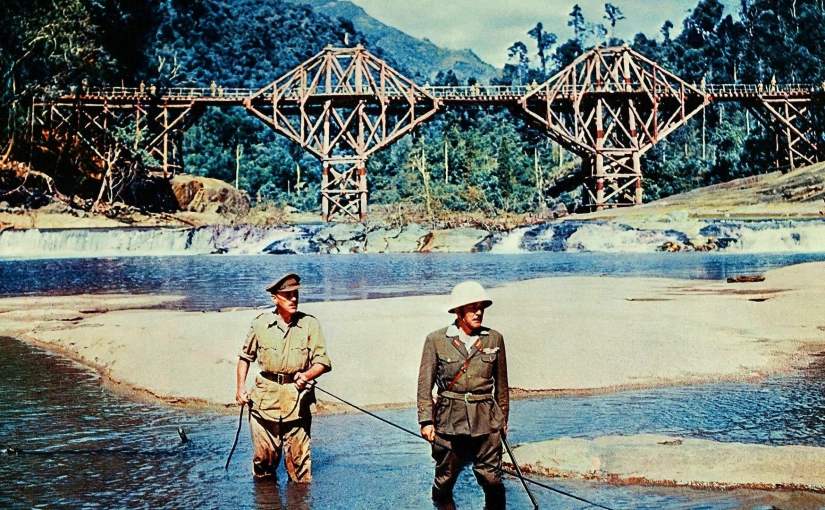
The film primarily takes place in Japanese occupied Burma during World War II.  A prison has just acquired a British platoon of soldiers, and the Japanese have mandated this squad to construct a railway bridge that will run over the Kwai river benefiting the Axis efforts in the war.  Colonel Nicholson (Alec Guinness, in a celebrated early career role) respects the rules of war that come with his battalion being held as prisoners of the Japanese enemy, and he is prepared to have his men begin construction.  However, as his copy of the Geneva Convention Agreement dictates, his officers are not obliged to join in the assignment.  

This is a far off deserted jungle however, that does not even need to be fenced off because an attempted trek to escape is bound to fail.  Therefore, the Geneva Convention Agreement has no value of authority out here in this bug infested, stilted and sweltering heat with minimal resources of food, clothing or medicine.  The Japanese commander Colonel Saito (Sessue Hayakawa) does not hesitate to swat Nicholson’s copy in the Englishman’s face.  Now, since the politics of war are no longer a factor, the stamina of these two men are what’s at stake.

Saito forces Nicholson into a cramped, isolated hot box with next to no food or water.  He’s lucky because his remaining officers are forced to share the other box together.  Saito will force them to comply, or he may just have to kill himself.

The Bridge On The River Kwai explores how productivity, leadership and endurance thrive, but at a startling cost of madness.  Before you realize it, none of these characters are speaking of their respective war efforts or even the mandates of war.  As Nicholson persists in his stance as a defiant leader, a remarkable tide turns within this prison camp.  Soon, the question arises as to who is running this camp and overseeing this bridge project. The enforcers or the prisoners? 

A separate storyline involves an American prisoner named Shears (William Holden) – one of the last men in his platoon to survive, and now only here to bury his fallen comrades.  He’s introduced to describe the harsh reality of what Nicholson and his men can expect.  Yet once Shears escapes the camp, he is caught in a twisted irony, being forced to return to the prison camp where he must destroy the bridge under the command of a British special forces leader named Warden (Jack Hawkins).  Warden goes through his own form of madness.  A badly injured foot becomes something worse than a bloody stump and still he insists on leading his small brigade into the jungle.  

Meanwhile, as Nicholson develops more control over the camp, with Saito realizing his own pitiful ineptitude, a faction of the British are now likely to engage with Nicholson’s newfound achievement as a leader over his own squad, as well as the human Japanese resources he’s also recruited to complete this solid foundation.

David Lean had a reputation for never settling for less on his pictures and The Bridge On The River Kwai is a perfect example.  I recently watched the film, for a second time, with my fellow Cinemaniacs.  Thomas and Miguel assuredly pointed out that one less than sturdy bridge was constructed by Lean’s crew to demonstrate its weaknesses and the lack of engineering the Japanese possess, before Nicholson fully takes over.  That structure collapses on film and thus lends to the next plight in the story, when Nicholson proves to Saito that he is more capable than his enemy counterpart.

Later, the actual bridge is finished leading to a nail biting ending that elevates in suspense as an oncoming Japanese train is heard approaching with its signature whistle and chugging overheard as Colonel Nicholson proudly walks across his success, newly minted with a plaque carved with his name.  Elsewhere in the area are Stearns and Hawkins.  What began with Japanese antagonism has shifted to one side likely to do battle with itself.  

Who is fighting who?  More importantly, what are they fighting for?  War or persistent, delusional madness?

The Bridge On The River Kwai is a magnificent adventure produced with sensational filmmaking.  The investment and risk that David Lean took to assemble this picture is astounding.  It was filmed within the actual jungles.  (Miguel said somewhere around Sri Lanka.) The costumes worn by the thousands of extras are tattered dirty scraps that certainly does not invite the sex appeal you’d expect in a modern film of this kind.  Moreover, the audacity of the filmmaker at least matches the nerve of the story’s cast of characters.  

The cast is marvelous, but it is Sessue Hayakawa and Alec Guinness who serve the impact of Lean’s film.  The movie comes close to a three-hour running time.  The first half of the film has Hayakawa positioned as the leading antagonist, but the second half has Guinness filling that spot.  They almost seem to mirror one another as their character arcs move in parallel but opposite directions working to accomplish their goals, while shedding any kind of humane concern for their underlings or the countries they serve.  

I consider this film to be groundbreaking.  It’s a spectacle, but it allows much to be examined in mental acuity, military allegiance and endurance.  The Bridge On The River Kwai tests how effective war can be for any side that participates.  My Cinemaniac comrade, Thomas,  informed me that the story, adapted from a novel by Pierre Boulle, is entirely fictional.  Still, I believe it garners an important message.  Are we supposed to truly embrace “rules of war?”  This is not Risk the board game.

These men might carry the titles and rankings issued to them by their governments. However, isolate them in the middle of nowhere and who is going to uphold any semblance of regulation?  War functions on efforts of violence.  When was the last time anyone had respect for violence?

HOBSON’S CHOICE (Great Britain, 1954)

by Miguel E. Rodriguez

Director: David Lean
Cast: Charles Laughton, John Mills, Brenda de Banzie
My Rating: 7/10
Rotten Tomatometer: 92% Fresh

PLOT: A widowed bootmaker in 1880s England with three unmarried daughters is thrown when his eldest daughter announces her intentions to marry his best cobbler and start her own business.


From Wikipedia: “A Hobson’s choice is a free choice in which only one thing is actually offered. … The most well-known Hobson’s choice is ‘I’ll give you a choice: take it or leave it’, wherein ‘leaving it’ is strongly undesirable.”

Ask ten cinephiles about their favorite David Lean films, and I’ll bet dollars to doughnuts not more than two of them will even know Hobson’s Choice exists.  It’s one of only two comedies Lean ever directed (the other being Blithe Spirit in 1945), and it’s one of the last smaller-scale movies he would direct before 1957’s The Bridge on the River Kwai made his name synonymous with big-budget cinematic spectacles.  Hobson’s Choice oozes charm from every frame, has many well-earned laughs, and features a brilliant performance from the great Charles Laughton.  I just wish it had a better ending.  I’ll try not to spoil it for you, but…dang.

Henry Hobson (Laughton) is a widowed bootmaker in late 19th-century England with three unmarried daughters.  The eldest daughter, Maggie (Brenda de Banzie), keeps house, manages the books, and essentially runs the business, leaving Henry free to drink himself silly at the local pub every night and come home drunk as a skunk.  Being of an undesirable age – 30 years old – Maggie is also considered unmarriable.  But she’s no dummy.  See, one of Henry’s employees is a cobbler named William (John Mills, a legendary, prolific British actor), and Maggie notices when a rich patron praises William’s boots as the best she’s ever owned.  So, Maggie hatches a plan that will accomplish three things: get herself married, steal her father’s prize employee, and start her own business with the best bootmaker in town.  Hobson, of course, will have none of it, for various reasons…one of which is that, as the father, he is expected to pay a handsome dowry to the bridegroom, and he’ll be damned if he’ll give hundreds of pounds to a lowly cobbler, nor will he allow his “uppity” daughter to get the best of him.  Comedy ensues.

There is a lot to like in Hobson’s Choice.  First, there is the clever skewering of the class system, both socio-economically and along gender lines.  Hobson is reluctant to pay anything to William other than his barely-livable wages.  When circumstances force him to treat William as if he were a member of the same middle class as he, Hobson, is, he becomes enraged because…he simply has no choice.  The idea of all men being created equal is alien to him.  This same principle applies to his treatment and perception of his daughters.  He may genuinely love them in his heart of hearts, but all we ever hear from Hobson is how bothersome and loud and “uppish” they are.  To him, their sole purpose is to keep things neat and tidy and have dinner ready when he demands it.  It never once occurs to him that Maggie, the eldest, would be capable of putting her plan together, let alone actually pulling it off.

I also enjoyed how a good chunk of the story parallels Shaw’s Pygmalion, at least in broad strokes.  Will, Hobson’s prize cobbler, is as low-class as you can get, and has been treated as such his entire life.  Part of Maggie’s plan is to get Will to behave and dress more genteelly, and her method is nothing short of brilliant.  Rather than follow Henry Higgins’s approach – bullying with a heavy hand – Maggie very gently points Will in the right direction, stepping in with a firm hand only when necessary, as when it becomes necessary to deal with Will’s landlady, one of the funniest bits in the movie.  At first, Will is taken aback by Maggie’s directness, but it’s fun watching how gradually he gets turned around.  He may not be the spitting image of a member of the royal family after all is said and done, but his transformation is unmistakable.

Another great factor is the blustery performance by Charles Laughton in a role that, in my opinion, deserves more attention from film fans.  He’s most commonly associated with Quasimodo or Captain Bligh or the barrister in Billy Wilder’s Witness for the Prosecution (1957), but in Hobson’s Choice, he convincingly plays a man who is painfully aware he’s being driven towards a specific decision he does not want to make.  He’s been lord of the “manor” his entire life, and the idea that he might be forced to bow to his daughter’s whims is unbearable.  He is the most fun person to watch in the film…although John Mills is a close second.  I love his borderline incomprehension as Maggie patiently explains her plans and orders him about.

As I said, there is a lot to like in Hobson’s Choice.  But, man, did that ending let me down.  I was reminded oddly of David Cronenberg’s most recent film, Crimes of the Future (2022), which rolls the closing credits at the EXACT moment it becomes the most interesting.  I have no theatrical knowledge of the play on which Hobson’s Choice is based (other than the fact it ran for over 130 performances), but if the play ends the way the movie does, and I had been a member of the audience at a performance of that play, I would have rolled up my program and chucked it at the curtain.  I don’t want to give too much away, but its abruptness is breathtaking.  In my mind, it leaves far too much unresolved, unless there’s something I missed in that final scene/conversation.  I kept waiting for Hobson to make his eponymous choice, and for a second it LOOKED like he did, but it also looked like he had a devious plan of his own, and then…credits.

Oh, well, no matter.  There is more charm in a single frame of Hobson’s Choice than there is in any two Will Ferrell rom-coms.  I found it thoroughly enjoyable, even if it did let me down at the end.  Since Lean directed my favorite movie of all time, I’m inclined to forgive it.  I’ve seen most of Lean’s other films, and none of them committed this same blunder, so…c’est la vieHobson’s Choice is still worth seeking out.

LAWRENCE OF ARABIA

By Marc S. Sanders

The moment finally arrived where I was able to see David Lean’s epic, also regarded as my colleague Miguel’s favorite film, Lawrence Of Arabia.  It truly is an eye-opening spectacle, and one of the most beautiful pictures I have ever seen, especially enhanced by an up-to-date Blu Ray restoration.  With a near four hour running time there is hardly an element or sliver of film that does not appear out of place.  Far ahead of the conveniences of dazzling special effects and CGI to arrive later in the twentieth century and beyond, Lawrence Of Arabia must be one of the greatest cinematic achievements ever created. 

When you factor in what David Lean made with an earlier picture, The Bridge On The River Kwai, it is fair to say that he was the James Cameron of his time – a bold, daring film director who did not surrender until every shred of a masterpiece was included in a final cut.  What puts a man like Lean ahead of Cameron perhaps, is that he depended on the resources of thousands of human extras and animals, broad desert landscape locations, painstaking architecture to set designs and buildings, along with authentic explosions and battlegrounds while delivering the story of British Lieutenant T.E. Lawrence and his efforts to aid an Arab nation into battle against the Turks during World War I. David Lean was persistent in bringing as much natural quality to his finished product as possible.  In fact, Miguel informed me that Lean was seeking out any possible way to point his cameras at the desert sun to heighten the feeling of the sweltering, unimaginable heat endured by his cast of characters.  It likely pained Mr. Lean that he had to settle for an optical illusion.  Nevertheless, when I was watching the movie, it did not occur to me once.  I was still appreciating his strive for absolute authenticity.

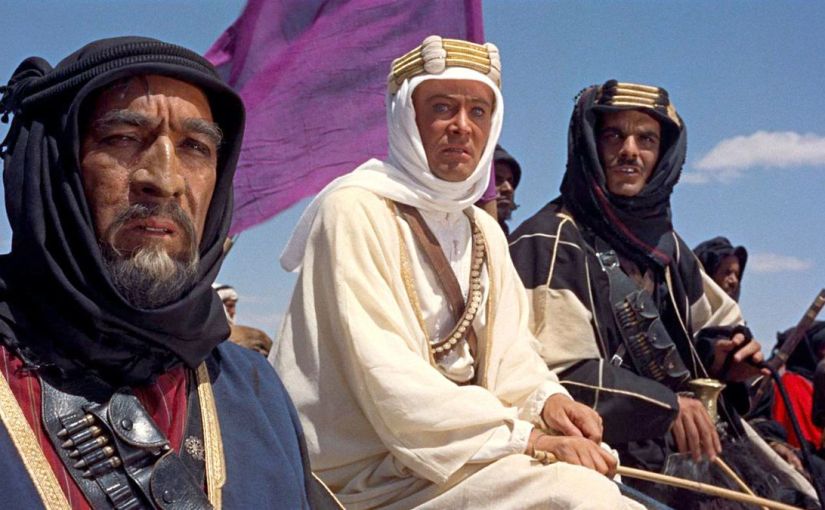
Peter O’Toole is the title character in his unforgettable film debut.  A daring, handsome, charming blond leading actor poised for adventure.  Lawrence is assigned to ally with the Arabs during the war to hold on to the necessary access of the Suez Canal which is a through way for oil, supplies and territory.  His determination for crossing wide, endless desert plains under a sun drenched open blue sky turn him into a leader, and a hero to the Arab soldiers, particularly represented by Sherif Ali (Omar Sharif).  They are a small band of fifty men, but Lawrence proceeds with the intent of gaining fifty more as he begins a long trek from one side of the desert to the other with persistent walking or by riding camel.  Lawrence won’t even leave a single man behind.  His resolve is courageous but could be costly later.

The technical construction of Lawrence of Arabia is likely what many notice and remember first, but the film comes with a well-set character arc for its protagonist.  Peter O’Toole was a perfect casting selection for this role.  Lawrence changes over the course of the film and it’s not a celebratory transformation.  Oft times, it seemed ironic to consider him the villain; perhaps a hero who falls from grace.  His derring-do is impressive, but likely also his undoing.  Lawrence allows strength and confidence to awaken a weak Arab nation who only survived for themselves with what little they held onto before their encounter with him.  Yet, the monster Lawrence creates within his own psyche may have also spawned a challenging threat from the Arabians for many years to come, long after this war is over and further generations come into play.  Bless a people with power but be aware of how that gift is used thereafter.

Lawrence accomplishes what has been regarded as seemingly impossible and now the Arabs adorn him in heroic white cloths (which must be one of the memorable costumes in film history).  He is who they look up to as the giver of their strength and confidence.  However, like most heroes that we find in the best of stories, T.E. Lawrence is weighed by fault, particularly his own hubris.  After his conceit gets him captured and tortured, it is not so easy to return to his home country who insist he continue to carry out his leadership.  Madness is invading his mindset and the hero we have borne witness to for well over two hours of film is now significantly diminished.  Parallel to that is the overconfidence and newfound freedom a political leader like Prince Faisal (Alec Guinness) absorbs for his Arabian people.  The end of David Lean’s film seems to imply what came of T.E. Lawrence’s contributions to the Arabs.  Was the world better or worse for what he achieved with his pioneering, yet dedicated military efforts?  What about Lawrence?  How did he fare, personally?

Forgive my incessant urge to compare David Lean to James Cameron.  I look at a film like Avatar and I see the monies and efforts invested to make that piece.  Yet, I feel like I walk away with little substance.  The films of Cameron not only fall short of story, but often lack texture as well.  I could never reach out and shake the hand of a “Pandoran.”  When I see Lawrence Of Arabia, though, I can feel the sweat and heat that O’Toole and Sharif experience.  Both are big films, not made on the fly. Rather, time and stress and a means to improve and show what’s never been seen or done before are offered.  David Lean might have been given all the monies in the world or the keys to kingdom to make his masterpiece.  However, it’s how he used these resources to painstaking perfection that lend to longevity in reputation for his career and Lawrence Of Arabia.

A train explosion near the start of third act is very impressive.  Lawrence and his men detonate a planted bomb on the tracks, and we see the locomotive derail onto its side, plowing into the hot desert sand.  We feel the immense weight of that steam engine.  We can detect the sand cloud that forms from the crash.  The collision of the cars being ripped apart and burned black thus create a new setting as Lawrence’s Arab followers rush to loot the train.

Grand battle scenes on horse and camel backs are meant to be seen at least ten times over in order to capture every piece of activity from the numerous extras and animals occupying a thousand different corners of the screen.  The bigger the screen, the better enhanced is the viewing experience. 

Long walks and camel rides in the desert may seem tedious for some, but not for me.  I was accompanying T.E. Lawrence and Sherif Ali on this journey.  This is another film where its running time affects what Lean set out to accomplish.  A trek through the desert is impossible to rush and this film is a testament to that notion.  I can’t say I’ve hiked through a desert plain that bears no end in near sight, but now I can lay claim that I’ve watched Lawrence Of Arabia.

Having only seen David Lean’s picture once thus far, I know that on repeat viewings I’d likely see something new each time hereafter.  This film is so alive of its period setting and backdrop and the unforgettable original score from Maurice Jarre give definition to the sweeping adventure that awaits with T.E. Lawrence’s travels.  The cast is marvelous as well.  Peter O’Toole is positively engaging.  Omar Sharif and Anthony Quinn are scene stealing character actors, much like Robert Shaw would become known for a decade later with Jaws.  Alec Guinness may be doing a brown face appearance as an Arab leader, but I’ll just salute the performance.  A charming actor of grand, yet subtle, skill.  I’m glad I’ve discovered him all over again from beyond …River Kwai and Star Wars.

Movies like Lawrence Of Arabia must remain at the top of the broad lexicon of films to watch.  It’s length and scope may be challenging, but its edits, its score, its immense visuals, and the performances therein, are unmatched by most anything else available to watch. 

GREAT EXPECTATIONS (1946, Great Britain)

by Miguel E. Rodriguez

Director: David Lean
Cast: John Mills, Valerie Hobson, Jean Simmons, Martita Hunt, Alec Guinness
My Rating: 8/10
Rotten Tomatometer: 100%

PLOT: A humble orphan boy in 1810s Kent is given the opportunity to go to London and become a gentleman, with the help of an unknown benefactor.


Before moving on to full-blown epics like Lawrence of Arabia and Doctor Zhivago, Sir David Lean’s reputation was already assured with his small-scale masterpieces like Brief Encounter [1945], Oliver Twist [1948], and Summertime [1955], one of the finest Katharine Hepburn films you’ve probably never heard of.  Among these little gems is another Dickens adaptation, Great Expectations [1946], co-starring an impossibly young Alec Guinness.

Having never read the source novel nor, in fact, seen any of the other adaptations (there are at least five others, according to IMDb), I was able to go in “cold” with no preconceived notions or, ahem, expectations of my own.  What I found was a surprisingly engaging melodrama full of gothic overtones and the kinds of coincidences and contrivances that are rife in Dickens’ literature.  Yet they do not feel like contrived literary devices.  They feel like the kinds of coincidences, large or small, that populate our ordinary lives.  (I’ll bet the narrator at the beginning of Magnolia LOVED Dickens.)

The movie opens with a young boy, Pip, visiting the graves of his mother and father.  These opening scenes set the tone: dark skies, bare trees creaking in the incessant wind, and an unexpected encounter with an escaped convict who demands food and a file, for the shackles still hanging from his wrists.  Pip is terrified and complies.  Later the convict is captured and has the opportunity to give up Pip as one who aided a criminal, but in an oddly moving scene, he merely says he stole the food with no one’s assistance.

Later, Pip is introduced to the lovely young Estella (Jean Simmons in one of her earliest roles), who lives in a sprawling, decaying mansion owned by the eccentric old Miss Havisham (Martita Hunt).  Miss Havisham has summoned/hired Pip because it amuses her to watch children play, but more importantly because it also amuses her to watch Estella flirt with and continuously berate Pip as being a commoner, a blacksmith’s son, and someone who is otherwise unworthy of Estella’s affections.  The reasons for Miss Havisham’s cruel games may be guessed at by the dilapidated state of the wedding dress she wears day and night and by the crumbling, molding wedding cake sitting on a cobwebbed banquet table.  (Miss Havisham’s mansion is one of the creepiest gothic locations I’ve ever seen.  I half-expected the story to take a macabre turn, a la Edgar Allen Poe, with a deserting bridegroom rotting away under the floorboards or something.)

Time passes, and in the first of those melodramatic contrivances of which Dickens is so fond, Pip is granted the chance to go to London to become a gentleman.  His livelihood will be sponsored by a handsome annual stipend from an anonymous benefactor through a corpulent attorney named Mr. Jaggers.  (Dickens has some of the greatest character names in literature: Jaggers, Magwitch, Herbert Pocket, Uncle Pumblechook, Mrs. Whimple…I love it.)  Pip enters this new stage of his life assuming, as we all do, that his anonymous benefactor is none other than Miss Havisham.  Makes sense, right?

Through the course of this second act, Pip falls in love with the beautiful but heartless Estella, who warns him she has no heart and only seeks to conquer and discard her many suitors.  This is her way of expressing genuine affection for Pip.  Would Pip rather she do the same to him?

He also meets and befriends his London roommate and business partner, Herbert Pocket, played by an inconceivably young Alec Guinness in his first major screen role.  This was, as they say, the beginning of a beautiful friendship, leading to collaborations between Lean and Guinness on The Bridge on the River Kwai, Lawrence of Arabia, and Doctor Zhivago, not to mention Guinness’ very next role as the odious Fagin in Lean’s own version of Oliver Twist.

The rest of the story, involving Jaggers’ mysterious maid, a test of Pip’s loyalty, the identity of his benefactor, and the wholly unforeseen fate of Miss Havisham, I leave for you to discover.  It all ends, it seemed to me rather abruptly, but it is satisfying.

To fans of Lean’s more ambitious films, a small film like this one hardly seems as if it were made by the same director.  In today’s terms, it might be like watching a small character-driven film made by the Russo brothers (Avengers: Endgame, Captain America: Civil War, etc.).  In his Great Movies Review for this film, Roger Ebert points out the difference between these two stages of Lean’s directing style:

“[Lean] was an editor for seven years before directing his first film, and his career stands as an argument for the theory that editors make better directors than cinematographers do. …What the earlier films have is greater economy, and thus greater energy, in their storytelling.”

Indeed, Great Expectations hurtles along breathlessly, not as quickly paced as a Marx Brothers comedy, but certainly without wasting a single moment on anything that is not necessary to move the story along, or at least provide just a small dash of character or color to the proceedings.  (One of my favorite small touches was the gruesome death masks hanging on the wall of Mr. Jaggers’ office.  For me, it was a kind of foreshadowing, alluding to the possible fate of the convict Pip encountered at the beginning of the film.) In his later epics, Lean’s pacing slows down in favor of presenting the viewer with grand desert or mountain vistas, so instead of watching a play, it feels like we’re at a museum. This isn’t a bad thing. It’s merely a different style of storytelling.

There is another, perhaps more famous, adaptation of Great Expectations out there, by the famed Mexican filmmaker Alfonso Cuarón, starring Ethan Hawke, Gwyneth Paltrow, and no less than Anne Bancroft as Miss Havisham, renamed Ms. Dinsmoor in this version.  It was updated to present day, some other character names were changed, and it is supposedly drenched in atmosphere.  I have yet to see it.  Until I do, Lean’s early masterpiece will remain my favorite version of this timeless tale, abrupt finale and all.