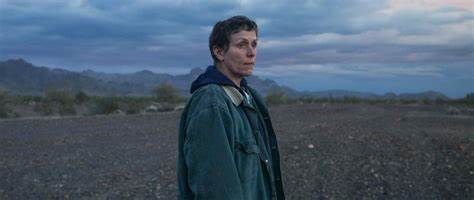
NOMADLAND (2020)

by Miguel E. Rodriguez

Director: Chloé Zhao
Cast: Frances McDormand, David Strathairn, and a cast of non-professionals/actual “nomads”
My Rating: 8/10
Rotten Tomatometer: 93% Certified Fresh

PLOT: A woman in her sixties, after losing everything in the Great Recession, embarks on a journey through the American West, living as a van-dwelling modern-day nomad.


Nomadland is one of the most visually beautiful films I’ve seen recently.  It mostly reminded me of Brokeback Mountain (2005) with its sprawling vistas of distant mountains, lonely country roads against a looming sky, and desert badlands illuminated by that elusive light that appears only during the “magic hour” so coveted by cinematographers and photographers alike.  It’s beautiful and well-made.  As a message film that won the Academy Award for Best Picture of 2020…I mean…it’s good and admirable, but it didn’t quite get to me like it was clearly trying to.

As a piece of propaganda (intentional or not), I can see Nomadland being effective for anyone who has been disillusioned of the American Dream by financial troubles.  Set in 2011, the film follows Fern (McDormand) as she hits the road in a van after the gypsum mining company her deceased husband worked for folded, displacing an entire town, Empire.  Even the town’s zip code was discontinued.  Fern literally lives out of her van, which doubles as living quarters, bedroom, dining room, and (revealed in a shot that I was stunned to learn was real) bathroom.  She works seasonal jobs throughout the American West at various parks, restaurants, and even an Amazon warehouse during the holidays.

On her travels, she encounters a large community of fellow nomads.  Periodically (I think annually), they gather at a location in the middle of the desert to trade goods, share stories and nomadic tips, and basically support each other for a week or a month or whatever…it’s not made clear exactly how long everyone stays before they go their separate ways once more.  On this occasion, she meets a fellow traveler named Dave (Strathairn) who trades her for a can opener.  Over the course of the film, Fern’s and Dave’s paths will intersect again and again.  I thought we were getting the kernel of a corny love story, but not quite.  The purpose of their relationship is pragmatic, not romantic.

Another traveler Fern meets is Swankie, a lively woman in her seventies who hangs a skull-and-crossbones flag from her van when she wants no visitors.  Honestly, it made me wish I had a similar flag to hang from my neck to communicate the same thing in public.  Anyway, Swankie reinforces Fern’s commitment to this way of living by describing trips to Alaska, a visit to a large community of swallows nesting on a cliff while on a canoe trip, and by revealing one of the real reasons Swankie has adopted this lifestyle in the first place.  All with no bills to pay, other than gas, food, and vehicular upkeep.

The movie follows Fern from one place to another over the course of a little over a year.  We see her working, driving, talking with people she meets, cooking on her tiny gas stove inside her van, dealing with the cold in the winter, reminiscing over old photos and slides.  There are two interesting side trips when she can’t avoid reaching out to…well, I guess “civilization” is the right word.  One occurs because her beloved van breaks down and she has to get to her sister’s to ask her for repair money.  Another occurs when she takes Dave up on an offer to…no, won’t spoil it.

At times, I found myself comparing Nomadland to Cast Away, Robert Zemeckis’ 2000 film where Chuck Noland (Tom Hanks) finds himself stranded on a desert island after a plane crash.  In both situations, the heroes find themselves isolated from civilization.  They must both learn to deal with an alternate way of life, and there is no alternative.  Adapt or die.  (When Swankie learns Fern doesn’t even know how to change a tire, she reprimands her.  “You can die out here.  You’re out in the wilderness, far away from anybody.  You can die out here.  Don’t you understand that?  You have to take it seriously.  You have to have a way to get help.  You have to be able to change your own tire!”  It’s a sobering reminder that, even though she has a cell phone (how she pays the bill is a mystery to me), Fern must be self-sufficient in order to survive.)

Furthering the similarities to Cast Away, there’s even a moment where Fern has an opportunity to sleep in a real bed.  We see her crawl underneath the covers…but in the middle of the night, she creeps back out to her faithful van to get a real night’s sleep, just like Chuck Noland sleeping on the floor of his hotel room.

But what does it all mean?  What is Nomadland trying to say?  I couldn’t shake the idea that Zhao’s film, based on a book of the same name, was an attempt, like Into the Wild (2007), to romanticize the concept of shedding our material needs, stripping ourselves down to the necessities, and getting back in touch with nature.  I have no doubt this notion appeals to many people.  Well, that much is clear because nearly everyone in the film besides McDormand and Strathairn are non-actors who are playing themselves, and they’re all nomads, too.  But is the movie simply showing me how and why a person makes this decision?  Or is it trying to convince me that I should do the same thing?  Is this one of Ebert’s “empathy machines” that allows me to live in someone else’s shoes for 107 minutes and experience life through their eyes, or, like Into the Wild, is it making the case that folks who haven’t made this decision themselves are slaves to a corporate system?

At one point, a gentleman named Bob, who is a real person and is one of the main coordinators of the community that meets once a year in the desert, makes a speech to the nomads who have gathered:

I think of an analogy as a work horse. The work horse that is willing to work itself to death, and then be put out to pasture. And that’s what happens to so many of us. If society was throwing us away and sending us as the work horse out to the pasture, we work horses have to gather together and take care of each other. And that’s what this is all about. The way I see it is that the Titanic is sinking, and economic times are changing. And so my goal is to get the lifeboats out and get as many people into the lifeboats as I can.

I’d be lying if I said his notion wasn’t appealing.  Who wouldn’t want to live a life of seeing the country, parts of which many of us may never see in our lifetimes?  Never being tied down to a job, to familial obligations, bills, taxes, the eternal quest for the almighty Dollar?  I get it.  But…if I didn’t have a job, didn’t earn a living, didn’t pay my bills, and have enough left over to buy a home entertainment system including the Blu-ray of Nomadland…I would never have seen this lovely film in the first place.

So, no, the concept of living as a nomad is not something I would seriously embrace…yet.  Life is good.  I have a job.  I have family.  I have friends who are as good as family.  I have the woman I love beside me.  I’ve seen Alaska, England, Greece, New York, Miami, and Key West.  Nomadland argues that, if any of that would ever change, there is an alternative to depression and slaving away and eking out a living in my retirement years in a 1-bedroom apartment.  Perhaps, on that day, I might re-evaluate my opinion of nomadic living.

But that day is not today.

Tomorrow is not looking good, either.

ETERNALS

By Marc S. Sanders

Was I dozing on and off during Marvel’s latest film, Eternals, or was I becoming interested and uninterested during a bloated running time of two and half hours?

As an avid comic book reader during the 70s and 80s, especially Marvel comics, I must admit I don’t know much about the team of gods known as The Eternals.  So, I went into this film kind of blind.  Reader, I don’t feel any more educated having seen the film.  These expressionless number of characters arrive on Earth 7000 years ago and apparently, they are assigned with protecting the planet’s course of events through history by fending off CGI monsters knowns as the Deviants, and that’s all they are supposed to do.  Allow the dinosaurs to perish.  Let Hitler do his thing.  Have Thanos snap his fingers.  Just take care of the Deviants. 

You know what the Deviants look like to me?  An early stage of computer graphics that we would see on a behind the scenes DVD documentary contained on the second disc of a Jurassic Park 25th anniversary edition.  The geeky visual effects wizard would show this deviant on his lap top as an early concept of a raptor or T-Rex.  I dunno.  Maybe it was the screening I saw at a Regal Cinema that soured me on the visuals in Eternals.  Everything seemed so dim and unlit at times.  When the Eternals are taking refuge in a woodsy campsite, that looks as simple as the Honey I Shrunk The Kids playground in Disney World, and a dino like Deviant roars and picks up a character with it’s tentacles only to toss the person into a wood shed, I felt like I was watching one of those 3D amusement park rides.  The computer animation blended with the human actors never flowed convincingly in this film.  This is maybe the worst looking special effects film in Marvel’s library of films. Nothing looks natural here. 

A small sect of the characters is interesting.  Most are quite boring actually.  Take Ikaris for example.  This guy, played by Richard Madden, flies and shoots powerful yellow laser blasts from his eyes.  Otherwise, there’s nothing I can say about his background.  He’s so unentertainingly morose and blah.  Sersi (Gemma Chan) is just the same, and yet she’s supposed to be more optimistic.  Almost twenty-four hours later and honestly, I forgot her powers or what she’s about.

Angelina Jolie is here too.  Moving on.  Salma Hayek is here as well, and yeah, moving on.

The most interesting character is the one causing controversy in the news over being the first Marvel super hero to have a gay kiss.  That’s only a fleeting moment and truly unworthy of causing any kind of uproar.  (Find something better to get pissed about people! Men fall in love with one another.  This is nothing new.) Brian Tyree Henry plays Phastos, who specializes in advancing technology over time that somehow becomes knowledge to the humans of Earth without him taking credit for it.  Phastos has a funny situation as he balances being a god on the planet for the last 7000 years, while also being a current day family man.  More so, he’s a tragically sad character.  The best moment (not scene, because regrettably it is not explored long enough) depicts Phastos gazing upon Hiroshima in 1945 following the dropping of the atomic bomb.  He can not help, as a god, to feel responsible for this outcome, while being consoled that this is not his responsibility to accept.  Remember Phastos, you’re just here to fend off dumb looking, unfinished monsters.

The other good character is Kingo (Kumail Nanjiani) – the god who eventually goes on to be a conceited and well-loved Bollywood actor/director.  Nanjiani is best used as the humor factor of the film with his tag along assistant cameraman (Harish Patel) who films all of the ongoing action for a possible documentary.  This is a good setup for a joke that doesn’t materialize well enough.

Marvel lent too much responsibility to its director Chloe Zhang, who to my knowledge does not have much experience with the big budget extravaganza films that’s expected of these installments.  Zhang was a large contributor to the script.  I’m going to take a guess and presume she’s not the comic book expert that say, Sam Raimi or Kevin Smith are.  She’s an Oscar winning director (Nomadland) who is a master photographer, but a film like Eternals tells me that if you take her out of the natural environments and put her in fantasy land computer graphics, you are not going to get the same thing.  This is like asking a guy who flips burgers at McDonald’s to prepare a $200 well aged Filet Mignon.  With Zhang directing this film, reader you are just not getting your money’s worth.

Everything seems very flat in Eternals.  The script is repetitive.  The narration of the story is that the team gradually reunites with one another following the unexpected death of one of their members.  When the characters do meet up with each other though, they explain the same news again and again and again.  This might be the way it is in real life when your 99-year-old grandfather kicks the bucket and you make one phone call after another.  However, in a film that luxury is not necessary to move the picture along.  Audiences are much more intelligent than this film gives credit.  They’ll make the safe assumption that when Phastos comes on the scene, he’ll have been caught up to date.  Yet, the picture ignores that opportunity of convenience, and just needlessly stretches the running time.

Eternals is not The Avengers.  These guys are boring.  They are written boring.  For the most part, they are acted boring.  There’s no sarcasm or biting insults among them.  There’s hardly any affection among them either, or even hate.  Think even beyond the Avengers for great team ups. Consider Daniel Radcliffe, Emma Watson and Rupert Grint in the first Harry Potter film, or Han, Luke and Leia in the original Star Wars trilogy.  There’s a chemistry to those characters that’s not in the Eternals; a love/hate relationship of jabs and hugs among the peers.  Even when they sit around a table for dinner, the most interesting thing the Eternals can talk about is who is going to take over the Avengers now that Iron Man and Steve Rogers are no longer around.  These folks have been separated from themselves for the last couple of thousand years or so.  Don’t they wanna catch up with one another, and maybe talk about themselves and what they’ve been up to?

The other issue with the film is the constant time jump from the times of B.C. to present day back to B.C. to early 20th century to present day and on and on.  This isn’t a Quentin Tarantino film where the fun is in piecing these moments together.  These time jumps have no impact.  I’d argue that it might have been more effective to just begin at the Eternals’ arrival on Earth and go through time chronologically.  Take me on a 7000-year journey.  Let me see what I can uncover.  For an observational director like Chloe Zhang, this is a missed opportunity here.  She could have demonstrated how the Eternal characters develop over time and get mixed up in side stories like becoming a private school teacher, or a loving dad or a film maker.  Then you have an arc to each of these misfits.  You’ll even have an arc to the planet Earth, and that could be very cool.  Don’t know what I mean?  Look at Zhang’s Nomadland from last year or Terrence Malick’s The Tree Of Life, or even Kubrick’s 2001: A Space Odyssey.  Eternals could have better demonstrated how history has an impact upon itself.

Within the Marvel lexicon, this is not a necessary film.  It quickly dismisses the biggest story that came down the pike with the Thanos character causing all kinds of trouble, and then settles into its own mire.  In other words, who asked for this picture?  I have to wonder if Marvel films are finally jumping the shark or crawling from under the dumpster (remember Glenn from The Walking Dead).  Have they used up all of the hot properties, that Disney owns at least, and are now settling for these minor characters?  Maybe or maybe not.  After all, the best parts of Eternals, for this comic book reader at least, were the post credit scenes.  Still, I didn’t pay $12.00 to wade through two and a half hours of sleep-inducing material just so I could catch a glimpse of two vague teaser moments either.

NOMADLAND

By Marc S. Sanders

amazon ( n.) a large strong and aggressive woman; Synonyms: virago. amazon ( n.) mainly green tropical American parrots; 2. Amazon ( n.) (Greek mythology) one of a nation of women warriors of Scythia (who burned off the right breast in order to use a bow and arrow more effectively);

As I reflect on watching the 2020 Best Picture Oscar winning film, Nomadland, I considered the literal translation of the word “amazon.”  To many of us, I would think the word has an entirely different meaning.  Director, writer and editor Chloe Zhao probably considers both the literal definition of the first noun (noted above), as well as the brand name that seemingly runs the world these days.

Fern, played without compromise by Frances McDormand, is likely a strong and aggressive woman, though only subconsciously large.  I’d argue you would have to be in order to survive as a nomad within a pre-Trump era mid-western America with a beat up van as your mobile residence and a deep plastic bucket for a toilet that isn’t hard on your knees when used.  Fern is a former resident of Empire, Nevada.  Empire and its postal zip code no longer exist as of 2011 when the sheetrock factory that sustained the town closed up after 88 years, thus forcing all its residents to give up their homes and relocate elsewhere.  Now that Fern is widowed, she does not see any other way to live other than in the van she calls “Vanguard.”  She lives paycheck to paycheck with seasonal jobs that are hopefully available.  The first of these jobs includes a packing facility for Amazon.  Once the holidays are over, it’s up in the air as to what she’ll come across next.

Zhao is an observational director.  To depict a film about a lonely, uncertain post middle age nomadic widow will require shots of the country like frost on the ground, deep snow, endless roads, hot deserts and moonlit campfires with other nomads who come by Fern’s way.  These people (many of which are real life nomads in the film) might travel individually but they are a community as well.  They teach one another in ways of being resourceful with auto repair or what’s the best bucket for a toilet.  They provide people like Fern with temporary job opportunities.  They also counsel one another with how to deal with grief and share their own health challenges like the various forms of cancer and illnesses they endure and how they plan to live out the remainder of their limited time on earth.  One woman with an inoperable brain tumor is determined to make it back to Alaska.  What drives these people is not necessarily a will to survive.  More importantly, it’s the knowledge that they will cross paths with one another again.  An experienced nomad who lost a son to suicide never considers saying goodbye to anyone he encounters.  Rather, he is staunch in telling others that he’ll “see them down the road,” at another time and place.  He reminds Fern that to live this life is to never close the book or end a chapter, and memories of those we have lost can only stay alive if Fern and others stay alive.

I appreciate a film like Nomadland simply because I’ve never been the brave traveler.  One of my greatest fears is being lost and alone.  It has always terrified me.  I still don’t trust the navigation apps on my cell phone.  I have to see the destination in front of me.  Luckily, my wife keeps me in check.  Yet, Nomadland is a film that gives me an opportunity to explore places I might never arrive at, while I sit safely in front of my flat screen.  Chloe Zhao shoots with wide lenses to take in gorgeous landscapes.  How fortunate for Fern that she can encounter all of this beauty in person.  How fortunate, as a viewer, a film like this allows me to witness what’s out there.  How sad though as well that sometimes this way of life seems treacherous and nonsensical.  Whatever entity created the earth allowed no sympathy for a flat tire or a broken-down engine, when you have no means of paying for replacement parts.  As well, mother nature is not always going to be that companion that holds your hand during lonely times.  Corporate America certainly won’t do that either, but it is a necessary evil.  Thank you, Amazon!

Frances McDormand is perfect for this role as she carries no inhibitions about herself.  She will truly show herself sans makeup or coiffed hairstyles, floating nude in a stream, or go so far as to literally defecate on screen in that practical bucket to demonstrate how truly unglamourous and unforgiving the life of a nomad is. 

Nomadland is not a favorite film of mine, but I can’t help but appreciate its honesty thanks to Zhao, McDormand and the numerous real-life nomads that inhabit the picture.  It’s a sad story; not a triumphant one, but it is also a film that tries to emulate the comfort of being “houseless…not homeless” as Fern describes with absolute certainty.  It might not be the life for many of us, but it is definitely a life meant for Fern.