MAN ON FIRE (2004)

By Marc S. Sanders

A movie that has eluded me until now is Man On Fire featuring Denzel Washington in another Tony Scott film.  I say eluded because with this director/actor combination I’m usually satisfied with the finished product.  That wasn’t the case here, though.

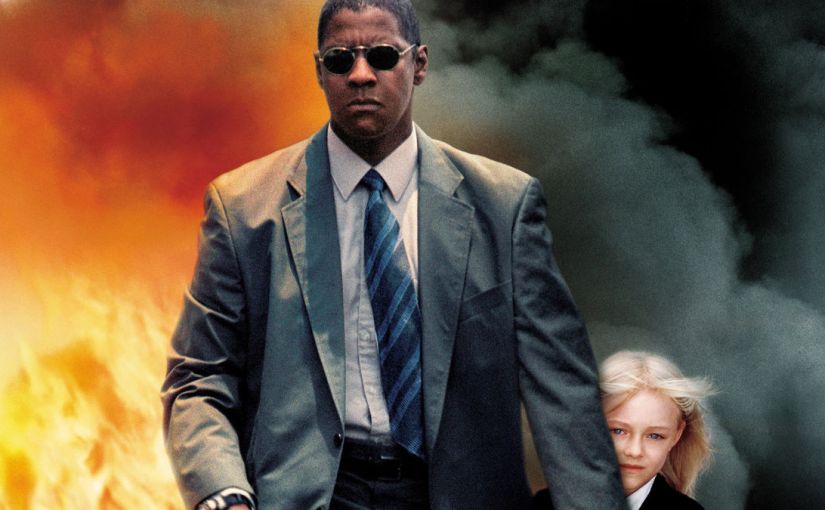
Washington portrays a hard drinking bodyguard named John Creasy.  He’s recruited by his war buddy, played by an uninteresting Christopher Walken, to protect a young girl named Pida (Dakota Fanning), daughter of an automobile industrialist and his always fashionable wife (Mark Anthony, Rahda Mitchell).  Creasy is a cold fish at first who refuses to accept Pida’s friendship.  Jump to a couple of quick scenes later and he’s become her surrogate father and swimming coach.  In a matter of seven minutes of running time, I’m supposed to accept that this guy has turned into a cuddly teddy bear for this kid.  As soon as that happens, Creasy is ambushed and Pida is kidnapped following her piano lesson. We are not even a quarter of the way through the picture, but the remaining hour and forty minutes play like an awful how-to documentary on effective means of torture for bad guys before ruthlessly killing them.

Tony Scott is a director who always seeks to demonstrate that glossy film styles are more significant than the screenplays he directs or the characters who reside within.  (Two exceptions come to mind though, Crimson Tide and True Romance.  Maybe some of Top Gun too.)  Man On Fire is a frustrating watch as Scott’s camera performs like a narrator with attention deficit disorder.  It can never sit still.  The movie jerks around so much with ridiculous quick cuts and deliberately grainy and distressed cinematography.  Just when I’m trying to comprehend a new player who enters the fold, the camera jumps to something else like a street corner or a moving car or Denzel Washington’s sunglasses. There are subtitles for the Spanish speaking characters that appear in a block letter font that looks like it came from a karaoke machine.  There’s also subtitles for what somehow appear to be “important” or “powerful” statements.  A line like “pass the salt” might read like “PASS the SaLt…PLEASE!!!!”  Tony Scott is obviously going for some kind of MTV music video approach, but it’s awfully distracting and downright annoying.  As well, I must ask why.  Why go through all this effort? The cameramen must have been getting motion sickness while fumbling and shaking around their equipment to shoot this picture.  So why bother?

The most interesting plot point happens in the first three seconds of the movie.  A statistic pops up describing how often kidnappings occur in Mexico (one every sixty seconds), and how as many as seventy percent of those incidents end up with a dead victim.  That’s a shocking dilemma, worthy of attention. Through his career, Washington’s selection of scripts has allowed him to tackle important issues with moments of debate and smart dialogue, as well as suspenseful action if there is a call for it.  However, Tony Scott and screenwriter Brian Helgeland are not interested in using these facts as a springboard with Man On Fire

Once the expected kidnapping occurs, and following a very quick healing – as in less than two days – of multiple gunshot wounds to the chest and back, John Creasy goes on a war path of revenge when he learns that Pida is dead.  Creasy doesn’t get to perform with much intellect here.  Having only a partial license plate number, he’s able to follow the breadcrumbs that lead to a crime syndicate notorious for winning millions in ransom demands.  Creasy simply goes up the food chain from one member to the next until he gets to the top of the pyramid.  That’s the movie!  That’s it!

He’ll cut a guy’s fingers off and cauterize them with a car cigarette lighter.  He somehow has access to a rocket launcher to use within the city.  Sadly, the most novel technique is to stick a rectal detonator (yes, I said rectal) up a man and set a timer for the guy to come clean with information before it goes off.  We can thank Tony Scott for putting up a countdown digital clock on the screen to gauge how close this thug is to his demise.

My past experience with movies like these have taught me that there’s always a traitor.  Someone set the plan in motion to abduct the little girl.  That’s not hard to figure out.  Once the character appears on screen, it could not be more obvious.  The motivation is just as ridiculous.

Man On Fire is only imaginative in how the protagonist dispatches one guy after another.  It lacks any effort in creativity towards its hero.  The guy drinks. He torments his enemies.  He’s got nothing interesting to say.  There’s a neglect for a very real and common problem within the country of Mexico.  The only design that is given attention is “artistic style” that Tony Scott adopts to mask away what is not there in any of the writing or character development.

I’d like to learn more about how the Mexican government responds to these kidnappings and maybe the experience that survivors endured.  Show me the torment that the families go through.  Can I see the method to the kidnappers’ plots or how they select their next target?  A very real predicament was offered with Man On Fire, but then it was tossed aside so I could see the effectiveness of an explosive suppository.  Now, is that really a movie that any of us want to see?

THE TAKING OF PELHAM 1 2 3 (2009)

By Marc S. Sanders

While the remake of The Taking Of Pelham 123 is not the best of the Tony Scott directed/Denzel Washington headlining thrillers, it’s still a good time. I’m a sucker actually for most of their films, though as of this writing I’ve yet to see Man On Fire. Washington and Scott made several action pictures together. You depend on Scott to work in all the fast cuts to wake up your pulse and allow Washington to form a variety of characters. Denzel Washington didn’t have to appear like the macho tough guy with the ripped muscles. In Pelham, it could not be more evident.

Washington plays Walter Garber (first name salute to Walter Matthau of the original film), a dispatch operator for the New York City subway line with years of experience in all facets of operation and management. However, he’s been demoted due to an ongoing investigation that he has accepted bribes. Now let me say that I like this angle. He’s not a typical alcoholic or drug addict that we might have seen a Bruce Willis guy do one too many times. This is something different and unexpected. Washington also appears with a pot belly, glasses and no fashion sense. He’s not a decorated war veteran. This is not an action hero. Screenwriter Brian Helgeland got it just right, with this character at least.

John Travolta is your bad guy known as Ryder, and I’m afraid he’s cut from similar cloths of his other career bad guys. He screams in the same way. He has the psycho meltdown attempts at hilarity. So he’s more of the same really.

Ryder and his crew hijack one car off the subway line that comes out of Pelham Bay, NY. Garber answers the call from Ryder with his demands for money within the hour or a hostage will get killed minute by minute after the deadline.

Now Helgeland and Scott are very aware of the absurdity going on here. When the apathetic Mayor (a welcome James Gandolfini) agrees to pay the cash, it has to be transported all the way from the bank reserve in Brooklyn. This requires Scott’s signature moves of racing police cars and bikes through congested New York City to get it to Ryder before the deadline. Only midway through this long sequence which gobbles up tons of the film’s running time, does someone ask why they just didn’t use the helicopter. Cue my colleague Miguel E Rodriguez: “Then there wouldn’t be a movie!!!!”

As much as I like the action shots, because I’m a guilty pleasure sucker for that stuff, I have to insist that there still could’ve been a movie; a better movie. Helgeland’s script wasn’t imaginative enough, or the producers insisted on more car crashes and things blowing up real good. The original with Walter Matthau and Robert Shaw maintained tension for its two hour running time. This remake could have learned a little more from its ancestor. Two great actors are at your disposal, and you might have gotten some good dialogue like that of Clarice & Hannibal, perhaps.

Still, the conversations between Washington and Travolta are serviceable on at least one side with most credit going to Washington. Surprises into the Garber character keep the film interesting. Travolta? Well, I saw this guy in Face/Off and Broken Arrow and Swordfish and on and on.

The Taking Of Pelham 123 always had my attention. Yet, I wish it showed me even more new things than just its unlikely hero. Denzel Washington shouldn’t have to be the only one putting in overtime.

PAYBACK

By Marc S. Sanders

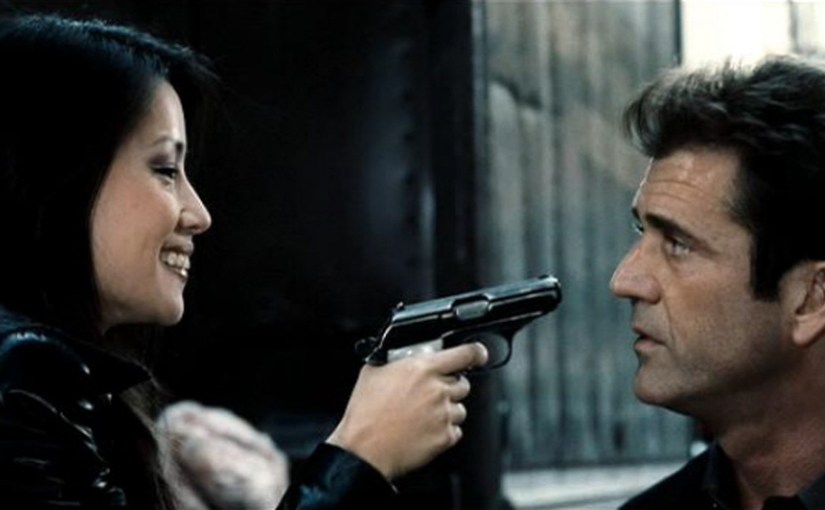
Mel Gibson is Porter. No first name given. He’s just recovered from three bullet holes in the back and all he wants is the $70,000 that he was ripped off after pulling off a heist. Nothing more. Just his seventy grand.

In Brian Helgeland’s film Payback, the idea is to root for the bad guy. Then again in this film, they’re all bad guys. So you are cheering for the best of the best bad guys, I guess. Porter catches up to Val (Gregg Henry), the partner who double crossed him which then leads to Val’s well established crime syndicate that he’s a member of headed by William Devane, James Coburn and Kris Kristofferson. Great surprise character actors for a picture like this. Porter also crosses paths with a professional dominatrix played Lucy Liu (credited here as Lucy Alexis Liu and primed for Quentin Tarantino material). She’s worth every penny you pay for her services.

Helgeland salutes the gritty, urban crime dramas of the seventies featuring the likes of Charles Bronson and Clint Eastwood. The language was more raw during that period. The city was filthy. The violence was even more unforgiving. The film feels quite modern but the cars don’t and the phones are all rotary dials. There’s a washed out grey hue to the cinematography of Payback, and its all very welcome. It’s a well made thriller only deliberately not as glossy.

The run on joke is that Porter is only interested in his seventy thousand dollar stake. The thugs he encounters might insist on not giving him a higher amount but as much as Porter gets tormented, he insists it’s all about just the seventy thousand. So, great responses come from that motif, especially Coburn as the fashionista gangster with the alligator skin luggage.

A film like Payback is simple in its story. The scenes are all about set up. How does Porter evade a drive by shooting? How does Porter handle a couple of dirty cops looking for a piece? How does Porter outwit a bomb in his apartment? The variety of characters that give Porter a rough time each come off like bad guys of the week in a Quinn-Martin television series. It’s just entertaining to watch Gibson as Porter get out of one situation after another.

Payback is a great Charles Bronson film, without Charles Bronson.