
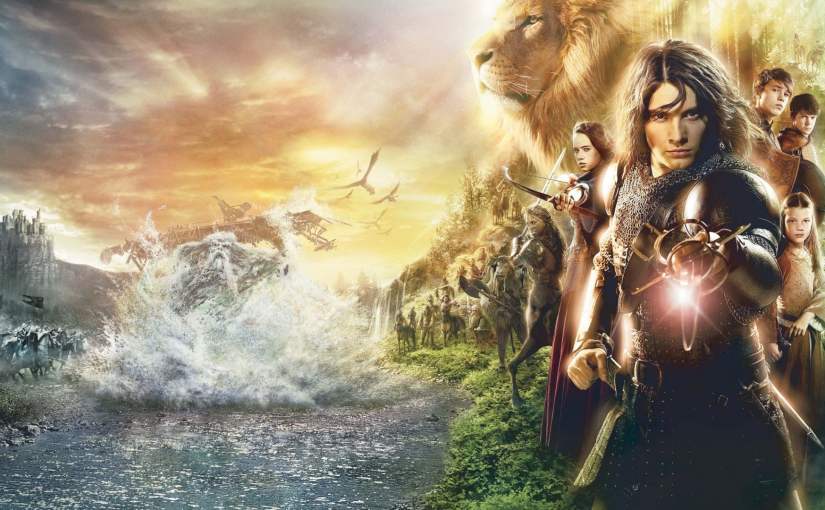
by Miguel E. Rodriguez
Director: Andrew Adamson
Cast: Ben Barnes, Georgie Henley, Skandar Keynes, William Moseley, Anna Popplewell, Peter Dinklage, Warwick Davis, Liam Neeson, Eddie Izzard
My Rating: 9/10
Rotten Tomatometer: 66%
PLOT: The Pevensie siblings return to Narnia, where they are enlisted to once again help ward off a tyrant and restore the rightful heir to the land’s throne, Prince Caspian (Barnes).
If The Chronicles of Narnia: Prince Caspian had been released in a world without the Lord of the Rings trilogy and the Harry Potter franchise, I believe (but cannot prove) it would have been hailed as one of the great works of fantasy cinema, with deeply drawn characters, political intrigues, spectacular battle scenes, and scores of wondrous creatures, some of the best put on film. Unfortunately, we don’t live in that world, and despite scoring over $400 million at the box office, it fell far shy of its 2005 predecessor, The Lion, the Witch and the Wardrobe, and was declared a failure.
I don’t mean to suggest that previous franchises are to blame for this so-called failure, but in re-watching it, it’s virtually impossible not to compare Prince Caspian to its epic predecessors, especially Lord of the Rings. Look at the visuals of the final epic battle in front of Aslan’s How. A massive army slowly advances on a stone-built fortress, while giant catapults hurl boulders from a safe distance. Narnia? Or the Battle of Pelennor Fields in The Return of the King? At one point, a small army of sentient trees intervenes. Narnia? Or the Battle of Orthanc at the end of The Two Towers? Susan Pevensie wards off numerous attackers using only a bow and arrow. Shades of Legolas, wouldn’t you say?
Whatever. It takes a conscious effort of will, but I believe it is possible to enjoy Prince Caspian on its own merits rather than judging it by comparison. Once you can do that, this is a highly enjoyable adventure. It captures the spirit of the source material, while also combining a childlike enthusiasm for all things fantastic, from centaurs to minotaurs to talking badgers, with a dark, mature storyline involving Game-of-Thrones-level castle politics.
In Prince Caspian, the Pevensie children are living their lives in 1942 London when they are once again magically transported back to Narnia, where they once ruled as beloved kings and queens. However, time seems to move much faster in Narnia; whereas only a year has passed in the real world since they returned to London, over a thousand years have elapsed in Narnia. During that time, the castle where they sat in power has been reduced to overgrown ruins that are barely recognizable. Narnians (magical creatures) are forced to live in hiding. And Aslan himself is nowhere to be found.
I found this particular story element rather powerful, but it’s hard to pinpoint why. If I had to guess, it’s because it’s almost like a post-apocalyptic tale. “We used to live here, when things were good. Now something terrible has happened, and everything we’ve known is reduced to ruin. What do we do now? How do we rebuild?” That kind of thing. I guess.
Anyway, I won’t bore you with a full summary, which you can find online. There’s a prince who’s been exiled by his greedy uncle, a talking mouse voiced by Eddie Izzard – an outspoken atheist appearing in a movie based on a work of Christian fiction, how ‘bout that? – daring rescues, single combat, an ingenious trap, and a provocative ending that suggests at least one Earthly traveler may have visited Narnia even before the Pevensies.
I think this is one of the most underrated and unfairly dismissed fantasy films in recent years.
 2 UNPAID MOVIE CRITICS!!!!