
By Marc S. Sanders
Joker: Folie à Deux is an unnecessary sequel. A lethargic bore. That is its one problem, and it infects the merits the film clings to but never gets off the ground.
It amuses me, with a pinch of vitriol, that at the closing credits the picture is said to be based on characters published in DC Comics. My perspective still stands as it did with Todd Phillips’ first film. These characters are not consistent with any variation that appears with any superheroes/super villains who occupy the assorted comic books. It is especially true in this new installment. Just because the players are named Joker, Harley Quinn and Harvey Dent does not translate to where these folks stemmed from. Joker: Folie à Deux stands on the shoulders of a hot, pop culture, geek property simply to bank on the residuals.
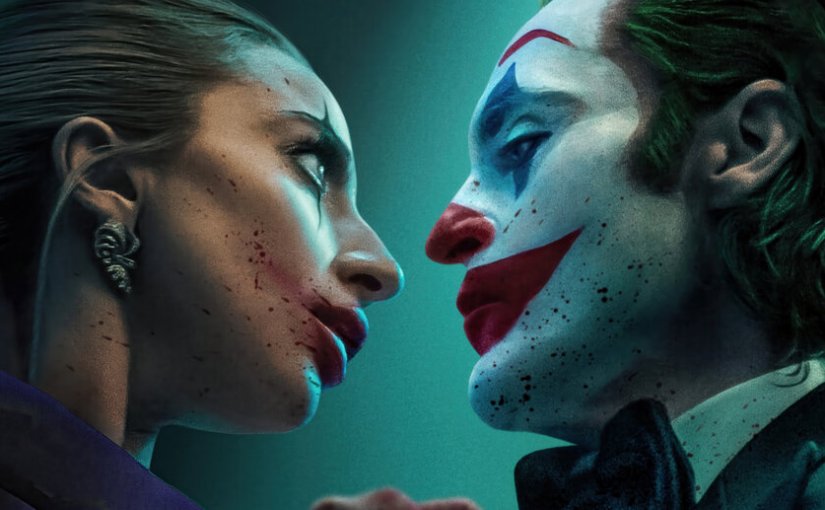
This sequel picks up two years after the original Joker left off. Arthur Fleck (Joaquin Phoenix, returning to his deserved Oscar winning role) is imprisoned and awaiting trial for the murder of five people including the famed talk show host he shot on live television. He’s abused both physically and verbally by the prison guards led by actor Brendan Gleeson, who is a better actor than this unoriginal dreck has to offer. His attorney played by Catherine Keener believes in upholding a defense by reason of insanity.
Arthur normally keeps quiet while endlessly smoking cigarettes (boring stuff). Everyone else talks. None of this goes nowhere for a very, very long time. The one positive that enters his life is a fellow inmate named Lee Quinn played by Lady Gaga, another actor worthy of better material. Lee is being held for setting fire to her parents’ house. The two develop a quick kinship.
Within his psyche, does the clown image of Arthur’s Joker personality let loose in morose song and dance performances with Lee, also known as Harley. Uplifting musical montages of classic numbers would normally invoke toe tapping cheerfulness. Yet, that is not what happens for this disturbed man. Numbers like That’s Entertainment, Get Happy, and What The World Needs Now are given somber and depressing interpretations for these sad sack clowns to sing. Singer Lady Gaga is not belting out the numbers. Rather, she puts on a weakened, hoarse inflection to her performance. Joaquin Phoenix works in tow with his co-star. YOU HAVE LADY GAGA!!!! YOU HAVE JOAQUIN PHOENIX WHO CAN ALSO SING (Walk The Line)!!!!! WHY WON’T YOU LET THEM REALLY, REALLY SING??????
The overall problem with Joker: Folie à Deux is that it remains very stationary. Director Todd Phillips and Phoenix will set up a performance scene with building intensity of the original score. You hear the treble of the string instruments build and build. The camera will zoom on Arthur while signing a book or smoking cigarette as he gets taunted, and you think the animal inside is going to unleash, but then it doesn’t and the moment pancakes flat out. Nothing means anything in this picture, and it looks like the script is being made up as the film goes along.
About halfway through the movie, the Catherine Keener character is simply dispatched from the film altogether with one line, never to be seen or focused on again. I guess this is supposed to be an impactful moment, but it seems to occur because the screenplay by Scott Silver and Todd Phillips had a bout of writer’s block and decided to “let’s try this!”. I got to know this person, only to realize she’s pointless. This is what an edit looks like within a finished product.
The difference between this film and its predecessor is the Arthur Fleck character actually does not appear in every single scene of the movie this time. The last film focused on Fleck’s internal struggle with an alternative personality and the cruel world he’s forced to live in. This film seems to observe Arthur as a subject from the outside. I believe Joaquin Phoenix has less dialogue this time as we get to hear from his attorney and the prison guards and Lee, and how each of them respectfully perceives Arthur. So, I credit the film for going in that different direction. It’s an alternate narrative. Yet, there’s no advance in Arthur’s plight or story development. The film just meanders and meanders. You’d be drunk about ten minutes after the movie begins if you paced yourself by how often a cigarette is lit. At the very least, Phoenix and Gaga could have exhaled smoke rings for a little fun. Only Big Tobacco will be this film’s biggest fan.
Look there’s Harley Quinn! Look there’s Harvey Dent! He’s the one that becomes Two-Face, right? Ha! They said the word Gotham. Oh, and check it out! Arthur and Lee are being held at Arkham Prison! Hold the phone! Did I hear that witness’ last name is Kane, as in Batman creator Bob Kane?
So what?
If you are seeking another DC Comics vehicle, look further please. Joker: Folie à Deux is a possessor of someone else’s intellectual property and the film should surrender it. Name drops from the universe of Batman does not constitute another variation of the celebrated Clown Prince of Crime. As good as Joaquin Phoenix’ performance was in the first film (here, in the second film it is nothing special, just the same old same old), his Joker does not belong anywhere in the fraternity house that is shared with the likes of Romero, Nicholson, Ledger and yes even Leto. Lady Gaga is doing the best she can here. Beyond the sleepy song and dance numbers, this role is not up there with some of her other memorable performances though. She is Lee, but she is not Harley Quinn. No one will remember Lady Gaga for this film.
The original Joker was a box office smash that truly hinged on a very special and impressive performance from Joaquin Phoenix. It also relied on the Joker label which Hollywood will never have enough of, despite Batman’s impressive vastness of villainous rogues. That first film garnered a worldwide box office of over a billion dollars. It stands to reason that Warner Bros would demand a follow-up film for more bucks to stuff under the mattress. Whatever this new picture earns is not merited on anything but the theft of the brand names it incorporates. This is a shameless cash grab that surges only to the top of that uncelebrated list.
I recommend movie goers find a real Gotham City to step into. Joker: Folie à Deux takes you on an endless detour you can’t find your way out of.

 2 UNPAID MOVIE CRITICS!!!!