
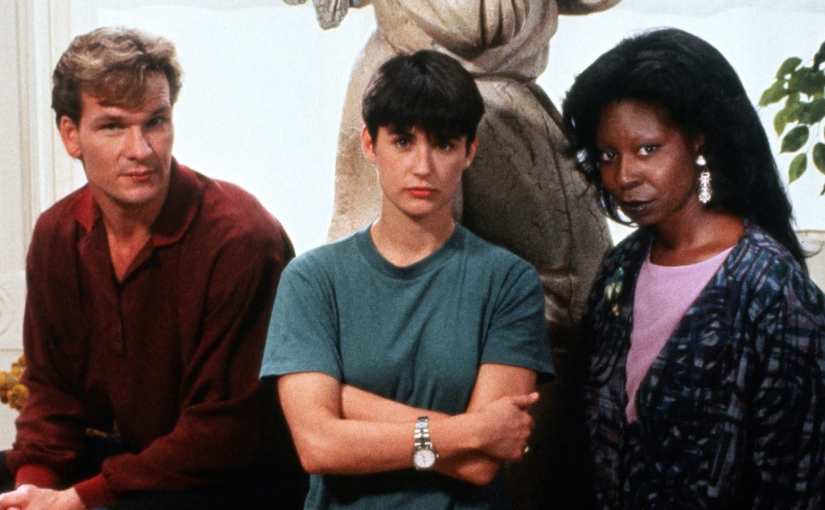
GHOST

By Marc S. Sanders

For a perfect blend of the supernatural, suspense, mystery, drama, romance and comedy, the first film that will always come to mind is the surprise hit film Ghost from 1990.  One of the zany Zucker brothers, Jerry to be more precise, who introduced the world to slapstick spoof (Airplane!, The Naked Gun) directed this film turning Demi Moore into a ten-million-dollar actress, placing Patrick Swayze ahead of his Dirty Dancing looks and earning Whoopi Goldberg a very well-deserved Academy Award.  Ghost was a film for all kinds of movie goers.

Sam Wheat (Swayze) is an up-and-coming New York City business executive who loves his new live-in girlfriend, Molly (Moore) even if he can only say “Ditto!” when she tells him she loves him.  Shortly after the picture begins Sam is gunned down following an evening at the theatre.  Unbeknownst to Molly and anyone else living on earth, Sam’s spirit lives on though, and he realizes that he was not the victim of some random mugging/murder.  Now, Sam must find out who arranged to have him killed and why, while also protecting Molly from becoming a victim.

Along the way, Sam crosses paths with a phony con artist, working as a medium, named Oda Mae Brown (Goldberg) who turns out to be the real thing when she can actually hear Sam’s voice and communicate with him.  Sam must recruit Oda Mae to be a go between for him with Molly and everyone else necessary to follow up on in order to resolve the mystery of his sudden death.

Ghost succeeded in every category of filmmaking.  Rewatching the film decades later, I believe Demi Moore should have gotten an Oscar nomination.  Her close ups on camera with beautiful, muted colors from Adam Greenberg’s cinematography are masterful.  Greenberg should have been nominated too.  He’s got perfect tints of pearl whites both on the cobble stone streets of New York with the outer architecture of the apartment buildings, as well as within the studio apartment where the couple lives.  He strives for an ethereal look with his lens. Gold often occupies Molly’s close ups with dim lighting.  Blues and blacks and steel glinting shines follow Sam’s trajectory. 

Look at the lonely scenes that Moore occupies in the couple’s apartment.  There’s a haunting image of isolation with no dialogue capturing the young actress at the top of a staircase when she eventually rolls a glass jar off the top and it shatters below.  It’s one of the moments that defines a sorrowful character, and not many cry on screen better than Demi Moore.  Later, Sam is engaging in a pursuit through the subway system and races down a steep blue escalator in the dead of night.  Zucker places Greenberg’s camera at the bottom of the escalator to show the depth of hell that Sam may be risking continuing his chase.  The images and transitions of this whole movie from scene to scene are stunning.

I mistakenly recall Whoopi Goldberg as just a comedienne doing her stand up schtick in this film.  Not so.  Goldberg looks radiant on film and while she starts out comically as the script calls for, she eventually resorts to sensitive fear of what her paranormal partner demonstrates as real within this fantasy.  There are so many dimensions to this character.  She’s silly.  She’s exact in her nature for what’s at stake and the dialogue handed to her from Bruce Joel Rubin’s Oscar winning script compliments the actress so well. Goldberg never looks like she’s working for the awards accolades. Yet, she earned every bit of recognition that followed her.

Patrick Swayze makes more out of the straight man role than what could have been left as simple vanilla.  His spirit character uncovers more and more about his afterlife and what happened to him as the film moves along. With each discovery, you’re convinced of Sam’s surprises and what he becomes capable of as a ghost.  Long before superhero films became the novelty, Sam Wheat operates like one who has to learn of his origin and then acquire his new talents and powers to fend off the bad guys.

Jerry Zucker, working with Rubin’s script, Greenberg’s photography and Oscar nominated editing from Walter Murch, along with haunting yet sweet scoring from Maurice Jarre, builds a near perfect film.  The narrative of Ghost shifts so often from comedy to crime to drama to romance and the various natures of the piece hinge so well off each other.  That’s due to storytelling and the editing necessary to smooth out any wrinkles.  You become absorbed in Jerry Zucker’s direction, especially with the movie’s most famous scene where Demi Moore and Patrick Swayze are sensually doing pottery together accompanied by Bill Medley’s rendition of “Unchained Melody.”  Watch that scene with someone you love or take it in on a late Saturday night by yourself with no one to distract you with cackles and eye rolls.  You’ll see how effective Zucker’s work is along with Swayze and Moore upholding the scene in a dark, empty apartment.  Take it as seriously as the scene was originally constructed.  (Then go watch Zucker’s Naked Gun 2 ½ for a chuckle.)

The mystery of Ghost works well with surprises if you are watching it for the first time.  You build trust with a character only to realize it is a ruse for something else.  I do not want to give too much away.  For viewers who have never seen the film, maybe you’ll see an early twist as soon as the film begins.  Maybe not.  Either way, Ghost performs very naturally, unlike a forced kind of twist that M Night Shyamalan too often relies upon.  I do advise that you not watch the trailer that was used for Ghost as I believe it deals out too many of the film’s secrets.

There are movies that I watch over and over again because I love to relive the special moments they offer.  Ghost has those kinds of gifts and yet I have not seen it in ages.  I’m glad.  To experience the picture again was such a treat.  While I recalled all of its secrets, this time I was able to take in the various technical achievements and the assembly of the piece, along with outstanding performances. 

I have no problem saying that Ghost possesses the best performances within the vast careers of Demi Moore, Patrick Swayze and Whoopi Goldberg.  Ghost still holds up. It deserves a rewatch and an introduction to new generations.

SOAPDISH

By Marc S. Sanders

To get inside the head of a character on a soap opera would best be portrayed by someone who’s literally living a soap opera off the set.  That’s the paramount theme of every member of the cast and crew of the daytime drama The Sun Also Sets.  Everyone is living through their own checkered background from the lead actress to the returning actor to the homeless deaf/mute extra on down to the trampy nurse and the buxom doctor on the show. By default, the program’s head writer and the producer fall into this category as well. 

The hilarity found in Soapdish gave me remembrances of classic films like All About Eve and Sunset Blvd. Ego and stardom are treasured commodities above all else and an actress’s greatest fear is being aged out of fandom and replaced by the new girl in town. 

Celeste Talbert (Sally Field) is a star actress with dozens of career awards but an insecurity with becoming past her prime. A diva concern is that the stories written for her are not worthy of her importance to the show.  David (Robert Downey Jr) is the young producer feeling the pressure to come up with something to boost the ratings before his boss, the always naturally funny Garry Marshall, replaces the program with game shows.  On David’s side for her own ulterior motives is Montana Moorehead (Cathy Moriarty) who plays the resident nurse and is ready to take the reins from Celeste and make the show her own.  She’ll seductively manipulate David into getting things to work out her way. 

In the meantime, Lori Craven (Elisabeth Shue) sneaks onto the set seeking an opportunity by way of Aunt Celeste.  Best she can get is to portray a deaf/mute homeless woman extra.  Head writer Rose (Whoopi Goldberg) has devised a new plot where Celeste’s character will be tried for murdering Lori’s homeless mute character.  Lastly, at least through the first thirty minutes of the film, Jeffrey Anderson’s (Kevin Kline) character who died on the show twenty years prior by an unfortunate beheading is recruited out of dinner theater by David to return to the program.  Both Lori and Jeffrey’s unexpected arrivals do not sit well with Celeste.

Following along okay, so far? Well…

SECRETS ABOUND on Soapdish!

This film was developed by the powers who delivered Steel Magnolias to the big screen a few years prior.  The original playwright and screenwriter, Robert Harling, teamed up with Andrew Bergman, to satirize the weepy material that daytime drama promises and which he embraced seriously with his beloved play.  The director of Magnolias, Herbert Ross, also serves as an executive producer on this film.  To add some extra authentic spice, Aaron Spelling is producer.  That’s right.  The guy who produced Dynasty, 90210 and Melrose Place.  Michael Hoffman directs. 

The look of this film is so odd and has a garish blood coated red appearance to the television studio where the show within the movie is set, as well as to the offices that hover above.  The set designer for the film, Eugenio Zanetti was inspired by Dante’s Inferno.  Makes sense really because no one is ever satisfied with how The Sun Also Sets develops from one atrociously delicious storyline to the next, and how it makes them look in the public eye.  Zanetti is quoted as saying the offices of the producers and writers hover above the set for the soap opera.  So, it looks as if the powers that be are staring down into the depths of hell that the cast and crew must work and reside in.  While it looks odd, after having seen the film, I can’t help but believe Zanetti makes sense.

There are moments here that are outright hilarious.  As a community theater actor and director, I can totally relate to Kline’s character being stuck in a retirement community steak/playhouse performing as Willie Loman in Death Of A Salesman while elderly patrons call for their waiters.  Poor Jeffrey also has to project that much louder for the old folks to hear him.  This scene stands as gold on its own. A whole farcical film could be developed on this side story alone. 

Soapdish does lose some of its comedic appeal before it reaches the middle of the picture when secrets are uncovered related to Celeste, Jeffrey, Lori and so on.  Sally Field goes for great physical comedy that lands perfectly with the skeletons that Celeste pulls out of the closet.  Kevin Kline makes for a hysterical arguing scene partner, and the craziness just gets bigger from there. 

Whoopi Goldberg is also very funny as the one with common sense and brains behind her character.  For once, she’s not going for the female Eddie Murphy equivalent.  I’m with Rose when she vents to David about how she’s supposed to write a believable return from the dead of a character who was killed when he lost his head.  Maybe a brain transplant?

Cathy Moriarty does a fine job of being the conniving seductress.  She’s a full-bodied intimidator of teased, frizzy blond hair and a buxom nurse’s uniform costume against Robert Downey, Jr.’s nervous preppy producer.

There’s satisfying moments for cameos from Carrie Fisher as a casting director as well as Teri Hatcher and Costas Mandylor as bubbleheaded supporting characters.  However, the best scene stealer is Garry Marshall. I don’t think a single line he’s given would be as funny if he was not providing them.  He’s just got that Neil Simon kind of delivery as the studio boss.  “The nurse is in the restaurant?  Was there a meeting I missed?”

Other than a few F bombs, I think Soapdish works as movie the whole family could watch the next time they are snowed in or hunkering down from a blizzard or hurricane.  Soap operas are designed for escape and the outrageous comedy of Michael Hoffman’s film reaches into outrageous areas that work with surprise and big laughs. 

This nonpaid critic, who endures his loving wife’s adoration for General Hospital each night before bed, is at least a fan of The Sun Also Sets and Death Of A Salesman dinner theater. 

THE COLOR PURPLE

By Marc S. Sanders

Steven Spielberg’s production of The Color Purple, adapted from Alice Walker’s novel is an absolute triumph of the human spirit. It is evidence that physical and mental beatings cannot break a person’s determination to live her life to the fullest.

The film takes place over roughly forty years during the early part of the 20th century in the rural plains of Georgia. The community consists of African Americans who own property farm lands where men feel justified in requesting possession of young girls. Celie, along with her sister Nettie, are two of those girls. Both girls were molested by their father. Celie was forced to give up the two children she carried.

A landowner named Albert (Danny Glover) takes Celie to live on his property as a means for endless housework and upkeep, and to use as a disposal for his sexual gratification. Albert also violently forces Nettie off his land when she refuses his advances. The sisters are separated from that point on.

Celie in her teen years through adulthood is astonishingly played by Whoopi Goldberg, and this must rank as one of the greatest all time debut performances on film. Like most of Spielberg’s heroes, Goldberg looks perfect in the director’s signature close ups of light. Watch as Goldberg gives a radiant smile or a wise look from behind her glasses. Spielberg’s camera is owned by the protagonist.

Beyond that, is Goldberg’s performance. There are so many reactions to play with here. She is a victim to Albert’s cruelty. She only will address him as “Mister.” Yet, she’s also denied the right to any kind of personal value or confidence. Albert pines for a traveling lounge singer named Shug (Margaret Avery) who drunkenly calls Celie ugly when they first meet. That’s more crushing to Celie than Albert’s beatings. Perhaps because the observation comes from another woman of color and not a blatantly obvious cruel man. Later, Shug finds the undeniable warmth within Celie and in a tender moment together demonstrates the personal worth that Celie has, as well as how to feel treasured in a sexually intimate moment. It’s a major turning point for Celie who eventually builds up her own strength to fight back against Mister’s oppression, and declare her independence.

Contrary to Celie’s plight is Sofia (Oprah Winfrey in her own magnificent debut role). Sofia is introduced as nothing but solid strength. Nothing will topple her spirit. Not even Albert when he objects to Sofia’s marriage to his son, Harpo (Willard E Pugh), a weak man who only knows to resort to Albert’s ways with treating women. Albert learned his own means of abuse from his father. Sofia won’t tolerate any of that, and leaves with their son. Later, upon telling the prejudiced white mayor and his wife to go to hell with a punch, she is sent to jail for a number of years, blinded in one eye. Afterwards, she is forced to degrade herself as the personal servant to the mayor’s unaware and over the top, ditzy wife. This once immovable object to outside forces is absolutely broken.

In this rural south, Celie ascends from weakness to strength, while Sofia takes a very surprising and heartbreaking descent.

Spielberg offers gorgeous landscapes of wide open fields and grassy plains, particularly areas of purple flowers for the sisters to escape to and dance together. The flowers may have been delivered by God whom Celie resorts to writing to since she has no idea where her loving sister is located. Albert is cruel enough to hide Nettie’s letters from Celie. Spielberg has a few breathtaking shots of a perfectly round and orange sun, choosing even to close his film on that sun in the background of his final shot. His treatment of the sun in this particular film reminded me of his famous decor of a full moon in E.T. The Extra Terrestrial. There are a few parallels with both films. Broken homes and personal connections or the want for personal connection are thematic in both pictures. Celie is denied to be with her loving sister Nettie, or even to know her whereabouts. Elliot in E.T. is eventually denied his bond with his new alien friend. Through an earthly environment within nature do the pairs of characters within each respective film eventually get their personal moments together. When they’re torn apart from one another, it’s absolutely crushing. Spielberg has a way of putting you in the place of Celie and Elliot, where you can almost imagine those perfectly quiet and treasured moments you’ve experienced with your loved ones, and then the heartache of being torn apart from them. When those characters can be reunited at last it is an absolutely rewarding experience. It’s a moment when you cry tears of joy.

The Color Purple is inspiring for anyone suffering from loss or weighed down by what seems like the most insurmountable obstacles. There are thrilling scenes within this film that’ll make you applaud at Celie and Sofia’s will to lift themselves up and declare their freedom. It couldn’t be more evident during one of the best dinner table scenes I’ve ever seen. There’s a force of genuine power and might in that scene.

There are also great opportunities for laughter. Spielberg reminds you that humor and music, compliments of Quincy Jones and company, are part of what keeps us alive.

These women are told they are nothing and worthless. Their only purpose is to serve the men forced into their lives and to be used for unconscionable abuse. Yet Spielberg demonstrates with Menno Meyjes’ script that each time they are reminded of their lack of self worth, they are only made that much stronger.

Again, The Color Purple is a triumphant film.